April 15, 2026

How Wall Street Pros Made Huge Profits On Silver ETF Crash As Small Investors Sold

The holdings of the iShares Silver Trust (SLV) declined by a substantial 505.10 tonnes from the previous week.  The decline in SLV silver holdings from the all time high of 11,390.06 tonnes reached on April 25th comes in at a hefty 1,448.73 tonnes or 12.7%.  Silver, meanwhile, has declined in price by $8.31 per ounce or 18.3% since April 25th.

Although the price per share of the SLV tracks the price per ounce of silver very closely, the actual bullion holdings of the SLV can fluctuate, sometimes dramatically, from the underlying price movements of silver.  This same situation applies to the SPDR Gold Shares (GLD).

The reason why the physical holdings of the SLV and GLD do not closely track the price of gold and silver is due to the complex mechanism by which Authorized Participants can “create or redeem” shares in the SLV and GLD.  The silver and gold trusts are structured to allow large Wall Street investment firms to act as Authorized Participants to arbitrage against a premium or discount of the SLV or GLD share prices to the underlying net asset value of the Trusts.

Premiums or discounts to the net asset value of the Trusts occur based on normal supply and demand by investors during the course of trading in SLV and GLD shares.  The Authorized Participants routinely reap profits from their arbitrage activities based on the prevailing discounts or premiums .  According to the prospectuses of the GLD and SLV, the Trusts were structured in this manner to allow the price of the GLD and SLV shares to closely correspond to the underlying value of gold and silver bullion.

The Trusts do not directly buy or sell bullion based on investor buy or sell orders for the SLV and GLD.  The Trusts are not structured like a typical mutual fund which liquidates its holdings if there is a surge of investor redemptions.  Changes in the number of Trust shares outstanding and changes in holdings of gold and silver occur only based on the creation or redemption of shares through Authorized Participants.

Premiums or discounts of the SLV and GLD shares to net asset values are normally less than 1% but can expand dramatically when trading is volatile.  For example, on May 2nd, when silver prices were plunging, the shares of the SLV reached a huge discount of 9.87% from the net asset value of silver held by the SLV Trust.  Investors desperately seeking to liquidate their SLV shares caused the value of the SLV to trade at a steep discount to the underlying net asset value of the Trust.

At this point the lucky Wall Street pros who act as Authorized Participants were gladly buying the SLV shares and simultaneously shorting silver bullion, locking in huge profits.  Authorized Participants who arbitraged during this volatile trading profited greatly at the expense of panicky SLV sellers who sold shares of the SLV at $42.79 that were worth $47.51 based on the net asset value of the SLV.  (Pricing data on the SLV share discount was obtained from the iShares Silver Trust web site).

The Authorized Participants who bought SLV shares during the panic sell off then delivered their SLV shares to the iShare Trust and requested that they be redeemed for silver bullion which was then used to close out short positions in silver bullion.  Under this situation, the silver bullion holdings of the SLV decreased since they delivered silver bullion to the Authorized Participants in exchange for redeemed SLV shares.  This is exactly the situation that has occurred during the May silver sell off and it is therefore no surprise that the holdings of the SLV have plunged.

The average investor in the iShares Silver Trust would be hard pressed to understand the “creation and redemption” features of the SLV shares.  Although the SLV can be an easy way for an investor to participate in silver bullion ownership, my investment thesis is to avoid investments that cannot be fully or easily understood.

For investors seeking to establish investments in gold and silver without having to hold the physical metal, the Sprott Physical Gold Trust (PHYS) or the Sprott Physical Silver Trust (PSLV) offer better opportunities.  Both of these Trust hold specific amounts of physical gold or silver which do not change.  Each share holder has an unallocated interest in the precious metals held by the Trust.

All precious metal holdings of the Sprott Trusts are secured not by a bank, as with the GLD, but by the Royal Canadian Mint of the Canadian Government which is responsible for any loss or damage .  The gold or silver backing the Sprott Trusts are specifically allocated by the Mint to the Sprott Trusts.

From a total investment return standpoint, it is also important to note that the shareholders of the PHYS and PSLV are taxed at the capital gains rate of 15% (if held for more than one year) whereas shareholders of the GLD and SLV are taxed at 28%.  For further information see Sprott Physical Gold Trust Advantages Over SPDR Gold Shares Trust.

GLD and SLV Holdings (metric tonnes)

May 25-2011 Weekly Change YTD Change
GLD 1,214.08 +22.74 -66.64
SLV 9,941.33 -505.10 -980.24

Holdings of the SPDR Gold Shares Trust (GLD) increased by a modest 22.74 tonnes from the prior week to 1,241.08 tonnes.   The GLD held 1,280.72 tonnes at the beginning of the year.  The all time record holdings were reached on June 29, 2010 at 1,320.47 tonnes.  The GLD currently holds 39.0 million ounces of gold bullion valued at $59.6 billion.
How Patient Investors Can Buy Gold At $250 Per Ounce

It’s not often that you can buy something at an 83% discount from the market price.  Yet that’s exactly the situation when it comes to buying certain gold stocks that are now selling at huge discounts to their intrinsic gold reserves value.

In an interview with Barron’s, value investor David Steinberg of DLS Capital Management explains how his contrarian investment strategy  has lead to superior investment results.  Since the inception of DLS in 2003, Steinberg has racked up returns of 18%, far outpacing the S&P which returned 8.4%.

Steinberg told Barron’s that his investment strategy is based on valuation and he is currently invested entirely in commodity ETFs and equities.  Investing in securities that are currently out of favor but with strong valuation metrics generates superior returns over time.  Steinberg believes that gold stocks are undervalued and that “gold mining companies give an investor the opportunity to buy gold in the ground at a significant discount to market prices.”

According to Steinberg, the value of gold reserves held by mining companies is at historical disparities to the price of gold.  One gold mining company owned by Steinberg is Kinross Gold (KGC).  Kinross recently sold off as investors took a dim view of the merger of Red Back Mining with Kinross.  Investors expected that the costs of the merger would adversely impact earnings per share but this has not been the case.

Steinberg told Barron’s that “by owning shares of Kinross, we are buying gold probably at$250 to $275 per ounce, versus the current spot price of about $1,500.  Our price target is 27 and the stock is around 15.”

Kinross recently released its first quarter results which showed revenue up by 42%, an adjusted net earnings increase of 81%, margins up 29% and adjusted operating cash flow up 67%.  The company’s gold production in the first quarter was 642,857 ounces, up 18% over last year.   Kinross is forecasting full year production of about 2.6 million ounces.  The company’s production cost per ounce was $543 in the first quarter and production costs are forecast to remain within previous guidance despite industry wide cost pressures.

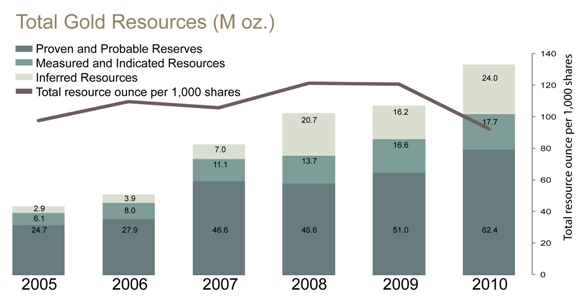
Kinross is based in Canada and has mines and projects in Brazil, Canada, Chile, Ecuador, Ghana, Mauritania, Russia and the United States.  Kinross has grown its reserve base by 25% per year over the past 5 years and currently has 92 ounces of gold resources per 1,000 shares.

Kinross Gold expects its equivalent gold production to increase by 77%, growing to 4.5 – 4.9 million ounces in 2015 from 2.6 million in 2011.  Of all the senior gold producers, Kinross says it has the best growth profile.

Based on the company’s operating results and forecasts, Kinross Gold stock could wind up being the big winner this year among the senior gold stocks.

Precious Metals Little Changed On Week While Investors Ponder Government Defaults

Precious metal prices traded in a narrow range this week.  As measured by the closing London Fix Price, gold, platinum and silver declined slightly while palladium gained $16 per ounce.

After the London close, prices of precious metals rose across the board in New York afternoon trading.  Gold closed at $1,514.50 up $19.70, silver at $35.26 up $.12, platinum at $1,775 up $8 and palladium at $739 up $8.   Buying in the precious metals may have been prompted by late day worries over the downgrade of Greek debt by Fitch Ratings as well as concerns over the worsening state of public finances in Spain, Portugal and Italy.

Yields of 25% on short term debt Greek debt imply that the markets are are pricing in a very high probability of default by Greece.  What markets do not seem to have priced in is the contagion risk of Greek default and what impact that would have on investor confidence, world financial markets and the global banking system.

Meanwhile the U.S. debt crisis continues to brew as the debt ceiling limit was reached with no indication of a resolution by Congress.  If the past is any guide, Congress will let the debt bomb/deficit crisis simmer until the last minute when the debt ceiling will be raised yet again under the guise of “future fiscal restraint” and the deficit spending and borrowing will continue as usual.

Ignoring the eroding financial condition of the U.S. today only ensures that the inevitable financial crisis will be more devastating than one might chose to contemplate.  The timing may be uncertain but the outcome is not.

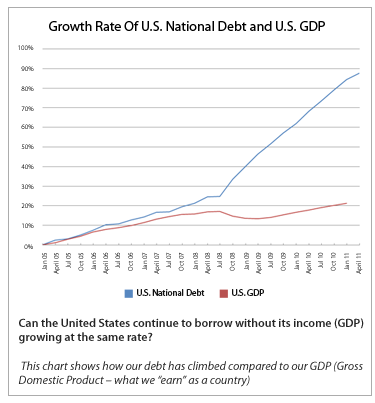
The American Precious Metals Exchange (APMEX) included a chart in one of its latest email newsletters that depicts the gap between the growth of  U.S. GDP and debt.  The chart graphically illustrates the extent to which the U.S. has been living beyond its means and using trillions in deficit financing to do so.

DEBT VS GDP - COURTESY APMEX

APMEX also notes that  “If there is no resolution (of the budget ceiling) by August 2nd, there could be disastrous ramifications for the U.S. and the global economy. The U.S. will be in default on its promises to pay. The value of the dollar could drop dramatically.”


Precious Metals Prices
PM Fix Since Last Recap
Gold $1,490.75 -15.00 (-1.00%)
Silver $34.80 -1.40(-3.87%)
Platinum $1,767.00 -7.00 (-0.39%)
Palladium $734.00 +16.00 (+2.23%)

Precious metals, silver in particular, have been undergoing corrective price action during May, but the fundamental reasons for owning precious metals grows stronger by the day.   Demand for precious metals remains strong.  The World Gold Council’s latest report shows that global demand for gold increased by 11% in the first quarter, while buying by Chinese investors reached all time highs.  The trend is still your friend in the precious metals markets and price weakness should be viewed as an opportunity to increase long term positions.

Gold Demand Soars As Chinese Buying Surges To Record Levels

According to the World Gold Council, total global demand for gold in the first quarter of 2011 jumped by 11% to 981.3 tonnes.   Gold demand was driven by increased investor purchases, especially in China where surging demand for gold reached record highs.

The World Gold Council foresees increased 2011 gold demand based on fundamental factors that include unrest in the Middle East, the sovereign debt crisis in Europe, global inflationary worries, weakness in the U.S. dollar, concern over a slowing U.S. economy and continued strong physical demand for gold by China and India.  Increased purchases of gold by central banks is also likely to increase to protect reserves against paper currencies issued by over indebted sovereign nations.

The World Gold Council noted that gold hit its eight consecutive record high price during the first quarter of 2011 after a brief pullback in prices early in the year.   Due to higher prices the value of gold purchased during the first quarter rose by almost 40% from $31.4 billion to $43.7 billion.

Investment demand surged by 26% during the first quarter to 310.5 tonnes and represented 31.6% of total first quarter gold demand.  The investment demand category includes physical bars, official coins, medals and ETF products.  Investors showed a strong preference for holding physical gold as bar demand increased by 62%, official bullion coins by 39% and medals by 3%.  Bullion holdings by ETFs declined by 55.9 tonnes during the quarter as investors decided to hold more physical gold due to worries about counterparty and credit risk.  Despite the reduction in first quarter ETF holdings, total global holdings of ETFs amount to 2,100 tonnes valued at approximately $95 billion.

Jewelry demand of 556.9 tonnes accounted for 56.8% of total gold demand during the first quarter.  Total jewelry demand grew by 7% during the first quarter with India and China accounting for 63% of total demand.  China, which has seen explosive demand for gold over the past decade, registered a 21% increase in jewelry sales to 142.9 tonnes.

Technology demand for gold, which includes electronics, industrial and dental use declined slightly to 113.8 tonnes.  Gold demand by the electronics industry remains strong and during 2010, the industry consumed a record 326.8 tonnes.

Despite the surging global demand for gold, supply is not increasing and actually dropped by 39.9 tonnes or 4.4% during the 2011 first quarter compared to last year’s first quarter.  The decline was primarily due to large central bank purchases which the World Gold Council deducts from available supplies.  Central Banks have been rapidly increasing their purchases of gold reserves and during the 2011 first quarter purchased 129 tonnes of gold  which exceeded the total amount purchased during the first nine months of 2010.

Surging gold prices should be a natural incentive for the mining industry to increase production but this has not been the case.  Mine production increased by only 7% to 663.9 tonnes during the first quarter, trailing total demand of 981.3 tonnes.  During 2010 gold mine production provided  62% of total supply with recycled gold accounting for the bulk of other supply.

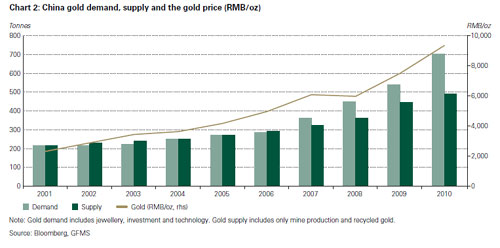
The big picture in the gold market remains focused on China.  The World Gold Council report notes that “The past 10 years have witnessed exponential growth in China investment demand for gold, which entered a new era with the opening of the Shanghai Gold Exchange.   By the end of 2010, annual gold demand totalled 187.4 tonnes, an increase of 71.1% over the previous year.”

Chinese gold demand has been increasing by 14% per year since 2001 with jewelry accounted for 64% of total demand.  During 2010 gold jewelry demand in China was 451.8 tonnes, up 100% since 2004.  Chinese gold investors are also huge buyers and in the first quarter of this year were the largest buyers in the world of physical bullion coins and bars.

The World Gold Council expects Chinese gold demand to double within less than ten years due to gold demand based on Chinese culture, inflationary fears, buying by the Chinese Central Bank, a desire to diversify wealth holdings, advise from prominent Chinese economists to increase gold reserves, increased institutional demand and increased demand by a growing middle class.

Courtesy World Gold Council


Why Higher Inflation And $5,000 Gold Are Inevitable

In his press conference on April 27, 2011, Federal Reserve Chairman Bernanke dismissed inflation worries, stating that “Our expectation is that inflation will come down and towards a more normal level”.   Should we believe him?  Not if you want to preserve your wealth and here’s why.
Chairman Bernanke has a perfect record of making inaccurate economic forecasts.

  • Bernanke, March 2007, prior to the historic housing crash said,  “At this juncture . . . the impact on the broader economy and financial markets of the problems in the subprime markets seems likely to be contained.”
  • Bernanke, February 2008, prior to the banking crisis that almost resulted in the collapse of the entire U.S. banking system  said, “I expect there will be some failures. I don’t anticipate any serious problems of that sort among the large internationally active banks that make up a very substantial part of our banking system.”
  • Bernanke, June 2008, prior to the worst recession and job losses since the 1930’s, said the danger of the economy falling into a “substantial downturn” appears to have waned.

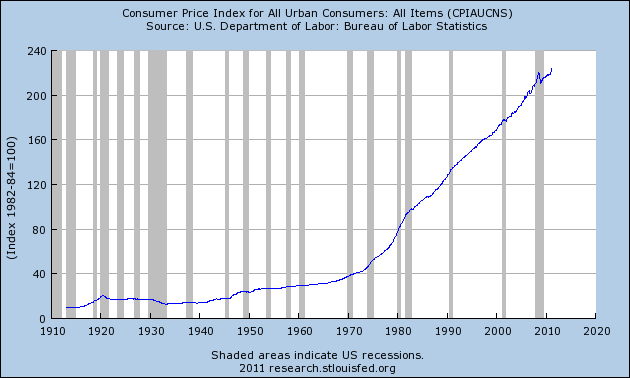
Even if the Fed was able to keep inflation at a “benign” rate of 2% a year, the long term effects on savings are devastating.  Over ten years, a 2% inflation rate reduces the value of $100,000 to $82,034, resulting in an 18% loss in purchasing power.

According to the Bureau of Labor Statistics, inflation averaged 3.4% since 1980.  At the beginning of 1980, one dollar had the same purchasing power as $2.86 at the end of 2010.

The cost of living has spiraled upwards since the early 1970’s, correlating perfectly to the point at which the value of the dollar was decoupled from gold.  In 1971, the United States stopped exchanging dollars for gold to foreign official holders of dollars and the dollar gold standard was officially ended in 1973.

The Fed’s policy of pushing easy credit for the past 30 years to fuel economic growth has left Americans swimming in debt.  The housing collapse and declining incomes have resulted in millions of mortgage defaults and underwater homeowners.  The Government’s attempt to bailout a collapsing economy and over leveraged banks and consumers has resulted in trillions of dollars in new debt and a $1.5 trillion deficit.

Government debt has exploded to the point where the solvency of the U.S. Government is now being questioned.  Large tax increases to erase the deficit would spin the U.S. into a deep recession.  The President and Congress lack the political will to cut spending.  The U.S. has spent and borrowed itself to the eve of financial ruin and must “inflate or die” at this point (see Why There Is No Upside Limit For Gold and Silver Prices).

The Fed, with the experience of two money printing campaigns already under its belt, will have no problems extending this practice.  As Bernanke noted in 2002 before he became Fed Chairman, “The U.S. Government has a technology, called a printing press, that allows it to produce as many U.S. dollars as it wishes at no cost”.

The Fed’s cheap money policies and concerted efforts to debase the value of the dollar are just beginning, and that means the biggest move up in precious metals is still in front of us.  My minimum long term forecast for gold remains at $5,000 per ounce and silver at $170 per ounce.

Soros Sells Gold But Also Bought Lehman Brothers and Countrywide Right Before Their Collapse

Countrywide Financial Corp

The $28 billion Soros Fund Management disclosed in SEC filings that it had sold virtually all of its holdings in the SPDR Gold Trust (GLD). At the end of the March, the Soros Fund, run by renown George Soros, owned only 49,400 shares of GLD after selling 4.7 million shares in the first quarter.

Rumors of GLD liquidation by Soros has been public for weeks now and may have contributed to the recent decline in the price of gold.

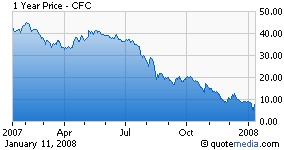
George Soros is one of the world’s most prominent hedge fund investors with a great track record, but like any investor, some of his stock picks have been disastrous. In late 2007, as financial stocks were swooning due to disclosures of huge mortgage loan losses, Soros acquired shares of Countrywide Financial. In the quarter ending September 30, 2007, the Soros fund picked up 1.8 million shares of Countrywide, acquired at an estimated average price of $25. As financial markets collapsed in 2008, Countrywide’s price plunged and it was ultimately acquired by Bank of America at $7 per share.

As markets plunged in 2008, Soros apparently could not comprehend the severity of the financial crisis. During the quarter ending June 30, 2008, Soros increased his stake in Lehman Brothers to almost 9.5 million shares from only 10,000 at the end of March. By mid August 2008, Lehman Brothers stock had plunged 80% on the year as losses on toxic debt holdings climbed into the billions. Shortly thereafter, when the Fed refused to bail out Lehman Brothers, they collapsed on September 15, 2008.

Time will tell if the decision by Soros to liquidate his gold position turns out to be another disastrously ill timed move.

Meanwhile, hedge fund manager John Paulson, who made billions during the financial crisis by shorting subprime mortgages has not reduced his massive $4.4 billion investment in the SPDR Gold Trust.

Soros may be playing the role of a short term trader while Paulson waits for the big payoff as he did with his bets on subprime mortgages.   Trader sentiment in both commodities and precious metals had become massively bullish  and with markets vulnerable to a sell off, perhaps Soros simply decided to take some profits short term.

Ultimately, market fundamentals suggest much higher gold prices and it would not be surprising to see the Soros Fund reestablish gold positions at some later date.

Insights From One Of The World’s Lengendary Gold Experts

The Standard & Poors 500 stock index is still below the level it reached more than 10 years ago in early 2000.  Interest rates on traditional bank savings have barely exceeded zero percent since the Fed instituted its zero interest rate policies in 2008.  Meanwhile, incomes are stagnant and the cost of items we use everyday have been inexorably increasing.
Investors who expected to achieve financial independence by investing in actively managed stock mutual funds have seen their dreams turn to nightmares.  The brutal truth is that the vast majority of mutual fund managers do not beat the market over the long run.   Investors who did not diversity out of traditional investments have seen the value of their savings diminished by inflation and stagnant stock prices.

By contrast, one legendary gold investor who has consistently made great calls in the precious metals markets has achieved average annual returns over the past ten years of over 29%.  Money doubles in about 2.5 years at 29%.  Investors who had the patience and conviction to ride out inevitable corrections have seen fabulous returns.

The man who achieved this stunningly successful investment record is Harvard educated John Hathaway, who has been with the Tocqueville Gold Fund (TGLDX) since its inception in 1998.  Hathaway’s success has been based on his ability to chose smaller mining companies that have the potential for explosive growth and then patiently wait for results.  The average gold mutual fund has an annual holdings turnover of 104% compared to 9% at TGLDX.  While other fund managers frenetically trade mining stocks, Hathaway’s deep knowledge of the companies he invests in has resulted in superior investment returns.  Also benefiting shareholders is the fact that the TGLDX does not charge  front end or deferred sales loads which reduce investor returns.

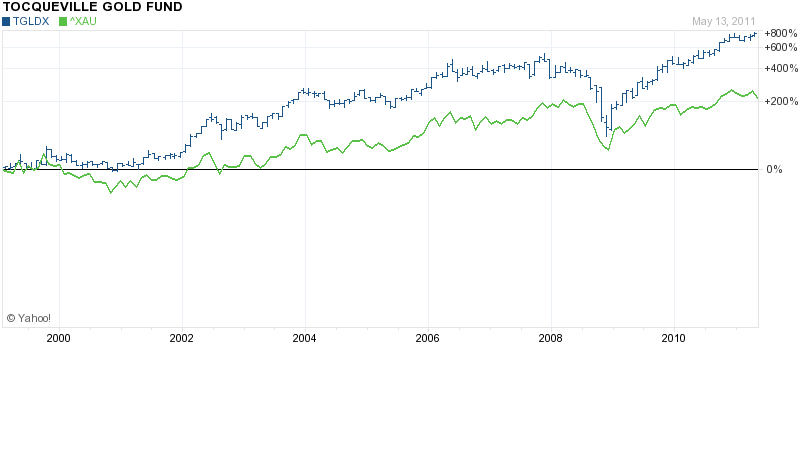
The TGLDX has soundly beaten the investment performance of both gold bullion and the widely followed PHLX Gold/Silver Sector (XAU) which holds a broad basket of gold and silver stocks.  Since 2000, the TGLDX has returned approximately 810% compared to 500% for gold bullion and 325% for the XAU.

TGLDX VS XAU - COURTESY YAHOO FINANCE

When John Hathaway speaks, serious gold and silver investors pay attention.  In the Tocqueville Gold First Quarter 2011 Observations, Mr. Hathaway explained why he remains positioned for further gains in the precious metals and related equities.

Mr. Hathaway noted that his current position on gold is based on interrelated macro economic issues which make the “current landscape especially tricky”.   Hathaway noted that “the Fed seems predisposed to maintain extremely lax monetary conditions” and that “a credible fiscal plan seems like a long shot”.   Conditions in the Middle East could worsen considerably, energy prices are likely to remain at levels that seemed “unthinkable” a year ago and if there is political resistance to the Fed reducing its balance sheet, “the conditions are ripe for an inflationary spiral”.

The dollar appears to be deeply oversold and a near term rally could slow gold’s uptrend, according to Hathaway.

Mr. Hathaway feels that by mid year, the outlook will be more clear but in the meantime, “we remain positioned for further advances in precious metals”.

The top 8 stock holdings of TGLDX at March 31, 2011 were Goldcorp (GG), Newmont Mining (NEM), IAMGold (IAG), Ivanhoe (IVN),  Silver Wheaton (SLW), Gold Resource Corp (GORO), Osisko Mining (OSK) and Randgold Resources (GOLD).

Zimbabwe Central Bank Chief Bashes U.S. Dollar While Promoting Gold Backed Currency

According to a news report in New Zimbabwe, the head of the Zimbabwe Central Bank is warning that the U.S. dollar may lose its reserve currency status soon and suggested that Zimbabwe institute a gold backed currency.

Central Bank Chief Gideon Gono said in an interview that  “There is a need for us to begin thinking seriously and urgently about introducing a Gold-backed Zimbabwe currency which will not only be stable but internationally acceptable.   We need to re-think our gold-mining strategy, our gold-liberalisation and marketing strategies as a country…to me, Gold has proven over the years that it is a stable and most desired precious metal.”

The irony here is overwhelming.   Zimbabwe, a country without a functioning currency due to hyperinflation is worried about the declining value of the U.S. dollar.  The Zimbabwe dollar has been worthless since 2009 and the Zimbabwe economy now functions through the use of foreign currencies, including the U.S. dollar.

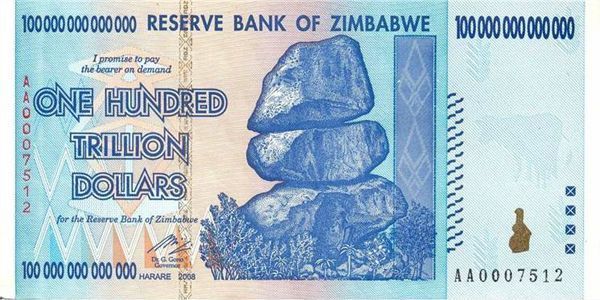
The central bank of Zimbabwe had fueled hyperinflation the old fashioned way by trying to use printed money to pay government expenses.  The people of Zimbabwe were not fooled and the currency soon lost all value.  A $100 trillion dollar Zimbabwe bank note is now a novelty item on EBay, going for about $7 each.

$100 Trillion Dollar Zimbabwe Note

The U.S. dollar must be in real trouble if officials of Zimbabwe are worried about accepting U.S. dollars.   Zimbabwe central bank officials have had first hand experience seeing how quickly a paper currency can become worthless.

According to Central Bank Chief Gono, “Zimbabwe is sitting on trillions worth of gold-reserves and it is time we start thinking outside the box, for our survival and prosperity.  The world needs to and will most certainly move to a gold standard and Zimbabwe must lead the way”.

How ironic would it be if the Central Bank of Zimbabwe winds up with the world’s strongest currency by introducing a gold backed currency?

Measuring Declines from the High for Gold and Silver Prices

The prices of gold and silver had each risen to fresh all time highs, just before the severe declines experienced over the past few days.
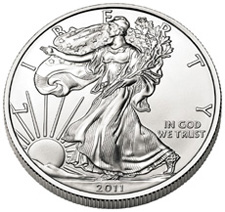
On April 25, 2011, the price of silver touched an intraday high of $49.82 per ounce. This narrowly eclipsed the previous all time high of $49.45 reached in 1980. Silver’s recent price of $34.64 represents a decline of $15.18 or 30.47%.

After breaking above the $1,450 per ounce level in early April, the price of gold had achieved a string of new all time highs. This culminated with the most recent high of $1,577.40 per ounce reached on May 2, 2011. The recent gold price of $1,473.60 per ounce represents a decline of $103.80 or 6.58%.

The severity of the decline for silver has drastically altered the Gold Silver Ratio. This ratio measures the number of ounces of silver necessary to purchase one ounce of gold. At their respective highs, the ratio would have been 31.65. Recent prices put the ratio at 42.54.

Gold

Recent High: $1,577.40 (May 2, 2011)
Recent Price: $1,473.60 (May 5, 2011)
Decline: -$103.80 (-6.58%)

Silver

Recent High: $49.82 (April 25, 2011)
Recent Price: $34.64 (May 5, 2011)
Decline: -$15.18 (-30.47%)

Gold and silver’s stellar performance over the past several years has been interrupted by other declines, some of them even more drastic. From intermediary peaks reached in March 2008, gold and silver fell sharply as the financial world melted down later that year. Gold fell from $1,011.25 to $712.50 per ounce, losing 29.54%. Silver fell from $20.92 per ounce to $8.88, for a loss of 57.55%.

Despite the recent carnage, both gold and silver hold onto gains for the year to date. From the price levels on December 31, 2010, gold is up $63.35 per ounce or 4.49% and silver is up $4.01 per ounce of 13.09%.

US Mint Gold and Silver Bullion Coin Sales By Month

Through the end of April, the United States Mint has now sold 466,000 ounces of gold and 16,375,000 ounces of silver through its bullion coin programs. In both cases the figures are far ahead of the numbers from the comparable year ago period, despite the higher market price per ounce for the bullion.

Last year through the end of April, US Mint gold bullion sales were 388,000 troy ounces, while the price of gold ranged from a low of $1,058.00 to a high of $1,179.25 per ounce. Silver bullion sales during this period were 11,531,000 with the market price ranging from a low of $15.14 to a high of $18.84 per ounce.

US Mint Gold and Silver Bullion Sales (in ounces)

January February March April Total
American Gold Eagle 133,500 92,500 73,500 108,000 407,500
American Gold Buffalo 38,000 20,500 58,500
Total Gold in ounces 133,500 92,500 111,500 128,500 466,000
American Silver Eagle 6,422,000 3,240,000 2,767,000 2,819,000 15,248,000
ATB Silver 1,127,000 1,127,000
Total Silver in ounces 6,422,000 3,240,000 2,767,000 3,946,000 16,375,000

During the latest month of April 2011, the US Mint recorded sales of 128,500 troy ounces of gold bullion, comprised of 108,000 ounces worth of American Gold Eagles and 20,500 ounces worth of American Gold Buffaloes.

Meanwhile, silver bullion sales for the latest month reached 3,946,000 ounces, the second highest level of the year. For three months running, the pace of sales for the American Silver Eagles had remained approximately the same base level, despite indications of higher demand. The restrained sales are presumably the impact of the US Mint’s allocation program, which rations the available number of bullion coins amongst the authorized purchasers.

The boost in silver bullion sales seen in April was due to the release of the 2011-dated America the Beautiful Silver Bullion Coins. These coins each contain five troy ounces of silver and have a diameter of 3 inches. Sales began on April 25, 2011, and authorized purchasers immediately purchased coins accounting for 1,127,000 troy ounces of silver.