April 15, 2026

Gold Down Slightly On Week While Silver, Platinum and Palladium Advance

Gold pulled back slightly on the week while silver, platinum and palladium registered strong gains.

As measured by the London PM Fix Price, gold gave up $10.75 on the week, while silver advanced by $2.19 for over a 6% gain.  Gold remains in a solid uptrend while silver has traded in a narrow range in the mid to high $30’s after the early May sell off.

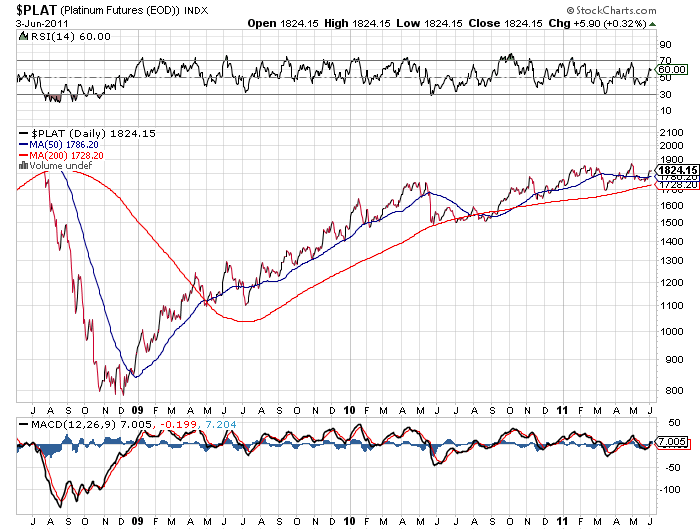
Platinum continued its winning ways with a $22 dollar gain after picking up $21 in the previous week.  As noted last week, platinum sells below the price at which new mine expansion is profitable.   A price of $2,100 per ounce in necessary in order to motivate platinum miners to expand exploration and production.

In addition, the platinum to palladium ratio is only 2.2 compared to a historical ratio of 3.0 to 4.0, suggesting that platinum is undervalued relative to palladium. Platinum prices have been in a narrow price range between $1,500 and $1,840 since the beginning of 2010.   A breakout above $1,900 could lead to sharply higher prices.

After advancing by $13 per ounce last week, palladium jumped by $45 on the week.  Palladium had a huge run from 1996 to 2000 when the price moved up from $100 to $1,100.  During the worst part of the financial crisis in 2008, palladium dipped below $200 but has since been in a strong uptrend.
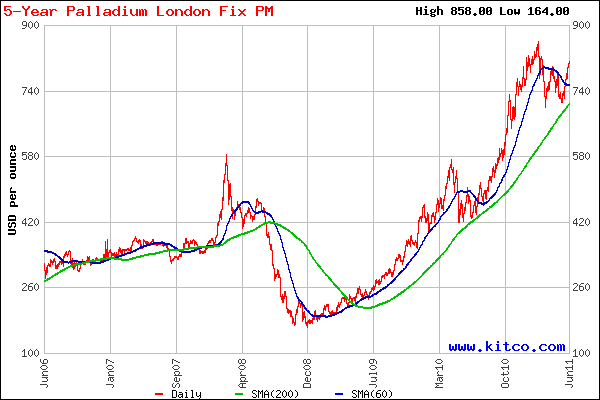
 

Palladium - Courtesy kitco.com

Although some might have expected gold to move up strongly in the face of steep sell offs in the financial markets and the looming threat of a debt ceiling stalemate, the uptrend in gold remains intact.

Anyone doubting the long term value of gold as a store of value versus the paper dollar can reflect on this week’s USA Today column  disclosing the precarious state of U.S. government finances.  Unfunded and off balance sheet financial commitments of the U.S. for government pensions, social security and medicare amount to $527,000 per household.

Precious Metals Prices
PM Fix Since Last Recap
Gold $1,529.25 -10.75 (-0.70%)
Silver $37.38 +2.19(+6.22%)
Platinum $1,829.00 +22.00 (+1.22%)
Palladium $815.00 +45.00 (+5.84%)

The Government has clearly made promises that are economically unfeasible.  What will happen when millions of people, with a strong sense of entitlement and blind belief in the Government, suddenly stop receiving benefit checks?  Or if the checks do keep coming (by virtue of the printing press) of what value will they be?
Gold and Silver ETF Holdings Decline On Week

Silver holdings of the iShares Silver Trust (SLV) declined for the week by 27.12 tonnes after being unchanged in the previous week.  The price of silver, as measured by the closing London PM Fix Price has declined by $1.73 or 4.6% since June 1st.

After reaching a high of $48.70 per ounce on April 28th, silver has declined by $12.48 or 25.6% based on today’s closing price.  From the low of $32.50 on May 12, silver has seen a price recovery of $3.72.

The iShares Silver Trust has seen a substantial reduction in silver holdings of 1,007.36 tonnes since the beginning of the year when silver traded at $30.67.  The decline in holdings by the SLV from late April have been even more dramatic.   The SLV hit an all time high for silver holdings on April 25, 2011 of 11,390.06 tonnes.  The decline in SLV holdings from the all time high registers at 1,448.73 tonnes or 46.6 million ounces of silver valued at $1.7 billion.

The iShares Silver Trust currently holds 318.7 million ounces of silver valued at $11.5 billion.  On April 27th, the value of silver held by the SLV was $16.1 billion.

At today’s closing price of $36.03, shares of the SLV traded at a premium of $0.71 or 2.0% to the net asset value of the Trust.  Since the beginning of the year, the SLV has gained 20.2% and over the past year has increased by 115.4%.  For a discussion on why silver prices may see a quick recovery to all time highs see – How Soon Will Silver Hit New Highs?

GLD and SLV Holdings (metric tonnes)

June 8-2011 Weekly Change YTD Change
GLD 1,211.57 -1.30 -69.15
SLV 9,914.21 -27.12 -1,007.36

Holdings of the SPDR Gold Shares Trust (GLD) were little changed on the week, declining by 1.3 tonnes, after a decline of 1.21 tonnes in the previous week.  The GLD currently holds 38.95 million ounces of gold valued at $59.9 billion.  Holdings of the GLD hit at all time record high of 1,320.47 tonnes on June 29, 2010.

Gold prices gained slightly on the week, closing up $4.00 per ounce from the June 1 close.  Gold has now gained $149.25 since the beginning of the year, up 10.75%.  Gold has remained in a narrow trading range for several months, consolidating its early year gains.  Gold has remained above the $1,500 level since May 20th when it closed at $1490.75 per ounce.

Inflation Is “Transitory” – More Nonsense From Bernanke And A Buy Signal For Gold

Federal Reserve

Federal Reserve Chairman Ben Bernanke, speaking at a conference of international bankers in Atlanta today, stated that “the recent increase in inflation will prove transitory.”   Citing the recent decline in commodity prices as an indication that future inflation will be subdued, Bernanke said the Fed will keep inflation under control “using whatever actions are necessary.”

It’s been awhile since a senior U.S. official had the audacity to assert official U.S. policy that is in direct contradiction to actual U.S. actions.   In June 2009, US Secretary Treasurer Tim Geithner told an audience of Chinese students in Beijing that the Obama administration would follow “very disciplined”  spending to reduce massive U.S. budget deficits.  In addition, Geithner stated that “We believe in a strong dollar.”

Finally, in response to concerns by Chinese economists who believed that holding U.S. debt was “risky, Geithner stated that “Chinese assets are very safe.” This final remark drew loud laughter from the audience of Chinese students.

The Chinese are not laughing today as the dollar has plunged in value and U.S. deficits have increased by trillions of dollars since 2009.

As the U.S. dollar continues its downward spiral, the Chinese have initiated actions to diversity out of U.S. dollars and into more stable stores of value by making large investments in natural resources and purchasing stakes in businesses worldwide.  The Chinese were not fooled in 2009 and Bernanke is not fooling anyone today by stating that inflation is transitory.

Bernanke was fortunate that his audience consisted of polite bankers who managed to subdue any overt laughter.  Inflation has been a continual event under our fiat monetary system.   Since officially coming off the gold standard in 1973, the dollar has seen a relentless loss of its value due to inflation and Bernanke knows it.

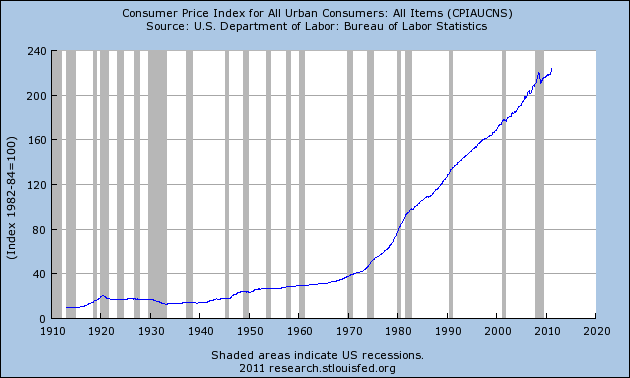
Bernanke also knows that his worse enemy is deflation which would make the repayment of debts impossible and propel the U.S. into a deep depression.  The U.S. cannot resolve its massive debt and unfunded spending commitments by either economic growth or increased taxation.  The only option left is inflation, which steals wealth by destroying purchasing power, but also allows debts to be repaid using debased dollars.   The Federal Reserve has consistently employed inflationary policies as shown by the BLS chart below.

Even as Bernanke was giving solemn assertions that the Fed would be vigilant in protecting the value of the dollar, the President of the Federal Reserve Bank of Atlanta, Dennis Lockhart, said that the Fed should establish a goal of 2% inflation as an “explicit numerical objective.”  Sorry Dennis, we are already way past 2% inflation.  An inflation rate of 2% may not ring alarm bells to the American public, but a 2% inflation rate equates to a whopping 18% loss of purchasing power over 10 years.

Despite Bernanke’s duplicitous assertion that the Fed will contain inflation “using whatever actions are necessary”, his greatest fear remains deflation. At the Fed’s 2010 summer meeting at Jackson Hole, Wyoming, Bernanke said the Fed would be “proactive” in preventing deflation and that  “The Federal Open Market Committee will strongly resist deviations from price stability in the downward direction.”

The relentless rise in the price of gold directly reflects the dollar debasement policies of the Federal Reserve.  Today’s statements by both Bernanke and Lockhart constitute a long term buy signal for gold investors.


A Large Cap Gold Stock That Could Double In Price

Many small cap gold mining companies have seen significant price gains, while large cap gold stocks have underperformed.  With fundamentals driving the price of gold steadily higher, many large cap gold mining companies are perfectly positioned to see large earnings increases that will propel their stock prices higher.

One large cap gold mining company that could be on the verge of doubling in price over the next few years is Newmont Mining Corporation (NEM).   The stock has underperformed other large cap gold mining companies despite the fact that the company’s fundamentals have dramatically improved over the past few years.  The improved fundamentals, once recognized by the market, are likely to push Newmont’s stock price much higher.

Newmont Mining is one of the world’s largest gold producers with operations in Ghana, Indonesia, Nevada, Australia, New Zealand, Peru, Canada and Mexico.  For the past three years, Newmont Mining has been positioning itself for future growth through financial and operational restructuring and is now poised for additional significant growth in revenue and profits.

Revenues have grown from $6.1 billion in 2008 to $9.5 billion for the year ending December 31, 2010.  During the past three years, gold production increased by only 3.7% from 5.2 million ounces in 2008 to 5.4 million ounces in 2010.  The majority of revenue increases over the past three years were driven by increased gold prices, but Newmont is forecasting an increase in gold production of 35% over the next six years to 7 million ounces annually.  The combination of increased gold production and higher gold prices could result in explosive earnings growth.

Newmont Mining has proven and probable gold reserves of 93.5 million ounces, equivalent to $285 per share.   Newmont is also a major copper producer with proven and probable reserves of 9.4 billion pounds, equivalent to 19.1 pounds per share.   The value of copper reserves is worth approximately $78 per share.   In 2010, Newmont produced 327 million pounds of copper.

Gold reserves are expected to increase based on the Company’s global portfolio and continual exploration efforts.

The Company paid shareholders a cash dividend of $0.50 per share in 2010 and expects to increase this by $0.20 per share for every $100 increase in the price of gold.

Newmont Mining has an extremely strong balance sheet with $5.6 billion in cash at year end 2010.   According to the Company’s annual report, Newmont offers investors the “best per-share gold-price leverage in the industry.  Every $100 increase in gold price translates into approximately $350 in additional after-tax operating cash flows, or approximately $0.70 per share.  We deliver better gold price leverage than any of our competitors.”

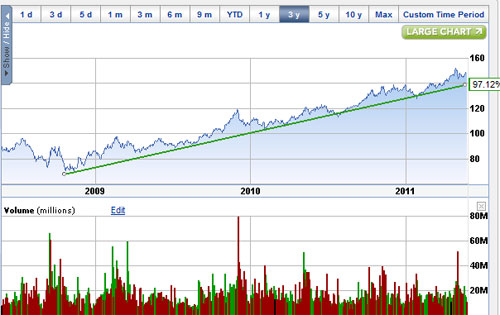
Newmont Mining’s stock price of $53.44 at today’s close is actually lower than five years ago when it traded at about $55 in early July 2006.


NEWMONT MINING - COURTESY YAHOO FINANCE

Newmont Mining trades at a low price earnings ratio of 12 and pays a 1.5% annual dividend.  Based on the Company’s recent results and bright prospects for future revenue and profit growth, it is only a matter of time before investors drive the stock price higher.  Many other major gold producers have price earnings ratios in the low 20’s or higher.  If Newmont Mining sold at a PE ratio in the low 20’s, the stock’s price would be over $100 per share.

Gold Advances On Week, Silver Retreats As Financial Crisis II Looms

Gold, platinum and palladium all advanced on the week while silver gave up most of the previous week’s gains.

As measured by the London PM Fix Price, gold gained $7 on the week to $1,540.00 while silver pulled back by $2.50 to $35.19.   Platinum moved up by $21 to $1,807.00 and palladium gained $13 to $770.00.  After the London close, prices of precious metals moved up strongly in New York trading, especially silver, which last traded at $36.39, up $1.20 from the earlier London closing price.

Financial markets worldwide pulled back sharply as the stock traders finally began to acknowledge the fragility of the world’s paper back financial system.  Governments that have borrowed and spent trillions of dollars to stimulate economic growth and support a fragile banking system now find themselves reaching the limits of their borrowing capacity.

It is becoming obvious that the financial crisis of 2008 was just a warm up act to the real financial nightmare that is looming ahead.  Despite trillions of dollars in stimulus spending, coordinated with a money printing campaign by world central banks, the economies of the U.S. and Europe have not recovered.  Unemployment continues to grow, real estate values continue to plunge, debt levels have reached unsustainable levels and real incomes for the majority of workers continue to decline.

There are numerous events that could trigger the second financial crisis  There is no way of knowing which specific event will trigger the next crisis,  nor does it matter.  What does matter is the manner in which Financial Crisis II will be dealt with by world governments and central banks.  Unable to raise taxes or take on trillions more in borrowing, monetary authorities will exercise the last resort option of money printing on a massive scale to avoid a total collapse of the world monetary system.  The gold market is already reflecting this scenario as one of the few safe havens against paper currencies that have little intrinsic value.  When Financial Crisis II gets under way, uninformed talk of a “gold bubble” will quickly disappear as investors will buy gold at any price to preserve their wealth.

Precious Metals Prices
PM Fix Since Last Recap
Gold $1,540.00 +7.00 (+0.46%)
Silver $35.19 -2.50(-6.63%)
Platinum $1,807.00 +21.00 (+1.18%)
Palladium $770.00 +13.00 (+1.72%)

Will platinum, which has lagged the price rallies in other precious metals, start to play catch up?  According to the Wall Street Journal, due to rising production costs for platinum, a price of $2,100 per ounce is necessary to encourage increased mine production.

The historical price ratio of platinum to palladium also suggests that platinum prices could rally significantly.  The Wall Street Journal notes that when palladium reached $860 per ounce in February, the ratio was 2.15 compared to 2.12 today.  The historical average of the platinum/palladium ratio is 3.0 to 4.0, suggesting that platinum is undervalued.


PLATINUM - COURTESY STOCKCHARTS.COM

Physical Gold Outperforms Vanguard And Fidelity Gold Mutual Funds

Investors in gold mutual funds have dramatically underperformed the return from holding physical gold over the past three years.  For a variety of reasons, many gold mining companies have been unable to turn higher gold prices into increased earnings.   As a result, gold stock mutual funds have dramatically underperformed the price gains of gold bullion.

Over the past three years, gold has increased by 80%, from a monthly low of $853 in May 2008 to $1,535 at today’s closing price.  Holders of the physical metal have done extremely well while investors in gold mutual funds run by two of the countries largest investment companies (Vanguard and Fidelity) have dramatically underperformed.

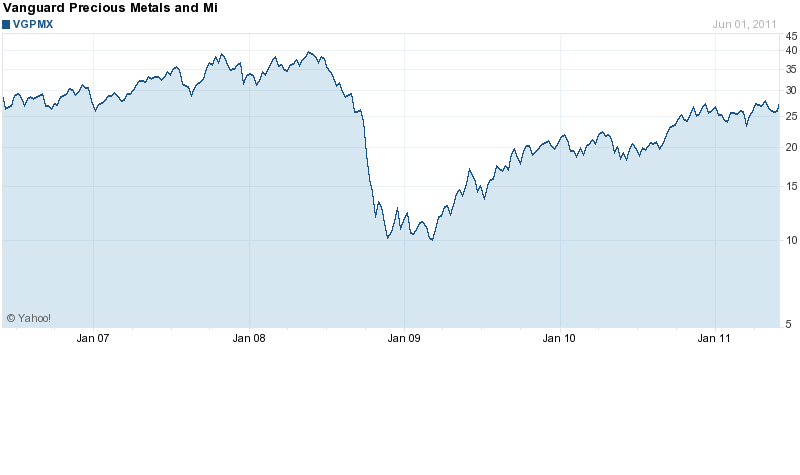
According to the Vanguard web site, the Vanguard Precious Metals and Mining Fund (VGPMX) has a three year average annual performance of -.46%, while the price of gold has soared 80%.  Vanguard states that although this fund is not a “pure gold or precious metals fund”, it invests in companies that are ” involved in the mining or of exploration for precious and rare metals and minerals”.  The Vanguard precious metals fund invests in 50 different stocks in 14 different countries and foreign holdings total 92% of assets.  The fund has net assets of $5.8 billion.

In early May 2008, the VGPMX reached $39 per share compared to today’s closing price of $27.20.  The fund has paid out dividends which added to the overall returns of the fund.

VGPMX - COURTESY YAHOO FINANCE

The ten year return on the Vanguard gold fund, however, would have outperformed holding physical gold.  A $10,000 investment in the Vanguard Precious Metals Fund made in May 2001, would now be worth approximately $76,300.  In May 2001, an investor could have purchased almost 38 ounces of gold for $10,000 which today would be valued at $58,330.  As noted above, the dividend payments by VGPMX added to the fund’s return.

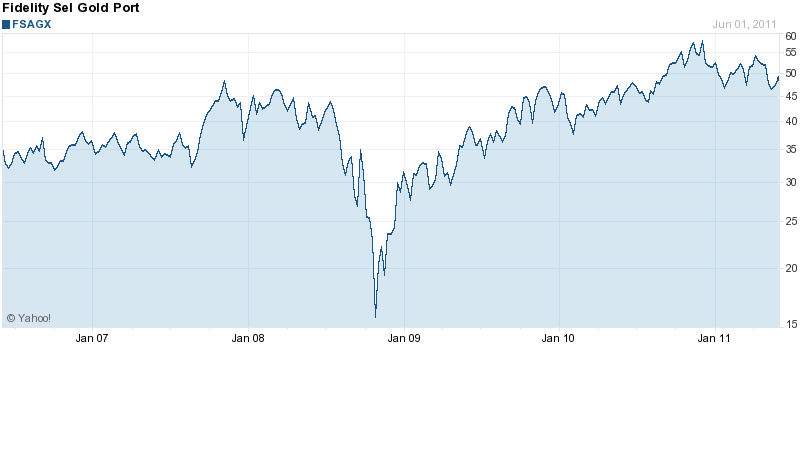
The Fidelity Select Gold Portfolio (FSAGX) has outperformed the Vanguard fund, but still trails the three year return on gold bullion.  According to the Fidelity web site, the Fidelity gold portfolio had a 3 year return of 16.2%, compared to an 80% increase in the price of gold.

The Fidelity Fund invests at least 80% of its assets in companies involved in gold mining, exploration or processing.  The Fund also invests in gold bullion or coins and to a lesser degree, platinum, silver and diamonds.  The FSAGX has net assets of $4.5 billion.  The top ten holdings of the Fund at March 31, 2011 were Goldcorp, Barrick Gold, Newcrest Mining, Anglogold Ashanti, Newmont Mining, Kinross Gold, Agnico-Eagle Mines, Yamana Gold, Rangold Resources and Eldorado Gold Corp.  The total number of holdings of the Fund is 131.

FSAGX - COURTESY YAHOO FINANCE

The long term results of the Fidelity gold fund slightly trail the Vanguard gold fund.  Fidelity had a 10 year average annual performance of 22.54% compared to a return of 24.02% for Vanguard.   Both the Vanguard and Fidelity fund had returns that exceeded the increase in the value of gold over the past ten years.

Will physical gold or gold mutual funds deliver the best return going forward?

A continued rise in gold prices should eventually translate into higher leveraged profits for gold mining companies, unless the substantial costs of gold mining exceed the increase in gold prices.  Inflation is rapidly rising as central banks continue to flood the global economy with cheap money.  A continued rise in energy costs and general inflation could negate the benefit of increased gold prices for gold mining companies.  Investors who hold physical gold or invest in gold trust ETFs, rather than gold mutual funds, should expect to see continued superior investment performance.

Gold And Silver ETF Holdings Show Little Change On Week

Holdings of the iShares Silver Trust (SLV) were unchanged on the week after dropping by 505.10 tonnes in the previous week.

After extreme price volatility at the beginning of May, silver prices were little changed over the previous week.  Based on the closing London PM Fix price, silver closed at $37.17 on May 25th compared to a closing price of $37.95 on June 1st.

The price of silver has now recovered by 16.7% or $5.45 from the low of $32.50 on May 12.  Silver reached a high for the year on April 28th closing at $48.70.  The price correction should be viewed as a buying opportunity since the fundamentals of the silver market have grown stronger with each passing day.

The debt crisis in Europe and the U.S. appear to be on the verge of spinning out of control.  The latest batch of economic reports show weak employment numbers, decline in the manufacturing sector and a continued collapse in U.S. real estate values.  Economies overburdened by debt desperately require higher economic growth which is simply not happening.  The prospect of continued economic weakness was finally acknowledged by previously bullish stock investors, as sellers pushed the Dow Jones down by almost 280 points for a 2.2% loss.

The latest sales figures from the U.S. Mint indicate that many investors see silver as a better store of value than paper currency.  Total year to date sales through May 31st of the Silver Eagle bullion coins totaled 18.9 million ounces, the most since 1986.  Comparable sales of the Silver Eagle for 2010 were 15.2 million ounces.

U.S. Mint sales of the Silver Eagles during May totaled 3.65 million ounces up from 2.82 million ounces in April.  If sales for the rest of the year continue at the average month’s sales volume, U.S. Mint sales of Silver Eagles would total 45.4 million ounces, valued at over $1.7 billion based on today’s closing price of silver.

GLD and SLV Holdings (metric tonnes)

June 1-2011 Weekly Change YTD Change
GLD 1,212.87 -1.21 -67.85
SLV 9,941.33 00.00 -980.24

The holdings of the SPDR Gold Shares Trust (GLD) decreased by a modest 1.21 tonnes over the past week, after gaining 22.74 tonnes in the previous week.   The GLD currently holds 38.99 million ounces of gold valued at $59.8 billion.  The price of gold gained slightly on the week, closing at $1,533.75, up $7.50 from May 25th.

Precious Metals Stage Impressive Rally – Are Gold Stocks Next?

As measured by the closing London PM Fix Price, precious metals staged impressive gains this week, rallying across the board.  Ongoing concerns about the sovereign debt crisis in Europe, the debt limit ceiling stalemate in the U.S. and a weak dollar all contributed to continued fundamental demand for the metals.

After the London close, precious metals continued to gain in New York trading with gold at $1,537.00, silver at $38.15, platinum at $1,805.00 and palladium at $766.00.

The star of the week was silver which gained $2.89 per ounce for a gain of 8.3% on the week.  Although the correction of silver in early May was dramatic, the sharp pullback has provided long term investors with an opportunity to add to positions.  Silver fundamentals remain strong as detailed in a recent report by the Silver Institute in which it was noted that demand remained robust despite higher prices.  In addition, although higher prices has lead to increased mine exploration and production, new silver production during 2010 rose by only 2.5%.

Precious Metals Prices
PM Fix Since Last Recap
Gold $1,533.00 +42.25 (+2.83%)
Silver $37.69 +2.89(+8.30%)
Platinum $1,786.00 +19.00 (+1.08%)
Palladium $757.00 +23.00 (+3.13%)

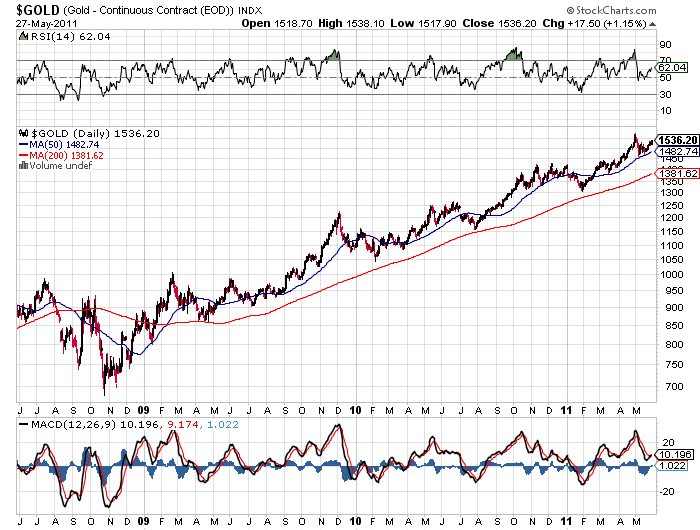
Gold has recovered nearly all of its early May price correction and is now only $8 off its high of $1,541.00 as measured by the London PM Fix Price.  The trend in gold remains solidly bullish and any price corrections should be viewed as a buying opportunity.


GOLD - COURTESY STOCKCHARTS.COM


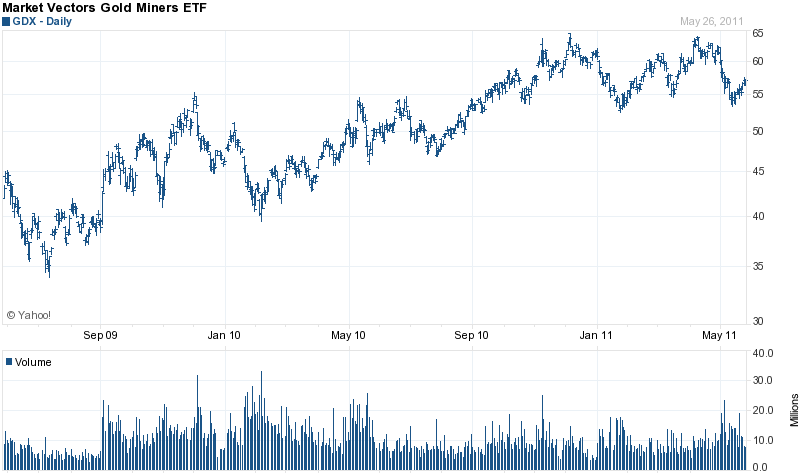
Gold stocks, many of which have trailed the returns of gold bullion, may also be viewed as attractive at this point. As measured by the Market Vectors Gold Miners ETF (GDX),  gold stocks are moving up after making multiple bottoms at the $55 support level.


GDX - COURTESY YAHOO FINANCE

Many of the gold mining stocks are selling at steep discounts to their gold reserves and represent solid values. Earlier this week, Kinross Gold, which sells at the equivalent of $250 per ounce, was a featured story. Value investor David Steinberg of DLS Capital Management, has a price target on Kinross of $27 per share. Kinross closed today at $16.11.

Sale Of U.S. Gold Reserves Would Accomplish Little

FORT KNOX

The U.S. slammed against the $14.3 trillion debt ceiling last week with a quick resolution to the problem no wheres in sight.

Congressional authorization to extend the debt limit remains mired in ideological disputes.  Secretary of the Treasury Tim Geithner states that the U.S will default in early August if the debt ceiling is not raised.

As the Treasury scrambles to avoid default, a discussion has started on the merits of selling United States gold reserves to avoid default and put the U.S. back on sound financial footing.

While the sale of U.S. gold reserves may appear to be an appealing solution, it would accomplish virtually nothing from a financial standpoint.

According to the U.S. Treasury, total gold holdings of the United States as of April 2011 were 261.5 million troy ounces.

At $1,500 per ounce, the total value of U.S. gold reserves is about $393 billion.  Sound like a lot of money?  Enough to get the U.S. out of the debt/spending crisis that we are in?  Here’s what the U.S. could do with an extra $393 billion.

  • Pay off 2.75% of the national debt
  • Pay less than one year’s interest on the national debt
  • Reduce the estimated 2011 budget deficit of $1.645 trillion by about 23%
  • Reduce this year’s U.S. budgeted spending of $3.8 trillion by about 10%
  • Pay for 40% of the $1 trillion dollar cost of the wars in Iraq and Afghanistan
  • Cover about 33% of the estimated cost of the bailing out Fannie Mae and Freddie Mac
  • Cover half of one percent of the estimated unfunded U.S. government liabilities for social security and medicare
  • Pay off about 4% of total mortgage debt held by American families

Selling the U.S. gold reserves may sound like a good idea until you take a look at the numbers.  The total value of U.S. gold reserves amounts to a mere rounding error in terms of total U.S. debt, spending, deficits and future obligations.   The United States has numerous valuable assets that it could sell, but the sale of U.S. gold reserves would accomplish little.


The Federal Reserve Can’t Produce Oil, Food Or Jobs But They Will Continue To Produce Dollars

Federal Reserve

No bull market goes straight up without normal price corrections along the way.  The recent sharp pullback in silver prices and the more subdued correction in gold prices are likely to be viewed in hindsight as a superb buying opportunity.

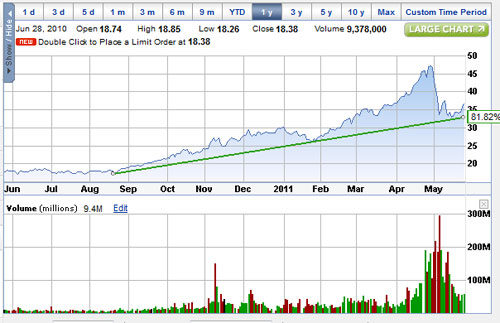
Simple trend line analysis suggests that current prices for gold and silver are in a buying range.  Using the SLV and GLD as proxies for the metals, we can see that the recent sell off has brought prices to trend line support.   Combining the “trend is your friend” theory along with solid fundamental underpinnings for gold and silver, higher prices seem inevitable.  For patient long term investors, especially in the gold market, every pullback of the last decade has simply been another opportunity to exchange depreciating paper dollars into a better store of value.

The SLV recently hit its trend line in the low 30’s.

SLV - COURTESY ETRADE.COM

The GLD’s long term trend line does not even hint of parabolic price movement, contrary to mainstream press reports warning the public of the dangers of gold investing.

GLD - COURTESY ETRADE.COM

Despite the assertions of Fed Chairman Bernanke that inflation is not a problem, any one outside of the academic inner circle of the Federal Reserve sees inflation everywhere they look.  Soaring gasoline and heating costs have decimated family budgets and retail food inflation is projected to hit 4% or higher in 2011.  Constantly higher inflation, as measured by the Consumer Price Index, has prevailed ever since the U.S. officially went off the gold standard in the early 1970’s.  (See also Why Higher Inflation and $5,000 Gold Are Inevitable).

This week we have seen announcements of higher prices by Starbucks, Smucker Co, Nestle, McDonald’s and Whole Foods.  Walmart previously warned that the debasement of the dollar was translating into higher retail prices on imported items.  The upward price spiral in the cost of necessities is especially burdensome since incomes for the majority of Americans are not increasing.

In an excellent article in the Wall Street Journal this week, Ronald McKinnon persuasively suggests that the United States is entering 1970’s type stagflation, the result of high inflation, high unemployment and stagnant demand.  According to Mr. McKinnon,  “the U.S. economy again seems to be entering stagflation. April’s producer price index for finished goods, which excludes services and falling home prices, rose 6.8%. The Bureau of Labor Statistics reports that intermediate goods prices for April were rising at a 9.4% annual clip. Meanwhile the official nationwide unemployment rate is mired close to 9%.”

McKinnon argues that stagflation is being caused by the Fed’s zero interest rate policies (which besides robbing retirees and savers), has cause a global flood of hot money that has resulted in surging inflation in Asia and Latin America and a 40% rise in commodity prices over the past year.

The Federal Reserve’s policy options at this point seem limited to continuing their policies of cheap money and dollar debasement.  The Fed cannot produce oil as Bernanke recently commented.  Nor can the Fed produce food, jobs or higher housing prices.  The one thing the Fed can and has done is to produce paper dollars in extraordinary quantities.  Debt, when allowed to expand to levels that make repayment impossible, leaves the debtor with no good options – a point that we are rapidly approaching. (See also Why There Is No Upside Limit To Gold and Silver Prices).