April 20, 2026

Is The Plunge In Gold Stocks Predicting A Drop In Gold?

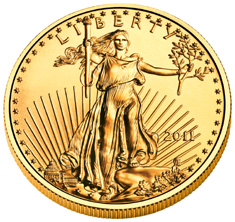
American Gold Buffalo

Gold stocks have been under performing gold bullion for the past three years.

The poor performance of gold stocks is reflected in the sub par returns of gold mutual funds run by two of the countries largest investment companies.  The three year return on Vanguard’s Precious Metals Fund (VGPMX) has actually had a negative return over the past three years as the price of gold has soared by 80%.  The Fidelity Select Gold Portfolio (FSAGX) has returned only 16.2% over the past three years. (See Physical Gold Outperforms Vanguard and Fidelity Gold Mutual Funds).

Senior gold producers such as Newmont and Kinross Gold are increasing gold production and solidly positioned for significant earnings increases but their stock prices have not been able to match the returns of gold bullion.

Although there are many reasons to expect that gold stocks will catch up to gold and deliver large gains to investors, so far this has not been the case.

Adding fuel to the investor debate over the relative merits of gold stocks versus gold bullion has been the drastic price divergence exhibited since the beginning of 2011.  While gold has held virtually all of its gains, the price of many gold stocks has plunged.  An investor in gold stocks not tracking the price of gold would probably conclude that the price of gold had collapsed during 2011.

Since January 1st, the price of gold has gained $116 per ounce or 8.3%.  From January lst to recent June lows, the price of Newmont Mining is down  by $9.27 (15.2%), Kinross Gold is down by $3.96 (20.8%) and Agnico-Eagle Mines is down by $16.01 (20.9%).  A broad basket of gold stocks, as measured by the Gold Miners ETF (GDX) has declined by $9.69 or 15.8%.

Adding to concerns about the recent sell off in gold stocks is the especially wide price divergence seen since May lst.  Although many individual gold stocks have long lagged the returns of gold, the GDX, a broad based index of gold stocks has generally tracked the price movement of gold over the past several years.  Since the beginning of May, however, the linkage between gold stocks and gold completely broke down, leaving investors to ponder the significance of such a wide divergence.
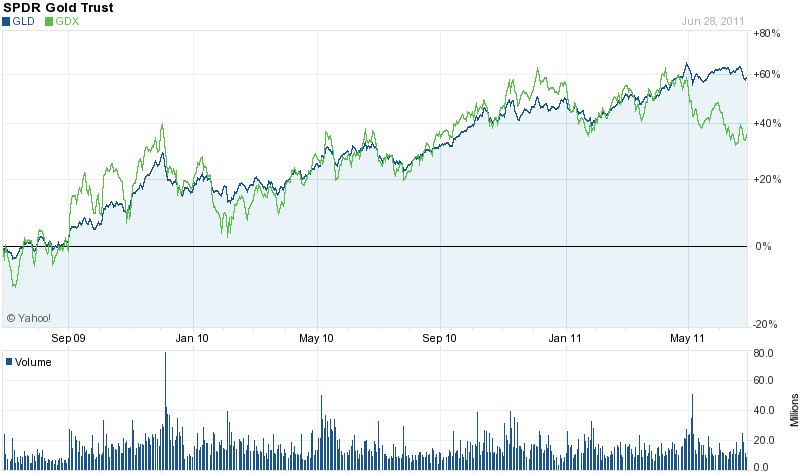
 

STOCKS VS GOLD - COURTESY YAHOO.COM


On past occasions, weakness in the gold mining shares has been a harbinger of a sell off in the gold market.  Is the current weakness in gold stocks currently forecasting a decline in the price of gold?  The end of the Fed’s money printing campaign, the world wide debt crisis, concerns about deflation, a weakening economy and the decline in commodity prices lead some to believe that a liquidity driven crisis could result in lower gold prices.

Despite short term concerns over the price of gold, the reasons for remaining long term bullish on gold are numerous.  The fundamental problems of excessive debt, debased currencies, widespread insolvency among sovereign states and out of control spending by the U.S. government all suggest that we remain on the precipice of another economic crisis.  Governments and central banks have no solutions except for the printing presses, which will be turned up to full speed at the inception of the next financial crisis.

At the margin selling may temporarily drive down gold prices in the short term, despite the solid long term bullish fundamentals for gold.  The long term trend for gold remains higher and any temporary price weakness would be a buying opportunity for gold investors.


Gold, Silver, Platinum and Palladium All Decline On Week

It was a dismal week for precious metals as prices declined across the board.  Platinum declined by over 3%, palladium and silver by 2% and gold by 1.5%.

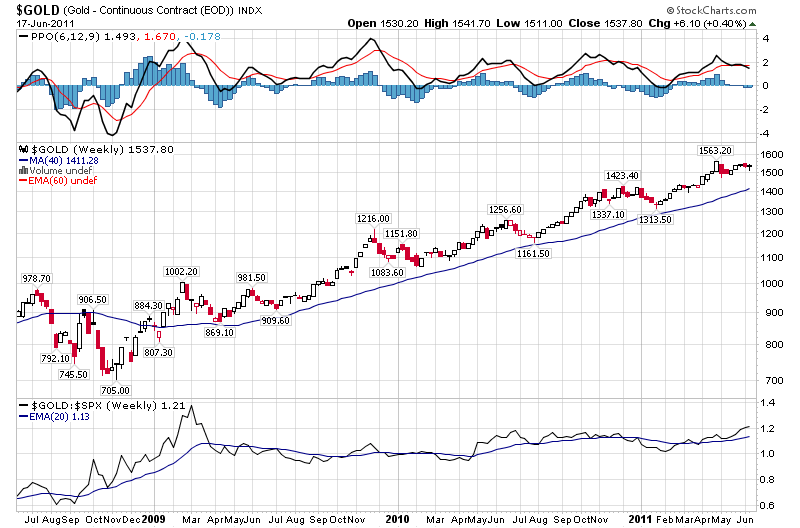
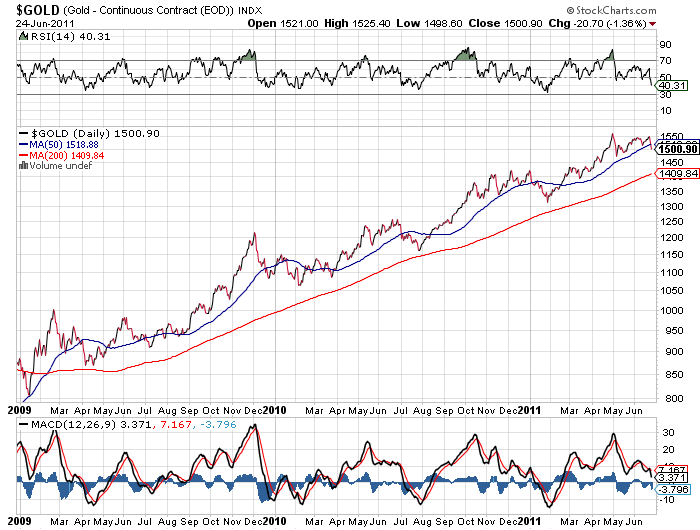
As measured by the London PM Fix Price, gold declined on the week by $22.75 after a gain of $8.25 last week.  After closing Wednesday at $1,552.50 gold was hit by selling that drove the price down by $37.75 at Friday’s close.  Gold has now dipped below its 50 day moving average as it has done on numerous occasions since early 2009 but remains solidly above the 200 day moving average.  Since early 2009 the price trend of gold has remained in a solid uptrend and every sell off to the 200 day moving average was followed by significant upward price moves.  The 200 day moving average for gold is currently at $1,410.


Gold - Courtesy Stockcharts.com

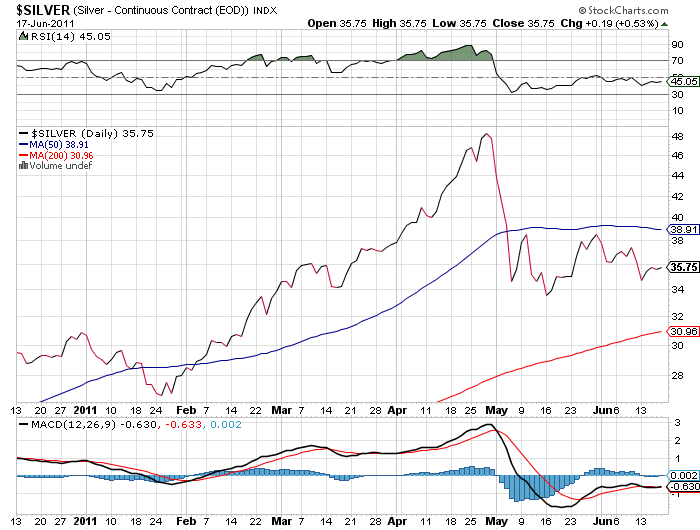
Silver declined modestly on the week, losing $0.66 and has remained in a tight trading range over the past two weeks between $36.22 and $34.68.

Platinum was down $55 on the week, closing at $1,751, after losing $78 in the previous week.  Palladium was also weak, falling $15 to $739 after retreating $61 in the previous week.  Both metals have large industrial uses and sold off as numerous economic indicators suggest a slowing world economy.

Precious Metals Prices
PM Fix Since Last Recap
Gold $1,514.75 -22.75 (-1.48%)
Silver $34.73 -0.66(-1.86%)
Platinum $1696.00 -55.00 (-3.14%)
Palladium $739.00 -15.00 (-1.99%)

Markets had been positioned for an improving economy, higher interest rates, higher inflation and additional monetary stimulus by the world’s central banks.  Since early May, the consensus has reversed considerably.  Commodity prices have declined substantially and U.S. interest rates, contrary to the expectations of many, have declined sharply.  Contributing to the sell offs in equity and precious metal markets were midweek comments by Fed Chairman Bernanke that, despite lower expectations for economic growth, the central bank had no plans for QE3.  Markets, confronting the loss of both fiscal and monetary stimulus along with slower economic growth, sold off sharply.

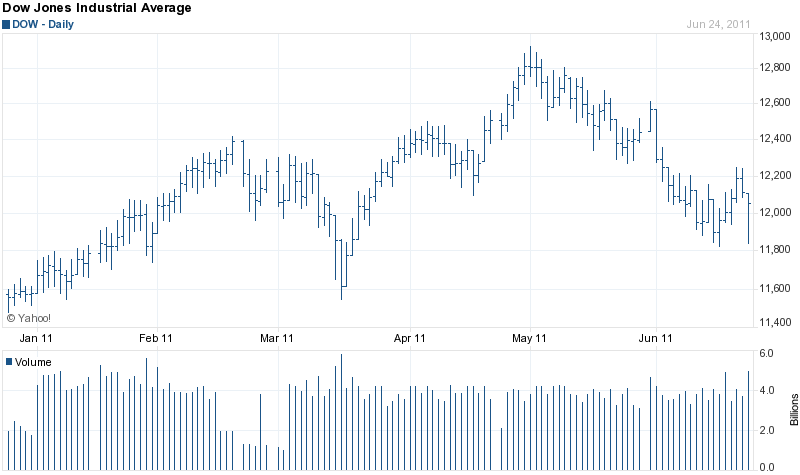
The Dow Jones has plunged over 900 points since early May.


DOW JONE - COURTESY YAHOO.COM

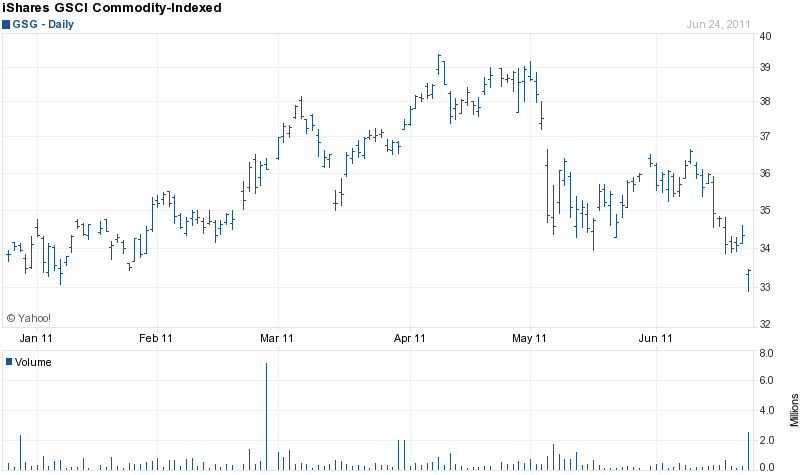
Commodities have tanked by 16%.


COMMODITIES - COURTESY YAHOO.COM

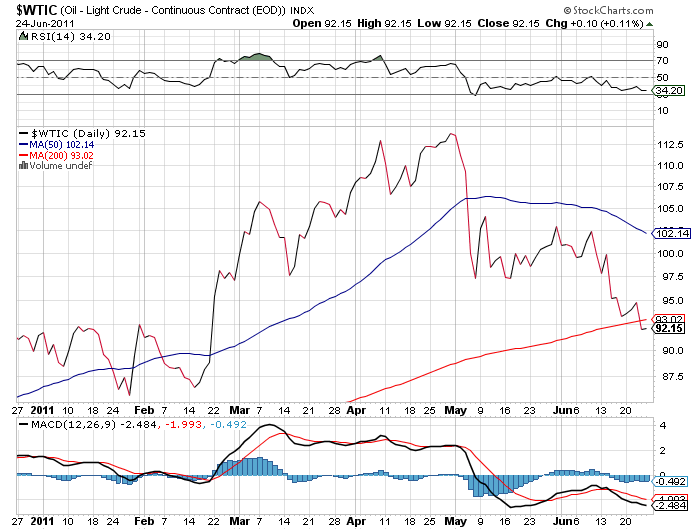
Oil, after peaking in early May at over $112 per barrel, has declined to the low $90’s.


OIL - COURTESY STOCKCHARTS.COM

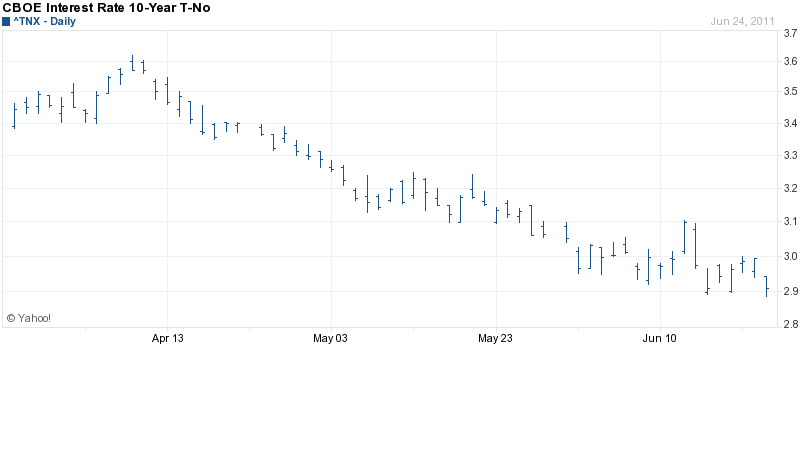
Interest rates, expected to soar after QE2 ended, have declined substantially with the 10 year Treasury note dropping from 3.6% to 2.9%.

10 year treasury - Courtesy yahoo finance


The massive amounts of debt in the system can no longer be supported by economic growth.  Bernanke knows this which is why he is terrified of deflation.  The collapse of asset bubbles have resulted in debt that is now unsupported by collateral value, threatening the solvency of banks and countries.

As the current market sell offs turn into a rout, the Fed will again turn to the only option left – money printing on a scale that will dwarf QE2.  As reported by Bloomberg, former Fed Governor Lyle Gramley said,  “The hurdle for QE3 is obviously high. But if large downside risks materialize and the economy slows enough so that the unemployment rate starts to increase again, QE3 would have to be considered.”

The Federal Reserve can’t create jobs, increase incomes, reduce unemployment or maintain the integrity of the dollar.  The one thing the Fed can and will do is produce dollars in infinite quantities to prevent a 1930’s type debt induced deflationary depression.

Steve Forbes Joins Ron Paul’s Call For Gold Backed Currency

Steve Forbes, CEO of Forbes Magazine, said the U.S. should return to a gold backed currency to prevent further debasement of the U.S. dollar.  Mr. Forbes joins a growing chorus of intellectually honest Americans who view the Federal Reserve as the greatest danger to the American economy and way of life.

The quest to preserve the value of the U.S. currency and rein in the Federal Reserve has long been championed by Rep. Ron Paul.  Apparently, Ron Paul’s message is beginning to make sense to more and more Americans as they watch the purchasing power of their dollars decline daily.

http://youtu.be/3CG9UVagFQ0

Bloomberg is reporting that the public approval rating of Fed Chairman Bernanke has dropped to the lowest level in two years. Bernanke has an approval rating of only 30% compared to 41% in late 2009.  Bernanke’s response to every problem has been to lower interest rates and print money, which have done little to improve the fundamental financial health of consumers or the government.

According to Bloomberg, the public has grown increasing skeptical of increased debt and money printing since unemployment is still near 10%, home values are still in a free fall and the declining purchasing value of the dollar has lowered the standard of living for most Americans.  The Bloomberg Poll showed that a resounding two thirds of Americans think the country is on the wrong track, with 55% expecting their children to have a lower standard of living.

Professor Bernanke can wax eloquent on the benefits of “quantitative easing” but the average American is smart enough to know that a country that needs to print money to pay its bills is in desperate financial condition.

Steve Forbes noted that the ability of the government to print money encourages reckless spending since money can be created out of “thin air.”  According to Mr. Forbes, if the country returned to a gold standard, unlimited spending could not occur.  Ironically, the ability to expand credit and print money is exactly why the government abandoned the gold standard.  The concept of a Federal Reserve and a gold backed currency have become almost mutually exclusive concepts.


Silver ETF Holdings Decline Again As Gold ETF Holdings Gain

Holdings of the iShares Silver Trust (SLV) declined again this week by 106.14 tonnes after a decline of 248.69 tonnes in the previous week.  The year to date decline in silver holdings by the SLV now totals 1,362.19 tons.

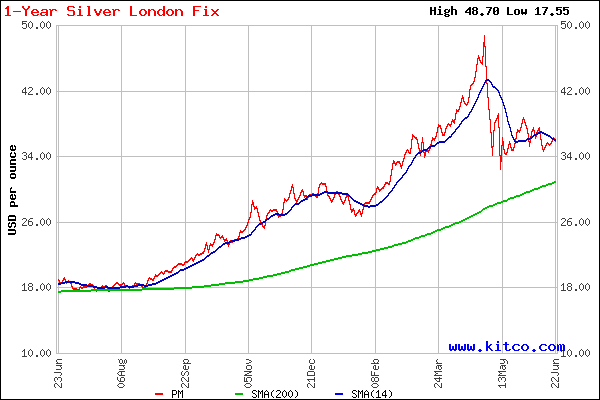
The decline in holdings of the SLV from its all time high of 11,390.06 tonnes on April 25, 2011 now totals 1,830.68 tonnes, or a decline of 16.1%.  There is not a direct and timely correlation between the price of silver and the holdings of the SLV as evidenced by the fact that silver has declined in price by a much larger percentage than holdings in the iShares Silver Trust.  From its high of $48.70 on April 28th, silver has had a price correction of 35.6%.

The holdings of silver by the SLV are structured in a complex manner.  The trust is set up so that the SLV price correlates closely to the price of silver.  This is accomplished by allowing Authorized Participants to arbitrage against a premium or discount of the SLV to the trust’s underlying net asset value  (see How Wall Street Made Huge Profits On Silver ETF Crash As Small Investors Sold).

As measured by the closing London PM Fix Price, silver closed today at $35.91, up slightly from last Wednesday’s close of $35.26.  Silver has been consolidating in the mid 30 range after the early May sell off.

As of June 22, 2011, the SLV held 307.3 million ounces of silver valued at $11.0 billion.


SILVER - COURTESY KITCO.COM

Silver seems to be building a base in the mid $30’s and presents a buying opportunity for long term investors.

GLD and SLV Holdings (metric tonnes)

June 22-2011 Weekly Change YTD Change
GLD 1,209.14 +9.09 -71.58
SLV 9,559.38 -106.14 -1,362.19

Holdings of the SPDR Gold Shares Trust (GLD) gained by 9.09 tonnes on the week after a decline of 11.52 tonnes in the previous week.   The GLD currently holds 38.88 million ounces of gold valued at $60.3 billion.

As measured by the closing London PM Fix Price, gold closed on Wednesday at $1,552.50, a new closing high on the year.  The price of gold remains in a solid uptrend supported by huge physical demand from investors and central banks.


GOLD - COURTESY KITCO.COM


Russia Joins China In Rejecting U.S. Debt, Buys Gold Instead

China, the largest foreign holder of U.S. debt, has been concerned about the safety of its U.S. treasury debt holdings for years.

In March 2009, Chinese Premier Wen Jinbao warned Washington that “We have lent a huge amount of money to the U.S.  Of course we are concerned about the safety of our assets. To be honest, I am definitely a little worried.”

Premier Jinbao’s  was right to worry about the safety of China’s U.S. debt holdings.   Since March 2009, the U.S. debt has increased by more than $3 trillion and Congress is now being pressured by the Federal Reserve and the Treasury to increase the national debt limit by another $2 trillion.  The parabolic increase in U.S. debt, along with recent downgrade warnings on U.S. debt from the credit rating agencies, must be keeping the Chinese up at night.

On Saturday, the Wall Street Journal reported that Russia also decided that holding U.S. debt has become too risky.  In comments to Dow Jones, Arkady Dvorkovich, chief economic adviser to Russian President Medvedev, said “The share of our portfolio in U.S. instruments has gone down and probably will go down further.”  According to the Wall Street Journal, Russia has already reduced its holdings of U.S. debt from $176 billion last fall to $125 billion in April of this year.

Besides diversifying into other currencies such as the Canadian and Australian dollar, Russia has also been substantially increasing its purchases of gold.  Recent reports from the World Gold Council and IMF show that Russia recently bought 50 tons of gold bringing its total gold holdings to almost 670 tons.

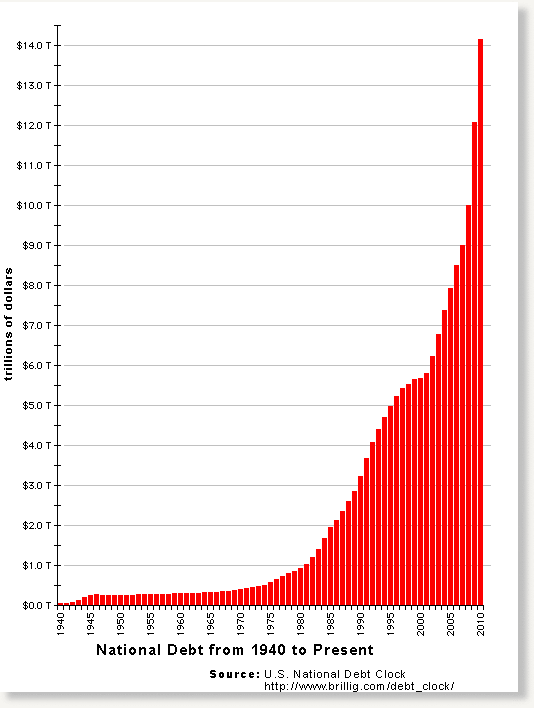
If Russian economic advisor Dvorkovich looks at the above chart of U.S. debt, he may well decide to run to the exits and dump all of Russia’s U.S. debt holdings.

The United States has truly entered the Bizarro stage of national finance.  As the exponential increase in U.S. debt moves the Nation ever closer to a debt crisis, Fed Chairman Bernanke and Treasury Secretary Geithner are predicting dire consequences if Congress does not increase the U.S. debt limit.  Should it really be a surprise that two of the world’s biggest holders of U.S. debt are heading for the exits?


BIZARRO WORLD -COURTESY COMICTREADMILL.COM


Gold Gains Slightly On Week While Silver, Platinum and Palladium Decline

Precious metals had a tough week as silver, platinum and palladium all declined, while gold registered a small gain.

As measured by the closing London PM Fix Price, gold gained $8.25 on the week after declining by $10.75 in the previous week.  Gold remains in a solid long term uptrend.  Since early 2009, gold has remained above its 40 day moving average and every dip to the 40 day moving average has followed with rallies to new highs for gold.

Gold’s last decline to the 40 day moving average in January of this year was subsequently followed by a rally of over $220 per ounce.  A correction to the 40 day moving average would bring gold back to the $1,400 level.


GOLD - COURTESY STOCKCHARTS.COM

Gold has held above $1,500 as world financial markets, oil and other commodities have declined substantially over economic worries.   As the European Central Bank struggles to prevent a Greek default that could trigger a series of other sovereign defaults, debt yields are soaring not only in Greece but also Spain, Portugal, Italy and Ireland.

Markets are beginning to reflect the unavoidable truth that we are reaching an end game where sovereign governments have become the new systemic risk to the financial system.  As debt burdened governments face the prospect of financial collapse and political unrest, the only option will be to sell new debt to the central banks who will buy the debt with newly printed money.  As central banks worldwide compete with each other in massive currency debasement, gold will soar to new highs beyond predictions of the boldest gold bulls.

As the slow motion collapse in Europe unfolds, investors in the U.S. seem resolute in the belief that “it can’t happen here, we are not Greece.”  This argument is rejected by Bill Gross who runs Pimco, one of the largest bond funds in the world.  According to Gross, who recently announced that he would stop buying U.S. Treasury debt, the U.S. is actually in worse shape than Greece.

The total debts of the U.S. government, including off balance sheet obligations for open ended social programs, totals $100 trillion.  Gross notes that “To think that we can reduce that within the space of a year or two is not a realistic assumption.  That’s much more than Greece, that’s much more than almost any other developed country.”

Critics who dismiss the warnings of Bill Gross point to the current level of low yields on U.S. treasury debt.  Why would the U.S. be able to sell its debt at such low rates if the finances of the United States are worse than Greece?  The answer is that crises develop in a linear fashion.  Investors don’t worry about credit risk until the crisis is upon them and suddenly everyone wakes up and panics.

Carmen Reinhart of Harvard and formerly of the IMF correctly predicted that a sovereign debt crisis would follow the financial crisis of 2008.  In a study of bond markets as a forecasting tool, Reinhart showed that rates are a poor forecaster of  repayment risk.  According to Reinhart, “Very often, interest rates are a coincident, rather than a leading indicator” of a looming financial crisis.

Preserving wealth during the next financial meltdown will require taking steps before the inevitable crisis develops.

Precious Metals Prices
PM Fix Since Last Recap
Gold $1,537.50 +8.25 (+0.54%)
Silver $35.39 -1.99(-5.32%)
Platinum $1,751.00 -78.00 (-4.26%)
Palladium $754.00 -61.00 (-7.48%)

Platinum had a volatile week, declining by $78 on the week to $1,751.00.  After moving up by $650 per ounce between July 2009 and May 2010, platinum has been consolidating its gains.  During 2011, platinum has remained in a narrow but volatile trading range between $1,700 and $1,850 per ounce as traders try to sort out whether the predominant demand for platinum is industrial usage or investor demand.

PLATINUM - COURTESY STOCKCHARTS.COM

Palladium had the biggest decline in the precious metals group, falling by $61 per ounce for a loss of 7.48%.  After reaching a high on the year of $858 in February, palladium has been correcting in a sideways pattern.


PALLADIUM - COURTESY KITCO.COM

Silver declined by $1.99 on the week to $35.39 after a gain of $2.19 in the previous week.  After the sharp decline in early May, silver has been building a base in the $34 to $38 range.


SILVER - COURTESY STOCKCHARTS.COM

Silver and Gold ETF Holdings Both Decline On Week

Holdings of the iShares Silver Trust (SLV) declined by 248.69 tonnes for the week after declining by 27.12 tonnes in the previous week.  The year to date decline of silver held by the SLV is 1,256.05 tonnes.

The holdings of the SLV hit an all time high on April 25, 2011 at 11,390.06 tonnes and the decline from this high now totals  a substantial 1,724.54 tonnes.  Total holdings of the SLV have declined by 15.1% from the high of April 25, while the price of silver has declined by 27.6%  from its high of $48.70 reached on April 28th.

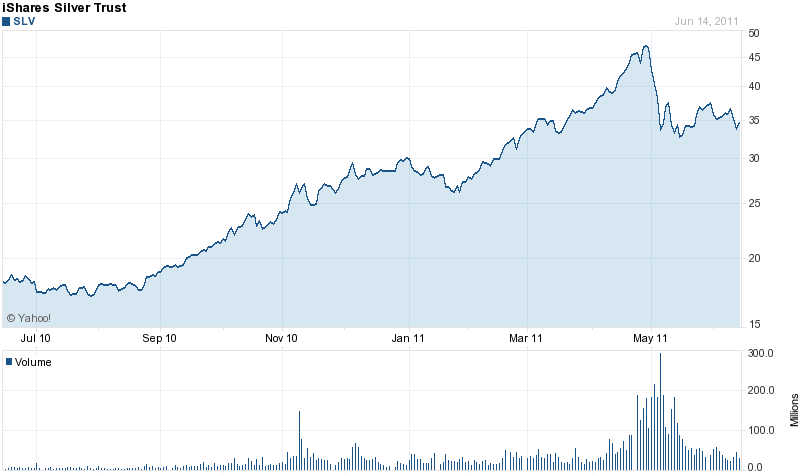
Silver closed today at $35.26 (as measured by the closing London PM Fix price), up $8.58 from the low of the year at $26.68 reached on January 28th.  Shares of the SLV closed today at $34.88, down $13.47 from the high of the year at $48.35.


SLV - COURTESY YAHOO FINANCE

The iShares Silver Trust currently holds 310.8 million ounces of silver valued at $10.95 billion.  At the start of 2011, the SLV held 351.1 million ounces of silver valued at $10.9 billion.  The holdings of the iShares Silver Trust does not directly track the price movement in silver due to the manner in which it is structured.  For a discussion of how SLV shares are created or redeemed by Authorized Participants, see How Wall Street Made Profits On Silver ETF Crash.

According to the iShares website, the SLV closed yesterday at a premium of 2.54% to the fund’s net asset value.  On rare occasions when silver is exhibiting large price swings, the premium or discount to net asset value has been as large as 6%.

GLD and SLV Holdings (metric tonnes)

June 15-2011 Weekly Change YTD Change
GLD 1,200.05 -11.52 -80.67
SLV 9,665.52 -248.69 -1,256.05

Holdings of the SPDR Gold Shares Trust (GLD) declined on the week by 11.52 tonnes, after declining in the previous week by 1.30 tonnes.  The GLD currently holds 38.58 million ounces of gold valued at $59.0 billion.  The all time record holdings of the GLD was 1,320.47 tonnes on June 29, 2010.

Gold traded in a narrow range over the past week, declining by $8 per ounce.  Gold has stayed above the $1,500 level since May 20th and has gained $141.25 since the beginning of the year.

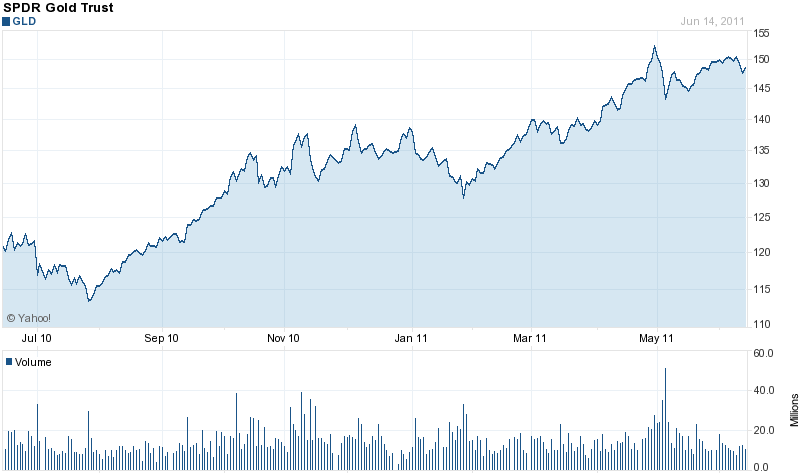
Shares of the SPDR Gold Trust closed at $149.12, up $0.45, not far off the year’s high of $153.61.


GLD - COURTESY YAHOO FINANCE

Why A Gold Backed Currency Is No Longer Possible

It is ironic that one of the most eloquent proponents of a gold standard did the most to ensure that we will never have one.  Alan Greenspan’s 1966 paper entitled “Gold and Economic Freedom” expounded on the role of a gold backed currency in protecting wealth against inflation by restricting the amount of money that could be produced.

Greenspan notes that the creation of the Federal Reserve was based on the premise that a central bank could supply increased reserves to banks when necessary and thereby offset natural turn downs in the business cycle.

“But the process of cure was misdiagnosed as the disease: if shortage of bank reserves was causing a business decline-argued economic interventionists-why not find a way of supplying increased reserves to the banks so they never need be short! If banks can continue to loan money indefinitely-it was claimed-there need never be any slumps in business. And so the Federal Reserve System was organized in 1913.”

It was not long before the Fed’s ability to allow unchecked credit expansion by banks laid the groundwork for the economic collapse know as the Great Depression.  Greenspan states that in an attempt to offset a mild business contraction in 1927, massive amounts of new bank reserves fostered a speculative boom ending with the Wall Street Crash of 1929.

“When business in the United States underwent a mild contraction in 1927, the Federal Reserve created more paper reserves in the hope of forestalling any possible bank reserve shortage… The excess credit which the Fed pumped into the economy spilled over into the stock market-triggering a fantastic speculative boom. Belatedly, Federal Reserve officials attempted to sop up the excess reserves and finally succeeded in braking the boom. But it was too late: by 1929 the speculative imbalances had become so overwhelming that the attempt precipitated a sharp retrenching and a consequent demoralizing of business confidence. As a result, the American economy collapsed. Great Britain fared even worse, and rather than absorb the full consequences of her previous folly, she abandoned the gold standard completely in 1931, tearing asunder what remained of the fabric of confidence and inducing a world-wide series of bank failures. The world economies plunged into the Great Depression of the 1930’s.”

Fast forward 75 years and we are looking at an eerily similar situation.  Unlimited credit creation by the Fed creates multiple asset bubbles that precipitate an economic crash and the dawn of Great Depression II.

Greenspan goes on to explain why there was ardent opposition to the gold standard despite the catastrophic results of unchecked  credit creation by the Fed in the 1920’s and why deficit spending is equivalent to the confiscation of wealth.

“But the opposition to the gold standard in any form-from a growing number of welfare-state advocates-was prompted by a much subtler insight: the realization that the gold standard is incompatible with chronic deficit spending (the hallmark of the welfare state).

In the absence of the gold standard, there is no way to protect savings from confiscation through inflation. There is no safe store of value. If there were, the government would have to make its holding illegal, as was done in the case of gold…The financial policy of the welfare state requires that there be no way for the owners of wealth to protect themselves.

This is the shabby secret of the welfare statists’ tirades against gold. Deficit spending is simply a scheme for the confiscation of wealth. Gold stands in the way of this insidious process. It stands as a protector of property rights.”

Ironically, the man who best understood the merits of a gold backed currency became the driving force behind the unlimited credit expansion that lead to the largest financial crisis in U.S. history.

Greenspan’s compromise of principles is beyond reproach for a man who understood the consequences of  ultra easy monetary policies, yet allowed himself to be corrupted by lobbyists, bankers and politicians.  Does anyone expect a better performance from current Fed Chairman Ben Bernanke, a man who blatantly prints money in an overt attempt to further debase the U.S. dollar?

Incredibly, Alan Greenspan disingenuously initiated another discussion on the need for a gold standard earlier this year.  In an interview with Fox News in January 2011,  Mr. Greenspan had the temerity to say:

“We have at this particular stage a fiat money which is essentially money printed by a government and it’s usually a central bank which is authorized to do so. Some mechanism has got to be in place that restricts the amount of money which is produced, either a gold standard or a currency board or something to that nature, because unless you do that, all of history suggest that inflation will take hold with very deleterious effects on economic activity.”

http://youtu.be/yRJs5yL62BA

Three conclusions can be reached regarding a U.S. gold standard:

1.  Mr. Greenspan should cease talk about a U.S. gold standard and the dangers of unlimited credit expansion – his previous record  speaks for itself.

2.  The ability of the U.S. to adopt a gold backed currency has been overwhelmed by the debt and leverage which now threaten to bring on a deflationary collapse.  Ben Bernanke knows this which is why he has been printing money on an unprecedented scale.

Ironically, the creation of new credit may be the only factor preventing us from sliding into a deflationary depression  triggered by massive debt defaults.  Ben Bernanke’s prescription of inciting inflation and curing excessive debt with more debt may be the only poor policy option remaining to forestall an unimaginable economic nightmare.  With the global economy tottering on the edge of another financial crisis,  the adoption of a gold standard by the U.S. remains a very remote possibility.

3.  Since the government is not interesting in preserving the value of our currency, individual initiative becomes necessary.  Ten years of rising gold prices tells us the smart money is not waiting for a gold backed currency but instead is turning directly to gold.

Ron Paul’s Call For Gold Backed Currency Would Value Gold At $54,300 Per Ounce

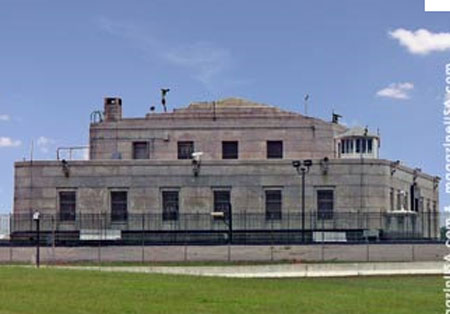
FORT KNOX

Ron Paul said today that the creation of a sound U.S. currency, “backed by gold or some other commodity respected by the market” was the most important first step to create new jobs and encourage capital investment in America.

In an article published on the Ron Paul website entitled “The Keys to Economic Growth“, Ron Paul argued that the U.S. economy was in “terrible shape” and that the trillions of dollars borrowed and printed by the U.S. government have done nothing to turn things around.  Rep. Paul noted that the real unemployment rate was closer to 20% rather than the officially published rate of 9.1% and that real job growth would only come from private capital financing existing business or entrepreneurial growth. New job growth will not occur, said Ron Paul, if we continue to punish those who accumulate capital needed for business expansion.

Ron Paul listed four essential steps that must be taken to turn around the American economy through new job creation.

  1. The U.S. economy cannot be restored, according to Ron Paul, until we “prohibit the Treasury and Federal Reserve from essentially creating money and credit from thin air.”  A currency that is rapidly being debased will not attract private capital.  In order to ensure a sound currency, the dollar should have its value legitimatized via gold or commodity convertibility.
  2. The extreme regulatory burdens on business have greatly inhibited job growth.  The vast bureaucracies and compliance nightmares being created by Obamacare and the Dodd-Frank Act have served to choke off business growth and new jobs since businesses cannot cope with “unknowable regulatory compliance burdens.”   Rep. Paul said it is time to “start shrinking the federal registry.”
  3. The trillion of borrowed dollars spent on foreign wars has reduced our economic growth by sapping the private sector and increasing the Federal debt. Rep. Paul declared that “There is no point in debating a foreign policy we cannot afford.”
  4. According to Ron Paul, the U.S. tax system needs to be revamped to allow U.S. foreign income to be repatriated tax free to the U.S. to allow the funds to be deployed in the domestic economy.   Ron Paul also said it would be better to simply “abolish the income tax altogether.”

Ron Paul noted that free market capitalism and respect for property rights was essential in allowing the creation of U.S. wealth.  The poorest nations on earth routinely demonstrate hostility to free markets, private property and the rule of law, with the predictable result of widespread poverty.

Ron Paul’s attempt to preserve the integrity of the U.S. dollar by backing the currency with gold has little chance of succeeding.  A gold backed currency would prevent Congress and the Fed from running deficits and printing money, something they would fight to avoid at all costs.

It is interesting to speculate, however, on what the value of gold would need to be to in order to back the massive debts and obligations that the U.S. government has piled up.  The United States has issued the most amount of debt of any nation on earth.  Ignoring the trillions in unfunded and off balance sheet obligations, the United States has official debt of $14.2 trillion dollars outstanding, including both marketable Treasuries and intergovernmental debt.

If the U.S. used its official gold reserves of 261.5 million ounces to back the $14.2 trillion of U.S. debt, gold would need to be valued at $54,300 per ounce.


Why Gold Stocks Are A Better Value Than Physical Gold Or Gold ETFs

Many investors in gold mining companies are probably asking “where did I go wrong”?   While the price of gold bullion has moved relentlessly higher,  many large cap gold stocks have seen little or no price appreciation in recent years.

In a previous post, we examined the poor returns of two major gold stock mutual funds compared to the return on owning physical gold.  While the price of gold has soared 80% over the past three years, the three year return on the Vanguard Precious Metals Fund (VGPMX) was -.46% and the three year return on the Fidelity Select Gold Portfolio (FSAGX) was only 16.2%.

Why gold stocks have so badly lagged the run up in the price of gold remains subject to conjecture.  Some analysts speculate that investors prefer to avoid the risks associated with gold mining stocks and as a result have turned to physical gold and gold ETFs.  Since their introduction in 2004, gold ETFs have become very popular with investors, and now hold a total of almost $98 billion in assets.  By way of comparison, the market value of three of the largest gold mining companies, Barrick Gold (ABX), Gold Corp (GG) and Newmont Mining (NEM) total $108 billion.

If the gold ETFs did not exist, it is likely that some of the funds that flowed to gold ETFs would have instead flowed into gold mining companies.  However, the historical correlation between gold bullion and gold mining stocks has not always been perfectly linked.  There have been times when gold stocks outperformed or simply matched the price gains of gold bullion.

The recent under performance of gold stocks relative to gold bullion will probably not continue.  Many large cap gold mining companies are positioned to see significant increases in earnings that will eventually propel their stock prices higher.  Going forward, it is likely that gold investors will see higher returns on quality gold mining stocks than on holdings of physical gold or gold ETFs.

Two high quality gold mining companies previously featured in the GoldandSilverBlog that should see significant price gains are Newmont Gold (NEM) and Kinross Gold (KGC).

Newmont Gold is one of the world’s largest gold producers.  The Company has been increasing profits and production for several years and is forecasting an increase in gold production of 35% over the next six years.  Newmont has gold and copper reserves valued at $363 per share and pays a cash dividend of $0.50 per share which will be increased by $0.20 for every $100 increase in the price of gold.  Newmont shares closed on Friday at $52.10.

Kinross Gold had very strong first quarter results with revenue up 42% and earnings up 81%.  The Company’s cost of production is $543 per ounce and Kinross is forecasting an increase in gold production of 77% by 2015.  At the current price of $15.50 per share, an investor is effectively buying gold at around $250 per ounce.  Kinross Gold pays a dividend of $.10 per share.

The current pricing disparity between quality gold mining stocks and gold bullion has presented investors with an opportunity to purchase gold shares at deeply discounted prices.

Besides being able to effectively buy gold at a steep discount, gold mining companies pay dividends which are likely to increase substantially.   Another significant benefit of owning gold mining companies is the much more favorable tax treatment on gains.  Gold bullion and gold ETFs are taxed as collectibles at 28%, while the long term capital gains tax rate on gold stocks is only 15%.