April 15, 2026

As Gold Hits Record Highs, Perth Mint Finds Success in Smaller Sized Coins

As the price of gold continues to climb, the cost of purchasing a one ounce gold bullion coin is approaching $1,600.  In order to provide the opportunity to own gold within a more reasonable price range, innovative mints have begun offering smaller sized gold coins.   In April 2010, the Perth Mint of Australia introduced a half gram 99.99% pure gold coin named the Mini Roo.

Struck with a fineness of .9999, each Mini Roo contains 0.016 troy ounces of gold. The coins have a diameter of 11.60 mm and thickness of 0.70 mm. By comparison, the one ounce Australian Gold Kangaroo has a diameter of 32.60 mm and thickness of 2.80 mm. The half gram Mini Roo and 1 oz. Gold Kangaroo are shown side by side in the image below.

According to the Perth Mint’s website, the Mini Roo is currently priced at $54.18. A major precious metals dealer’s website currently quotes the price of a single one ounce 2011 Gold Kangaroo at $1,668.23.

Alexandra Lucchesi of the Perth Mint Public Relations Department was kind enough to some insights on the objectives and sales levels of the diminutive gold coins.

Gold and Silver Blog:  Can you provide us with any indication of the sales levels of the Mini Roo half gram gold coin and how it compares to the sale of one ounce coins?

Alexandra:  To compare sales of the Mini Roo and 1oz gold bullion coins would not be a valid comparison.  The issues vary considerably in weight and price, and therefore, do not encompass the interest of the same individual and institutional investors.  Furthermore, the Mini Roo is targeted more toward collectors and gift buyers, whereas the gold coins of the Australian Kangaroo and Lunar series are directed more toward investors.

Gold and Silver Blog:  Has the half gram gold coin met sales expectations and have sales increased as the price of gold has climbed?

Alexandra:  The release of the Mini Roo has met our objectives at both wholesale and retail levels, with sales exceeding more than 15,000 2010-dated coins to date since being released in April last year.  With the 2011 coin only just released a fortnight ago [April 5, 2011], we can not yet estimate sales for the remainder of the year, although, with periodic prompted promotion, we are also anticipating favourable sales of this issue.

Gold and Silver Blog:  Will the Mini Roo become a regular annual issue?

Alex:  A Mini Roo was first introduced to the market in April 2010.  Complementing the world renowned Australian Kangaroo gold bullion coin series, the Mini Roo is expected to be released each year and will continue to portray the identical design as, or a simplified version of, the iconic Australian Kangaroo annual issues.

Gold and Silver Blog:  I would suspect that the much lower cost of the Mini Roo allows greater participation by investors and collectors as well as placing the Mini Roo within the affordable gift category.  Was the higher price of gold the determining factor in deciding to produce the half gram coin?  Have the offerings of smaller sized gold coins resulted in an increased number of new customers?

Alexandra:  That is correct.  The Perth Mint introduced the Mini Roo to encourage a broader audience to start investing in, or collecting, precious metal coin products.  In addition, the smaller coin was perfect to capture the interest of those who, traditionally, were unable to afford the classic Australian Kangaroo bullion coin sizes.  The timing for the initiative was also enhanced by the rising price of gold.  The lower price point of the button-sized Mini Roo does give individual precious metal investors, coin collectors and gift buyers the opportunity to purchase a pure gold coin at an affordable price featuring a similar design as its traditional counterpart.

The Perth Mint Australia

APMEX CEO Says No Bullion Shortage

Despite recent volatility, gold and silver prices continue to push to new highs.  After a brief pullback on earlier this week, silver rebounded strong and once again approaches the $50 level. Gold, which has lagged the price gains in silver, recently rose to a fresh all time high and remains solidly above the $1,500 level.
The rapid rise in silver prices has resulted in the Chicago Mercantile Exchange increasing the margin requirements on silver futures for the third time.  The press provided numerous accounts of traders taking huge positions in bearish silver puts.  Silver also faces the psychologically important barrier of $50 per ounce.   During the last great silver bull move of the early 1980’s silver rapidly collapsed from the $50 range and subdued for decades.

Despite the calls for a major correction by silver bears, the metal remains near all time highs and there have been numerous press reports of a physical shortage of silver based on intense investor demand.

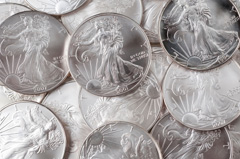
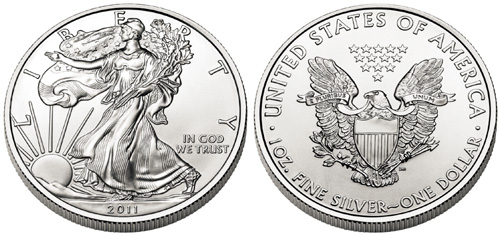
Indications of a supply/demand imbalance in the bullion markets can be seen in many areas.   The US Mint has been rationing Silver Eagle bullion coins to its authorized purchasers and earlier this year the Royal Canadian Mint admitted that it was having major problems in sourcing adequate supplies of silver due to high demand.  The spot price of physical silver is trading above the price of futures contracts (known as backwardation) and this is an indication of huge physical demand.  In addition, earlier this week, APMEX, a major precious metals dealer, offered to buy bullion at a generous premium from its customers and cited “incredible demand” for gold and silver bullion products.

Although APMEX says there is no supply/demand imbalance, they recently increased their buy price for some US Mint bullion products. In particular, they are offering $3 over spot silver for one ounce American Silver Eagles. This is higher than the company’s cost of acquisition directly from the United States Mint, which sells the coins at $2 over spot to authorized purchasers.

In order to get a better assessment of the precious metal markets and supply/demand situation in bullion products, Gold and Silver Blog interviewed Michael Haynes, the CEO of American Precious Metals Exchange (APMEX).

When asked about the high prices APMEX is offering for Silver Eagles, Haynes said, “APMEX had not made a general offer to the customer base in quite some time and it seemed logical to remind the customers that APMEX has a need to buy. With respect to prices on Silver Eagles, you rightly describe that APMEX is offering more than the Mint sell price and you also rightly observe that the Mint is allocating product. As previously discussed, APMEX supplements its buying needs from the secondary market. Therefore, APMEX is buying at the bid offered to the customers and as mentioned above, APMEX would rather buy from its customers than a commercial dealer”.

Thus, despite the challenges experienced in other sectors of the market, from APMEX’s perspective they are able to obtain adequate supplies to meet customer demand.   Michael Haynes noted that APMEX is “currently able to buy the products needed to maintain adequate inventories for customers”.

Michael Haynes also provided insights into current customer buying trends.  According to Mr. Haynes, “average order sizes are increasing slightly, but that may be attributed to higher prices of the underlying product.  Recently, the purchases have shifted slightly toward silver”.  There has been no dramatic changes in customer buying patterns related to product size or premium according to Mr. Haynes.

Addressing  the appreciation in precious metals prices, Mr. Haynes noted that “APMEX sales seem to rise in either a rising market or a declining market.  The customers that purchase under those different scenarios are different, in that new customers tend to purchase on increases and mature customers tend to purchase on pullbacks”.

APMEX has apparently met the challenges of meeting surging customer demand for physical bullion products and, in addition, maintains a liquid market for those investors who chose to sell.  Mr. Haynes calls APMEX “one of the great business stories of the internet age”. APMEX was founded by Scott Thomas who has built the company into one of the largest dealers in coins and precious metals based on “a great passion to satisfy customers”.   Mr. Haynes stated that one of his goals is to “reach more of the population with the opportunity to own precious metals”.

Silver and Gold ETF Holdings Decline Amidst Volatile Trading

In a week of volatile precious metals trading, holdings of both the iShares Silver Trust (SLV) and the SPDR Gold Shares Trust (GLD) saw modest declines.
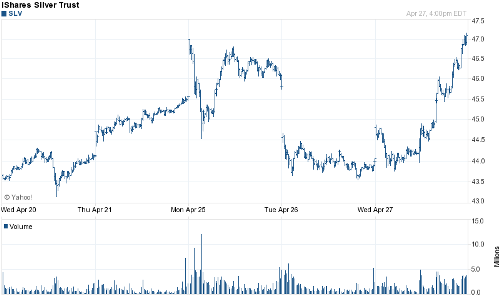
The holdings of the SLV declined by 130.49 tonnes or 1.2% from last week to 11,053.20 tonnes.  Looking at the daily changes, however, provides a a better indication of the volatility in SLV holdings during the week.

The holdings of the SLV hit an all time record high amount of 11,390.06 tonnes on Monday April 25th.  The substantial decline of 336.86 tonnes over the following two days mirrors the volatile price action of the SLV, which declined more than $2 on Tuesday before recovering to all time  highs at Wednesday’s closing price.

SLV - COURTESY YAHOO FINANCE

The SLV currently holds 355.4 million ounces of silver valued at $16.1 billion.  The SLV is currently the largest silver ETF and has seen tremendous growth in holdings since the Trust’s inception in April 2006, when it held a mere 653.17 tonnes valued at $263.5 million.  According to the Silver Institute, at the end of the first quarter 2011, total holdings held by all silver ETFs was 612 million ounces.

Despite the tremendous appreciation of the SLV, the silver market remains a relatively small market which leads to speculation that silver prices are being manipulated.  Volatility in silver trading over the past week was enhanced by rumors of massive short positions by traders, attempts to corner the market by larger players, and the inability to deliver physical silver on futures contracts.

The recent volatility in silver is likely to continue as additional players are drawn into one of the hottest markets of 2011 and wide price swings may become the norm over the short term.

For long term  investors, the fundamentals of the silver market should overweight any short term volatility.  Sales of Silver Eagles by the US Mint in the first quarter of 2011 was 37% higher than the previous year reflecting continuing investor demand.

GLD and SLV Holdings (metric tonnes)

April27-2011 Weekly Change YTD Change
GLD 1,229.64 -0.61 -51.08
SLV 11,053.20 -130.49 +131.63

Gold holdings in the GLD declined modestly by 0.61 tonnes after an increase of 17.29 tonnes for the previous week.  The current holdings of the GLD amount to 39.5 million ounces of gold valued at $59.7 billion.

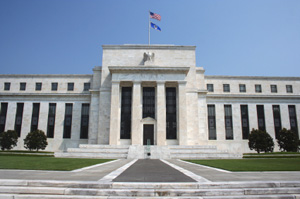
Gold hit another all time high today, recently trading at $1,531.  The Federal Reserve ignited a sharp rally in gold and silver after releasing details of this week’s FOMC meeting. The precious metal markets moved higher after the Federal Reserve said it would continue super aggressive monetary policies despite the June wind down of QE2.  The Fed indicated that it would not reduce the size of its balance sheet and would leave short term interest rates at zero.

The Fed also left the door open to future unconventional policy moves if deemed necessary.  Since the Fed cannot move rates below zero, any additional “unconventional easing” would almost certainly mean additional money printing by the Fed.   The US dollar traded lower on Fed comments and is now threatening to break to new all time lows.


Federal Reserve May Cause Stampede Into Gold and Silver This Week

At the end of a two day Federal Reserve policy meeting, Fed Chairman Bernanke has scheduled a news conference on Wednesday that has the potential to rattle markets worldwide.   Every analyst and investor at the news conference is certain to focus their questions on Fed plans after the scheduled completion of QE2  in June.
Current market expectations are that the Fed will not announce a new program of asset purchases and will initiate steps to slowly reduce the size of its bloated $2.5 trillion balance sheet.  Through the end of June, the Fed will have purchased $600 billion of treasury debt using newly created dollars, after having purchased $1.7 trillion of assets under QE1.

The Federal Reserve has been supporting the skyrocketing federal deficit by purchasing 85% of all new treasury debt since QE2 was initiated.   Some analysts think that interest rates on US debt will increase once the largest buyer of treasury debt steps aside.  The withdrawal of massive stimulus by the Fed could also cause a sell off in stocks and bonds, and result in lower housing prices and higher unemployment.  Under this scenario, another round of quantitative easing by the Fed would become inevitable.

Chairman Bernanke’s comments on the Federal Reserve’s exit strategy from a super easy monetary policy could cause major moves in many markets, especially precious metals.  If the markets sense that the Fed may need to initiate another round of quantitative easing, gold and silver prices will explode to the upside.  This prediction is based on the results of the current QE2 program which benefited certain asset categories but did little to help the average American.

Since last August when it became clear that the Fed would initiate QE2, we have witnessed the following results.

  • Home prices have continued to decline.
  • The 30 year mortgage rate has increased from 4.2% to 4.8%.
  • New housing starts declined to all time lows.
  • The 10 year treasury note rate has increased from 2.6% to 3.4%.

The Fed has continued its policy of near zero short term interest rates at the expense of consumers who receive virtually no return on savings.  Banks, meanwhile have increased US treasury and agency securities to a massive $1.7 trillion, benefiting from the spread between short and long rates.

The Fed’s policy of overt currency debasement, while helping to increase exports and earnings for multinational corporations has resulted in the dollar declining to the all time lows reached in early 2008.   Foreign countries with dollar reserves are protecting themselves by diversifying out of dollars and into other currencies and hard assets.

The lower value of the US dollar, while helping multinational corporations, has resulted in higher oil and food costs which has put  additional strains on consumers already burdened with excessive levels of debt and declining incomes.

Unemployment has remained stubbornly high despite unprecedented fiscal and monetary stimulus.  The Fed can print money but it cannot directly create an increase in real incomes for the average American family.  Nor can the Fed fool the people – recent Gallup polls show that almost half of the public has little faith in the Federal Reserve’s ability to do the right thing.

The Fed’s explicit policies of dollar debasement and zero interest rates risks triggering a major collapse in the value of the dollar.   Since last summer the dollar has seen a decline of 16% as investors do the logical thing and dump dollars.

Huge US  budget deficits, uncontrolled spending  and money printing by the Fed resulted in a warning by S&P that a credit downgrade on US debt was possible, putting further pressure on the US dollar.

QE2 liquidity did result in higher stock and precious metal prices benefiting a minority of Americans while doing nothing to solve the problem of too much debt and too little income.  Reliance on the Fed to come to the rescue with ever increasing amounts of cheap money has become the last resort, self defeating option.

The gold and silver markets are reflecting the failure of  unsustainable fiscal and monetary policies which virtually guarantee further appreciation in the precious metals sector.  Any pullback in prices should be viewed as a long term buying opportunity.

Are Gold Stocks Really Underforming Gold Bullion?

Depending on which gold stock investor you talk to, gold stocks have either been under performing or outperforming gold bullion.
Theoretically, given the earnings leverage associated with gold miners, a big move up in gold bullion should translate into handsome gains for shareholders of gold mining companies as earnings per share increase.  In the real world, however, the cost of exploration and development, mine depletion and the energy intensive process of gold mining and refining can result in costs that exceed the increased revenue from higher gold prices.  Gold mining companies with operations in less developed countries with weak property rights can also wake up one morning and discover that the government has expropriated their mines.

So which is it?  Would it have been better to own gold stocks or simply buy a gold ETF or take physical possession of gold bullion?  Like many things in life, it all depends, and the result reinforces the argument to maintain a well diversified portfolio.

Gold miners that have been able to translate higher gold prices into higher profits have done very well while other gold miners with poor results have significantly lagged the gains seen in gold bullion.   The results have been company specific.  A gold stock investor who was correct in predicting higher gold prices but picked the “wrong” gold stocks fared poorly.

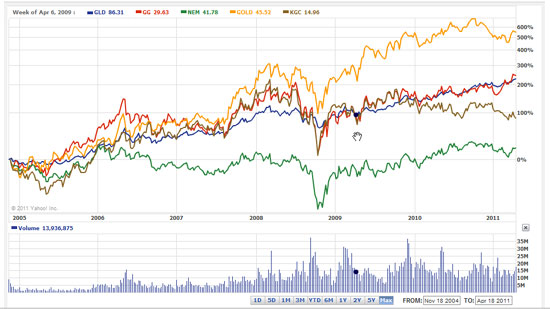
Here’s a sample of the relative performance of some of the largest gold miners compared to the price of gold, using the SPDR Gold Trust (GLD) as a proxy for bullion prices.  Two major gold miners, Newmont Mining Corporation (NEM) and Kinross gold Corporation (KGC), dramatically under performed the GLD, while Goldcorp (GG) tracked the GLD performance.  If you were lucky enough to own Randgold Resources (GOLD), your profits would have been twice the gains on the GLD.

RELATIVE PERFORMANCE STOCKS VS GLD - COURTESY YAHOO FINANCE

The bottom line is that unless an investor has considerable expertise in assessing the gold mining industry and specific company prospects, the better choice was to go with a gold ETF or stash gold bullion in a safe deposit box.  If the biggest gains in gold prices are yet to come, as I believe, an investor with a 100% allocation to individual gold stocks should consider reassessing his portfolio allocation.

The last option that should be mentioned for those seeking higher returns from the leverage of owning gold stocks instead of a gold ETF, would be to invest in a gold mutual fund with a solid track record of investment success.

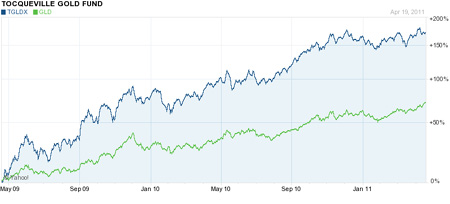
Tocqueville Gold Fund Performance vs. GLD

The Tocqueville Gold Fund(TGLDX) is a highly regarded mutual fund with solid portfolio managers who have had a very successful track record in picking the right gold stocks.  Over the past two years, the TGLDX has outperformed the GLD and with far less volatility.

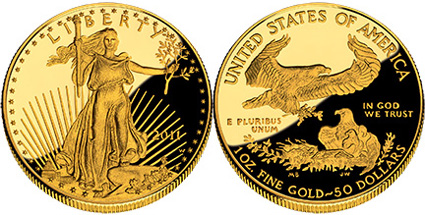
2011 Proof Gold Eagles Available April 21

The United States Mint has provided details for the upcoming release of the 2011 Proof American Gold Eagle coins. These collector versions of the popular bullion coin have traditionally been offered each year since the introduction of the series in 1986.

The only year that the US Mint did not offer a collector version of the Gold Eagle was in 2009. In explaining the cancellation, the US Mint cited their requirement to produce the bullion versions of the coins in quantities sufficient to meet public demand. Since they could not meet full demand, they sourced all incoming precious metals blanks to the production of more bullion coins.

In 2010, the offering was resumed, with Proof Gold Eagles available starting on October 7, 2010. The available options sold out by early January of the following year.

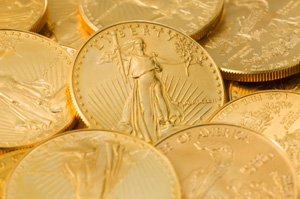
The 2011 Gold Eagles will go on sale April 21, 2011. The US Mint will offer individual product options for the 1 oz, 1/2 oz, 1/4 oz, and 1/10 oz coins, as well as a combined 4 Coin Set option. Each coin is struck in 22 karat gold, with the stated weight reflecting the gold content of each coin. The product limits established by the US Mint are shown below.

Product Product Limit
1 oz. Coin 30,000
1/2 oz. Coin 15,000
1/4 oz. Coin 16,000
1/10 oz. Coin 30,000
4 Coin Set 40,000

If the US Mint can achieve a full sell out of the stated product limits for each option, that would represent 118,500 troy ounces of gold. Through the first three months of the year, the US Mint has sold an average of just under 100,000 ounces of Gold Eagle bullion coins per month. Sales of the collector versions typically take place more slowly, since they are sold at a higher premium and marketed to collectors.

Prices will be determined based on the average London Fix gold price for the week prior to the release date. If gold remains within the current range, the 1 oz proof coin would be priced at $1,735.00, reflecting a premium of 16.68% over the market price of the gold content. The 1/2 oz, 1/4 oz, and 1/10 oz coins would cost $881.00, $453.00, and $195.50, respectively. The 4 coin set would cost $3,215.50.

Smart Money Sees the Perfect Storm for Gold and Silver Prices

A broad sell off in commodity prices triggered by a Goldman Sachs prediction of a “substantial pullback” in oil prices had little impact on the strong uptrend in gold and silver prices. Based on the London closing PM Fix Price, gold ended Tuesday off only $19 or 1.3% from Friday’s all time close. Silver, meanwhile, the absolute star of the precious metals group, closed Tuesday at $40.44, up 22 cents from Friday’s 31 year closing high. After the recent huge run up in both gold and silver prices, the very modest price declines suggests that the bulls are on the right side of the trade.
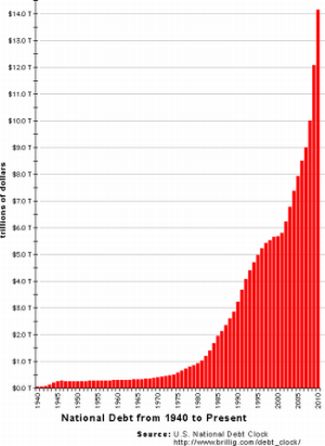
Every bull market has corrections and precious metals will not be an exception. The point to remember is that the U.S. has already passed the point of no return on its inevitable journey to a debt crisis.  The mainstream press focuses on the looming battle in Washington over raising the nation’s legal debt limit past $14.2 trillion, yet there is little discussion of the U.S. Government’s total unfunded liabilities of $75 trillion based on open ended entitlement programs.   The U.S. is in a debt trap from which a painless escape is impossible.

While the majority of Americans don’t know or don’t care about the spiraling debt disaster facing the Nation, smart money is taking steps to survive and profit from the inevitable day of reckoning.

One of the largest bond investors in the world who has a superb investment track record proclaims that U.S. debt securities have “little value.” In recent remarks, Bill Gross of Pimco candidly states his view on how the U.S. debt crisis will soon end. Mr. Gross states that Pimco has sold all holdings of U.S. debt because “they have little value within the context of a $75 trillion total debt burden. Unless entitlements are substantially reformed, I am confident that this country will default on its debt; not in conventional ways, but by picking the pocket of savers via a combination of less observable, yet historically verifiable policies – inflation, currency devaluation and low to negative real interest rates.”

The smart money sees the future.  One logical investment alternative to preserving wealth is in the timeless currencies of gold and silver that governments cannot devalue.

The recent sorry spectacle in Washington only affirms that elected leaders are incapable of preventing an eventual U.S. default (see Why There Is No Upside Limit To Gold and Silver Prices).  After scaring half of the old ladies in the country that they wouldn’t get their next social security check, both political parties declared victory after “reducing spending” by $38 billion – a fraction of a percent of total government spending.  Even worse, the Washington Post reports that many of the “spending cuts” are accounting gimmicks and budget tricks that will not reduce overall spending.

The great “achievement” of Congress becomes even more pathetic after considering that the national debt has expanded by $3 trillion in the past two years and projected budgeted spending will add almost another $10 trillion in debt over the next 10 years.  These horrendous projections assume a growing economy and no major adverse macro economic shocks.

Massive  levels of debt and spending commitments leave the U.S. with two ruinous policy choices.  Congress can cut spending dramatically and watch the economy collapse after which the Government would re-institute massive spending programs and quantitative easing on an unimaginable scale.  The second choice is the odds on favorite – continue the parabolic increase in spending and money printing and watch the economy implode as all bond investors (not just Bill Gross) refuse to purchase worthless treasury debt leaving the U.S. unable to meet its obligations. Either way, the inescapable dilemma that the Nation faces has created the perfect storm for gold and silver.

Ron Paul Links Bullion Coin Shortage To Horrendous Currency Debasement

Rep. Ron Paul, during a Subcommittee hearing on problems at the US Mint, linked the shortage of gold and silver coins to the “huge debasement” of the United States currency.

The remarks came during a hearing by the House Financial Services Subcommittee on Domestic Monetary Policy, entitled “Bullion Coin Programs of the United States Mint: Can They Be Improved?”  Four different coin and previous metals industry experts provided testimony on how to address ongoing problems with coin production and shortages.

After some lengthy discussion by witnesses and committee members regarding shortages of silver coin blanks and marketing and production problems at the US Mint, Rep. Paul focused on what he considered to be the primary reason why the US Mint was, at times, unable to meet public demand for gold and silver coins.

Listed below are highlights of Rep. Paul’s remarks at the Subcommittee hearing.

  1. It is “imperative” that the US Mint should be able to produce an adequate supply of coins to the U.S. public.  According to Rep. Paul, investors are rushing to purchase gold and silver due to quantitative easing by the Federal Reserve.
  2. The US Mint should take the appropriate steps to source enough planchets to meet public demand for gold and silver coins.  People are worried, stated Rep. Paul, and are trying to preserve their wealth through the purchase of gold and silver due to government policies that will lead to inflation and debasement of the currency.  Rep. Paul stated that “If we had a sound currency” there would not be a shortage of gold and silver coins since demand by the public would be a non event.
  3. Rep. Paul detailed the “horrendous huge debasement” that has occurred with the US currency.  In the early 1930’s, when gold was on a fixed exchange rate with the US dollar, the dollar was worth 1/20 ounce of gold.  It was subsequently devalued to 1/35 ounce of gold during the 1940’s, to 1/38 ounce of gold in the early 1970’s and to 1/42 in 1973.  Once it became legal for US citizens to own gold and the dollar was based on market prices, the value of one dollar subsequently dropped to 1/1450 ounce of gold.
  4. Rep. Paul noted that total annual demand during 2011 for Silver Eagle bullion coins should reach 48 million ounces, but that total US silver production would amount to only 40 million ounces.  The US Mint should take all necessary steps to ensure that adequate supplies of silver are available to meet public demand for silver coins.

Although not specifically addressed, the issue of whether the US government is making an effort to limit the sale of gold and silver coin to the public remains an open question.  By law, the US Mint is required to produce coins “in quantities and qualities that the Secretary determines are sufficient to meet public demand”.  There were no US Mint representatives present at the Subcommittee hearing to explain why the US Mint is unable to comply with production mandates specified by law.

Silver Price Above $40 and Gold Hits New All Time High in Overseas Trading

Gold soared to new all time highs in Asian markets and silver pierced the $40 per ounce level as new demand continues to drive precious metal prices higher.
The world spot price of gold hit an all time high of $1,470.80 up $12.40 and silver pierced the psychological $40 level, reaching $40.23 per ounce.  Platinum and palladium were also both up over 1% to $1,808 and $794, respectively.

Precious metal buyers had numerous reasons to be bullish including skyrocketing oil and food prices, the worsening situation with the European debt crisis, continuing conflicts in major oil producing countries and the ugly specter of a government shutdown in the U.S. due to the inability of Congress to come to grips with an exploding deficit and looming debt crisis (see Budget Fiasco Sends Wrong Message To U.S. Creditors).

Gold has now risen by over $31 per ounce this week and by $50 since March 28, breaking through resistance at the $1,450 level. Investors are seeking to protect their wealth from inflation and the continuing debasement of paper currencies as nation after nation continues to run huge deficits in an attempt to revive weak economies.  A glimpse of the end game to massive government deficits and liabilities is currently on display in Washington and the message is a resounding endorsement for diversifying out of paper money.  Politicians will not cut spending for a large variety of reasons, calling into question the future solvency of numerous sovereigns worldwide.

Silver has now advanced a spectacular $9.33 or 30% since the beginning of the year and shows no sign of slowing down.  According to the Silver Institute, world investment demand for silver skyrocketed by 40% during 2010 and was the primary reason for the huge 78% increase in silver prices last year.  Total fabrication demand, which accounted for 83% of silver demand last year,  increased by almost 13% despite the large rise in silver prices.

The looming global debt crisis and the printing of money has lead to surging investor demand for real assets.  Since late last summer when the Federal Reserve initiated its latest money printing campaign, the price of raw material prices as represented by the S&P GSCI Spot Index has soared by 35%.

Gold and Silver Prices Soar As Budget Fiasco Sends Wrong Message To U.S. Creditors

Gold and silver prices rose to new highs today on continuing concerns over a weak U.S. dollar, the European debt crisis, growing conflicts in the MidEast and escalating doubts over the ability of the United States to avoid a debt crisis.  The ongoing budget charade in Washington makes it perfectly clear that neither political party has the desire or ability to seriously address the exploding level of U.S. debt.
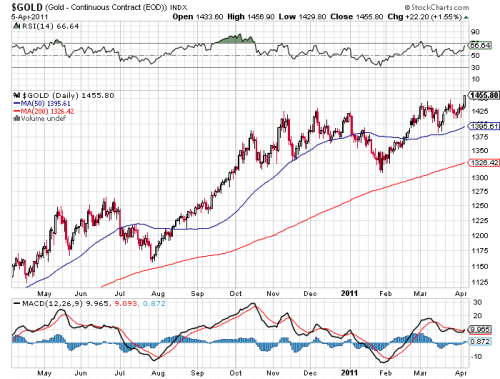
Gold hit a new all time high of $1463.70 and silver reached a 31 year high at $39.79.  Prices of both metals eased in early afternoon trading with the New York Spot Price for gold at $1456.70 and silver down fractionally at $39.33.  The limit on future increases in precious metals prices has effectively been removed due to the absolute inability of Congress to address the looming debt crisis.

GOLD - COURTESY STOCKCHARTS.COM

With the United States facing a $1.5 trillion dollar deficit on a projected budget of $3.6 trillion, politicians are threatening to shut down the Government over their inability to agree on whether spending should be cut by $40 or $60 billion.  Does anyone really believe that Congress is capable of coming to terms with the reality of an exploding deficit and spiraling national debt when agreement cannot be reached on $20 billion – a mere one half of one percent of total government spending?

The surge in gold prices reflects the realization that the nation is on the fast track to higher interest rates, a spiraling increase in the cost of living and a continued debasement of the U.S. dollar (see Why There Is No Upside Limit To Gold and Silver Prices).

Meanwhile, as the threat of a Government shutdown looms, Treasury Secretary Geithner warned of dire consequences if the U.S. is not allowed to borrow more money by raising the debt ceiling above its current limit of $14.3 trillion.  At a meeting with a Senate Appropriations subcommittee Secretary Geithner forecast that a U.S. default would lead to much higher interest rates, the failure of hundreds of thousands of businesses, payment cuts to senior citizens and a financial crisis worse than that of 2008 – 2009.

Geithner’s prediction of Armageddon, unfortunately, comes with no prescription on how to reign in out of control Government financial policies which are the fundamental threat to the country’s economic future.  It’s not just this year’s or last year’s multi trillion dollar deficits that are the root of concern, but rather the massive long term structural deficits that are now built into Government spending budgets.

The debt limit will eventually be raised and both political parties will claim victory.  America’s creditors will ponder the increasing risk of U.S. Treasury debt and ultimately conclude that the U.S. has no will to fix a financial system on the brink of insolvency.  The ultimate day of financial Armageddon, alluded to by Secretary Geithner, will not be forestalled by our unworkable political process.  The final reckoning and hard choices will be made only when forced upon us by markets that refuse to finance additional U.S. borrowing.