April 15, 2026

Gold Featured on Magazine Cover- Should We Be Worried?

There is a body of empirical evidence suggesting that once a particular investment category is featured on the cover of a popular magazine, a major trend change is imminent.

This theory, know as the “Magazine Cover Indicator” was first documented by Paul McRae Montgomery, a strategist at Legg Mason.  According to Mr. Montgomery, “The great value of popular magazine covers is they indicate the extent to which awareness of fundamental factors is widely shared, and therefore are unable to move prices significantly further”.

The Magazine Cover Indicator has been dismissed for being overly simplistic.  Nonetheless, Mr. Montgomery’s research shows that after a financial trend is featured on the cover of a widely distributed magazine, there is a high likelihood of a major trend reversal.  The focus of Mr. Montgomery’s research was Time Magazine cover stories going back to 1914.  When  a specific financial investment was the cover feature, within a year and up to 80% of the time, the trend featured on Time’s cover had reversed and sometimes in a dramatic fashion.

One of the all time great clarion calls for investors was the now infamous BusinessWeek cover story headlined “The Death of Equities” in August, 1979, just prior to the greatest bull market for stocks in history.  According to Montgomery, the indicator has resulted in profits for him and his clients, stating that “It has worked surprisingly well, but people don’t take it seriously.  I actually move money based on it, but I don’t think many other people do”.

Given the research cited above, should we be worried about this week’s magazine cover story by SmartMoney entitled “The Power of Gold”?

Despite the apparently bullish title, after reading “The Power of Gold”, one gets the distinct impression that the article is bearish on the yellow metal.  Investors are portrayed as beset by doubts about owning gold and worried that they will be regarded as “crackpots” if they disclose their predilection for gold ownership.  If the article had been rampantly bullish, it would have quoted gold investors bragging about their investment acumen and predicting further huge price gains.  A bullish article would have also featured photos of small time “joe six pack investors” lined up outside of bullion dealers, desperately clutching handfuls of dollars to convert into gold.  We are not even close to classic signs of a top in the gold market.

SmartMoney notes that “people are buying gold in record amounts, but in many cases they don’t really feel good about it…Others fear that they’ll be targets for robberies or scams, or be branded as crackpots by their friends and neighbors”.  Although SmartMoney mentions the huge growth of the SPDR Gold Shares Trust (GLD), ownership of gold by Americans is still small, representing only one-eighth of all bullion and coins in the world.

SmartMoney also plays down any further upside movement in gold stating that “Of course, a further price surge isn’t inevitable or even, in the eyes of some professional investors, probable.”

The “Magazine Cover Indicator” in this case represents a solid buy signal for gold based on SmartMoney’s bearish article.

Whether one believes in the “power of magazine covers” or not, the fundamental reason for owning gold remains intact – preserving the purchasing power of accumulated wealth.  The value of paper dollars is under ferocious assault by both the government and a financial system that must inflate to survive.

The only government response to the debt crisis has been to add more debt.  The Government budget proposal for fiscal 2012 has the United States borrowing almost half of the entire amount to be spent next year.  The proposed budget requires deficit financing by the United States of an unimaginable $1.65 trillion, or 44% of proposed spending of $3.73 trillion.  Even more disconcerting, a large proportion of the deficit will be funded by the Federal Reserve creating dollars via “quantitative easing”.

Governmental, private and corporate indebtedness has reached levels that make repayment mathematically impossible.  Deflation and debt collapse is not an option being entertained by the government nor is it an option that most Americans would select over inflation.   The nation needs inflation to prevent a level of defaults that would make the Great Depression look like a minor recession.  When this dark reality becomes obvious, gold will have no upside limit.
Gold’s Role in India’s Inflation Battle

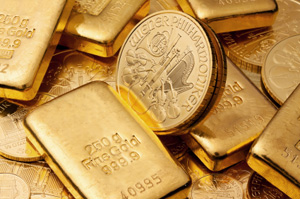
In India, the problem with inflation shows most clearly when you examine the country’s current level of gold trade and importation. Shipments have increased to 800 metric tons from 557 tons in the last year. That is an all time high and forecasts say that the number is still rising.
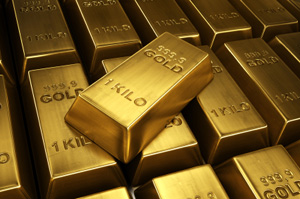
The purchase of all this gold shows clearly the concerns that investors have regarding the local economy and the central bank’s battle with inflation.

Why Buy Gold?

“Gold is being used as a store of value to protect against never ending inflation,” according to the head of fixed income at Canara Robeco Asset Management Ltd., Ritesh Jain.

It makes sense, since in India gold is historically and culturally tied to the concepts of wealth and prosperity. Investors are used to buying into gold either as a physical asset or on the exchange market where gold can be purchased and traded without ever taking physical possession. And while the value of gold has climbed in India—the value of the rupee and of the bonds that support the central bank have not done nearly as well.

The Inflation Situation

In the last year alone, more investment dollars flowed out of India’s economy than in. Global funds sold $250 million more shares in Indian companies than they bought. Meanwhile, inflation has been on the rise, such that food prices have risen by 18.3% in the final weeks of 2010.Citizens and politicians alike are calling for actions to be taken to curb this inflation—all the while investing in more and more gold.

China’s Emerging Influence in the Gold Market

China and its people have a long held interest in the gold market. The country’s history has been marked by periods of unrest, and its people have regularly chosen to heed history’s warnings when it comes to investment. Their general preference has been for investments that they perceive as safe and solid, as opposed to paper instruments. Thus, their top two investment choices are gold and real estate.

During the course of 2010, China’s gold imports grew nearly 500 percent. What is most surprising is that we have this information at all. Normally China is quite secretive about their gold investments and imports.

China Comes Out

Further information on the Chinese gold market reveals that turnover on the Shanghai Gold Exchanges for the first three quarters of 2010 exceeded total global identifiable demand. The number of individual customers on the exchange neared 1.6 million.

When you also consider the fact that China is the world’s top gold producer and the recent joint announcement of ministry promotion of the gold market—its easy to see why China is considered to be a force to be reckoned with in the 2011 gold investment market.

Searching for Gold

The gloves are finally off after all. China has announced its first gold mutual fund and investment demand in the country is increasing from both individual and governmental sources. The country has positively connected their future development of the gold market to the competitiveness of financial markets and made it known to the world that they don’t plan to keep their movements quiet anymore.

Sensible investors and analysts are taking China’s actions into account when trying to predict the movements of the gold market for the coming year. After all, no one wants to ignore one of the biggest players in the room.

Are Investors Abandoning Gold?

The Associated Press reported that gold and silver are responding to an improved U.S. economy by losing ground in the investment market. Since the start of the year, gold has dropped nearly $50 per ounce, measuring a decline of about 3.5% while silver has fallen by $2.31 per ounce, or 7.5%.

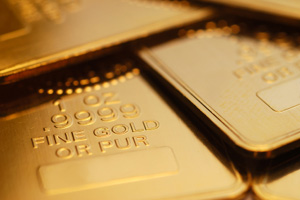
Some experts are responding by beginning to question the continued duration of the record interest in gold and other precious metals. They’re looking for signs that the bubble might pop in the face of predictions about gold’s strength.

Looking at Safety?

In their article, the Associated Press looks at gold and silver prices and suggests that as a consequence of the potential comeback in the U.S. economy, investors are willing to risk abandoning safe haven investments in order to seek out something a little more risky.

During the recent years of economic uncertainty, many investors responded by moving their funds into precious metals like gold and silver. Now that things are looking up, investors are reconsidering that choice in order to seek out more lucrative investment opportunities.

Looking to the Future

It is only the third week of 2011, however, so it remains to be seen whether this movement is real or perceived. No doubt, the state of the economy will give us some hints.

After a decade of stellar performance for gold, we may need to reassess based on the changes in the world economy, if not the production levels of the metal itself. In the meantime, however, gold will remain the commodity to watch and enjoy among investors everywhere.

Brazilian Gold Mine Robbed

It seems that the current interest in physically backed gold is not limited to investment markets. Last week, it was  reported that a British Colombian gold firm was the victim of an armed robbery. The company in question was the Luna Gold Corp, and their Aurizona Mine in Brazil was attacked early Wednesday morning. The robbery did not result in any employee injuries, but approximately 1,500 ounces–$2 million worth—of gold were successful stolen.

The Target

The Luna Gold Corp identifies itself as a “gold mining and exploration company engaged in the exploration and development of gold deposits and advanced stage gold exploration projects in Brazil.” Currently, their attention is focused on the site that was robbed—the Aurizona gold mine. This mine is only in its initial stages of production and the company anticipates an eventual annual production of 60,000 ounces a year.

The surrounding areas are believed to be home to other major gold deposits as well, but that is highly speculative at the moment. Unfortunately, the mine is also relatively isolated—located as it is between the two cities of Sao Luis and Belem in Maranhao state.

The Fallout

That isolation rendered the facility vulnerable to the robbers, who gained access to the site and escaped without being caught. More importantly, they escaped without harming anyone.

The company’s statement touched upon this and other fallout from the event, saying “The safety and welfare of our employees is our highest priority and we will ensure that those involved receive appropriate support and counseling. Theft in this manner is disturbing and regrettable. The company is co-operating with authorities and will update the market when information becomes available.”

As for the loss, Luna Gold Corp will be filing a claim with insurance while the Maranhao Police continue to investigate the incident.

Looking for a Top in Gold

Investors and analysts alike are looking at the record prices of gold last year and trying to predict the future. Last year the price of gold rose by more than 27%, contributing to an increase of more than 400% over the past decade.
Another year of double digit gains in the gold price has many experts considering whether prices will continue their upward trajectory, or whether there are warning signs for a potential top. The predictions are as varied as their sources:

  1. According to Goldman Sachs, gold will top in 2012 at $1,750 an ounce.
  2. John Nadler at Kitco.com predicts that gold will cap by the end of 2011.
  3. The CEO of U.S. Gold, Rob McEwen believes that the market is “a third of the way” to a mania.
  4. Jim Rodgers estimates that the long bull market in gold will result in a huge bubble for the commodities market as a whole—and he thinks we’re halfway there already.
  5. Scott Redler at T3Live.com predicts that if the price gap is truly filled, gold will stay range bound between $1,320 and $1,400 for a time before mustering up a bigger rally.

Everyone is eying the market and trying to decide what it is going to do next so that they can react accordingly. Surprisingly though, most investors do not own their own gold and have never owned it.

According to The Street, you’re much more likely to see people selling gold than buying it. Still, the media excitement about gold prices, not to mention the prices themselves, is generating new investors. The SPDR Gold Shares added 155 tons this year, for example. Longtime investors are waiting for the day when everyone jumps on the bandwagon, resulting in the gold bubble they’re currently trying to predict.

US Mint Sells 1,429,500 Ounces of Gold Bullion During 2010

The United States Mint sold less gold bullion during 2010 than the previous year, as measured in ounces. Across their offerings of American Gold Buffalo and American Gold Eagle bullion coins, sales reached 1,429,500 in the current year compared to 1,625,000 in the prior year.
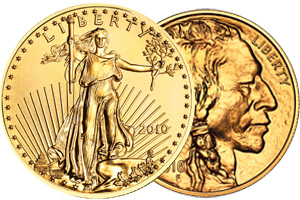
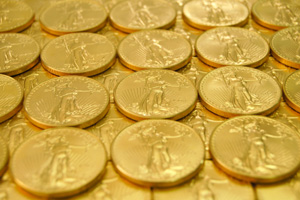
The American Gold Buffalo is struck in one ounce of 24 karat (.9999 fine) gold and carries James Earle Fraser’s classic design from the Buffalo Nickel. The 2010-dated coins were first available on April 29, 2010 and remained available for ordering by authorized purchasers until late September 2010.

The American Gold Eagles are struck in a composition of 22 karat ( .9167 fine) gold and carry the obverse design of Augustus Saint Gaudens’ classic double eagle. A range of weights are available to provide greater investment flexibility. The one ounce 2010 Gold Eagle went on sale January 19, 2010, with the one-half ounce, one-quarter ounce, and one-tenth ounce size coins on sale June 10. The coins remained on sale through the end of the year.

For the calendar year, the US Mint sold the following quantities of gold bullion coins:

Coins Total oz.
American Gold Eagle 1 oz 1,143,000 1,143,000
American Gold Eagle 1/2 oz 46,000 23,000
American Gold Eagle 1/4 oz 62,000 15,500
American Gold Eagle 1/10 oz 390,000 39,000
American Gold Buffalo 1 oz 209,000 209,000
Total 1,429,500

The drop in total ounces sold from the prior year is 195,500, representing a decline of about 12%.

Despite the drop in ounces sold, there was likely an increase for the year based on total dollar sales due to the higher price of gold. For 2010, the price of gold was up more than 27%.

Authorized purchasers are allowed to order gold bullion coins directly from the US Mint in minimum quantities of 1,000 ounces. The price paid is based on the London PM Gold Fix price following the day of order.

Gold and Silver: Investment Differences

Gold just had an amazing year, in which it reached a new all time high, rising about 25%. Silver provided an even more stellar performance, with a gain of about 75% and counting. It’s no wonder then, that more and more investors are becoming interested in the potential offered by silver.
One of the most pronounced differences between gold and silver is the price per ounce. Gold is currently around $1,400 per ounce, while silver is at $30. The difference has not always been so large.

The gold-silver ratio, or the number of ounces of silver it takes to buy one ounce of gold, is currently around 47:1. Historically, this ratio has been around 16:1, which closely corresponds to the ratio of gold to silver within the earth’s crust. Thus on an absolute basis, the difference in price is justified, but not to such a degree as current prices have suggest.

Another key difference between gold and silver is the price volatility. While gold has enjoyed a string of ten straight years of annual gains, silver’s price performance has not been as constant. Some years have been downright disastrous, such as the 27% drop silver experienced during 2008. From the start of the year to the low, silver had experienced a decline of nearly 40%. During 2008, gold had booked a 4.32% gain, with a maximum decline of 14.54% from the start of the year.

Finally, while gold and silver are both metals that store value, silver has been long served as an industrial metal. The recent case for gold demand has been as a hedge against inflation or a safe harbor from fiat currencies. Demand from these factors has offset declines in demand from gold jewelry, which has historically been the predominant source of demand. Silver, on the other hand, can serve in a dual capacity, with possible appreciation in value in times of both economic distress and prosperity.

Silver’s roles may be expanding once again, as it is starting to be utilized for its antibacterial qualities.

With an impressive year nearly in the books, the story for silver seems hardly over. Next year might be telling as to whether silver will continue to make progress in catching up with the historic ratios and start to challenge the label of “poor man’s gold.”

2011 American Gold Eagle Release Date

The United States Mint will begin accepting orders from authorized purchasers for 2011 Gold Eagle bullion coins on January 3, 2011. This will coincide with the start of sales for the 2011-dated Silver Eagles.

Initially, the US Mint will only offer the one ounce version of the 2011 Gold Eagle. Each year since 1986, fractional weight coins have also been offered to accommodate different investment levels and provide greater flexibility. Other sizes include one-half ounce, one-quarter ounce, and one-tenth ounce coins. For the past two years, the Mint has released the one ounce coins first, with the fractional versions offered later in the year.

American Gold Eagles feature Augustus Saint Gaudens’ design used for the $20 double eagle, minted from 1907 to 1933, on the obverse. This is paired with an image depicting a family of eagles on the reverse, designed by Miley Busiek. The composition of the Gold Eagle is 22 karat, or 91.67% purity. Each coin contains its stated weight in pure gold.

As with other bullion coins, the US Mint utilizes a network of authorized purchasers to distribute Gold Eagles to the public. There are six primary distributors who may purchase gold bullion directly from the Mint. The price paid is determined based on the London PM Gold Fix on the date following the order date, plus a premium of 3% (for one ounce coins). The minimum order quantity is 1,000 ounces.

The US Mint will continue to sell 2010 Gold Eagles to authorized purchasers as long as inventories remain. Any 2010-dated coins remaining on January 3, 2011 will be sold on a ratio basis to authorized purchasers who order 2011-dated coins.

Gold and Silver: Investment Similarities

Gold and silver just seem to go together. They’re two precious metals that we love to invest in, especially after the strong performance of the metals during 2011, and gold’s string of consecutive annual gains stretching back a decade.

This year, gold futures have grown as much as 25% this year and silver futures as much as 75%. It’s this last figure that really interests us though. It is indicative of growing investor interest in a metal that is much more affordable than gold, but still offers many of the same benefits in the precious metals market.

Gold and Silver Investment Options

The major similarities that we can point to are related to the various ways that gold and silver are sold and traded among investors. In most cases, a potential investor has a few different options:

  • They can invest in bullion coins
  • They can invest in numismatic coins
  • They can invest in exchange traded funds or ETFs

Gold and silver bullion coins are produced by a number of different world mints. A few of the most widely traded options include the American Silver Eagle from the United States Mint, the Silver Maple Leaf from the Royal Canadian Mint, and the Silver Philharmonic from the Austrian Mint. These coins are issued each year and are generally sold based on the market price of silver plus a mark up. The mark ups might be $2.50 to $4.00 per coin, depending on the quantity purchased.

Numismatic gold and silver coins are those which are valued not only based on their intrinsic value, but also their rarity and condition. In some cases, a rise in the price of precious metals might not result in an increase in value for numismatic coins since other factors come into play. It takes some understanding of the coin market and grading scales to invest in numismatic coins.

For many beginning investors, Exchange Traded Funds provide a useful alternative. Precious metals ETFs are traded on stock exchanges in the same manner as stocks and generally track the price of the underlying metals. There are different types of ETFs, which use either physical metal or futures and contracts to track the price of the underlying metal. The largest and widely held precious metals ETFs are the SPDR Gold Shares ETF (GLD) and the iShares Silver Turst (SLV).