April 15, 2026

Why There Is No Upside Limit for Gold and Silver Prices

The past decade has seen a virtually nonstop advance in the price of gold.  Silver, which lagged gold until last year,  recently hit a 31 year price high.  Gold and silver, both used as currency for thousands of years, have gained broad investor appeal as a hedge against paper currencies.

The increase in the value of gold and silver is due to the fiscal and monetary policies of nations struggling to deal with massive levels of debt – policies that virtually guarantee a continued rise in the price of gold and silver.

Central banks, having exhausted all conventional means of monetary easing, have moved on to the last resort option of quantitative easing and currency debasement.  Federal Reserve Chairman Bernanke has twice resorted to the printing presses, and then shamelessly explained the “virtues” of his money printing policy (in convoluted terms) to a gullible public on national television.  The subsequent absence of broad public opposition to a policy that is certain to ultimately destroy the financial well being of most Americans seems based on ignorance and/or indifference.

One American who is not ignorant or indifferent to the Fed’s policy of printing money issued a dire warning this week on the dangerous path the Federal Reserve has taken.  The reason we should all pay great attention to this warning is because it was issued by a powerful policy maker at the Federal Reserve.

According to Reuters, Richard Fisher, President of the Dallas Federal Reserve stated in a speech that the debt situation in the U.S. is at a “tipping point.” He is quoted as saying, “If we continue down on the path on which the fiscal authorities put us, we will become insolvent.  The question is when”.   Bank President Fisher further said that no additional extraordinary measures should be taken when the current round of money printing ends in June of this year.

We shall see what happens comes mid year when QE2 is scheduled to end.  The problem facing the Fed is that they are out of conventional policy bullets to ease credit conditions with rates already at zero.  The ease and apparent lack of consequences in printing money has made additional quantitative easing a very seductive method of  allowing huge deficit spending by the government.  QE2 is a thinly disguised monetization of the Federal deficit in which the Federal Reserve purchases government debt from the primary dealers after they purchase the debt at Treasury auctions.

Government officials argue that unprecedented deficit spending and quantitative easing are necessary to stimulate economic  growth, but this theory has not worked in the real world.  Despite trillions in stimulus spending,  job creation and economic growth have been extremely weak and are likely to remain so according to economists Kenneth Rogoff and Carmen Reinhart who wrote This Time Is Different: Eight Centuries of Financial Folly.  According to Rogoff and Reinhart, economic growth is subpar when public sector debt exceeds 90% of GPD which the U.S. and many other developed nations have already surpassed.  In addition, a recovery of the job and housing markets after a financial crisis take many years due to the burden of excessive levels of debt.  Ultimately, Rogoff and Reinhart predict that austerity measures will need to be imposed along with some type of debt restructuring.

Is the U.S. capable of reducing spending and  instituting austerity measures? Cutting deficits means cutting payments to a long list of incomeless recipients who really don’t care where the entitlement money comes from.  Those still actually paying taxes will object strongly to any proposed tax increase to fund government spending.  Unable to cut spending or raise taxes leaves the Government with one bad option – print more money.

Politicians, who value getting elected above all else, are likely to strong arm the reliably compliant Federal Reserve Chairman Ben Bernanke to “come to the rescue” again with QE3.   In the minds of politicians and Federal Reserve officials, there will always be very compelling reasons to continue borrowing and money printing.  With the expected retirement of Federal Reserve Bank of Kansas President Thomas Hoenig this October, the Federal Reserve will be dominated by dovish members who favor the easy money policies of Fed Chairman Bernanke.  President Hoenig is one of the few Fed members who oppose continued zero interest rates and quantitative easing.

The correlation between parabolic increases in government debt and the price of gold is clear.   Since 2000 both government borrowing and the price of gold have been closely correlated as seen below.  The increased value of gold directly reflects the decreasing value of paper money.

A nation that has reached the limits on taxation and borrowing has few viable policy options other than a continuing series of quantitative easing programs.  Current government policies, if left unchanged, virtually guarantee a continued increase in the price of precious metals.
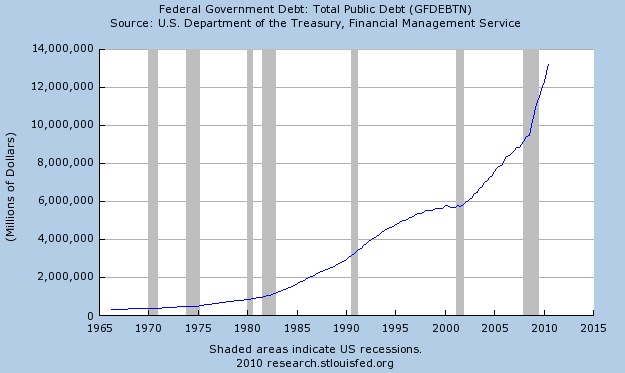
TOTAL PUBLIC DEBT
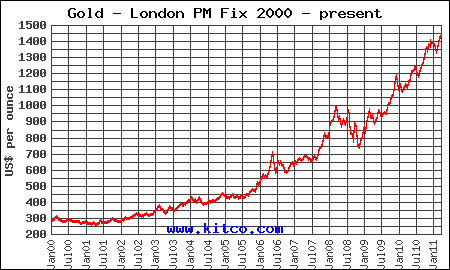
GOLD PRICE - COURTESY KITCO.COM
Should I Buy Gold Bullion or Gold Trust Shares?

Gold trusts have probably been a decisive factor in promoting the ownership of gold and expanding the market to investors who would otherwise not participate in the market. Prior to the establishment of the gold trusts, investors had two primary options for investing in gold, both of which had drawbacks. Gold investors could purchase the shares of gold mining companies or physically purchase gold coins or bars.

The problem with investing in gold stocks or gold mutual funds is that the investment returns may under perform the appreciation in gold bullion. Many gold stocks have vastly underperformed the price appreciation of gold bullion due to company specific issues such as ore depletion, foreign expropriation, environmental problems or financial difficulties relating to the huge cost of mine exploration, development and production. Picking the right gold stock was often difficult.

Physically purchasing gold coins or bullion presents another wide array of problems and costs. Finding a conveniently located and reputable gold bullion dealer takes time and usually entails a trip to the dealer for every transaction consummated. Liquidity is an issue as well since the physical gold would have to be physically transported or shipped to a dealer prior to receiving sales proceeds. Transactions costs on each side of the trade can easily exceed 5%.  Physically holding gold is expensive due to security, storage, transportation and insurance costs.   Gold coins or bullion can also be lost or stolen, the ultimate nightmare for an investor.

Investment in gold share trusts eliminates all of the problems associated with stock selection and physically holding gold. Shares representing an interest in gold can be sold at any time throughout the trading day at market prices.   Investor ownership of gold trust shares represents an undivided, fractional interest in physical gold held by the trust.

Gold share trusts have become extremely popular with investors due to the advantages of owning gold via gold trust shares.  Investors have poured over $57 billion into two of the largest gold share trusts, the SPDR Gold Shares Trust (GLD) and the Sprott Physical Gold Trust (PHYS).

As gold prices continue to increase, the gold share trusts are likely to be the investment of choice for many investors seeking to establish or increase an investment in gold.

Gold Price Hits All Time High, Silver At 31 Year High

The price of gold hit an all time highs for the second day in a row, while silver prices moved up to a new 31 year high.

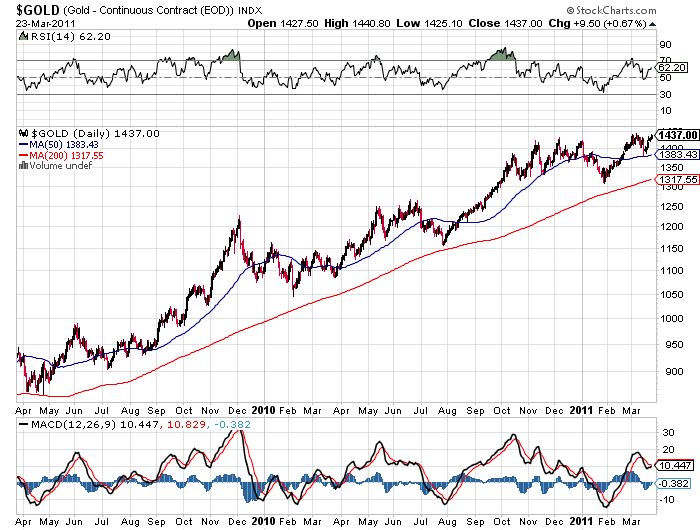
As measured by the closing London P.M. Fix Price, gold reached an all time high of  $1,447.00 up from yesterday’s all time high of $1,439.50.  The previous record London Fix Price was $1,437.50 on March 7th.   The all time record high intraday price of gold was also reached on March 7th at $1,444.95.  Earlier in the day, Comex gold futures had hit an all time high of $1,448.60 before a pull back erased the day’s gains.  In late afternoon trading the bid on New York spot gold was $1,431.30.

Silver futures scored another new 31 year high at $38.18 before sliding to $37.45 in New York spot trading.   The closing London P.M. Fix Price for silver was $37.78.

GOLD - COURTESY STOCKCHARTS.COM

In 2010, the price of gold advanced by 30% as investors grew increasing nervous about the value of paper currencies and the increasing threat of inflation.  The U.S. Federal Reserve policy of printing money to fund government deficits sets a horrendous precedence and it appears that other central banks will soon be conducting their own versions of quantitative easing.

The European Central Bank is struggling to prevent numerous sovereign defaults in an effort to preserve the European Union and monetization of the debt seems to be the only feasible “solution”.   Japan, the most heavily indebted developed nation in the world, needs hundreds of billions of dollars for reconstruction after a devastating earthquake and the printing press seems to be their only option.

Reflecting on the fiscal and monetary policies being conducted by the U.S. Government, Warren Buffet stated that “We’re following policies that will lead to a lot of inflation down the road unless changes are made.  The U.S. can’t run the kind of deficits we’re running and other policies without it being enormously inflationary”.

Unfortunately, intelligent changes are not being made and the ruinous policies of central banks seems likely to continue at an accelerated rate.  Gold has broken out to new highs and should see significant price gains in 2011.

Sprott Physical Gold Trust (PHYS) Advantages Over SPDR Gold Shares Trust (GLD)

Investors seeking to increase or establish positions in the gold market have been pouring money into gold trusts. The largest gold trust is the SPDR Gold Trust Shares (GLD) which, since its launch in November 2004, has seen huge investor demand. The GLD currently holds over 39 million ounces of gold valued at $55.5 billion.
The Sprott Physical Gold Trust (PHYS), which began trading on the New York Stock Exchange in late February 2010, is similar to the SPDR Gold Trust Shares in that the investor owns an undivided, fractional interest in gold held by the trust. The PHYS, however, has some major differences from the GLD which may result in an investor preference for PHYS.

As detailed below, the advantages of the PHYS over the GLD are a much lower tax rate on gains and government custody of the physical gold backing the PHYS.

PHYS is not an exchange traded fund (ETF) but rather a closed-end mutual fund trust which means that the physical gold holdings and investor units outstanding do not change.  The PHYS holdings remain constant based on the initial trust offering.  The PHYS holds over 820,000 ounces of gold valued at $1.18 billion.

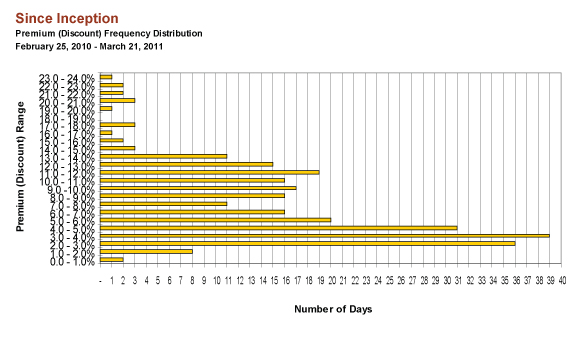
As with any closed end fund, the net asset value of the PHYS can trade at a discount or premium to the market value of gold held by the trust.   Since its creation, the PHYS has consistently traded at a premium to its net asset value.  The premium has at times reached a substantial 24%.  To avoid paying an excessive premium, potential investors in PHYS should compare the net asset value to the purchase cost of PHYS.

PHYS Premium to net asset value - source: Sprott Gold Trust

The premium paid by an investor to own the PHYS is based on two major factors –  very favorable tax treatment and extremely secure custody holding  of the physical gold that backs the PHYS as explained below.

Discounts or premiums to net asset values also occur with the GLD ETF, based on investor supply and demand during the course of daily trading.  Premiums or discounts on the GLD, however, are extremely small, typically ranging only plus or minus 0.5%.  The very small discount or premium on the GLD is due to the complex manner in which the fund is structured.

The GLD has a complex mechanism by which shares can be “created or redeemed” by the GLD Trust via Authorized Participants.  Authorized Participants are large Wall Street investment firms that profit by arbitraging against a premium or discount to the GLD.  The transactions of the Authorized Participants can result in significant changes in gold holdings by the GLD .  The SPDR Gold Trust was structured in this manner so that the price of the GLD would closely correspond to the underlying price movements in gold.

The PHYS holds 99.5% of its assets in physical gold bullion stored at the Royal Canadian Mint in Ottawa, Canada.  The gold backing the PHYS is specifically allocated by the Royal Mint to PHYS.  The Trust does not invest in gold certificates or other paper instruments.  The Royal Canadian Mint of the Canadian Government is responsible for any loss or damage to the bullion held for the PHYS and the gold bullion is subject to annual audits.

The custodian for the gold held by the SPDR Gold Trust (GLD) is HSBC Bank in London. The GLD prospectus notes that the gold held by the Trust is specifically allocated to GLD and that the allocated gold bars “are not a part of the bankrupt’s estate in the event of the bankruptcy of the Custodian”.  In addition, the gold bars allocated to the GLD are identified by number and updated everyday.  After witnessing the failure of very large banks in 2008, investors may be more secure with a Government custodian.

A very significant advantage of the PHYS according to Sprott Asset Management is that investors holding units for more than one year are only taxed at the capital gains rate of 15% compared to a 28% tax rate on gold ETFs and physical gold coins. The gold held by investors in the GLD ETF is considered to be “collectibles” by the IRS and thus taxed at a higher 28% rate.

The prospectus for the PHYS discloses that the fund does have a physical redemption feature that is exercisable on the 15th of each month and processed at the end of the month, a setup which is designed to discourage redemptions. Given the inconvenience, cost and delays involved in redeeming units for physical gold, the Trust expects that most investors will chose to sell their units rather than redeem them for gold bullion.

The reason why the Sprott Physical Gold Trust discourages redemptions is due to the fact that a redemption would be considered a sale of gold by the Trust for tax purposes and thus be taxed at 28%. The taxes paid by the Trust would be passed on to shareholders who would then be liable for taxes above the 15% capital gain rate based on their pro rata share of the gain. Sprott Management believes that it is highly unlikely that any investors would chose redemption versus selling their units on the market.

In any event, even if a partial redemption of units occurred, the pro rata gains would still result in a tax rate significantly less than the 28% that applies to gains on the sale of an ETF. In the extremely unlikely event that all units were physically redeemed, an investor’s tax rate would still be no higher than the 28% rate that applies to an ETF.

Long term ownership of the PHYS in a non tax deferred account thus conveys significant tax advantages over an ETF.  Net investment gains on the PHYS could result in a 13% higher return than an equivalent investment in a gold ETF.  Investors should consult with their tax expert and read the PHYS prospectus before investing.

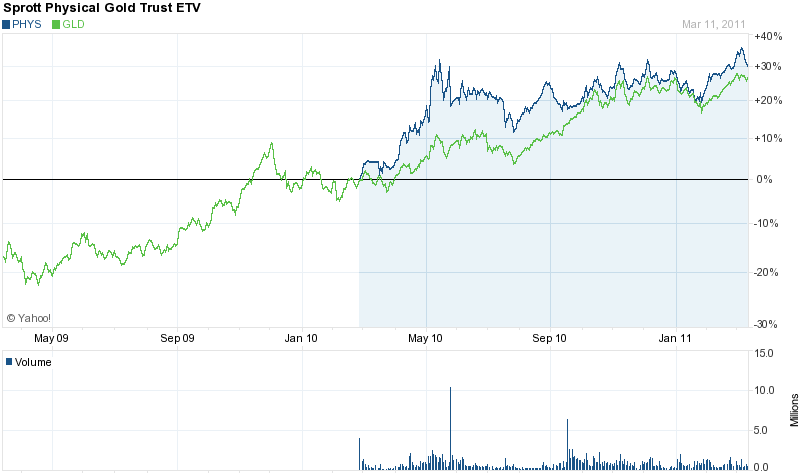
Since its inception, the PHYS has had a higher return than the GLD.

PHYS VS GLD

The PHYS fund is managed by Sprott Asset Management based in Toronto, Canada. Sprott offers hedge funds, mutual funds, fixed asset funds, limited partnerships and bullion focused funds. The holding company, Sprott, Inc. trades on the Toronto Stock Exchange under the symbol “SII”.


US Mint Begins 2011 Gold Buffalo Coin Sales

Earlier this week the United States Mint began sales of the 2011 American Gold Buffalo coins to their network of authorized purchasers. So far, sales are off to somewhat of a tepid start compared to the high initial demand experienced in recent years.

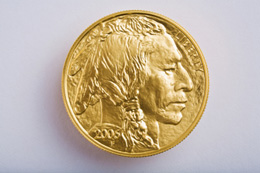
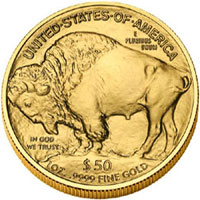
The American Gold Buffalo is a one ounce 24 karat gold coin that has been issued since 2006. Featuring the classic Buffalo Nickel design created by James Earle Fraser, it has enjoyed popularity with both bullion investors and collectors. The US Mint has offered a bullion version of the coin, which is sold to authorized purchasers based on the market price of gold plus a premium, and various collector versions, which are sold to directly by the Mint at higher premiums.

The bullion versions of the coin have not been available since late September, when inventories of the 2010-dated coins became depleted. Prior to the start of sales for the 2011-dated coins on March 14, 2011, the US Mint indicated that they would have a sufficient quantity of the coins to meet public demand. As such, their allocation program, which serves to ration available supplies, would not be necessary. The authorized purchasers were allowed to order unrestricted quantities of the coins, under the typical procedures.

Through March 16, 2011, the US Mint has recorded sales of 21,500 of the one ounce gold bullion coins.

This represents a slower start than the prior two years. In 2009, figures available for the first three days of sales indicated 71,500 coins sold. Last year, opening day sales figures had reached 48,500 coins.

Is Gold Losing Its Safe Haven Status?

In the view of many, recent world events should have resulted in soaring gold prices as investors flocked to gold, the ultimate safe haven investment.  Oddly enough, major sell offs in world stock markets due to turmoil  in the Middle East and a massive earthquake in Japan did nothing to push gold above its all time closing high of $1,440 hit in early March.
As if that weren’t enough, the Bank of Japan flooded its financial markets with yen equivalent to half a trillion U.S. dollars while the U.S. Federal Reserve continued its own money printing campaign to supplement its zero interest rate policy.  In addition, many suspect that in order to prevent Ireland, Greece, Portugal and Spain from defaulting on their sovereign debt, the European Central Bank will have no option but to resort to the printing press.

Traditionally, gold is held in a portfolio due to its negative correlation with returns from more traditional investments such as stocks and bonds.  Gold, as a safe haven investment, is supposed to offset the declines in other asset classes that occur during times of great economic distress.  Exactly how did gold perform relative to the financial markets, using the Dow Jones as a benchmark?

The recent sell off in the Dow Jones Industrial Average resulted in a loss of over 550 points or a 4.5% decline from the yearly high reached in early February.  The price of gold during this tumultuous period dropped by over $40 per ounce resulting in a loss of 2.9% from its all time high.  Although the stock market experienced an intraday loss of 300 points earlier this week, a decline of 4.5% hardly qualifies as a financial panic, thus rendering moot the recent action of gold versus stocks.

The real test of gold as a safe haven asset needs to be examined at a time of extreme financial panic such as was experienced during 2008.  Most people expect gold to perform the best during times of crisis or to be a hedge against a declining stock market.  Unfortunately, those who expected gold to insulate them from losses during the financial meltdown of 2008 were disappointed.

Brutal selling hit virtual every asset class during the panic of 2008 and gold was no exception to the surprise of many.  In late 2008, gold experienced a 30% drop from its yearly high in the $1,000 range to a low of $700 in November.  Regardless of asset allocation, virtually every investor lost money during 2008.  Why did gold decline so dramatically in 2008 instead of performing as a safe haven asset?  It could be argued that gold’s sharp decline during 2008 was due to the fact that highly leveraged investors held large gold positions believing that this would reduce risk in their portfolios.  As other asset classes were decimated, investors receiving multiple margin calls were forced to liquidate everything, including gold positions.

Looking further than the snapshot year of 2008, it can be argued that gold was in fact a safe haven since it outperformed stocks.  At the low of $700 per ounce reached in late 2008, gold was still above its low of $615 reached during early 2007.  Stocks by contrast fared much worse with the Dow Jones plunging 50% from its high of 14,000 reached during 2007.   The Dow Jones is still over 2,000 points below its 2007 high while gold has more than doubled since 2007.  As can be seen on the chart above, gold has outperformed the Dow by about 200% since 2006.

Will gold protect a portfolio during the next financial panic?   Based on the above analysis, gold outperformed stocks during the financial panic of 2008 and significantly outperformed stocks since 2006.  In an uncertain and volatile world, gold is one hedge that has worked quite well for long term investors.

Historical Gold Silver Ratio Predicts $100 Silver Price

The gold silver ratio chart below shows the dramatic fashion in which silver has been outperforming gold since last August.  The gold silver ratio is calculated by dividing the price of gold by the price of silver.  A declining gold silver ratio indicates that silver has been outperforming gold.   The gold silver ratio has declined from 65 last summer to a current level of 41.
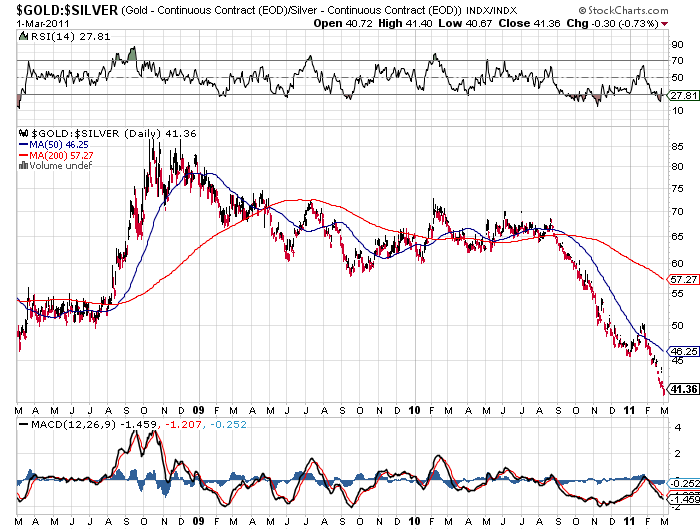

Since August 2010 gold has moved up 22% from the $1,175 level while silver has soared 92% from the $18 range.  Does the declining gold silver ratio indicate that silver prices are due for a correction or is this a fundamental change in the price relationship?

The gold silver ratio has averaged around 60 since the mid 1970’s.  In January 1980, as silver hit its peak price of $48.70, the gold silver ratio briefly hit 16, but rapidly rose as the Hunt brother’s attempt to corner the silver market came undone and silver prices collapsed.

Gold Silver Ratio - Courtesy Stockcharts.com

Will the current decline in the gold silver ratio continue?  From a very long term historical perspective, a gold silver ratio in the 16 range has been the norm.  Since ancient times, it has typically taken 16 ounces of silver to purchase one ounce of gold.  Interestingly, the earth’s  reserves of silver exceeds that of gold by roughly 16 times.  If this ultra long term relationship were to reassert itself, silver would sell for approximately $90 per ounce based on the current price of gold.  With gold at $2,500 per ounce, silver would have a value of $156 per ounce at the historical gold silver ratio of 16.

The fundamental reason that may drive the gold silver ratio back to the 16 range is growing demand by small investors.  Silver, known as the poor man’s gold has seen a huge surge of public demand, as evidenced by record sales of the Silver Eagles.

Increasing public recognition of the need to preserve wealth against paper currencies will continue to propel silver to historic highs.  Simply put, silver is more affordable to the average buyer who cannot afford the higher priced Gold Eagles.  Silver has a lot of catching up to do and we are probably in the early stages of a fundamental reversion to a lower gold silver ratio which will send silver prices soaring past $100 per ounce.

Gold Demand Soars as Supplies Increase Marginally

Gold demand increased strongly across all sectors during 2010, as the supply of gold barely increased.
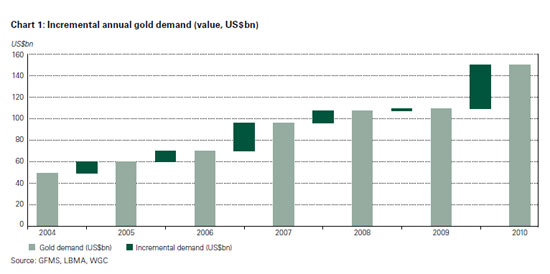

According to the World Gold Council, global demand for gold hit a 10 year high of 3,812.2 tonnes worth $150 billion.  The demand for gold hit an all time high in value as gold prices hit a record high of $1,421 per ounce on the London PM fix.  Typically, as the price of an item increases demand will decrease, but in the case of gold, it seems that  higher gold prices are creating more demand.  The risk of sovereign defaults, inflation, economic concerns and weak currencies have convinced many investors that gold is  integral to the preservation of wealth.

The demand for gold in 2010 was nothing less than extraordinary considering the 25% increase in gold prices.  The London PM Fix price of $1,121.50 at the beginning of 2010 increased steadily throughout the year and closed on December 30, 2010 at $1,405.50.

The World Gold Council noted that key factors affecting the price of gold during 2010 included the following:

  • Jewelry demand increased by 17% over 2009, with demand particularly high in both India and China.  Asia accounted for 51% of total investment and jewelry demand during 2010.
  • For the first time in 21 years, central banks became net purchasers of gold.
  • Investment demand for gold during 2010 was actually down by 2% in 2010 to 1,333 tonnes, but was the second highest demand year on record.

Gold Demand - World Gold Council

The value of gold demand skyrocketed by 38% in 2010 to $150 billion, despite the 40% increase in gold’s value since 2008.  The statistics for specific demand categories, according to the World Gold Council were as follows:

  • Total gold jewelry demand increased by 17% to 2059.6 tonnes despite increased gold prices.  The value of jewelry demand was $81 billion.
  • Investment demand for bar and coin and ETFs remained stable in 2010, down only 2% from the previous year.  In value terms, demand strongly increased by 23% to $52 billion.  Demand for physical bars increased by 56% to 713.2 tonnes.
  • ETFs accounted for 9% or 338.0 tonnes of gold during 2010 which was down by 45% from the peak of 617.1 tonnes in 2009.  At year end 2010 gold holdings by ETFs amounted to 2,175 tonnes worth $96 billion.
  • Gold demand by the technology and electronics industry rose 12.4% to 419.6 tonnes.
  • The market with the strongest growth in gold demand was India.  Gold demand by Indian consumers increased by 66% to 963.1 tonnes worth $38 billion.
  • The market with the strongest investment demand was China which saw a 70% increase in demand for coins and small bars to 179.9 tonnes worth $7 billion.

Total gold supply increased by only 2% as mines struggled to find new deposits and increase production from existing mines.  Out of total yearly gold supply, 40% comes from recycled gold.

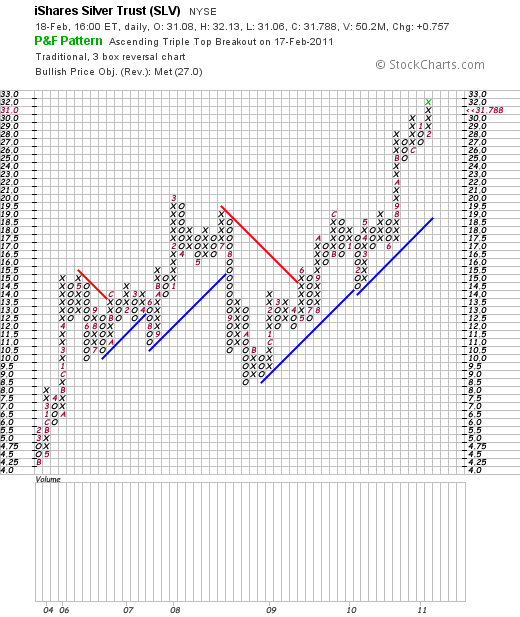
Silver Breaks Out of Triple Top for New Bull Move – Is Gold Next?

Triple tops are a well known chart formation that signal the potential for a price trend reversal.  A classic triple top occurs over a period of three to six months during which prices decline after hitting a series of multiple equal highs.  For the reversal pattern to register a definitive sell signal, the price must break below support levels.
A triple top has certain characteristics, each of which must be analyzed.

  • The three highs must be within reasonable price points of each other and spaced over equal time periods.
  • A previous long term uptrend must have occurred which established a definitive uptrend.
  • Volume levels tend to decrease during the formation of a triple top.  If volume increases on a pullback from the third top, more significance must be given to the potential for a significant trend reversal.
  • A triple top is not completed unless the price level breaks a key support level which would be the lowest price point on previous pullbacks from the intermittent tops.
  • A triple top chart pattern is not considered bearish unless support levels are decisively broken

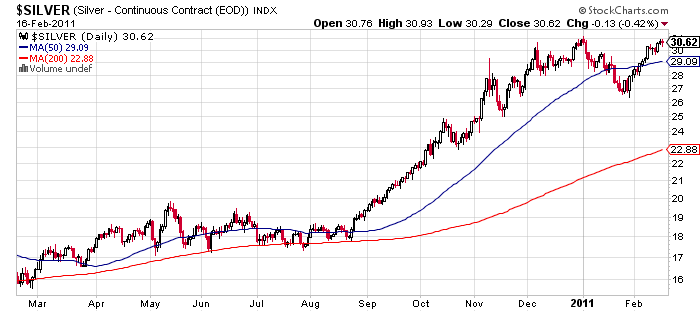
Examining the chart for silver before the recent move up, we could see a pattern developing with characteristics of a triple top.  The critical support level for silver was at  the $27  level.  Silver’s inability to break resistance at the $30 level would have been at best a neutral signal and a break below $27 would have forecast further price declines.   The strong upward price movement in silver last week as it soared past the $30 area is extremely bullish and tells us that the bull market in silver is intact.

Silver - courtesy stockcharts.com

TRIPLE TOP BREAKOUT - COURTESY STOCKCHARTS.COM

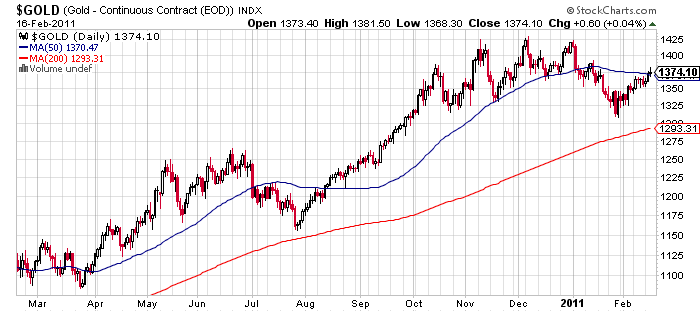
Viewing the chart of gold, we can see that the same potential for a triple top exists.

Gold - courtesy stockcharts.com

Gold has been turned back three times at the $1425 level, the tops are equally spaced over a period of almost 4 months and gold has been in an established uptrend for an extended period of time.  In the case of gold, a drop below support at $1320 would be a bearish signal and reason to take a defensive posture.

Considering the strong fundamentals supporting gold, we may soon see a breakout in the price of gold similar to what we have just witnessed with silver.

John Paulson Maintains Huge Holdings in SPDR Gold Shares Trust (GLD)

In 2010, John Paulson personally earned $5 billion, vaulting him into the ranks of the world’s wealthiest persons.  Incredibly, this was not a one time event precipitated by a heavily leveraged bet that just happened to turn out right.  Mr. Paulson had previously made another brilliant call prior to the financial crisis.  Based on his analysis of the subprime mortgage market, Mr. Paulson had the acumen to establish a major bearish position in mortgages, prior to the mortgage meltdown, that resulted in billions of dollars in profits.

It was how Mr. Paulson made $5 billion during 2010 that makes his every move the object of  intense scrutiny by gold investors worldwide.  Mr. Paulson believes that the Federal Reserve is determined to re-inflate every asset class possible, using whatever means necessary.  Without the “benefit” of inflation, the crushing levels of national debt would eventually lead to massive defaults and an economic disaster.   Based on this conviction, Mr. Paulson invested heavily in gold futures, the SPDR Gold Shares Trust (GLD), and other gold structured investments that resulted in his massive paycheck for 2010.

Last October, while speaking at the University Club in New York, Mr. Paulson predicted that the price of gold could easily reach $4,000 an ounce.

With Mr. Paulson’s track record, any change in his gold holdings would obviously be of great interest to gold investors worldwide.

Mr. Paulson directs most of his investments through his hedge fund, Paulson & Co, and is required to report major holdings to security regulators with 45 days after the end of each quarter.   The latest regulatory Form 13-F filing shows that Mr. Paulson’s position in the SPDR Gold Shares Trust was unchanged for the latest quarter.

At December 31, 2010, Mr. Paulson’s holdings in the GLD amounted to $4.37 billion dollars or about 8% of the total value of the Gold Trust.  The value of the GLD’s holdings are currently $53.95 billion.

Other big time successful investors also maintained or increased their holdings in the GLD.  The Soros Fund Management at year end held $655 million of GLD while PIMCO (run by super star bond manager Bill Gross) had holdings of $307.7 million.