April 6, 2026

Investor Gold Demand Hits All Time Record – China and India Grab 61% Of Total Gold Mine Production

Investor demand for gold during 2011 hit an all time high, fueled by soaring demand in China and India.  Total gold demand by China and India during 2011 amounted to a staggering 61% of all gold mine production last year.

The 2011 Gold Demand Trends report issued by the World Gold Council show a huge increase in gold demand and a small increase in global gold mine production.  This continues a trend that has been in place since 2001.  Despite an almost 600% increase in the price of gold since 2001, global gold mine production has increased by only 7.7%.

Typically, a large increase in price will bring forth additional supplies as producers rush to take advantage of higher prices.   This has not happened with gold due to the depletion of existing gold reserves and the inability of miners to discover and develop new gold deposits.  The continuing increase in gold demand and the lack of new supply will eventually result in gold prices higher than most people can imagine today.

Highlights of the Gold Demand Trends report are summarized below.

  1. For the first time ever, on a dollar basis, gold demand hit all time record highs at $205.5 billion, representing 4,067.1 tonnes of gold.
  2. Investor demand for gold hit all time record of 1,640.7 tonnes, up 5% from the previous year.
  3. Demand for gold by China soared 20% last year to 769.8 tonnes and demand by India, despite currency weakness, was 933.4 tonnes.  It is expected that China will become the largest gold market in the world during 2012 based on continued record setting demand.
  4. Global gold production increased by only 4% last year to 2,809.5 tonnes.  The combined gold demand of 1,703.2 tonnes by China and India consumed 60.6% of all new gold mine production.  It is projected that the supply of new gold will remained “restrained” for the foreseeable future.
  5. The desire to protect wealth accounted for surging gold demand in Europe as the European Central Bank engages in a massive money printing campaign to prop up the insolvent banking system.
  6. Central banks continued to buy gold during 2011, increasing total purchases to 440 tonnes, up by 77 tonnes from last year.
  7. The amount of gold available to meet demand is being restrained not only by low mine production but also by reduced supplies of gold from recycling.   Despite a 28% increase in gold prices last year, the supply of recycled gold declined by 2% to 1,611.9 tonnes.  According to the Gold Council, this implies that “market supplies are drying up and that consumers may be holding on to their gold in the expectation of higher prices.”
  8. Investors are showing a strong preference for physical gold as seen by the investment flows into bar and coin compared to ETF demand.   Demand for gold bar and coin during 2011 totaled 1,486.7 tonnes compared to ETF demand of only 154.0 tonnes.
  9. Gold demand by ETFs increased in the 2011 fourth quarter over the comparable period last year, but total demand during 2011 of 154.0 tonnes was far below ETF gold demand of 367.7 tonnes during 2010.

The Gold Council bullishly notes that the gold market is unique in that it is driven by a “diverse set of factors” and multiple sources of demand.
Lowering Gold Stock Portfolio Risk Through Diversification

There are numerous investment strategies available to capitalize on the gold bull market.  Gold investors have the option of investing in gold bullion, gold coins, gold ETFs, gold mutual funds and individual gold mining stocks.

Although many gold investors prefer to exclusively hold physical gold, diversifying into selected gold stocks can dramatically increase total returns.  Although gold stocks as a group have recently underperformed bullion, selected gold stocks have outperformed gold bullion.

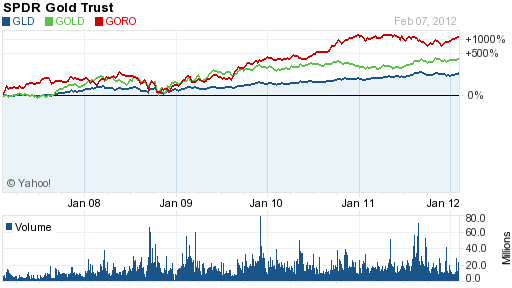
Well managed gold mining companies with large ore reserves and increasing mine production have provided investment returns far in excess of the gain in gold bullion as seen below with the examples of Randgold Resources (GOLD) and Gold Resource Corp (GORO).  Both of these gold mining companies have vastly outperformed gold bullion when compared to the SPDR Gold Trust (GLD) which tracks the price of gold bullion.

GORO, GOLD vs GLD - Courtesy yahoo.com

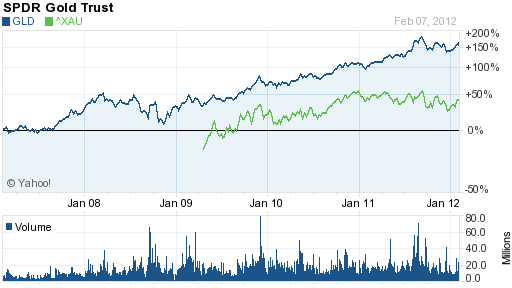
Selecting the gold stock that will outperform bullion is difficult, however, as seen by the lagging performance of the PHLX Gold/Silver Sector (XAU) when compared to the GLD.  The XAU Gold/Silver Sector is a broad based index of sixteen large precious metal mining companies.  The GLD has outperformed the XAU by three times since 2009.

GLD vs XAU - courtesy yahoo.com


As with any stock portfolio, diversification is required into order to avoid the risk of under performance.  An example of the risk of holding a gold portfolio with only a small number of stocks was seen today when the price of Nevsun Resources (NSU) collapsed by almost 31% after the company unexpectedly announced that gold production will plunge by nearly half in 2012 due to a reduction in estimated gold reserves.

Since selecting individual gold stocks can be a daunting task for investors, a better alternative would be to invest in an actively managed gold stock mutual fund with a proven record of superior investment returns.  Past performance has shown that an actively managed gold stock mutual fund has outperformed passively managed gold index funds.

One gold fund that should top the list for investors to consider is the Tocqueville Gold Fund (TGLDX), run by legendary gold investor John Hathaway.  The Tocqueville Gold Fund has a remarkable average annual return over the past ten years of 23.3%, almost double the gain in the Philadelphia Gold/Silver Index.

courtesy yahoo.com

Although gold bullion has outperformed gold stocks since 2008, Mr. Hathaway’s outlook for gold remains extremely bullish and he expects that as gold continues to increase in price, gold stocks should once again outperform the returns of gold bullion.  In his latest Investment Update, here is what Mr. Hathaway had to say.

Gold and gold stocks appear to be bottoming in the wake of a four month correction which began in mid -August when the metal peaked at $1900/oz. Bearish sentiment is at extremes not seen in many years. This and a number of other indicators, such as stocks that have been hit by negative sentiment, the downtrend in gold prices since August, and tax loss selling, support our view that a rally lies ahead. This very bullish market set-up, in our opinion, mirrors the extraordinary investment opportunity of the despondent year end in 2007. Even though gold prices have been declining for several months, they finished the year with substantial gains. This suggests that the value represented by gold mining equities held in our portfolio could be extraordinary.

Disarray in Europe is, in our opinion, a slow motion version of the global market meltdown in 2007. It appears to us that the U.S. Fed is once again acting as the lender of last resort to European central banks in their efforts to save the euro. As in 2007, U.S. sovereign credit will be substituted for failing credits, in this case, peripheral European states. The fig leaf to justify such action on the Fed’s part is sado-fiscalism, or extreme austerity packages administered by technocrats. Tough restraints on profligate public spending, which has become a way of life in all Western democracies, will not go down easily. These measures are deflationary and will be ultimately met by howls of protests from mobs demanding renewed money printing and deficit spending. In our opinion, the fundamentals for gold are stronger than ever because the outlook for paper currencies is dire. The difficult correction of the last four months has shaken out all but the strongest holders, a perfect set-up for advances to new all-time highs in 2012.

Platinum To Gold Ratio Plunges – Is This A Buy Signal Or A New Metric?

Platinum is one of the rarest earth elements with the vast majority of deposits found in only one place on earth.  Annual platinum production is only 30 tonnes per year compared to approximately 2,800 tonnes for gold and 23,000 tonnes for silver.

Roughly 80% of annual platinum production comes from only three mines in South Africa.  Siberia and other geographically scattered locations provide the balance of annual platinum production.

Investment demand for platinum constitutes only 10% of annual demand .  Since 90% of platinum demand comes from jewelry and industrial users, the price of platinum can be very volatile.  During an economic downturn,car sales plunge and jewelry is a very discretionary purchase.  During the 2008 financial meltdown, platinum plunged by nearly two thirds of its value compared to a drop of only one third in the price of gold.


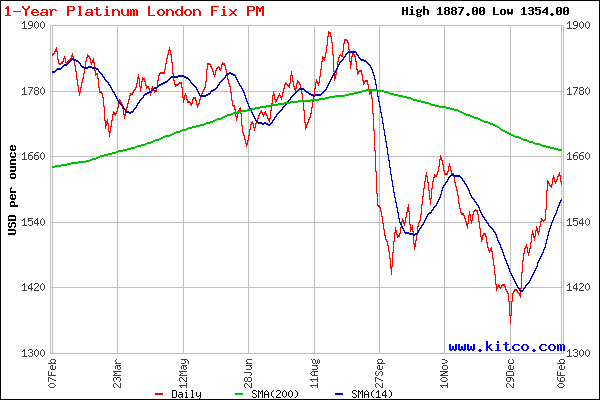
Platinum - courtesy kitco.com

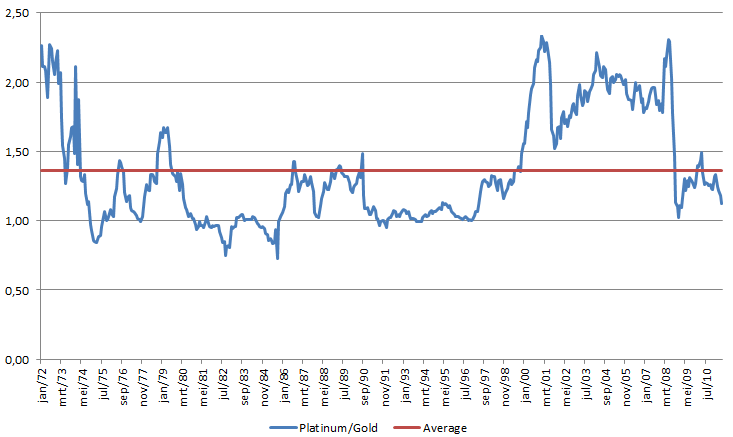
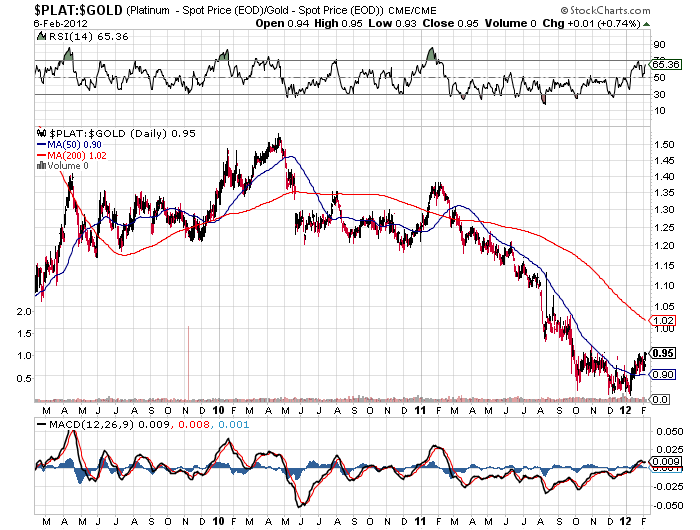
The ongoing economic turmoil in Europe has contributed to a large drop in the price of platinum.   Last year, platinum declined from $1,887 in August to $1,354 at 2011 year end, a drop of $533 per ounce.  Although platinum has recovered to $1,609, it is considerably undervalued  when viewed through the lens of the platinum to gold ratio.  A platinum to gold ratio below 1.0 is historically a signal that platinum is selling at a bargain price.  The platinum to gold ratio is currently at .95, a level not seen since 1986.


Long term ratio - courtesy http://profitimes.com


Platinum to gold ratio - courtesy stockcharts.com

Has the long term historical significance of the platinum to gold ratio lost its relevance?  If the world plunges into a deflationary depression, platinum may wind up becoming a much greater bargain at a later date.  The more likely scenario is that a new pricing metric is not being established and that the multi-decade low in the platinum to gold ratio is a major buy signal for platinum.

The central banks of the world have made it abundantly clear that they will print and inflate their way out of the debt crisis.  Ownership of a precious metal such as platinum is one method of maintaining a store of value against depreciating currencies.

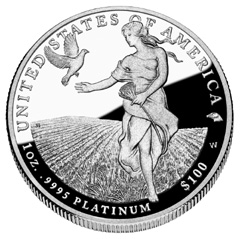
Numismatic versions of the platinum coin can be purchased by investors directly from the U.S. Mint.  The 2011 Proof Platinum Eagle has been available since May 26, 2011 with a maximum mintage of 15,000 pieces.  The current price to purchase the 2011 American Eagle one ounce platinum proof coin from the U.S. Mint is $1,892.00 with no order limit.  No sales tax is charged on the purchase and a credit card can be used to pay for the coins.

According to coinupdate.com, the United State Mint may bring back the American Platinum Eagle bullion coins.  The U.S. Mint has not minted the bullion versions of the platinum coin since 2008.  Production of the American Platinum Eagle is not required by law, as is the case for the American gold and silver eagles.  Production of the platinum coins are at the discretion of the Secretary of the Treasury.  The 2008 and earlier bullion version of the one ounce American Platinum Eagle coins are available from coin dealers and are currently priced at around $1,860 each.

Have Gold Investors Become Too Bullish? Ask The Same Question At $5,000

Have too many investors gotten overly bullish on gold?

After a stunning advance of almost $200 per ounce from last year’s closing price, some are asking if gold has gotten ahead of itself.  After advancing almost nonstop since the beginning of the year, gold sold off sharply, dropping by $32.50 to close in New York trading at $1725.90.

Analyst Mark Hulbert, who tracks investor sentiment as reported in the Hulbert Gold Newsletter, reports that bullish sentiment on gold has become extreme.  At the end of 2011, short term gold timers were completely out of the gold market.  The Hulbert Gold Newsletter Sentiment Index (HGNSI) registered 0.3% on December 29th compared to 51% today.  Mr. Hulbert sees the rapid return to bullishness by gold investors as a worrisome signal and notes that the HGNSI never got as high as it is today when gold previously traded at current price levels.

Mr. Hulbert notes that his indicator can be early as was the case last year.  In early December Hulbert noted that bearish sentiment was reaching extreme levels but gold subsequently plunged from $1,752 on December 1st to $1,574.50 on December 30th.

One indicator of gold sentiment that does not seem to be signaling an imminent sharp correction in gold is the CBOE Gold ETF Volatility Index (Gold VIX) which measures gold volatility based on SPDR Gold Trust (GLD) options trading.  As bearish put positions on the GLD increase, the VIX rises as it did last August prior to a sharp correction in the price of gold.  After peaking at 40 last year, the VIX is currently at 22.

CBOE Gold VIX (GVZ) - courtesy cboe.com


Could the price of gold correct in the short term? Yes.  Should long term investors who hold gold as a safe haven against a government that has an official policy of debasing the currency be worried?  No.

A short term correction is nothing more than a buying opportunity for long term investors.  Why would one care if gold corrects to $1,600 on its way to $5,000?  Here are a few items for consideration by those worried about a “correction” in the price of gold.

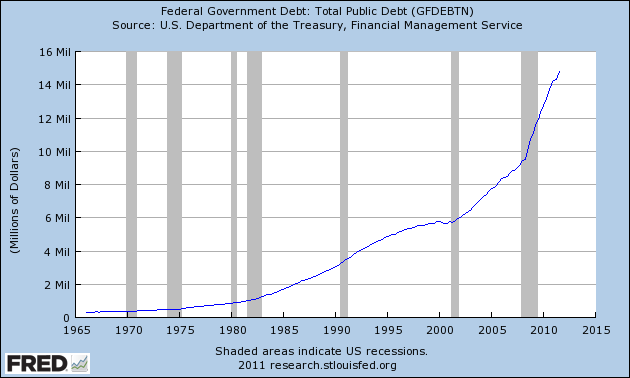
The U.S. has accumulated debt obligations and promises that are mathematically impossible to repay.  Neither future economic growth nor tax increases will be sufficient for the government to meet its obligations without debasing the value of the dollar.  The government is spending $1.60 for every $1.00 collected in revenues, half of all families receive some type of government payment and half of all wage earners pay no taxes.

The government’s “solution” for too much debt remains the same – more debt.  Here’s what Treasury Secretary Geithner said when he asked Congress to raise the debt limit in August 2009 when government debt totaled “only” $12.1 trillion.

“Congress has never failed to raise the debt limit when necessary. Because members of both parties have long recognized the need to keep politics away from this issue, these actions have traditionally received bipartisan support. This is clearly a moment in our history that calls for continuation of that tradition.”

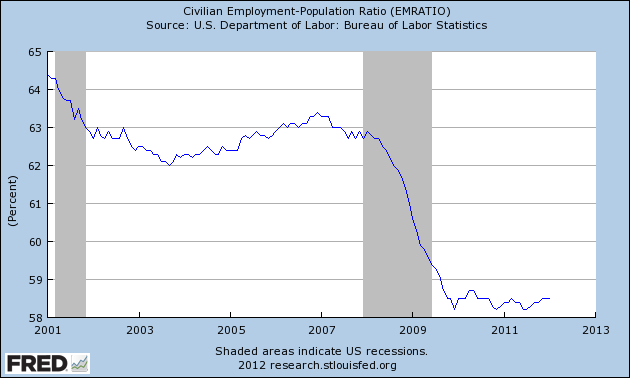
As the debt burden approaches the day of reckoning, the proportion of the population actually working continues to decline.

Investors late to the party attempting to diversity into gold may find that it’s too late – gold may not be available at any price.

Gregor Macdonald notes that global gold production over the last decade has been below the average of the past 110 years.  Normally, higher prices will  result in higher supplies as producers rush to capitalize on higher prices.  Despite the fact that the price of gold has increased every year for the past decade, gold production has barely increased – there is simply not that much gold left which hasn’t already been mined.


Global gold production - courtesy gregor.us

A looming price correction in gold?  Bring it on!

Gold Bullion Coin Sales Soar By 94% In January As Confidence In The Dollar Crumbles

According to the latest production figures from the U.S. Mint, January sales of American Gold Eagle bullion coins soared by 93.8% over the previous month.

A total of 127,000 ounces were sold in January compared to 65,500 ounces in December 2011.  The surge in demand for gold bullion coins is now at the highest level since January 2011 when 133,500 ounces were sold.

Investors are taking opportunity of the bargain price of gold which remains below last year’s high.  After hitting a London PM Fix price of $1,895 on September 6, 2011, gold sold off by 19.2% to a closing low of $1,531.00 on December 29, 2011.

Since the beginning of the year, the price of gold has steadily advanced.  The closing London PM Fix price of $1,744.00 on January 31st represents a gain of $213 per ounce for the month, up 13.9% from the 2011 year end price.  The price of silver has also advanced strongly in 2012 with a gain of 26.8% from last year’s low amid record breaking demand for the American Silver Eagle bullion coins.

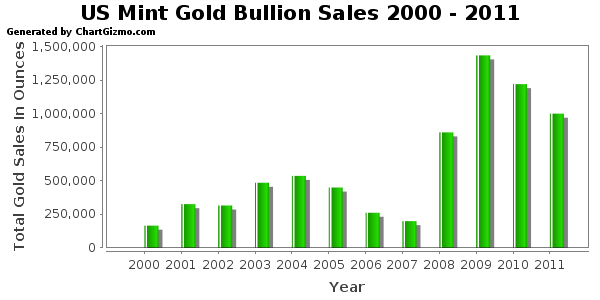
Sales of the American Gold Eagle bullion coins hit an all time record in 2009 when 1,435,000 ounces were sold.  A summary of annual gold bullion sales since 2000 is shown below.

Total yearly gold bullion coin sales from January 1, 2000 to January 31, 2012 are shown below.

Gold Bullion U.S. Mint Sales By Year
Year Total Ounces Sold
2000 164,500
2001 325,000
2002 315,000
2003 484,500
2004 536,000
2005 449,000
2006 261,000
2007 198,500
2008 860,500
2009 1,435,000
2010 1,220,500
2011 1,000,000
2012 127,000
7,376,500
Note: 2012 total through January 31, 2012

The huge demand during 2009 for gold bullion coins came in the wake of the 2008 financial system meltdown as investors sought a safe haven from paper assets.  Here we are four years later and the financial system is more fragile than ever with insolvent banks  and governments being propped up by central banks that are printing money on a scale previously unimaginable.

Although I have been a precious metals investor for many years (more sometimes than I care to think about), many of the people I deal with on a personal  and professional level seemed to be totally confident holding only paper assets, even after the financial system came very close to a total collapse in 2008.

That confidence now seems  to be slowly but persistently eroding and I am seeing many people enter the precious metals market for the first time.  It is not an “all in” seismic shift but rather a thoughtful and fundamental portfolio reallocation based on the growing realization that paper dollars are being constantly debased.

A one time bout of money printing by the Federal Reserve to “save the system” can perhaps be quickly forgotten, but a persistent and deliberate effort to debase the currency is another matter.  The growing realization that the Federal Reserve is deliberately destroying the integrity of the dollar will be the basis for continual future demand for the only real money left – gold.

The growing movement to reallocate wealth into gold is still in its infancy which implies a future gold value many thousands of dollars higher than today’s price.

There’s No Reason Gold Stocks Should Be So Cheap – Newmont Mining On The Bargain Rack

Over the past five years, gold bullion has dramatically outperformed the average gold stock.  Reasons why bullion has outperformed gold stocks include an investor preference for physical gold and the inability of gold miners to produce earnings gains commensurate with the increase in the price of gold.

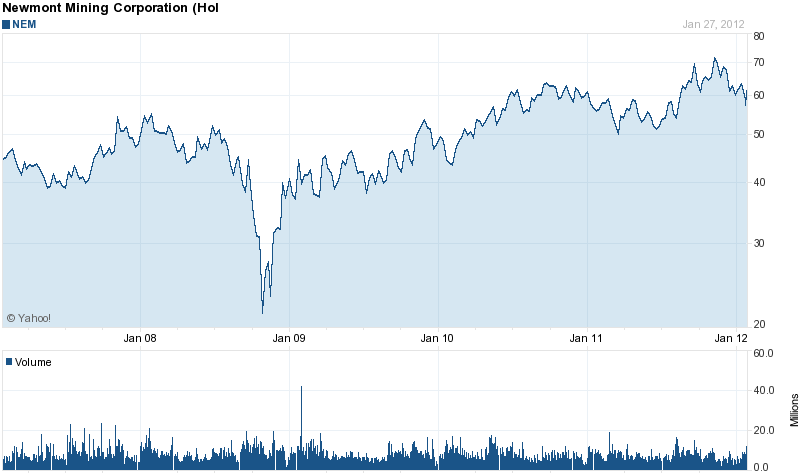
The end result of investor aversion to gold stocks has resulted in many quality gold stocks, such as Newmont Mining (NEM), winding up on the bargain rack.  Newmont Mining is one of the world’s largest gold producers that has positioned itself for profitable growth after restructuring its operations.  Newmont Mining management is forecasting a 35% increase in gold production to 7 million ounces annually over the next six years.

Revenue growth at Newmont has grown by 10% annually over the past 10 years.  Earnings per share increased from $.45 per share in 2002 to $4.68 per share in 2010.  For the year ending December 31, 2010, gross margins hit a record 61%, cash holdings increased to $4.1 billion and revenues climbed by 23% to $9.5 billion.  Newmont Mining has a dividend yield of 2.3% with a very low payout ratio of 18% and is committed to increasing the dividend in line with the increase in the price of gold.  Newmont’s total proven and probably gold reserves of 93.5 million ounces are valued at only $285 per share.

Newmont Mining - courtesy yahoo finance


In this week’s Barron’s Roundtable, analyst Fred Hickey talks about Newmont Mining and why he is bullish on gold.

Hickey: Newmont Mining [NEM], which I recommended last year, outperformed. [The stock rose 5.5% through Dec. 30.] The driver is gross margin expansion. Gold prices are up by a factor of six through this bull market, yet costs have roughly doubled. The company has had tremendous cash flow, leading to dividend increases. Newmont has tied its dividend policy to the gold price. If the price rises, you are guaranteed more dividends. The money won’t be wasted on bad acquisitions. In 2008 Newmont earned under $2 a share. It could earn $4.82 for 2011, and $5.96 in 2012. There’s no reason these stocks should be so cheap.

As Felix has said, owning physical gold is important. In addition, you can own gold through exchange-traded funds, such as the GLD [ SPDR Gold Shares]. They are audited. The U.S. government’s gold holdings haven’t been independently audited in decades. The GLD charges fees of 0.40% of assets. The IAU, or iShares Gold Trust, charges only 0.25% of assets. It trades for about a hundredth of the price of gold, so it is selling for $15.76 a share. It has been around since 2005 and has $9 billion in assets and 171 tons of gold. It stores its gold in vaults around the world. Last year I recommended stocks. This year I like the GDX, or Market Vectors Gold Miners ETF. It gives you diversification with 31 names, including a few silver stocks. Barrick Gold [ABX], Newmont and Goldcorp [GG] account for 41% of assets. At some point gold stocks will outperform bullion.

Newmont is currently selling at a steep discount to the underlying value of its gold reserves.  As the price of gold continues to rise, the stock will eventually reflect the fundamentals and could easily double from current levels.

Major Buy Signal For Gold And Why Stock Markets Are Ignoring Predictions Of Economic Collapse

Predictions that the global economic system will collapse have been coming at an accelerated pace lately.  Usually, many of  the most extreme scenarios are from sources more interested in gaining publicity rather than offering a balanced analysis.

What’s unusual is that lately, many of these apocalyptic predictions are coming from some of the most normally sedate institutions in the world such as the IMF and the World Bank.

Central bankers and the heads of world financial organizations usually speak in oblique and obfuscated terms designed to convey confidence.  Either the financial powers are writing a new book of rules or we are all headed for some unimaginably horrific scenario of financial and social chaos.

Here’s a small sample of the latest warnings from the sedate and not so sedate.

IMF Chief Warns Europe Must Fuel Growth

BERLIN—The head of the International Monetary Fund warned that in addition to cutting yawning budget deficits Europe needs to do more to promote growth and stop the crisis from spreading to the world economy.

“It is about avoiding a 1930s moment, in which inaction, insularity, and rigid ideology combine to cause a collapse in global demand,” IMF Managing Director Christine Lagarde said before the German Council on Foreign Relations. “A moment, ultimately, leading to a downward spiral that could engulf the entire world,” she said.

World Bank Projects Global Slowdown

“Developing countries need to evaluate their vulnerabilities and prepare for further shocks, while there is still time,” said Justin Yifu Lin, the World Bank’s Chief Economist and Senior Vice President for Development Economics.

Developing countries have less fiscal and monetary space for remedial measures than they did in 2008/09. As a result, their ability to respond may be constrained if international finance dries up and global conditions deteriorate sharply.

“An escalation of the crisis would spare no-one. Developed- and developing-country growth rates could fall by as much or more than in 2008/09” said Andrew Burns, Manager of Global Macroeconomics and lead author of the report. “The importance of contingency planning cannot be stressed enough.”

Feliz Zulauf Sees More Trouble Ahead

Felix Zulauf: Yes, I believe the peripheral nations have entered recession territory, and I believe it will get worse.

So, the situation in Europe will get worse before it gets better. Moreover, the ECB, which has its roots in the German Bundesbank, will see to it that the ECB does not become the lender of last resort until they are absolutely forced into it by the market. For investors, this is very important to understand. The new leader Mr. Draghi may leave Trichet’s conservative path, however, as since he is in power he has talked one way and acted in another way. This is delicate as the credibility of the ECB could be lost quickly.

Euro Breakup Would Cause Global Meltdown

In his speech at Davos, Soros will say it is “now more likely than now” that Greece will formally default in 2012, Newsweek said. Soros nevertheless thinks the euro will survive, according to Newsweek.

The world is facing a period of “evil,” Soros said, adding that he foresees Europe descending into chaos and conflict, while rioting in the streets of the U.S. will lead to a curtailment of civil liberties and the global economic system possibly collapsing altogether, Newsweek reported.

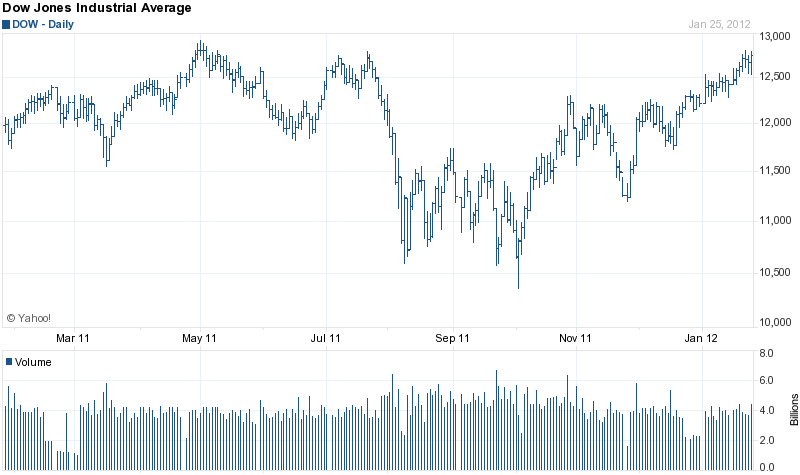
All of the risks to global prosperity mentioned above have been well known by investors for months now.  The day the IMF Chief warned of a global depression worse than the 1930’s, the Dow Jones yawned and drop by 10 points.

Is there a major disconnect from reality by U.S. investors or has the worst already been discounted after the steep stock market sell off last August?  Ever since an inside out day on October 3 of last year, the Dow Jones has powered higher, ignoring all the bad news and warnings of Armageddon.  Exactly what is going on?


Dow Jones - courtesy yahoo.com

The answer is positive for both stocks and gold.  The “collective wisdom” of the markets saw a resolution to the imminent threat of the European debt crisis last fall, and that resolution is known as quantitative easing.  As previously noted in this blog last December, Every Solution To the Euro Crisis Involve Printing Money, which is exactly what happened.  Both the European Central Bank (ECB) and the Federal Reserve stand ready to print whatever quantity of money is required to paper over the European and U.S. debt crisis.

The massive first phase of the ECB’s Long Term Refinancing Operation advanced about $780 billion to Europe’s insolvent banking system, buying time and postponing the day of reckoning.  The ECB will hold a similar operation in February.

Long term this does little to solve Europe’s fundamental problems, but is short term bullish for stocks and extremely long term bullish for gold and silver.


The Gold Bubble Myth – Investors Remain Underinvested In Gold

The chronic myth that gold is in a bubble continues to persist, perhaps driven by the fact that gold has risen for the past 11 years.

The mainstream press has float stories year after year that gold was dangerously overpriced and unsuitable for most investors.  This gold bubble mindset, promulgated by “analysts” who have never owned gold has succeeded in keeping the vast majority of investors out of the best performing asset class of the past decade.

Despite every effort by the Federal Reserve to debase the value of the U.S. dollar, an uninformed and gullible public seems content to hold paper dollars which continue to decline in purchasing power.   Worse yet, in an effort to forestall insolvency and reduce the value of debt obligations that are mathematically impossible to repay, the Fed has explicitly adopted a dollar debasement policy.

While the smart money has been moving into gold, the vast majority of investors are under invested in precious metals.  The relatively low demand for gold can be seen from the third quarter gold demand and supply statistics from the World Gold Council.

Total gold demand has remained relatively stable for the past four years at approximately 4,000 tonnes.  Various categories of gold demand such as bar and coin and ETF rose while jewellery demand actually dropped and technology demand remained relatively unchanged.  Total global gold demand of 4,000 tonnes is valued at only about $230 billion.  By comparison the market value of Apple is $415 billion, the market value of IBM is $222 billion and the market value of Microsoft is $248 billion.

Meanwhile, monetary authorities world wide are printing money to prop up governments that have reached the limits of taxation and borrowing abilities.  This, along with the low level of demand for gold tells us that we are not even close to the ultimate highs that will be seen in the gold market.

More on this topic:

Gold Bull Market Could Last Another 20 Year With $12,000 Price Target

Why There Is No Upside Limit For Gold and Silver Prices

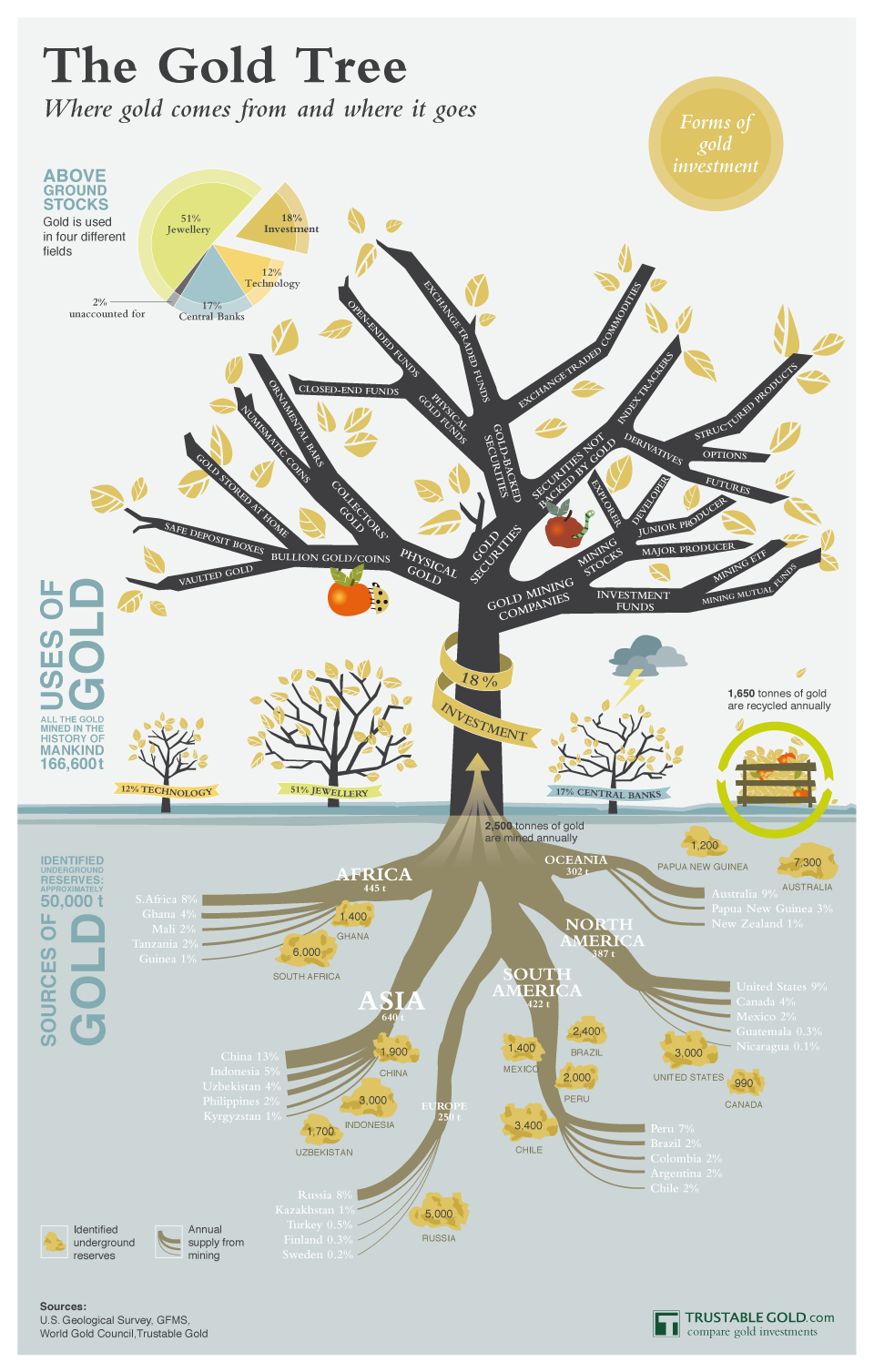
Sources and Demand For Gold

A nifty graphic detailing the sources and demand for gold can be seen below from Trustable Gold, which provides investors with information on gold investment opportunities.


Courtesy - trustablegold.com

Gold Soars As The Fed Explicitly Promises To Debase The U.S. Dollar

Federal Reserve Chairman Bernanke hit the panic button today by announcing a specific inflation target, vowing to keep rates at zero until at least 2014 and pledging to offer additional monetary stimulus. The Fed also noted, as it has in the past, that the economy still faces “significant downside risks”.

These actions by the Fed come nearly four years after the financial crisis began in 2008.  During that time, the Fed has ballooned its balance sheet to almost $3 trillion, driven real interest rates to negative 1.2% and encouraged lending by flooding the banking system with reserves.  The Fed’s monetary easing was supplemented by trillions of dollars in U.S. deficit financed spending  aimed at restoring economic growth and gluing back together the shattered real estate bubble.

Despite these unprecedented and controversial actions, the economy refuses to rebound.  Collapsing home prices, declining real incomes and an “official” unemployment rate of 8.5% are deflationary and this is what has panicked Bernanke more than anything else.  Deflation is the mortal enemy of a credit fueled, debt burdened economy.  Today’s actions by the Fed show that Bernanke will do whatever is necessary to prevent a deflationary collapse.  Of course, the markets already knew this.

GOLD 01/25/2012 17:15 1710.80 1711.80 +44.40 +2.66% 1648.20 1714.00
SILVER 01/25/2012 17:15 33.27 33.37 +1.22 +3.81% 31.46 33.53

The real reason behind the explosive move up in gold and silver was the historic change in Fed policy with the announcement of an explicitly targeted inflation rate of 2%.   Although the Federal Reserve has been debasing the value of the currency ever since its creation, for the first time ever, currency debasement and financial repression has now become an officially stated policy goal.


Gold Explodes - courtesy kitco.com


The concept of explicit inflation targeting is dangerous and reckless, which is why it has never been done before.  If the Fed decides that we need 2% inflation today, does the rate go higher later?  How will the Fed know exactly when and exactly how to stop creating inflation?  This is the same Fed run by the same Ben Bernanke who could not identify the biggest credit fueled real estate bubble in history.

Will debt-deleveraging overpower the Fed’s ability to create inflation?   Bloomberg’s Michael Kinsley persuasively tells us, Please Remain Worried About Rising Inflation.

About two years ago I wrote an article saying that despite the lack of evidence, and despite the near-universal belief among economists that it was not a problem, I was worried about inflation. My reason was that I couldn’t see how the government could pay off the massive debt it was running up except by inflating at least part of it away.

For this, I was widely ridiculed, and I’d like to take this opportunity to claim vindication. That is, I’d like to — but I can’t. Inflation (CPI) has been creeping up the past couple of years – – from less than 2 percent to more than 3 percent — but that’s still pretty low. Nevertheless, I double down: Barring a miracle, there will be a fierce storm of inflation sometime in the next few years and it will wipe out a big chunk of the national debt, along with the debts of individual citizens, and the savings of others.

One reason I say this is that the arguments on the other side have shifted. It used to be, “It’s not gonna happen — so don’t worry about it.” Now it’s, “You know, a moderate dose of inflation would be no bad thing. So don’t worry about it.” Kenneth Rogoff, an economics professor at Harvard University, is the leading spokesman for this view. He wrote in August that he would like “a sustained burst of moderate inflation, say, 4 percent to 6 percent for several years.” Five years of 5 percent inflation would reduce the value of debts by 27 percent —

It has been four years now, and things are starting to look up a bit. Time to raise taxes or cut spending? Time to stop borrowing? No, not yet (says Krugman). So, when? After eight years? Twelve? Soon you’ll be bumping into the next recession. Or do the annual deficit and the national debt simply not matter? If that’s the case, why do we pay taxes at all?

Although Kinsley cites the example of how “moderate”  inflation of 5% for 5 years would reduce the value of debt by 27%, the obvious corollary would be a decline in the value of the dollar by the same amount.  The U.S. dollar can no longer even pretend to be a store of value, given the new Fed policy of targeted inflation.

The old adage “don’t fight the Fed” is true – and the Fed has just given an all out buy signal on gold.

A Rush For Gold In Iran – Currency Collapse Sends Gold Prices Soaring

The already weak economy of Iran faces additional pressure after the European Union banned all oil imports from Iran effective July 1.   The EU actions support a U.S. directed effort to embargo Iranian oil and sanction the Iranian banking system, effectively freezing Iran out of the international financial system.

The moves by the United State and the European Union were taken in an effort to force Iran to abandon its nuclear weapons programs.

Without  foreign currency receipts from the sale of oil, Iran is unable to pay for necessary imports, resulting in soaring inflation and the collapse of the Iranian currency, the rial.  As a result, Iran’s currency tumbles to a new record low and currency holders desperately rush for gold.

The Iranian currency, the rial, tumbled Monday in black market trading to a new record low against the dollar, news agencies said, as the EU moved to impose an oil embargo and fresh sanctions on Tehran.

The unofficial rate in central Tehran was around 20,500 rials to the dollar, the official IRNA news agency reported.

A rush for gold and other non-currency assets has since taken hold, with the price of gold coins in Iran rising by 25 percent since January 18.

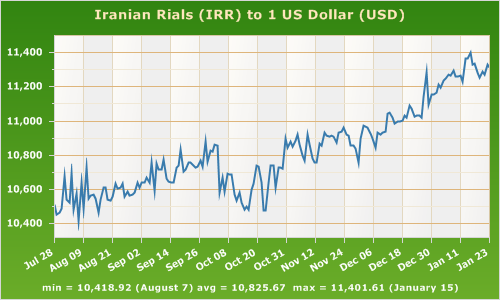
As recently as July, it cost only approximately 10,500 rials to buy a dollar, as can be seen in the chart below which depicts the “official” exchange rate.

Courtesy: exchange-rates.org

As the economic collapse in Iran progresses, a desperate population is discovering that ultimately, the only real money is gold.