April 6, 2026

Ron Paul – “The World Will Abandon The Dollar As The Global Reserve Currency”

In August Ron Paul accused the U.S. Treasury “guilty of counterfeiting dollars” by virtue of its monopoly power on money in America.  Paul noted that the expanding role of the Federal Reserve in monetizing government debt has resulted in a massive debasement of the purchasing power of the U.S. dollar.

Continued reckless money printing by the Federal Reserve and massive government deficits will ultimately result in the loss of confidence by holders of  U.S. dollars.  Ron Paul sees the U.S. dollar inexorably losing its status as global reserve currency unless the dollar is backed by precious metals or commodities.

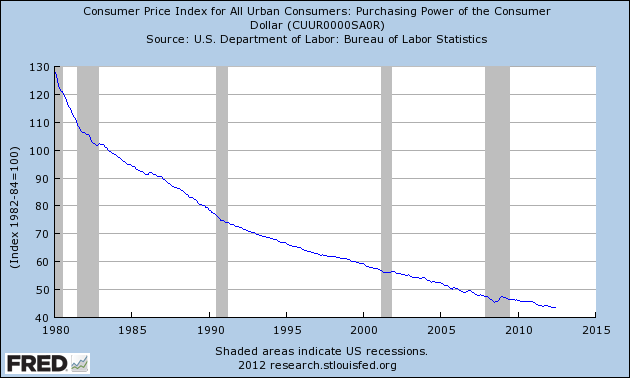
Evidence of the horrendous loss of purchasing power by the U.S. dollar is not hard to understand.  The average citizen sees it everyday as higher prices and lower incomes relentlessly lower our standard of living.   The systematic destruction of the U.S. dollar’s purchasing power can be seen in a chart published by the Federal Reserve Bank of St. Louis.
How Long Will the Dollar Remain the World’s Reserve Currency?

By: Congressman Ron Paul

We frequently hear the financial press refer to the U.S. dollar as the “world’s reserve currency,” implying that our dollar will always retain its value in an ever shifting world economy.  But this is a dangerous and mistaken assumption.

Since August 15, 1971, when President Nixon closed the gold window and refused to pay out any of our remaining 280 million ounces of gold, the U.S. dollar has operated as a pure fiat currency.  This means the dollar became an article of faith in the continued stability and might of the U.S. government.

In essence, we declared our insolvency in 1971.   Everyone recognized some other monetary system had to be devised in order to bring stability to the markets.

Amazingly, a new system was devised which allowed the U.S. to operate the printing presses for the world reserve currency with no restraints placed on it– not even a pretense of gold convertibility! Realizing the world was embarking on something new and mind-boggling, elite money managers, with especially strong support from U.S. authorities, struck an agreement with OPEC in the 1970s to price oil in U.S. dollars exclusively for all worldwide transactions. This gave the dollar a special place among world currencies and in essence backed the dollar with oil.

In return, the U.S. promised to protect the various oil-rich kingdoms in the Persian Gulf against threat of invasion or domestic coup. This arrangement helped ignite radical Islamic movements among those who resented our influence in the region. The arrangement also gave the dollar artificial strength, with tremendous financial benefits for the United States. It allowed us to export our monetary inflation by buying oil and other goods at a great discount as the dollar flourished.

In 2003, however, Iran began pricing its oil exports in Euro for Asian and European buyers.  The Iranian government also opened an oil bourse in 2008 on the island of Kish in the Persian Gulf for the express purpose of trading oil in Euro and other currencies. In 2009 Iran completely ceased any oil transactions in U.S. dollars.  These actions by the second largest OPEC oil producer pose a direct threat to the continued status of our dollar as the world’s reserve currency, a threat which partially explains our ongoing hostility toward Tehran.

While the erosion of our petrodollar agreement with OPEC certainly threatens the dollar’s status in the Middle East, an even larger threat resides in the Far East.  Our greatest benefactors for the last twenty years– Asian central banks– have lost their appetite for holding U.S. dollars.  China, Japan, and Asia in general have been happy to hold U.S. debt instruments in recent decades, but they will not prop up our spending habits forever.  Foreign central banks understand that American leaders do not have the discipline to maintain a stable currency.

If we act now to replace the fiat system with a stable dollar backed by precious metals or commodities, the dollar can regain its status as the safest store of value among all government currencies.  If not, the rest of the world will abandon the dollar as the global reserve currency.

Both Congress and American consumers will then find borrowing a dramatically more expensive proposition. Remember, our entire consumption economy is based on the willingness of foreigners to hold U.S. debt.  We face a reordering of the entire world economy if the federal government cannot print, borrow, and spend money at a rate that satisfies its endless appetite for deficit spending.
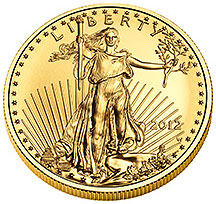
Gold and Silver Bullion Coin Sales Jump 25% In August, San Francisco Silver Eagle Set Sold Out

The latest sales figures from the U.S. Mint for August show a significant increase in sales of both gold and silver bullion coins.
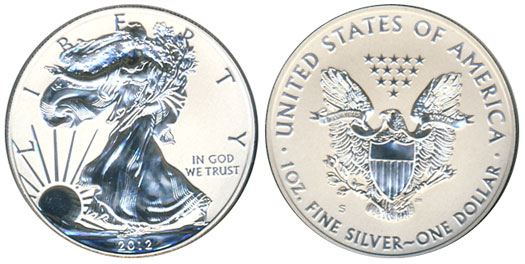
Sales of gold bullion coins during 2012 have varied dramatically from month to month with a high of 127,000 ounces in January to a low of only 20,000 ounces in April.  Monthly gold bullion sales through August have averaged 51,625 ounces.

Monthly sales of silver bullion coins have been more consistent during 2012.  The U.S. Mint sold over 6 million ounces of silver bullion coins in January, but the monthly pace has tapered off to under 3 million ounces.  The average monthly sales of silver bullion coins through August is 2,817,500.

American Eagle Gold Bullion Coin Sales

Total sales of the American Eagle Gold bullion coins during August totaled 39,000 ounces, up 27.9% from July’s total of 30,500 ounces.  Total sales of gold bullion coins by the U.S. Mint through August totaled 413,000 ounces, valued at approximately $700 million based on today’s closing gold price.

On an annualized basis, the U.S. Mint will sell almost 620,000 ounces of  gold bullion to investors this year valued at $1.0 billion if the price of gold remains at $1,692.  During 2009, the peak year of gold bullion coin sales by the U.S. Mint, investors purchased 1,435,000 ounces valued at $1.4 billion based on the average price of gold of $972 per ounce.

Investors who have reduced gold bullion purchases due to the increased cost per ounce will no doubt regret this decision as the price of gold continues to increase.  The value of gold should be viewed in the context of the reduced purchasing power of the dollar – as the Federal Reserve constantly destroys the purchasing power of the U.S. dollar, the “dollar cost” of gold will naturally increase.  The price of gold is merely reflecting the fact that paper dollars are worth less and less every day.

As the Fed continues to do what it does, expect the bull market in gold to continue.

Listed below are yearly sales figures for the American Eagle gold bullion coins since 2000.  Sales for 2012 are through August 31st.

Gold Bullion U.S. Mint Sales By Year
Year Total Sales Oz.
2000 164,500
2001 325,000
2002 315,000
2003 484,500
2004 536,000
2005 449,000
2006 261,000
2007 198,500
2008 860,500
2009 1,435,000
2010 1,220,500
2011 1,000,000
2012 413,000
Total 7,662,500

American Eagle Silver Bullion Coin Sales

Sales of the American Eagle Silver bullion coins by the U.S. Mint during August totaled 2,870,000 ounces, up 25% from the July total of 2,278,000 ounces.  Investor demand for silver has remained strong, with many investors taking the opportunity to purchase additional silver below the highs reached during 2011.  Sales of the silver bullion coins remain near record levels and total sales for 2012 should be well in excess of 30 million ounces for the third consecutive year.

Total annual sales by the U.S. Mint of the silver bullion coins since 2000 are shown below.  Sales for 2012 are through August.

American Silver Eagle Bullion Coins
YEAR OUNCES SOLD
2000 9,133,000
2001 8,827,500
2002 10,475,500
2003 9,153,500
2004 9,617,000
2005 8,405,000
2006 10,021,000
2007 9,887,000
2008 19,583,500
2009 28,766,500
2010 34,662,500
2011 39,868,500
Jul-12 22,540,000
TOTAL 220,940,500

U.S. Mint Numismatic American Eagle Gold and Silver Coins

Both the American Eagle gold and silver bullion coins can only be purchased from the U.S. Mint by Authorized Purchasers who in turn resell the coins to other dealers and the general public.  The numismatic versions of the American Eagle series coins can be purchased directly from the U.S. Mint.

Many of the numismatic silver coins produced by the U.S. Mint attract strong demand and often times, the coins will sell at a premium in the secondary market.  A recent example of this is the 2012 San Francisco Silver Eagle Set.  According to the Mint News Blog:

The 2012 San Francisco Silver Eagle Set was one of the United States Mint’s most anticipated product releases of the year. Each set contained one 2012-S Proof Silver Eagle and one 2012-S Reverse Proof Silver Eagle.

Product sales began on June 7, 2012 at 12:00 Noon ET with pricing of $149.95 per set. Rather than establishing a maximum product limit, as had been done for similar products in the past, the US Mint would accept orders during a four week ordering window and produce the sets to meet the total demand. A sales odometer which was updated daily gave collectors an indication of the progress of the offering. Sales officially closed on July 5, 2012 at 5:00 PM ET. The last indicated sales total was 251,302 sets.

On the secondary market, prices for the sets remain above the issue price. A quick survey of eBay auctions completed within the past few days show the prices realized for raw sets mostly falling into a range of $180 to $190, compared to the issue price of $149.95.

Sets which have been graded by PCGS or NGC and received the top grade of Proof-70 have sold for premiums above raw sets. Sets with the two coins graded PCGS PR70DCAM and PR70 have recently sold for prices around $425 to $450. Sets with the two coins graded NGC PF 70 Ultra Cameo and PF 70 have sold for prices around $300 to $325.

Fed’s Easy Money Policies Will Continue – Why Bernanke Must Err On The Side Of Inflation

By Axel Merk

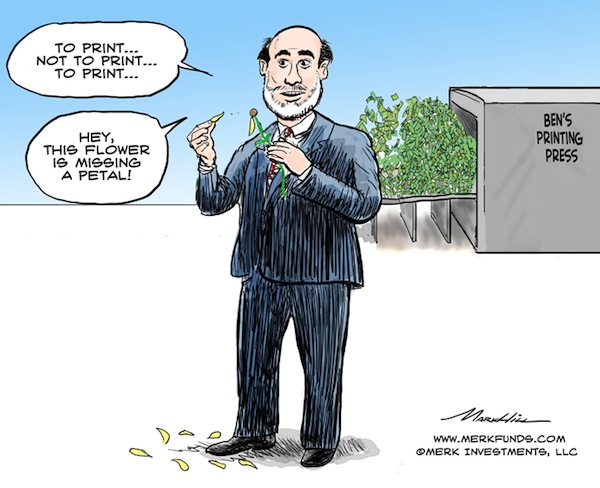
To print or not to print? Odds are that Fed Chairman Bernanke has been contemplating this question while drafting his upcoming Jackson Hole speech. The one good thing about policy makers worldwide is that they may be fairly predictable. As such, we present our crystal ball as to what the Fed might be up to next, and what the implications may be for the U.S. dollar and gold.

First off, we may be exaggerating: on process rather than substance, though. That is, Bernanke isn’t just thinking about whether to print or not to print as he is sitting down to draft his speech. Instead, he considers himself a student of the Great Depression and has been pondering policy responses to a credit bust for some time. Consider the following:

  • Bernanke has argued that going off the gold standard during the Great Depression helped the U.S. recover faster from the Great Depression than countries that held on to the gold standard for longer.
    • Bernanke is correct: subject to many risks, debasing a currency (which going off the gold standard was) can boost nominal growth. Think of it this way: if the government takes your purchasing power away, you have a greater incentive to work. Not exactly the mandate of a central bank, though.
    • Note by the way that by implication, countries that hold on to the gold standard invite a lot of pain, but have stronger currencies. Fast forward to today and compare the U.S. to Europe. While neither country is on the gold standard, the Federal Reserve’s balance sheet has increased more in percentage terms than that of the European Central Bank since the onset of the financial crisis. Using a central bank’s balance sheet as a proxy for the amount of money that has been “printed”, it shouldn’t be all that surprising that the Eurozone experiences substantial pain, but the Euro has been comparatively resilient.
    • Possibly the most important implication: Bernanke considers the value of the U.S. dollar a monetary policy tool. When we have argued in the past that Bernanke might be actively working to weaken the U.S. dollar, it is because of comments such as this one. This is obviously our interpretation of his comments; a central banker rarely says that their currency is too strong, although such comments have increasingly been made by central bankers around the world as those pursuing sounder monetary policy have their economies suffer from competitive devaluations elsewhere.
  • Bernanke has argued that one of the biggest mistakes during the Great Depression was that monetary policy was tightened too early. Here’s the problem: in a credit bust, central banks try to stem against the flow. If market forces were to play out, the washout would be severe and swift. Those in favor of central bank intervention argue that it would be too painful and that more businesses than needed would fail, the hardship imposed on the people is too much. Those against central bank intervention point out that creative destruction is what makes capitalism work; the faster the adjustment is, even if extremely painful, the better, as the recovery is healthier and stronger.
    • If the policy choice is to react to a credit bust with accommodative monetary policy, fighting market forces, and then such accommodation is removed too early, the “progress” achieved may be rapidly undone.
    • We are faced with the same challenge today: if monetary accommodation were removed at this stage (interest rates raised, liquidity mopped up), there’s a risk that the economy plunges right back down into recession, if not a deflationary spiral. As such, when Bernanke claimed the Fed could raise rates in 15 minutes, we think it is a mere theoretical possibility. In fact, we believe that the framework in which the Fed is thinking, it must err on the side of inflation.

Of course no central banker in office would likely ever agree with the assessment that the Fed might want to err on the side of inflation. But consider the most recent FOMC minutes that read:

  • An extension [of a commitment to keep interest rates low] might be particularly effective if done in conjunction with a statement indicating that a highly accommodative stance of monetary policy was likely to be maintained even as the recovery progressed

As the FOMC minutes were released three weeks after the FOMC meeting, many pundits dismissed them as “stale”; after all, the economy had somewhat improved since the meeting. Indeed, it wasn’t just pundits: some more hawkish Fed officials promoted that view as well. But to make clear who is calling the shots, Bernanke wrote in a letter dated August 22 (the same date the FOMC minutes were released) to California Republican Darrell Issa, the chairman of the House Oversight and Government Reform Committee: “There is scope for further action by the Federal Reserve to ease financial conditions and strengthen the recovery.” Various news organizations credited the faltering of an incipient U.S. dollar rally on August 24 with the publication of this Bernanke letter.

For good order’s sake, we should clarify that the Fed doesn’t actually print money. Indeed, printing physical currency is not considered very effective; instead, liquidity is injected into the banking system: the Fed increases the credit balances of financial institutions in accounts held with the Fed in return for buying securities from them. Because of fractional reserve banking rules, the ‘liquidity’ provided through this action can lead to a high multiple in loans. In practice, one of the frustrations of the Fed has been that loan growth has not been boosted as much as the Fed would have hoped. When we, and Bernanke himself for that matter, have referred to the Fed’s “printing press” in this context, referring to money that has been “printed”, it’s the growth in the balance sheet at the Federal Reserve. That’s because the Fed’s resources are not constrained; it’s simply an accounting entry to pay for a security purchased; that security is now on the Fed’s balance sheet, hence the ‘growth’ in the Fed’s balance sheet.

Frankly, we are not too concerned about the environment we are in. At least not as concerned as we are about the environment we might be in down the road: that’s because we simply don’t see how all the liquidity can be mopped up in a timely manner when needed. At some point, some of this money is going to ‘stick’. Even if Bernanke wanted to, we very much doubt he could raise rates in 15 minutes. To us, it means the time for investors to act may be now. However, talking with both existing and former Fed officials, they don’t seem terribly concerned about this risk. Then again Fed officials have rarely been accused of being too far sighted. We are concerned because just a little bit of tightening has a much bigger effect in an economy that is highly leveraged. Importantly, we don’t need the Fed to tighten: as the sharp selloff in the bond market earlier this year (and the recent more benign selloff) have shown, as soon as the market prices in a recovery, headwinds to economic activity increase as bond yields are rising. That’s why Bernanke emphasizes “communication strategy”, amongst others, to tell investors not to worry, rates will stay low for an extended period. This dance might get ever more challenging.

In some ways, Bernanke is an open book. In his ‘helicopter Ben’ speech a decade ago, he laid out the tools he would employ when faced with a collapse in aggregate demand (the credit bust we have had). He has deployed just about all tools from his toolbox, except for the purchase of foreign government bonds; recently, he shed cold water on that politically dicey option. Then two years ago, in Jackson Hole, Bernanke provided an update, specifying three options:

  • To expand the Fed’s holdings of longer-term securities
  • To ease financial conditions through communications
  • To lower the interest rate the Fed pays on bank reserves to possibly 10 basis points or zero.

We have not seen the third option implemented, but the Fed might be discouraged from the experience at the European Central Bank: cutting rates too close to zero might discourage intra-bank lending and cause havoc in the money markets.

As such, expect Bernanke to give an update on his toolbox in Jackson Hole. The stakes are high as even doves at the Fed believe further easing might not be all that effective and could possibly cause more side effects (read: inflation). As such, we expect him to provide a framework as to why and how the Fed might be acting, and why we should trust the Fed that it won’t allow inflation to become a problem. For investors that aren’t quite as confident that the Fed can pull things off without inducing inflation, they may want to consider adding gold or a managed basket of currencies to mitigate the risk to the purchasing power of the U.S. dollar.

Please sign up to our newsletter to be informed as we discuss global dynamics and their impact on gold and currencies. Please also follow me on Twitter to receive real-time updates on the economy, currencies, and global dynamics.

Axel Merk
President and Chief Investment Officer, Merk Investments
Merk Investments, Manager of the Merk Funds

Gold – The Escape From Slavery

By Axel Merk

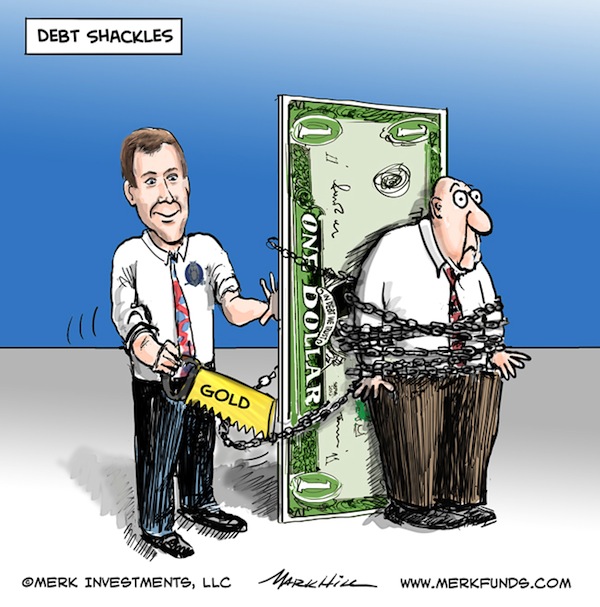
Vice President Joe Biden was accused of racism when suggesting a Romney administration would “unchain banks” that in turn might put the black audience he was talking to back into “shackles.” The political uproar overshadows a reality that knows no racial boundaries: a person in debt is not a free person; a nation in debt is not a free nation. Does it mean those with large bank accounts are free? Not so fast…

We don’t want to downplay the horrific crime of slavery, but want to provide food for thought: debt is often taken on voluntarily; once taken on, however, one is forced to work to pay off one’s debt. To be unshackled from banks and creditors, investors may want to consider living debt free and owning gold. Let us explain.

Chains and Dollar

Access to credit may fundamentally change one’s lifestyle. On the plus side, it opens the path to home ownership and access to capital goods, be that a car, or these days even a mattress or exercise machine. But it also makes the creditor, rather than oneself the boss. One symptom of the building credit bubble that caught my attention a decade ago was the rise of Spanish language billboards promoting mortgages. Proud immigrants in search of the American dream were lured into mortgages they could ill afford. Rather than focusing on feeding themselves and their family, the focus shifted to serving the bank. That shift only became apparent once the loan became too expensive to service, either because interest rates were resetting to higher levels or because someone lost their job and thus their income, but the debt remained.

Berkshire Hathaway CEO Warren Buffett famously discusses in his annual shareholder letters that the insurance business is a great business to be in, as policyholders pay him to hold money:

“Insurers receive premiums upfront and pay claims later. … This collect-now, pay-later model leaves us holding large sums — money we call ‘float’ — that will eventually go to others. Meanwhile, we get to invest this float for Berkshire’s benefit. …”

Indeed, Buffett has said that he would never allow his firm to be in a situation where he is at the mercy of banks. It doesn’t mean he will never borrow money. But it means that when borrowing money, he always wants to be in a situation where he could pay it back if needed. Consumers have seen all too often that they only qualify for a loan when they don’t really need it. Jamie Dimon, CEO of JPMorgan Chase has said responsible banks act like mothers: they will decline your loan request if it is too risky for you.

One cannot be a truly free person with debt. While bankruptcy may have been downgraded to a mere business transaction in the U.S., some countries continue to put those that can’t pay into prison. The neighborhood surrounding Dubai’s airport has seen thousands of abandoned cars, often Ferraris or other expensive vehicles, as the formerly rich fled the country after their fortunes turned to avoid debtors prison.

Anyone is likely to argue that a nice pile of cash in a bank account will make one feel financially secure – some place that pile at $100,000. Some at a million; as a million bucks isn’t what it used to be, the wealthy often say they are not comfortable if they don’t have $10,000,00 or more. We have met people with very modest means that feel that they are wealthy; and others that have lots of money, but don’t feel wealthy. Aside from the fact that some of them might simply have a distorted sense of reality, the wealthy often also carry a great deal of debt. Those able to manage their debt thrive in this low interest rate environment. But let even a wealthy person with debt hit a road bump, say lose a job (or face an obstacle in refinancing a loan) and such a person may quickly join the lower ranks of the 99%. In our assessment, highly accommodative monetary policy is a greater driver of an increasing wealth gap than the policies of either Democrats of Republicans.

But even with $100 in a bank account, what does one really hold? One owns a promise by the bank to pay $100. The $100 bill is a Federal Reserve Note; it’s a piece of paper issued by the Federal Reserve. That $100 bill could be returned to the Fed; in return the Fed would issue a credit balance to your account (you would have to go through a bank, as the Fed won’t open accounts for individuals). The “resources” of the Fed are without limit: through its various quantitative easing programs, the Fed has increased the credit balances of the financial institutions where it has purchased securities. The Fed literally creates money out of thin air, with the stroke of a keyboard. Even prudent central banks like to see a little bit of inflation; it means that the dollar bills you hold erode in purchasing power, giving you an incentive to put the money to work to make up for the shortfall.

Importantly, the $100 bill in your bank account is really someone else’s loan – the bank’s loan, the Fed’s loan. In fact, if you take out a loan from a bank, you will pay a merchant, who will in turn deposit the proceeds in his or her bank. As such, we talk about credit in a society. For simplicity’s sake, let the banks hold 10% in reserves; $100 in bank reserves with an offsetting $100 in demand deposit liabilities can thus be multiplied into $100 in bank reserves plus $900 in loan assets with an offsetting $1,000 demand deposit liabilities through the leverage of the fractional reserve banking system as banks lend and new deposits are made in a circular fashion. Between the Fed and the banks and the banks and their depositors the system can have a multiplier effect of about 100; that is, $100 created by the Fed can lead to $10,000 in credit. That’s why we sometimes call the credit created by the Fed (the monetary base) super credit. In the current environment, banks have not been aggressive in lending, and as such, we have not seen the “velocity” of money pick up. A key reason why many are concerned about the Fed’s increase in monetary base is because it has the potential to fuel inflation. Indeed, a key reason I personally hold a lot of gold is not because of the environment we are in, but because I am concerned about how all the liquidity that has been created might be mopped up one day. Federal Reserve Chairman Bernanke claims he can raise rates in 15 minutes; we think there may be too much leverage in the economy to have the flexibility when the time is needed; the political will to induce a severe recession to root out inflation may not be there.

It’s all about debt. So if one doesn’t want to have debt, what is one to do? The answer is real assets that are free of claims. Real estate held free and clear might be one answer, although keep in mind that governments tax real estate, thus making home owners tenants of the government. As the housing bust since 2008 has shown, the fact that many others owe a lot of money on their property changes the dynamics of this real asset.

The purest form of a debt free asset is gold. Gold is true money, the only form of money that isn’t someone else’s liability. While central banks might be able to lower the gold price by dumping their own reserves, central banks cannot print more gold – it’s very difficult to ramp up gold production. If your bank goes broke, if Greece goes broke, gold will still be there. Some call gold a relic from the past. To us, it’s the purest indicator of monetary policy, precisely because it has little industrial use. We created the cartoon below last year after CNBC’s Steve Liesman suggested to me on the air that gold might not be accepted in a store.

Cash vs. Gold

Mind you, we are not suggesting that everyone should sell all they own and buy gold instead. Everyone should consult with his or her financial adviser for specific investment advice. Specifically, one must be keenly aware of the volatility the price of gold can have relative to the U.S. dollar; given that we have a lot of our expenses in U.S. dollars, one has to be aware of the fluctuating value of the investment relative to the U.S. dollar. But we want to get investors to be keenly aware that we live in a credit driven society. We also believe that the developed world has made too many promises, too much debt has been issued.

Governments with too much debt may a) engage in austerity to pay off their debt; b) default outright; c) default though inflation. All scenarios suggest to us to hold assets that are debt free. We see gold playing a very important part in portfolios that take the risk into account that our policy makers continue to spend and “print” more money than is prudent. We don’t need actual money to be printed – credit creation through quantitative easing – is far more powerful.

Please sign up to our newsletter to be informed as we discuss global dynamics and their impact on currencies. Please also follow me on Twitter to receive real-time updates on the economy, currencies, and global dynamics.

Axel Merk
President and Chief Investment Officer, Merk Investments
Merk Investments, Manager of the Merk Funds

“Gold and Silver Heading Lower” – Classic Sign Of A Market Bottom

Yahoo Finance ran a story today entitled “Gold, Silver & Copper Are All Heading Lower.”  Nothing worth discussing about the specifics of the article – the real story here is that this a classic contrary headline seen at market bottoms, not tops.

What is the really smart money doing in the gold market as the mainstream press encourages John Q. Public to sell off his gold holdings?  Here’s a nice recap from The Economic Collapse:

When men like John Paulson and George Soros start pouring huge amounts of money into gold, it is time to start becoming alarmed about the state of the global financial system.

The amount of money that these men are investing in gold is staggering….

And the central banks of the world are certainly buying gold at an unprecedented rate as well.  According to the World Gold Council, the central banks of the world added 157.5 metric tons of gold last quarter.  That was the biggest move into gold by the central banks of the globe that we have seen in modern financial history.

But that might just be the beginning.

According to a recent Marketwatch article, there are persistent rumors that China has plans to buy thousands of metric tons of gold….

The gold bull market is far from over when two of the world’s most successful investors are increasing their gold holdings.  The price correction in gold since last summer has provided another excellent buying opportunity for long term investors.

More on this topic:

Why There Is No Upside Limit For Gold and Silver

Why Higher Inflation and $5,ooo Gold Are Inevitable

The Federal Reserve Can’t Produce Oil, Food or Jobs But They Will Continue To Produce Dollars

Ultimate Price of Gold Will Shock The World As Loss Of Global Confidence Leads To Economic Collapse

Gold Bull Market Could Last Another 20 Years With $12,000 Price Target

New Gold and Silver Baseball Commemorative Coins Highlight Lack Of Innovation By U.S. Mint

How Congress Stifles Innovative Coin Designs By U.S. Mint

Ever wonder why the U.S. Mint shows a lack of innovation in coin design compared to other world mints?  Here’s part of the reason as detailed by Mint News Blog:

Many coin related bills are introduced each year, but only a small number become law. In order for a bill to become law, it must be passed by both the House and Senate and then signed into law by the President. Under Congressional rules, two-thirds of each body must co-sponsor a bill before it is even put up to a vote, which is the hurdle that many bills cannot meet. Another rule limits the number of commemorative coin programs to only two per year.

The most recent bill to become law was the National Baseball Hall of Fame Commemorative Coin Act. The bill H.R. 2527 was introduced on July 14, 2011, passed in the House of Representatives on October 26, 2011, passed by the Senate on July 12, 2012, and signed by the President on August 3, 2012.

The program calls for the minting and issuance of up to 50,000 $5 gold coins, 400,000 silver dollars, and 750,000 clad half dollars in recognition and celebration of the National Baseball Hall of Fame. These coins will be issued only during the one-year period beginning on January 1, 2014.

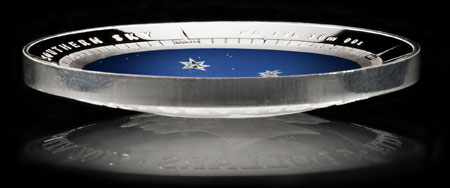
Mint New Blog goes on to discuss how the coin design will be unique with the reverse of the coin made convex and the obverse concave to enhance the resemblance to a baseball.  The coin may resemble a recently produced dome shaped coin issued by the Royal Australian Mint as shown below.

The commemorative baseball coin would represent the first innovation in coin design by the U.S. Mint since 2000 when the Library of Congress $10 coin was produced, which was the first and only US Mint bimetallic coin.  While the new baseball coin will certainly increase public interest in precious metal coins, Congress should grant the U.S. Mint more latitude to produce a wide variety of innovative coins without an onerous legislative process.

How To Avoid Financial Fraud In The Gold Market

By Vin Maru

Financial Alchemy and Fraud In Gold

The gold bull market is alive and well as the summer doldrums come to a close and gold accumulation and trading starts to heat up going into the fall.  As the gold bull market matures and it draws more attention from investors all around the world, it does open up the doors for fraud.  By now we have heard many stories and accusations about manipulations by central planners, bullion banks, short-sellers and futures traders.  The regulators in the West have largely ignored these accusations and have looked the other way when it comes to oversight and creating a fair and legal market place for precious metals.

Financial Fraud in the Gold Market

When it comes to opportunity for fraud, the East is not innocent either.  Last month, police in Central China rounded up 33 people suspected of illegal gold-futures trading.  The case involved 5,000 investors and at least 380 billion Yuan ($59.62 billion) in which the suspects claimed to be agents of overseas companies dealing in London gold with the promise of huge returns.  They promoted investments in Loco London gold and charged exorbitant consulting fees without warning investors of the risks of these transactions or having a signed detailed contract.  This had been going on since October 2008 in a low key operation using private bank accounts, mobile phones and online messaging services.  Several suspects were caught and detained since March 2, 2012 while more arrests are expected to be made across China as the investigation continues.

As observers of the precious metals market, we know that many Eastern central banks are accumulating physical gold.  It is in their best interest to accumulate the physical metal and diversify out of toxic Western paper assets that were sold to them by the western financial puppet masters.   It is obvious that Western cartels like Goldman Sacs and JP Morgan are great at creating and selling financial instruments of mass destruction.

One only has to look at the CDO market or the mortgage backed securities sold in the past decade.  These paper products were backed by mortgages from over inflated real estate bought by people who could not afford to buy property and were thus set up to fail.  Another example is the derivative market which is reportedly over $600T worth of contracts used for “hedging” all the toilet paper assets sold by Western institutions.  This includes derivatives and “insurance” products to protect from default or significant changes in valuation on assets such as government bonds, interest rates & credit default swaps and most other paper assets.  There is no way these contracts are backed by any real asset and when they are called to perform, the system will collapse.  This is most likely why they changed the name and structure of the recent Greek default on bonds; they cannot afford to trigger the derivative time bomb.

Any observer of the financial markets can see that the derivative market is just an insurance scam being sold as a hedging tool for paper products.  They cannot and will not every pay out on derivatives because the cascading effect would bring down the system.  Yet the paper pushers are still selling these “contract assurances” in volumes in order to create a “financial hedge” of the entire system.    When push comes to shove, planners may not let Goldman or JPM collapse because they are TOO connected to fail and they are the ringleaders in pushing paper products for the world to buy in their pump and dump scams.

Masters of Alchemy – Turning Paper in to GOLD

This past week, it was reported that George Soros was unloading investments in major financial stocks and started investing back in gold by way of GLD.  We always question the choice of investment vehicles used by large fund managers.  As a investor in the gold sector, why wouldn’t anyone stick with the physical metal vs. an ETF such as GLD which is supposedly backed by gold?  There have been lots of questions around GLD and its physical holdings, which was primarily sold by JP Morgan, one of the many bullion banks with a questionable short position in the precious metals market (Silver in particular).  If the past decade is any indication of paper manipulation (and they are known to have a track record for selling paper products which turn out to be fraudulent), why would anyone buy an ETF like GLD from these Masters of Financial Alchemy when they have the proven ability to turn paper into gold?

When looking at GLD and the many other “un-backed” gold trading vehicles being sold into the market, these products are very questionable on how much gold they have held on storage or available for delivery.  Even if there was significant amounts of gold, with the lack of good auditing practices, who knows how much is really owned by the fund.  Much of it could be used as collateral, hypothecated, leased out or swapped in contracts by the issuers of these products.  When called to perform and deliver the gold, expect questions of ownership and scandals much like MF Global or PFGBest.  This is the nature of products created by the Wall Street paper pushers; everything should be questioned eventually.  But for now and most of this bull market, GLD will not be questioned or audited.  It will be used as another tool for selling an ETF in a particular asset class, one that will become more and more in demand as the bull market for gold evolves.  This ETF will be used by the likes of all major trading houses, funds, sovereigns and investors because it is a trading vehicle and a proxy for gold, and it could be used for hedging purposes much like the derivative market.

Going back to why Soros would invents in such a fund:  Our suspicion is that Soros is reducing exposure in financials because they have structural problems and have many questions surrounding the assets they hold.  While a $50M withdrawal is not much for a fund his size, a purchase of $130M in GLD is significant.  His strategy is probably to take these funds and go long on GLD as a hedging tool for the exposure he still has remaining in financials.  Soros is just being smart and realizing that he must hedge using gold, even if it has to be with GLD.  He knows the paper pushers need GDL as a tool for hedging, so do not expect it to collapse anytime soon.   This means more than likely that the “Masters of Financial Alchemy” such as JPM Morgan and Goldman Sacs will continue to sell paper with promises of gold backing and it will get accepted by the market as “Good as Gold”. We at TDV, however, know better.

At this point, it is a very wise move for anyone who doesn’t have any exposure to gold to start getting exposure immediately.  If you have not taken this necessary step to protect your assets and hedge against any potential financial storm that may be brewing, you are placing yourself and any remaining assets at risk.  Owning the physical is always suggested as a private investor, but if need be look at GLD as a trading and hedging vehicle.

In a strange and ironic way, we need GLD to continue its paper scams as it still legitimizes gold as an investible asset class.  The more GLD grows and continues to gain attention, the stronger and longer this bull market will last in precious metal.   As much as we realize that GLD could be a scam and owning the physical is the prudent thing to do, we cannot discount the need for GLD as a tool for hedging.  There is no way the physical market for gold can absorb demand coming from central banks, pension funds, sovereigns and the general investing public all at the same time.  It would make gold reach sky high prices in very short order which would not be healthy for a strong and long gold bull market.  Unfortunately, we need GLD and more gold ETFs around the world.  There is way too much fiat paper floating around and much more coming, the physical market couldn’t absorb this amount of funny money coming into the physical sector.  As much as I hate to say this, GLD is a necessary evil for the longevity of this bull market.   There is many more reason why we need more gold backed ETFs and products such as GLD mentioned above, however using this ETF as a hedging tool is a very important one.

In the near future we will look at additional reasons for owning gold through the various ETFs as a tool for trading and hedging.  We will also explore the various options available for owning paper or physical gold in the numerous ETFs around the world.  This information will be made available on our blog to everyone interested in evaluating gold specific ETFs. If you enjoyed reading this article and are interested in protecting your wealth with precious metals, you can receive our free blog by visiting TDV Golden Trader.

Platinum Soars $78 On Week As Bodies Pile Up In South Africa

South Africa continues to be wracked by violence as striking platinum mine workers clash with police.   In a confrontation between police and striking mine workers, a gunbattle resulted in the shooting deaths of 34 miners.

The center of the violence is at the Lonmin mine which suspended most production earlier this week when violence between rival labor unions resulted in the deaths of 10 miners.  The Lonmin mine is the world’s third largest producer of platinum.  South Africa is virtually the world’s sole source of platinum accounting for over 75% of total production.

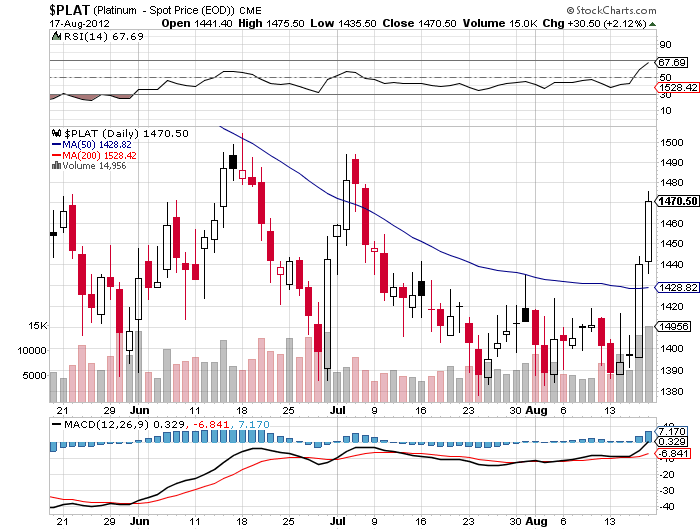
As discussed in a previous post, the initial strike and violence at the Lonmim mine had virtually no impact on the price of platinum.  The majority of demand for platinum comes from the automobile and jewelry industries, both of which have seen weak demand due to a slowing world economy and outright recession in most of Europe.   In addition, a surplus stockpile of 4.5 million ounces of platinum, representing almost a year’s worth of demand has served to depress prices.

The time to buy often comes when there is no apparent reason to buy.   In “Platinum Perspectives – Time to Buy or Will The Bears Win?“, we argued that the steep $500 per ounce price decline since last year had already discounted reduced demand for platinum as well as the surplus stockpiles. Despite the apparently worsening fundamentals, platinum refused to drop decisively below $1,400 and rallied every time the price dipped below $1,400.

courtesy stockcharts.com

Even more intriguing was the fact that hedge funds had established the largest short positions is history in the futures market.  The crowd was definitely leaning in one direction.  Any news of further supply disruptions or an increase in demand for platinum would force bearish shorts to cover, resulting in sharply higher prices.  That is exactly what happened this week as fears spread that the increasing violence between police and striking platinum miners would result in further mine shutdowns.

Platinum soared by $78 on the week to close in New York trading at $1,479.

Will the unrest in South Africa spiral out of control?  As the world economy continues to get worse, social unrest has spread from one country to another resulting in toppled leaders, bloodshed and civil wars.  South Africa is a potential hotbed for social unrest and violence with a 25% unemployment rate, 50% of the population living below the poverty line and 50% of those under the age of 35 unemployed.

Prior to the violence at the Lonmin mine, miners had been on strike earlier this year for six weeks at Impala Platinum mine resulting in lost production of 120,000 ounces of platinum.  Unless the authorities and mine management can quickly contain the violence at the platinum mines, unrest could quickly spread to other mining operations and throughout South Africa.

South Africa is also a major gold producer ranking 5th in the world.  Although South African gold production recently declined to a 90 year low, annual production during 2011 was 190 tonnes, representing almost 8% of total worldwide annual gold production of about 2,500 tonnes.  South Africa’s annual production of gold declined from 400 tonnes in 2001 to only 190 tonnes in 2011, due to lower grade ore deposits and depletion of existing mines.

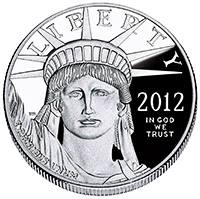
Proof American Platinum Eagles can be purchased by consumers directly from the U.S. Mint.  The U.S. Mint recently announced that production of the 2012 Proof American Platinum Eagles will be set at 15,000 coins.  The Mint has been producing the proof platinum eagle coins since 2009.  Initial pricing per coin for the Proof American Platinum Eagles was set at $1,692.

Gold Could Soar When Canadian Housing Bubble Bursts

By Vin Maru

Bank of Canada may be ahead of all its peers in ensuring its banks meet the Basel capital requirements. And it may have done a better job in regulating the banking sector, but they are not innocent of allowing bubbles in Canada to form.  Even Mark Carney feels that the housing market is overheated. Carney made recent comments about the health of Canadian banks.

As for Canada’s banks, Carney said they may have some exposure to record household debt levels and the overheated housing market, but he noted that high risk mortgages are insured by the federal government.

The Canadian real estate housing bubble still seems to get inflated in some major cities like Toronto.

I recently heard a story of someone who bought a house pre-construction for $701K about 18 months ago. The house is now selling for $850K by the builder.  Let’s say the buyer put down 25% or about $180K.  Their $180K investment in the house provided a $149K return, or 82.78% profit on paper already in less than a year and a half.  Annualized, this is a 55.19% return on the initial investment thanks to buying pre-construction, which is something you still don’t get in the regular real estate market by trying to buy and flip already built homes.

But even the homes that are already built and occupied are keeping up with real inflation.  It still seems the average house is rising by 5% a year.  Let’s say you own a modest $400k starter house in the suburbs, and have 25% down, or $100K.  The house value is going up 5% a year or $20K/year on a $400K home, this would mean your equity portion of $100K is now worth $120K after one year and on paper, you just made 20% ROI on your house.  The cost to carry a $300K mortgage at a 4% interest rate is about $12k if you’re paying just on a straight home equity line of credit (interest only).  Even if you add $3000 for taxes, the cost of living in that house is only $15k a year. Yet your investment appreciates by $20K.  So essentially, putting $100K down to buy a house, the Canadian market is paying you on paper $5K net (which is almost the same as the inflation rate) to live in a house for free.

Under this scenario, your initial investment in the house earns you the same rate as inflation, so your purchasing power of that investment remains constant.  But because the value of the house is rising by 5%, the house price at $400k is rising by $20K a year of which $5k or 25% can be attributed to your investment ($100K down payment) and $15k or 75% is the bank’s mortgage. However, the banks portion of $15K appreciation does not go to them directly. It’s attributed to the market value of your house “on paper” and you are just making payments to them by way of $12K/year interest payments.  So you pay the bank’s interest payments of $12K/year on real money you must first earn from hard labour and in return the inflation of the housing price pays you $20K a year on paper.  Under this system, the paper inflation of the housing bubble is allowing a homeowner to live for free in that house and still make about 5% on your initial investment.  What a great system we have in Canada, where the ongoing housing bubble is allowing the homeowner to live for free and pays him a return on his initial investment, which keeps up with inflation!

This scenario is a win-win for all parties involved.  The homeowner lives for free (on paper) and earns a 5% return on their initial investment.  The banks get paid 4% a year by issuing a mortgage almost out of thin air under fractional reserve and fiat banking.  The government earns property taxes, income taxes, VAT and whatever other tax scams they create to steal wealth from the citizens. The only person who doesn’t win under this scenario is a person who doesn’t have enough down to pay for the deposit of an inflated house.  But then there is a cure for that too.

The Canadian gov’t also has a program for insuring mortgages for people who can’t put enough down for a house.  It’s called the Canada Mortgage and Housing Corporation (CMHC), similar to Freddy and Fanny down in the United States. So we don’t have to worry about these people not being able to afford a house.  Their high-risk mortgages are insured by the federal government, which means the Canadian taxpayers are on the hook if the housing bubble ever burst (see Mark Carney’s statements above).  Of course, Mark Carney is totally encouraging this privatization of benefits and socialization of costs.  He is guaranteeing this boom will continue by leaving interest rates low in order to keep interest payments low on Canada’s growing debt and help the export economy by preventing a stronger Canadian dollar.


Good Intentions Create Bad Behaviours

While the concept of owning a house sounds good, especially given the housing inflation scenario above, is it really sustainable?  The record debt levels by Canadians are on average just as high as all other western nations.  The average salary or wage earnings are not rising and in a world of global competition the westerns salaries should continue to deteriorate with economic slowdown.

The artificial affordability of houses despite inflated prices makes it more difficult to enter the real estate market as a first time home buyer.  Why?  Everyone is now a real estate investor because it keeps rising in certain markets, thus pushing the prices higher and fuelling the boom.  Given the scenario above, why not become a real estate investor?  On paper, you get paid to own a house and the prices keep rising as more and more investors continue to bid up real estate.  The average Canadian real estate investor now owns multiple properties which were acquired with very little down and they’ve made out a like bandits while prices keep rising. And then there’s the fact they can collect rent from people who can’t afford to buy inflated houses.

The real estate agents are also making out like bandits in the Canadian real estate boom.  Many of them were buyers in preconstruction deals, so they bought really cheap and saved on the real estate commission.  They also cashed in from the buying and selling real estate for clients and lately their job has never been easier. They simply list the homes on the MLS and collect commissions with very little effort on their part since the houses and condos literally sell themselves in a real estate boom.  The agents on average are making 5-6% helping investors buy and sell houses as an investment, so their motive to keep the boom going is clear.

With rising and elevated home prices, their incomes continue to rise as long as the boom continues.  With the advent of technology such as the internet and MLS, their job is even easier.  An average $500K home yields $25K in commissions at a 5% rate, which is split between the buying and selling agent.  This is a great payday for simply listing a house on the MLS, then doing a one day showing and waiting for a willing and eager buyer to show up (which is not difficult in boom times).  Then do some simple paperwork to close the deal.  Being a real estate lawyer surely doesn’t pay off like that, however.  Real estate lawyers only make about $1500 for either involvement in the transaction. They are definitely in the wrong field.

All this goes back to a question we have been asking for years.

How Long Can The Real Estate Boom In Canada Last?

The real estate boom will last as long as we have the same environment that created and maintains this boom lasts. We still have low interest rates, a stable and strong economy and buyers believing that real estate prices will continue to rise. This real estate boom in Canada has gone on much longer than we would have thought, but here we are and the prices are still trending higher.  The boom will last until there is triggering event that will turn it into a bust.  All booms and busts are usually created by a triggering event which is mostly a result of central bank actions such as the increase or decrease of the money supply or interest rate manipulation.

The housing boom in the US came after the tech bust and a drop in interest rates and a loosening of lending policies.  The US real estate bust came with the subprime scandal.  The US bankers’ fraud in bundling mortgages came to light and blew up in their faces.  Who paid for that bust?  Everyone in the world paid for it with the financial meltdown we saw in 2008. Since then most real estate markets around the world have gone bust.  In fact I can’t think of many countries around the world that haven’t had a decent correction in real estate.  Most have corrected or are in the process of correcting.  Yet certain markets in Canada seems to defy economic gravity. These Canadian real estate markets haven’t gotten sucked down like the rest of the world.

Why?  Because no one is willing to prick this bubble.  After all it’s a win-win for everyone.  The investor wins with appreciation on their investment and gets to live for free.  The banks win with continued interest revenues.  Government win with continuous tax revenues.  The central bank looks like a hero for maintaining a stable banking system and everyone working in the industry wins with continuous record incomes and commission.  Why would anyone want such a wonderful party to end?

While there have been some recent efforts to contain the bubble, such as higher deposit requirements and shortening of the amortization period of mortgages, that doesn’t seem to be enough of a deterrent to cool down the real estate bubble.  For the most part, having the low interest rate policy still makes being a real estate investor a profitable endeavor, especially if the properties can continue to provide cash flow.  The investor in real estate still wins because he makes good cash flow from a renter who cannot afford to buy at these prices and so must pay rent, which goes to paying off the investor’s mortgage.  If a first time homeowner is able to scrape up the 10% deposit and get the CMHC, he will most likely buy even at these inflated prices because he has very little choice… either he is paying inflated rental prices or inflated home prices.  His income has not risen significantly, but he is still forced to pony up a higher percentage of his income just to live in Canada because of the inflated real estate prices.

This turns out be a vicious cycle that benefits only the investor/owners/bankers/government and everyone else who is involved in gaming the system with ever increasing real estate prices.   As a result of this inflationary real estate policy the percentage of income that goes toward rent or homeownership keeps rising for new entrants to the market.  If you purchased a home a while ago, you are fine.  But good luck to a young couple or a new immigrant who is looking to be a first time home buyer.  They have been priced out of the market by everyone that has an interest in keeping the real estate inflation game alive and well.  Frankly, they should have gotten into the real estate racket earlier on in the cycle.


Canada’s Ponzi Real Estate Market

Like most bubbles or ponzi schemes, the real estate bubble will continue as long as new entrants/buyers are willing to buy from the people who got in earlier.  When it comes to investing, asset prices will continue to rise as long as there are new entrants to the market and the belief holds that the asset class will continue to reward everyone involved.  Real Estate is probably the most heavily invested asset class there is in Canada so everyone involved would love to see the status quo maintained.  As long as you are involved in the ponzi scheme and it continues to pay you, you have no motivation in wanting to see it collapse.

For someone who is new to the RE market as an investor, my suggestion is to look at other markets or countries which have already corrected.  You will find much more value than in Canada’s over inflated RE market.  The ponzi scheme here still continues and you don’t want to be the investor stuck at the bottom of the pyramid with an over inflated investment hoping to sell it to some other sucker later on down the road.  What happens if that sucker wises up and realizes he is being played for a fool in a market that continues to get inflated because it’s rigged to benefit only the people already involved?

The other real estate ponzi schemes around the world have already busted, but Canada’s real estate market continues to inflate because no one is willing to burst it.  When it comes to a world of ponzi investing with fiat paper, you want to be at the top of the next great ponzi scheme.  You want to be rent/income collector and not the payer.  It’s tough entering today’s RE market in Canada as in investor.  You would be at the bottom of the ponzi pyramid, so your chances of success get limited.  In fact there is a lot of evidence that the ponzi real estate market in Canada is already popping.  It seems like a few pockets of RE such as Vancouver and in Alberta are already cooling off, more so because they got way more over inflated than the average real estate market during the commodities boom and influx of money from China.  Yet many areas in southern Ontario and especially GTA Toronto are still seeing price rises similar to the scenario mentioned above. Still, these markets are probably closer to busting than continuing down this ponzi path.

In a world where central banks create booms and busts, you are better off finding another ponzi scheme they are creating and get in early.  The real estate market in Canada may continue to rise, but in our opinion you are already too late to this party and more than likely it is ready to burst.   If you are heavily invested in real estate, you may want to take profits while they are still available or create a hedge.

The central banks and governments around the world have created another massive bubble in the government bond market which continues to grow.  This will most likely be the next bubble that will pop in the next few years.  Once it starts bursting, easy profits will be made shorting the bond market, something we will keep readers aware of when the time looks right.  Once this bond market starts to burst, we expect the gold market will start rising significantly.  While many media outlets claim that gold is in a bubble, it has not even come close to bubble territory.  The average investor hasn’t even considered gold as an investible asset class. He doesn’t own any and probably hasn’t even considered owning any.  This will all change and everyone will rush into gold over the coming years once the government debt bubble bursts.  While one bubble bursts (bonds), money rushes into another asset class and the only bubble that hasn’t been fully inflated is precious metals.

If you enjoyed reading this article and are interested in protecting your wealth with precious metals, you can receive our free blog by visitingTDVGoldenTrader.

Cheers,

Buy The SPDR Gold Trust – You Don’t Argue With Paulson and Soros

Despite the correction in gold prices since last summer, investors in gold ETFs have increased their stakes.  Worldwide holdings of gold ETFs are now at a record 2,417 metric tons according to Bloomberg News.

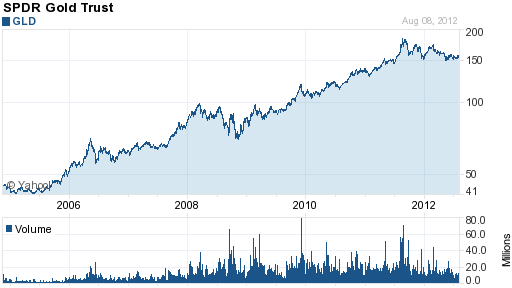
The SPDR Gold Trust (GLD) is the largest gold ETF and has returned a lustrous annual return of 18.4% since the fund’s inception on November 18, 2004.  The GLD currently holds 1,258.15 tonnes (40.45 million ounces) of gold in trust valued at $64.8 billion.  The all time record high holdings of the SPDR Gold Trust was 1,320.47 tonnes on June 29, 2010.

The slight decline from record gold holdings of the GLD do not represent a lessening of gold demand by investors.  Numerous competing gold trusts such as the iShares Gold Trust (IAU) which holds $9.3 billion of gold bullion have simply given investors a wider choice of options and expanded the overall market for gold ETFs.

Word that two of the world’s most successful investors have increased their stakes in the SPDR Gold Trust highlight the fact that the bull market in gold is far from over.   Billionaires John Paulson and George Soros, both long time investors in the GLD , both recently increased their holdings.

Courtesy yahoo finance

While Paulson has increased his massive stake in the GLD over time, Soros attempted to time the market.  In the first quarter of 2011, Soros sold 4.7 million shares of the GLD which brought his holdings down to a token 49,400 shares.  Subsequent to his sale, gold soared about $500 per ounce higher to $1,900 during August 2011.  Short term trading is difficult for anyone, including one of the world’s most successful investors.  Since the fundamental reasons for owning gold have only become more compelling, small investors would be best advised to hold long term instead of trying to trade a temporary price pullback.

Courtesy kitco.com

According to Bloomberg, Paulson and Soros Add Gold As Price Declines Most Since 2008.

Billionaire investors George Soros and John Paulson increased their stakes in the biggest exchange- traded fund backed by gold as prices posted the largest quarterly drop since 2008.

Soros Fund Management more than doubled its investment in the SPDR Gold Trust to 884,400 shares as of June 30, compared with three months earlier, a U.S. Securities and Exchange Commission filing for second-quarter holdings showed yesterday. Paulson & Co. increased its holdings by 26 percent to 21.8 million shares.

Paulson, 56, who became a billionaire in 2007 by betting against the U.S. subprime mortgage market, lost 23 percent in his Gold Fund through July as lower bullion prices and slumping mining stocks contributed to declines.

Still, prices have rallied for 11 consecutive years, gaining more than sevenfold, as investors snapped up the metal after government and central bank stimulus programs boosted speculation that inflation would accelerate. The metal is up 2.4 percent this year.

“People expect prices to rise in the third quarter since historically it has been proved that it’s one of the best periods for gold, and investors who see easing coming in from various central banks are either increasing or holding on to their positions,” Donald Selkin, the New York-based chief market strategist at National Securities Corp., which manages about $3 billion of assets, said by telephone.

Paulson’s increased stake in the GLD should come as no surprise.  In a previous post during July, it was noted that Paulson remained steadfastly bullish on gold with a $4,000 target.