April 6, 2026

Two Masterpiece Gold and Silver Medals

Precious metal investors who have a deep appreciation for the artistry of gold and silver coins are likely to be blown away by the latest medals issued by the Royal British Mint.

As reported by World Mint News Blog, the Royal Mint has issued two magnificent gold and silver medals that showcase the skill and craftsmanship of mint engravers.  Both coins have extremely limited mintage with the gold medal issue limit set at only 25.  The purchase price of the gold medal is £23,500.00 or $36,843.  I would expect both of these low mintage medals to be priced substantially higher in the secondary market if they ever become available for sale.
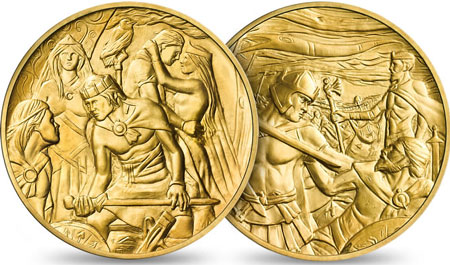
The obverse of the medal depicts Arthur as a Warrior King defeating the Saxons as Merlin stands in the background. The battlefield is shown with mist and smoke rising into the air and the dragon flags planted by the cavalry symbolizing victory. The reverse depicts Arthur as a wounded and defeated King offering his sword Excalibur to his Knight Bedivere. In the background appear Arthur’s wife Guinevere embracing Lancelot and Arthur’s half sister Morgana holding her staff with a raven atop.
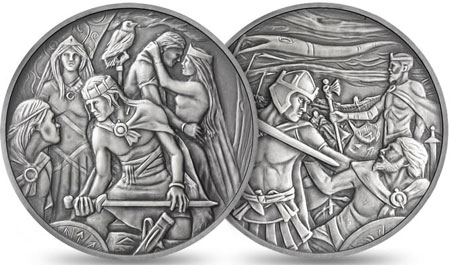
Both the gold and silver medals feature the same intricate design and are struck in high relief. Both are oversized to provide a large canvas for the work. The .999 silver coin has a weight of 250 grams (8.04 troy ounces) and diameter of 80 mm. The .999 gold coin has a weight of 313 grams (10.06 troy ounces) and diameter of 65 mm.

As might be expected, these are extremely limited in mintage and premium priced. The silver medal has an issue limit of 500 and is £695.00, and the gold medal has a limit of just 25 and is priced at £23,500.00. The product pages can be found here and here.

The U.S. Mint should pay attention to the artistry of coins produced by other world mints.  Imaginative new gold and silver coin designs by the U.S. Mint would not only be appreciated by numismatists but would probably broaden investor interest in standard gold and silver bullion coins.
Ron Paul – “U.S. Treasury Guilty of Counterfeiting Dollars”

When Ron Paul retires after his current term in Congress, one of the most notable voices for a sound currency and protection of civil liberties against a despotic government will be gone from the official Washington scene.  Although Paul was never able to rein in a government that assumes more power over our lives with each passing minute, his warnings gave Americans the opportunity to understand the threats to their financial future and personal liberties.
What may be one of Ron Paul’s last legislative efforts is his campaign to allow competing currencies in the United States in order to break the monopoly on money by the Treasury and Federal Reserve.

I recently held a hearing in my congressional subcommittee on the subject of competing currencies.  This is an issue of enormous importance, but unfortunately few Americans understand how the Federal Reserve and Treasury Department impose a strict monopoly on money in America.

This monopoly is maintained using federal counterfeiting laws, which is a bit rich.  If any organization is guilty of counterfeiting dollars, it is our own Treasury.  But those who dare to challenge federal legal tender laws by circulating competing currencies– at least physical currencies– risk going to prison.

Like all government created monopolies, the federal monopoly on money results in substandard product in the form of our ever-depreciating dollars.

Yet governments have always sought to monopolize the issuance of money, either directly or through the creation of central banks. The expanding role of the Federal Reserve in the 20th century enabled our federal government to grow wildly larger than would have been possible otherwise.  Our Fed, like all central banks, encourages deficits by effectively monetizing Treasury debt.  But the price we pay is the terrible and ongoing debasement of our money.

Allowing individuals and business to use alternate currencies, especially currencies backed by gold and silver, would expose the whole rotten system because the marketplace would prefer such alternate currencies unless and until the Fed suddenly imposed radical discipline on its dollar inflation.

Sadly, Americans are far less free than many others around the world when it comes to protecting themselves against the rapidly depreciating US dollar.  Mexican workers can set up accounts denominated in ounces of silver and take tax-free delivery of that silver whenever they want.  In Singapore and other Asian countries, individuals can set up bank accounts denominated in gold and silver.  Debit cards can be linked to gold and silver accounts so that customers can use gold and silver to make point of sale transactions, a service which is only available to non-Americans.

The obvious solution is to legalize monetary freedom and allow the circulation of parallel and competing currencies.  There is no reason why Americans should not be able to transact, save, and invest using the currency of their choosing.  They should be free to use gold, silver, or other currencies with no legal restrictions or punitive taxation standing in the way.  Restoring the monetary system envisioned by the Constitution is the only way to ensure the economic security of the American people.

After all, if our monetary system is fundamentally sound– and the Federal Reserve indeed stabilizes the dollar as its apologists claim–then why fear competition?  Why do we accept that centralized, monopoly control over our money is compatible with a supposedly free-market economy?  In a free market, the government’s fiat dollar should compete with alternate currencies for the benefit of American consumers, savers, and investors.

As Austrian economist Ludwig von Mises explained, sound money is an instrument that protects our civil liberties against despotic government. Our current monetary system is indeed despotic, and the surest way to correct things simply is to legalize competing currencies.

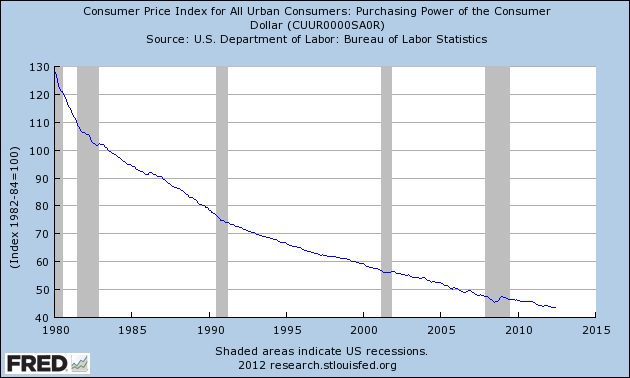
Ron Paul is routinely dismissed as a naif by the Federal Reserve and Treasury.  Yet a quick look at the  chart of the purchasing power of the U.S. dollar (published by the St. Louis Fed) proves the legitimacy of Ron Paul’s concerns.  Federal Reserve policies have resulted in the systematic destruction of the purchasing power of the consumer dollar.

Will Ron Paul be successful in his quest to legalize a competing U.S. currency?  Let’s look at Paul’s track record.

Of the 620 bills that Paul had sponsored through December 2011, over a period of more than 22 years in Congress, only one had been signed into law – a lifetime success rate of less than 0.3%.   The sole measure authored by Paul that was ultimately enacted allowed for a federal customhouse to be sold to a local historic preservation society (H.R. 2121 in 2009).

Although Ron Paul’s crusade against corrupt government and the Federal Reserve is a losing battle, the value of his message is invaluable.   Ron Paul has seen the future of constant U.S. dollar debasement and positioned his personal portfolio heavily into gold and silver – something that the average American should think about.

Platinum Perspectives – Time To Buy Or Will The Bears Win?

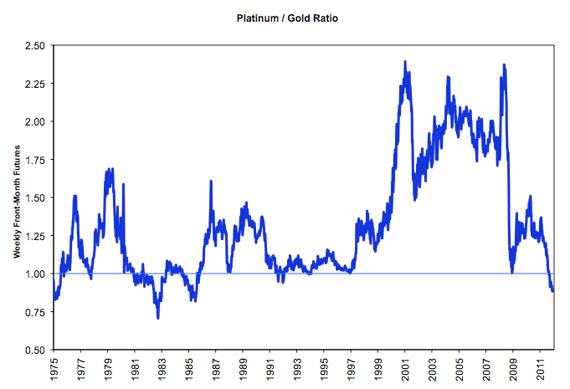
We last examined the dynamics of the platinum market in February when the platinum to gold ratio had declined to levels last seen over two and a half decades ago.

Platinum has extremely volatile price fluctuations due to the fact that 90% of platinum demand is fueled by industrial use and jewelry sales.  A weak economy can send the price of platinum plunging as was the case in 2008 when the metal lost almost two thirds of its value.   Purchases of jewelry and cars (which require platinum for catalytic converters) are two of the most readily postponed purchases by consumers during a steep recession.

Besides its traditional uses, it now seems that platinum is taking on a new role as a way to profit from further weakness in the European economy.  Bearish hedge funds are betting on further declines in platinum prices due to worsening economic conditions in Europe.   The Wall Street Journal reports that hedge funds have established the largest short positions ever in the future markets with the expectation that falling car sales will drive the price of platinum lower.   The Journal notes that new car registrations have declined by almost 8% this year.  Since almost a quarter of annual platinum demand comes from Europe, hedge fund managers have concluded that weak demand will result in lower platinum prices.

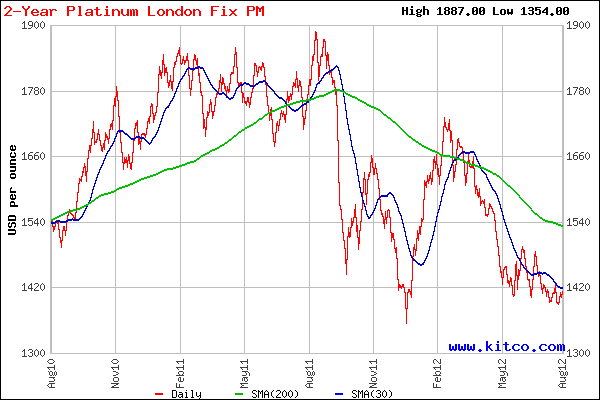
With almost everyone leaning in the same direction, will the sudden epiphany by hedge funds on platinum’s future price direction prove correct?  Europe’s deep economic problems are old news and if we examine the price charts, declining platinum demand may already be discounted.  Last summer, when Wall Street finally took serious notice of Europe’s crumbling economic prospects, the price of platinum plunged from a high of almost $1,900 to $1,354 by the end of 2011.

Courtesy: kitco.com

Here’s where the price action in platinum gets interesting.   The economy in Europe has become remarkably worse since last year, with country after country in outright depression (think Greece, Portugal, Spain) and the rest of Europe sliding into recession.  Despite the rapid deterioration of Europe’s economy during 2012, the price of platinum has not broken through the lows set last year.

Here are some pros and cons to consider before joining the bearish crowd on platinum.

  • The vast majority of platinum deposits are in South Africa and annual production is only about 30 tonnes per year.  By way of comparison, gold mining production is about 2,800 tonnes per year.
  • Investment demand for platinum constitutes only about 10% of annual demand.
  • The gold to platinum ratio is at the lowest since 1985, which may or may not mean very much.  Platinum is primarily an industrial metal whereas gold is a currency substitute or monetary metal.  Probably the only conclusion one may draw by viewing the long term platinum to gold ratio is that, on a long term basis, platinum turned out to be a good investment in the 1:1 ratio range.

  • By the time the average investor hears from the mainstream press about hedge funds betting en masse against platinum, it is probably a safe bet that you are late to the party.
  • Although platinum demand is expected to be lower than supply this year, this fact is already well known and discounted.
  • The Journal notes that Europe may at some point start to recover as the European Central Bank opens the monetary floodgates with oceans of quantitative easing.
  • Platinum is difficult and expensive to mine and at the current price, mining companies are barely breaking even.  In June, the fourth largest platinum producer, Aquarius Platinum, suspended mining operations due to low platinum prices.
  • Platinum’s lower price may encourage an increase in investor demand for a precious metal that has unique properties and is available in limited quantities.

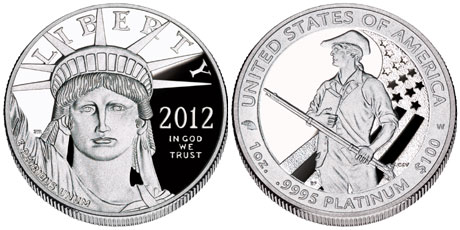
The U.S. Mint has been producing the Proof American Platinum Eagle since 2009.  According to MintNewsBlog, the entire 2009 production of 8,000 Proof Platinum Eagles sold out in a week.  During 2010, the U.S. Mint produced 10,000 Proof Platinum coins which also quickly sold out.  During 2011, the mintage was set at 15,000 coins but the sales pace slowed considerably with pricing set at $2,092 and the coin has still not sold out with total sales of 14,760 as of the last U.S. Mint report.  On August 9th, the U.S. Mint announced that production of the 2012 Proof American  Platinum Eagles will be set at 15,000 coins.  Orders are limited to 5 per household with initial pricing at $1,692.

Time To Buy The Summer Bottom In Gold

By Vin Maru

General Outlook for Gold and the Miners

It is our firm belief that the precious metals sector has bottomed out and the downside is very limited from here on out.  While there doesn’t seem to be an immediate rush back into the sector, now is a great time to be acquiring physical metals, but more importantly producers with growth profiles. That’s where we really see the value and upside potential.  Now would be a good time to start adding and scaling into any new positions you plan on taking.

If we would have to make a speculative/educated guess/evaluation, by looking at the charts and fundamentals for precious metals and the miners, we believe that the worst is over.  We are fairly certain that we have seen the bottom over this past summer and building a good position in the physical, ETFs, and select miners right now is looking very promising.

Support has pretty much held throughout the summer and it’s looking good going into the fall.  While we still may see one more down wave, it would be more of a fake breakdown below support just to scare the remaining weak hands.  If that happens, I would think backing up the truck is a good idea, and start getting aggressive in adding exposure to the sector.  Buying at support around $1570 is a good place to start adding to positions.  Over the next few weeks we expect gold to trade around $1600 (+ or – $30) in a sideways trading range.

The HUI is still lagging gold, but a solid base under 400 has been building and it looks like a good time to add at support around 390.  If you look at the chart below, it started a major correction back at the beginning of March (when we suggested selling) and made a bottom in the middle of May.  Since then the index has traded sideways between 390 and 460.  A particular item to note on the chart is a 3 fan formation that seems to be developing since March.  If the summer lows and support holds at 390, then a re-test of 420 and the 50 dma should come soon, this happens to be the top of 2nd fan line.  If it crosses above the 2nd fan line and holds above the 50 dma, it could trigger a move to 460 and overhead resistance, with a possible move to the 200 dma at 485.  This is something we will watch for and take one day at a time.

Juicing Profits with Covered Calls on the Senior Producers

If you are interested in options strategies for a flat market, you may want to consider writing calls against the shares you currently own or if you plan on take a position in the senior producers over the next few weeks.   This is great way to squeeze some extra money out of the market by writing covered calls while still maintaining a position in your favourite seniors.

If you own or are buying shares in major producers (which is a good idea as long as PM stay flat), make some extra money by selling call options slightly higher than market price (up to 20% higher is a good price) with a covered call option strategy.  This way you get to own the stock, collect dividends if the producer pays them and then collect the premiums by selling the calls.  If the stock breaks above the call strike price, you have the shares to deliver, and can still buy back your position at spot or wait for a slight pull back.

If you are unfamiliar with the covered call strategy, you can learn more about it by a simple google search or by visiting the Investopedia site discussing covered calls, below is a brief description from their site.

Definition of ‘Covered Call’

An options strategy whereby an investor holds a long position in an asset and writes (sells) call options on that same asset in an attempt to generate increased income from the asset. This is often employed when an investor has a short-term neutral view on the asset and for this reason hold the asset long and simultaneously have a short position via the option to generate income from the option premium.

Summary of Strategy

Our subscribers have been provided some good ideas for buying several senior producers.  There are many small to mid size producers which we also like and a few great exploration plays that are also on our radar.  Over the next few weeks, we will provide some additional companies which also merit owning a position in.  While it may not be feasible to buy shares in all these companies, you should create a basket of producers and exploration companies in your own portfolio.  At the moment, all the producers have great value (even if you bought at today’s prices) and most will do very well in the next few years.  You could literally throw a dart and pick anyone of the majors and they will all raise in share price once gold starts rising.  Our goal is to help find the ones that have greater upside potential and organic growth.

If you are familiar with options trading, you should consider buying some call options in many of the majors.  If you are very knowledgeable about options, consider the covered call strategy we just suggested with several of the majors that don’t have a great growth profile in the next year.  With a covered call, you want the stock to sit sideways while you collect the premiums for selling the calls.  If you don’t understand covered calls, we suggest you stay away from them or ask before you initiate this strategy.

For the moment, we suggest slowly picking away at the junior and explorers as they are usually the last to rise in price in a normal cyclical move higher in precious metals.  Could this time be any different?  Absolutely, they have become so cheap that many are trading for cash value and very little value is given to proven reserves.  This could change at any time and this is something we will watch for when all boats start rising with the coming tide into gold and the miners.  We feel that tide is coming soon and you want to be positioned to ride the wave once it does arrive, and looking out on the horizon all we can say is: SURF’S UP.

If you enjoyed reading this article and are interested in protecting your wealth with precious metals, you can receive our free blog by visiting TDV Golden Trader.

Cheers,

The Bright Side Of Plunging Gold Stocks

Each day another gold stock blows up.  Last week it was NovaGold (NG) and then Newmont Mining (NEM) and before that a long list too painful to mention.  Although I strongly prefer holding physical precious metals over mining companies, the gold stocks that I do own have put in less than a sterling performance.
I won’t bother going through the reasons why gold stocks could recover or mention the fact that many of them are trading at a fraction of what they were worth when gold was a thousand dollars lower.  Stocks are ultimately valued on earnings and for a variety of reasons, many of the mining companies have not been able to translate higher gold prices into higher dividends or earnings.

To put this all into perspective, I was pondering on two innate character traits I possess that can be confirmed by anyone who knows me.

First and foremost, I procrastinate on everything in life, but actually have a very profound theory to validate the benefits of a trait that many would view as indolence.  Despite the occasional guilt for not doing something today instead of next week, I have conclusively proved to myself that a large percentage of those “today to do list” items somehow resolve themselves without my intervention.  Perhaps just a rationalization but it seems to work.

My second dominate character trait, and this one actually relates to plunging gold stocks, is my innate belief that somehow there is a blessing lurking next to each catastrophe.  What often times seems like Armageddon may be a benefit.  So how exactly do plunging gold mining stocks wind up benefiting long term gold investors?  The answer is actually in the details of each poor earnings report delivered regularly by gold miners.  When you drill into the core reasons for poor earnings, the answers all correlate  to lower gold production due to overestimates of ore reserves, mining difficulties and the higher cost of mining lower grade ore reserves.

The fundamental fact is that the quantity of high grade ore reserves has declined dramatically making it much more costly and difficult to produce gold.  In a recent article the Wall Street Journal estimated that at current production rates, all known gold reserves would be depleted within ten years.  It wouldn’t take much of a bump in demand to eventually propel gold to multiples of today’s price.

Here’s a neat info graphic from visual.ly.  Note that net gold supply has been static for the past decade and large scale high grade gold deposits are rarer than ever.

Gold Part II: Mining and Supply 


Gold Bullion Coin Sales Plunge 50% In July, Silver Sales Off 20%

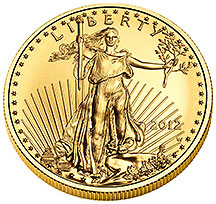
The latest sales figures from the U.S. Mint show that sales of both gold and silver bullion coins declined dramatically during July.  While sales of silver bullion coins have remained at historically high levels, sales of the gold bullion coins have been in a steep decline since 2009.
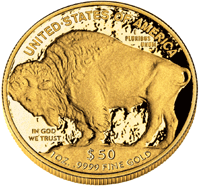
American Eagle Gold Bullion Coin Sales

Sales of the American Eagle Gold Bullion coins during July totaled 30,500 ounces, a 49.2% decline from June sales of 60,000 ounces.  Two previous months of the year had lower gold coin sales than July.  During February 21,000 ounces of gold bullion coins were sold and in April only 20,000 ounces were sold.   The year to date average monthly sales figures for gold bullion coins total 53,428 compared to a monthly average of 83,333 during 2011.

The all time yearly sales record for the American Eagle gold bullion coins was set during 2009 when it looked as if the entire U.S. banking system was about to collapse.  Sales in each subsequent year have been lower than 2009 despite the increase in the price of gold since then.  In 2009 gold closed the year at $1,087.50 per ounce, subsequently hit a high of $1,895 on September 5, 2011 and closed today at $1,615.90 in New York trading.  If sales during 2012 are annualized, total gold bullion coin sales will reach approximately 641,000 ounces, the lowest amount since 2007 when yearly sales came in at 198,500 ounces.

Listed below are yearly sales figures for the American Eagle gold bullion coins since 2000.  Sales for 2012 are through July 31st.

Gold Bullion U.S. Mint Sales By Year
Year Total Sales Oz.
2000 164,500
2001 325,000
2002 315,000
2003 484,500
2004 536,000
2005 449,000
2006 261,000
2007 198,500
2008 860,500
2009 1,435,000
2010 1,220,500
2011 1,000,000
2012 374,000
Total 7,623,500

The graph below shows gold bullion coins sales since 2012, with sales annualized for 2012.

American Eagle Silver Bullion Coin Sales

According to the U.S. Mint, sales of the American Eagle silver bullion coins totaled 2,278,000 ounces during July, a decline of 20.3% from June’s total of 2,858,000.   The highest monthly sales of the silver bullion coins during 2012 was 6,107,000 ounces recorded in January followed by the lowest monthly sales of 1,490,000 ounces in February.  Average monthly sales of the silver bullion coins through July was 2,810,000.

The silver bullion coins have showed resilient demand despite the drop in silver prices since mid 2011.  Based on year to date sales figures, total sales of the silver bullion coins could approach 34 million ounces, not far below the record sales figure recorded in 2011 when almost 40 million ounces were sold.

Total annual sales by the U.S. Mint of the silver bullion coins since 2000 are shown below.  Sales for 2012 are year to date totals through July.

American Silver Eagle Bullion Coins
YEAR OUNCES SOLD
2000 9,133,000
2001 8,827,500
2002 10,475,500
2003 9,153,500
2004 9,617,000
2005 8,405,000
2006 10,021,000
2007 9,887,000
2008 19,583,500
2009 28,766,500
2010 34,662,500
2011 39,868,500
Jul-12 19,670,000
TOTAL 218,070,500

The American Eagle gold and silver bullion coins are sold by the U.S. Mint only to Authorized Purchasers who in turn resell the coins to the general public and other dealers.  Numismatic versions of the American Eagle series gold and silver coins can be purchased by the public directly from the U.S. Mint.

75% Of Americans Believe The Fed Should Be Audited – Why It Won’t Happen

Most Americans under 30 have a strange sense of unease that something is very wrong with the way things are going in America.  If you are 60 or older and can remember with nostalgia how life in America was prior to the days of blatant  and corrupt crony capitalism, you know for sure we are heading in a very wrong direction at an accelerating pace.
I can remember the days when the average worker could support his family without putting his wife to work, without having to give up on having children, without having to worry about banks going under, without having to worry about an implosion of the financial system and without the expectation that the government would provide handouts to solve every little one of life’s problems.

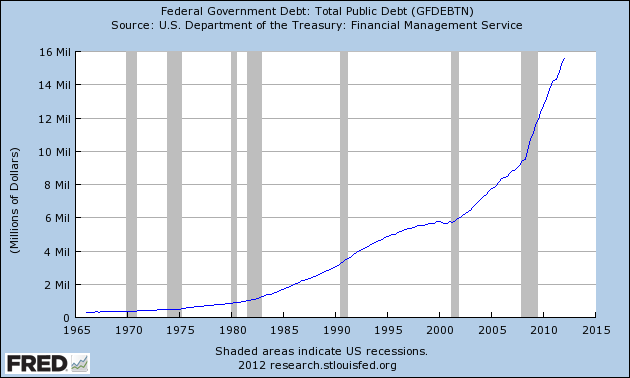
Gradually, it has begun to dawn on the average American of all ages that the Federal Reserve may be at the heart of the nation’s financial problems.  Much has been written about this, but two graphs sum up the situation quite nicely.  Since the Federal Reserve was created in 1913, the value of the dollar has declined to a fraction of what it was once worth and since the abandonment of the gold standard, government debt has reached levels that are no longer sustainable without further debasement of the paper dollar.  The American public is beginning to connect the dots.

Ron Paul has been a lonely voice in spreading the message about the Fed but has finally reached a milestone with the House passage of his proposed “Audit The Fed” legislation.  In an update Ron Paul notes that 75% of the American public supports his bill according to a recent poll.

Last week the House of Representatives overwhelmingly passed my legislation calling for a full and effective audit of the Federal Reserve.  Well over 300 of my Congressional colleagues supported the bill, each casting a landmark vote that marks the culmination of decades of work.  We have taken a big step toward bringing transparency to the most destructive financial institution in the world.

But in many ways our work is only beginning.  Despite the Senate Majority Leader’s past support for similar legislation, no vote has been scheduled on my bill this year in the Senate.  And only 29 Senators have cosponsored Senator Rand Paul’s version of my bill in the other body.  If your Senator is not listed at the link above, please contact them and ask for their support.  We need to push Senate leadership to hold a vote this year.

Understand that last week’s historic vote never would have taken place without the efforts of millions of Americans like you, ordinary citizens concerned about liberty and the integrity of our currency.  Political elites respond to political pressure, pure and simple.  They follow rather than lead.  If all 100 Senators feel enough grassroots pressure, they will respond and force Senate leadership to hold what will be a very popular vote.

In fact, “Audit the Fed” is so popular that 75% of all Americans support it according to this Rasmussen poll.  We are making progress.

Of course Fed apologists– including Mr. Bernanke– frequently insist that the Fed already is audited.  But this is true only in the sense that it produces annual financial statements.  It provides the public with its balance sheet as a fait accompli: we see only the net results of its financial transactions from the previous fiscal year in broad categories, and only after the fact.

We’re also told that the Dodd-Frank bill passed in 2010 mandates an audit.  But it provides for only a limited audit of certain Fed credit facilities surrounding the crisis period of 2008.  It is backward looking, which frankly is of limited benefit.

The Fed also claims it wants to be “independent” from Congress so that politics don’t interfere with monetary policy.  This is absurd for two reasons.

First, the Fed already is inherently and unavoidably political.  It made a political decision when it chose not to rescue Lehman Brothers in 2008, just as it made a political decision to provide liquidity for AIG in the same time period. These are just two obvious examples.  Also Fed member banks and the Treasury Department are full of former– and future– Goldman Sachs officials.  Are we really to believe that the interests of Goldman Sachs have absolutely no effect on Fed decisions? Clearly it’s naïve to think the Fed somehow is above political or financial influence.

Second, it’s important to remember that Congress created the Fed by statute.  Congress therefore has the full, inherent authority to regulate the Fed in any way– up to and including abolishing it altogether.

My bill provides for an ongoing, thorough audit of what the Fed really does in secret, which is make decisions about the money supply, interest rates, and bailouts of favored banks, financial firms, and companies.  In other words, I want the Government Accountability Office to examine the Fed’s actual monetary policy operations and make them public.

It is precisely this information that must be made public because it so profoundly affects everyone who holds, saves, or uses US dollars.

Will the bill pass the senate, considering the incestuous and corrupt self dealing relationships between too big to fail banks, government and politicians?  Probably not in our lifetimes, but at least public awareness of the problem is growing.  Ron Paul might have added in his update that the vast majority of Americans no longer believe they are ruled with the consent of the governed.

Would Auditing The Fed Send Gold Higher?

By Vin Maru

The House Passes H.R. 459 Bill from Ron Paul to Audit the Fed

July 25, 2012 should go down in history as the date the Federal Reserve may become fully accountable to the US government. A motion to pass the bill as amended was unanimously approved by the house to require a full audit of the boards of governors of the Federal Reserve System and banks. This will be done by the Comptroller General of the US before the end of 2012 and they are required to issue their report within 12 months of enactment.  The votes in the House in the bill’s passing this was 326 yea votes to 99 nay votes with 7 non votes.  Interestingly enough it was the Republicans that strongly supported this bill with 239 yea and 1 nay vote, while the Democrats voted 88 yea and 98 nay.
http://youtu.be/C47DVVUmHDw

There are many hurdles ahead of this bill before it takes effect; it still has to be ratified by the Senate and the President.  However, finally getting approved in the House is a step in the right direction.  Even if it does pass how much effect will the audit have in reality?  Probably not much since the banking institution known as the Federal Reserve operates outside of any law.  Even if they are found guilty of any wrong doing in managing the value of the US dollar or being involved in rigging the Libor rate, who will be there to prosecute them?  Remember they operate outside the law, so even if they are found guilty, it will be the US citizens and holders of paper/digital US dollars that will somehow pay for it.

In a world where bank’s losses are socialized, the Federal Reserve (the banker for banks) misconducts have always been socialized on the people.  Of course, this socialization of losses by the Fed has been taking place ever since its illegal inception.  In 1913, the Federal Reserve stole the power to issue and control money by introducing the Federal Reserve note, something we call the US dollar.  Since then, it is estimated that the dollar has lost 95% of its purchasing power by way of inflation (the increase of the money supply), so it really has only 5% left to go.   As the value of the US dollar moves towards its intrinsic value of zero, gold and silver as true money has only one way to go and that is up.

Usually first reactions are correct and looking at this news the value of the US dollar reacted negatively, while gold went higher in most major currencies around the world.

Could This be the Catalyst that Gold Needs for a Major Break Out to the Upside?

In a manipulated market, it’s tough to say, but the fact that there is support for auditing the Fed and making it accountable is definitely a step in the right direction.  With the recent news about major banks manipulating the Libor rate, any investigation into the Fed’s involvement is most welcome and has to be gold-positive.  Recently, we have been writing about how gold is moving towards the financial system with several different proposals for making it a tier 1 asset class and its use as collateral by financial institutions. If these proposals take effect, they are planned for January 2013, which coincides nicely with this audit being completed by the end of 2012.

Normally, the summer doldrums represent the lows in price for precious metals with a significant rally occurring in the fall and winter.  With this recent down turn, we have most likely seen the lows, and there are many catalysts for G&S to move higher into next years.

For example:

1. Food inflation is rising with this drought.

2. Gold could carry a zero risk weighting on bank books by Jan 2013 (BIS and FDIC are proposing this).

3. Paper currencies are Fiat, essentially worthless, but they will be used to create inflation, there is no other choice at the moment—QE to Infinity.

4. Market manipulation by bullion banks will be overrun by physical buyer (mostly now coming from central banks).

5. The investment community is only 1% invested in gold; historically this has been 5-10%.

6. Political tensions with Iran could heat up again later this year or early next, causing higher oil prices and as such gold.

7. More banking manipulation and scandals are emerging this summer, the Libor scandal is just the tip of the iceberg.

8. They system for true price discovery is broken, regulators have failed and the LBMA & Comex have lost all control and credibility.

9.  The price suppression by the west will be overrun by the East and physical buyers. The West cannot win this paper game.

10. MOST importantly: GOLD and SILVER is a hard asset and it has a history of over 5000 years being REAL MONEY. This paper/digital money has been only in place over the last 100 years and is doomed to fail.

Now is the time to be investing in gold and silver, during this consolidation.  A long period of consolidation is usually followed by a major move either to the upside and downside.  Given gold and silver’s favourable fundamentals, the break out will most likely be to the upside as gold moves towards the financial system.  Today’s positive price action could be the start of a new trend higher going into the fall and early next year.  If this trend plays out, there will be several opportunities to trade in and out of several precious metals ETFs.  The gold miners are great value compared to gold and we have been evaluating several that have great upside potential and production growth.

The key is to be ahead of the curve before it happens, take a position and place a tight stop loss in case this is a fake break out and gold continues to correct lower against its fundamentals.  If the correction in gold is over and we are at a start of a new trend higher over the next year, this summer will prove to one of the best buying opportunities we have seen in a very long time.  Significant profits could be made buying gold and many of the producers during the summer doldrums and then selling into the fall and winter, the only question is are you positioned to take advantage of a trend change in gold when it happens.

If you enjoyed reading this article and are interested in protecting your wealth with precious metals, you can receive our free blog by visiting TDV Golden Trader.

Cheers

Hong Kong’s Secret $50 Billion Gold Bullion Vault

Bloomberg TV asks Where do you hide $50 billion of gold in Hong Kong?

The location is secret but the reason for building a new massive bullion vault in Hong Kong is not.  According to Bloomberg, the decision by Malca-Amit to build the bullion vault was based on unrelenting physical demand for gold in Asia.  During 2011, gold demand in China increased by 20%.  In addition, customers vaulting their holdings want the gold to be kept close to home.

The new gold bullion vault is designed to hold 1,000 metric tonnes of gold, worth about $51 billion at today’s price.  The vault already holds 2,400 tonnes of gold owned by gold exchange traded funds (ETF).

Beyond its importance as a storage location, the massive amount of gold holdings that the vault will eventually hold signals a fundamental change for the gold market.  The massive holdings of Asian gold will shift price setting action away from the London and the U.S. exchange cartels which dominate and manipulate gold pricing.

Gold’s Fundamental Role In The Financial System

By Vin Maru

It is currently estimated that the largest 110 central banks have 16% of their reserves as gold.  Anyone who follows the gold market knows that many central banks have become net buyers of gold in the last few years, and the pace of accumulation seems to be growing.  While central banks continue to accumulate gold, the misinformed mainstream media are still chanting the “gold is in a bubble” mantra.   What they are not acknowledging is the clear evidence that the highest level of bankers and regulators are proposing that gold become a Tier 1 asset class with zero risk, which can also be used for collateral in financial transactions.

Recently, we wrote an article about a proposal made by the FDIC to make rule changes and allow gold bullion to be recognized as a Tier 1 asset class with zero percent risk weighting.  Even the Bank of International Settlements (BIS), which is the central bank for central banks, is considering reclassifying gold as a risk-free assets as part of the Basel III framework. In their recent progress report, on page 26 under the section for other assets, they state the following (in footnote 32):

“At national discretion, gold bullion held in own vaults or on an allocated basis to the extent backed by bullion liabilities can be treated as cash and therefore risk-weighted at 0%.”

The Basel Committee on Banking Supervision is an international regulatory agency that brings together banking regulators from 27 nations including the US, the UK, and China. This past week they published a draft of standards which creates “International consistency” with regards to margin requirements and seek tougher rules for non-centrally cleared swaps in the over-the-counter derivatives market.  This proposal helps to align rules for the $648 trillion market for OTC derivatives in which regulators are seeking tougher oversight after the 2008 collapse.  The proposal sets out a partial list of assets that companies can use as collateral for trading in the OTC derivatives market.  It includes a range of financial instruments to be used as collateral, including cash, government debt, “high-quality corporate and covered bonds,” gold and equities listed on “major” stock exchanges.   This is just another example of how the gold role in the financial system is changing; it is becoming viewed as a safe asset class to hold as collateral.  If implemented, financial firms trading in the OTC derivative market will be able to use gold as collateral for posting and meeting margin requirements.

The evidence is clear as day when you look at the facts.  Gold is moving towards the financial system, not away from it.  The bankers and regulators are now considering rule changes to introduce gold back into the financial system.  If these proposals take effect in January 2013, the world will realize that gold is here to stay; maybe even MSM will warm up to the idea that gold is a safe asset to own.  The only question is at what price gold will be trading at when all this happens.

The current weakness during the summer doldrums seems like a good time to accumulate physical while support holds above $1530.   If the paper manipulators decide to push gold below support, it should be short lived and expect a quick rebound to current prices.  The worlds financial problems have not gone away, the debts continue to grow, and inflation by way of the printing press is here to stay.  Gold may not cure all of the world’s financial problems, but it is here to stay and the gold bull run is far from over.  Expect to see higher prices in 2013 and beyond, especially as the central bankers and regulators voluntarily introduce gold back into the financial system as a risk free, Tier 1 asset class.

Hard asset advocates have always known the value of owning and holding gold.  Central bankers and regulators are now finally acknowledging gold’s value in the monetary system as an asset class.  Next year MSM will be touting the virtues of owning gold once again.  The key is to be ahead of this curve before it happens.  If any of these proposals take effect, you want to be ahead of the herd as more and more banks and financial institutions stampede towards gold in the years ahead.


If you enjoyed reading this article and are interested in protecting your wealth with precious metals, you can receive our free blog by visiting TDV Golden Trader.