April 5, 2026

Two Masterpiece Gold and Silver Medals

Precious metal investors who have a deep appreciation for the artistry of gold and silver coins are likely to be blown away by the latest medals issued by the Royal British Mint.

As reported by World Mint News Blog, the Royal Mint has issued two magnificent gold and silver medals that showcase the skill and craftsmanship of mint engravers.  Both coins have extremely limited mintage with the gold medal issue limit set at only 25.  The purchase price of the gold medal is £23,500.00 or $36,843.  I would expect both of these low mintage medals to be priced substantially higher in the secondary market if they ever become available for sale.

The obverse of the medal depicts Arthur as a Warrior King defeating the Saxons as Merlin stands in the background. The battlefield is shown with mist and smoke rising into the air and the dragon flags planted by the cavalry symbolizing victory. The reverse depicts Arthur as a wounded and defeated King offering his sword Excalibur to his Knight Bedivere. In the background appear Arthur’s wife Guinevere embracing Lancelot and Arthur’s half sister Morgana holding her staff with a raven atop.

Both the gold and silver medals feature the same intricate design and are struck in high relief. Both are oversized to provide a large canvas for the work. The .999 silver coin has a weight of 250 grams (8.04 troy ounces) and diameter of 80 mm. The .999 gold coin has a weight of 313 grams (10.06 troy ounces) and diameter of 65 mm.

As might be expected, these are extremely limited in mintage and premium priced. The silver medal has an issue limit of 500 and is £695.00, and the gold medal has a limit of just 25 and is priced at £23,500.00. The product pages can be found here and here.

The U.S. Mint should pay attention to the artistry of coins produced by other world mints.  Imaginative new gold and silver coin designs by the U.S. Mint would not only be appreciated by numismatists but would probably broaden investor interest in standard gold and silver bullion coins.
Ron Paul – “U.S. Treasury Guilty of Counterfeiting Dollars”

When Ron Paul retires after his current term in Congress, one of the most notable voices for a sound currency and protection of civil liberties against a despotic government will be gone from the official Washington scene.  Although Paul was never able to rein in a government that assumes more power over our lives with each passing minute, his warnings gave Americans the opportunity to understand the threats to their financial future and personal liberties.
What may be one of Ron Paul’s last legislative efforts is his campaign to allow competing currencies in the United States in order to break the monopoly on money by the Treasury and Federal Reserve.

I recently held a hearing in my congressional subcommittee on the subject of competing currencies.  This is an issue of enormous importance, but unfortunately few Americans understand how the Federal Reserve and Treasury Department impose a strict monopoly on money in America.

This monopoly is maintained using federal counterfeiting laws, which is a bit rich.  If any organization is guilty of counterfeiting dollars, it is our own Treasury.  But those who dare to challenge federal legal tender laws by circulating competing currencies– at least physical currencies– risk going to prison.

Like all government created monopolies, the federal monopoly on money results in substandard product in the form of our ever-depreciating dollars.

Yet governments have always sought to monopolize the issuance of money, either directly or through the creation of central banks. The expanding role of the Federal Reserve in the 20th century enabled our federal government to grow wildly larger than would have been possible otherwise.  Our Fed, like all central banks, encourages deficits by effectively monetizing Treasury debt.  But the price we pay is the terrible and ongoing debasement of our money.

Allowing individuals and business to use alternate currencies, especially currencies backed by gold and silver, would expose the whole rotten system because the marketplace would prefer such alternate currencies unless and until the Fed suddenly imposed radical discipline on its dollar inflation.

Sadly, Americans are far less free than many others around the world when it comes to protecting themselves against the rapidly depreciating US dollar.  Mexican workers can set up accounts denominated in ounces of silver and take tax-free delivery of that silver whenever they want.  In Singapore and other Asian countries, individuals can set up bank accounts denominated in gold and silver.  Debit cards can be linked to gold and silver accounts so that customers can use gold and silver to make point of sale transactions, a service which is only available to non-Americans.

The obvious solution is to legalize monetary freedom and allow the circulation of parallel and competing currencies.  There is no reason why Americans should not be able to transact, save, and invest using the currency of their choosing.  They should be free to use gold, silver, or other currencies with no legal restrictions or punitive taxation standing in the way.  Restoring the monetary system envisioned by the Constitution is the only way to ensure the economic security of the American people.

After all, if our monetary system is fundamentally sound– and the Federal Reserve indeed stabilizes the dollar as its apologists claim–then why fear competition?  Why do we accept that centralized, monopoly control over our money is compatible with a supposedly free-market economy?  In a free market, the government’s fiat dollar should compete with alternate currencies for the benefit of American consumers, savers, and investors.

As Austrian economist Ludwig von Mises explained, sound money is an instrument that protects our civil liberties against despotic government. Our current monetary system is indeed despotic, and the surest way to correct things simply is to legalize competing currencies.

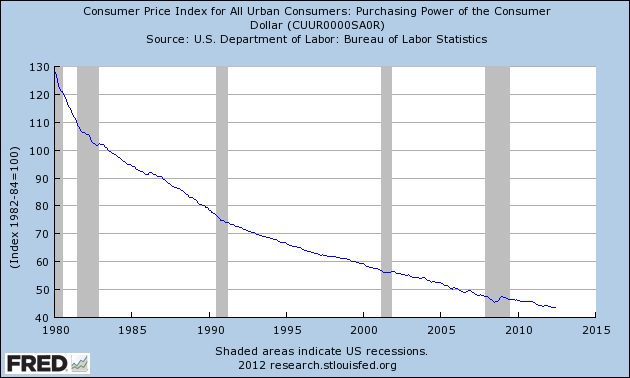
Ron Paul is routinely dismissed as a naif by the Federal Reserve and Treasury.  Yet a quick look at the  chart of the purchasing power of the U.S. dollar (published by the St. Louis Fed) proves the legitimacy of Ron Paul’s concerns.  Federal Reserve policies have resulted in the systematic destruction of the purchasing power of the consumer dollar.

Will Ron Paul be successful in his quest to legalize a competing U.S. currency?  Let’s look at Paul’s track record.

Of the 620 bills that Paul had sponsored through December 2011, over a period of more than 22 years in Congress, only one had been signed into law – a lifetime success rate of less than 0.3%.   The sole measure authored by Paul that was ultimately enacted allowed for a federal customhouse to be sold to a local historic preservation society (H.R. 2121 in 2009).

Although Ron Paul’s crusade against corrupt government and the Federal Reserve is a losing battle, the value of his message is invaluable.   Ron Paul has seen the future of constant U.S. dollar debasement and positioned his personal portfolio heavily into gold and silver – something that the average American should think about.

Time To Buy The Summer Bottom In Gold

By Vin Maru

General Outlook for Gold and the Miners

It is our firm belief that the precious metals sector has bottomed out and the downside is very limited from here on out.  While there doesn’t seem to be an immediate rush back into the sector, now is a great time to be acquiring physical metals, but more importantly producers with growth profiles. That’s where we really see the value and upside potential.  Now would be a good time to start adding and scaling into any new positions you plan on taking.

If we would have to make a speculative/educated guess/evaluation, by looking at the charts and fundamentals for precious metals and the miners, we believe that the worst is over.  We are fairly certain that we have seen the bottom over this past summer and building a good position in the physical, ETFs, and select miners right now is looking very promising.

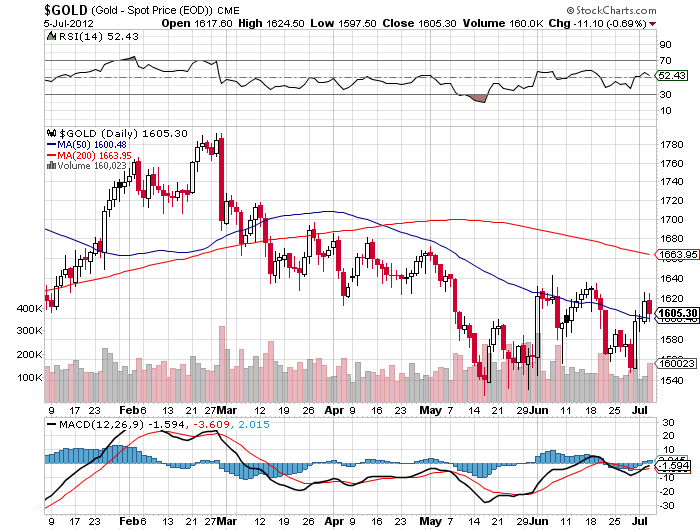
Support has pretty much held throughout the summer and it’s looking good going into the fall.  While we still may see one more down wave, it would be more of a fake breakdown below support just to scare the remaining weak hands.  If that happens, I would think backing up the truck is a good idea, and start getting aggressive in adding exposure to the sector.  Buying at support around $1570 is a good place to start adding to positions.  Over the next few weeks we expect gold to trade around $1600 (+ or – $30) in a sideways trading range.

The HUI is still lagging gold, but a solid base under 400 has been building and it looks like a good time to add at support around 390.  If you look at the chart below, it started a major correction back at the beginning of March (when we suggested selling) and made a bottom in the middle of May.  Since then the index has traded sideways between 390 and 460.  A particular item to note on the chart is a 3 fan formation that seems to be developing since March.  If the summer lows and support holds at 390, then a re-test of 420 and the 50 dma should come soon, this happens to be the top of 2nd fan line.  If it crosses above the 2nd fan line and holds above the 50 dma, it could trigger a move to 460 and overhead resistance, with a possible move to the 200 dma at 485.  This is something we will watch for and take one day at a time.

Juicing Profits with Covered Calls on the Senior Producers

If you are interested in options strategies for a flat market, you may want to consider writing calls against the shares you currently own or if you plan on take a position in the senior producers over the next few weeks.   This is great way to squeeze some extra money out of the market by writing covered calls while still maintaining a position in your favourite seniors.

If you own or are buying shares in major producers (which is a good idea as long as PM stay flat), make some extra money by selling call options slightly higher than market price (up to 20% higher is a good price) with a covered call option strategy.  This way you get to own the stock, collect dividends if the producer pays them and then collect the premiums by selling the calls.  If the stock breaks above the call strike price, you have the shares to deliver, and can still buy back your position at spot or wait for a slight pull back.

If you are unfamiliar with the covered call strategy, you can learn more about it by a simple google search or by visiting the Investopedia site discussing covered calls, below is a brief description from their site.

Definition of ‘Covered Call’

An options strategy whereby an investor holds a long position in an asset and writes (sells) call options on that same asset in an attempt to generate increased income from the asset. This is often employed when an investor has a short-term neutral view on the asset and for this reason hold the asset long and simultaneously have a short position via the option to generate income from the option premium.

Summary of Strategy

Our subscribers have been provided some good ideas for buying several senior producers.  There are many small to mid size producers which we also like and a few great exploration plays that are also on our radar.  Over the next few weeks, we will provide some additional companies which also merit owning a position in.  While it may not be feasible to buy shares in all these companies, you should create a basket of producers and exploration companies in your own portfolio.  At the moment, all the producers have great value (even if you bought at today’s prices) and most will do very well in the next few years.  You could literally throw a dart and pick anyone of the majors and they will all raise in share price once gold starts rising.  Our goal is to help find the ones that have greater upside potential and organic growth.

If you are familiar with options trading, you should consider buying some call options in many of the majors.  If you are very knowledgeable about options, consider the covered call strategy we just suggested with several of the majors that don’t have a great growth profile in the next year.  With a covered call, you want the stock to sit sideways while you collect the premiums for selling the calls.  If you don’t understand covered calls, we suggest you stay away from them or ask before you initiate this strategy.

For the moment, we suggest slowly picking away at the junior and explorers as they are usually the last to rise in price in a normal cyclical move higher in precious metals.  Could this time be any different?  Absolutely, they have become so cheap that many are trading for cash value and very little value is given to proven reserves.  This could change at any time and this is something we will watch for when all boats start rising with the coming tide into gold and the miners.  We feel that tide is coming soon and you want to be positioned to ride the wave once it does arrive, and looking out on the horizon all we can say is: SURF’S UP.

If you enjoyed reading this article and are interested in protecting your wealth with precious metals, you can receive our free blog by visiting TDV Golden Trader.

Cheers,

Gold Bullion Coin Sales Plunge 50% In July, Silver Sales Off 20%

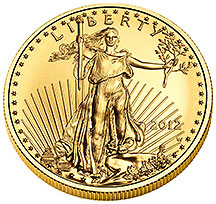
The latest sales figures from the U.S. Mint show that sales of both gold and silver bullion coins declined dramatically during July.  While sales of silver bullion coins have remained at historically high levels, sales of the gold bullion coins have been in a steep decline since 2009.
American Eagle Gold Bullion Coin Sales

Sales of the American Eagle Gold Bullion coins during July totaled 30,500 ounces, a 49.2% decline from June sales of 60,000 ounces.  Two previous months of the year had lower gold coin sales than July.  During February 21,000 ounces of gold bullion coins were sold and in April only 20,000 ounces were sold.   The year to date average monthly sales figures for gold bullion coins total 53,428 compared to a monthly average of 83,333 during 2011.

The all time yearly sales record for the American Eagle gold bullion coins was set during 2009 when it looked as if the entire U.S. banking system was about to collapse.  Sales in each subsequent year have been lower than 2009 despite the increase in the price of gold since then.  In 2009 gold closed the year at $1,087.50 per ounce, subsequently hit a high of $1,895 on September 5, 2011 and closed today at $1,615.90 in New York trading.  If sales during 2012 are annualized, total gold bullion coin sales will reach approximately 641,000 ounces, the lowest amount since 2007 when yearly sales came in at 198,500 ounces.

Listed below are yearly sales figures for the American Eagle gold bullion coins since 2000.  Sales for 2012 are through July 31st.

Gold Bullion U.S. Mint Sales By Year
Year Total Sales Oz.
2000 164,500
2001 325,000
2002 315,000
2003 484,500
2004 536,000
2005 449,000
2006 261,000
2007 198,500
2008 860,500
2009 1,435,000
2010 1,220,500
2011 1,000,000
2012 374,000
Total 7,623,500

The graph below shows gold bullion coins sales since 2012, with sales annualized for 2012.

American Eagle Silver Bullion Coin Sales

According to the U.S. Mint, sales of the American Eagle silver bullion coins totaled 2,278,000 ounces during July, a decline of 20.3% from June’s total of 2,858,000.   The highest monthly sales of the silver bullion coins during 2012 was 6,107,000 ounces recorded in January followed by the lowest monthly sales of 1,490,000 ounces in February.  Average monthly sales of the silver bullion coins through July was 2,810,000.

The silver bullion coins have showed resilient demand despite the drop in silver prices since mid 2011.  Based on year to date sales figures, total sales of the silver bullion coins could approach 34 million ounces, not far below the record sales figure recorded in 2011 when almost 40 million ounces were sold.

Total annual sales by the U.S. Mint of the silver bullion coins since 2000 are shown below.  Sales for 2012 are year to date totals through July.

American Silver Eagle Bullion Coins
YEAR OUNCES SOLD
2000 9,133,000
2001 8,827,500
2002 10,475,500
2003 9,153,500
2004 9,617,000
2005 8,405,000
2006 10,021,000
2007 9,887,000
2008 19,583,500
2009 28,766,500
2010 34,662,500
2011 39,868,500
Jul-12 19,670,000
TOTAL 218,070,500

The American Eagle gold and silver bullion coins are sold by the U.S. Mint only to Authorized Purchasers who in turn resell the coins to the general public and other dealers.  Numismatic versions of the American Eagle series gold and silver coins can be purchased by the public directly from the U.S. Mint.

Would Auditing The Fed Send Gold Higher?

By Vin Maru

The House Passes H.R. 459 Bill from Ron Paul to Audit the Fed

July 25, 2012 should go down in history as the date the Federal Reserve may become fully accountable to the US government. A motion to pass the bill as amended was unanimously approved by the house to require a full audit of the boards of governors of the Federal Reserve System and banks. This will be done by the Comptroller General of the US before the end of 2012 and they are required to issue their report within 12 months of enactment.  The votes in the House in the bill’s passing this was 326 yea votes to 99 nay votes with 7 non votes.  Interestingly enough it was the Republicans that strongly supported this bill with 239 yea and 1 nay vote, while the Democrats voted 88 yea and 98 nay.
http://youtu.be/C47DVVUmHDw

There are many hurdles ahead of this bill before it takes effect; it still has to be ratified by the Senate and the President.  However, finally getting approved in the House is a step in the right direction.  Even if it does pass how much effect will the audit have in reality?  Probably not much since the banking institution known as the Federal Reserve operates outside of any law.  Even if they are found guilty of any wrong doing in managing the value of the US dollar or being involved in rigging the Libor rate, who will be there to prosecute them?  Remember they operate outside the law, so even if they are found guilty, it will be the US citizens and holders of paper/digital US dollars that will somehow pay for it.

In a world where bank’s losses are socialized, the Federal Reserve (the banker for banks) misconducts have always been socialized on the people.  Of course, this socialization of losses by the Fed has been taking place ever since its illegal inception.  In 1913, the Federal Reserve stole the power to issue and control money by introducing the Federal Reserve note, something we call the US dollar.  Since then, it is estimated that the dollar has lost 95% of its purchasing power by way of inflation (the increase of the money supply), so it really has only 5% left to go.   As the value of the US dollar moves towards its intrinsic value of zero, gold and silver as true money has only one way to go and that is up.

Usually first reactions are correct and looking at this news the value of the US dollar reacted negatively, while gold went higher in most major currencies around the world.

Could This be the Catalyst that Gold Needs for a Major Break Out to the Upside?

In a manipulated market, it’s tough to say, but the fact that there is support for auditing the Fed and making it accountable is definitely a step in the right direction.  With the recent news about major banks manipulating the Libor rate, any investigation into the Fed’s involvement is most welcome and has to be gold-positive.  Recently, we have been writing about how gold is moving towards the financial system with several different proposals for making it a tier 1 asset class and its use as collateral by financial institutions. If these proposals take effect, they are planned for January 2013, which coincides nicely with this audit being completed by the end of 2012.

Normally, the summer doldrums represent the lows in price for precious metals with a significant rally occurring in the fall and winter.  With this recent down turn, we have most likely seen the lows, and there are many catalysts for G&S to move higher into next years.

For example:

1. Food inflation is rising with this drought.

2. Gold could carry a zero risk weighting on bank books by Jan 2013 (BIS and FDIC are proposing this).

3. Paper currencies are Fiat, essentially worthless, but they will be used to create inflation, there is no other choice at the moment—QE to Infinity.

4. Market manipulation by bullion banks will be overrun by physical buyer (mostly now coming from central banks).

5. The investment community is only 1% invested in gold; historically this has been 5-10%.

6. Political tensions with Iran could heat up again later this year or early next, causing higher oil prices and as such gold.

7. More banking manipulation and scandals are emerging this summer, the Libor scandal is just the tip of the iceberg.

8. They system for true price discovery is broken, regulators have failed and the LBMA & Comex have lost all control and credibility.

9.  The price suppression by the west will be overrun by the East and physical buyers. The West cannot win this paper game.

10. MOST importantly: GOLD and SILVER is a hard asset and it has a history of over 5000 years being REAL MONEY. This paper/digital money has been only in place over the last 100 years and is doomed to fail.

Now is the time to be investing in gold and silver, during this consolidation.  A long period of consolidation is usually followed by a major move either to the upside and downside.  Given gold and silver’s favourable fundamentals, the break out will most likely be to the upside as gold moves towards the financial system.  Today’s positive price action could be the start of a new trend higher going into the fall and early next year.  If this trend plays out, there will be several opportunities to trade in and out of several precious metals ETFs.  The gold miners are great value compared to gold and we have been evaluating several that have great upside potential and production growth.

The key is to be ahead of the curve before it happens, take a position and place a tight stop loss in case this is a fake break out and gold continues to correct lower against its fundamentals.  If the correction in gold is over and we are at a start of a new trend higher over the next year, this summer will prove to one of the best buying opportunities we have seen in a very long time.  Significant profits could be made buying gold and many of the producers during the summer doldrums and then selling into the fall and winter, the only question is are you positioned to take advantage of a trend change in gold when it happens.

If you enjoyed reading this article and are interested in protecting your wealth with precious metals, you can receive our free blog by visiting TDV Golden Trader.

Cheers

Hong Kong’s Secret $50 Billion Gold Bullion Vault

Bloomberg TV asks Where do you hide $50 billion of gold in Hong Kong?

The location is secret but the reason for building a new massive bullion vault in Hong Kong is not.  According to Bloomberg, the decision by Malca-Amit to build the bullion vault was based on unrelenting physical demand for gold in Asia.  During 2011, gold demand in China increased by 20%.  In addition, customers vaulting their holdings want the gold to be kept close to home.

The new gold bullion vault is designed to hold 1,000 metric tonnes of gold, worth about $51 billion at today’s price.  The vault already holds 2,400 tonnes of gold owned by gold exchange traded funds (ETF).

Beyond its importance as a storage location, the massive amount of gold holdings that the vault will eventually hold signals a fundamental change for the gold market.  The massive holdings of Asian gold will shift price setting action away from the London and the U.S. exchange cartels which dominate and manipulate gold pricing.

Gold’s Fundamental Role In The Financial System

By Vin Maru

It is currently estimated that the largest 110 central banks have 16% of their reserves as gold.  Anyone who follows the gold market knows that many central banks have become net buyers of gold in the last few years, and the pace of accumulation seems to be growing.  While central banks continue to accumulate gold, the misinformed mainstream media are still chanting the “gold is in a bubble” mantra.   What they are not acknowledging is the clear evidence that the highest level of bankers and regulators are proposing that gold become a Tier 1 asset class with zero risk, which can also be used for collateral in financial transactions.

Recently, we wrote an article about a proposal made by the FDIC to make rule changes and allow gold bullion to be recognized as a Tier 1 asset class with zero percent risk weighting.  Even the Bank of International Settlements (BIS), which is the central bank for central banks, is considering reclassifying gold as a risk-free assets as part of the Basel III framework. In their recent progress report, on page 26 under the section for other assets, they state the following (in footnote 32):

“At national discretion, gold bullion held in own vaults or on an allocated basis to the extent backed by bullion liabilities can be treated as cash and therefore risk-weighted at 0%.”

The Basel Committee on Banking Supervision is an international regulatory agency that brings together banking regulators from 27 nations including the US, the UK, and China. This past week they published a draft of standards which creates “International consistency” with regards to margin requirements and seek tougher rules for non-centrally cleared swaps in the over-the-counter derivatives market.  This proposal helps to align rules for the $648 trillion market for OTC derivatives in which regulators are seeking tougher oversight after the 2008 collapse.  The proposal sets out a partial list of assets that companies can use as collateral for trading in the OTC derivatives market.  It includes a range of financial instruments to be used as collateral, including cash, government debt, “high-quality corporate and covered bonds,” gold and equities listed on “major” stock exchanges.   This is just another example of how the gold role in the financial system is changing; it is becoming viewed as a safe asset class to hold as collateral.  If implemented, financial firms trading in the OTC derivative market will be able to use gold as collateral for posting and meeting margin requirements.

The evidence is clear as day when you look at the facts.  Gold is moving towards the financial system, not away from it.  The bankers and regulators are now considering rule changes to introduce gold back into the financial system.  If these proposals take effect in January 2013, the world will realize that gold is here to stay; maybe even MSM will warm up to the idea that gold is a safe asset to own.  The only question is at what price gold will be trading at when all this happens.

The current weakness during the summer doldrums seems like a good time to accumulate physical while support holds above $1530.   If the paper manipulators decide to push gold below support, it should be short lived and expect a quick rebound to current prices.  The worlds financial problems have not gone away, the debts continue to grow, and inflation by way of the printing press is here to stay.  Gold may not cure all of the world’s financial problems, but it is here to stay and the gold bull run is far from over.  Expect to see higher prices in 2013 and beyond, especially as the central bankers and regulators voluntarily introduce gold back into the financial system as a risk free, Tier 1 asset class.

Hard asset advocates have always known the value of owning and holding gold.  Central bankers and regulators are now finally acknowledging gold’s value in the monetary system as an asset class.  Next year MSM will be touting the virtues of owning gold once again.  The key is to be ahead of this curve before it happens.  If any of these proposals take effect, you want to be ahead of the herd as more and more banks and financial institutions stampede towards gold in the years ahead.


If you enjoyed reading this article and are interested in protecting your wealth with precious metals, you can receive our free blog by visiting TDV Golden Trader.

Precious Metals Storage – Everything You Need To Know But Probably Don’t

By Nick Barisheff:

Worldwide economic uncertainty has created a growing interest in precious metals as a way to preserve wealth. Today, global risks for investors include currency devaluation, sovereign debt defaults, bond market collapses and stock market losses, all underpinned by ever-increasing government debt.

For protection from impending economic Armageddon, investors are turning in increasing numbers to the traditional safe haven of precious metals. Unfortunately, many today don’t know how to purchase or store bullion, and consequently may find themselves as vulnerable to financial collapse as those who didn’t purchase any bullion at all.

This increased interest in precious metals as portfolio insurance has spawned a new generation of precious metals-based financial products, many of which are paper proxies or derivatives of bullion. There are even unregulated markets for the exchange of “digital gold.”

A clear case for transparency

In 2007, former Bank of Canada Governor David Dodge gave a speech entitled “A Clear Case for Transparency”  to the Canada-UK Chamber of Commerce. “…[I]investors will have to take on more responsibility for diligent research,” he said, “so that they can better understand the nature of their investments and demand greater transparency where it is now lacking … they must do their own homework and make a concerted effort to understand what they are buying.”

Most investors do not read the fine print of the agreements they sign with respect to financial investments; they make assumptions, but do not definitively know if they own actual bullion. Some are attracted to certain bullion investments because of low premiums and low storage fees, but when was the last time Wall Street and the major banks gave the investing public a deal?

Investors who don’t do their homework may be dismayed to find that their safe haven asset has proved to be anything but. These same people perform rigorous due diligence when purchasing a home, car or boat, demanding that they have clear legal title to the asset in question. The same attention to detail must be paid when investing in bullion.

The most important concept to understand is that a financial institution CAN sell an investor’s bullion if the agreement states that it can. Banks are not raiding allocated accounts; rather, they are following the provisions of the contract, in which the bullion is not allocated despite an investor’s assumptions.

There does appear to be cause for concern regarding the transparency of bullion products. As reported by the economic news website ZeroHedge, financial services giant Morgan Stanley paid out $4.4 million in June 2007 to settle a class action lawsuit brought by clients after the firm charged them to “buy and store” precious metals, but did neither .

Similarly, a class action lawsuit filed in New York’s federal court accuses UBS Financial Services of misleading silver investors, and charging them storage fees for metals that were never purchased, let alone allocated or stored for them.

A larger problem has been brewing for several years now, that of exchange-traded funds (ETFs). These are generally viewed as a low-cost panacea that replaces almost any investment strategy, including the purchase of gold bullion, and they are giving investors a false sense of security.

False sense of security for ETF investors

ETFs started as equity index vehicles, in which brokers acting as Authorized Participants borrowed shares from institutions, hedge funds, mutual funds or their clients’ margin accounts to contribute to the Origination Basket of shares. They received ETF shares at Net Asset Value (NAV) in exchange, and sold them to investors at NAV – keeping all of the money. This is standard practice, as brokers have always been able to borrow shares from clients’ margin accounts for the purpose of shorting or for lending to other brokers.

Essentially, many ETFs hold assets that have been borrowed. Because there are no specific prohibitions to prevent the same practice from being used in precious metals ETFs, the same methodology is likely being used. Many investors are attracted by the low management fees offered by precious metals ETFs, but few understand the problems that may arise when more than one person has claim to the same asset.

ETF-based financial crisis could make 2008 look like child’s play

This ETF structure will work during normal market conditions. However, it may result in losses and disputes if the Authorized Participants, acting as market makers, become insolvent or step aside during a precipitous decline. If a bank or brokerage firm becomes an insolvent Authorized Participant, either the lender of the assets or the ETF shareholders will suffer losses. During a market crash, existing holders may be unable to sell their ETF shares.  Although this possibility was considered remote when ETFs were created, the recent and recurring failures of banks and brokerage firms make these concerns far more real .

The bottom line on ETFs is that they are tracking vehicles with multiple claims/counterparty risks on their assets as well as their shares. As debt-based stress on the global financial system continues to build, the flash-crash of 2010 may well have foreshadowed an ETF-based financial crisis that will make the subprime mortgage crisis of 2008 look like child’s play.

Own bullion with clear title

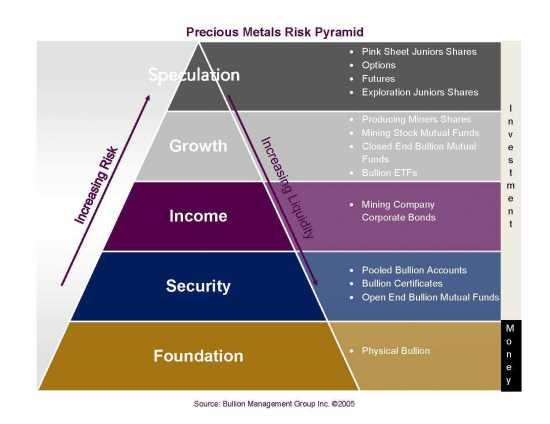
When we at Bullion Management Group sit down with clients seeking to own bullion, we present them with our Precious Metals Pyramid Chart. Moving up the pyramid increases risk; moving down the pyramid increases safety. A portfolio’s foundation should consist of physical bullion owned outright. Farther up the pyramid are proxies of bullion in one form or another that are more risky and often less liquid; in other words, the opposite of a safe haven asset you can count on in times of financial stress. Bullion should always meet two criteria: It should not be someone else’s liability, and it should not be someone else’s promise of performance.

To establish a physical bullion portfolio foundation with metals that are stored on an allocated and insured basis, one that will protect against what could be called ethical mayhem in today’s financial sector, investors must, as Governor Dodge advised, make a concerted effort to understand what they are buying. While reading legal documents and prospectuses is tedious, the truth is in the fine print and investors must do their own due diligence, and beware of complex investment structures.

Demand documentation that transfers title directly to the purchaser

For a bullion product, be it a fund or actual bullion bars, to earn its place as the foundation of a portfolio, the bullion purchaser must demand documentation that legally transfers title of specific, physical bars directly to them. Do not accept IOUs, paper proxies or derivatives. It is important to read the purchase documents carefully to ensure they convey legal title. Only after the purchaser has legal title can they enter into a binding custody agreement for bullion storage on an allocated, insured basis. In that agreement, the purchaser must be able to identify all terms and rights concerning insurance and secure, allocated storage.

Proper insurance and allocated storage in a credible, guarded vault costs money, so steer clear of bullion products promising low fees. If the deal appears too good to be true, the physical bullion may not exist. What the investor may have is paper bullion that will not offer protection when it is most needed; they may simply be an unsecured creditor of the dealer. It is hardly prudent to be tempted by low storage fees that will save a fraction of a percentage point while risking an entire bullion holding. Short cuts and penny pinching are inadvisable strategies for any asset intended as an ultimate safe haven of wealth protection.

Home storage not worth the risk of invasion or physical assault

Many people think that storing their bullion at home is a good way to economize on physical bullion storage fees, but be aware that any sizeable amount of home-stored bullion will not be covered by a household insurance policy.

Keeping a modest—and secret—stash of small-denomination gold or silver for barter purposes is recommended in the event that ATM machines aren’t working, or a ‘bank holiday’ is announced. This may seem like an excess of caution until you consider that, earlier this year, the Bank of Italy authorized the suspension of payments by Bank Network Investments Spa (BNI) without first advising depositors .

Unless absolute secrecy is maintained, home storage means putting yourself and your family at risk of a home invasion. There has been an increase of home invasions in England during Asian wedding season, when gold gifts are stored in homes, and street gangs and professional thieves are only too happy to relieve people of their precious metals .

Even in peace-loving Canada, a British Columbia man lost his life savings of $750,000 in silver bars to knife-and-gun wielding thugs who arrived at his door disguised as police officers. When he let them in, the ‘officers’ forced him to open his vault and stole the silver . For any sizeable amount of bullion, home storage is clearly not worth the risk.

Many precious metals dealers do not trust banks for storage, and prefer private vault facilities. They may rethink this approach on reviewing a British case where authorities raided three private safe deposit box centres, and opened 6,717 private boxes . The owners of the boxes were required to provide proof of the contents of their box before their possessions were returned. Most could not do so, and much of the cash involved went missing while other items are in dispute. The ensuing litigation will likely last for decades; in the meantime, those who stored bullion in their boxes have been relieved of their metal, and may only receive compensation in the amount of the value of the bullion at the time of the raid.

Another consideration is that safe deposit box contents cannot be insured, and there is no proof that anything is actually in the box. Investors who are still interested in private vaults or safe deposit box centres should perform due diligence on the financial condition of the operator and the owner of the vault, since stored assets may be at risk in the case of a private vault’s insolvency.

Storing bullion at home, in a safe deposit box or in a private vault is another form of false economy, wherein investors put their safe haven asset at risk to save a small amount in storage fees.

LBMA bullion in LBMA member vaults

Another important aspect of due diligence for a proper foundation of wealth preservation is the assurance that your bullion is in the form of Good Delivery bars, and stored in the vault of a London Bullion Market Association (LBMA) member.

The LBMA is a wholesale, over-the-counter market for trading gold and silver. Its members include the majority of the bullion banks that hold gold, plus producers, refiners, fabricators and other traders throughout the world.

The reason for insisting on LBMA bullion is that it assures the purchaser of the quality and fineness of the bars. Once gold is outside a chain of integrity such as that of the LBMA, it may need to be re-assayed before it can be sold. This prevents gold-plated Tungsten bars from entering the chain of integrity. Re-assaying is time consuming, engenders extra cost and once again defeats the purpose of a safe haven store of wealth that offers efficient liquidity.

We constantly hear stories of discount bullion, or bullion sold at no premium to the spot price. The likelihood that this is pure bullion from an ethical source is slight to none.

In case of fire, you need an extinguisher, not a picture of one

Bullion demand is clearly growing as both sovereign nations and the world’s largest financial institutions buckle under the burden of unserviceable debt, leaving helicopter-loads of new money printing and associated currency devaluation as the only way out.

Investors can protect their portfolios by purchasing physical bullion. Just as with any large asset purchase, demand documentation that confers legal title to the bullion you are purchasing, review a written custodial agreement that specifies insured, allocated storage without giving the custodian the right to deal with the bullion in any way, and insist on Good Delivery bars.

When the next financial firestorm erupts, you need real, physical bullion and not a paper proxy; just as in a fire you need a real fire extinguisher, not a picture of one.

Nick Barisheff is President and CEO of Bullion Management Group Inc., a bullion investment company that provides investors with a cost-effective, convenient way to purchase and store physical bullion. Widely recognized in North America as a bullion expert, Barisheff is an author, speaker and financial commentator on bullion and current market trends.  His first book, $10,000 Gold: Why Gold’s Inevitable Rise is the Investors Safe Haven, will be published in the fall of 2012. For more information on Bullion Management Group Inc. visit: www.bmgbullion.com.

Have Gold Stocks Hit Bottom Yet? Richmont Mines Latest Disappointment

The price of gold is almost exactly unchanged on the year.  The first trading day of the year saw gold close at $1598 per ounce.  After reaching a high of $1781 on February 28th, gold has drifted lower and at today’s closing price of $1604 gold is up a fraction of a percent on the year.


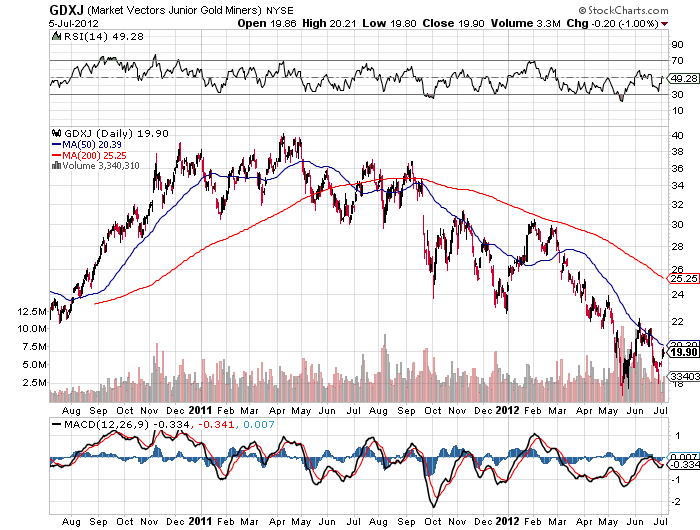
The story has been quite different for stockholders in gold mining companies.   Gold stocks have gone through a brutal sell off during 2012 despite the neutral price action of gold bullion.  Stock prices of the junior gold miners have been particularly brutalized as shown by the Market Vectors Junior Gold Mine ETF (GDXJ) which is down over 50% from its high late last year.


GDXJ - Courtesy stockcharts.com

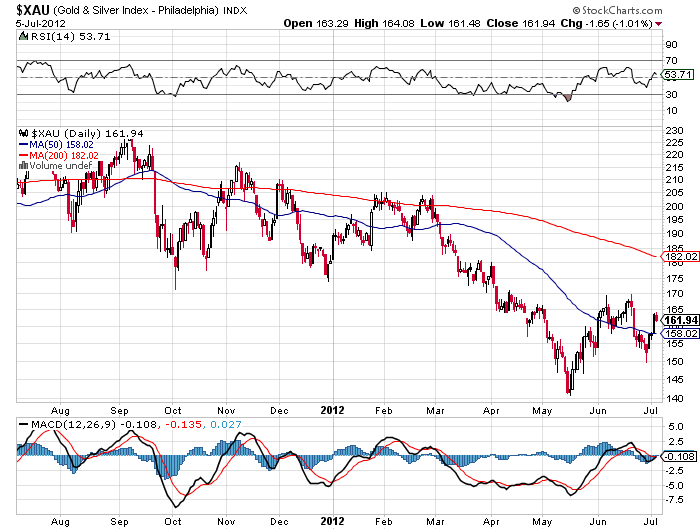
The shares of the largest gold miners have also seen major losses during 2012.  The PHLX Gold and Silver Index (^XAU), comprised of 16 major gold and silver producers, has decline by 21% from its peak reached in early February.


XAU - courtesy stockcharts.com

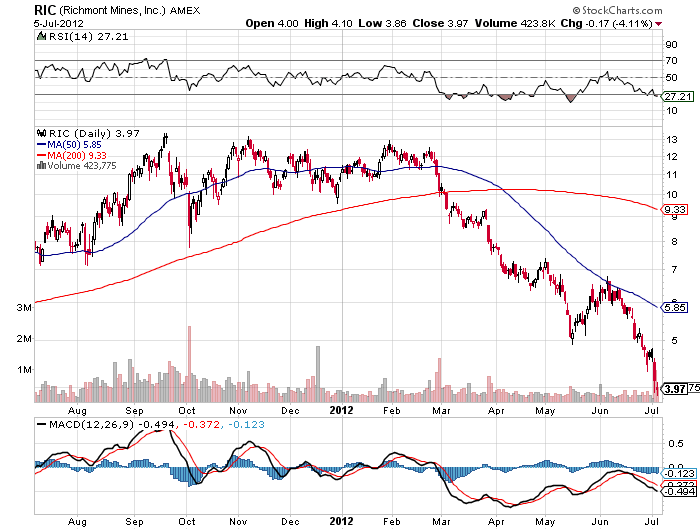
The latest casualty in the junior gold mining sector was Richmond Mines (RIC) which recently lowered its estimate of reserves and production and took a major write down on assets.  Richmond, a highly regarded gold mining company with excellent reserves and earnings prospects, was only one of the latest blowups in the junior gold mining sector.  Richmond Mines has collapsed 70% from its $13 per share price in late January, closing today at $3.97.


Courtesy stockcharts.com

Is the decline in gold mining shares a harbinger for the future trend in gold bullion or is the latest sell off a major buying opportunity?

Here are some thoughts from two of the brightest minds in the industry who both have superb long term track records.

Legendary gold investor John Hathaway of the Tocqueville Gold Fund (TGLDX) remains bullish as discussed in his latest Gold Strategy Investment Letter.

Why would anyone own them other than for the possibility of a higher gold price?  While we do not wish to minimize such issues as capital spending cost pressures, resource nationalism, or competition from GLD and similar instruments, we believe those concerns will fall by the wayside with the resumption of the bull market in the metal.  If gold were to trade at $2,000/oz. later this year, and should the ratio of gold mining shares (XAU basis) return to the mid -point of its range since the launch of GLD in 2004, or roughly 15% versus the current level roughly 10%, mining stocks could  double on a 25% increase in the gold price.

The policy challenges facing the Volcker Fed and the Reagan administration that ultimately capped the previous bull market in gold seem mild by comparison to those of today.  We believe that gold remains under owned and misunderstood notwithstanding a thirteen year bull market.  It is considered a fringe strategy to most, a little bit exotic and slightly risqué to the mainstream investor.  While policy makers attempt to buy time by inventing solutions that are incomprehensible to most, the dream of mainstream investors for robust growth amidst stable economic conditions remains alive.  Faith in half-baked policy improvisations that are nothing more than repackaging bad debt in the envelope of sovereign credit, along with hope that ever increasing quantities of sovereign debt will generate growth is, in our opinion, delusional.

Peter Grandich gives an excellent in-depth analysis on both gold stocks and gold bullion in a recent post on the Grandich Letter website.  The full post is a must read – here are some of his latest thoughts.

Despite general metals prices much, much higher than a decade or two ago, the mining and exploration industry is far more challenged now than ever before. This is especially true as you move further down the food chain in the junior resource sector.

I’m certain there are other reasons, but I believe the above is a good part of why we’re where we are today. The question now is does this mean the mining and exploration stocks are no longer worthy?

The “mother” of all bull markets continues thanks to four key reasons:

  • Once dominant sellers that capped any advances, Central Banks are now net buyers.
  • Gold producers, who once “cut their noses to spite their faces” by selling forward large quantities of future production and helped capped the price by doing so, now operate under the belief hedging is a “four-letter” word among investors.
  • Gold Exchange Traded Funds (ETFs) greatly changed the balance between supply and demand. Investors who never or rarely sought exposure to gold beforehand (because of difficulties associated with physical bullion buying) and/or who ended using mining shares for exposure only to see them not come close to correlating movements in the gold price themselves, embraced ETFs in a big and powerful way in order to have exposure to gold. Whether or not those ETFs are really direct ways to physical ownership doesn’t concern them, but their large-scale appetite for them combined with the changes among Central Banks and gold producers greatly altered the supply versus demand in favor of demand.
  • Gold is money. There’s no Central Bank printing it like it’s going out of style. There’s no government(s) borrowed up to their eyeballs in it. Where you find real growing wealth in the world you find those people acquiring it are using gold as a storer of their wealth.

Gold Bullion Coin Sales Up 13% In June, Silver Bullion Coin Sales Remain Steady

According to the latest report from the U.S. Mint, sales of gold bullion coins increased by over 13% during June, while total sales of the silver bullion coins were essentially unchanged from May.
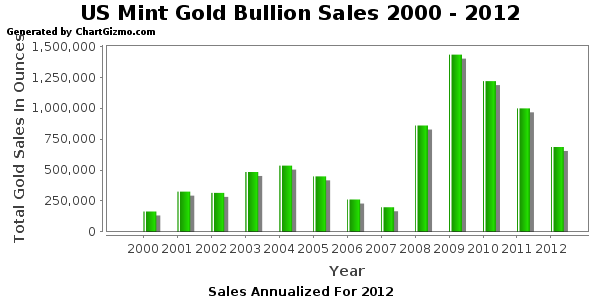
Monthly sales of the American Eagle gold bullion coin have fluctuated considerably during 2012 with sales reaching a monthly high of 127,000 ounces in January and a monthly low of 20,000 ounces in April.  Sales rebounded strongly in May to 53,000 ounces and continued higher in June with the sale of 60,000 ounces.

Sales of the American Eagle gold bullion coin can vary dramatically from month to month based on many factors.  The all time yearly sales record for the gold bullion coins of 1,435,000 ounces was reached in 2009  when many people feared that the financial system would collapse.  Sales volume of the gold bullion coins have not, however, had a direct correlation to the price of gold.  Gold closed 2009 at $1,087.50 per ounce and subsequently went on to hit a 2011 high of $1,895 on September 5th.  Despite the fact that gold increased by over 74% since year end 2009, total gold bullion coin sales declined in both 2010 and 2011.

If the European financial storm continues to unwind into a collapse similar to what we experienced in 2008, sales of the gold bullion coins could easily expand dramatically over the record levels seen in 2009.  With each passing day, there seem to be fewer reasons to maintain confidence in the paper money system as central bankers and governments attempt to prop up a debt burdened world economy with additional debt and money printing.

Listed below are the yearly sales of the American Eagle gold bullion coins since 2000.  The total for 2012 is through June 30th.

Gold Bullion U.S. Mint Sales By Year
Year Total Sales Oz.
2000 164,500
2001 325,000
2002 315,000
2003 484,500
2004 536,000
2005 449,000
2006 261,000
2007 198,500
2008 860,500
2009 1,435,000
2010 1,220,500
2011 1,000,000
2012 343,500
Total 7,593,000

If the sales trend of American gold bullion coins continues on the pace it has been on thus far, 2012 may turn out to be the fourth year in a row of lower sales.  The graph below shows gold bullion coin sales since 2000 with figures for 2012 annualized based on sales through June 30th.

U.S. Mint sales of the American Eagle silver bullion coin continued strong in June at 2,858,000 ounces, down slightly from the May total of 2,875,000 ounces.  After a strong start in January with sales of over 6 million ounces, sales dipped below 2 million ounces in February and April.  Year to date sales through June 2012 of the silver bullion coins total 17,392,000 ounces, down by 22% from the comparable sales period in 2011 when 22,303,500 ounces were sold.

If sales of the silver bullion coins continue at the same pace for the remainder of 2012, total sales could exceed 34 million ounces, not far below the record set during 2011 of 39.9 million ounces.   Considering that silver has corrected in price from $48.70 reached during April of 2011, the volume of silver bullion coin sales is very robust, with buyers taking advantage of lower prices.

In addition to gold and silver bullion coins, the U.S. Mint sells numismatic series of both gold and silver American Eagle coins which the public can purchase directly from the U.S. Mint.  Bullion versions of the gold and silver American Eagles are only sold to Authorized Purchasers who in turn resell the product to the general public and other dealers.

Total annual U.S. Mint sales of the American Silver Eagle bullion coins since 2000 are shown below.  Sales totals for 2012 are through June 30th.

American Silver Eagle Bullion Coins
YEAR OUNCES SOLD
2000 9,133,000
2001 8,827,500
2002 10,475,500
2003 9,153,500
2004 9,617,000
2005 8,405,000
2006 10,021,000
2007 9,887,000
2008 19,583,500
2009 28,766,500
2010 34,662,500
2011 39,868,500
2012 17,392,000
TOTAL 215,792,500