April 10, 2026

Spectacular Anglo-Saxon Gold Treasure Discovery On Display

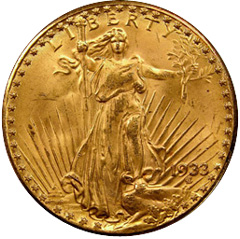
Most amateur treasure hunters searching for buried treasure with a metal detector would be delighted to find an occasional dated silver coin.  The discovery of buried gold treasure, however, remains only a dream for the vast majority of treasure seekers.

Imagine the excitement of a British treasure hunter who unearthed one of the most exquisite and extensive collection of gold artifacts ever discovered.   Searching on a Staffordshire farm in July of 2009, Terry Herbert stumbled across a treasure hoard of 3,500 artifacts, of which many were masterfully crafted out of gold.

It will never be ascertained who buried the fabulous treasure that came to be known as the “Staffordshire Hoard”.  The English countryside where the treasure was discovered has a long and violent history of warfare by numerous conquerors and barbarian tribes.  In any event, those who buried the treasure approximately 1300 years ago never retrieved it, bequeathing to history a fabulous array of ancient artifacts.

The vast majority of the exquisitely crafted items discovered were made for military use or adornment.  The treasure hoard contained no gold or silver coins.

The estimated value of the Staffordshire Hoard is estimated at $5.3 million.  The treasure hoard consisted of 11 pounds of gold which accounted for three quarters of the treasure’s total weight.

The Staffordshire Hoard is owned by the Birmingham Museums and Art Gallery, which will preserve the magnificent treasure for future generations.

The November issue of National Geographic has an extensive photo display of the Staffordshire Hoard, several of which are featured below.

Courtesy National Geographic, Photo by robertclarkphoto.com

Beyond the historical and cultural value of the Staffordshire Hoard, a large percent of the treasure’s value can be ascribed to the value of the gold content which held value for approximately 13 centuries.  The cold ground of the English countryside preserved a treasure for future generations.  Anyone care to ponder on what the value of U.S. dollars buried in the ground today would be worth in the year 3311??

 

Courtesy nationalgeographic.com, Helmet re-creation

Gold Demand Soars On Fears Of European Debt Defaults

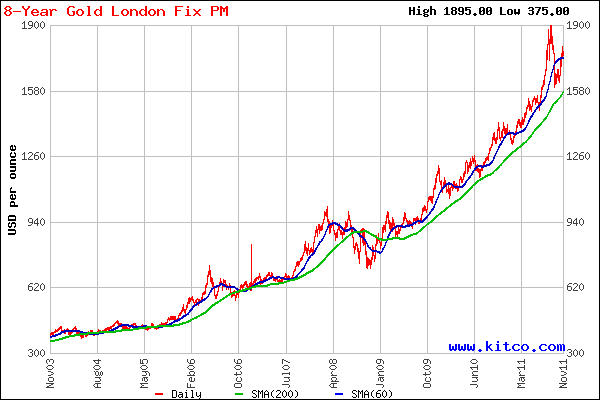
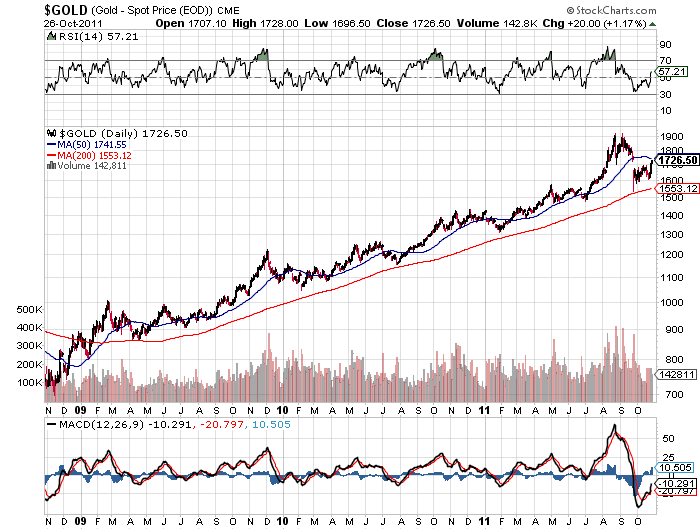
After a sharp September price correction, gold is on track to hit all time highs.  According to a Bloomberg survey, 80% of the forecasters with the most accurate track records are predicting that gold will reach $1,950 by the end of the first quarter.   Investors world wide are fleeing paper currencies as the threat of debt defaults spread across Europe.

Ironically, central bank attempts to stimulate debt burdened economies by lowering interest rates to zero has contributed to the worldwide rush to gold.  Why would investors hold return free government debt with the added risk of principal loss?

As financial turmoil spreads across the globe, gold traders are the most bullish since 2004.

Gold traders and analysts are the most bullish in at least seven years as investors accumulate metal at the fastest pace since August to protect their wealth from a widening European debt crisis.

Gold exceeded $1,800 an ounce for the first time in seven weeks on Nov. 8 and hedge funds are holding their biggest bet on higher prices since mid-September, Commodity Futures Trading Commission data show. The metal is rebounding after tumbling as much as 20 percent in three weeks in September on demand for what are perceived as the safest assets. Almost $9 trillion was wiped off the value of global equities since May and yields on Italian and Greek bonds rose to euro-era records this week.

“Throughout history gold has protected people from the sort of turmoil that we’re seeing,” said Mark O’Byrne, the Dublin-based executive director of GoldCore Ltd., a brokerage that sells everything from quarter-ounce British Sovereigns to 400-ounce bars. It’s “an important thing to own when there is this sort of volatility in stock markets and concern about currency devaluations.”

Gold climbed 24 percent to $1,766.72 this year, heading for an 11th consecutive annual advance. It’s the second-best performer behind gas oil in the Standard & Poor’s GSCI Index of 24 commodities, which rose 5 percent.

Technical indicators suggest the rally that began in September has further to go. While gold jumped 14 percent since reaching an 11-week low Sept. 26, its 14-day relative-strength index is at 58, below the level of 70 that indicates to some who study technical charts that the metal is poised to drop.


Gold - courtesy kitco.com

As discussed previously in this blog, proclamations by the mainstream press after the September gold price correction that the “gold bubble had burst” constituted a contrarian buy signal for gold and silver.  The September correction was simply another opportunity for long term gold investors to add to positions at bargain prices.

The fundamental reasons for owning gold and silver have not changed and are not likely to anytime soon.


$40 Silver Predicted By Year End

Will silver hit $40 by year end?

The latest in depth report on silver from the Silver Institute builds a sound fundamental rationale for a price of $40/ounce or higher by 2011 year end.  The Silver Institute report analyzes the current silver market, sources of investment demand, paper instruments linked to silver, silver mining stocks and privately held silver stocks.

Highlights of the Silver Institute report are summarized below and the full report can be found here.

1.   China and India dominate retail demand for silver but demand from India can be volatile with periods of heavy disinvestment such as occurred in 2009.  The key to silver demand in India remains linked to consumer price expectations and inflation in India has been soaring, reaching almost double digits.

Based on India’s current 9% inflation rate, 2012 is likely to see continued huge demand for both gold and silver.   Paper assets currently have little appeal to Indians seeking to preserve their wealth since interest rates are currently negative.  According to an article published at GATA, the yield on ten year notes is almost 1% below the rate of inflation resulting in an erosion of wealth for holders of paper assets.  Savers are reacting accordingly and purchasing precious metals to preserve their wealth.  During October, imports of gold and silver rose 40% to $7.2 billion.

2.   The Silver Institute forecasts that gold and silver will benefit as a safe haven based on the expanding European sovereign debt crisis which appears to be spiraling out of control.  Silver should also benefit from asset reallocation as recession in Europe causes losses in traditional paper assets.

Amazingly, as both paper currencies and governments continue to collapse, investors still have a blind misguided faith in paper assets back only by the “full faith and credit” of insolvent nations.  Proof of this is seen by the Silver Institute’s forecast of only a 10% increase in retail demand for bullion coin and small bar in Europe.  Demand for precious metals in the U.S. is forecast even lower at 7%.  Such modest demand for the only currency that cannot be debased by government actions completely refutes those who claim that precious metals are in a bubble.

3.  The Silver Institute forecasts that investment demand in 2011 will reach new record highs of $10 billion.  Chinese demand for physical silver should grow by 25% and Indian demand for silver should increase by a massive 55% to 45 million ounces.  The Institute Report also notes that the silver market in China is still very small since the market for silver was only recently liberalized in 2009.

U.S. investors have also taken the opportunity to capitalize on bargain silver prices.   U.S. Mint sales of American Silver Eagle bullion coins should easily hit an all time record high of over 42 million ounces in 2011.

4.   The Silver Institute notes that the rise in silver prices has correlated with the increased price of gold and also benefited from the introduction of ETF products, such as the iShares Silver Trust (SLV).  The iShares Silver Trust has grown to $10.6 billion with holdings of 314.6 million ounces of silver since its launch in 2006.

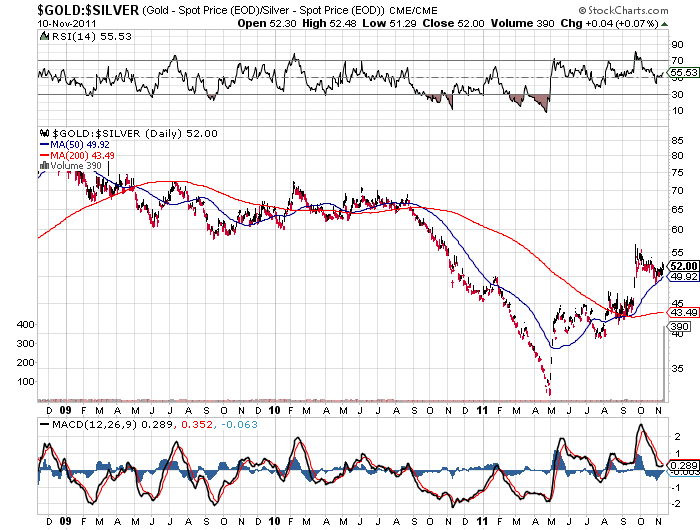
The correlation of silver to gold prices, as represented by the gold/silver ratio, also suggests that the price of silver is undervalued.   From a long term historical perspective, a gold/silver ratio of 16 has prevailed.   After dropping from 70 to 30 during the first half of the year, the gold/silver ratio has climbed to 52.  If the gold/silver ratio returns to 16, silver prices could easily reach $110 per ounce based on the current price of gold.

The increasingly tenuous “value” of paper currencies combined with increased worldwide demand for silver as a safe haven asset makes a compellingly bullish case for additional investment in silver.


American Silver Eagle Bullion Sales Soar As Investors Buy At Bargain Prices

The US Mint’s latest monthly reports on the sale of American Silver Eagle bullion sales show that investor buying has hit all time record levels.

Total sales of the American Silver Eagle bullion coins in 2010 came in at a record high of 34,662,500.

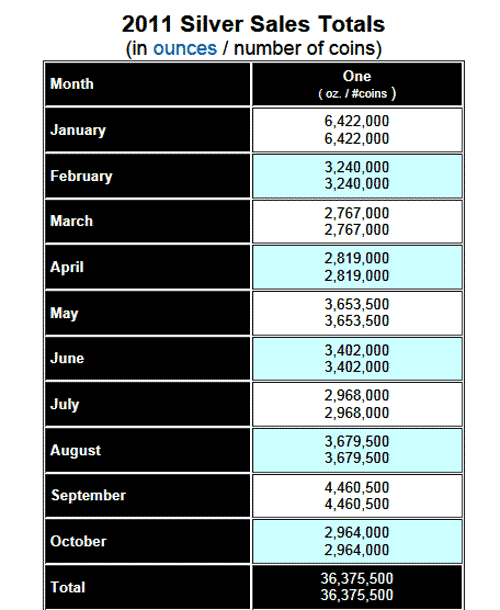
With over two months remaining in 2011, sales of the American Silver Eagle have already surpassed the record level of 2010 with sales of 36,375,500 ounces.  If sales of the Silver Eagle for November and December match the levels of 2010, total sales for 2011 should total over 42 million ounces or more than 20% above the record breaking sales level of 2010.

A review of sales by month for 2011 indicate solid fundamental buying by silver investors.  Typically, buying of an asset will increase as prices go higher and decrease as prices decline.  This was not the case with the American Silver Eagles – despite a sharp sell off in May and September, monthly sales increased as investors took advantage of bargain prices.

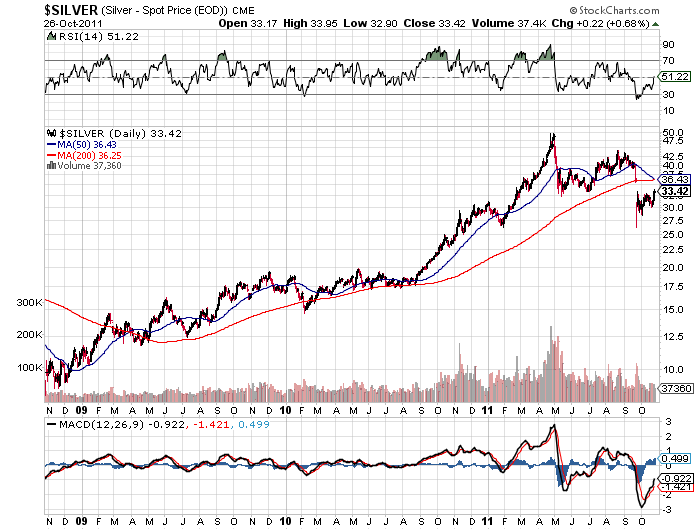
Silver had a volatile year, selling at $30.67 per ounce at the beginning of the year and moving up to a high of $48.70 (as measured by the London PM Fix Price) on April 28th.  Silver closed yesterday at $33.47, up $2.80 or 9.1% on the year.

Based on strong fundamental demand for physical silver, expect silver prices to end the year considerably higher.

Why Gold And Silver Prices Will Continue To Rise

The September correction in the price of gold and silver resulted in a flood of bearish articles by the mainstream press, proclaiming that the “gold and silver bubbles” had burst.

Since the mainstream press does not comprehend why precious metals have been in a bull market for the past ten years, the proclamation of the “end of the gold and silver bull markets” was, in reality, a contrarian bullish call.

Every long term bull market has sharp sell offs and gold and silver are no exception to this rule.  The sharp rise of gold prices during the summer attracted hot money from speculators and hedge funds who quickly liquidated positions based on short term technical sell signals, driving down the price of gold by over $300 per ounce.

As previously discussed, the fundamental reasons for owning gold and silver have not changed – in fact, they have grown stronger.  The September sell off in precious metal prices was simply another fantastic opportunity for long term investors to increase positions at bargain prices.

Long term investors in precious metals have outperformed virtually every asset class for the past ten years.  Even after the panic selling of September, gold still held gains of over 20% on the year from a price of $1,405 at the start of 2011.  Silver, despite a very volatile year, also remains above its price of $30.67 at the beginning of the year.

Both gold and silver remain in established long term up trends and remain at oversold, bargain level prices.


One strong fundamental factor providing support for further price gains in gold and silver comes from Mark Hulbert, whose Hulbert Financial Digest measures newsletter sentiment on the gold market.  Recent readings of the Hulbert Gold Newsletter Sentiment Index (HGNSI) (tracked by the Hulbert Financial Digest) revealed that at the end of last week gold timers were extremely bearish on gold.

The HGNSI readings dropped to the most bearish level in two and a half years, with gold market timers recommending a 13% short allocation in gold portfolios.  Hulbert’s research shows that gold usually rises when gold timers are very bearish.  Hulbert notes that gold timers have not been this bearish since March of 2009 – a level from which gold prices subsequently doubled.


Ron Paul Blames Destructive Fed Policies For Housing Crash And Economic Bust

Ron Paul explains better than anyone else the destructive economic forces unleashed by Federal Reserve monetary policies.  According to Paul,  loose monetary policies and manipulation of interest rates has caused “every single boom and bust that has occured in this country since the bank’s creation in 1913.”

In a Wall Street Journal editorial, Ron Paul explains exactly how the Fed has wrecked the economy, why they are clueless for the reasons behind their failures and why further Fed actions will only further exacerbate the problems caused by the Fed in the first place.

Adding new money increases the supply of money, making the price of money over time—the interest rate—lower than the market would make it. These lower interest rates affect the allocation of resources, causing capital to be malinvested throughout the economy. So certain projects and ventures that appear profitable when funded at artificially low interest rates are not in fact the best use of those resources.

Eventually, the economic boom created by the Fed’s actions is found to be unsustainable, and the bust ensues as this malinvested capital manifests itself in a surplus of capital goods, inventory overhangs, etc. Until these misdirected resources are put to a more productive use—the uses the free market actually desires—the economy stagnates.

Yet policy makers at the Federal Reserve still fail to understand the causes of our most recent financial crisis. So they find themselves unable to come up with an adequate solution.

The Fed fails to grasp that an interest rate is a price—the price of time—and that attempting to manipulate that price is as destructive as any other government price control. It fails to see that the price of housing was artificially inflated through the Fed’s monetary pumping during the early 2000s, and that the only way to restore soundness to the housing sector is to allow prices to return to sustainable market levels. Instead, the Fed’s actions have had one aim—to keep prices elevated at bubble levels—thus ensuring that bad debt remains on the books and failing firms remain in business, albatrosses around the market’s neck.

If the Fed would stop intervening and distorting the market, and would allow the functioning of a truly free market that deals with profit and loss, our economy could recover. The continued existence of an organization that can create trillions of dollars out of thin air to purchase financial assets and prop up a fundamentally insolvent banking system is a black mark on an economy that professes to be free.

Fed policies have pushed the U.S. and global economies to the precipice of a full blown depression.  What are the odds that they  reverse course and follow Ron Paul’s recommendations?  Zero, in my opinion.  Bernanke still believes in the fantasy illusion that creating more dollars at zero interest rates will somehow ignite economic growth.  The Fed blindly ignores the fact that in all of recorded human history, once great powers that incurred massive debt loads have all failed.

Ron Paul concludes that the Fed will continue its self defeating policies because of  the pressure to “just do something”.  And right on cue, former Federal Reserve Vice Chairman Alan Blinder recommends (in his own concurrent Journal editorial) that the U.S. government needs to incur whatever amount of debt is necessary to cure the housing crisis.  Blinder’s idiotic recommendation comes on the heels of previous failed and costly housing programs that cost billions and futher delayed the recovery in housing by keeping unqualified homeowners in homes they can’t afford to be in.

Here’s Blinder’s advice on How to Clean Up The Housing Mess, which is the exact opposite of Ron Paul’s free market solutions.

Given the huge magnitude of the aggregate gap between house values and mortgage balances, a comprehensive anti-foreclosure solution requires hundreds of billions of dollars.

So what can be done now? There is no silver bullet; we need different remedies for different types of (actual or prospective) foreclosures. And to succeed, we must overcome the three barriers. Foreclosure mitigation is expensive. It will encounter political resistance. It probably requires bending some property rights.

Blinder’s new spending plans and previous similar ones have cost the Government trillions, tremendously debased the dollar and accomplished nothing except to make the case for owning gold even more compelling.


Gold’s Long Term Trend Is Up As America Commits Suicide

Every bull market has pullbacks.  Sharp sell offs can generate fear and panic, causing investors to sell at the worse possible time.

Steep and sudden price declines are  characteristic of any long term bull market.  Speculators and investors with short term perspectives wind up selling instead of adding to positions during the buying opportunity that arises from panic selling.

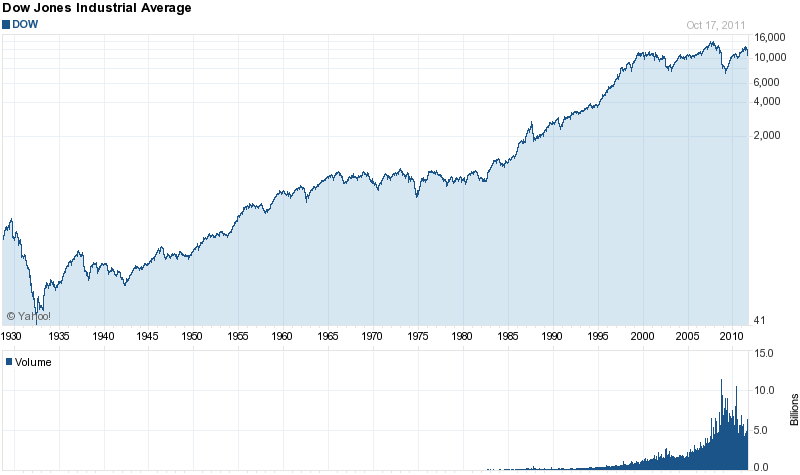
The great bull market in stocks, which lasted from the early 1980’s to 2000, provides a classic case of a sell off that proved to be a great buying opportunity.  On October 19, 1987, a day now referred to as Black Monday, the Dow collapsed in a sea of sell orders that left the Dow down by 508 points for a shocking loss of almost 23% in one day.

The loss on the Dow was the largest in history, causing panic among investors.  After Black Monday, a group of the world’s foremost economists unanimously predicted an economic downturn similar to the 1930’s.

Although the exact cause of the Crash of 1987 is still being debated, those who stayed in the market and used the sell off to add to positions, went on to enjoy one of the greatest bull markets in history.  Anyone gazing at a long term price chart of the Dow has to squint to see the Crash of 1987 that transpired during the super 20 year bull market that finally ended in 2000.


DOW JONES - COURTESY YAHOO FINANCE

We have recently witnessed what some are referring to as a “crash” in the gold market, with bullion dropping suddenly by $300 per ounce.   Although a rapid depreciation in the price of gold by over 15% can be painful, especially if new positions were initiated prior to the sell off, the decline should be of minor concern to long term gold investors.  The fundamental reasons for owning gold have not changed.  Investors in the gold market today are being given an opportunity similar to that offered to stock investors in late 1987.

Gold is the only defense against fiat currencies which all ultimately fail and the day of reckoning may be sooner than many think. In his new book “Suicide Of A Superpower”, Patrick Buchanan makes a compelling case that America could collapse financially before 2025.  In an interview with Sean Hannity on Fox News (see video link below), Buchanan argues that:

  • America’s problems are “deep and endemic”.
  • Half of the American population are “tax consumers” rather than tax payers and thus have no incentive to support reduced government spending.
  • American society has lost its moral foundations and its sense of right and wrong.
  • The widely different views of the major political parties cannot be reconciled and America thus faces a “Balkanization” that will further contribute to the breakdown of American society.
  • America will soon become California – bankrupted by the demands of “tax consumers” who will always demand more.  By virtue of their majority status, the “tax consumers” will elect politicians who promise them the most, thus ensuring the bankruptcy of America.

The decline of America that Buchanan warns about is already well underway. From a long term perspective, that is all gold investors really need to know.

Audio Link to Suicide Of A Superpower narrated by Patrick Buchanan.


Gold Stocks Vastly Outperform Gold On The Week – Will The Trend Continue?

For the week ending October 14, gold continued to rally, gaining $26 on the week to $1,678.00 as measured by the closing London PM Fix Price.

Gold stocks, by comparison,  dramatically outperformed the gain in bullion by almost fourfold.  In order to get a broad based assessment of relative performance, gold was compared to the XAU, GDXJ and TGLDX.

The XAU or Philadelphia Gold/Silver Sector is a broad based index of sixteen large precious metal mining companies, the GDXJ or Market Vectors Junior Gold Miners tracks small and medium cap gold and silver miners and the TGLDX  or Tocqueville Gold Fund is a diversified gold stock fund with one of the best track records in the industry.

A summary of gold compared to the XAU, GDXJ and TGLDX for the one week period ending October 14th is shown below.

WEEK ENDING OCT 14, 2011
% GAIN OR (LOSS)
GOLD 1.57%
XAU 5.51%
GDXJ 6.85%
TGLDX 5.68%

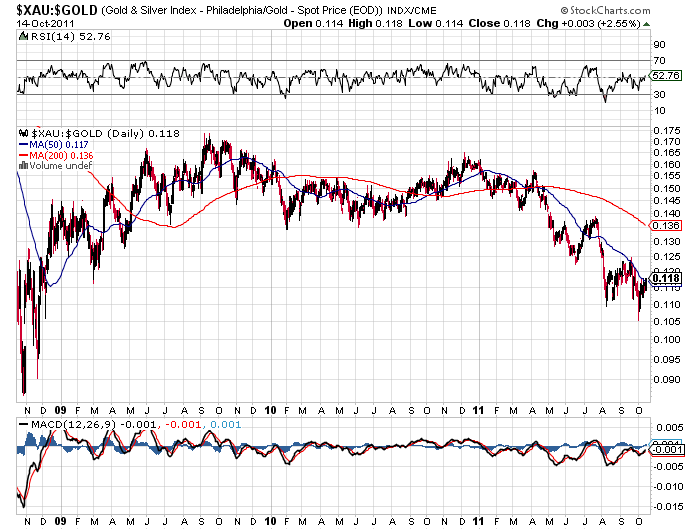
One week does not ensure that a trend will continue but the gold stocks have long been under priced in relationship to gold bullion. Eventually, this pricing disparity will converge. Throughout 2011, gold stocks underperformed gold as can be seen by comparing the performance of gold to the XAU.


XAU VS GOLD - courtesy stockcharts.com

The Tocqueville Gold Fund (TGLDX), run by legendary gold investor John Hathaway, has vastly outperformed the S&P, the XAU and gold bullion over the past decade with an average annual return of over 26%.  This is what John Hathaway had to say about the long term performance of gold stocks in his first half investment update for the Gold Fund.

During the 1st half of 2011, gold shares lagged the gold price. Bullion rose 5.56% while the XAU benchmark declined 10.57%. The Tocqueville Gold Fund declined 5.53%. This apparent disconnect is not unprecedented. For example, during the credit crisis of 2008, the XAU declined 28.54% while the price of gold rose 5.77%. Even though the gold price is the single most important fundamental determining value for gold mining shares, they often do not move in lockstep and the first half of 2011 is one such example. In 2010, gold shares performed particularly well and the XAU rose 34.67% while the metal rose 29.52%. In our opinion, the relative underperformance of gold shares during the first six months of this year represented a healthy and necessary consolidation. The Tocqueville Gold Fund owns physical bullion but is much more heavily weighted to gold mining stocks, as has been the case over the past ten years.
We believe that there is significant performance catch up potential ahead for gold mining shares relative to bullion. Earnings reports for the quarter just completed should be exceptionally strong for all producers and in most cases surpass all- time records. We expect such results to be accompanied by numerous announcements of dividend hikes. Should gold prices maintain or exceed the $1500 level, skeptical investors will become more willing to normalize the earnings power that is soon to be demonstrated.
The factors that drive liquid assets into gold bullion continue to flourish. Most important, negative real interest rates open the floodgates for capital to seek out the safety of gold. In addition, the never ending sagas of the Eurozone debt woes and the US debt ceiling remind investors that sovereign debt of nearly all Western democracies are not the safe havens they were once regarded. Nevertheless, while we expect bullion prices to set new highs during the second half, we believe gold mining shares will provide returns superior to the metal.

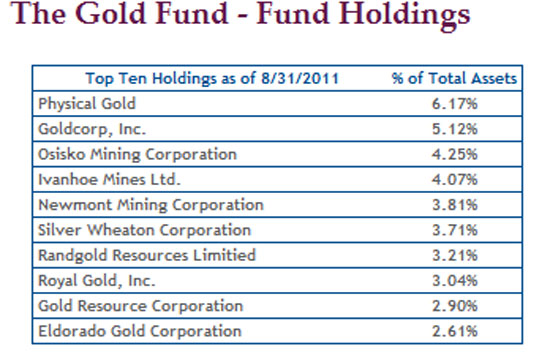
The latest report on the top ten holdings of the Tocqueville Gold Fund are shown below.


Why The Gold Bull Market Is Only Getting Started

According to one market seer who has been a long term gold bull, the fear of higher inflation should not be viewed as the primary factor driving gold prices higher.

In an interview with Fortune Magazine, Stephanie Pomboy explains why she likes gold despite the powerful deflationary undertones of the world economy. Ms. Pomboy is the head of MacroMavens, a firm she founded in 2002. Major institutional investors and giant money management firms have become clients of MacroMavens based on Pomboy’s successful ability to forecast major trend moves based on macroeconomic factors.

Ms. Pomboy has correctly been bearish on the U.S. economy since late 2008, predicting a long period of deleveraging due to declining incomes and the deflated housing bubble. Deflated asset bubbles, declining incomes and a slow economy are not the classic ingredients for inflation. Pomboy correctly argued that low inflation, or actual deflation, would not prevent gold prices from surging higher.

Pomboy has a superb track record predicting gold prices. In a December 2008 interview with Barron’s, Pomboy prophetically concluded that “We are going to see a secular rotation from paper assets to hard assets like gold. The whole global competitive currency devaluation, including that of the dollar, plays right into that. We are acting as though there are no consequences to basically running the money off the printing press and handing it to the Federal government to backstop financial markets or bail out homeowners or what not. There is no consequence to doing this, unless or until the rest of the world says to us, ‘We don’t like this game’ and We don’t want to have all the dollar claims we are holding debased by [Fed Chairman Ben Bernanke] running his printing press.”

Those who heeded Pomboy’s advice have seen gains of about 100% as gold moved from the $850 range in 2008 to the current price of $1,675.   As a means of protecting capital against the debasement of all major currencies, gold remains the best hard asset to own.

In a follow up interview with Barron’s in February of this year, Pomboy made another extraordinarily accurate call on both gold and bonds.  Despite referring to treasury bonds as certificates of confiscation, Pomboy recommended buying U.S. government debt and gold, a seemingly contradictory stance.  As Pomboy explained it to Barron’s:

My bullishness on these flimsy pieces of paper is purely opportunistic. It is based on (1) my view that the perception of the economy has run far ahead of the reality and that disappointment will find yields declining. And (2), as I discussed in the interview, my belief that this will find the Fed extending QE–a policy which involves the Fed’s outright purchase of Treasuries… Not only is the Fed now the largest holder of Treasuries, but thanks to Ben’s printing press, it has unlimited capacity to buy. So this is one market where the fundamental laws of supply and demand do not apply.

Finally, for those who can’t fathom going long gold and Treasuries in combination? it’s simple. It’s the neatest expression of a bet on continued Fed monetization which, again, entails the direct PURCHASE of Treasuries!!! The wisdom of this trade has been on full display for ?oh? the last FOUR and A HALF years! The fact that it is still viewed as some kind of oxymoron only reinforces how much farther it has to go.

The Fed’s commitment to further assets purchases was revealed today when the Fed released the minutes of their last meeting.  Although the Fed temporarily stopped outright asset purchases when QEII ended, policy makers are already discussing when to resume the practice.  The Fed has already purchased about $1.6 trillion in government bonds, financed via quantitative easing.  As the economy slows further and government spending continues its upward spiral, anyone who thinks the Fed won’t start monetizing the public debt is delusional.

In her recent interview with Fortune Magazine, Pomboy remains bullish on gold and forecasts higher oil prices as emerging nations reduce dollar reserves.  According to Pomboy, “I’m really interested in strategic resources — commodities that emerging nations like China are trying to stockpile.  Oil would be at the forefront. I think it will continue to be a beneficiary of this global debasement of currency and the need for emerging nations to diversify the foreign exchange resources that they’re sitting on, which are being debased every single day. Why not take that money and spend it on building strategic oil reserves rather than watching it go up in smoke?”

Pomboy’s perfectly logical theory that emerging nations will sell dollar assets to buy oil implies that demand for U.S. treasuries will drop dramatically since emerging nations such as China have been one of the biggest purchasers of U.S. debt.   The absence of sufficient bids at Treasury auctions will immediately cause the following two events to occur:  1) the Fed will be forced to monetize ever greater amounts of debt in order to keep U.S. interest rates from rising and 2)  the price of gold will soar.


You Know Paper Currencies Are In Trouble When Investors Flock To The “Safety” Of The Yen

Investors in paper currencies are running out of safe havens.  As Europe totters on the brink of a debt implosion and the Dow routinely plunges 1,000 points every other week, holders of paper wealth are desperately searching for a store of stable value.

Ironically, the two currencies viewed as the least risky are the Japanese yen (issued by the country with the highest debt/GDP ratio in the world) and the U.S. dollar (issued by the country with the largest amount of debt in the world).

Investors in U.S. dollars remain forever at risk to the Fed’s policies of dollar debasement and money printing, but to seek safe haven in the yen seems like an even more foolhardy proposition.  Consider It’s 1987 Without the Bubble In Japan for insights into the fundamental weakness of the economy backing the paper yen.

Japan’s labor force shrank last month to its smallest size since October 1987, when the nation’s stock-market benchmark was 185 percent higher and land prices were 85 percent greater than today.

Employers cut payrolls by 160,000 and a further 200,000 workers retired or abandoned efforts to find a job, leaving the seasonally adjusted number of employed at 59.4 million, the statistics bureau said today in Tokyo. Separate figures showed industrial production rose 0.8 percent from the previous month, less than all but three of 28 forecasts in a Bloomberg survey.

The data deepen concern that Japan’s recovery from the March earthquake will be stunted by manufacturers shifting operations abroad because of gains in the yen, a deterioration in consumer confidence and prospects for higher taxes at home. The challenges add to the burden of an economy already beset by a shrinking and aging population.

The yen traded at 76.59 as of 12:11 p.m. in Tokyo, less than 1 percent from the post-World War II record high of 75.95 on Aug. 19. The Nikkei 225 Stock Average was little changed at 8,723.12, compared with the peak of 38,915.87 when it closed out 1989, capping a four-year run when it soared almost 200 percent.

Japan has been in a contained depression for two decades, propped up by massive deficit spending and BOJ money printing.  A double dip world recession will send Japan’s economy into a nosedive since exports account for 15% of GDP.

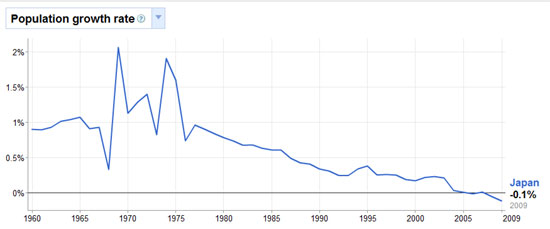
In order for Japan to service its crushing debt burden, they need rapid economic growth and and a large expansion of their labor force.  Will this happen?  In a word, no.  The world economy has been in a downward spiral since 2007  and massive stimulus efforts by governments and central banks have failed to contain the ongoing depression.  Making matters even worse for Japan is the fact that the Japanese are slowly exterminating themselves.  The birth rate in Japan has been plunging since the early 1970’s and has now gone negative.  An economy with a dwindling labor force and an aging population has little hope of servicing a massive debt burden.

Japan population growth: Courtesy google.com


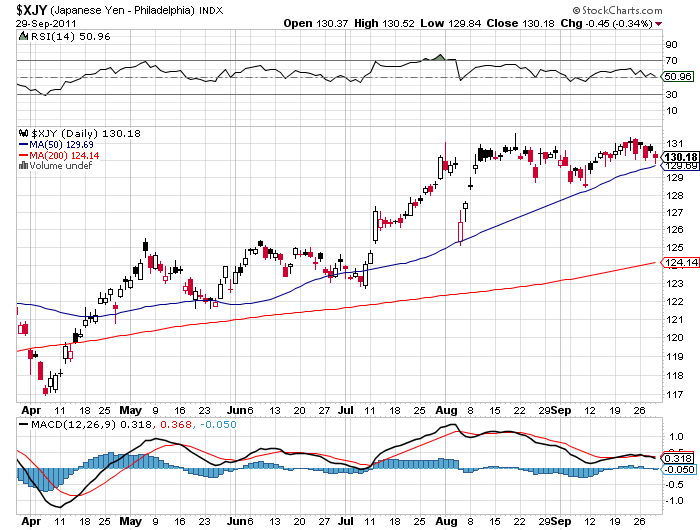
The appreciation of the yen is forcing Japanese companies to fire domestic employees and move operations overseas in order to remain competitive.   The Japanese government has intervened numerous times in the currency markets, trying to force the yen lower without success.  Despite the weak fundamentals of the Japanese economy and a suffocating level of debt, the yen continues to appreciate, suggesting that investors perceive other currencies to be riskier than the yen.   The yen has gained the dubious distinction of being the cleanest shirt in the dirty laundry.


Yen - courtesy stockcharts.com

There is no way of predicting how long the value of the paper yen can defy economic reality.  Markets will eventually price to fundamental values and investors will question the value of all paper currencies.  At this point, gold will rightfully be perceived as the only currency with real value.  What price level gold will soar to during the chaos of collapsing currencies cannot be predicted – what can be predicted is that holders of gold will be the only ones left holding a currency with any value.