 Most Americans under 30 have a strange sense of unease that something is very wrong with the way things are going in America. If you are 60 or older and can remember with nostalgia how life in America was prior to the days of blatant and corrupt crony capitalism, you know for sure we are heading in a very wrong direction at an accelerating pace.
I can remember the days when the average worker could support his family without putting his wife to work, without having to give up on having children, without having to worry about banks going under, without having to worry about an implosion of the financial system and without the expectation that the government would provide handouts to solve every little one of life’s problems.
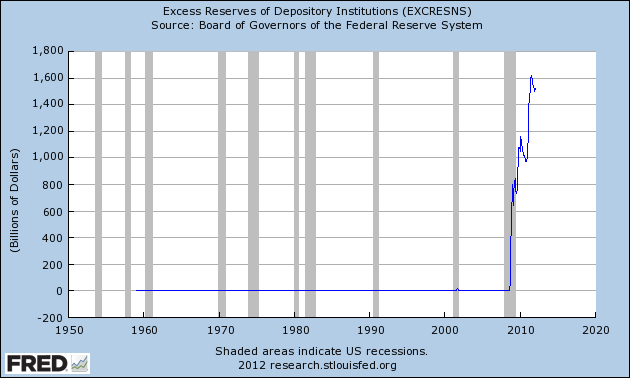
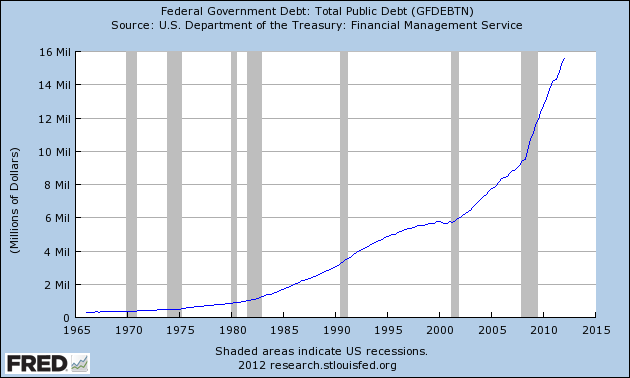
Gradually, it has begun to dawn on the average American of all ages that the Federal Reserve may be at the heart of the nation’s financial problems. Much has been written about this, but two graphs sum up the situation quite nicely. Since the Federal Reserve was created in 1913, the value of the dollar has declined to a fraction of what it was once worth and since the abandonment of the gold standard, government debt has reached levels that are no longer sustainable without further debasement of the paper dollar. The American public is beginning to connect the dots.

Ron Paul has been a lonely voice in spreading the message about the Fed but has finally reached a milestone with the House passage of his proposed “Audit The Fed” legislation. In an update Ron Paul notes that 75% of the American public supports his bill according to a recent poll.
Last week the House of Representatives overwhelmingly passed my legislation calling for a full and effective audit of the Federal Reserve. Well over 300 of my Congressional colleagues supported the bill, each casting a landmark vote that marks the culmination of decades of work. We have taken a big step toward bringing transparency to the most destructive financial institution in the world.
But in many ways our work is only beginning. Despite the Senate Majority Leader’s past support for similar legislation, no vote has been scheduled on my bill this year in the Senate. And only 29 Senators have cosponsored Senator Rand Paul’s version of my bill in the other body. If your Senator is not listed at the link above, please contact them and ask for their support. We need to push Senate leadership to hold a vote this year.
Understand that last week’s historic vote never would have taken place without the efforts of millions of Americans like you, ordinary citizens concerned about liberty and the integrity of our currency. Political elites respond to political pressure, pure and simple. They follow rather than lead. If all 100 Senators feel enough grassroots pressure, they will respond and force Senate leadership to hold what will be a very popular vote.
In fact, “Audit the Fed” is so popular that 75% of all Americans support it according to this Rasmussen poll. We are making progress.
Of course Fed apologists– including Mr. Bernanke– frequently insist that the Fed already is audited. But this is true only in the sense that it produces annual financial statements. It provides the public with its balance sheet as a fait accompli: we see only the net results of its financial transactions from the previous fiscal year in broad categories, and only after the fact.
We’re also told that the Dodd-Frank bill passed in 2010 mandates an audit. But it provides for only a limited audit of certain Fed credit facilities surrounding the crisis period of 2008. It is backward looking, which frankly is of limited benefit.
The Fed also claims it wants to be “independent” from Congress so that politics don’t interfere with monetary policy. This is absurd for two reasons.
First, the Fed already is inherently and unavoidably political. It made a political decision when it chose not to rescue Lehman Brothers in 2008, just as it made a political decision to provide liquidity for AIG in the same time period. These are just two obvious examples. Also Fed member banks and the Treasury Department are full of former– and future– Goldman Sachs officials. Are we really to believe that the interests of Goldman Sachs have absolutely no effect on Fed decisions? Clearly it’s naïve to think the Fed somehow is above political or financial influence.
Second, it’s important to remember that Congress created the Fed by statute. Congress therefore has the full, inherent authority to regulate the Fed in any way– up to and including abolishing it altogether.
My bill provides for an ongoing, thorough audit of what the Fed really does in secret, which is make decisions about the money supply, interest rates, and bailouts of favored banks, financial firms, and companies. In other words, I want the Government Accountability Office to examine the Fed’s actual monetary policy operations and make them public.
It is precisely this information that must be made public because it so profoundly affects everyone who holds, saves, or uses US dollars.
Will the bill pass the senate, considering the incestuous and corrupt self dealing relationships between too big to fail banks, government and politicians? Probably not in our lifetimes, but at least public awareness of the problem is growing. Ron Paul might have added in his update that the vast majority of Americans no longer believe they are ruled with the consent of the governed.
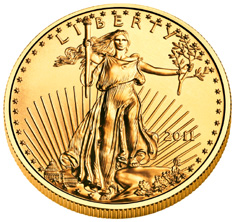
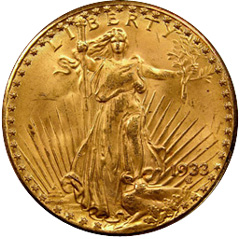
 According to the latest report from the U.S. Mint, sales of gold bullion coins increased by over 13% during June, while total sales of the silver bullion coins were essentially unchanged from May.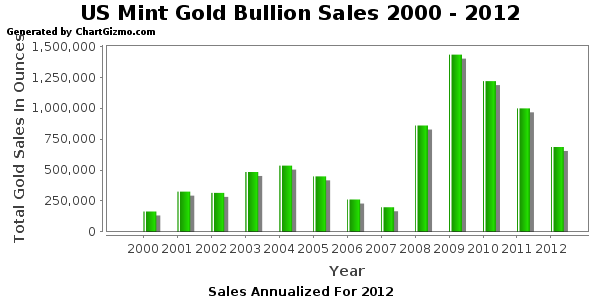
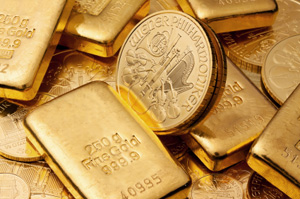 Although Federal Reserve Chairman Ben Bernanke refuses to acknowledge that gold is money, another major regulatory agency views the value of gold money as a risk free asset for calculation of Tier 1 regulatory capital by banks. Meanwhile, as Ben Bernanke dismisses the value of gold, other central banks around the world continue to increase gold reserves. As the world financial system spirals closer to a complete breakdown, it is the holders of paper currencies that are squarely placed at the highest point of the risk spectrum.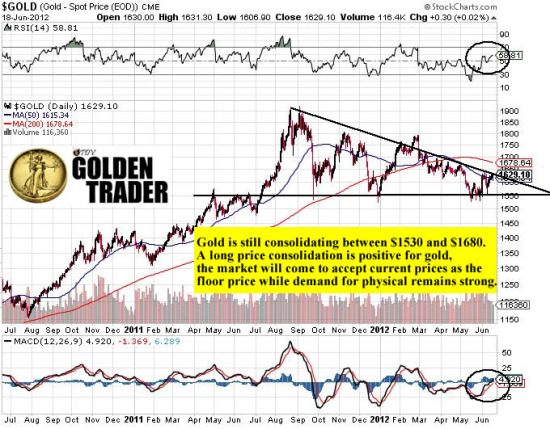
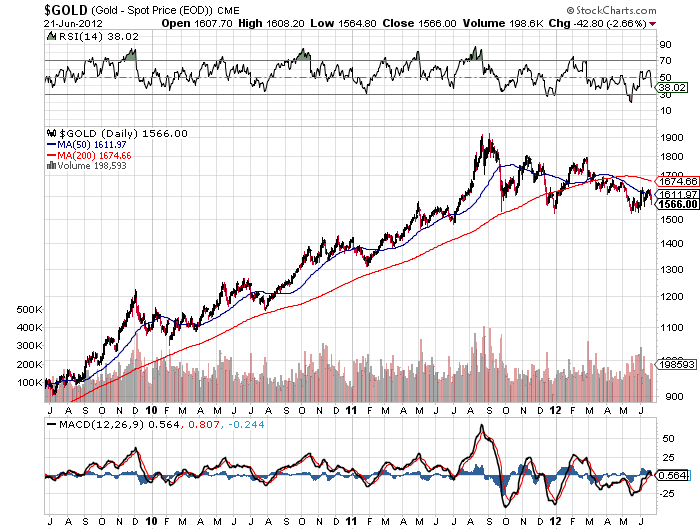
 The combination of increasingly ominous economic reports along with the Fed’s failure to announce bold new monetary initiatives resulted in a brutal reassessment of risk by investors. Stock, commodity and precious metal markets all plunged with the Dow down 250 points, gold down by $41.60 per ounce to $1,566 and silver off by 4.4% to $26.98. Crude oil in New York trading was off 4%, dropping below $80 a barrel for the first time in eight months.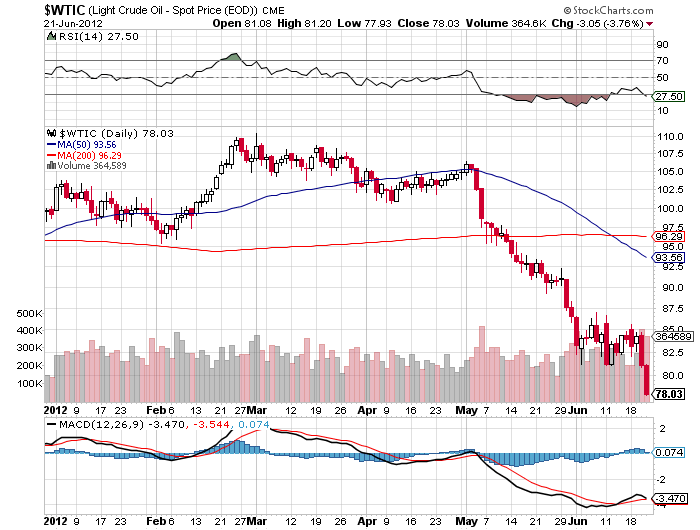
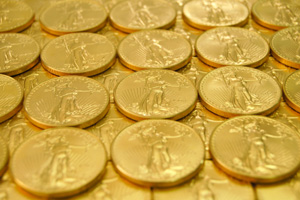
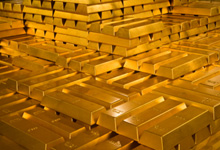 According to the latest report from the U.S. Mint, sales of both gold and silver bullion coins rebounded strongly during May.
 It is no secret that the price of gold has been declining since reaching almost $2,000 per ounce last year. After rallying in the early part of the year, gold prices have now fallen to $1,556, representing a decline of $42 per ounce or 2.6% below the closing price on the first trading day of 2012.


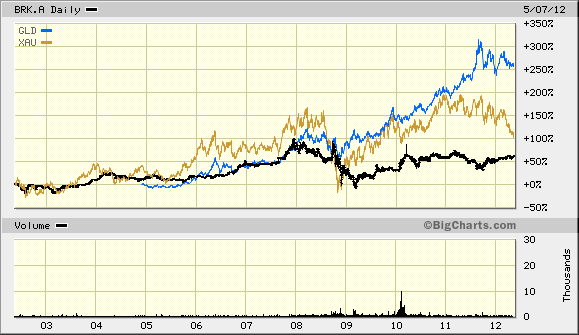
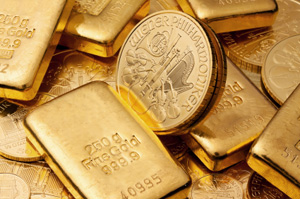 According to Warren Buffett, the decade long rally in gold has been based solely on fear and the greater fool theory. Buffett, believed by many to be one of the greatest investors of all time, has gone out of his way lately to ridicule gold investors.