April 20, 2026

Gold and Stocks Diverge As Central Banks Pledge Unlimited Money Printing

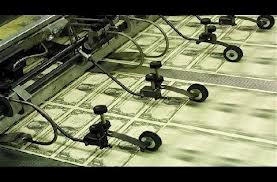
Both the Federal Reserve and the Bank of Japan have gone all in with their attempts to revive weak, debt burdened economies with a pledge of unlimited money printing.

Japan’s incoming Liberal Democratic Party Prime Minister Shinzo Abe, who ran on a platform of unlimited quantitative easing and higher inflation, has quickly forced capitulation by the Bank of Japan to surrender its independence from political influence.

The Bank of Japan pledged Thursday to review its price stability goal, admitting that the move was partly in response to incoming Prime Minister Shinzo Abe’s aggressive calls for the central bank to step up its fight against deflation.

At its two-day policy board meeting, the BOJ decided to expand the size of its asset-purchase program—the main tool of monetary easing with interest rates near zero—and promised to review next month its current inflation goal, something Mr. Abe demanded during Japan’s parliamentary campaign.

Countering speculation that the board’s decision-making process is being driven by politicians, Gov. Masaaki Shirakawa said the bank reviews its price goal every year. But he acknowledged that the policy board had taken Mr. Abe’s request into account.

The Bank of Japan’s quick surrender of monetary policy independence reflected the fact that they had little choice in the matter.  Mr. Abe had previously threatened a  “law revision to take away the BOJ’s independence if it didn’t comply with his demands.  Mr. Abe said the election shows that his views have the support of the people, and, on the night of his victory, he specifically said he expected the BOJ to do something at this week’s meeting.”

The policy of unlimited money printing by Japan came shortly after similar actions were announced by the U.S. Federal Reserve in early December.  Fed Chairman Ben Bernanke, architect of the U.S. “economic recovery” announced that the Fed would purchase $45 billion of US Treasuries every month in addition to the open ended monthly purchase of $40 billion of mortgage backed securities.  The Fed’s expanded “asset purchase programs” will be monetizing over $1 trillion of assets annually, effectively funding a large portion of the U.S. government’s annual deficit with printed money.

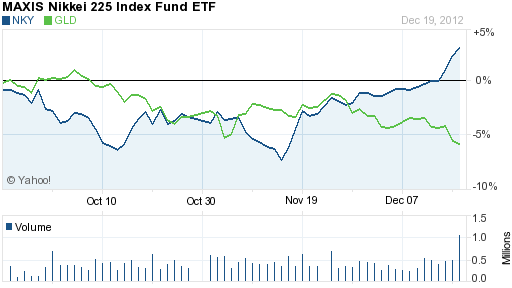
The impact of blatantly unlimited money printing by two of the world’s largest economies surprised many gold investors as the price of stocks and gold quickly diverged, with gold selling off and stocks (especially in Japan) gaining.
Why would gold, the only currency with intrinsic value that cannot be debased by governments, sell off as governments pledged to flood the world with freshly printed paper currencies?  Here’s one insight from John Mauldin.

When you reduce the amount of leverage in the system, you’re actually reducing the total money supply. So the Fed can come in and print money, and the money supply – the total amount of credit and leverage and material that’s going through the system – really hasn’t increased.

A lot of monetary economic theories say “the money supply is directly related to inflation.”

It is, but the amount of leverage and credit in the system is also directly related to inflation. It becomes a much more complicated mix. What happens at the end of the debt supercycle, as you’re reducing that leverage, you’re actually in a deflationary world. That is the whole debate between deflation and inflation.

If you read the polls in the United States, we’re just totally dysfunctional. We want to pay less taxes and we want more health care – that doesn’t work. We are going to have to be adults and recognize that problem.

The reason is the Fed is going to do everything they can to fight deflation. The only thing they can do is to print money. They’re going to be able to print more money than any of us can possibly imagine and get away with it without having inflation.

Mr. Mauldin may have a valid point, but a more likely explanation is the suppression of gold prices by governments and central banks as voluminously documented by GATA.

“Those who follow GATA may not be surprised when the monetary metals markets don’t make sense, since they really aren’t markets at all but the targets of constant intervention by governments.”

Silver Investment Demand Soars In China

The use of silver as a monetary asset in China goes back for centuries.  As detailed in the latest report from the Silver Institute, China’s entire monetary system was based on a silver standard until 1935.  Things changed dramatically after the Communists came to power in 1949 and effectively nationalized the entire silver stock.  Private citizens were prohibited from owning silver or gold and private sales of silver and gold jewelry was banned.
As China slowly adopted free markets principles, government control over silver was liberalized and in 2000, China finally ended the government monopoly on silver trading.  Private exchanges were established which allowed both the supply and demand of silver to expand rapidly.

A momentous moment for silver occurred in 2009 when the People’s Bank of China finally allowed private investors to buy silver.  The opening of the silver market to the Chinese public along with explosive economic growth resulted in an exponential increase of silver demand.  A middle and upper class that was rapidly accumulating financial assets saw silver as the logical store of value to protect their wealth from inflation and currency debasement.

Removing the prohibition on the private ownership of silver resulted in explosive demand for silver bar, coins and metals.  Demand for coins and medals increased from 3.0 million ounces in 2009 to 5.8 million ounces in 2011.  Demand for silver bar increased from 1.3 million ounces in 2009 to 11.3 million ounces in 2011.

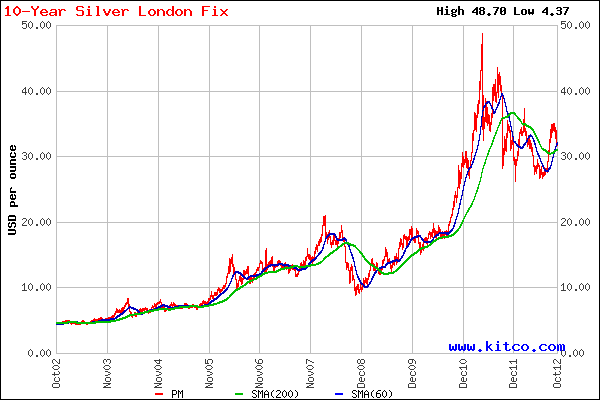
The Silver Institute projects that retail investment demand for silver will grow robustly as silver becomes more available to the growing masses of the Chinese middle class.  Currently, investor demand for silver accounts for only a small part of total silver demand.  In 2011, total Chinese silver demand was 170.7 million ounces, with investors purchasing only 17.1 million ounces of coins, medals and bars.  With a population of almost 1.4 billion people, demand for silver could surge exponentially.  If only 1 out of 4 people in China buy one ounce of silver each year, that would represent silver demand of a staggering 350 million ounces, which exceeds total annual silver supply of 281.5 million ounces in 2011.

Long term investors in both gold and silver who understand the underlying fundamental reasons for owning precious metals should ignore short term price fluctuations and increase positions on short term weakness.

Gold Has Outperformed Stocks By 300% Over The Past Decade

By Axel Merk

Superior Performance of Gold

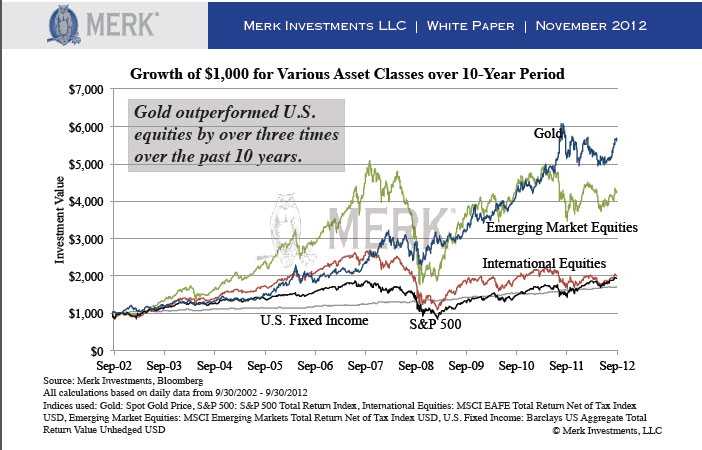
Over recent years, gold has performed remarkably well relative to other asset classes, in terms of both absolute performance and risk-adjusted performance. Over the preceding 10 years, an investment in gold would have significantly outperformed a corresponding investment in the S&P 500 Index or U.S. bonds, not to mention international and emerging market equities. Over the past 10 years, gold outperformed U.S. equities by over three times:

Courtesy: merkinvestments.com

Gold Shines even when Under-performing

Note that even during time periods when gold underperforms other asset classes, as it did during the 20-year time period analyzed above, the addition of a gold component improves the overall risk-adjusted return profile of a risky portfolio. We consider this to be largely driven by the low levels of correlation between the two assets and thus the positive impact it has on the volatility profile of the hypothetical portfolio above. For example, we find that a portfolio comprised 50% gold and 50% the S&P 500 would have exhibited an annualized standard deviation of returns of 12.7% over the 20-year period ended September 30, 2012.  This is a significant reduction to the annualized standard deviation of returns exhibited by a portfolio comprised 100% the S&P 500, which was 19.2% over the same time frame.

Read the full article here.

Gold Becomes The Ultimate Store Of Value As Central Bankers Create Unlimited Fiat Money

By Vin Maru

Lately we have seen many articles about China and many other central banks continuing to buy and increase their holdings of gold as part of their effort to continue diversifying out of foreign paper currencies. Who can blame them? Would you want to hold paper promises to pay off financial obligations from countries that are essentially bankrupt as a part of your currency reserve? China is doing what is the right thing and in the best interest of China, buying more gold to hold as a part of your reserves in order to make your currency more marketable. They want to make the yuan a competing currency to the other major currencies around the world and they will succeed and owning gold is part of their strategy.

There is some speculation that China is increasing its gold holding to make the yuan a gold-backed currency in an effort to make it a world currency reserve. While it is an interesting concept, it will most likely never happen. In order to back a currency, their gold holdings must increase or decrease alongside the increase or decrease in the number of currency units in the system. A gold backed currency would entail having a fixed rate of convertibility for each ounce of gold to a specific number currency units issued by that country. There is probably no country in the world that will honour convertibility on a fixed basis, it would be financial suicide and is part of the reason why Nixon closed the gold window. Also having a gold backed currency would mean the country would be continually increasing gold purchases to match the inflation of currency units issued. Tracking the amount of gold that is backing currency would also be next to impossible since there is a complete lack of transparency around the amount of currency units being issued by central banks and the amount of gold held by them. Currently currencies can be converted to gold on a floating basis at market price, but going to a gold backed currency would likely never happen.

China is making its currency more readily available for trade, thus bypassing the US dollar and making its currency the payment of choice for its export. Currently the yuan is fixed to the US dollar, but over time it will most likely have to adopt a floating currency like the rest of the world. Until then, expect China to continue adding to its gold reserve in an effort to make the yuan a competing currency for international trade. The US will lose its reserve currency status over time (most likely some time this decade) but it most likely will never go away completely and the yuan will not take over completely. We will most likely just have bi-lateral trade agreements with several national currencies being used for payments. The yuan is just the new kid on the block but there is still the Euro, British pound, Japanese yen, the US$ and probably the IMFs SDR that will also be used. Even the Canadian dollar has been strengthening lately, as the IMF said it’s considering classifying the Canuck buck and the Australian dollar as reserves currencies.

While gold may not be convertible at a fixed rate any time soon, VTB Group is Russia’s first lender to sell perpetual bonds and debt linked to the country’s benchmark equity index and is now selling the nation’s debut notes tied to the price of gold (see Bloomberg article). VTB is offering 1 billion rubles ($32 million) of securities that will be redeemed in December 2013 that will pay a rate on returns based on the gold price up to a limit of 20 percent. Being a pioneer in the Russian market, VTB is the 2nd largest bank and will provide pension funds an alternative to invest in gold without the limits placed on commodity holding by regulators. The article even talks about how even Western financial institutions such as JP Morgan, Barclays, and Credit Suisse are issuing notes tied to gold this month. This is just another example of how gold is becoming an important financial asset. The need to diversify and protect wealth becomes more apparent in an era of currency wars which will destroy the value of fiat money. Financial institutions realize that central banks will continue down the path of printing money, inflation and currency devaluation, there is no other choice. They see the writing on the wall and are now capitalizing on a new markets by providing financial assets tied to the price of gold price.

All these currencies will continue to inflate and I doubt the bankers will allow gold to become a competing currency for everyday transactions. However its role as a store of value will continue to appreciate as long as fiat money continues to exits. So we should be happy that government and central bankers will continue to use and expand fiat currency, it makes their currency worth less and gold will continue to benefit in the long run.

What we are seeing now, with short term fluctuations in the price of gold is just market noise and short term trading opportunities created by the gold market high frequency traders and bullion banks. This will come to pass as the price of gold gets smoothed out and then slowly advances higher with a two steps forward one step back dance along a rising trend. All this talk about gold by mainstream media is just market noise to try and explain very short term movements in price. They have very little understanding of gold and the role it will play in the future as a store of value. Being the good slaves and puppets for the central bankers, MSM is only good at misdirecting the public and they are paid very well for doing so. Once gold finishes this consolidation, the price should continue to advance to all time highs in 2013 and 2014 with a possibility of doubling from the current price to reach a minimum target of $3500 in the next few years.

If you enjoyed reading this article and are interested in protecting your wealth with precious metals, you can receive our free blog by visiting TDV Golden Trader. Also learn how you can purchase and protect your gold holdings by getting a copy of our special report Getting Your Gold out of Dodge or protecting the stock investments you currently own with Bullet Proof Shares.

Regards,

Gold Ready For Explosive Rally Based On Sentiment, Seasonal Factors and Fed Money Printing

Gold has had a volatile year.  From January’s opening price of $1,598, gold quickly moved up by $183 per ounce by the end of February.  An ensuing correction that lasted into July brought the price of gold down by $225 per ounce to $1,556 in mid July, the low of the year.  In August gold started to rally, closing yesterday at $1716.25 per ounce, up $118.25 or 7.4% on the year.
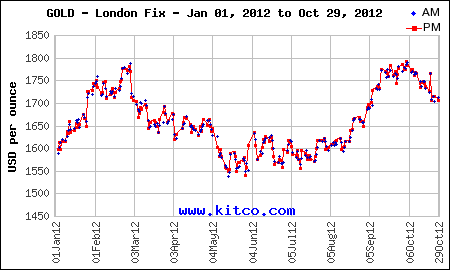
Gold now appears ready to mount an explosive rally that could easily push prices past $2,000 based on sentiment, seasonal factors and rampant money printing by the Federal Reserve.

Gold Traders Bullish

According to Bloomberg, gold traders are the “most bullish in 10 weeks…the highest level since August 24.  Gold rallied strongly from August 24th, adding $124 per ounce by October 4th.

Gold traders are the most bullish in 10 weeks and investors are hoarding a record amount of bullion as central banks pledge to do more to spur economic growth.

Eighteen of 27 analysts surveyed by Bloomberg expect prices to rise next week and five were bearish. A further four were neutral, making the proportion of bulls the highest since Aug. 24. Holdings in gold-backed exchange-traded products gained the past three months, the best run since August 2011, data compiled by Bloomberg show. They reached a record 2,588.4 metric tons yesterday, the data show.

The Bank of Japan (8301) expanded its asset-purchase program on Oct. 30 for the second time in two months, increasing it by 11 trillion yen ($137 billion). The Federal Reserve said last week it plans to continue buying bonds and central banks from Europe to China have pledged more action to boost economies. Gold rose 70 percent as the Fed bought $2.3 trillion of debt in two rounds of quantitative easing from December 2008 through June 2011.

“Central banks are all very concerned about a depression, so they’re keeping monetary policies as loose as possible,” said Mark O’Byrne, the executive director of Dublin-based GoldCore Ltd., a brokerage that sells and stores everything from quarter-ounce British Sovereigns to 400-ounce bars. “People are buying gold as a store of value to protect against currency depreciation.”

Seasonal Factors

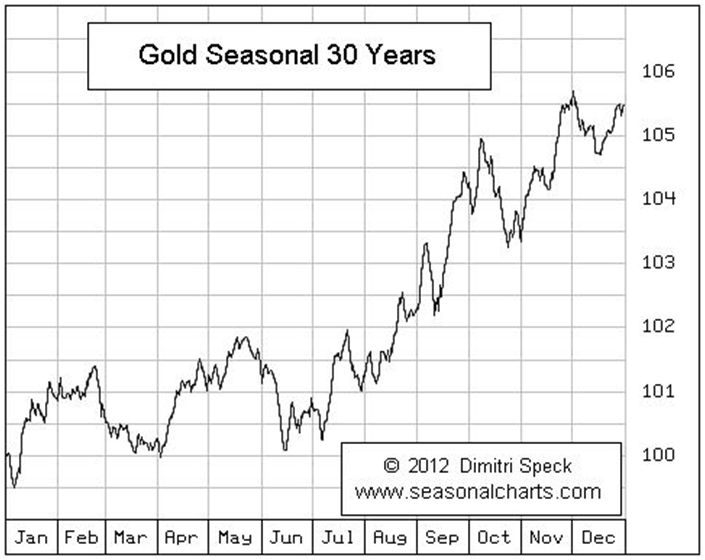
Gold has a pronounced seasonal tendency to rally strongly in the last quarter of the year.  The chart below from GoldCore shows the seasonal strength of gold over the past 30 years.

Courtesy goldcore.com

Rampant Money Printing By The Federal Reserve

Central Banks worldwide have gone on a money printing rampage to save governments that are unable to control spending or raise sufficient tax revenues.  David Einhorn, President of Greenlight Capital, who has a brilliant investment track record, is rampantly bullish on gold and raises the question of what type of truly desperate measures central banks will take if the world economy enters another recession or suffers an exogenous shock.

“It seems as if nothing will stop the money printing, and Chairman Bernanke in fact assures us that it will continue even after the economic recovery strengthens.  Even after the economy starts to recover more quickly, even after the unemployment rate begins to move down more decisively, we’re not going to rush to begin to tighten policy.  Apparently, anything less than a $40 billion per month subscription order for MBS is now considered ‘tightening’.  He’s letting us know that what once looked like a purchasing spree of unimaginable proportions is now just the monthly budget.”

“If Chairman Bernanke is setting distant and hard-to-achieve benchmarks for when he would reverse course, it is possibly because he understands that it may never come to that.  Sooner or later, we will enter another recession.  It could come from normal cyclicality, or it could come from an exogenous shock.  Either way, when it comes,  it is very likely we will enter it prior to the Fed having ‘normalized’ monetary policy, and we’ll have a large fiscal deficit to boot.  What tools will the Fed and the Congress have at that point? If the Fed is willing to deploy this new set of desperate measures in these frustrating, but non-desperate times, what will it do then?  We don’t know, but a large allocation to gold still seems like a very good idea.”

Gold In The News – German Gold, Gold Confiscation, Technical Charts, New Perth Mint Coins

Gold news from around the web-

Gold Confiscation?

Are those predicting the confiscation of gold by the U.S. government simply seeking headlines or seriously misguided?  Jim Sinclair has the answer.

I am sick of all this confiscation talk of gold and even gold companies. It emanates from gold people who do not know or understand the history of gold. We condemn MSM for inaccurate, false and misleading news. I condemn gold writers who practice sensationalism, who offer their opinions as if they were facts and simply make things up out of thin air as if they were insiders privy to things that no one else is. Right now leaders of this community are printing stuff as misleading as MOPE or MSM ever have.

Eric De Groot put what I have been trying to teach you perfectly today. In the 1930s gold was to the monetary system what QE is today, a means of increasing the supply of money for Fed and Treasury discretionary use. The US Secretary of the Treasury and President Roosevelt set the gold price higher at their daily breakfast together arbitrarily. Higher because to create money then the system required a higher value of gold to have more money outstanding. This is why Roosevelt ordered the confiscation of gold in order to unfold his type of monetary stimulation, his QE. This is what confiscationophiles simply do not know.

 Your fears and the outrageous untrue statement by the Scottish hedge fund manager are based on totally wrong reasoning and misunderstanding. Gold was not confiscated because it was going up in price. Gold’s order of confiscation came as a tool of monetary stimulation in order to create monetary creation in order to attempt to increase employment.

So, Exactly Where is Germany’s Gold?

The Germans, tough with monetary policy, turn out to be wimps when it comes to safeguarding their own massive 3,396 ton gold stockpile.  Turns out that the Germans, who allegedly hold most of their gold in French, British and U.S. vaults, never even bothered to conduct a physical audit of their holdings – talk about trusting your neighbors! After severe criticism and a national “Bring Back Our Gold” campaign, the Bundesbank is finally promising to conduct audits and bring their gold back home.  MarketWatch wonders if the expatriation of German gold may be the beginning of a move to a gold backed currency.

Gold and Silver Technical Charts

Some really amazing gold and silver charts suggest that we may be in the initial stages of a massive gold and silver rally.

Gold and Silver – The Ideal Holiday Gift

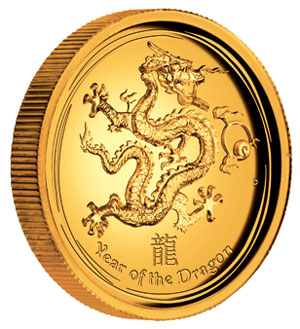
A stunning selection of new gold and silver coins from The Perth Mint  provides the answer to “what should I get her for Christmas?”  Included in the November product releases are some unique rectangular colored silver coins.

Gold Through the Centuries

One of the largest Roman gold coin hoards every found was discovered in Great Britain.  The coins are approximately 1600 years old.  Any guesses on what $10,000 of U.S. currency buried today would be worth in the year 3612??

Big Money Is Bullish On Gold

Big money managers are bullish on gold according to the pros interviewed in Barron’s latest fall survey.  A resounding 69% of big money managers are bullish on gold and 22% forecast that precious metals will be the best performing asset class over the next six to twelve months.

Courtesy Barron’s

The big money is bearish on Federal Reserve strategy with over 60% of poll respondents disapproving of the Fed’s current interest rate policy.  Reinforcing their low opinion of Fed strategy, an overwhelming 78% of the pros believe that additional Fed easing policies will be counter productive.  Summing up the general opinion on Ben Bernanke’s money printing schemes, one money pro said “The Fed is well past the point of interest-rate policy having any meaningful impact on the economy.  Bernanke & Co. now risk damage to both the dollar and the Fed’s own balance sheet.  This is the biggest misallocation of capital in the history of mankind.”

Not surprisingly, the overwhelming consensus (89%) of the big money pros think that treasuries are severely overvalued.  Although the pros don’t see interest rates rising significantly in the next six months, Barron’s notes that even a small increase in interest rates would result in losses to bondholders.  The Fed has manipulated interest rates to such a low level, that few money pros see any value in treasuries.  One money pro noted that without massive security purchases by the Fed, the 10 year bond would currently yield 5%, representing a real yield of 2% plus 3% for inflation.   Absent Fed efforts to suppress free market yields on treasuries, bondholders would be faced with shocking losses as interest rates rose.

The big money bearish sentiment on Bernanke and bullish forecast for gold tells us that the pros don’t expect implementation of sound monetary policy by the Fed any time soon.

Why Are Americans Underinvested In Gold and Silver?

Although there are no definitive statistics on how many Americans own gold or silver, the number is certainly small.  A Gallup poll earlier this year showed that 28% of respondents thought that gold was the “best investment” but the actual number of people actually owning some form of gold or silver bullion is far less.  A Kitco poll indicated that the number of Americans owning precious metals may be as low as 1%.
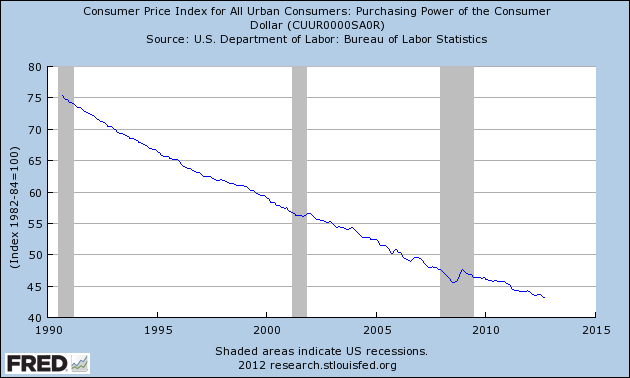
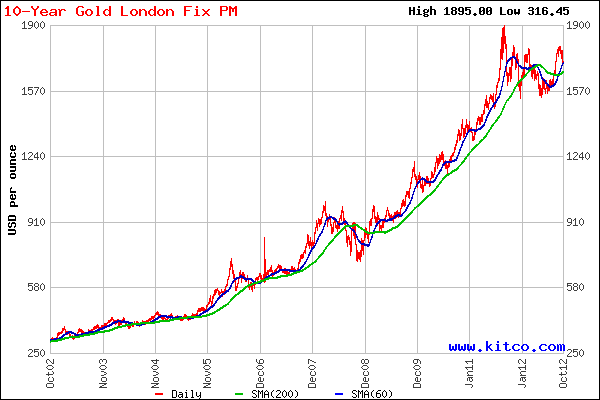
Despite the steady erosion in the purchasing power of the U.S. dollar, Americans retain their faith in paper money, apparently oblivious to the destruction of their wealth.  Monetary debasement is an insidious process that few Americans fully understand as explained by economist John Maynard Keynes in 1921.

“By a continuing process of inflation, Governments can confiscate, secretly and unobserved, an important part of the wealth of their citizens. By this method they not only confiscate, but they confiscate arbitrarily; and, while the process impoverishes many, it actually enriches some …. Those to whom the system brings windfalls …. become “profiteers” who are the object of the hatred … the process of wealth-getting degenerates into a gamble and a lottery .. Lenin was certainly right. There is no subtler, no surer means of overturning the existing basis of society than to debauch the currency. The process engages all the hidden forces of economic law on the side of destruction, and does it in a manner which not one man in a million is able to diagnose.”

Most Americans don’t bother trying to understand economic theories but it is not hard to understand the following charts.

courtesy: kitco.com

When the average American finally realizes what is happening to the value of the dollar, the rush to gold and silver will result in a massive upward surge in precious metal prices.  That day has not yet arrived and until it does, buy gold and silver with impunity, especially on corrections.

“How To Buy Gold and Silver Bullion Without Getting Ripped Off” – Free Kindle Book For Gold and Silver Blog Readers

Here’s a really great book on how to buy gold and silver that came to my attention.  I would recommend this book (“Stack Silver Get Gold”) to both long time gold and silver investors as well as those considering their first purchase.  Best of all, the price is right.  Author Hunter Riley has offered readers of the goldandsilverblog.com a free copy anytime between this Saturday, October 27th and Wednesday, October 31, 2012, offered through Amazon Kindle.  After October 31st, the purchase price of the book will be $9.99.

If you have a computer, you do not need a kindle to read the book. You can download Amazon.com’s free kindle reader here.
In addition, the author of the book, Hunter Riley, has added a contest where anyone who downloads the book during the Oct27-Oct31st free promotional period gets entered to win some American Eagle silver bullion.
Here’s the introduction to the book which I found compelling


The short book covers the following essential topics:

– How to avoid dealers and con artists who will rip you off

– Coins, rounds, bars, numismatic coins and junk silver – what premium you pay for each form of metal, and the advantages of each type
– What is premium and spot price?
– What type of silver and gold should you buy?
– What forms of gold and silver investments should you avoid?
– What are the dangers of ETF’s?

– Fraudulent dealers selling gold and silver that they don’t possess!
– Gold and silver mining stocks – good or bad investments?
– Gold and silver pools and leveraged accounts
– Phone dealers, TV ads and commemorative coins
– Where should you store your silver and gold?
– What type of home safe should you invest in?
– Wan you ad physical gold or silver investments to your IRA?
– Which is better as an investment? Gold or Silver?

– How to profit as the dollar collapses.
– What are the best gold and silver investing newsletters?
– Where can you buy gold and silver online?

– Which are the most reputable companies to deal with?

Note:  The Gold and Silver Blog receives no compensation for promoting this book.  It is done solely to educate investors on investing in gold and silver.

Global Gold Production Set For Major Decline As South African Mines Close

Global gold production could drop sharply as South African miners plan to dismiss thousands of workers for illegally striking.  South African precious metal miners have been beset by labor unrest for months as workers protest low wages and dangerous working conditions.  The latest disruption came Wednesday as South Africa’s largest gold miner announced plans to dismiss about 12,000 workers.
South Africa’s biggest gold miner by output, AngloGold Ashanti Ltd., said Wednesday it will begin a process to dismiss about 12,000 workers, following in the footsteps of other mining companies desperate to end crippling strikes.

If AngloGold follows through on its threat, it means more than 35,000 mining workers at several companies have been dismissed for illegally striking in recent weeks. The mass firings have prompted criticism from unions and the government, but so far have not provoked a repeat of the violence that sparked national labor unrest in South Africa in August.

Several major South African gold and platinum producers are struggling to end weeks of wildcat strikes that have halted thousands of ounces of gold and platinum production and caused billions of rand in lost revenue.

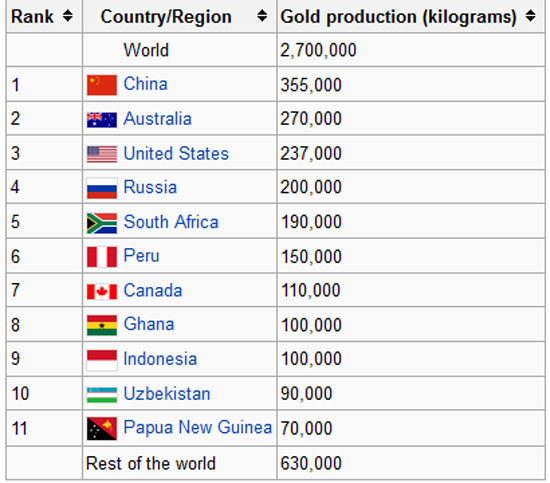
Gold production problems in South Africa run deeper than merely resolving a labor/management dispute over low wages.  The cost and effort to mine gold has grown exponentially as the easy to reach grades of gold ore have been depleted.  Miners have had to dig much deeper to reach low grades of ore with a corresponding increase in extraction costs.  South Africa, once the leading country in gold production has dropped to fifth place.

Courtesy wikipedia.com

In 2006, South Africa produced 272,128 kilograms of gold, but by 2011 output had plunged by 30% to only 190,000 kilograms.  With workers no longer willing to work for what amount to slave labor wages, along with declining ore reserves, gold output from South African mines will continue to decline dramatically.  SBG Securities analyst David Davis says “Almost all of the gold mines on strike are mature.  These mines were going to have to be restructured and downsized anyhow in the next 12 to 36 months.”

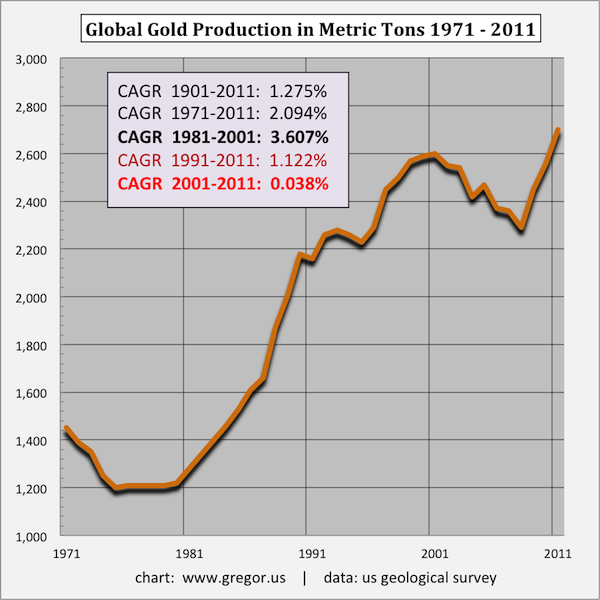
Further reductions in future global gold supply will continue based on the constantly increasing costs of mining lower grade ores and the lack of major new gold discoveries.  According to the US Geological Survey, gold production decreased in every year from 2001 to 2008, a remarkable statistic in light of the huge increase in gold prices during that period of time.  Gold sold for only around $300 per ounce in 2001 compared to today’s price of over $1,700 per ounce.

Over the past three years from 2009 to 2011, gold production increased as miners went all out to take advantage of surging gold prices.  According to the World Gold Council, mine production rose from 2,611 tonnes in 2009 to 2,822 tonnes in 2011.  The previous production peak for yearly gold production occurred in 2001 at 2,600 tonnes.  As the current situation in South Africa shows, much of the recent increase in gold production came as mining companies desperately worked old mines to depletion while paying workers as little as possible.   Those days are now over and South African gold production will continue to plummet.

Ironically, gold production soared from 1981 to 2000 as gold declined in price from $750 per ounce in 1981 to under $300 by the turn of the century.  Gold miners were forced to produce as much gold as possible to stay in business as revenues constantly declined due to the drop in the price of gold.

Absent major new discoveries of large gold deposits, gold mining production could decline substantially in future years.  Declining supplies, along with massive currency printing by central banks worldwide, will create the perfect storm for a continuation of the decade long bull market in gold.  Note to Ben Bernanke – no, you can’t print gold.