April 10, 2026

Ron Paul Goes All In On Gold and Silver

Rep. Ron Paul, a long time critic of the Fed and advocate of the gold standard, is all in on gold and silver.  Ron Paul has consistently warned of the dangers of a Fed gone wild on easy money and a Government that has borrowed itself into financial oblivion.

The “Honest Money” essay on the Ron Paul website is an all time favorite explanation of how money and inflation work and has drawn almost 6,000 comments.

What, then, is fiat money? It’s exactly what we just talked about: money that can be inflated or increased at the push of a button at the say-so of a powerful person or organization. Nowadays most dollars are just blips on a computer screen and it’s extremely easy for the Federal Reserve to create money out of thin air whenever they want to.

As you can see, inflation and fiat money are very seductive and beneficial to those at the top, and very dangerous to everyone else and the nation as a whole. That’s exactly what Henry Ford was talking about. He knew that every country that relies too much on fiat money is ruined sooner rather than later.

There is only one possible solution to the inflation problem: Stop creating money out of thin air. But we’re already in such a mess that the only way to have a real impact on the money supply is to increase interest rates so that people pay back their loans and borrow less money from the banks, which decreases the amount of money in circulation. However, higher interest rates might very well crash the economy. So the Fed’s current “solution” to overcoming inflation is… creating even more of it.

Fiat money is a dangerous addiction. Even if the Fed found a way to stop inflation, as long as the current system persists the temptation will always be there to resume pushing the easy money button. That’s why we need to get back on the gold standard and eliminate the Federal Reserve altogether.

In order to protect the purchasing power of his savings, Ron Paul has implemented the sound advice that he has been dispensing to America for many years.

As disclosed in Barron’s this weekend, Ron Paul’s top 10 holdings listed in required financial statement disclosures show that his portfolio is 100% in gold and silver mining stocks.  Ron Paul apparently also owns gold bullion, but the disclosure of asset holdings that may be considered as collectibles is not required.

Without getting into a discussion of the merits of a diversified investment portfolio, Ron Paul’s 100% investment allocation to gold and silver demonstrate his integrity.  If someone believes that the Government is persistently and continually debasing the value of the currency, why would you not invest exclusively in gold and silver?

Ron Paul has taken steps to protect himself from the disastrous affects that Federal Reserve policies will ultimately have on the value of the U.S. currency.  The average American would be well advised to follow his lead.

Here is Ron Paul’s portfolio as disclosed by Barron’s.
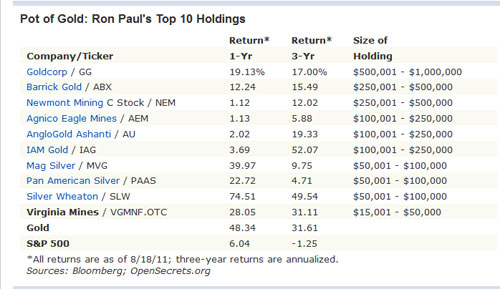
Ron Paul portfolio - courtesy Barron's
Americans Remain Tragically Underinvested In Gold And Silver

As predicted many times in this blog, the over indebted and over leveraged world financial system is starting to unravel at warp speed.   Massive amounts of  borrowing by governments during the financial meltdown of 2008 has effectively put many sovereign states at the limits of their borrowing ability.

A rapidly contracting economy and job losses will result in a flood of defaults in the private sector by both businesses and individuals.  A vicious self reinforcing cycle of defaults will cause major banking failures that a bankrupt FDIC will be unable to contain.  Banking holidays will become routine, the jobless rate will triple, the middle class will face financial destruction and social unrest will explode across the country.

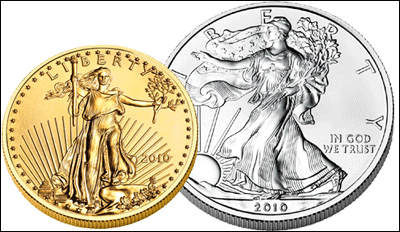
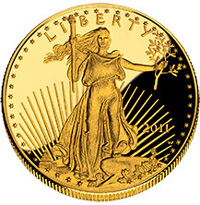
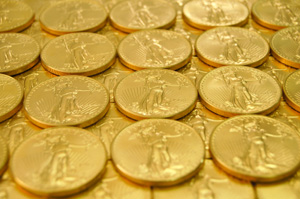
Crushing levels of debt will be the trigger that causes an economic depression that will make the 1930’s look like a minor recession.  Eventually, the creative destruction of capitalism (as described by economist Joseph Schumpeter) will extinguish debt burdens through defaults, allow for economic recovery and the creation of new wealth.  The downside to recovery through creative destruction, however, is that existing wealth is mercilessly devalued as paper based asset wealth is destroyed.  At this point, which would you prefer to own – a pile of paper dollars or a stack of American Gold Eagles?

The ultimate restructuring of a fiat based monetary system to one backed by more than promises is inevitable.  The timing of the event is the only open question since governments will use every power, legal or otherwise, to prevent the scenario described above.  Unfortunately, for holders of paper financial assets, the only viable option available for governments at this point are the printing presses.  The ocean of paper currencies that will be printed to “save the system” will debase paper financial assets, reducing their purchasing power to virtually nothing.

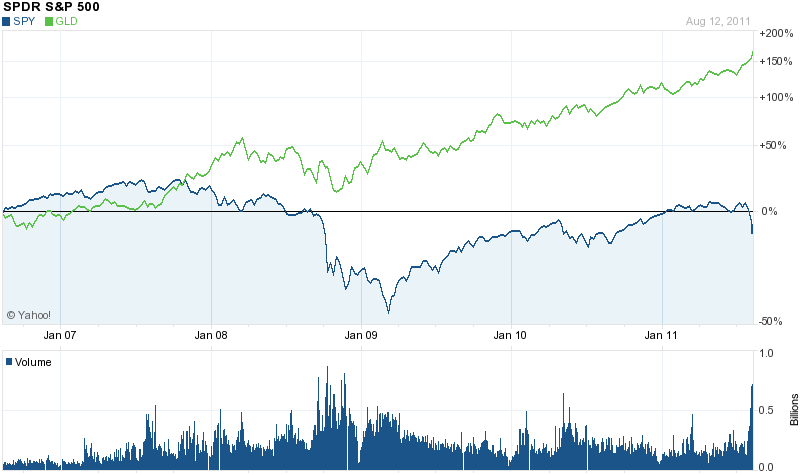
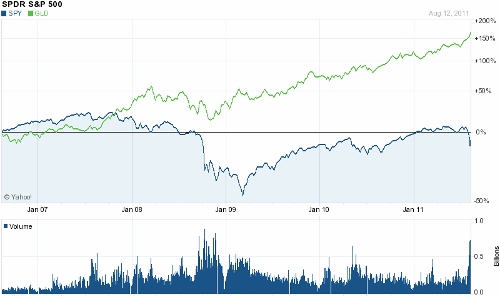
Gold, the only enduring currency, has been forecasting a financial crisis for the past decade and especially since 2008.  As economic Armageddon looms, however, most Americans remain tragically under invested in gold and silver.  Conventional financial planners and investment advisers recommend a zero or minor position in precious metals even as gold steadily outperforms stocks, bank savings and other financial assets.


S&P vs Gold - courtesy yahoo finance

Making matters worse, many Americans are selling the little amount of gold and silver that they do own as the conventional press publishes “gold bubble” articles every time gold hits a new high.  As reported in coinupdate.com, one major dealer reports that:

As for the general public, they have been selling jewelry by the droves this past week.  On Tuesday, my companies set a record going back more than 30 years for the most number of purchases from the public in a single day.  We broke that record Wednesday and weren’t that far from another all-time record on Thursday.  The main pieces that customers have brought to us have been gold jewelry.  The amount of silver and platinum jewelry has remained steady.

We talk with dozens of coin dealers around Michigan and the country every day.  They are reporting the exact same pattern of activity as we are experiencing.

Perhaps many of these sellers are dumping their gold jewelry due to economic duress, but if they were expecting gold to continue to soar higher, they would not be selling.  The bull market in gold and silver is just beginning and those who hold significant positions will preserve and expand their wealth.

SPDR Gold Trust And iShares Silver Trust Holdings Decline

Gold holdings of the SPDR Gold Trust (GLD) declined slightly on the week by 24.54 tonnes after a gain of 10.22 tonnes in the previous week.   GLD  gold holdings have declined by 8.74 tonnes since the beginning of the year.   The all time high holdings of the GLD occurred on June 29, 2010 when the Trust’s holdings reached 1,320.47 tonnes.

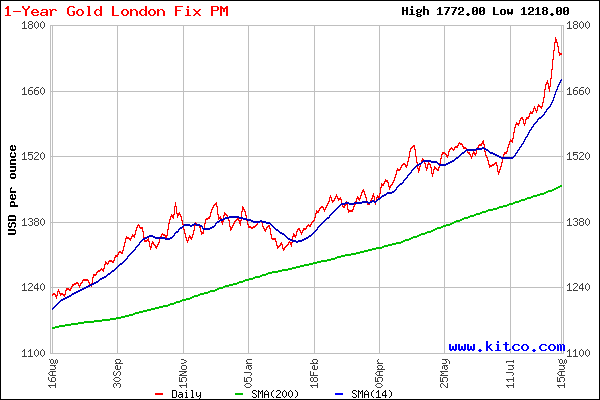
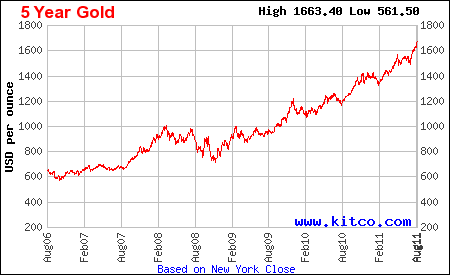
As measured by the closing London PM Fix Price, gold started the year at $1,388.50.  Gold closed in Wednesday trading at $1,790.00 for a gain of $401.50 or 28.9% on the year.  Gold has been in a steady, virtually uninterrupted uptrend since late 2008.  At the beginning of July, the price trend of gold entered an accelerated uptrend.


GOLD - COURTESY KITCO.COM

Although a pullback is possible after an almost vertical rise of $256 since July 1st, it is just as likely that gold could confound the skeptics and continue to rise.  The increase in gold prices for the past  decade has reflected widespread apprehension over the value of paper currencies.  The world economy never recovered from the financial crisis starting in 2008 despite the borrowing and printing of trillions of dollars by world central banks and governments.  The increase in the price of gold is reflecting the growing realization that governments and central banks no longer have the ability to contain a second full blown financial crisis.  Under this scenario, gold effectively has no ceiling price.

The GLD is the largest gold exchange traded fund with 40.9 million ounces of gold.  According to Bloomberg, the total holdings of all  major gold  ETFs worldwide amount to 70.7 million ounces of gold.  Holdings of all gold ETFs worldwide have increased by 4.1 million ounces or 6.2% since the beginning of the year.

The SPDR Gold Trust currently holds 40.9 million ounces of gold valued at $73.2 billion.  For perspective, the entire value of the GLD would fund less than 18 days of US Government deficit spending which is projected to exceed $1.5 trillion this year.


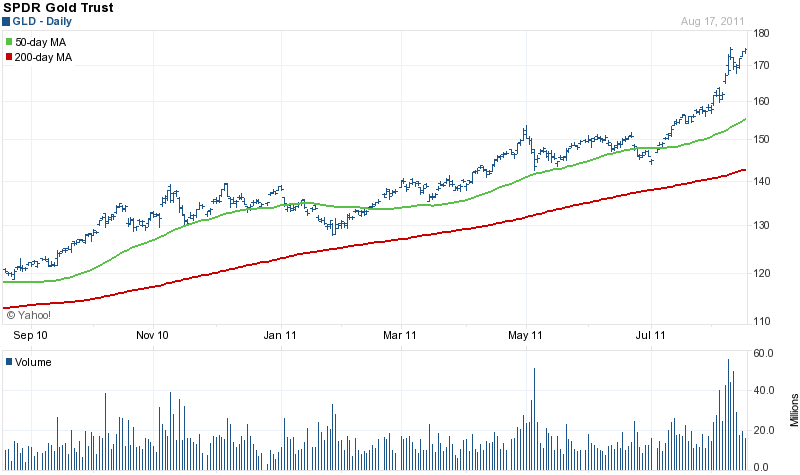
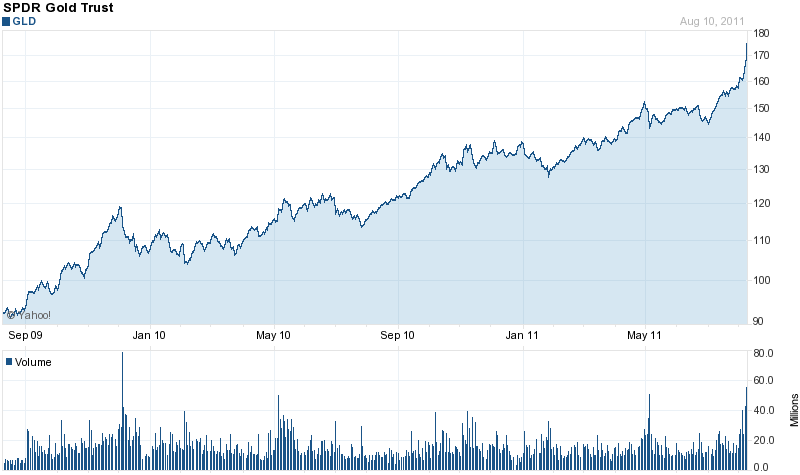
GLD - COURTESY YAHOO FINANCE

The GLD closed the day at $174.42, fractionally below its all time high of $175.13

GLD and SLV Holdings (metric tonnes)

August 17-2011 Weekly Change YTD Change
GLD 1,271.98 -24.54 -8.74
SLV 9,727.10 -45.46 -1,194.47

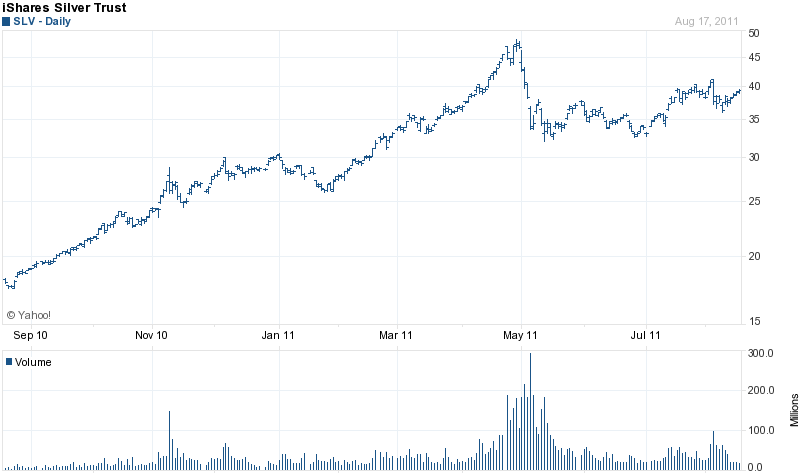
Holdings of the iShares Silver Trust declined by 45.46 tonnes on the week after a decline of 86.36 tonnes in the previous week.  Since July 1st, the SLV has gained 190.95 tonnes.

After a price correction in early May, silver has recovered in price and is building a base in the $40 range before the next move up.  Silver has gained $6.17 or 18.2% since July 1st, rising from $33.85 to $40.02.


SLV - COURTESY YAHOO FINANCE

The SLV currently holds 312.7 million ounces of silver valued at $12.5 billion.  Investors in the SLV have had an annual rate of return of 25% over the past three years.

Smart Money Investors Assess Gold Market

Given the recent extreme volatility in worldwide financial markets, Barron’s interviewed their Roundtable Panelists for an assessment on where we are headed next.   Three of the smart money investment pros interviewed gave their insights on where they think gold is headed next.

Here’s what they had to say:

1.  Investor Felix Zulauf thinks that the stock market will see new lows in the fall and that eventually both the Fed and the European Central Bank will step in to support the financial system.  Although Felix feels that providing additional liquidity is not a solution, “if we don’t do it the system will break down.”  According to Felix, at some point, as the problems get bigger, central banks may hit the panic button and wind up “like Zimbabwe”.  The increasing price of gold reflects the loss of confidence in policy makers, central banks and the currency.  Felix’s recommendation for a bleak future – “own a lot of gold, and don’t have debt.”

2.  Fred Hickey, who is editor of The High-Tech Strategist, also sees the Fed being forced to initiate more quantitative easing as economic conditions deteriorate.  The drawback of more money printing, however, is that “the Fed…can raise the nominal prices of assets – but not the real prices, because inflation will rise.”   Hickey, who owns both bullion and gold ETFs think the better play right now is in gold mining stocks since they have lagged the price increase in gold bullion.  Hickey is recommending Agnico-Eagle Mines (AEM), Newmont Mining (NEM) and Yamana Gold (AUY).

3.  Marc Faber, Editor of The Gloom, Boom & Doom Report, sees a short term bounce in stock prices and a possible correction in gold of $100 to $150.  After a rally off oversold levels, Marc thinks stocks will drift lower due to concerns over sovereign defaults, a dollar crisis, continued social upheaval in the Middle East and developed countries in the West, recession, lower corporate profits and the possibility of a “bust in China.”   As for the gold market, Faber remains long term bullish saying that “As long as the trio of Obama, Geithner and Bernanke are in power, gold is destined to move higher.  Long term treasuries have no value.  They will default by paying interest in a worthless currency.”

Bill Gross, head of investment firm Pimco, while not specifically addressing the gold market, is also bearish on the economic outlook for the the United States and implied that the more quantitative easing is the only option left.  According to Gross, the recent Fed announcement that it will keep interest rates at zero for another two years “indicates that monetary policy has been exhausted, while fiscal policy is hammerlocked by the results of the debt ceiling debate.”

Gold is beginning to look more and more like the only safe haven in a dangerous world.

Ultimate Price Of Gold Will Shock The World As Loss Of Global Confidence Leads To Economic Collapse

Gold had another stellar week while stock markets gyrated wildly.   As measured by the closing London PM Fix Price, gold gained $77.25 on the week, hitting all time highs and closing at $1,736.   After the London close, gold recovered from an earlier pullback and closed in New York trading at $1,747.30, up $11.30 from the London close.

Silver ending the week down slightly at $38.29 while platinum gained $91 to $1,800 and palladium edged up $5 to $747.

Gold has gained $253 or 17% since July 1st when it closed at $1,483.00.  The rapid price gains have pushed gold above its long term trend line.  Gold is now trading at $290 (or 20%) above its 200 day moving average.  On previous occasions in late 2009 and the fall of 2010 gold also traded more than $200 dollars above the 200 day moving average and the result was a minor pullback or sideways consolidation.


Gold - courtesy kitco.com

Gold may be overbought on a short term basis but the fundamental reasons for owning gold are expanding exponentially.  Public realization that dysfunctional governments are incapable of solving our economic problems is resulting in a loss of confidence.  A loss of confidence combined with a debt crisis and out of control spending can have only one result – increasingly worthless paper money and stocks as the  world central banks attempt to prevent an economic collapse with zero interest rates and printed money.

Gold Outperforms paper stocks

Government and  central bank policies have been destroying the value of the US currency for decades and have given birth to crashing housing markets, lower incomes, depression level unemployment and numerous stock market crashes.  When one  considers that the last hope of preventing an all out depression now lies in the hands of the very central banks who have already brought Hell down upon us, we should all be very, very scared.

If the last ditch efforts of the Central Banks fail to contain the financial collapse that is imminent, expect to see governments institute totalitarian measures in order to maintain a semblance of organized society.  As bankrupt empires collapse, they also attempt to expropriate every last dollar of wealth from its citizens in order to maintain their grip on power as long as possible.

The most recent large scale example of the implosion of an empire was the USSR, whose sudden collapse surprised CIA analysts who had been studying the Soviet Empire in detail for decades.  Ironically, those even more surprised by the collapse of the USSR were the politicians and bureaucrats who ran the country into the ground as they remained oblivious to their economy killing policies.  Tragically, misguided and misinformed middle class citizens of the USSR saw the value of their rubles collapse along with pension plans, bank savings and other financial assets.  Those who walked away with more than they had, other than corrupt politicians, were those few citizens who converted paper money into gold or silver before the financial system imploded.

A potential short term price correction in gold is a meaningless concern.  Developed world economies are in inexorably decline from which there is no escape.  The primary concern for most US citizens should be to develop a financial strategy that does not leave them impoverished when the end game arrives.

Unfortunately, most Americans have a religious conviction that “The Government” will save and nourish them as has been promised by every politician of this century.  These promises will all be broken but Americans won’t believe it until it happens, at which point there is no financial escape.

As a worldwide systemic financial collapse grows more probable with each passing day, Americans remain in denial and place their life savings in US government debt and bank accounts, secure with the promise that they are “guaranteed by the government”.   Sorry folks, bankrupt governments don’t keep promises.  The proof of American citizens’ faith in paper assets is their very low commitment to gold and silver.  The public will belatedly turn to gold and silver en masse when the system starts crashing down around them.  This event will be the real rush to gold and at that point, prices will rise thousands of dollars per week.

When establishment journalists warn of a “bubble” or “top” in gold, don’t get annoyed – simply buy more gold, especially on pullbacks.  The ultimate price of gold will wind up shocking even the biggest gold bulls.  When gold demand is insatiable and supply very limited, attempting to figure out the ultimate high price for gold is a fruitless exercise. (see Why There Is No Upside Limit For Gold and Silver).

Precious Metals Prices 8/12/11
PM Fix Since Last Recap
Gold $1,736.00 +$77.25 +4.66%
Silver $38.29 -$0.95 -2.42%
Platinum $1,800.00 +$91.00 +5.32%
Palladium $747.00 +$5.00 +0.67%


Gold ETF Holdings Hit All Time High As Silver ETF Holdings Decline

The SPDR Gold Shares Trust (GLD) added 10.22 tonnes of gold since last week as gold prices continue to surge higher.  The GLD now has a net gain in gold holdings of 15.80 tonnes since the first of the year.  The all time high holdings of the Gold Shares Trust was 1320.47 tonnes reached on June 29, 2010.

The value of the GLD during August has increased by 12.1% to $73.9 billion on high volume.  During July, the highest volume day for the GDL was on July 13th when 25.2 million shares traded.  On August 8th, 9th and 10th, volume on the GLD exceeded 40 million shares.  On previous occasions when trading volume in the GLD surged, gold prices either pulled back slightly or consolidated in sideways trading before continuing higher.

All of the fundamental factors that have been pushing gold prices higher for the past decade are now being amplified by a looming currency collapse and sovereign debt crises.  Adding to concerns is the apparent inability of central banks and governments to contain the rapidly expanding financial crisis.

As measured by the closing London PM Fix Price, gold started the year at $1388.50 and closed Wednesday in New York trading at $1796.50, up $51.30.  Gold has gained $407.90 or 29.4% since the first of the year.

Total holdings of all gold ETFs recently reached a record of 2,276 tonnes of gold, valued at $130 billion.  The GLD currently holds 41.7 million ounces of gold valued at $73.9 billion.

GLD - COURTESY YAHOO FINANCE


The GLD hit a new all time high in Wednesday trading, closing at $174.58, up $5.97.

GLD and SLV Holdings (metric tonnes)

August 10-2011 Weekly Change YTD Change
GLD 1,296.52 +10.22 +15.80
SLV 9,772.56 -86.36 -1,149.01

Holdings of the iShares Silver Trust (SLV) declined by 86.36 tonnes on the week but have gained 236.41 tonnes since July 1st when silver prices began rallying.

Silver prices have not kept pace with the increase in gold prices as investors worry about reduced industrial demand for silver in a severe economic downturn.  Silver closed Wednesday at $39.39, up $1.58.  Silver began the year at $30.67 and is now up by $8.72 on the year returning investors a gain of 28.4%.

The SLV peaked in late April at the $50 level before prices corrected to the low 30’s.  The SLV has had an average annualized total return of 25% over the past three years.

The iShares Silver Trust currently holds 314.2 million ounces of silver valued at $12 billion.


SLV - COURTESY YAHOO FINANCE

As the world economy marches off the edge of the cliff and many wonder why, we look back at some prophetic  thoughts from Bill Murphy, co-founder of the Gold Anti-Trust Action Committee (GATA) in an interview with The Motley Fool in June 2010.

“What’s important for your readership to understand is that the markets have been made dysfunctional by U.S. policy and what these bullion banks are doing. Even Alan Greenspan said recently that interest rates were left too low for too long. Had the gold price been allowed to trade freely, interest rates wouldn’t have been able to stay down as low as they were. It would have been a warning sign for people not to get involved in the behavior that they did … not to go with all of the risks that developed. And there’s a good likelihood that the disaster would have been nowhere near as bad as it was.

“Alan Greenspan called gold a “thermometer.” So they diffused the thermometer by keeping the gold price managed. And what’s important for people to understand now is that the same thing is going on. If we’re correct, it’s going to lead to a bigger catastrophe, because no one has learned any lessons.”


Fed Lays Groundwork For Price Explosion In Gold

Gold hit another all time high of $1,779.10 before pulling back to close at $1745.10, up $26.90.  Gold has advanced strongly over the past year as the Federal Reserve engaged in quantitative easing and extremely loose monetary policy.  Over the past 30 days gold has gained $198 and over the past year, a stunning $548.70 per ounce.

At the conclusion of the Federal Open Market Committee (FOMC) meeting on Tuesday, the Fed announced that it would maintain its zero interest rate policy through the middle of 2013.   The Fed does not normally make commitments that limit future policy flexibility and three of the seven members of the FOMC  voted against the pledge to maintain zero interest rates.

The Fed has held interest rates at zero for 32 months now with little to show for it as debt burdened consumers continue to reduce spending.  With inflation running at 5 to 10% (depending on whose stats you believe), real interest rates are negative and savers are seeing the purchasing power of their dollars destroyed by Fed policies.

The FOMC also said that they expect “a somewhat slower pace of recovery over the coming quarters” and that future action might be taken to “promote stronger economic recovery.”  Since the Fed has already exhausted all normal policy tools, the FOMC seems to be positioning itself for another round of quantitative easing.  Some analysts speculate that the Fed will discuss further easing measures later this month at the Fed’s annual conference in Jackson Hole, Wyoming, where QE2 was launched.

Further fiscal stimulus seems improbable given the restrictions put on future spending by Congress as part of the debt limit agreement.  In a sign of how desperate the financial condition of the United States has become, all eyes are now turned towards the Fed.

Since zero interest rates and two rounds of money printing have done little to turn around the US economy, the expectation is that the Fed will need to do more of what failured before, except on a grander scale.  I expect that as the economy continues to weaken, the Fed will announce a “shock and awe” campaign of massive money printing accompanied by an explicit statement that they are committed to higher inflation.

Federal Reserve policies have been the primary factor pushing the price of gold higher.  The inevitable announcement of further quantitative easing will be trigger that pushes gold prices thousands of dollars higher.

Consider the statement of the former Fed Chairman Alan Greenspan who on a “Meet the Press” interview arrogantly proclaimed that the United States could never default because “The United States can pay any debt it has because we can always print money to do that. So there is zero probability of default.”  This is what the United States has come to under the easy money policies of the Federal Reserve and a government that believes prosperity can be created by oceans of debt.  Is it any wonder that the currency is collapsing and the purchasing power of the dollar declining precipitously?

Meanwhile, Kenneth Rogoff (of This Time It’s Different fame) who attended Harvard with Bernanke, tells Bloomberg that the Fed should explicitly set a high inflation target and engage in massive quantitative easing.

Federal Reserve policy makers are likely to embark on a third round of large-scale asset purchases, moving “more decisively” to secure the U.S. recovery, said Harvard University economist Kenneth Rogoff.

“They certainly should do something right away,” said Rogoff, a former International Monetary Fund chief economist who attended graduate school with Fed Chairman Ben S. Bernanke.

“Out-of-the-box policies are called for, especially much more aggressive monetary policy, however unpopular that may be,” said Rogoff, 58, a former Fed economist who like Bernanke earned a Ph.D. from the Massachusetts Institute of Technology. The Fed is “going to move more decisively,” Rogoff said.

Rogoff recommended the Fed say in “very clear statements” that it’s trying to create “moderate inflation.” “In the classic classroom QE, it’s open-ended,” Rogoff said. “You say, ‘I’m trying to create inflation of, let’s say 2 or 3 percent, and I’m going to do whatever it takes.’”

The extreme policy measures recommended by Greenspan and Rogoff prove that the US has already passed the tipping point and has only one policy option left.  If the Fed does not print like crazy, the whole rotten edifice of towering debts will collapse, plunging the country into a deflationary collapse.

Gold will have price corrections as it continues to move upward but the ultimate price will be many thousands of dollars higher than today.  Gold investors should continue to accumulate positions, especially on price weakness and enjoy the unfolding of one of the greatest bull markets in history.

$100 Up Days For Gold To Become Routine

Gold is a small part of most investment portfolios despite a decades long uptrend.  Investment advisers have either routinely dismissed gold as part of an investment portfolio or recommend only a token position as a hedge.  This is likely to change as gold gains recognition as a safe haven alternate currency.  As investors rush to establish positions in gold, $100 up days are likely to become a routine event.

The reasons for investing in gold are well known to readers of this blog.

The financial crisis that began in 2008 was not resolved and is now entering the end game phase.  Governments that propped up the financial system with trillions of dollars of debt have exhausted their borrowing capacity and now need to be rescued themselves.

Crippling levels of debts and deficits have suffocated economic growth necessary to service debt.

A panic is engulfing the global financial system as investors realized that governments are no longer able to contain the debt crisis.

All eyes are now turned towards the central banks.  Will the central banks allow the world to slide into collapse or will they “come to the rescue” with a massive rescue plan using printed money?  The price movement in gold has already answered this question.


Gold Soars Past $1,700 As Debt Crisis Spirals Out Of Control

Gold soared to a new all time high over $1,700 in Asian trading after the credit downgrade of  the United States by Standard & Poors and news that the ECB would conduct large scale purchases of Italian and Spanish bonds. These two event have escalated the debt crisis in Europe and the United States to a new dangerous level.  Investor confidence has been shattered in both equity and bond markets as events seem on the verge of spiraling out of control.

The European Central Bank has been unable to form a coherent strategy to deal with the debt crisis and the Federal Reserve seems to be running out of policy options.  The governments that “saved the world in 2008” through massive fiscal and monetary stimulus now need to be saved themselves.

The relentless rise of gold since the financial crisis began reflects the increasing risk of sovereign defaults and  the rampant debasement of paper money.  The gold market is effectively a report card on the failed policies of governments and the grade is an F.

Gold - courtesy kitco.com

The response by U.S. policy makers to the S&P downgrade reflects a dangerous disconnect from reality and political posturing.  In a shoot the messenger response, Treasury Secretary Geithner said that S&P used “terrible judgment” and have “shown a stunning lack of knowledge about the basic US fiscal budget math”.  A more realistic assessment of the US debt downgrade came from investor Jimmy Rogers who said two months ago that “America should already be downgraded. It should have been downgraded years ago. These people, the rating agencies, have got it wrong for 10-15 years now. America is bankrupt”.

The Federal Reserve, which could not recognize the housing bubble, has also been at a loss to deal effectively with the debt crisis.  Consider Bernanke Models Prove Faulty:

“We haven’t had any historical event that really would allow us to reliably statistically calibrate an event like the one we’ve had,” David Stockton, director of the Fed’s Division of Research and Statistics, who has overseen forecasting for a decade, said in an interview at the end of June. “There isn’t going to be a simple story here.”

Stockton calls the 2007-2009 period “an unprecedented financial crisis in the lives of almost every economic agent.”

“That had profound effects on people’s balance sheets, on their spending, and their impetus to deleverage,” he said in the interview. “Something beyond transitory factors are at work.”

Suite of Models

The suite of models used by Fed staff to forecast changes in consumption and investment rely to some extent on past relationships between interest rates, income, and profits. Most also assume credit will be supplied and demanded at a given price or interest rate. Without adjustments, they revert to the mean — after a period of slump they begin to point upward, in line with previous recoveries.

All of those tendencies have made the models less trusty guideposts for what is happening in the current recovery. The staff has to venture judgments and explore new analyses.

“Something new and different is going on,” said Allen Sinai, chief global economist at Decision Economics Inc. in New York. “Neither monetary nor fiscal policy is giving us the kind of bang we have traditionally got. The household sector is simply not spending as it has in the past.”

Ordinarily, monetary policy works by making borrowing cheaper so households and businesses can access credit and keep their consumption stable through an economic slump. Now, that channel is less effective.

Banks have raised lending standards, and the private sector’s expectations about consumption may be shifting to a lower path, said Julia Coronado, chief economist for North America for BNP Paribas in New York, who worked for Stockton from 1997 to 2005.

“This is a standard-of-living shock,” Coronado said. “What we thought we could afford, and what we leveraged to, is much more than we can afford at present and in the future.”

In other words, the problem is too much debt, and the Fed’s response has been to encourage more debt by dropping interest rates to zero and printing money.  As long as the Fed continues its failed policies, the price of gold will continue to soar.


Gold Retains Safe Haven Status – Fundamentals Driving Gold Higher Intensify

Is the day of reckoning finally arriving?

Financial markets are suddenly starting to take the debt crisis seriously.  The sell off in global stock markets has intensified as investors rush to sell risk assets and flee to the safety of cash.  The value of all US stocks as represented by the Wilshire 5000 lost $800 billion on Thursday’s selloff and an astounding $1.9 trillion since mid July.

Gold also dipped in Thursday’s sell off to close in New York at $1,649.80 after trading as high as $1,683.30 in morning trading.  The quick intraday reversal had many in the mainstream press proclaiming that gold was just another risk asset.

Should we be worried about the price of gold sliding into the abyss along with stocks?  The answer is no.  Gold’s modest pullback came after a run up of almost $200 since July 1st while stocks were in the midst of a severe sell off.  To see some profit taking and liquidity driven selling by gold traders on a 500 point down day in the Dow is not surprising.  The fundamental factors driving gold higher are not only still valid but have intensified as the debt crisis ultimately puts the value of all paper assets at risk.

The bullish trend in gold remains intact.  The biggest pullback in gold during the last decade occurred during the financial meltdown of 2008 when gold declined by $250 but quickly recovered thereafter.  To long term gold investors, the decline in 2008 is hardly noticeable on the long term charts.  While gold dropped by 25%, numerous other asset classes saw losses up to three times as large.

Gold - courtesy kitco.com

Gold is at the upper end of its trading channel and a pullback of $50 or $100 to the lower band of the trading channel would merely be another small correction in the long term uptrend.  If investors lose confidence that governments and central banks are no longer capable of containing the debt crisis, gold will begin a rapidly accelerated price move with $100 up days becoming routine.

The debt crisis, which has been building for decades, seems to be reaching a super critical stage.

The massive sell off in global equity markets is based on the realization that we are approaching the financial nightmare of defaulting sovereign states, a looming recession, massive debt levels, a slowing world economy, a disastrous reduction in tax receipts and declining income growth. The end of QE2 along with austerity measures and spending cuts now being discussed in Congress leaves the Federal Reserve as the last firewall against a collapse into depression.

The clumsy and uncoordinated efforts of the ECB to contain the Greek debt crisis resulted in the government imposing losses on bondholders.  The realization by investors that they will not be protected from losses on holdings of other weak sovereign debt was the trigger that set off the rush to sell risk assets and move to cash.  Financial stress in European banks is rising steadily and many are already experiencing a classic run on the bank as depositors withdraw funds and move to (ironically) dollar assets.

It may be too late for the US to attempt a move to fiscal conservatism and austerity measures.  Despite the worries about exploding government deficits, an abrupt end to government deficit spending would probably tip the US economy into a full blown depression with massive job losses and a downward spiral in wage growth.  Politicians don’t think long term – they are worried about the next election.  As unemployment grows along with declining wages and home values, the public pressure on politicians to “do something” will become intense.

The Wall Street Journal recently reported that three former top fed officials are already arguing for a third round of quantitative easing if the economy weakens.  We already have a weak economy.  Both the public and the politicians, oblivious to the dangers of unsustainable deficit spending, will demand that the government “do something.”  Once the Fed has political support, the floodgates of money printing will become wide open.  Open ended quantitative easing may produce the inflation necessary to reduce the real value of sovereign debts, but it will also decimate the purchasing value of paper money.

In the end, the government will continue to administer the same medicine to the dying patient – zero interest rates and fiscal and monetary stimulus.  The arguments will also be the same – these are temporary measures to get the economy growing and buy some time, similar to what the Japanese have been doing since 1990.  Japan has put off the day of reckoning with zero interest rates, money printing and massive fiscal stimulus – the result is a debt to GDP ratio twice that of the United States.  Wasn’t it Thomas Aquinas who said that “problems are not solved, they are survived”?

Many emerging nations experiencing high inflation (due in part to Fed money printing) are turning to gold in a big way as an alternate form of currency and to diversity reserve holdings.  The central banks of emerging nations have already bought almost 180 tonnes of gold this year, more than double the amount purchased for all of last year.

Any price corrections in gold should be viewed as an opportunity to add to positions.  The biggest risk to investors is to be under allocated in gold. (see also Smart Money Sees Perfect Storm for Gold and Silver and Why There Is No Upside Limit For Gold).