April 6, 2026

Bearish Gold Forecasts Suggest Soaring Gold Prices In 2012

Will gold soar this year as central banks go wild with money printing?  Or will gold collapse as debt defaults overwhelm the system and propel the world economy into a deflationary black hole?

Members of this week’s Barron’s Roundtable were asked what they thought about gold.  Panel members offered their usual variety of informed opinions on what could happen to the price of gold during 2012 – here’s what they had to say.

Marc Faber, editor of the Gloom, Boom & Doom Report, expects massive money printing by central banks during 2012 and a continuing correction in gold prices.

The worse the news gets, the more the U.S. and the European Central Bank and China will print money.
In the past 10 years gold and silver have performed superbly. The gold price overshot on the upside when it reached $1,921 an ounce on Sept. 6. Now it is in a correction phase and could fall another $200.
It is not that the gold price will go up. It is that the value of paper money will go down. Diversification is important, and people should put 15% to 25% of their assets in gold.

Brian Rogers, Chief Investment Officer of T. Rowe Price, sees oil as a good investment but does not foresee a big rally in gold prices.

It is easier to get your arms around oil than gold in terms of the numbers and demand.  Oil is a good investment in the next few years, with optionality to the upside if something extreme happens in the Middle East. Gold is a good diversifier, but not a great way to make money.

Fred Hickey, editor of The High-Tech Strategist, predicts higher gold prices this year and views gold stocks as a relative better value than gold bullion.

Gold will rally, then have a seasonal selloff. By the end of the year it could be up 15%, as has been typical in this 11-year secular bull market for gold.
Gold stocks have been terrible. They dropped 20% last year, so that makes them a better buy relative to the price of gold. Last year I owned a lot of gold. Now I have more money in gold stocks than in physical gold or the GLD [ SPDR Gold Trust].
I own a smaller amount of exploration companies through the GDXJ [ Market Vectors Junior Gold Miners exchange-traded fund] and a larger percentage of producers.

Felix Zulauf, President of Zulauf Asset Management, sees gold prices soaring as the world economy approaches depression like conditions, forcing central banks to print money on a vast scale.

The world economy will experience a brutal slowdown. Deflationary forces are going to strengthen and commodities in general will decline. You can buy oil to hedge a decline in base metals. Gold started a cyclical correction within a secular bull market last summer. The first wave of selling is ending now. Gold has to be bought some time this year, probably in the second half, below $1,600. Then the monetary authorities will load their guns again and print more money, which will make investors buy more gold. The gold market is so tiny that when people want to shift just a small piece of their wealth into gold, the price flies to new highs.

Scott Black, President of Delphi Management, favors a modest position in gold stocks but thinks that people holding gold as a hedge against inflation are misguided.

A lot of people own gold as a hedge against inflation. I don’t see inflation in the cards in the U.S. Capacity utilization in the manufacturing sector it is only 77%. We own a couple of gold stocks but buy them as we do other stocks. We look for high returns on equity and low P/Es. We own Barrick Gold [ABX], which trades for 7.8 times this year’s expected earnings. Even absent a big upswing in gold prices, it will do well because production is growing.

Putting things into perspective, the rather lukewarm endorsement for gold by the Barron’s Roundtable should be viewed as a bullish indicator for gold prices.  The healthy and normal correction in the price of gold from the high of $1,900 in August has resulted in rampant bearishness and numerous predictions that the bull market in gold is over.  Ironically, many of the most bearish gold forecasts are coming from the same “analysts” who were predicting the end of the gold bull market multiple times over the past decade.

Bearish sentiment on gold has reached extreme levels according to the Hulbert Gold Newsletter Sentiment Indicator.  The average gold timer has thrown in the towel.  Over leveraged speculative investors panicked at the first sign of weakness in gold and sold out.  According to Hulbert, “this is building a strong foundation for a fresh assault on gold’s recent all-time high above $1,900 an ounce.”

Bearish sentiment on gold stocks has also reached extreme levels as seen by the Gold Miners Bullish Percent Index.
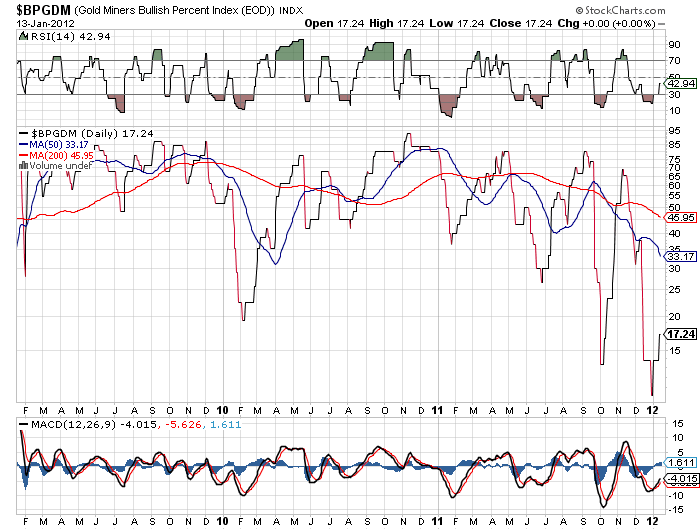
 

Courtesy: Stockcharts.com

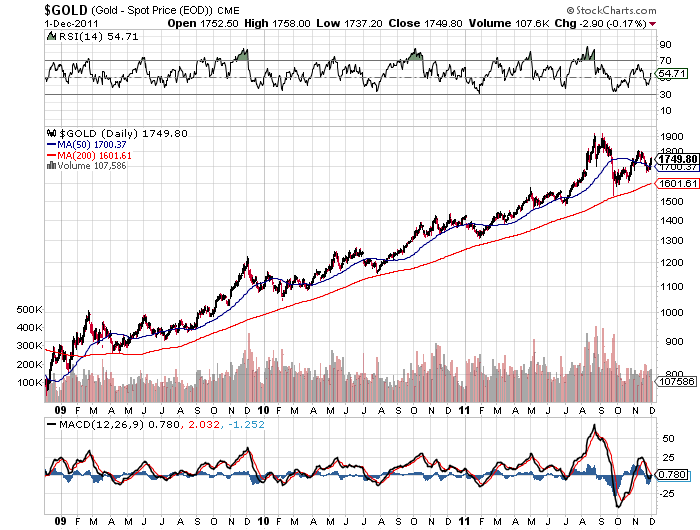
After briefly falling below the 200 day moving average, gold rebounded strongly, rising from $1,598 at the start of the year to a Friday closing price of $1,635.50.  Over the past decade, the few times that gold previously fell through the 200 day moving average  set the groundwork for a major price advance.
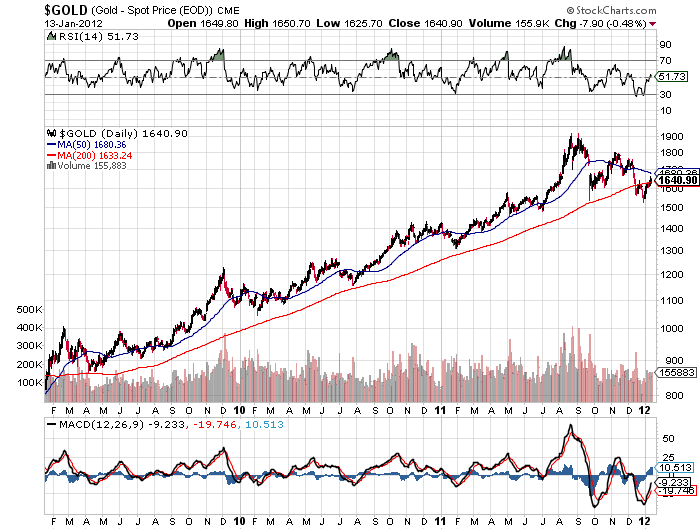
 

Courtesy: stockcharts.com

The fundamental and technical indicators for gold remain rock solid.  Gold may very well wind up shocking the bears by outperforming every other asset class in 2012.
How Did An Investment Pro Lose Money Investing In Gold?

Despite the recent set back in gold prices due to panic selling by investors, gold has still racked up an impressive 15.7% gain with a price increase of $218 per ounce since the first of the year.  So how does a hedge fund manager with one of the best track records in the industry wind up losing over 10% on his gold portfolio?

The man who can answer this question is John Paulson, famous for his billion dollar gains betting against subprime mortgages before they collapsed in price.  Making matters even worse, the set back in Paulson’s Gold Fund, although painful, pales in comparison to losses run up by the Paulson Advantage Fund, as reported by Bloomberg.

John Paulson, the billionaire money manager mired in the worst slump of his career, lost 10.5 percent in his Gold Fund this year even as the metal heads for its 11th straight annual gain, according to people familiar with the fund’s performance.

The fund, which invests in mining stocks and other gold- related securities, remains the best performer in Paulson’s $28 billion fund family this year. His Paulson Advantage Fund, which seeks to profit from corporate events such as takeovers and bankruptcies, has fallen about 35 percent. The performance numbers for the two funds are from Dec. 28, 2010, through Dec. 20, 2011, and may not reflect returns for all shareholders, said the people, who asked not to be identified because the information is private.

Paulson & Co., based in New York, has lost money this year on investments including Citigroup Inc., Bank of America Corp. and Sino-Forest Corp., the Chinese forestry company accused by short-seller Carson Block of overstating timberland holdings. Paulson, 56, cut the so-called net exposure in his main hedge funds to 30 percent last month and reduced bullish bets across all his funds.

Paulson’s frustrations with the losses on his gold portfolio mirrors that of other investors who have bet on gold stocks and lost despite the fact that gold bullion scored another impressive advance this year.

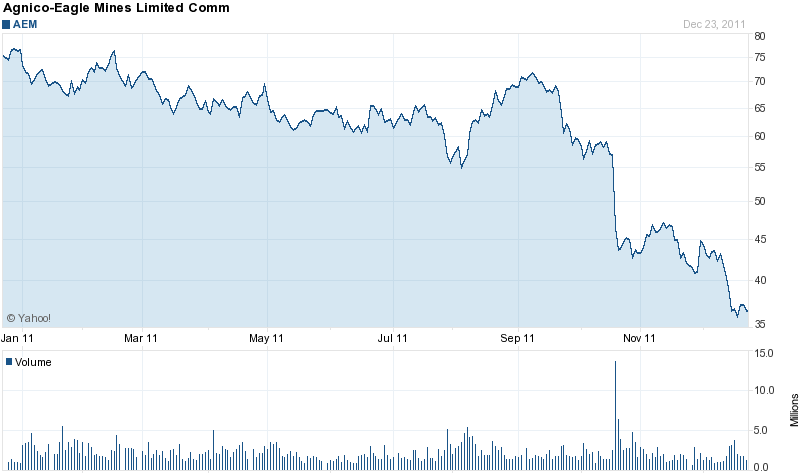
Paulson’s had large positions in Anglo Gold Ashanti (AU), Gold Fields Ltd (GFI), Nova Gold Resources (NG), Agnico-Eagle Mines (AEM), Iamgold Corp (IAG) and Barrick Gold Corp (ABX), all of which declined.  Agnico-Eagle Mines was the worst performer with a stunning decline of over 50% on the year.

It will be interesting to see if Paulson dramatically reduces his positions in gold mining shares over the coming quarters.  Given the fact that the fundamentals for owning gold are stronger than ever and gold mining shares are deeply oversold, it would not be surprising to see Paulson actually increase his gold stock holdings.

Every “Solution” To The Euro Crisis Involves Printing Money

Attempts by central banks to blatantly manipulate the price of gold lower should come as no surprise to long time gold investors.  Market News International reported on Thursday that the Bank of England, the Federal Reserve and the Bank for International Settlements mounted coordinated selling in an attempt to drive the price of gold lower. After advancing to $1,757.80, gold reversed course, ending the day in New York trading at $1,706.80, down $51 from the morning high.

The reported attempt to crush the price of gold coincides with the growing perception that every “solution” offered thus far to resolve the potentially catastrophic debt crisis in Europe revolves around the creation of vast amounts of new fiat currency.

European countries that have piled up ruinous levels of indebtedness are quickly discovering that they have run out of options. The limits on imposing new taxes have been reached, bond markets won’t finance additional borrowing, austerity won’t work and debt costs are spiraling out of control as Euro zone economies grind to a halt.

Here’s a rundown of some of the bizarro world “solutions” that have been offered by European rulers to prevent an economic collapse in Europe.  Try to figure out which option does not, at its core, involve the printing of new Euros.

European Central Bank (ECB) President Mario Draghi insists that the central bank will not finance government deficits by purchasing new government debt with freshly created Euros.  The amount of government bonds already purchased by the ECB exceed €200 billion and the ECB continues to buy billions of additional euro debt each week.  In addition, the ECB is currently lending European banks as much money as they ask for.  Although the ECB’s charter prohibits it from financing governments by buying their debt directly, the ECB has no qualms about buying government debt in the secondary market.

-Financial assistance from the International Monetary Fund is another option being discussed.  Where would the IMF get the money to lend to debt stressed European governments?  The IMF would be funded with money created by Europe’s central banks which the IMF would then re-lend to the same European nations whose central banks created the money in the first place.

-The European Stability Mechanism (ESM) was established to bail out insolvent members of the European Union.   The amount of ESM funding was grossly inadequate to address the debt crisis.  The proposed solution – grant the ESM a banking license (read license to print money) which would allow the ESM (as a bank) to borrow unlimited amounts of money from the European Central Bank.

If you correctly guessed “none of the above”, you probably are already invested in gold although probably not to the extent that you should be.

Printing money is the last desperate attempt of failed governments to keep the lights on.  Allowing the price of gold to soar would expose the extent to which the Euro, in particular, and all paper money in general have been debased by insane monetary policies.  The Central Banks cannot hide this truth anymore.  Nor can they prevent the price of gold money from ultimately reflecting its true value priced in paper currencies.  Any retreat in gold prices should be viewed as a buying opportunity, courtesy of central banks.


Gold Bullion Coin Sales Plunge 63% In November and 20% YTD – Have Americans Given Up On Gold?

Total sales of American Gold Eagle bullion coins plunged in November according to production figures from the U.S. Mint.

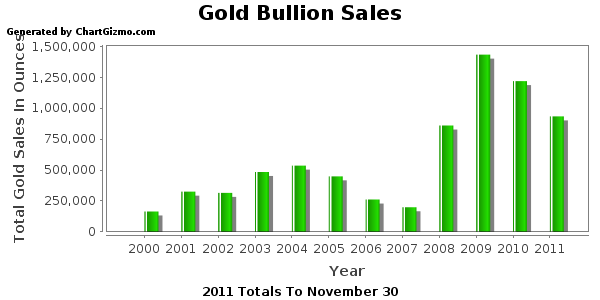
Total sales of gold U.S. Mint bullion coins declined by 63.4% in November from the previous year.  Sales of U.S. Mint gold bullion coins declined by 19.5% on a year to date basis through the end of November.  A total of 41,000 ounces were sold in November 2011 compared to sales of 112,000 ounces in November 2010.  Year to date sales through November totaled 934,500 ounces compared to the previous year to date totals of 1,160,500 ounces.

The reduction in the purchase of U.S. Mint gold bullion coins continues a trend of reduced sales since the record breaking year of 2009 when a total of 1,435,000 ounces were sold.  Total gold bullion sales  for 2011 will probably slip below one million ounces for the first time since 2009.  If sales decline in December by the same percentage amount as in November, total 2011 sales of gold bullion coins will come in at 956,500 ounces.

A summary of gold mint bullion coin sales since 2000 is shown below.

Gold Bullion Sales Since 2000

Gold Bullion U.S. Mint Sales Since 2000
Year Total Ounces Sold
2000 164,500
2001 325,000
2002 315,000
2003 484,500
2004 536,000
2005 449,000
2006 261,000
2007 198,500
2008 860,500
2009 1,435,000
2010 1,220,500
2011 934,500
Total 7,184,000

Why would gold bullion coin sales be plunging when gold has been steadily rising?  Have Americans given up on gold?  Let’s look at various trends in gold sales to get some perspective.

-Annual sales of gold bullion exceeded a half million ounces only once before 2008.  The financial crash of 2008 precipitated concerns about the integrity of both the banking system and the U.S. dollar, causing a huge increase in demand for physical gold.  Gold bullion sales exploded higher in 2008 and sales for 2011 remain far above levels seen prior to 2008 despite the recent drop in sales.

-Based on the current price of gold, the total value of all gold bullion purchased from the U.S. Mint since 2000 is $12.6 billion.  This amount represents only a fraction of the amount of investment dollars that have flowed into gold over the past decade.  In addition to purchasing physical gold, investors now have the option to purchase gold through gold trust ETFs.  The amount of money poured into the gold trust ETFs is many multitudes greater than the investment in physical gold bullion coins.  For example, since their inception in 2005, the combined gold holdings of the SPDR Gold Shares Trust (GLD) and the iShares Gold Trust (IAU) have grown to 47.2 million ounces valued at $82.5 billion.

-Gold ETFs have grown exponentially from their inception a short six years ago but the largest gold ETF, the SPDR Gold Shares Trust (GLD), has not been able to exceed its record gold holdings of 1,320.47 tonnes reached on June 29, 2010.  In addition, billionaire John Paulson recently liquidated a substantial portion of his GLD holdings, although much of the selling may have been forced due to severe losses in his hedge funds.

-Gold trader sentiment is either bullish or bearish, depending on who you talk to.

-Central banks, which have been increasing their purchases of gold since 2000, have sharply accelerated their purchases of gold bullion over the past several years.  Central banks from Asia and Latin America have accounted for most of the increased purchases.

-According to the World Gold Council, global gold investment demand increased by 33% in the 2011 third quarter compared to the prior year.  Investment demand for gold bars and coins increased by 29% and global gold holdings by gold trust ETFs increased by almost 78 tonnes.  Demand for gold increased notably during the third quarter in Europe and China.

While it is indisputable that global gold demand has increased, the appetite for gold by U.S. investors seems to be diminishing.  What do you think?


Bearish Outlook On Gold Signals Buying Opportunity

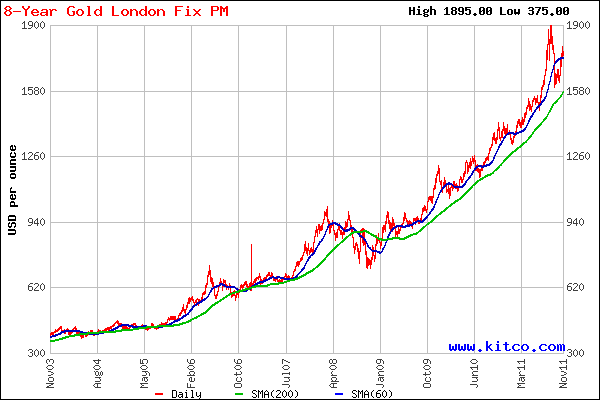
Despite the fact that gold has outperformed virtually every other asset class for the past decade, the September correction in gold prices has caused market sentiment to turn decidedly bearish.  As measured by the London closing fix price, gold reached an all time high of $1,895 on September 5th.   Within the next three weeks, gold had plunged by almost $300 per ounce, closing at $1,598 on September 26th.

Did September mark a turning point in the decade long gold rally, as many have suggested, or is it a buying opportunity?  A review of the factors contributing to the September sell off suggest that from a contrarian and fundamental point of view, the groundwork is being laid for a move to new highs in gold.

Extreme volatility in global equity markets due to the European debt crisis resulted in losses and subsequent margin calls for many leveraged investors who indiscriminately liquidated whatever they owned, including gold investments.

In mid November, SEC documents disclosed that Paulson & Co., the hedge fund run by legendary investor John Paulson had liquidated 11.2 million shares of the SPDR Gold Trust (GLD) during the quarter ending September 30th.  Paulson’s exact motives in selling the GLD remain unknown, but is was reported that huge losses in his hedge funds had resulted in the forced selling of SPDR Gold Trust shares.

Besides helping to drive down the price of gold, investors may view Paulson’s large sale as a bearish signal from an investor who has an incredibly successful long term track record.  Paulson, however, still remains the largest shareholder in the SPDR Gold Trust with a position of 20.3 million shares at September 30th.  In addition, Paulson reportedly remains long term bullish on gold and may have large positions in physical gold through allocated bullion accounts.

In addition to the factors mentioned above, gold may simply have gotten ahead of the fundamentals.  Every long term bull market experiences episodes of sharp price corrections and consolidation.  Over the past decade, with a brief exception in 2008, gold has found solid support at the 200 day moving average.  In April 2009, July 2010 and February 2011, gold experienced a sustained multi-month rally after correcting down to the 200 day moving average.  Currently, a retreat to the 200 day moving average would bring gold down to the $1,600 level.


Gold - courtesy stockcharts.com

Mark Hulbert, of the Hulbert Gold Newsletter, who tracks investor sentiment on gold says that the bearish sentiment on gold is reaching extreme levels.  Hulbert says “According to contrarian analysis, this is building a strong foundation for a fresh assault on gold’s recent all-time high above $1,900 an ounce.  This doesn’t guarantee that gold will rise from here, of course, or that it will do so right away. But it does mean that contrarian analysis is currently on the side of the bulls”.

Patient long term investors in gold have been well rewarded.  Despite the September correction, gold prices have advanced by $364 per ounce in 2011, for a gain of 26%.


Did Central Bank Coordinated Easing Also Include Manipulation of The Gold Market?

On a day when coordinated central bank monetary easing sent stocks and commodities soaring into orbit, the price action in the gold market was curiously muted.

The Dow Jones, S&P 500 and Nasdaq all increased by over 4%.  Gains in various S&P sectors ranged from 4.75% for the transportation sector to 7.51% for the financial sector.  Gold, by contrast, rose a mere 2%.

INDEX PERCENTAGE INCREASE
DOW 4.24%
S&P 500 4.33%
NASDAQ 4.17%
S&P 500 DIV FINANCIAL IX 7.51%
S&P 500 AUTO & COMP IDX 6.99%
S&P 500 BANKS INDEX 6.92%
S&P 500 MATERIALS INDEX 5.91%
S&P 500 INSURANCE INDEX 5.60%
S&P 500 SEMI & SEMI EQP 5.62%
S&P 500 ENERGY INDEX 5.49%
S&P 500 CAPITAL GDS IDX 5.32%
S&P 500 REAL ESTATE INDX 5.17%
S&P 500 TRANSPTN INDEX 4.75%
GOLD – CLOSING NEW YORK PRICE 1.98%

The massive monetary easing by central banks should have sent the price of gold into the stratosphere.  It has become crystal clear that central banks will continue to create whatever amount of money is necessary to prop up a collapsing, debt saturated system.

Why would central banks collude to restrain the price of gold?  GATA has explored this question in depth and in a recent exchange between Lawrence Williams of Mineweb and GATA, Williams writes  “If one assumes that governments as a matter of course manipulate currency exchange rates, then there is logic in their manipulating the gold price too, as many throughout the world consider gold as money (currency) and a rise in the gold price thus equates to a depreciation in currencies — notably the U.S. dollar.”

Most of the world already suspects that the “emperor has no clothes” when it comes to central bank money creation.  Had the value of gold been allowed to soar hundreds of dollars per ounce today, under free market conditions, the entire crumbling edifice of fiat currencies would have been exposed.

Gold is the only currency that central banks cannot destroy.  If central banks did not suppress the price of gold, the true extent of the debasement of paper  currencies would become blatantly obvious and thereby threaten the entire system of fiat currencies.  Central banks have every motive in the world to suppress the price of gold.  How long they can remain successful at it (as they engage in blatant, massive and world wide money printing) is the question on most gold investors’ minds.

More on this topic:

Where In The World Is The Gold?


Ron Paul Calls Central Bank Intervention A “Form of World Wide Quantitative Easing”

Central banks, spear headed by the U.S. Federal Reserve, launched a massive joint effort to provide liquidity to a European banking system that was teetering on the verge of collapse.

The six central banks involved in the emergency lending program were the U.S. Federal Reserve, the Bank of Japan, the Swiss National Bank, the Bank of England, the Bank of Canada and the European Central Bank.  The central bank actions provided European banks with cheap access to  funding through U.S. dollar swap lines.  Under dollar swaps, the U.S. Federal Reserve supplies dollars to foreign central banks which in turn lend the dollars to banks that need U.S. dollars to meet funding needs denominated in U.S. dollars.

In a joint statement, the six central banks said “The purpose of these actions is to ease strains in financial markets and thereby mitigate the effects of such strains on the supply of credit to households and businesses and so help foster economic activity.”  As one European bank after another appeared to be on the verge of collapse, the calls for central bank intervention to “save the world” had become deafening.  Today, the central banks obliged, effectively endorsing the theory that more debt is the solution to the debt crisis.

In an early day interview on CNBC, Ron Paul gave his take on the massive central bank intervention, calling it “a form of worldwide quantitative easing.”

Ron Paul also noted that the central bank actions “penalize the American people” and that the Federal Reserve actions will simply result in “more debt and more inflation.”

Ron Paul said the Fed is doing the same thing that it has done for the past 40 years.  “Spending excessively, running up debt, printing up money, and manipulating interest rates.  We’re up against the wall now, it doesn’t work anymore. Lowering interest rates is essentially impossible.   That’s what they’re desperately trying to do today.  But, you know, when our interest rates to the banks are down to zero, what are they going to do next?  Used to be that Congress would just spend more money and that would help.  How can they spend more money when there’s no more money in the Treasury?”

The answer to Ron Paul’s last question is obvious and should deeply concern every American.  Funding needs of the Treasury will continue to be supplied by the Federal Reserve with printed money and the U.S. currency will continue to lose value.  The rising price of gold has reflected the systematic destruction of our currency.  Based on the predictable response of central banks worldwide to print their way out of the debt disaster, there is effectively no upside limit to the price of gold.

Chinese Seek To Buy Undervalued Gold Mining Company

China has been steadily adding to its gold reserves as it attempts to diversify its huge holdings of foreign currency.  From only 395 tonnes in 1988, the Chinese central bank has increased its gold reserves to 1,054 tonnes.  As the largest foreign holder of U.S. Treasury debt, the Chinese have complained loudly about America’s addiction to debt and the nonstop efforts of the Federal Reserve to debase the U.S. dollar.

Besides buying ever increasing amounts of gold bullion, the Chinese have now decided to add gold mining companies to their shopping list.  Given the incredible disconnect between the market value of gold mining companies compared to the value of gold bullion, the decision to buy gold mining companies should come as no surprise.   Many gold mining stocks are selling at a substantial discount to their net asset values of proven gold reserves.

As reported by Bloomberg, China’s second largest gold producer, Shandong Gold Group Co, Hunts for Brazilian Gold Acquisition.

Jaguar Mining Inc. (JAG), which is exploring its options after receiving acquisition proposals, is proving that even a record takeover premium for a gold company can be a bargain.

Shandong Gold Group Co., owner of China’s second-largest gold producer, offered to buy Jaguar for $785 million in cash, two people familiar with the deal said Nov. 16. The $9.30-a- share bid is 77 percent more than Jaguar’s prior 20-day average, the highest premium in a cash takeover of a gold miner greater than $500 million, according to data compiled by Bloomberg. Jaguar is still trading at a 3.5 percent discount to its net asset value, cheaper than 94 percent of comparable gold miners.

“Relative to their peers, Jaguar is trading at a pretty substantial discount,” Sachin Shah, a Jersey City, New Jersey- based special situations and merger arbitrage strategist at Tullett Prebon Plc, said in a telephone interview. “Even a $9.30 offer may be undervaluing the company. They could actually get a longer-term value asset at a cheap price. It’s the Brazilian assets that make Jaguar so appealing.”

After closing at $7.80 in New York on Nov. 16, Jaguar fell 3.5 percent yesterday to $7.53. The company is trading at 0.97 times its net asset value of $7.80 a share, based on the average of analysts’ estimates compiled by Bloomberg. That means it’s still cheaper than 16 of 17 other gold companies with similarly sized mines, the data show. Jaguar’s rivals are worth an average of 1.8 times the value of their underlying assets.

“The stock has lagged the group and generally underperformed, and as a result the company was ripe for the picking,” Mark Kellstrom, a senior partner at Summit, New Jersey-based Strategic Energy Research and Capital LLC, which focuses on energy and natural resources, said in a phone interview. “For a purchaser like Shandong, there’s a real opportunity here to buy gold reserves at cheaper valuations, improve the operating results and therefore reap a nice return.”

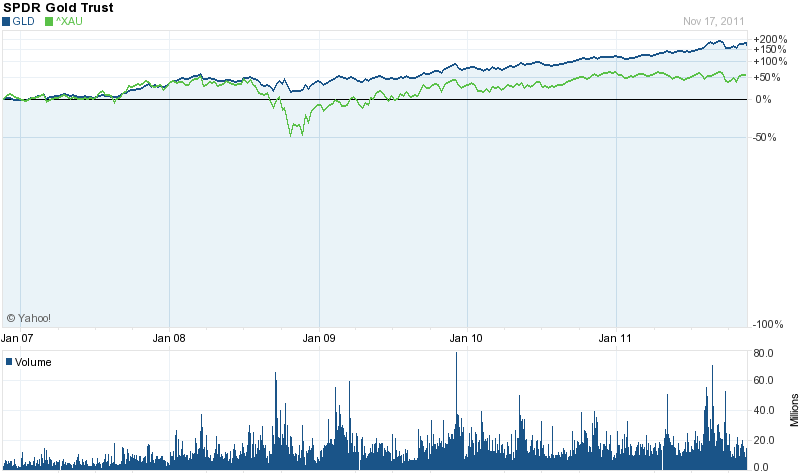
It was simply a matter of time before cheap gold mining companies became acquisition targets.  Gold mining companies have lagged far behind the gains of gold bullion and are selling at huge discounts to the value of their gold reserves.  A look at the comparative performance of the SPDR Gold Trust (GLD) to the PHLX Gold/Silver Index (XAU) shows that since 2008, gold has returned approximately 200% compared to a return of only 50% for the XAU.

The fundamental appeal of gold mining stocks is further bolstered by increasing demand for gold bullion.  The Gold Demand Trends released by the World Gold Council shows that global demand for gold increased by 6% in the third quarter.


Courtesy yahoo finance

Despite the recent volatility in gold prices, the long term fundamental case for gold remains intact and, in fact, grows stronger by the day as one sovereign nation after another stares into the abyss of debt default.  The move by the Chinese to acquire Jaguar Mining could be the spark that sets off a stampede to acquire undervalued gold mining companies.

Spectacular Anglo-Saxon Gold Treasure Discovery On Display

Most amateur treasure hunters searching for buried treasure with a metal detector would be delighted to find an occasional dated silver coin.  The discovery of buried gold treasure, however, remains only a dream for the vast majority of treasure seekers.

Imagine the excitement of a British treasure hunter who unearthed one of the most exquisite and extensive collection of gold artifacts ever discovered.   Searching on a Staffordshire farm in July of 2009, Terry Herbert stumbled across a treasure hoard of 3,500 artifacts, of which many were masterfully crafted out of gold.

It will never be ascertained who buried the fabulous treasure that came to be known as the “Staffordshire Hoard”.  The English countryside where the treasure was discovered has a long and violent history of warfare by numerous conquerors and barbarian tribes.  In any event, those who buried the treasure approximately 1300 years ago never retrieved it, bequeathing to history a fabulous array of ancient artifacts.

The vast majority of the exquisitely crafted items discovered were made for military use or adornment.  The treasure hoard contained no gold or silver coins.

The estimated value of the Staffordshire Hoard is estimated at $5.3 million.  The treasure hoard consisted of 11 pounds of gold which accounted for three quarters of the treasure’s total weight.

The Staffordshire Hoard is owned by the Birmingham Museums and Art Gallery, which will preserve the magnificent treasure for future generations.

The November issue of National Geographic has an extensive photo display of the Staffordshire Hoard, several of which are featured below.

Courtesy National Geographic, Photo by robertclarkphoto.com

Beyond the historical and cultural value of the Staffordshire Hoard, a large percent of the treasure’s value can be ascribed to the value of the gold content which held value for approximately 13 centuries.  The cold ground of the English countryside preserved a treasure for future generations.  Anyone care to ponder on what the value of U.S. dollars buried in the ground today would be worth in the year 3311??


Courtesy nationalgeographic.com, Helmet re-creation

Gold Demand Soars On Fears Of European Debt Defaults

After a sharp September price correction, gold is on track to hit all time highs.  According to a Bloomberg survey, 80% of the forecasters with the most accurate track records are predicting that gold will reach $1,950 by the end of the first quarter.   Investors world wide are fleeing paper currencies as the threat of debt defaults spread across Europe.

Ironically, central bank attempts to stimulate debt burdened economies by lowering interest rates to zero has contributed to the worldwide rush to gold.  Why would investors hold return free government debt with the added risk of principal loss?

As financial turmoil spreads across the globe, gold traders are the most bullish since 2004.

Gold traders and analysts are the most bullish in at least seven years as investors accumulate metal at the fastest pace since August to protect their wealth from a widening European debt crisis.

Gold exceeded $1,800 an ounce for the first time in seven weeks on Nov. 8 and hedge funds are holding their biggest bet on higher prices since mid-September, Commodity Futures Trading Commission data show. The metal is rebounding after tumbling as much as 20 percent in three weeks in September on demand for what are perceived as the safest assets. Almost $9 trillion was wiped off the value of global equities since May and yields on Italian and Greek bonds rose to euro-era records this week.

“Throughout history gold has protected people from the sort of turmoil that we’re seeing,” said Mark O’Byrne, the Dublin-based executive director of GoldCore Ltd., a brokerage that sells everything from quarter-ounce British Sovereigns to 400-ounce bars. It’s “an important thing to own when there is this sort of volatility in stock markets and concern about currency devaluations.”

Gold climbed 24 percent to $1,766.72 this year, heading for an 11th consecutive annual advance. It’s the second-best performer behind gas oil in the Standard & Poor’s GSCI Index of 24 commodities, which rose 5 percent.

Technical indicators suggest the rally that began in September has further to go. While gold jumped 14 percent since reaching an 11-week low Sept. 26, its 14-day relative-strength index is at 58, below the level of 70 that indicates to some who study technical charts that the metal is poised to drop.


Gold - courtesy kitco.com

As discussed previously in this blog, proclamations by the mainstream press after the September gold price correction that the “gold bubble had burst” constituted a contrarian buy signal for gold and silver.  The September correction was simply another opportunity for long term gold investors to add to positions at bargain prices.

The fundamental reasons for owning gold and silver have not changed and are not likely to anytime soon.