April 13, 2026

APMEX CEO Says No Bullion Shortage

Despite recent volatility, gold and silver prices continue to push to new highs.  After a brief pullback on earlier this week, silver rebounded strong and once again approaches the $50 level. Gold, which has lagged the price gains in silver, recently rose to a fresh all time high and remains solidly above the $1,500 level.

The rapid rise in silver prices has resulted in the Chicago Mercantile Exchange increasing the margin requirements on silver futures for the third time.  The press provided numerous accounts of traders taking huge positions in bearish silver puts.  Silver also faces the psychologically important barrier of $50 per ounce.   During the last great silver bull move of the early 1980’s silver rapidly collapsed from the $50 range and subdued for decades.

Despite the calls for a major correction by silver bears, the metal remains near all time highs and there have been numerous press reports of a physical shortage of silver based on intense investor demand.

Indications of a supply/demand imbalance in the bullion markets can be seen in many areas.   The US Mint has been rationing Silver Eagle bullion coins to its authorized purchasers and earlier this year the Royal Canadian Mint admitted that it was having major problems in sourcing adequate supplies of silver due to high demand.  The spot price of physical silver is trading above the price of futures contracts (known as backwardation) and this is an indication of huge physical demand.  In addition, earlier this week, APMEX, a major precious metals dealer, offered to buy bullion at a generous premium from its customers and cited “incredible demand” for gold and silver bullion products.

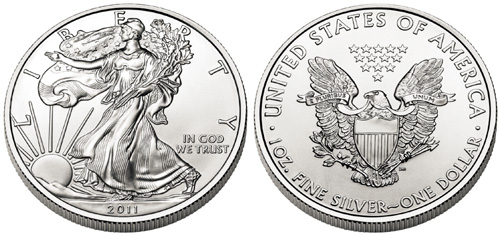
Although APMEX says there is no supply/demand imbalance, they recently increased their buy price for some US Mint bullion products. In particular, they are offering $3 over spot silver for one ounce American Silver Eagles. This is higher than the company’s cost of acquisition directly from the United States Mint, which sells the coins at $2 over spot to authorized purchasers.
In order to get a better assessment of the precious metal markets and supply/demand situation in bullion products, Gold and Silver Blog interviewed Michael Haynes, the CEO of American Precious Metals Exchange (APMEX).

When asked about the high prices APMEX is offering for Silver Eagles, Haynes said, “APMEX had not made a general offer to the customer base in quite some time and it seemed logical to remind the customers that APMEX has a need to buy. With respect to prices on Silver Eagles, you rightly describe that APMEX is offering more than the Mint sell price and you also rightly observe that the Mint is allocating product. As previously discussed, APMEX supplements its buying needs from the secondary market. Therefore, APMEX is buying at the bid offered to the customers and as mentioned above, APMEX would rather buy from its customers than a commercial dealer”.

Thus, despite the challenges experienced in other sectors of the market, from APMEX’s perspective they are able to obtain adequate supplies to meet customer demand.   Michael Haynes noted that APMEX is “currently able to buy the products needed to maintain adequate inventories for customers”.

Michael Haynes also provided insights into current customer buying trends.  According to Mr. Haynes, “average order sizes are increasing slightly, but that may be attributed to higher prices of the underlying product.  Recently, the purchases have shifted slightly toward silver”.  There has been no dramatic changes in customer buying patterns related to product size or premium according to Mr. Haynes.

Addressing  the appreciation in precious metals prices, Mr. Haynes noted that “APMEX sales seem to rise in either a rising market or a declining market.  The customers that purchase under those different scenarios are different, in that new customers tend to purchase on increases and mature customers tend to purchase on pullbacks”.

APMEX has apparently met the challenges of meeting surging customer demand for physical bullion products and, in addition, maintains a liquid market for those investors who chose to sell.  Mr. Haynes calls APMEX “one of the great business stories of the internet age”. APMEX was founded by Scott Thomas who has built the company into one of the largest dealers in coins and precious metals based on “a great passion to satisfy customers”.   Mr. Haynes stated that one of his goals is to “reach more of the population with the opportunity to own precious metals”.
Silver and Gold ETF Holdings Decline Amidst Volatile Trading

In a week of volatile precious metals trading, holdings of both the iShares Silver Trust (SLV) and the SPDR Gold Shares Trust (GLD) saw modest declines.
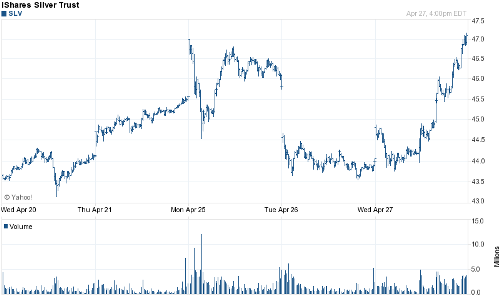
The holdings of the SLV declined by 130.49 tonnes or 1.2% from last week to 11,053.20 tonnes.  Looking at the daily changes, however, provides a a better indication of the volatility in SLV holdings during the week.

The holdings of the SLV hit an all time record high amount of 11,390.06 tonnes on Monday April 25th.  The substantial decline of 336.86 tonnes over the following two days mirrors the volatile price action of the SLV, which declined more than $2 on Tuesday before recovering to all time  highs at Wednesday’s closing price.

SLV - COURTESY YAHOO FINANCE

The SLV currently holds 355.4 million ounces of silver valued at $16.1 billion.  The SLV is currently the largest silver ETF and has seen tremendous growth in holdings since the Trust’s inception in April 2006, when it held a mere 653.17 tonnes valued at $263.5 million.  According to the Silver Institute, at the end of the first quarter 2011, total holdings held by all silver ETFs was 612 million ounces.

Despite the tremendous appreciation of the SLV, the silver market remains a relatively small market which leads to speculation that silver prices are being manipulated.  Volatility in silver trading over the past week was enhanced by rumors of massive short positions by traders, attempts to corner the market by larger players, and the inability to deliver physical silver on futures contracts.

The recent volatility in silver is likely to continue as additional players are drawn into one of the hottest markets of 2011 and wide price swings may become the norm over the short term.

For long term  investors, the fundamentals of the silver market should overweight any short term volatility.  Sales of Silver Eagles by the US Mint in the first quarter of 2011 was 37% higher than the previous year reflecting continuing investor demand.

GLD and SLV Holdings (metric tonnes)

April27-2011 Weekly Change YTD Change
GLD 1,229.64 -0.61 -51.08
SLV 11,053.20 -130.49 +131.63

Gold holdings in the GLD declined modestly by 0.61 tonnes after an increase of 17.29 tonnes for the previous week.  The current holdings of the GLD amount to 39.5 million ounces of gold valued at $59.7 billion.

Gold hit another all time high today, recently trading at $1,531.  The Federal Reserve ignited a sharp rally in gold and silver after releasing details of this week’s FOMC meeting. The precious metal markets moved higher after the Federal Reserve said it would continue super aggressive monetary policies despite the June wind down of QE2.  The Fed indicated that it would not reduce the size of its balance sheet and would leave short term interest rates at zero.

The Fed also left the door open to future unconventional policy moves if deemed necessary.  Since the Fed cannot move rates below zero, any additional “unconventional easing” would almost certainly mean additional money printing by the Fed.   The US dollar traded lower on Fed comments and is now threatening to break to new all time lows.


Physical Silver Shortage Worsens Due To Mint Rationing and Surging Investment Demand

The inability of the US Mint to meet public demand for gold and silver bullion products was discussed at a recent House Financial Services Subcommittee hearing.  Testimony by industry experts revealed that the US Mint was losing an estimated one-third of potential bullion sales because they cannot meet demand.

For the past several weeks the US Mint sales figures for Silver Eagle bullion coins have been essentially flat. The US Mint sells its bullion products in bulk to authorized purchasers (AP’s).  The AP’s resell the bullion coins to dealers who then sell the products to the public.  The US Mint has been rationing the 2011 Silver Eagle bullion coins to AP’s, leaving one to conclude that the flat sales of Silver Eagles have been the result of Mint production constraints or supply shortages, rather than flat or reduced market demand.

On past occasions, the US Mint has cited the lack of adequate supplies of silver planchets as the cause for the continuing rationing of silver bullion coin sales. Earlier this year, the Royal Canadian Mint admitted that they were having significant problems in sourcing silver since huge demand was outpacing silver supply.

Combine rationing and surging demand and the obvious result is a severe shortage of  physical gold and silver bullion products.  Confirming this situation, American Precious Metals Exchange (APMEX), announced yesterday that they were seeking to purchase US Mint bullion products from their customers in order to meet “recent incredible demand for gold and silver bullion products”.

APMEX, one of the country’s largest precious metals dealers, offered to purchase American Gold Eagles and American Silver Eagles at generous premiums over spot prices in order to secure inventory.  Despite the increase in the price of gold and silver, public demand obviously remains incredibly strong.

The American public has been provided with plenty of evidence that out of control deficit spending and money printing policies by the Federal Reserve are destroying the value of the paper dollar and they are acting accordingly (see Why There Is No Upside Limit To Gold and Silver Prices).  A loss of confidence in paper money is fueling the rise in gold and silver prices as people seek to protect their wealth.  Any pullbacks in precious metal prices should be viewed as another major buying opportunity.

Federal Reserve May Cause Stampede Into Gold and Silver This Week

At the end of a two day Federal Reserve policy meeting, Fed Chairman Bernanke has scheduled a news conference on Wednesday that has the potential to rattle markets worldwide.   Every analyst and investor at the news conference is certain to focus their questions on Fed plans after the scheduled completion of QE2  in June.
Current market expectations are that the Fed will not announce a new program of asset purchases and will initiate steps to slowly reduce the size of its bloated $2.5 trillion balance sheet.  Through the end of June, the Fed will have purchased $600 billion of treasury debt using newly created dollars, after having purchased $1.7 trillion of assets under QE1.

The Federal Reserve has been supporting the skyrocketing federal deficit by purchasing 85% of all new treasury debt since QE2 was initiated.   Some analysts think that interest rates on US debt will increase once the largest buyer of treasury debt steps aside.  The withdrawal of massive stimulus by the Fed could also cause a sell off in stocks and bonds, and result in lower housing prices and higher unemployment.  Under this scenario, another round of quantitative easing by the Fed would become inevitable.

Chairman Bernanke’s comments on the Federal Reserve’s exit strategy from a super easy monetary policy could cause major moves in many markets, especially precious metals.  If the markets sense that the Fed may need to initiate another round of quantitative easing, gold and silver prices will explode to the upside.  This prediction is based on the results of the current QE2 program which benefited certain asset categories but did little to help the average American.

Since last August when it became clear that the Fed would initiate QE2, we have witnessed the following results.

  • Home prices have continued to decline.
  • The 30 year mortgage rate has increased from 4.2% to 4.8%.
  • New housing starts declined to all time lows.
  • The 10 year treasury note rate has increased from 2.6% to 3.4%.

The Fed has continued its policy of near zero short term interest rates at the expense of consumers who receive virtually no return on savings.  Banks, meanwhile have increased US treasury and agency securities to a massive $1.7 trillion, benefiting from the spread between short and long rates.

The Fed’s policy of overt currency debasement, while helping to increase exports and earnings for multinational corporations has resulted in the dollar declining to the all time lows reached in early 2008.   Foreign countries with dollar reserves are protecting themselves by diversifying out of dollars and into other currencies and hard assets.

The lower value of the US dollar, while helping multinational corporations, has resulted in higher oil and food costs which has put  additional strains on consumers already burdened with excessive levels of debt and declining incomes.

Unemployment has remained stubbornly high despite unprecedented fiscal and monetary stimulus.  The Fed can print money but it cannot directly create an increase in real incomes for the average American family.  Nor can the Fed fool the people – recent Gallup polls show that almost half of the public has little faith in the Federal Reserve’s ability to do the right thing.

The Fed’s explicit policies of dollar debasement and zero interest rates risks triggering a major collapse in the value of the dollar.   Since last summer the dollar has seen a decline of 16% as investors do the logical thing and dump dollars.

Huge US  budget deficits, uncontrolled spending  and money printing by the Fed resulted in a warning by S&P that a credit downgrade on US debt was possible, putting further pressure on the US dollar.

QE2 liquidity did result in higher stock and precious metal prices benefiting a minority of Americans while doing nothing to solve the problem of too much debt and too little income.  Reliance on the Fed to come to the rescue with ever increasing amounts of cheap money has become the last resort, self defeating option.

The gold and silver markets are reflecting the failure of  unsustainable fiscal and monetary policies which virtually guarantee further appreciation in the precious metals sector.  Any pullback in prices should be viewed as a long term buying opportunity.

Gold At Record High As Silver Price Soars Towards $50 – Why The Rally Will Continue

As government spending spirals out of control and the Federal Reserve perpetuates a deliberate strategy of currency debasement, precious metals prices continued to soar. Gold, as measured by the London PM Fix Price, closed at $1504.00, up $27.25 on a shortened four day trading week .
Gold has gained $86 during April and $185 from its January low of $1,319.  The price acceleration in April comes in the aftermath of the government’s dismal failure to reduce deficit spending, even as S&P warned of a credit ratings downgrade for the U.S.  The great budget compromise reached by both parties was soon exposed as a shameful hoax by the Congressional Budget Office, which said that government spending would actually be higher after the “budget cuts” due to gimmicks.

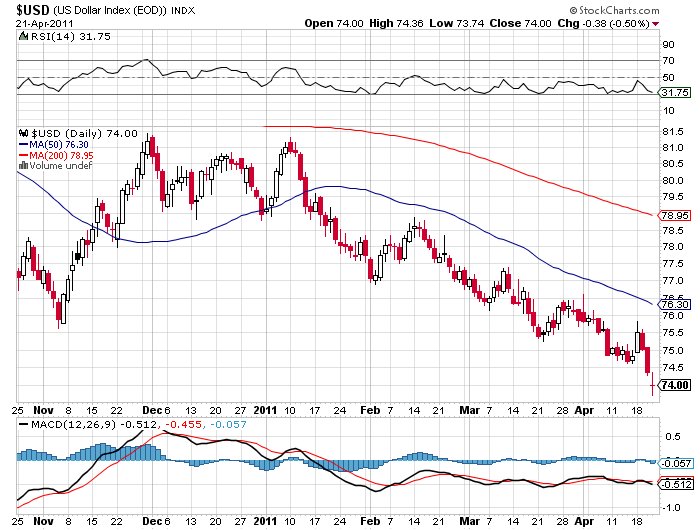
As unsustainable government debt continues to balloon and the Fed continues to print money, the dollar is getting trashed. Governments worldwide are taking steps to protect themselves from the Fed’s explicit policy of dollar debasement and this means selling dollars.  The US dollar has fallen almost 10% since the beginning of the year.  Gold and silver are becoming the de facto reserve currency, as the flight from dollars intensifies.

US Dollar- COURTESY STOCKCHARTS.COM

Silver has continued to confound the bears with another standout performance, gaining $3.65 or 8.57% on the week, after gaining $2.39 in the previous week. The closing price for silver as measured by the London PM Fix Price was $46.26.   Silver is rapidly closing in on its all time closing high of $48.70 hit in January 1980. The current price momentum in silver could easily push silver into new all time highs next week.

The huge rally in silver prices has some wondering if there will be a pullback soon.  Silver has gained $8.63 per ounce this month for a 22% gain.   Since the January low of $26.68, silver has gained a spectacular $19.58 per ounce for a huge gain of 73%.  The question is not one of if, but rather of when there will be a pullback – a routine event in every bull market.

Precious Metals Prices
Fri PM Fix Since Last Recap
Gold $1,504.00 +27.25 (+1.84%)
Silver $46.26 +3.65(+8.57%)
Platinum $1,812.00 +25.00 (+1.40%)
Palladium $765.00 -7.00 (-0.91%)

But perhaps the bears will have to wait a while longer for the much anticipated pullback.  The volume in put options on the silver ETFs has seen numerous days of record volume, implying that some big players are betting on a significant decline in silver prices.  Does the record put buying on silver reflect speculators betting on a silver plunge or merely long time silver investors hedging long positions?  Either way, the implication is that the expectations for a silver pullback seems to be growing, but markets rarely accommodate investors’ perceptions of when a market is truly overbought – expect higher silver prices to shock the put buyers in silver.

Long term, any price pullback in silver should be looked at as a gift.  Financial players should never “fight the Fed”  and in this case, both Federal Reserve and Government policies guarantee higher precious metals prices (see Why There Is No Upside Limit To Gold and Silver Prices).

US Mint Gold and Silver Bullion Sales Flat as Prices Hit New Highs

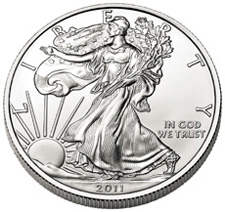
Currently, the United States Mint has three bullion products available to its network of authorized purchasers. The American Silver Eagle is struck in one ounce of .999 fine silver. The American Gold Eagle is struck in 22 karat gold and comes in one ounce, half ounce, quarter ounce, and tenth ounce bullion weights. The American Gold Buffalo is struck in 24 karat gold and available in one ounce size only.

Authorized purchasers may order bullion coins from the US Mint in bulk quantities based on the price of the previous metals plus a fixed (silver) or percentage (gold) markup. In the latest week, bullion sales at the US Mint were little changed from recent levels, even as the price of gold hit a fresh all time high and the price of silver trades at a 31-year high, approaching its all time high price.

US Mint Bullion Coin Program Sales 4/20/2011 (ounces)

Prior Week Month to Date Year to Date
American Silver Eagle 727,000 2,101,000 13,803,000
American Gold Eagle 13,500 58,500 358,000
America the Beautiful Silver 0 0 0
American Platinum Eagle 0 0 0
American Gold Buffalo 5,000 12,500 50,500

The US Mint sold 727,000 ounces worth of Silver Eagles during the period. For several weeks running, sales have stayed around this same basic level, which is a more reflection of the US Mint’s production capacity than market demand. Since the start of sales for the 2011 Silver Eagles, the US Mint has imposed its rationing program, allocating available supplies amongst the authorized purchasers.

Gold bullion sales were 18,500 ounces in the past week, up slightly from the 17,500 ounces sold in the prior period. Sales consisted of 13,500 ounces of Gold Eagles and 5,000 ounces of Gold Buffalo coins.

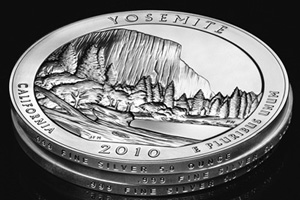
Next week, the US Mint will expand their bullion offerings when the first two designs of the 2011 America the Beautiful Silver Bullion Coins go on sale. Production has been indicated at 126,500 units for each design, representing 1,265,000 troy ounces of silver since each coin has a weight of 5 ounces.

iShares Silver Trust and SPDR Gold Trust Holdings Increase As Worries Over Paper Money Grow

Both the iShares Silver Trust (SLV) and the SPDR Gold Shares Trust (GLD) saw holdings jump on the week as precious metal prices continued to climb.
The holding of the SLV increased by a substantial 213.98 tonnes over the past week after posting a decline of 192.74 tonnes in the previous week.  The all time record holdings of the SLV was reached on April 11, 2011, at 11,242.89 tonnes.

Strong investment and fundamental demand for silver continued to push silver prices higher with the London PM Fix Price for silver closing yesterday at $44.79, up from $40.22 a week ago.

While some analysts worry about the “inflation” in silver prices, the world’s most successful investor is worried about dollar inflation.  Warren Buffet – “We’re following policies that will lead to a lot of inflation down the road unless changes are made”.  The U.S. can’t “run the kind of deficits we’re running and other policies…without it being enormously inflationary”.

The SLV currently holds 359.6 million ounces of silver bullion valued at $16.1 billion.  The SLV has seen seen an astonishing increase in the value of its holdings.  At the Trust’s inception in April 2006, silver holdings of 653.17 tonnes were valued at $263.5 million.

GLD and SLV Holdings (metric tonnes)

20-April-2011 Weekly Change YTD Change
GLD 1,230.25 +17.29 -50.47
SLV 11,183.69 +213.98 +262.12

Gold holdings of the SPDR Gold Shares Trust increased on the week by 17.29 tonnes to a total of 1,230.25 tonnes, after an increase of 7.49 tonnes in the previous week.  The GLD now holds a total of 39.6 million ounces of gold valued at $59.4 billion.

Gold continued to gain this past week and, as measured by the London PM Fix Price, closed yesterday at an all time high of $1,501.00.  Gold has gained $43.50 over the past week and since the beginning of the month is up $83 per ounce or 5.8%.

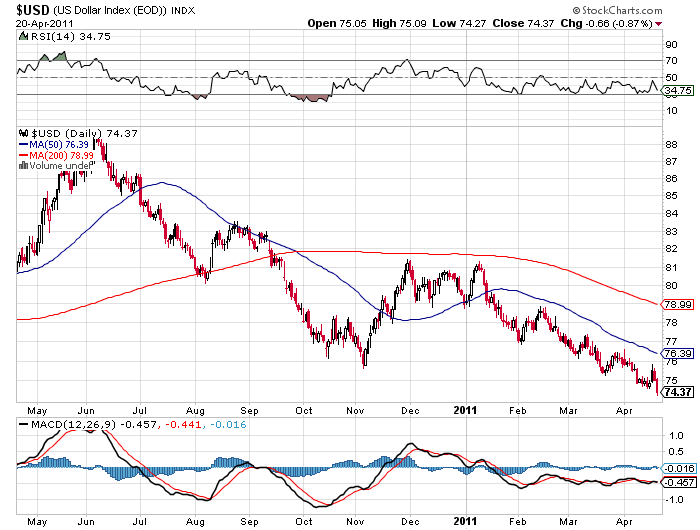
The price gains in gold continue to confound the numerous skeptics of the golden metal who can’t understand why gold is going up in the absence of high rates of inflation.  Perhaps the skeptics should pay attention to the increasingly vocal concerns by governments holding large reserves of U.S. dollars and whose economies are being harmed by the flood of rapidly depreciating U.S. dollars.

COLLAPSING US DOLLAR - COURTESY STOCKCHARTS.COM

Nyet to diplomacy. In extremely blunt remarks, Russian Prime Minister Vladimir Putin, commenting after the S&P downgrade on the U.S. debt outlook, said:  “Look at their (the U.S.) trade balance, their debt and budget.  They turn on the printing presses and flood the entire dollar zone – in other words, the whole world, with government bonds.  There is no way we will act this way anytime soon.  We don’t have the luxury of such hooliganism”.   Nor is Mr. Putin simply talking tough – the Russian government is also acting to protect its financial interests by reducing their holdings of U.S. treasury debt.  Russia, the world’s third largest holder of U.S. debt has been greatly reducing its dollar holdings this year.

China, the world’s largest holder of U.S. dollars totaling a massive $3 trillion, has been expressing its frustrations and concerns with U.S. monetary policy for years.  A plunging US dollar reduces the value of US debt held by China.  To offset the losses from holdings US paper assets, China has been reducing its holdings of U.S. dollars and buying physical assets worldwide.  China also took major steps this week to gradually implement full convertibility of the yuan in world markets which would allow it to hold fewer US dollars.

Governments worldwide are taking major steps to reduce loss exposure from holding US dollars that can be printed in the trillions by the U.S. Federal Reserve.  In another sign of disgust towards U.S. fiscal and monetary policies,  Brazil, Russia, India, China, and South Africa recently agreed to use their own currencies among themselves instead of the U.S. dollar.

The result of ultra loose U.S. monetary policies, huge budget deficits and money printing by the Federal Reserve have all contributed to the flight to wealth preservation as reflected by a collapsing US dollar and skyrocketing precious metals prices.

Are Gold Stocks Really Underforming Gold Bullion?

Depending on which gold stock investor you talk to, gold stocks have either been under performing or outperforming gold bullion.
Theoretically, given the earnings leverage associated with gold miners, a big move up in gold bullion should translate into handsome gains for shareholders of gold mining companies as earnings per share increase.  In the real world, however, the cost of exploration and development, mine depletion and the energy intensive process of gold mining and refining can result in costs that exceed the increased revenue from higher gold prices.  Gold mining companies with operations in less developed countries with weak property rights can also wake up one morning and discover that the government has expropriated their mines.

So which is it?  Would it have been better to own gold stocks or simply buy a gold ETF or take physical possession of gold bullion?  Like many things in life, it all depends, and the result reinforces the argument to maintain a well diversified portfolio.

Gold miners that have been able to translate higher gold prices into higher profits have done very well while other gold miners with poor results have significantly lagged the gains seen in gold bullion.   The results have been company specific.  A gold stock investor who was correct in predicting higher gold prices but picked the “wrong” gold stocks fared poorly.

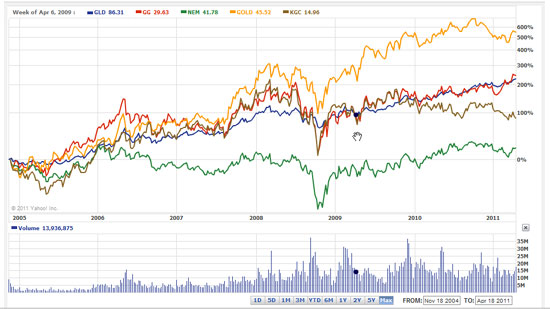
Here’s a sample of the relative performance of some of the largest gold miners compared to the price of gold, using the SPDR Gold Trust (GLD) as a proxy for bullion prices.  Two major gold miners, Newmont Mining Corporation (NEM) and Kinross gold Corporation (KGC), dramatically under performed the GLD, while Goldcorp (GG) tracked the GLD performance.  If you were lucky enough to own Randgold Resources (GOLD), your profits would have been twice the gains on the GLD.

RELATIVE PERFORMANCE STOCKS VS GLD - COURTESY YAHOO FINANCE

The bottom line is that unless an investor has considerable expertise in assessing the gold mining industry and specific company prospects, the better choice was to go with a gold ETF or stash gold bullion in a safe deposit box.  If the biggest gains in gold prices are yet to come, as I believe, an investor with a 100% allocation to individual gold stocks should consider reassessing his portfolio allocation.

The last option that should be mentioned for those seeking higher returns from the leverage of owning gold stocks instead of a gold ETF, would be to invest in a gold mutual fund with a solid track record of investment success.

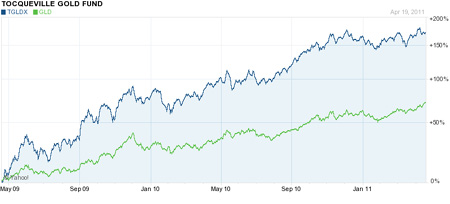
Tocqueville Gold Fund Performance vs. GLD

The Tocqueville Gold Fund(TGLDX) is a highly regarded mutual fund with solid portfolio managers who have had a very successful track record in picking the right gold stocks.  Over the past two years, the TGLDX has outperformed the GLD and with far less volatility.

For Silver, This Time It’s Different

To many investors with a sense of history, the four most dangerous words are “this time it’s different”. The phrase is usually evoked in an attempt to justify why a huge price gain in a particular asset class can continue to defy common sense and historical valuation norms. A surfeit of explanations on why “this time is different” is usually enough to send seasoned investors to the exits.

Silver, having defied the low expectations of many investors, has now seen a monster rally of 392% from $8.88 in October 2008 to the recent market price of $43.67. The pace of the advance has gone almost vertical with silver gaining 60% from the lows of late January.

Long term silver investors no doubt remember the aftermath of the last rapid run up in silver prices to $48.70 in January 1980. Silver prices collapsed shortly thereafter and ultimately slid to the $5 range where it remained throughout the 1990’s. Silver dropped off the radar for most investors and remained dead money for 25 years before decisively breaking out of a very long base in early 2006.

Will history repeat with another meltdown in silver prices at some near point in the future, or is the rise in silver prices indicative of a major trend change in our economic future? I have never believed that the mechanical application of past price trends was a useful tool for predicting the future. Each point is history is unique with new players and new sets of circumstances. Understanding today’s fundamentals are far more important than ascribing importance to past events that are largely irrelevant.

To understand why silver prices are in the initial stages of a long term super cycle advance rather than a replay of the 1980’s, it is necessary to review the differences of the late 1970’s compared to our current situation. Gold and silver both advanced in the 1970’s as a booming, demand driven economy fueled inflation. The huge cost of financing the Vietnam War, low employment and surging wages all contributed to a steadily rising rate of inflation which peaked at 13.5% in 1981. Federal Reserve Chairman Paul Volcker finally stopped inflation dead in its tracks through a series of massive interest rate increases which brought the prime rate to a high of 21.5% in mid 1981. High interest rates caused a severe recession but by 1983, the rate of inflation had collapsed to 3.2%.

Both gold and silver moved dramatically higher during the inflation surge of the late 1970’s and early 1980’s but the meteoric rise in silver prices was driven by specific events. Wealthy brothers Nelson and William Hunt acquired a massive position in silver in an attempt to corner the market. Prices skyrocketed on the news and silver went from $11 per ounce in late 1979 to $48.70 in early 1980. Regulators did not take kindly to market manipulation and margin requirements on commodities were dramatically raised. The Hunt brothers’  ill conceived attempt to drive silver prices higher collapsed along with their net worth. Silver prices plunged to less than $11 per ounce within two months. The last great silver “bull market” lasted less than six months, driven not by fundamental demand but rather by heavily leveraged speculators.

Fast forward 30 years – the finances of governments worldwide have reached the tipping point under ballooning debt levels and massive deficits. Additional borrowing by insolvent nations to rollover debt simply delays the day of reckoning – more debt is not the solution for too much debt.

The message from the gold and silver markets is clear – governments have reached the limits on borrowing and the day of debt Armageddon is approaching. The accelerating exodus from paper assets to historical stores of value is only in its initial stages as desperate governments take desperate measures to stay afloat (see Smart Money Sees The Perfect Storm for Gold and Silver).

The great debt bubble of the United States and much of the rest of the world is reaching its end game as creditors realize that a stealth default of some type is inevitable via a combination of inflation, money printing, currency debasement and/or negative interest rates.  Nor is it likely that S&P’s lowered outlook on U.S. government debt to negative from stable will have any affect on reining in ballooning U.S. debt (see Why There Is No Upside Limit To Gold and Silver Prices).

From a long term perspective, perhaps this time is not different but simply a replay of the history of currencies backed only by the “full faith and credit” of governments.  Voltaire had this to say regarding fiat money – “Paper money eventually returns to its intrinsic value – zero”.

2011 America the Beautiful Silver Bullion Coins Release

On April 25, 2011, the United States Mint will make the first of the 2011-dated America the Beautiful Silver Bullion Coins available for purchase. This year’s release and distribution of the 5 ounce silver bullion series is expected to be much different than experienced for the previous year.

As with other bullion programs of the United States Mint, the coins are distributed through a network of authorized purchasers. A group of primary distributors may purchase the coins directly from the Mint in bulk quantities based on the market price of the metal plus a modest premium. For the 5 oz. ATB silver bullion coins, this premium is $9.75 per coin. After acquisition, the authorized purchasers resell the coins to other bullion dealers, coin dealers, and the broader public.

For this year’s offering, the US Mint will start by releasing two different designs featuring Gettysburg National Military Park and Glacier National Park, each with a mintage of 126,500 units. This will be followed by three additional designs released later in the year featuring Olympic National Park, Vicksburg National Military Park, and Chickasaw National Recreation Area. The US Mint has stated that their goal is to produce a minimum of 126,500 coins for each of these designs.

For the 2010-dated issues, all five designs had been released on the same date, late in the year. Each of the designs had production of only 33,000 units. This extremely limited mintage generated excitement with collectors, as the coins were viewed more as low mintage numismatic products than bullion coins. In an attempt to prevent price gouging, the US Mint would halt sales and impose terms and conditions on the distribution of the coins at the authorized purchaser level. This included capping the premiums on the coins and distributing directly to the public, with a household limit imposed.

For the upcoming releases, mintage levels are high enough that the US Mint will not impose similar terms on their distributors, except for the standard allocation (rationing) program and a requirement to certify that all of the prior year coins have been distributed in accordance with the rules previously set.