April 10, 2026

Gold And Silver Bullion Coin Sales Plunge In February

The latest production figures from the U.S. Mint show a dramatic decline in the sale of both gold and silver bullion coins.

According to the U.S. Mint, sales of American Gold Eagle bullion coins in February 2012 totaled 21,000 ounces, a decrease of 83.5% from January sales of  127,000 ounces.  Gold bullion coin sales declined by 77.3% from the prior year when a total of 92,500 ounces were sold in February 2011.

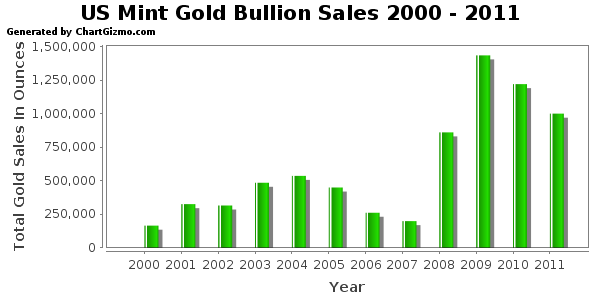
Sales of the American Gold Eagle bullion coins during February is the lowest since June 2008 when the Mint sold 15,500 ounces.  During 2011, the U.S. Mint sold an average of 83,333 ounces of gold bullion coins each month and rang up annual sales of 1,000,000 ounces.  During 2011, sales of the gold bullion coins declined for the third consecutive year.
Sales of the American Silver Eagle bullion coins also declined dramatically during February.  The U.S. Mint reports total February sales of 1,490,000 silver bullion coins, down 76.6% compared to 6,107,000 during the previous month.  Sales of the silver bullion coins during February declined by 54% from February 2011 sales of 3,240,000 ounces.  Sales of the American Silver Eagle bullion coins were the lowest since November 2011 when the U.S. Mint sold 1,384,000 ounces.

Gold and silver sales detailed above do not include U.S. Mint gold and silver numismatic coins which are sold directly to the public.

The American Gold and Silver Eagle bullion coins cannot be directly purchased by the public from the U.S. Mint.  The U.S. Mint sells the gold and silver eagle bullion coins only to a network of authorized purchasers (AP’s) who in turn resell them to the public and secondary retailers.  The U.S. Mint determined that the AP distribution system was the most efficient means of retailing coins to the public at competitive prices.

Total yearly U.S. Mint gold bullion coin sales from January 1, 2000 to February 29, 2012 are shown below.

Gold Bullion U.S. Mint Sales By Year
Year Total Ounces Sold
2000 164,500
2001 325,000
2002 315,000
2003 484,500
2004 536,000
2005 449,000
2006 261,000
2007 198,500
2008 860,500
2009 1,435,000
2010 1,220,500
2011 1,000,000
2012 148,000
7,397,500
Note: 2012 total through February 29, 2012

Shown below are the yearly U.S. Mint sales figures since 2000 for the American Silver Eagle bullion coins.   Sales totals for 2012 are through February.

American Silver Eagle Bullion Coin Sales
YEAR OUNCES SOLD
2000 9,133,000
2001 8,827,500
2002 10,475,500
2003 9,153,500
2004 9,617,000
2005 8,405,000
2006 10,021,000
2007 9,887,000
2008 19,583,500
2009 28,766,500
2010 34,662,500
2011 39,868,500
2012 7,597,000
TOTAL 205,997,500

The U.S. public has acquired over 200 million ounces of American Silver Eagle bullion coins since 2000 which are now valued at roughly $7.4 billion.  By comparison, the iShares Silver Trust ETF (SLV) currently holds 313 million ounces of silver bullion valued at $11.7 billion.

Gold and Silver Plunge On Bernanke’s Remarks – What Happens Next?

The price of gold and silver plunged today after investors concluded that the Federal Reserve had no immediate plans for further quantitative easing.  In testimony to Congress Fed Chairman Bernanke made positive comments on future U.S. economic growth.  When Bernanke gave no indication that further monetary easing  would be necessary, a selling stampede began in the precious metals markets.

In New York trading, gold closed down $87.20 for a 4.9% loss on the day and silver declined by $2.29, down 6.2%.  Platinum got rocked with a $40 decline to $1,685 and palladium gave up $18 to close at $707.

Why the violent sell off in precious metals when the Federal Reserve and other central banks worldwide are still printing money on a massive scale?  For some thoughts on today’s precious metals rout and what’s likely to happen next, here are some links to excellent gold and silver related stories and blog posts:

Gold Falls In “Manic” Plunge

Explanations from various money managers on why gold and silver sold off.  Investors expecting continued monetary easing were disappointed.  William O’Neill, partner at Logic Advisors said “Bernanke’s comments seem to have eliminated hope of U.S. quantitative easing coming anytime soon.”

Gold, Silver Tumble on Heavy Profit Taking

Importantly, the gold and silver futures markets were ripe for corrective, technical and profit-taking pullbacks following recent strong gains that had sent gold and silver prices to multi-month highs. The Bernanke testimony gave many traders and investors an excuse to “ring the cash” register and take some profits. Also, veteran commodity market watchers know these markets can make sudden, unexpected price moves to temporarily roil investors and traders.

Kitco Interviews GATA Chairman

Interview with GATA Chairman Bill Murphy on today’s smashdown in the gold and silver markets.

Bernanke Tries Talking Down Commodities

If one basically states that the economy is doing better – not out of the woods yet but better – and all the hedgies are leveraged to the gills because the FED GAVE THEM THE GREEN LIGHT TO DO EXACTLY THAT when it first announced that it would keep this near zero interest rate policy out to the end of 2014, then it is a simple matter of throwing a bit of uncertainty in that regards to generate a bout of selling. Toss in the same permabears as always capping at the highs of the day and the algorithms did the rest of the work as the stops were picked off.

First Eagle’s Eveillard Openly Suspects Gold Market Rigging

Gold fund manager Jean-Marie Eveillard has just told King World News that he suspects that today’s pounding of the gold price was a matter of central bank intervention:

Eveillard, who manages $50 billion in assets, is among the few respectables in the gold world, and his stunning acknowledgment today is the price the Western central banks must begin paying for their increasingly brazen market rigging. It is a sign that GATA is making progress, however slow.

Progress could be made a lot faster, as Eveillard and a few other respectables might blow the market rigging to smithereens if they mustered a little courage and activism, such as a donation to GATA, which has been documenting, litigating against, and screaming about gold market rigging for years:

Today Window Dressing Fall In Gold

Please do not be bothered by today’s intervention. The following news is what creates the absolute need for QE.

It is the thesis of my Formula of 2006 of no major recovery that gives the foundation to my thesis of QE to Infinity.

Has serial money printer Bernanke suddenly converted to become a staunch proponent of a sound dollar?  Don’t bet your gold on that one.  As noted in a previous post, The Federal Reserve Can’t Produce Oil, Food or Jobs But They Will Continue to Produce Dollars.

Late note – gold is up $20.60 in Asian trading.

What Is Google Trends Telling Us About Gold?

It has been some time since we last looked at what Google Trends can tell us about the future price of gold.

Google Trends allows us to see volume trends for specific search items related to gold.  In the past, extreme spikes in search volume have correlated closely with major turning points in the gold market.  What is the predictive power of Google Trends telling us about gold today?

When we looked at Google Trends in March 2009, we examined search engine results for “Sell Gold” and “Buy Gold” (see What Can Google Trends Tell Us About Gold?).  It was observed that as gold was hitting its peak in March 2008, there was a spike in search volume for “Sell Gold”.  After the brutal sell off that correlated with the substantial decline in all asset categories due to the financial meltdown during 2008, there was a spike in “Buy Gold” search inquiries that correlated closely to the gold bottom in late 2008.

What is Google Trends telling us today, after gold’s increase of $183 per ounce since the beginning of the year?

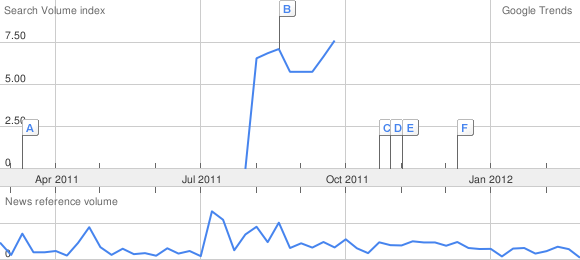
As we can see from the chart below, a huge spike in search queries for “Sell Gold” corresponded closely to the all time high in the price of gold at $1,895 reached in September 2011.  The current lack of search volume queries for “Sell Gold” as well as the decline in news reference volume (despite gold’s large price increase since the beginning of the year) is a clear bullish signal for gold.

"Sell Gold"


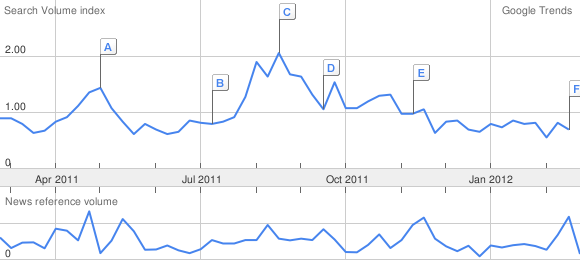
Another indicator suggesting that the general public is totally apathetic on gold is seen by viewing the Google Trends results for “Gold Investment”.   Last year, search queries for “Gold Investment” spiked as gold was reaching its September highs.  Despite the huge gold rally of 2012, low news volume and search queries for “Gold Investment” indicate very low interest in gold and constitute a contrary bullish indicator.

"Gold Investment"


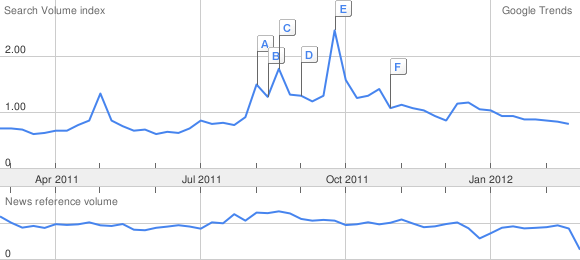
Finally, a look at the volume of search queries for “Gold” also indicates that the current gold rally has a long ways to go.  Even as the price of gold has increased non stop since January, the volume of search queries and news references has plunged.

"Gold"


The very low search inquiries for gold as shown in Google Trends is a strong contrary bullish indicator.  The risk of buying gold right now seems exceptionally low and the rewards exceptionally high.

Last year, Google Trends search inquiries on gold did not flash a sell signal until after gold had spiked by 26%.  If the same ratio applies going forward, “Google Gold Trends” won’t flash a sell signal until gold prices reach the $2,250 range.

Gold and Silver News & Headlines – February 2012

Gold and silver continue their strong 2012 advance with relatively sparse mainstream press headlines.  Gold is now only $114 per ounce below the all time high of $1,895 reached on September 6, 2011 and silver looks more and more like it is getting ready to challenge the $50 range last seen in mid 2011.

Based on the closing London Fix Price, gold has advanced from $1,598.00 at the beginning of the year to today’s closing price of  $1,781.00, for a gain of 11.5% or $183 per ounce.  Silver’s advance has been even more dramatic.  Since the start of the year, silver has risen 23.7% to $35.60 per ounce, a gain of $6.82 per ounce.

Here are some recent links to excellent gold and silver related stories and blog posts:

One-Half Ounce Proof Gold Eagle Sold Out, Some Silver Products Suspended

The one-half ounce 2011 Proof Gold Eagles have sold out at the U.S. Mint.  The one ounce Proof Gold Eagle had previously sold out last October.  In addition, some silver numismatic product sales have been suspended pending pricing updates due to the rapid rise in silver prices.

The Financial System Is Sick – Are Precious Metals The Cure?

Over thousands of years, gold and silver are the only currencies that have not failed and have protected wealth.  With rampant worldwide money printing, the wealth of nations is being stolen through endless money printing.  Expect the severely undervalued gold stocks to rally strongly.

Gold Market of the 1970s Was A Dress Rehearsal

Jim Sinclair sees QE to infinity and persuasively argues that the only tool left in the toolbox is money printing which is required to prevent a global implosion from towering levels of debt.

Gold Should Be $2,100 – $2,200 Right Now

Great interview with Jim Puplava who discusses central bank money printing, financial repression, economic issues and why gold is undervalued by at least 22%.

Why The U.S. Government Confiscated Gold in 1933 – Can It Happen Again?

The U.S. government is already seizing the wealth of millions of Americans through financial repression.  Through executive order U.S. citizens were forbidden to own gold from 1933 through 1974.  Julian Phillips examines the reasons why this occurred and wonders if  it could happen again?

Silver Price Rises Twice As Fast As Gold As The Eurozone Floods With Money

Silver has been on a tear this year, up 24% compared to an increase of 12% for gold.  How should investors react to position themselves  if gold soars over $2,000 and silver spikes to over $50?

Ex-Fed Governor Warsh Again Confirms Gold Price Suppression

GATA highlights the role of governments in financial repression and suppression of gold prices.  Ex Fed Governor Kevin Warsh notes the growing call in Europe and the U.S. to devalue debts through money printing and higher inflation.  Warsh says that “Such an inflation tax would transfer wealth from those who have lent money, in good faith, to the borrowers.  Inflation is a blunt and inappropriate instrument for assigning winners and losers from profligate fiscal policy or excessive borrowing by private individuals and firms.”

If Gold Could Talk

Terrific article on the enduring characteristics of gold, why gold is money and how much gold should an investor own?  Be prepared to get your checkbook out after reading this article.  Whatever amount of gold you currently own, it’s not enough!

Gold Remains The Best Alternative To Paper Money

Two examples of the frustrations that some gold investors have gone through in the past year offers a valuable lesson to long term gold investors.

  1. During 2011, despite being heavily invested in gold, John Paulson’s Gold Fund wound up losing 11% of its value.  This despite the fact that gold bullion gained $142.50 during 2011, closing the year at $1,531.00, up 10.2% (see How Did An Investment Pro Lose Money Investing in Gold?).
  2. Investors in the $4.4 billion Vanguard Precious Metals Fund (VGPMX) which holds almost all of its assets in a diversified portfolio of precious metal mining stocks dropped by a stunning 27.4% last year, declining from $26.71 on January 3rd to $19.39 on December 30, 2011.

In both of the above cases, the declines in value were primarily due to the large under performance of gold stocks to gold bullion during 2011.  Nonetheless, nothing stings more than picking the right asset class only to somehow wind up losing.  An investor bullish on gold and investing completely in gold stocks would have had a disastrous year.  An investor with a large position in gold, diversified across gold mining stocks, gold bullion and gold ETFs would have performed substantially better.

Although gold stocks can often outperform gold bullion, many investors may lack the expertise to pick the best gold stock or gold mutual fund.  The best strategy for most small gold investors is to buy physical gold bullion at regular intervals with a commitment to a long term holding period.  Over the years, I have seen far too many uninformed investors who want a position in gold wind up trading speculative junior gold stocks, often times resulting in large losses.  Gold mining stock prices can be volatile and even when an investor selects quality gold stocks, the temptation to liquidate a position during  price weakness often results in losses.

The gold investor who has purchased gold bullion consistently over the past decade has been amply rewarded and there is no reason to expect this trend to change.

Meanwhile, John Paulson remains committed to gold and recently told Bloomberg News that he personally owns over half of the $1.2 billion Gold Fund he manages.

John Paulson, the hedge fund manager seeking to rebound from record losses in 2011, told investors his Gold Fund will outperform his other strategies over five years, according to a person with knowledge of the matter.

The billionaire, at a meeting yesterday at the Metropolitan Club in New York, said the metal is the best hedge against currency debasement as countries inject money into their economies, said the person, who attended the event and asked not to be named because the information is private. Paulson also cited gold as a hedge against the euro currency, as a breakup may occur, and an eventual increase in inflation.

The manager told clients his own money comprises 55 percent of the Gold Fund’s $1.2 billion in assets, the person said. The fund, which can buy derivatives and other gold-related securities, declined 11 percent last year after the metal slumped 14 percent in the final four months.

Europe’s sovereign-debt crisis may continue to affect bullion in the near term, Paulson, whose firm manages $23 billion, said this month in a year-end letter to investors. The metal serves as the best long-term alternative to paper currencies, he said.

“We remain excited about the outlook for the Paulson Gold Funds over the next few years,” he said in the letter. “We would argue that the potential upside in gold outweighs the potential downside.”

In addition to his Gold Fund, Paulson also holds a large position in the SPDR Gold Trust (GLD) ETF, valued at $2.9 billion.  As of February 24, 2011, the SPDR Gold Trust holds 41.3 million ounces of gold valued at $73.4 billion.

An Undervalued Gold Stock That Could Double In Price

Leveraged earnings gains from rising gold prices have historically resulted in gold stocks outperforming gold bullion.   From 2000 to the highs of 2008, the PHLX Gold/Silver Index (XAU) rose by 345% compared to a 252% increase in the price of gold.

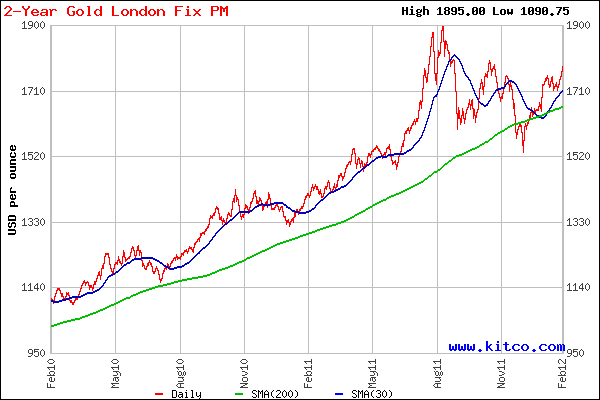
Over the past two years, the out performance of gold stocks has come to a dead halt despite the surge in gold prices.  From $1,121.50 in January of 2010, gold has advanced to the current price of $1,781.10 for a gain of $659.60 per ounce or 58.8% while gold stocks have basically flat lined as represented by the Market Vectors Gold Miners ETF (GDX).

The divergence between gold bullion and gold stocks has resulted in a markdown of world class gold producers, resulting in the best buying opportunity since the 2008 sell off.  John Hathaway, who runs the Tocqueville Gold Fund and has the best track record in the industry recently said this in his Investment Update.

Gold and gold stocks appear to be bottoming in the wake of a four month correction which began in mid -August when the metal peaked at $1900/oz. Bearish sentiment is at extremes not seen in many years. This and a number of other indicators, such as stocks that have been hit by negative sentiment, the downtrend in gold prices since August, and tax loss selling, support our view that a rally lies ahead. This very bullish market set-up, in our opinion, mirrors the extraordinary investment opportunity of the despondent year end in 2007. Even though gold prices have been declining for several months, they finished the year with substantial gains. This suggests that the value represented by gold mining equities held in our portfolio could be extraordinary.

GDX - couresy yahoo.com

Gold price - courtesy kitco.com

Will the glaring price disparity between gold and gold stocks continue?  I have argued in a previous post (see Gold Stocks are Positioned For An Explosive Move Up) that major gold producers with large proven gold reserves are on the bargain table.  The steeply discounted value of gold stocks will ultimately result in gold stock prices surging as the fundamentals of gold stocks are recognized by investors.

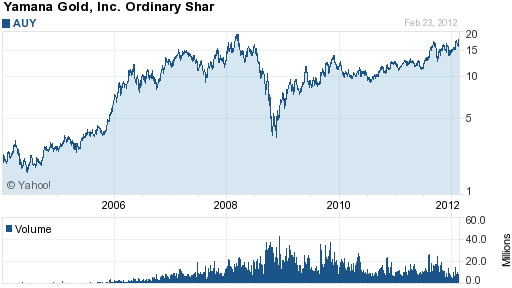
The gold stocks most likely to outperform are the ones with the strongest current relative price strength.  One gold stock that fits this criteria and has outperformed the gold stock indexes is Yamana Gold (AUY), a Canadian gold producer.

AUY OUTPERFORMS - courtesy yahoo.com

Yamana has producing, development stage and exploration properties in Chile, Mexico, Colombia and Brazil.  The Company recently announced record fourth and year end results for 2011.  Highlights of Yamana’s performance for 2011 are shown below.

  • Gold production increased by 5% to 916,284 ounces
  • Silver production reached 9.3 million ounces
  • Revenues increased by 29% to $2.2 billion
  • Cash margin increased by 28% to $1,517 per ounce
  • Earning increased by 59% to $713 million equivalent to $0.96 per share
  • Cash flow increased by 48% to $1.3 billion
  • The annual dividend was increased to $0.20 per share
  • The Company’s net earnings were equivalent to $497 per ounce with an average realized gold price per ounce of $1,670.
  • Yamana has industry low cash costs and operates in stable areas
  • Yamana management forecasts that annual sustainable gold production will increase by over 60% to 1.75 million ounces by 2014

Gold prices have surged thus far in 2012 and there is every reason to believe that gold will end the year far higher than its current price (see Fed Lays Groundwork For Price Explosion in Gold and also Why There Is No Upside Limit for Gold and Silver Prices).

The stage is set for an explosive move upwards in Yamana’s stock price based on the confluence of higher gold prices, soaring profits and increased gold production.   Based on the fundamentals, Yamana’s stock is dirt cheap.  The stock is on the verge of breaking out to a new all time high and could easily double in price during 2012.

AUY - COURTESY YAHOO.COM

Black Swan Silver Treasure Plundered By Spain With “Surreptitious” Help From U.S.

Over the years, Odyssey Marine Exploration has discovered hundreds of shipwrecks at the bottom of the vast oceans.  Using state of the art technology, researchers and scientists, the company has recovered vast amounts of treasure and artifacts spanning the thousands of years that mariners have sailed the oceans.

Some of Odyssey’s more recent discoveries include:

  1. The SS Republic, a Civil War era shipwreck from which over 51,000 coins and 14,000 historically significant artifacts were recovered.  The wreck was discovered in 2003 at 1,700 feet below the surface.
  2. The discovery of the HMS Victory in 2008 was described by Odyssey as “one of the most significant shipwrecks in history.  The HMS Victory, the flagship of Admiral Sir John Balchin, went down in 1744.
  3. In 2011, Odyssey fascinated the world with the discovery of two ships that were sunk by enemy fire during the World Wars.  The SS Mantola, a British steamer, torpedoed and sunk by a German submarine on February 8, 1917, is believed to have 600,000 ounces of silver on board.  The SS Gairsoppa, a British cargo ship, was sunk by a German submarine on February 17, 1941 and lies 4,700 meters below the surface.  The SS Gairsoppa is believed to hold about 7,000,000 ounces of silver.  Recovery on both wrecks is scheduled to begin this year.  Under agreements with the UK Government, Odyssey will retain 80% of the cargo salvaged from the two wrecks.

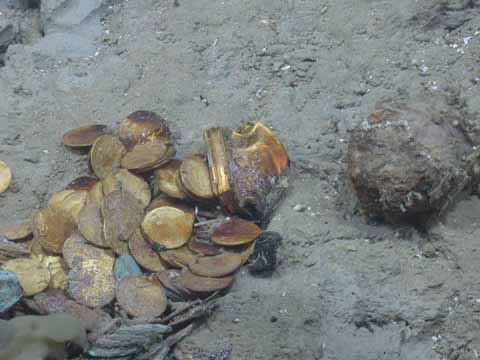
In May 2007,  Odyssey announced the “Black Swan” discovery of a Colonial era shipwreck located off the coast of Portugal.  Odyssey recovered more than 500,000 silver coins that were scattered about on the ocean bottom.  The treasure hoard weighed more than 17 tons which equates to about 545,000 ounces of silver.   In addition to the silver coins, Odyssey also recovered hundreds of gold coins and worked gold from the wreck site.

Based on the facts presented in Odyssey’s website, it seemed clear that the treasure belonged to Odyssey.  Little did Odyssey realize that the U.S. Government was working behind the scenes to overturn established law and strip Odyssey of its rights to the Black Swan treasure.

Black Swan gold - courtesy shipwreck.net

After Odyssey announced the find, the Kingdom of Spain laid claim to the sunken treasure, contending that the wreck was a Spanish sovereign ship and therefore the property of Spain.  Since the shipwreck was clearly in international waters, Odyssey was confident that any claims against its find would not be upheld by the courts.

Black Swan silver - courtesy shipwreck.net


Spain claimed that the sunken ship was the Nuestra Señora de las Mercedes, a Spanish merchant ship that was sunk by the British in 1804.  Odyssey maintained that there was no hull or other evidence available at the site to positively identify the ship and, in addition, a number of other ships had gone down in the area.

Odyssey noted that even if the ship could be positively identified as the Nuestra Senora, as a commercial vessel, Spain would have no valid claim to the salvaged treasure.  International law prohibits treasure seekers from claiming salvage rights only to sunken warships and not commercial vessels.  Odyssey also said that Peru, from whom the treasure had been plundered, was also seeking to assert its rights to the silver treasure.

Last week, Odyssey was shocked when the a Federal judge sided with Spain and ordered Odyssey to surrender the gold and silver treasure to Spain.  Odyssey, which held the gold and silver in its custody pending court ruling, said it spent $2.6 million on recovery, transportation and conserving the treasure.  It was not immediately clear if Odyssey would be compensated for its costs.   The value of the recovered treasure has been estimated to be as high as $500 million.

Odyssey was clearly stunned by the court ruling and the lack of a coherent explanation by the Federal judge as to why Spain prevailed in its case against Odyssey.  Spain, which is tottering on the edge of sovereign default, desperately needs the money that the sale of the Black Swan treasure would bring.  Was there some behind the scenes manipulation by the U.S. Government to help Spain?

Based on secret information disclosed by WikiLeaks, Odyssey believes that the court ruling went against them due to “surreptitious negotiations” between the U.S. and Spain and that the court’s decision was “contrary to established law”. Odyssey went to their Congresswoman for help who wrote the following letter to Hillary Clinton, Secretary of State.

Congresswoman Castor raises serious questions about the troubling role of the U.S. Government in manipulating the outcome of Spain’s claim against Odyssey.  Property rights and the rule of law seem to have been trashed by the Government based on some ulterior motive to award the Black Swan treasure to Spain.  The most chilling aspect of this case for holders of precious metals or wealth of any type is that government expropriation of property can be arbitrarily exercised and there is nothing you can do about it.

Are Gold Investors Nuts?

How many of the countries best financial advisors are telling their customers to invest in gold?  Despite the fact that gold has gone up for the past eleven years, a Barron’s survey shows that gold remains distinctly out of favor by mainstream investment advisors.

Barron’s interviewed 51 of the countries most successful investment advisors from each of the fifty states plus the District of Columbia.  Although investment returns were not disclosed, Barron’s selected the best investment pros based on the amount of assets managed, revenues generated, gain in the number of clients and the quality of their practices.

The 51 pros selected by Barron’s are the best in the business, work hard, serve wealthy sophisticated clients and manage hundreds of billions of dollars of wealth.  According to the survey, the most common investment strategy of the top financial advisors was to generate income flows and potential capital gains by owing high quality blue chip stocks.  Most of the advisors were optimistic, predicting that dividend paying stocks would outperform government securities on which yields have plunged to all time lows.

Of the 51 advisors interviewed, only two specifically recommended a small portfolio allocation into gold.  The investment advisor from Iowa recommended that clients make “sure 3% to 5% of their portfolios are in gold” and the investment pro from Nebraska suggested a 10% position in gold mining stocks.

The number of investment pros recommending gold was surprising low, especially after considering the potential for another financial meltdown precipitated by sovereign debt crises, rampant money printing by central banks and towering levels of debt that threaten to crush the world economy.

Gold - courtesy kitco.com

Gold has proven to be a vehicle for wealth preservation over thousands of years and is insurance against financial disaster.  Has the increase in gold since 2000 already fully discounted the worst possible economic and financial scenarios?

Barron’s smart money pros apparently think that gold’s run is over.  Are gold investors nuts to argue with the world’s best money managers, especially after an almost 7 fold increase in the price of gold since 2000?  What do you think?

More on this topic: Gold Bull Market Could Last Another 20 Years With $12,000 Price Target

Investor Gold Demand Hits All Time Record – China and India Grab 61% Of Total Gold Mine Production

Investor demand for gold during 2011 hit an all time high, fueled by soaring demand in China and India.  Total gold demand by China and India during 2011 amounted to a staggering 61% of all gold mine production last year.

The 2011 Gold Demand Trends report issued by the World Gold Council show a huge increase in gold demand and a small increase in global gold mine production.  This continues a trend that has been in place since 2001.  Despite an almost 600% increase in the price of gold since 2001, global gold mine production has increased by only 7.7%.

Typically, a large increase in price will bring forth additional supplies as producers rush to take advantage of higher prices.   This has not happened with gold due to the depletion of existing gold reserves and the inability of miners to discover and develop new gold deposits.  The continuing increase in gold demand and the lack of new supply will eventually result in gold prices higher than most people can imagine today.

Highlights of the Gold Demand Trends report are summarized below.

  1. For the first time ever, on a dollar basis, gold demand hit all time record highs at $205.5 billion, representing 4,067.1 tonnes of gold.
  2. Investor demand for gold hit all time record of 1,640.7 tonnes, up 5% from the previous year.
  3. Demand for gold by China soared 20% last year to 769.8 tonnes and demand by India, despite currency weakness, was 933.4 tonnes.  It is expected that China will become the largest gold market in the world during 2012 based on continued record setting demand.
  4. Global gold production increased by only 4% last year to 2,809.5 tonnes.  The combined gold demand of 1,703.2 tonnes by China and India consumed 60.6% of all new gold mine production.  It is projected that the supply of new gold will remained “restrained” for the foreseeable future.
  5. The desire to protect wealth accounted for surging gold demand in Europe as the European Central Bank engages in a massive money printing campaign to prop up the insolvent banking system.
  6. Central banks continued to buy gold during 2011, increasing total purchases to 440 tonnes, up by 77 tonnes from last year.
  7. The amount of gold available to meet demand is being restrained not only by low mine production but also by reduced supplies of gold from recycling.   Despite a 28% increase in gold prices last year, the supply of recycled gold declined by 2% to 1,611.9 tonnes.  According to the Gold Council, this implies that “market supplies are drying up and that consumers may be holding on to their gold in the expectation of higher prices.”
  8. Investors are showing a strong preference for physical gold as seen by the investment flows into bar and coin compared to ETF demand.   Demand for gold bar and coin during 2011 totaled 1,486.7 tonnes compared to ETF demand of only 154.0 tonnes.
  9. Gold demand by ETFs increased in the 2011 fourth quarter over the comparable period last year, but total demand during 2011 of 154.0 tonnes was far below ETF gold demand of 367.7 tonnes during 2010.

The Gold Council bullishly notes that the gold market is unique in that it is driven by a “diverse set of factors” and multiple sources of demand.

Lowering Gold Stock Portfolio Risk Through Diversification

There are numerous investment strategies available to capitalize on the gold bull market.  Gold investors have the option of investing in gold bullion, gold coins, gold ETFs, gold mutual funds and individual gold mining stocks.

Although many gold investors prefer to exclusively hold physical gold, diversifying into selected gold stocks can dramatically increase total returns.  Although gold stocks as a group have recently underperformed bullion, selected gold stocks have outperformed gold bullion.

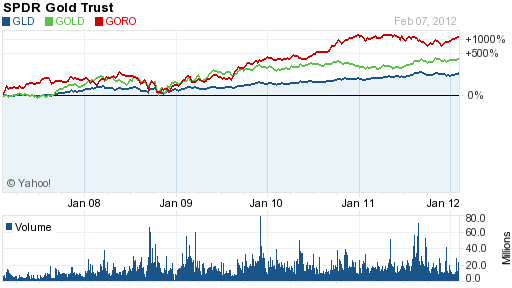
Well managed gold mining companies with large ore reserves and increasing mine production have provided investment returns far in excess of the gain in gold bullion as seen below with the examples of Randgold Resources (GOLD) and Gold Resource Corp (GORO).  Both of these gold mining companies have vastly outperformed gold bullion when compared to the SPDR Gold Trust (GLD) which tracks the price of gold bullion.

GORO, GOLD vs GLD - Courtesy yahoo.com

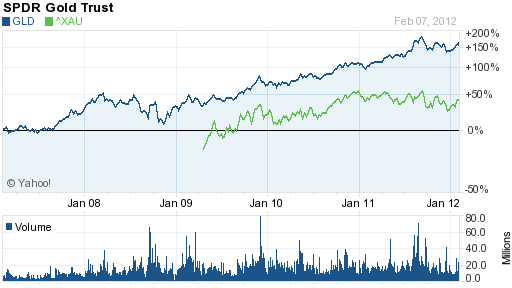
Selecting the gold stock that will outperform bullion is difficult, however, as seen by the lagging performance of the PHLX Gold/Silver Sector (XAU) when compared to the GLD.  The XAU Gold/Silver Sector is a broad based index of sixteen large precious metal mining companies.  The GLD has outperformed the XAU by three times since 2009.

GLD vs XAU - courtesy yahoo.com


As with any stock portfolio, diversification is required into order to avoid the risk of under performance.  An example of the risk of holding a gold portfolio with only a small number of stocks was seen today when the price of Nevsun Resources (NSU) collapsed by almost 31% after the company unexpectedly announced that gold production will plunge by nearly half in 2012 due to a reduction in estimated gold reserves.

Since selecting individual gold stocks can be a daunting task for investors, a better alternative would be to invest in an actively managed gold stock mutual fund with a proven record of superior investment returns.  Past performance has shown that an actively managed gold stock mutual fund has outperformed passively managed gold index funds.

One gold fund that should top the list for investors to consider is the Tocqueville Gold Fund (TGLDX), run by legendary gold investor John Hathaway.  The Tocqueville Gold Fund has a remarkable average annual return over the past ten years of 23.3%, almost double the gain in the Philadelphia Gold/Silver Index.

courtesy yahoo.com

Although gold bullion has outperformed gold stocks since 2008, Mr. Hathaway’s outlook for gold remains extremely bullish and he expects that as gold continues to increase in price, gold stocks should once again outperform the returns of gold bullion.  In his latest Investment Update, here is what Mr. Hathaway had to say.

Gold and gold stocks appear to be bottoming in the wake of a four month correction which began in mid -August when the metal peaked at $1900/oz. Bearish sentiment is at extremes not seen in many years. This and a number of other indicators, such as stocks that have been hit by negative sentiment, the downtrend in gold prices since August, and tax loss selling, support our view that a rally lies ahead. This very bullish market set-up, in our opinion, mirrors the extraordinary investment opportunity of the despondent year end in 2007. Even though gold prices have been declining for several months, they finished the year with substantial gains. This suggests that the value represented by gold mining equities held in our portfolio could be extraordinary.

Disarray in Europe is, in our opinion, a slow motion version of the global market meltdown in 2007. It appears to us that the U.S. Fed is once again acting as the lender of last resort to European central banks in their efforts to save the euro. As in 2007, U.S. sovereign credit will be substituted for failing credits, in this case, peripheral European states. The fig leaf to justify such action on the Fed’s part is sado-fiscalism, or extreme austerity packages administered by technocrats. Tough restraints on profligate public spending, which has become a way of life in all Western democracies, will not go down easily. These measures are deflationary and will be ultimately met by howls of protests from mobs demanding renewed money printing and deficit spending. In our opinion, the fundamentals for gold are stronger than ever because the outlook for paper currencies is dire. The difficult correction of the last four months has shaken out all but the strongest holders, a perfect set-up for advances to new all-time highs in 2012.