April 10, 2026

$10,000 Gold Possible As Fed Ramps Up Money Printing

In the wake of the near death of the financial system in 2008, the Federal Reserve engaged in two rounds of quantitative easing and pumped trillions of dollars into banks and other financial institutions.  Ben Bernanke insists that such drastic actions by the central bank were necessary to prevent a depression, a claim that economists will no doubt be debating for decades.

What may not be open to debate, however, is the wisdom of the Fed’s decision to engage in non stop money printing with the announcement of QE3.  A policy tool previously applied to prevent a financial collapse has now become a routine operation in a desperate attempt to ramp up economic growth.  The Federal Reserve seems oblivious to the fact that no nation in history has ever increased its wealth and real economic growth by resorting to the printing presses.

Three most probable outcomes of the Fed’s open ended money printing operations:

1. Continued decline in economic growth.

Following the Fed’s announcement of another round of permanent QE, Egan-Jones Cuts U.S. Rating.

Egan-Jones Ratings Co. cut its credit rating for the U.S. one level to AA-, citing the potential for the Federal Reserve’s third round of large-scale asset purchases to weaken the dollar and drive up inflation.

U.S. debt to gross-domestic-product has risen to 104 percent from 66 percent in 2006, Egan-Jones said today in a report. The firm lowered the U.S. to AA in April. Yields on 10- year Treasuries have fallen five basis points since the end of that month to 1.86 percent.

The Fed’s latest program will “stoke the stock market and commodity prices, but in our opinion will hurt the U.S. economy and, by extension, credit quality,” Egan-Jones said. “The increased cost of commodities will pressure profitability of businesses, and increase the costs of consumers, thereby reducing consumer purchasing power.”

The Fed yesterday announced its third round of large-scale asset purchases since 2008, saying it will buy $40 billion of mortgage debt a month. The central bank didn’t set any limit on the ultimate amount it would buy or the duration of the program. Policy makers also extended the prospect of near-zero interest rates until mid-2015 and said policy will stay accommodative “for a considerable time” even after the economy strengthens.

2. Continued destruction of the purchasing power of the U.S. dollar. 

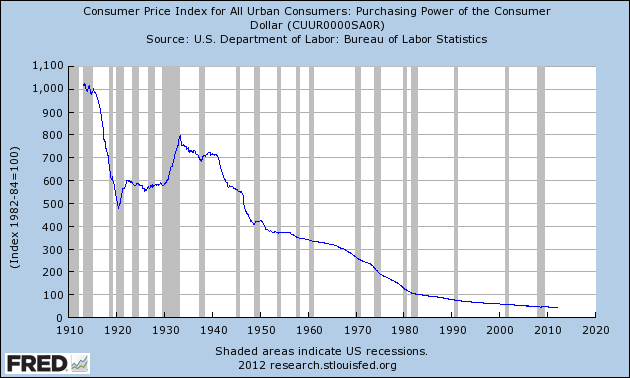
Federal Reserve policies have contributed to a dramatic decline in the purchasing power of the U.S. dollar for decades, resulting in a lower standard of living for Americans.  Expanded money printing will accelerate this trend.
3. Continued increase in the price of gold.
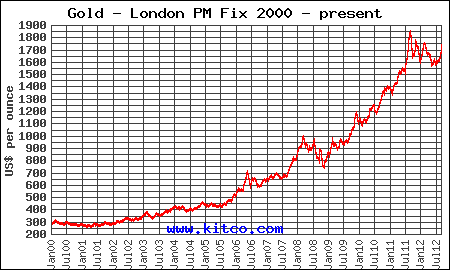
Courtesy: Kitco.com

The decade long rally in gold will dramatically accelerate.  A Barron’s interview asks Could Fed Miscalculations Lead to $10,000 Gold?

These are times that try an asset manager’s soul. The world’s economy is a soft-paste porcelain vase set on a wobbly plant stand in the heart of an active earthquake zone. The Middle East is sending out foreshocks of war. The South China Sea is a smoking caldera of tension. Social unrest in the EU threatens tidal waves. And, according to the agitated rats and snakes of the financial press, China is headed into a recession.

Hedging against the most pessimistic case without crippling the upside potential of a better or even miraculous case appears to be as unsolvable as the proverbial Gordian knot. Alexander the Great “solved” the intellectually challenging knot riddle by severing it with his sword. Scott Minerd, chief investment officer of Guggenheim Partners, offers a more reasoned but equally simple solution to the hedging conundrum: gold. In extreme circumstances—like miscalculations regarding inflation by the Federal Reserve—the metal could hit $10,000 per troy ounce, he asserts. Thursday, after the Fed disclosed its latest financial-stimulus scheme, the metal rose about 2% to $1,768.

Minerd frets about the Fed’s ability to reduce its swollen $2.9 trillion balance sheet if rates suddenly were to rise. Because the assets have longer-term durations, their market value immediately would tumble. If rates rose 1%, the Fed would have a $150 billion capital deficit, he says. This would have negative ramifications for the dollar. Minerd says the über-wealthy have been migrating toward hard assets like gold, real estate, and art. Every portfolio should be partially composed of such assets, he asserts. Is yours?

Gold and Silver Blog has long argued that gold would eventually advance to at least $5,000.  The latest Fed actions make that price target seem conservative.
Fed’s Open Ended Money Printing Will Destroy The Purchasing Power Of U.S. Dollar

By Axel Merk

May we suggest a Twitter version of today’s FOMC statement: “Don’t worry, be happy! ” – No, the economic outlook hasn’t improved. In fact, the Fed may want you to take a valium to stomach the ride ahead. Alternatively, if you don’t get mollified by the Fed’s “communication strategy”, you may want to consider taking action to protect the purchasing power of your hard earned dollars.

Here’s the challenge: the Federal Reserve (Fed) wants to keep interest rates low across the yield curve (from short-term to long-term rates) to aid the economic recovery. But good economic data might send the bond market into a tailspin, i.e. raise long-term rates and thus cause massive headwinds to the economic recovery. We got a taste of how quickly the bond market can sell off earlier this year when the economy appeared to pick up some steam. Higher interest rates would further encourage the major deleveraging that market forces still warrant, not a desirable scenario from our understanding of Fed Chairman Bernanke’s thinking.

Engaging in further rounds of asset purchases (“Quantitative Easing”, “QE3”, “QEn+1”) may alleviate some of those upward pressures on interest rates, but the moment a program is announced, the market prices it in and looks ahead, threatening to mitigate any lasting impact of QEn+1. Picture the Fed as trying to hold a carrot in front of the donkey, well, market, to make us believe another stimulus is coming, without actually giving it. That way, the Fed can print less money to achieve its goals. The Fed calls it communication strategy.

Some have suggested a more open-ended approach to asset purchases. But that would likely come with some sort of guidance as to when to stop it, such as when a certain level of unemployment or nominal growth is reached. Given that everything Bernanke has done has been signaled well ahead of time (the blogosphere is full of the “best kept secret”, the likelihood of more QE), introducing a completely new concept is rather un-Bernanke-ish. You may not agree with Bernanke, but as an investor please don’t act surprised.

In recently released FOMC minutes, the Fed tells us that it might communicate to the market that rates may remain low even as the economy recovers. Bingo! We have long argued that Bernanke considered the early monetary tightening during the Great Depression as a grave mistake, as it undid all the “progress” that had been achieved. But more to the point, the Fed needs to get our attention away from the economy. By keeping the link to the economy, the Fed will always struggle to keep the upper hand on the bond market. So forget about the carrot: we need valium, not carrots. By communicating with the market that rates will remain low independent of how the economy might perform, the bond market just might not be selling off as aggressively as economic growth picks up.

That’s exactly the path we believe the Fed is going to go down. It will be interesting, however, to see what the Fed’s explanation will be. We doubt they will use the valium analogy. Some Fed watchers would like to see a nominal GDP target or something similar, but don’t bet your donkey on Bernanke going that far.

The basic challenge is – and we are interpreting here as we don’t think the Fed or any central banker in office would ever frame it this way: the Fed wants to have inflation, wants to move the price level higher to bail out home owners, wants to push up nominal wages, and wants to push up nominal GDP to make the debt burden more bearable. But the Fed doesn’t want the market to price in inflation, as that would push interest rates up.

That’s why we may be heading ever more into the “Land of Make-Believe.” But as investors enjoy their valium, the U.S. dollar is at risk of melting away under their feet. Drugged up, we are too busy laughing at Greece and doling out advice to Europe to notice that our “don’t worry, be happy” approach might lead to rather unhappy purchasing power. If you think you are above the fray, let me just ask whether you have watched the euro in recent months? As of late, that perceived weakling of a currency appears to be giving the greenback a run for its money. We are not suggesting that investors dump their U.S. dollars and exchange them all for euros. However, we would like to encourage investors to consider embracing currency risk, for example through a managed basket of currencies, as a way to manage the risk posed to the purchasing power of the U.S. dollar. Adding currency exposure to a portfolio may have valuable diversification benefits.

Some sympathize with the ever greater complexity of monetary activism around the world. But it’s really rather simple: there’s too much debt in the world. To deal with the debt, countries may deflate, default or inflate. In the US, we have what both Bernanke and his predecessor Greenspan have called the printing press; as such, so their argument goes, the U.S. dollar is safe – in nominal terms at least. Greece is not capable of procuring valium, which creates a different set of challenges. But stop pitying Greece and consider taking action to protect your purchasing power at home.

Please sign up to our newsletter to be informed as we discuss global dynamics and their impact on gold and currencies. You can also engage with me directly at Twitter.com/AxelMerk where I provide real-time updates on the economy, currencies, and global dynamics..

Axel Merk
President and Chief Investment Officer, Merk Investments
Merk Investments, Manager of the Merk Funds

Why Gold Will Outperform Bonds

By Vin Maru

This past week was a major catalyst for the precious metals, as they closed the week up strongly based on strong fundamentals for the sector. We have been anticipating the next catalyst for the PM sector to start making a strong advance, and we got it with a coordinated effort from central banks around the world. They will print whatever is necessary to fight off deflation and another financial collapse. Here are a few headlines we saw from the media lately:

“Gold Prices Gain on German Ruling”, “ECB to launch ‘outright monetary transaction’ plan”, andIMF’s Lagarde backs ECB-bond buying plan”

This afternoon, the FOMC meeting concluded and was followed by a press conference by Ben Bernanke. The precious metals market has been on a strong uptrend over the last month in anticipation of additional bond buying and stimulus (AKA Quantitative Easing).  Over the last month, the fed has hinted that they will stimulate if needed but never actually pulled the trigger. Precious metals still rose in anticipation of coming QE.  Well, he finally did it and the metal prices are up on this news, below is some commentary on what the fed announced. See Reuters article about this QE.

This looks to be stimulus like the original QE 1 and 2 and this is super bullish for gold, like it was back in 2009 and 2010.  This starts off another major uptrend for gold and it will be going to $3500 over the next few years.  Now is the time to be getting invested again, it’s almost an all in moment on any pullback and then its onwards and upwards from here.  We can expect this QE to last indefinitely just like we can expect a low interest rate environment for an extended period of time.  It’s QE to infinity and gold will definitely shine.

ECB Bond Buying Program

With headlines like these, the world markets are proven to be irrational in their approach to dealing with debts; the central banks around the world will print and by up bonds as needed. The West may have saved themselves for the moment, but this really opens up the door for moral hazard and the mindset that debts don’t matter has been rationalized around the world. The Western central planners rationalize their action by stating the bond buying program will be sterilized. The hazard is that other central bankers around the world will also engage in sterilized bond buying and supporting of governments, all of which is backed by nothing except faith. They claim the bond buying is sterilized because the central banks print money to buy bonds of the governments to keep yields low and then make up new bonds to sell to other central banks and all of this financial alchemy is based on buying and selling of foreign currency bonds. To learn more about currency intervention and how the bonds could be sterilized, you can read about it here.

They claim the net effect is there is no increase in the monetary base, but any rational human can see this is pure manipulation and gaming the system. With no new monetary base, the money supply in the system does not increase and it is very similar to Operation Twist. The net effect of the new bond buying program is there will be no direct stimulus to the economy and the governments will continue to be supported by the central banks. The new bonds issued by the government will carry lower interest rates, which will then be supposedly paid back to the CBs over an extended period of time. The old government debt will be rolled over and extended from this bond buying program and only small amounts of additional interest will be paid on these new bonds, which tax payers will eventually have to pay one way or another. The governments will then have to accommodate the additional interest payments on the new debt which could eat into budgets, so they will either tax more or reduce some of their spending. The paper currency Ponzi scheme will be allowed to continue and coup d’état over the financial system has been accomplished by the central bankers. The idea is that bad loans and debts do not matter anymore in an attempt to keep the system afloat, eventually that will fail and precious metals will prosper as a result.

With keeping interest rates low, bonds have virtually no upside from here since interest rates can’t go much lower from here.  Savers will be forced to speculate in order to create yield and precious metals will benefit over the next few years from a negative yield interest rate environment.  Business with tons of cash on the sidelines will be forced put that money to work in search of economic returns and banks with tons of cheap cash on hand will be loaning out more money to qualified people and businesses. Deflation and collapse is no longer an option, the system will be supported and soon the market will be talking about expansion and growth again. Money will be put to work even though the western economies may stagnate over the next decade. The market will soon look beyond the Euro and US mess and move forward in search of yield.  It may continue looking at emerging markets for growth and opportunities, but it definitely look to precious metals for safety from the depreciation of paper currencies.

Once we start seeing this money turning over in the system, the velocity of money will increase significantly which will then lead to higher inflation, this is when we can expect gold to really shine.  While the upside for bonds will be limited in a low interest rate environment, the upside for gold is unlimited from endless printing of fiat currencies and bonds by all central bankers and governments around the world.  The upside for the price of bonds is limited to interest rates going to zero and they can be printed to infinity.  The amount of gold available in the world is fixed to current inventory plus expected additional supply.  Because supply is limited, gold’s price could go to infinity to equally match the unlimited printing of bonds and currency units which are used to purchase them. So in the end, bond prices are limited on the upside while supply is infinite, while gold supply is limited and it’s price is limitless in a world based on fiat currencies—which would you rather own?

Gold Update

In the last 2 weeks, gold has made a great break out move above $1620 and then $1660-$1680. The price is now holding strong above $1720 as central bankers are planning on bond buying programs and additional stimulus in a coordinated effort to avoid a deflationary spiral. This opens up the door to QE to infinity, they will print since there is no other option and precious metals will benefit from this. Gold and silver are going much higher in the years to come, but it won’t be in a straight line. Expect volatile moves to the upside and swift corrections, but the general trend for the next few years is towards higher prices. Keep with the trend and buy the dips and sell into major strength if you plan on trading the paper markets. If you purchased the physical metals during this past summer, you may want to consider holding on to them, we may not see these prices again, ever.

The RSI is rising and starting to move above 80, which could be getting into overbought territory, however the MACD is in a slow steady trend higher over the last couple of months. Look for new support to be around $1680 (which would be a good opportunity to add to positions) and short term overhead resistance to be at $1780-1800 (sell trading positions currently open) which has been overhead resistance back in November and February, at which time we could see a significant correction. If the gold market clears $1800 and holds on a closing weekly basis, we could retest the previous highs and go on to make new highs .

The HUI Gold Miners Index

The HUI clearly broke the downtrend line by gapping up above it late last week. The RSI is still rising and so is the MACD. If gold makes a move to $1800, expect the HUI to rise towards 500 before taking a break and correction. This would be a great time to sell open trading position in the next few weeks, especially after any news from the Fed about stimulus and QE. The fact that gold and the HUI has risen so much in the last month based on expectations for QE and the indicators are getting close to  overbought territory.  We may see an initial jump in price for the HUI index after any announcement, then a minor correction as much of this news could be priced into the metals and the miners.  Watch the reaction of the metals and the HUI later this week and next, but if the advance higher starts stalling out, you may want to consider closing trading positions and book some profits.

More than likely towards the end of this month/early next month, we could start to see a minor correction going into October and November as election approach, the market may take a breather. We may also see some strong year end selling this year, especially coming from the US as their tax laws on capital gains are scheduled to change next year. It would be a good time to start new positions or add to current holdings during that correction.  We can expect the trend to continue higher as the metals go on to make higher highs and higher lows over the next 6 to 9 months.

If you enjoyed reading this article and are interested in protecting your wealth with precious metals, you can receive our free blog by visiting TDV Golden Trader.

There Is “A Limited Amount of Gold, An Unlimited Amount of Paper Money”

Legendary bond king investor Bill Gross, who presides over the world’s largest bond funds makes a compelling case for owning gold in an interview with Bloomberg TV.  Lead manager of influential Pacific Investment Management Company (PIMCO) since 1987, Bill Gross reputedly made $200 million in 2011.
The PIMCO Total Return fund has produced a fat 9.5% return for investors over the past five years, trouncing the returns on the S&P 500 and the vast majority of competing bond funds.  Total funds managed by PIMCO total a staggering $1.8 trillion.

PIMCO’s success has in large part been due to Bill Gross’s ability to accurately assess the macroeconomic picture.  Bill Gross’s bullish position on gold is not something to be lightly discounted by investors.

According to Bill Gross, the bullish outlook for gold rests on the endless expansion of credit by central banks.  Gold has a considerable store of value that paper money does not and there is a “limited amount of gold, an unlimited amount of paper money.”

When world central banks engage in a long term period of money printing and start writing checks in the trillions, it is best to have something that’s tangible and can’t be reproduced like gold. Gross expects that central banks, which have trillions of dollars in reserves, will continue to expand their holdings of gold rather than invest in 10 year government bonds that pay a paltry 1% interest.

Gold and Debt – What Would Benjamin Franklin Have Said?

Benjamin Franklin, one of the most eloquent wordsmiths in American history, coined one of the most famous quotations of all time in a letter to Jean-Baptiste Leroy in 1789.
“Our new Constitution is now established, and has an appearance that promises permanency; but in this world nothing can be said to be certain, except death and taxes.”

Contemplating the nation’s growing indebtedness lead me to wonder what immortal phrase Ben Franklin would conjure up to describe the current state of our financial affairs.

Recently and without much public drama, the national debt ticked up by another trillion dollars.  Including off balance sheet liabilities for social security, medicare and a host of other government guarantees brings the true national debt figure up to around a cool $70 trillion.

The majority of the public is either unable to comprehend how much a trillion is or doesn’t much care.  One way or the other, however, the debt falls upon the backs of American families who are already being crushed by zero rates on savings, job losses, lower income and a higher cost of living.  Viewing the debt burden per household gives us a perspective on how bleak our economic future may become.

The official national debt per America’s approximately 118 million households is $136,000.  Throw in the off balance sheet liabilities and we get up to $593,000.  Consider that the median annual household income is only $49,445 and has been declining for the past 20 years.

Are things really as hopeless as they look?  Doesn’t the United States hold the world’s largest amount of gold reserves?   The good news first – yes the U.S. owns 8,133.5 metric tonnes of gold, more than twice as much as second place Germany with 3,395 metric tonnes.   The bad news is that at today’s undervalued gold price, total U.S. gold reserves are only worth $454 billion.  Gold reserves per American households amount to only $3,847, a fraction (0.65%) of total household debt.

Exactly how the Fed’s Frankenstein experiment in fiat money creation will end, nobody knows – but it won’t end well for most of us.  Right now, increases in both the value of gold and the amount of debt seem as certain as death and taxes.  I wonder how Ben Franklin would have phrased it?

Government Brazenly Confiscates 1933 Gold Double Eagles – Bury Your Gold Deep

Nothing seems to obsess the U.S. government more than gold.  Could this be due to the fact that gold represents an alternative currency to the failing U.S. dollar, despite the assertions of Fed Chairman Bernanke that “gold is not money?”
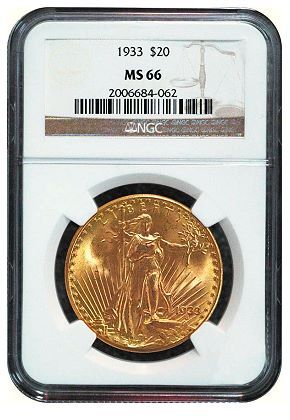
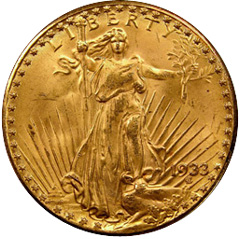
The case of the government’s effort to seize 10 1933 Double Eagle gold coins from the heirs of a private coin collector highlight the unlimited time, effort and expense the government is willing to expend in their war against gold.  The heirs of coin dealer Israel Swift discovered the Double Eagles in a safe deposit box.  After voluntarily showing them to the U.S. Treasury, the government promptly confiscated the coins, claiming that the coins had never been officially released by the U.S. Mint due to President Roosevelt’s executive order on April 5, 1933, ordering all private citizens to turn over their gold to the government.

An in depth article by Coin Week examines the case of the 1933 Double Eagles and details substantial evidence against the validity of the government’s right to confiscate the coins.  The article also wonders what implications this case will have on future seizures of rare coins from private citizens and comments on the government’s decades old zeal in pursuing the 1933 Double Eagles.

“It is unbelievable to me how much the government has spent on this,” exclaims Dr. Steven Duckor. “It is ludicrous for the government to be spending this much time, effort and money in the 1940s, from 1996 to 2002, and now in the Langbord case. The government should spend money on more important priorities,” in Duckor’s view. “It would be okay to make a deal like they did last time. I would not mind some type of deal.” Dr. Duckor is an expert in Saint Gaudens Double Eagles. Among living collectors who reveal their names, he is probably the most sophisticated and widely respected.

After the government seized the Double Eagles in 2004, the Swift family heirs sued the government for their return.  Last July, after the conclusion of a civil trial, a jury concluded that the government had the right to seize the coins.  The case remained on hold while a federal judge considered subsequent legal motions filed in the case.  On August 29th, the federal judge ruled that the gold coins “remain the property of the United States” and that “Given the evidence, a reasonable jury could find that the ’33 Double Eagles were knowingly stolen or embezzled from the Mint.”   What a shocker – a federal judge ruling in favor of the government!

The case of the Double Eagle seizure is not an isolated incident and the federal government has become increasingly brazen about suspending or ignoring rules of law to settle matters in its own favor.  In a Bloomberg interview, Professor David Skeel says blatant violations of long established law principles by the government is starting to have a profoundly negative impact on the nation’s economy.

Will government gold seizures and other actions that violate principles of law continue to escalate?   We don’t even want to think about how bad things will get.  GATA reports today that in an interview with King World News , Marc Faber fears that “gold will rise so fast that governments will feel compelled to try to confiscate it from investors.”

The very thought that gold investors need to live in fear of their own government is a chilling thought.  Bury your gold deep!

India’s Attempt To Curb Gold Purchases Will Ultimately Fail

India may increase the import tax on gold for the third time this year in an attempt to shore up the weak rupee.  Purchases of gold and silver account for a huge 12.5% of all Indian imports and are contributing to a record current-account deficit according to Bloomberg.
“The government may look at increasing the duty to 7.5 percent,” Prithviraj Kothari, president of the Bombay Bullion Association, said in a phone interview. D.S. Malik, a finance ministry spokesman in New Delhi, declined to comment.

The tax on bars and coins was doubled to 4 percent in March after imports jumped to a record 969 metric tons in 2011. A further increase may deter jewelry buyers and investors during India’s festival season, which starts this month, as a decline in the rupee against the dollar boosts domestic gold prices to an all-time high. Imports plunged 42 percent to 340 tons in the first half, according to the producer-funded World Gold Council.

Curbing shipments of gold will help the country to narrow the current-account deficit as the drop in rupee boosts the cost of crude-oil purchases, according to the finance ministry. The shortfall widened to a record 4.2 percent of the gross domestic product in the year ended March from 2.7 percent in 2010-2011.

The rise in the deficit, the broadest measure of trade, was due to slower exports and so-called relatively inelastic imports of petroleum products, gold and silver amid a rally in global prices, Finance Minister P. Chidambaram said on Aug. 23.

Will India’s attempt to restrict import of precious metals be successful and what impact will this have on the price of gold and silver?  Let’s consider the following:

1.  The Indian government should know better.  In 1962, India passed the Gold Control Act which prohibited Indian citizens from owning gold bars and coins.  The result was the instant creation of a huge black market that continued to supply gold and silver throughout India.

The (Gold Act) legislation killed the official gold market and a large unofficial market sprung up dealing in cash only. The gold was smuggled in and sold through the unofficial channel wherein, many jewelers and bullian traders traded in smuggled gold. A huge black market developed for gold.

In 1990, India had a major foreign exchange problems and was on verge of default on external liabilities. The Indian Govt. pledged 40 tons gold from their reserves with the Bank of England and saved the day. Subsequently, India embarked upon the path of economic liberalization. The era of licencing was gradually dissolved. The gold market also benefited because the government abolished the 1962 Gold Control Act in 1992 and liberalized the gold import into India on payment of a duty of Rs.250 per ten grams. The government thought it more prudent to allow free imports and earn the taxes rather than to lose it all to unofficial channel.

2.  India should be more concerned with maintaining a currency that offers their population a stable store of value rather than depriving their citizens of viable alternate currencies such as gold and silver.

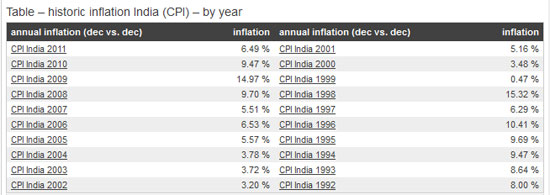
3.  The centuries old tradition in India of holding gold and silver as a source of liquidity and for capital preservation is unlikely to change.  The rupee, like most other paper currencies, has been systematically debased.  Inflation in India over the past decade has made holding rupees a losing proposition.

Courtesy: inflation.eu

4.  The reduction in gold demand during the first half of the year by both China and India has been widely touted in the mainstream press as a reason for a continued sell off in the precious metal markets.  Right.  Despite the reduction in gold demand by China and India, gold based out in the $1,600 range before rallying sharply to $1,697.   Gold is now $99 or 6.2%  higher than it was on the first trading day of 2012.

courtesy: stockcharts.com

5.  By attempting to restrict gold purchases, India has simply advertised the rupee’s intrinsic lack of value to their citizens which will ultimately create an even greater demand for gold and silver.

Ron Paul – “The World Will Abandon The Dollar As The Global Reserve Currency”

In August Ron Paul accused the U.S. Treasury “guilty of counterfeiting dollars” by virtue of its monopoly power on money in America.  Paul noted that the expanding role of the Federal Reserve in monetizing government debt has resulted in a massive debasement of the purchasing power of the U.S. dollar.
Continued reckless money printing by the Federal Reserve and massive government deficits will ultimately result in the loss of confidence by holders of  U.S. dollars.  Ron Paul sees the U.S. dollar inexorably losing its status as global reserve currency unless the dollar is backed by precious metals or commodities.

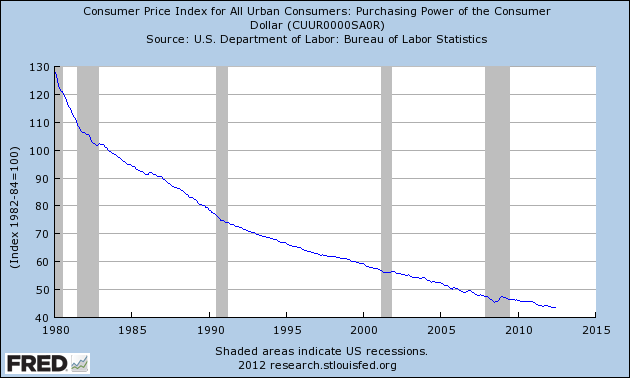
Evidence of the horrendous loss of purchasing power by the U.S. dollar is not hard to understand.  The average citizen sees it everyday as higher prices and lower incomes relentlessly lower our standard of living.   The systematic destruction of the U.S. dollar’s purchasing power can be seen in a chart published by the Federal Reserve Bank of St. Louis.

How Long Will the Dollar Remain the World’s Reserve Currency?

By: Congressman Ron Paul

We frequently hear the financial press refer to the U.S. dollar as the “world’s reserve currency,” implying that our dollar will always retain its value in an ever shifting world economy.  But this is a dangerous and mistaken assumption.

Since August 15, 1971, when President Nixon closed the gold window and refused to pay out any of our remaining 280 million ounces of gold, the U.S. dollar has operated as a pure fiat currency.  This means the dollar became an article of faith in the continued stability and might of the U.S. government.

In essence, we declared our insolvency in 1971.   Everyone recognized some other monetary system had to be devised in order to bring stability to the markets.

Amazingly, a new system was devised which allowed the U.S. to operate the printing presses for the world reserve currency with no restraints placed on it– not even a pretense of gold convertibility! Realizing the world was embarking on something new and mind-boggling, elite money managers, with especially strong support from U.S. authorities, struck an agreement with OPEC in the 1970s to price oil in U.S. dollars exclusively for all worldwide transactions. This gave the dollar a special place among world currencies and in essence backed the dollar with oil.

In return, the U.S. promised to protect the various oil-rich kingdoms in the Persian Gulf against threat of invasion or domestic coup. This arrangement helped ignite radical Islamic movements among those who resented our influence in the region. The arrangement also gave the dollar artificial strength, with tremendous financial benefits for the United States. It allowed us to export our monetary inflation by buying oil and other goods at a great discount as the dollar flourished.

In 2003, however, Iran began pricing its oil exports in Euro for Asian and European buyers.  The Iranian government also opened an oil bourse in 2008 on the island of Kish in the Persian Gulf for the express purpose of trading oil in Euro and other currencies. In 2009 Iran completely ceased any oil transactions in U.S. dollars.  These actions by the second largest OPEC oil producer pose a direct threat to the continued status of our dollar as the world’s reserve currency, a threat which partially explains our ongoing hostility toward Tehran.

While the erosion of our petrodollar agreement with OPEC certainly threatens the dollar’s status in the Middle East, an even larger threat resides in the Far East.  Our greatest benefactors for the last twenty years– Asian central banks– have lost their appetite for holding U.S. dollars.  China, Japan, and Asia in general have been happy to hold U.S. debt instruments in recent decades, but they will not prop up our spending habits forever.  Foreign central banks understand that American leaders do not have the discipline to maintain a stable currency.

If we act now to replace the fiat system with a stable dollar backed by precious metals or commodities, the dollar can regain its status as the safest store of value among all government currencies.  If not, the rest of the world will abandon the dollar as the global reserve currency.

Both Congress and American consumers will then find borrowing a dramatically more expensive proposition. Remember, our entire consumption economy is based on the willingness of foreigners to hold U.S. debt.  We face a reordering of the entire world economy if the federal government cannot print, borrow, and spend money at a rate that satisfies its endless appetite for deficit spending.

Gold and Silver Bullion Coin Sales Jump 25% In August, San Francisco Silver Eagle Set Sold Out

The latest sales figures from the U.S. Mint for August show a significant increase in sales of both gold and silver bullion coins.
Sales of gold bullion coins during 2012 have varied dramatically from month to month with a high of 127,000 ounces in January to a low of only 20,000 ounces in April.  Monthly gold bullion sales through August have averaged 51,625 ounces.

Monthly sales of silver bullion coins have been more consistent during 2012.  The U.S. Mint sold over 6 million ounces of silver bullion coins in January, but the monthly pace has tapered off to under 3 million ounces.  The average monthly sales of silver bullion coins through August is 2,817,500.

American Eagle Gold Bullion Coin Sales

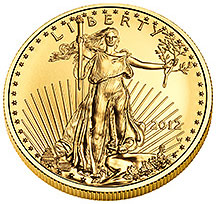
Total sales of the American Eagle Gold bullion coins during August totaled 39,000 ounces, up 27.9% from July’s total of 30,500 ounces.  Total sales of gold bullion coins by the U.S. Mint through August totaled 413,000 ounces, valued at approximately $700 million based on today’s closing gold price.

On an annualized basis, the U.S. Mint will sell almost 620,000 ounces of  gold bullion to investors this year valued at $1.0 billion if the price of gold remains at $1,692.  During 2009, the peak year of gold bullion coin sales by the U.S. Mint, investors purchased 1,435,000 ounces valued at $1.4 billion based on the average price of gold of $972 per ounce.

Investors who have reduced gold bullion purchases due to the increased cost per ounce will no doubt regret this decision as the price of gold continues to increase.  The value of gold should be viewed in the context of the reduced purchasing power of the dollar – as the Federal Reserve constantly destroys the purchasing power of the U.S. dollar, the “dollar cost” of gold will naturally increase.  The price of gold is merely reflecting the fact that paper dollars are worth less and less every day.

As the Fed continues to do what it does, expect the bull market in gold to continue.

Listed below are yearly sales figures for the American Eagle gold bullion coins since 2000.  Sales for 2012 are through August 31st.

Gold Bullion U.S. Mint Sales By Year
Year Total Sales Oz.
2000 164,500
2001 325,000
2002 315,000
2003 484,500
2004 536,000
2005 449,000
2006 261,000
2007 198,500
2008 860,500
2009 1,435,000
2010 1,220,500
2011 1,000,000
2012 413,000
Total 7,662,500

American Eagle Silver Bullion Coin Sales

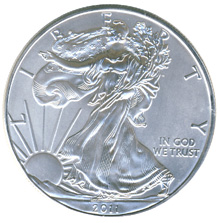
Sales of the American Eagle Silver bullion coins by the U.S. Mint during August totaled 2,870,000 ounces, up 25% from the July total of 2,278,000 ounces.  Investor demand for silver has remained strong, with many investors taking the opportunity to purchase additional silver below the highs reached during 2011.  Sales of the silver bullion coins remain near record levels and total sales for 2012 should be well in excess of 30 million ounces for the third consecutive year.

Total annual sales by the U.S. Mint of the silver bullion coins since 2000 are shown below.  Sales for 2012 are through August.

American Silver Eagle Bullion Coins
YEAR OUNCES SOLD
2000 9,133,000
2001 8,827,500
2002 10,475,500
2003 9,153,500
2004 9,617,000
2005 8,405,000
2006 10,021,000
2007 9,887,000
2008 19,583,500
2009 28,766,500
2010 34,662,500
2011 39,868,500
Jul-12 22,540,000
TOTAL 220,940,500

U.S. Mint Numismatic American Eagle Gold and Silver Coins

Both the American Eagle gold and silver bullion coins can only be purchased from the U.S. Mint by Authorized Purchasers who in turn resell the coins to other dealers and the general public.  The numismatic versions of the American Eagle series coins can be purchased directly from the U.S. Mint.

Many of the numismatic silver coins produced by the U.S. Mint attract strong demand and often times, the coins will sell at a premium in the secondary market.  A recent example of this is the 2012 San Francisco Silver Eagle Set.  According to the Mint News Blog:

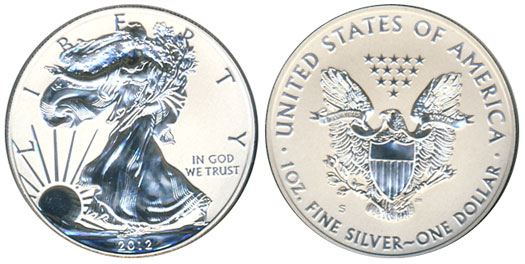
The 2012 San Francisco Silver Eagle Set was one of the United States Mint’s most anticipated product releases of the year. Each set contained one 2012-S Proof Silver Eagle and one 2012-S Reverse Proof Silver Eagle.

Product sales began on June 7, 2012 at 12:00 Noon ET with pricing of $149.95 per set. Rather than establishing a maximum product limit, as had been done for similar products in the past, the US Mint would accept orders during a four week ordering window and produce the sets to meet the total demand. A sales odometer which was updated daily gave collectors an indication of the progress of the offering. Sales officially closed on July 5, 2012 at 5:00 PM ET. The last indicated sales total was 251,302 sets.

On the secondary market, prices for the sets remain above the issue price. A quick survey of eBay auctions completed within the past few days show the prices realized for raw sets mostly falling into a range of $180 to $190, compared to the issue price of $149.95.

Sets which have been graded by PCGS or NGC and received the top grade of Proof-70 have sold for premiums above raw sets. Sets with the two coins graded PCGS PR70DCAM and PR70 have recently sold for prices around $425 to $450. Sets with the two coins graded NGC PF 70 Ultra Cameo and PF 70 have sold for prices around $300 to $325.

Fed’s Easy Money Policies Will Continue – Why Bernanke Must Err On The Side Of Inflation

By Axel Merk

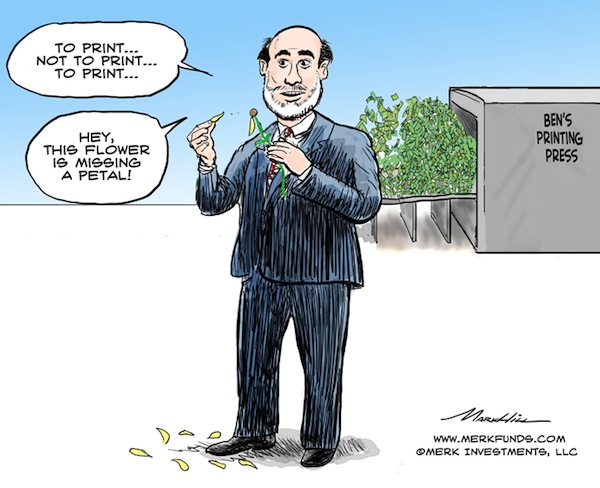
To print or not to print? Odds are that Fed Chairman Bernanke has been contemplating this question while drafting his upcoming Jackson Hole speech. The one good thing about policy makers worldwide is that they may be fairly predictable. As such, we present our crystal ball as to what the Fed might be up to next, and what the implications may be for the U.S. dollar and gold.

First off, we may be exaggerating: on process rather than substance, though. That is, Bernanke isn’t just thinking about whether to print or not to print as he is sitting down to draft his speech. Instead, he considers himself a student of the Great Depression and has been pondering policy responses to a credit bust for some time. Consider the following:

  • Bernanke has argued that going off the gold standard during the Great Depression helped the U.S. recover faster from the Great Depression than countries that held on to the gold standard for longer.
    • Bernanke is correct: subject to many risks, debasing a currency (which going off the gold standard was) can boost nominal growth. Think of it this way: if the government takes your purchasing power away, you have a greater incentive to work. Not exactly the mandate of a central bank, though.
    • Note by the way that by implication, countries that hold on to the gold standard invite a lot of pain, but have stronger currencies. Fast forward to today and compare the U.S. to Europe. While neither country is on the gold standard, the Federal Reserve’s balance sheet has increased more in percentage terms than that of the European Central Bank since the onset of the financial crisis. Using a central bank’s balance sheet as a proxy for the amount of money that has been “printed”, it shouldn’t be all that surprising that the Eurozone experiences substantial pain, but the Euro has been comparatively resilient.
    • Possibly the most important implication: Bernanke considers the value of the U.S. dollar a monetary policy tool. When we have argued in the past that Bernanke might be actively working to weaken the U.S. dollar, it is because of comments such as this one. This is obviously our interpretation of his comments; a central banker rarely says that their currency is too strong, although such comments have increasingly been made by central bankers around the world as those pursuing sounder monetary policy have their economies suffer from competitive devaluations elsewhere.
  • Bernanke has argued that one of the biggest mistakes during the Great Depression was that monetary policy was tightened too early. Here’s the problem: in a credit bust, central banks try to stem against the flow. If market forces were to play out, the washout would be severe and swift. Those in favor of central bank intervention argue that it would be too painful and that more businesses than needed would fail, the hardship imposed on the people is too much. Those against central bank intervention point out that creative destruction is what makes capitalism work; the faster the adjustment is, even if extremely painful, the better, as the recovery is healthier and stronger.
    • If the policy choice is to react to a credit bust with accommodative monetary policy, fighting market forces, and then such accommodation is removed too early, the “progress” achieved may be rapidly undone.
    • We are faced with the same challenge today: if monetary accommodation were removed at this stage (interest rates raised, liquidity mopped up), there’s a risk that the economy plunges right back down into recession, if not a deflationary spiral. As such, when Bernanke claimed the Fed could raise rates in 15 minutes, we think it is a mere theoretical possibility. In fact, we believe that the framework in which the Fed is thinking, it must err on the side of inflation.

Of course no central banker in office would likely ever agree with the assessment that the Fed might want to err on the side of inflation. But consider the most recent FOMC minutes that read:

  • An extension [of a commitment to keep interest rates low] might be particularly effective if done in conjunction with a statement indicating that a highly accommodative stance of monetary policy was likely to be maintained even as the recovery progressed

As the FOMC minutes were released three weeks after the FOMC meeting, many pundits dismissed them as “stale”; after all, the economy had somewhat improved since the meeting. Indeed, it wasn’t just pundits: some more hawkish Fed officials promoted that view as well. But to make clear who is calling the shots, Bernanke wrote in a letter dated August 22 (the same date the FOMC minutes were released) to California Republican Darrell Issa, the chairman of the House Oversight and Government Reform Committee: “There is scope for further action by the Federal Reserve to ease financial conditions and strengthen the recovery.” Various news organizations credited the faltering of an incipient U.S. dollar rally on August 24 with the publication of this Bernanke letter.

For good order’s sake, we should clarify that the Fed doesn’t actually print money. Indeed, printing physical currency is not considered very effective; instead, liquidity is injected into the banking system: the Fed increases the credit balances of financial institutions in accounts held with the Fed in return for buying securities from them. Because of fractional reserve banking rules, the ‘liquidity’ provided through this action can lead to a high multiple in loans. In practice, one of the frustrations of the Fed has been that loan growth has not been boosted as much as the Fed would have hoped. When we, and Bernanke himself for that matter, have referred to the Fed’s “printing press” in this context, referring to money that has been “printed”, it’s the growth in the balance sheet at the Federal Reserve. That’s because the Fed’s resources are not constrained; it’s simply an accounting entry to pay for a security purchased; that security is now on the Fed’s balance sheet, hence the ‘growth’ in the Fed’s balance sheet.

Frankly, we are not too concerned about the environment we are in. At least not as concerned as we are about the environment we might be in down the road: that’s because we simply don’t see how all the liquidity can be mopped up in a timely manner when needed. At some point, some of this money is going to ‘stick’. Even if Bernanke wanted to, we very much doubt he could raise rates in 15 minutes. To us, it means the time for investors to act may be now. However, talking with both existing and former Fed officials, they don’t seem terribly concerned about this risk. Then again Fed officials have rarely been accused of being too far sighted. We are concerned because just a little bit of tightening has a much bigger effect in an economy that is highly leveraged. Importantly, we don’t need the Fed to tighten: as the sharp selloff in the bond market earlier this year (and the recent more benign selloff) have shown, as soon as the market prices in a recovery, headwinds to economic activity increase as bond yields are rising. That’s why Bernanke emphasizes “communication strategy”, amongst others, to tell investors not to worry, rates will stay low for an extended period. This dance might get ever more challenging.

In some ways, Bernanke is an open book. In his ‘helicopter Ben’ speech a decade ago, he laid out the tools he would employ when faced with a collapse in aggregate demand (the credit bust we have had). He has deployed just about all tools from his toolbox, except for the purchase of foreign government bonds; recently, he shed cold water on that politically dicey option. Then two years ago, in Jackson Hole, Bernanke provided an update, specifying three options:

  • To expand the Fed’s holdings of longer-term securities
  • To ease financial conditions through communications
  • To lower the interest rate the Fed pays on bank reserves to possibly 10 basis points or zero.

We have not seen the third option implemented, but the Fed might be discouraged from the experience at the European Central Bank: cutting rates too close to zero might discourage intra-bank lending and cause havoc in the money markets.

As such, expect Bernanke to give an update on his toolbox in Jackson Hole. The stakes are high as even doves at the Fed believe further easing might not be all that effective and could possibly cause more side effects (read: inflation). As such, we expect him to provide a framework as to why and how the Fed might be acting, and why we should trust the Fed that it won’t allow inflation to become a problem. For investors that aren’t quite as confident that the Fed can pull things off without inducing inflation, they may want to consider adding gold or a managed basket of currencies to mitigate the risk to the purchasing power of the U.S. dollar.

Please sign up to our newsletter to be informed as we discuss global dynamics and their impact on gold and currencies. Please also follow me on Twitter to receive real-time updates on the economy, currencies, and global dynamics.

Axel Merk
President and Chief Investment Officer, Merk Investments
Merk Investments, Manager of the Merk Funds