April 10, 2026

The Fed’s Outrageous Attempt To Debase The Dollar Will Send Gold Soaring

By Axel Merk

Doubling down on QE3, the Federal Reserve (Fed) Chairman Bernanke tells China and Brazil: allow your currencies to appreciate. One does not need to be a rocket scientist to conclude that Bernanke wants the U.S. dollar to fall. Is it merely a war of words, or an actual war? Who is winning the war?

The cheapest Fed policy is one where a Fed official utters a few words and the markets move. Rate cuts are more expensive; even more so are emergency rate cuts and the printing of billions, then trillions of dollars. As such, the Fed’s communication strategy may be considered part of a war of words. Indeed, the commitment to keep interest rates low through mid 2015 may be part of that category. But quantitative easing goes beyond words: QE3, as it was announced last month, is the Fed’s third round of quantitative easing, a program in which the Fed is engaging in an open-ended program to purchase Mortgage Backed Securities (MBS). To pay for such purchases, money is created through the strokes of a keyboard: the Fed credits banks with “cash” in payment for MBS, replacing MBS on bank balance sheets with Fed checking accounts. Through the rules of fractional reserve banking, this cash can be multiplied on to create new loans and expand the broader money supply. The money used for the QE purchases is created out of thin air, not literally printed, although even Bernanke has referred to this process as printing money to illustrate the mechanics.

Why call it a war? It was Brazil’s finance minister Guido Mantega that first coined the term, accusing Bernanke of starting a currency war. Here’s the issue: like any other asset, currencies are valued based on supply and demand. When money is printed, all else equal, supply increases, causing a currency to decline in value. In real life, the only constant is change, allowing policy makers to come up with complex explanations as to why printing money does not equate to debasing a currency. But even if intentions may have a different primary focus, our assessment is that a central bank that engages in quantitative easing wants to weaken its currency. It becomes a war because someone’s weak currency is someone else’s strong currency, with the “winner” being the country with the weaker currency. The logic being a weaker currency promotes net exports and GDP growth. If the dollar is debased through expansionary monetary policy, there is upward pressure on other currencies. Those other countries like to export to the U.S. and feel squeezed by U.S. monetary policy. Given that politicians the world over never like to blame themselves for any shortcomings, the focus of international policy makers quickly becomes the Fed’s monetary largesse.

Bernanke speaking at an IMF sponsored seminar in Tokyo pointed to the other side of the coin: if China, Brazil and others don’t like his policies because they create inflation back home, they should allow their currencies to appreciate. But these countries are reluctant as stronger currencies lead to a tougher export environment.

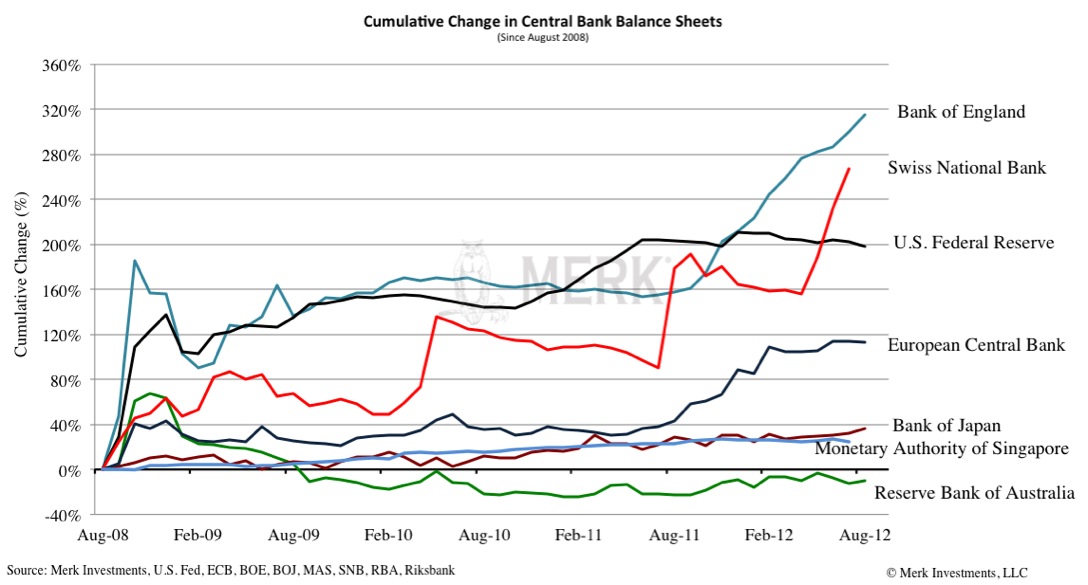
Now keep in mind that it is always easier to debase a currency than to strengthen it. Switzerland, the previously perceived safe haven by many investors, has taken the lead. Using a central bank’s balance sheet as a proxy for the amount of money that has been printed, the Swiss National Bank’s printing press has surpassed that of the Federal Reserve considering relative growth since August 2008. Again note that no real money has been directly printed in these programs; also note that some activities, such as the sterilization of bond purchases by the European Central Bank, cause a central bank balance sheet to grow, even if sterilization reflects a “mopping up” of liquidity:
Japan has warned about intervening in the markets on multiple occasions, but the size of the Japanese economy as well as the lack of political will make an intentional debasement more difficult. Indeed, the Japanese did their money printing in the 1990s, but forgot we had a financial crisis in recent years.

Bernanke does acknowledge the concerns of emerging markets, but argues they are blown out of proportion. He elaborates that undervaluation and unwanted capital inflows are linked: allow your currencies to appreciate (versus the dollar) and you won’t have to be afraid of excessive capital inflows, inflation and asset bubbles. Ultimately, and importantly, Bernanke says the Fed will continue its course, suggesting that it will strengthen the U.S. economic recovery; and by extension, strengthen the global economy.

Let’s look at the issue from the viewpoint of emerging markets: policy makers like to promote economic growth, among other methods, through a cheap exchange rate, up to a certain point. They don’t want too much inflation or too many side effects. Historically, they manage these side effects with administrative tools. However, taking China as an example, taming price pressure through, say, price controls, has not been very effective. We believe that’s a good thing, as China would otherwise experience product shortages akin to what the Soviet Union experienced. Conversely, however, China must employ a broader policy brush to contain inflationary pressures. We believe – and Bernanke appears to agree – currency appreciation is one of the more effective tools.

So how will this currency war unfold? The ultimate winner may well be gold. But as the chart above shows, it’s not simply a race to the bottom. If one considers what type of economy can stomach a stronger currency, our analysis shows an economy competing on value rather than price has more pricing power and therefore the greater ability to handle it. Vietnam mostly competes on price; as such, the country has, more than once, engaged in competitive devaluation. At the other end of the spectrum in emerging markets may be China: having allowed its low-end industries to move to lower cost countries, China increasingly competes on value. Within Asia, we believe the more advanced economies have the best potential to allow their currencies to appreciate. It’s not surprising to us that China’s Renminbi just recently reached a 19-year high versus the dollar.

What we have little sympathy for is an advanced economy, e.g. the U.S., competing on price. We very much doubt the day will come when we export sneakers to Vietnam. As such, a weak dollar only provides the illusion of strength with exports temporarily boosted. Yet the potential side effects, from inflation to the sale of assets to foreign investors with strong currencies, may not be worth the risk.

Please register to join us as we discuss winners and losers of the unfolding currency wars in our Webinar this Thursday, October 18, 2012.

Axel Merk is President and Chief Investment Officer, Merk Investments
Merk Investments, Manager of the Merk Funds.

Gold As An Investment Will Continue To Shine

Despite the non stop rally in the price of gold for over a decade, every normal pullback has been proclaimed as “the end of the gold bull market” by the mainstream media.  Will gold eventually become an over-owned and overpriced asset?  Yes – but that day will not arrive until gold is many thousands of dollars higher.   Long term gold investors who have stayed with the primary trend have already outperformed every other asset class over the past decade as shown in this neat infographic from the Visual Capitalist.

visualcapitalist.com

Is Gold The Only Protection From The Fed’s Monetary Madness?

By Axel Merk

Investors are concerned about inflation. But how can investors attempt to inflation-proof their portfolios? Buy TIPS? Short Treasury bonds? Stocks? Real Estate? Commodities? Gold? Currencies? Or should investors regard those warnings about inflation as fear mongering?

Indeed, as the Federal Reserve (Fed) announced its latest round of quantitative easing (“QE3”), gauges of future inflation expectations spiked. In our assessment, the market reacted strongly as it became apparent that the Fed is moving away from its focus on inflation to a focus on employment. We believe the Fed wants to raise the price level so as to bail out millions of homeowners that are ‘under water’, i.e. owe more on their homes than they are worth. Fed Chair Bernanke considers a healthy housing market to be key to healthy consumer spending (see our Merk Insight Don’t worry, be Happy).

Judging from the market reaction to QE3, fears about future inflation are warranted. Having said that, market fears about looming inflation have calmed down a bit since the initial flare up. Could it be this calming of the market is due to the fact that the Fed is intervening in the TIPS market? TIPS are “inflation protected” Treasury securities that are linked to the Consumer Price Index. Investors buying TIPS do so in the hope that their purchasing power might be protected. When the Fed intervenes in the market to buy TIPS (or any other security for that matter), such securities are intentionally over-priced, raising doubt as to whether investors are truly “protected” from inflation. It’s not just investors that now have more limited access to measuring inflation expectations – it’s also the Fed itself. By managing the entire yield curve (short-term through long-term interest rates), we believe the Fed has blindfolded itself, as it has taken away one of the most important gauges about the health of the economy. Aside from the Fed’s intervention in the TIPS market, the government is free to change the inflation adjustment factor employed in TIPS before the securities mature. TIPS payouts are adjusted using the consumer price index (CPI), which has seen methodology changes many times. When the recent debt ceiling impasse was discussed, both Republicans and Democrats talked in favor of changing the CPI definition so that it would nominally live up to inflation linked entitlement promises while clearly eroding the purchasing power of such payouts. Even without such gimmickry, the CPI may not be reflective of the basket of goods and services consumed by investors as they approach retirement given, for example, that healthcare may comprise an ever-increasing part of one’s spending. Alas, much of investing is about trying to preserve purchasing power and, alas, buying TIPS may not provide adequate protection.

If one is negative about the inflation outlook, why not simply short Treasuries, either directly or through ETFs? While we are pessimistic about the long-term outlook of Treasuries, it can be very costly to short them, given that – as a short seller – one has to continuously pay the interest of the securities one shorts. If one buys an ETF shorting Treasuries, the cost of the ETF is to be added. Shorting Treasuries might make sense for investors that are good at market timing. However, calling the top in major bubbles is rather difficult, just reflect on former Fed Chair Alan Greenspan’s “irrational exuberance” speech years ahead of the stock market collapse in 2000; similarly, those that saw the bubble in the housing market coming didn’t necessarily get the timing right.

If TIPS don’t provide enough bang for the buck, and shorting Treasuries can be costly, what about buying stocks? Bernanke appears to use every opportunity possible to praise the benefits QE has on rising stock prices. While we agree that QE has pushed stock prices higher, it may be dangerous for the Fed to praise this link given that it raises expectations of more Fed easing whenever the markets plunge (see Merk Insight: Bernanke Put). For example, how many investors buy Cisco 1 shares because of the great management skills of CEO John Chambers as compared to those who buy because of QE3? We pose this question because stocks are rather volatile; not only are stocks volatile, but the volatility of stocks can be all over the place. Historically, the annualized standard deviation of the S&P 500 index hovers in the mid 20% range, with outbursts into the 40% range in 2008. So why are investors taking on the “noise” of the stock market, when the reason they invest is because of QE? Indeed, our analysis shows that investors appear to be ever more chasing the next perceived intervention by policy makers rather than investing based on fundamentals. That’s not only bad for capital formation (these misallocations are summarily referred to as “bubbles” these days), but also suggests that we might want to look for a more direct way to take a position on what we call the “mania” of policy makers.

Talking about policy makers: you might not agree with them, but if there is one good thing to be said about our policy makers, it is that they may be quite predictable.

What about real estate? In the U.S., depending on where one lives, the real estate market has bottomed out or appears to be bottoming out. With what appears to be the Fed’s razor sharp focus on real estate, it might be foolish to bet against the Fed. Indeed, yours truly bought a property in Palo Alto in late 2009. Unlike other real assets, keep in mind that real estate is often purchased with borrowed money; as such, it is prone to speculative bubbles such as the most recent episode. Investing in REITs might allow one to allocate a smaller share of one’s portfolio to real estate; a downside of REITs is that they tend to be highly correlated with equity markets. As policy makers steer equity prices, everything appears to be ever more highly correlated, investors may want to look for something that offers low correlation to other investments.

That brings us to commodities. In a world where policy makers appear to favor growth at just about any cost, commodity prices have been beneficiaries. As we have seen in recent weeks, it is not a one-way street, as dynamics within the market can be rather complex. The dynamics for commodities within agriculture differ from those in metals or energy. There are special considerations in storing and delivering many commodities, creating challenges for investors. We agree that commodities might do well in the long run, but urge investors to consider all the risks that come with investing in commodities. Notably, commodities can have stretches of low volatility, luring investors to jump in, only to be greeted with a jolt that can be rather hazardous to one’s wealth. As a simple rule of thumb: if you can’t sleep at night with your investment, you own too much of it.

Gold is worth singling out as the one commodity that has arguably the least industrial use. Rather than writing gold off as a barbaric relic, we like gold: its relative simplicity might make it the investment purest in reflecting monetary policy. In the medium term, we believe gold may be a good inflation hedge. But, again, keep in mind that price movements can be rather volatile. Even staunch gold bugs rarely have all their assets in gold.

This leads us to currencies as a potentially attractive way to diversify beyond gold. The Chinese have long diversified their reserves to a basket of currencies, in an effort to mitigate their U.S. dollar exposure. Some say currencies are difficult to understand. We argue that it is far easier to understand the dynamics of ten major currencies, as well as others worth monitoring, than to understand the dynamics of thousands of stocks. Importantly, we believe the currency markets might be an ideal place to take a position on the mania of policy makers. Indeed, as we believe that the Fed might want to debase the U.S. dollar (Please see Fed may want to debase dollar), why not express that view in the currency markets? Unlike their reputation, currencies are far less volatile than equities: if one does not employ leverage, a move in the euro by 1 cent is rather small on a percentage basis. The U.S. dollar index has historically had an annualized standard deviation of returns in the low teens; in 2008, that volatility rose a tad, approaching the mid-teens. For investors looking for predictability on the risks in a portfolio, the currency markets have historically shown a far more consistent risk profile than equities or many other asset classes. A corollary is that during market downturns, unlevered currency strategies may offer some downside protection given the lower risk profile. This clearly doesn’t mean an investment in currencies is safe; but managed currency risk can be seen as an opportunity given the purchasing power risk taken by holding U.S. dollars.

If investors agree that the Fed: a) may want to have – or at least accept – higher inflation; and b) may not readily see the warning signs of higher inflation, then it appears to us prudent to take the risk of higher inflation into account. Indeed, for those managing money on behalf of others, it might be their fiduciary duty to take that risk into account. Those that ignore the risk of inflation might do so at their own peril. Many investors might feel they can take action once inflation is obvious. “Obvious” is in the eye of the beholder: just as we preferred to be early in warning about the crisis in 2008, it appeared rather challenging to reposition one’s portfolio in October 2008. Gold has gone up by a factor of about 7 since its lows. The dollar has fallen relative to a basket of currencies over the past 10, 30 and 100 years: in our assessment, we simply have the better printing press. Hedging inflation risk isn’t about being right about the future; it’s about the risk of being right.

Axel Merk
Axel Merk is President and Chief Investment Officer, Merk Investments
Merk Investments, Manager of the Merk Funds

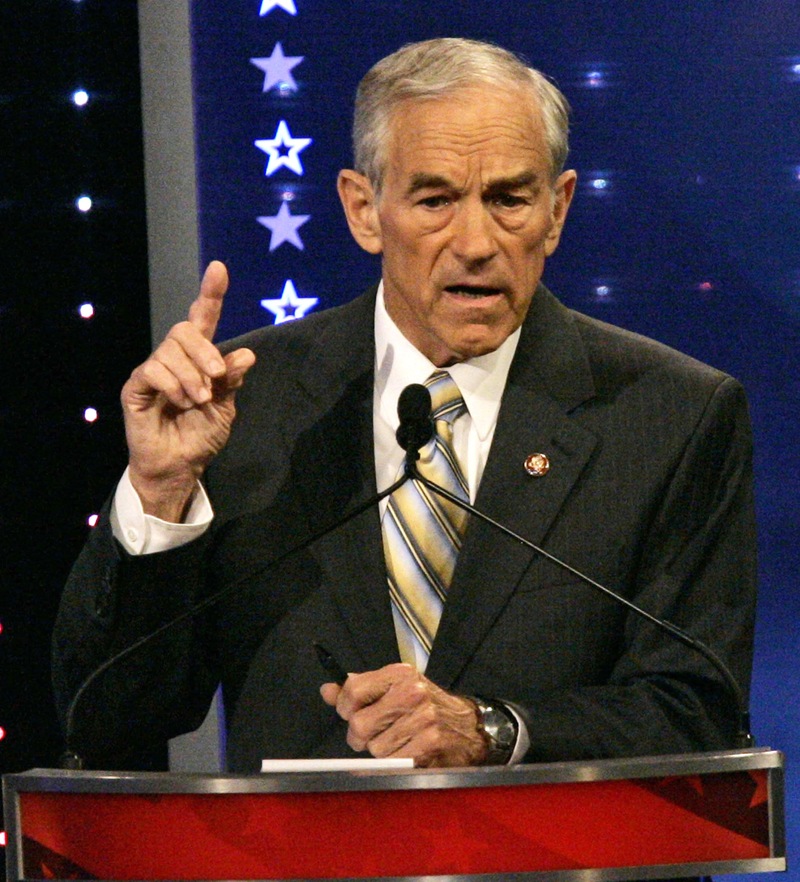
Ron Paul Accuses The Federal Reserve of Devastating America

While Wall Street cheers the Federal Reserve’s decision to engage in perpetual quantitative easing, Congressman Ron Paul says the Fed is devastating the U.S. economy through its blatant manipulation of interest rates.  According to Ron Paul, manipulating interest rates to the zero bound level has caused a massive misallocation of capital, destroyed the purchasing power of the U.S. dollar and will eventually lead to another financial crisis.
Ron Paul’s warnings have been routinely dismissed by both Wall Street and his colleagues in Congress.  The majority of the American public know that something is seriously wrong with our financial system but can’t quite connect the dots between the Fed and lower wages and higher prices.  Those who do understand how the Fed is destroying the U.S. economy and are worried about preserving their wealth, should simply copy the investment strategy of Ron Paul who has gone all in on gold and silver.

By Ron Paul

One of the most enduring myths in the United States is that this country has a free market, when in reality, the market is merely the structural shell of formerly free institutions. Government pulls the strings behind the scenes. No better illustration of this can be found than in the Federal Reserve’s manipulation of interest rates.

The Fed has interfered with the proper function of interest rates for decades, but perhaps never as boldly as it has in the past few years through its policies of quantitative easing. In Chairman Bernanke’s most recent press conference he stated that the Fed wishes not only to drive down rates on Treasury debt, but also rates on mortgages, corporate bonds, and other important interest rates. Markets greeted this statement enthusiastically, as this means trillions more newly-created dollars flowing directly to Wall Street.

Because the interest rate is the price of money, manipulation of interest rates has the same effect in the market for loanable funds as price controls have in markets for goods and services. Since demand for funds has increased, but the supply is not being increased, the only way to match the shortfall is to continue to create new credit. But this process cannot continue indefinitely. At some point the capital projects funded by the new credit are completed. Houses must be sold, mines must begin to produce ore, factories must begin to operate and produce consumer goods.

But because consumption patterns have either remained unchanged or have become more present-oriented, by the time these new capital projects are finished and begin to produce, the producers find no market for their goods. Because the coordination between savings and consumption was severed through the artificial lowering of the interest rate, both savers and borrowers have been signaled into unsustainable patterns of economic activity. Resources that would have been used in productive endeavors under a regime of market-determined interest rates are instead shuttled into endeavors that only after the fact are determined to be unprofitable. In order to return to a functioning economy, those resources which have been malinvested need to be liquidated and shifted into sectors in which they can be put to productive use.

Another effect of the injections of credit into the system is that prices rise. More money chasing the same amount of goods results in a rise in prices. Wall Street and the banking system gain the use of the new credit before prices rise. Main Street, however, sees the prices rise before they are able to take advantage of the newly-created credit. The purchasing power of the dollar is eroded and the standard of living of the American people drops.

We live today not in a free market economic system but in a “mixed economy”, marked by an uneasy mixture of corporatism; vestiges of free market capitalism; and outright central planning in some sectors. Each infusion of credit by the Fed distorts the structure of the economy, damages the important role that interest rates play in the market, and erodes the purchasing power of the dollar. Fed policymakers view themselves as wise gurus managing the economy, yet every action they take results in economic distortion and devastation.

Unless Congress gets serious about reining in the Federal Reserve and putting an end to its manipulation, the economic distortions the Fed has caused will not be liquidated; they will become more entrenched, keeping true economic recovery out of our grasp and sowing the seeds for future crisis.

Gold Bullion Coin Sales Soar 76% In September, Silver Sales Up 13%

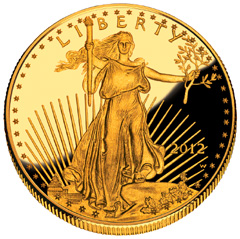
According to the latest report from the U.S. Mint, demand for both gold and silver bullion coins during September surged to the highest levels since January.
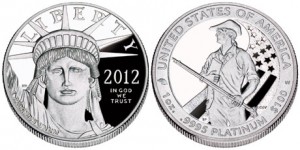
Total sales of the American Eagle Gold bullion coins during September soared 75.6% to 68,500 ounces from 39,000 ounces in August.  Monthly sales of gold bullion coins have fluctuated widely during 2012 with a high of 127,000 ounces in January and a low of 20,000 ounces in April.   The average monthly sales of gold bullion coins through September is 53,500.

Total sales of the American Eagle Gold bullion coins through September total 481,500 ounces.   Unless sales surge dramatically during the last three months of the year, 2012 will be the fourth year of declining sales of the gold bullion coin.   As detailed below, the all time record for sales of the gold bullion coins was during 2009 when sales exceeded 1.4 million ounces.

Gold Bullion U.S. Mint Sales By Year
Year Total Sales Oz.
2000 164,500
2001 325,000
2002 315,000
2003 484,500
2004 536,000
2005 449,000
2006 261,000
2007 198,500
2008 860,500
2009 1,435,000
2010 1,220,500
2011 1,000,000
Sept-12 481,500
Total 7,731,000

U.S. Mint sales of the American Eagle Silver bullion coins during September totaled 3,255,000 ounces, up 13.4% from August sales of 2,870,000 ounces.

Investor demand for the American Eagle Silver bullion coins has been relatively consistent throughout the year.  After a very strong January during which over 6.1 million coins were sold, demand remained strong with monthly sales well in excess of 2 million ounces except for February when sales slumped to 1,490,000 ounces.  If monthly sales of the American Eagle silver coins continue at the September sales pace, total sales for 2012 will be close to the record year of 2011 when almost 40 million ounces were sold.

Total annual sales by the U.S. Mint of the silver bullion coins since 2000 are shown below.  Sales for 2012 are through September.

American Silver Eagle Bullion Coins
YEAR OUNCES SOLD
2000 9,133,000
2001 8,827,500
2002 10,475,500
2003 9,153,500
2004 9,617,000
2005 8,405,000
2006 10,021,000
2007 9,887,000
2008 19,583,500
2009 28,766,500
2010 34,662,500
2011 39,868,500
Sept-12 25,795,000
TOTAL 224,195,500

The American Eagle gold and silver bullion coins produced by the U.S. Mint can only be purchased by Authorized Purchasers who in turn resell the coins to other dealers and the general public.  Numismatic versions (uncirculated or proof) of the American Eagle series coins can be purchased by the public directly from the U.S. Mint.

Platinum Has Soared 17% Since Early August – What Now?

Since establishing multiple chart bottoms at $1,400 during June and July, platinum has soared along with other precious metals.  Based on the London Fix Price, platinum has soared 16.5% from a low of $1,390 on August 3, 2012 to a September 20 closing price of $1,620.
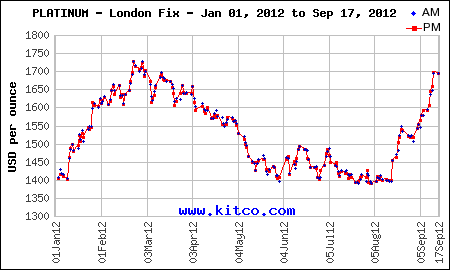
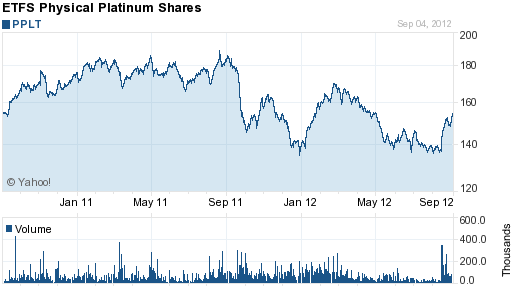
In early August, Gold and Silver Blog examined the ostensibly poor fundamentals which had driven down the price of platinum and concluded that, based on the widely held bearish consensus and chart action, platinum had already fully discounted all bearish news.  In addition, the gold to platinum ratio had reached a low not seen since 1985, another signal that platinum was undervalued.  (See Platinum Perspectives – Time To Buy or Will The Bears Win?)

Courtesy: Kitco.com

Despite the recent normal consolidation in platinum, prices are likely to move substantially higher over time along with the rest of the precious metals complex.

As noted in early August, Platinum can be purchased from the U.S. Mint in the form of Proof Platinum Eagles.

The U.S. Mint has been producing the Proof American Platinum Eagle since 2009.  According to MintNewsBlog, the entire 2009 production of 8,000 Proof Platinum Eagles sold out in a week.  During 2010, the U.S. Mint produced 10,000 Proof Platinum coins which also quickly sold out.  During 2011, the mintage was set at 15,000 coins but the sales pace slowed considerably with pricing set at $2,092 and the coin has still not sold out with total sales of 14,760 as of the last U.S. Mint report.  On August 9th, the U.S. Mint announced that production of the 2012 Proof American  Platinum Eagles will be set at 15,000 coins.  Orders are limited to 5 per household with initial pricing at $1,692.

For investors disinclined to hold physical platinum, positions can be easily established through the purchase of the ETFS Physical Platinum Shares (PPLT) which holds physical platinum.  The PPLT holds a relatively small amount of platinum reflecting the lack of broad investor participation in the platinum sector.  The PPLT recently held about 5,000 ounces of platinum valued at $79.6 million.  Gold remains the premier investment choice in precious metals but a position in platinum could add some luster to an investor’s precious metals portfolio.

Courtesy – yahoo finance

More on this topic:
Closed Platinum Mines Offset By Stockpile Surplus – Is A Surprise Platinum Rally Coming?

Platinum Soars $78 On Week As Bodies Pile Up In South Africa

Gold Mining Industry Becomes Attractive To Capital Markets

By Vin Maru

Over the past summer we suggested that we would see more money become available to quality mining projects from banks sitting on tons of cash ready to loan out on credit worthy projects in their ever increasing need for higher yield. In our September 11th, 2012 blog post we stated that “Project funding will become available via bank loans on favourable projects; we can expect alot of money coming into the resource space and new projects will move towards production”.

Here is an exerpt from the TDV Golden Trader newsletter sent out to subscribers on July 23, 2012:

I suspect alot of that money will come into the commodities market and especially into the mining sector. There are many great projects which show great preliminary economic studies with today’s current prices of commodities. Banks can provide the funds necessary to help put projects into production by way of corporate bonds or loans with higher interest rates. Even with a 7-10 % rate, many of these projects are very economical, provide a positive IRR and have short payback period (3-5 years). Potential producers should really look at this option for funding their projects, the interest rates are reasonable and this would eliminate the need for further dilution.

It is also in the bankers’ best interest in making these loans to the various development projects for many reasons. First, they will be making a much higher positive yield over the next 3-5 years than most other fixed income investments. They can probably become first in line as a creditor guaranteeing their investment and using the company assets and reserves to help determine valuations as possible collateral. Also, their funds are probably safer at a cash flow positive producing mine versus buying bonds of a pig country that can only make interest payment by robbing Peter to pay Paul. In their need to make secure investments, banks can also guarantee their payments will not be interrupted by keeping a floor under the commodities prices. This floor price can be achieved by forcing the producer to hedge part of their production at current prices, thus guaranteeing a predictable minimum future cash flow.

Lately we have seen more debt offerings, issuance of debentures and credit being given to mining companies who can prove strong economics on new projects or expansion to current mining operations. Here are few examples from the last few months:

Stornoway Diamond Corp. (TSX:SWY) has entered into a mandate letter with seven financial institutions concerning debt financing for the company’s Renard diamond project in northern Quebec. The mandated lead arrangers are Bank of Montreal, Caterpillar Financial, Export Development Canada, Investissement Quebec, Nedbank Capital Limited (London Branch), Societe Generale (Canada Branch) and The Bank of Nova Scotia which will arrange senior loans of up to $475 million, the company says.

Lake Shore Gold Corp. (“Lake Shore Gold” or the “Company”) (TSX:LSG)(NYSE MKT:LSG)  announced today that the Company has completed the previously announced public offering (the “Offering”), on a “bought deal” basis, of C$90 million principal amount of 6.25% convertible senior unsecured debentures (the “Debentures”) maturing on September 30, 2017.

Kirkland Lake Gold Announces $50 Million Private Placement of Convertible Debentures – The Debentures will mature on June 30, 2017 (the “Maturity Date”), unless earlier redeemed, and will bear interest, accruing, calculated and payable semi-annually in arrears on June 30 and December 31 of each year, at a rate of 6.0%. 

While the quality juniors have been able to raise capital in the last year, most are still finding it difficult to raise funds. In the past, small producers and exploration companies relied on the capital markets to raise funds by way of private placement and issuing shares which have been highly dilutive and overall negative for investors in these companies. We have a feeling that many juniors will be able to raise capital in this market, but they will have to be creative in their approach to getting funding deals done without diluting shareholders.

Private Sector Enters the Gold Mining Industry

However, the nature and investing climate for the mining sector has changed recently. We are now seeing investment funding and credit becoming available to mining companies from the private sector. Cluff Gold (TSX:CFG) a West Africa focused gold mining company recently announced a strategic alliance with Samsung C&T Corporation where Samsung will provide an unhedged US$20M facility to Cluff Gold in a Memorandum of Understanding (MOU). The MOU also provides a framework for the potential long term funding of Cluff’s Baomahun project and other development opportunities.

In my opinion, Samsung, being a visionary in the electronics industry, has realized it needs to make strategic investments with its cash in order to protect purchasing power and secure availability of gold and silver to be used in its products. This is a game changer and as fiat paper currencies get destroyed by the central banks and governments, the smart money will continue to gravitate towards gold, the true store of wealth. This could be the start of a new trend where private sector corporations start paying attention to gold as currency and hedge against paper assets. I would expect this trend to continue as more private companies and fund manager will find a need to diversify out of paper money and into the currency of last resort: gold. While it may be difficult for these companies and institution to buy the physical metal on the open market, the smart money will go right to the source and get invested where profits can be maximised, which means going to the miners.

We are in next phase of this bull market in precious metals, and gold and silver will continue to move higher now that printing money to infinity has become official policy. It will be the miners who are still undervalued and have growth potential that will really benefit from this next round of QE and rising gold prices. Expect to hear more stories about investments coming to the mining sector and as this trend grows, so will the attention being paid to the minors. While the ETFs may be a good way to trade the price of metals rising, the leverage and exponential gains will be made with selecting the right mining company. The next leg of this bull market will benefit the miners and they could easily outperform the gold price over the next few years, this is where we see the real gains to be made.

I will be speaking at the Cambridge House Toronto Resource Investment Conference on September 27 and 28, 2012. You may register here to attend the show. I will be presenting a 30 minute workshop on Friday the 28th at 4:00 pm on “Trading Opportunities: Looking for Catalysts and Developing Strategies to Trade Precious Metals Shares”. On Thursday morning I will also be a panel speaker alongside Bill Murphy, Chris Powell, and Jay Taylor discussing gold’s diminishing supply and increasing demand.

If you enjoyed reading this article and are interested in protecting your wealth with precious metals, you can receive our free blog by visiting TDV Golden Trader.

Why The Fed Is Committed To Higher Inflation

By Axel Merk

Is the Fed’s goal to debase the U.S. dollar? The Federal Reserve’s announcement of a third round of quantitative easing (QE3) might have been the worst kept secret, yet the dollar plunged upon the announcement. Here we share our analysis on what makes the FOMC tick, to allow investors to position themselves for what may be ahead.

We have heard policy makers justify bailouts and monetary activism because, as we are told, these are no ordinary times: extraordinary times require extraordinary measures. Acronyms are needed, as we are told that things are complicated. We respectfully disagree. It’s quite simple: we have had a credit driven boom; we have had a credit bust; and Fed Chairman Bernanke thinks monetary policy can fix it. Merk Senior Economic Adviser and former St. Louis Fed President William Poole points us to the fact that the Soviet Union, Cuba and North Korea have one thing in common: monetary policy could not have compensated for the shortcomings of the respective regimes. The successor nations to the Soviet Union, as well as China had economic booms because they opened up, not because of printing presses being deployed. Monetary policy affects nominal price levels, not structural deficiencies. In the U.S., the economy may be held back because of uncertainty over future taxes (the “fiscal cliff”) and regulation; monetary policy cannot fix these.

But the above experiences have something else in common: they refer to lessons of recent decades. Bernanke, in contrast, is a student of the Great Depression, the 1930s. Bernanke firmly believes that tightening monetary policy too early during the Great Depression was a grave mistake, prolonging the Depression. Never mind that there had been major policy blunders by the Roosevelt administration that might have been driving factors; Bernanke’s research squarely focuses on how history would have evolved differently had his prescription for monetary policy been implemented.

The reason why Bernanke thinks tightening too early after a credit bust is a grave mistake is because a credit bust unleashes deflationary market forces. Left untamed, a deflationary spiral may ensue driving many otherwise healthy businesses into bankruptcy. Nowadays, we hear “it’s a liquidity, not a solvency crisis.” With easy money, the Fed can stem the tide. Whenever the Fed has the upper hand, the glass is half full, “risk is on” as traders like to say; but then it appears that not quite enough money has been printed and, alas, the glass is half empty, “risk is off.” The high correlation across asset classes is, in our assessment, a direct result of the heavy involvement of policy makers. Sure, markets may move up when money is printed; the trouble is everything moves up in tandem, making it ever more difficult to find diversification, so that on the way down, investors find protection. It’s for that reason, by the way, that we focus on currencies: why bother taking on the noise of the equity markets if investors buy or sell securities merely because they try to front-run the next perceived intervention of policy makers? In our assessment, the currency markets are a great place to take a position on the “mania” of policy makers. Note that if one does not employ leverage, currencies are historically less risky than equities.

So we know Bernanke wants low interest rates. But there’s more to it: as we saw earlier this year, a string of good economic indicators sent the bond market into a nosedive. Treasuries were bailed out by subsequent mediocre economic news, allowing bond prices to recover. The challenge here, in our assessment of Bernanke’s thinking, is that the bond market can do the tightening for you. When Bernanke bragged in his Jackson Hole speech in late August that a well-behaved bond market is proof that his policies are well received, we had a more somber interpretation: the reason the bond market is well behaved is because the economy is in the doldrums. Let all the money that has been printed “stick”, i.e. let this economy kick into high gear. Sure, Bernanke says he can raise rates in 15 minutes (he can pay interest on deposits at the Fed), but given the leverage in the economy, any tightening that comes too early might undo all the “progress” that has been achieved so far. Differently said – and we are putting words into Bernanke’s mouth here – Bernanke has to err on the side of inflation.

But how do you err on the side of inflation, without the bond market throwing a fit? A central banker is most unlikely to ever call for higher inflation. You do it with “communication strategy”, a commitment to keeping interest rates low; you do it with quantitative easing, i.e. buying Mortgage-Backed and Treasury securities; you do it with Operation Twist, depressing yields by buying longer dated Treasury securities. But, “when inflation is already low…” as Bernanke stated in his 2002 “Helicopter Ben” speech, “the central bank should act more preemptively and more aggressively than usual.” How do you do that? First, you create an open-ended buying program, so that the market cannot price in all easing within moments of the announcements. And more importantly, you break the link between monetary policy and inflation. Bernanke wants to make sure investors realize that policy is now tied to a “substantial improvement in the labor market” rather than its inflation target. It’s only then that the Fed can go all out on promoting growth without having the bond market sell off.

Does it work? Judging from the initial market reaction, no. Bond prices have fallen, inflation expectations as expressed in the spreads between inflation protected Treasury securities (TIPS) and underlying Treasuries have shot higher. It might be because the dust from the Fed’s bombshell hasn’t settled; or it might be that the Fed hasn’t had time to intervene in the market by buying TIPS (while not extensively, the Fed has been buying TIPS on occasion) depressing inflation indicators.

Either way, however, many observers have wondered whether lowering interest rates a tad further is really the panacea the economy needs. Part of it is that mortgage rates aren’t falling at this stage, if for no other reason than banks have such dramatic backlogs, that they have little incentive to open the floodgates even more for further refinancing activity. But even without such backlogs, how many more projects are worth financing with the 10-year bond trading at 1.6% versus 1.8%? Interest rates are low, no matter how one slices it.

That leaves one other interpretation open. Don’t take our word for it, but read the 2002 Helicopter Ben speech: “Although a policy of intervening to affect the exchange value of the dollar is nowhere on the horizon today [in 2002], it’s worth noting that there have been times when exchange rate policy has been an effective weapon against deflation.” The argument here is that a lower dollar boosts exports and thus the economy. Ignored is the fact that Vietnam might try to compete on price, but an advanced economy should work hard to compete on value added. As such, we are only providing a dis-incentive to invest in competitiveness if the Fed’s printing press provides the illusion of competitiveness. We use the term printing press because it is Bernanke in the aforementioned 2002 speech that refers to the Fed’s buying of securities (QEn) as the electronic equivalent of the printing press.

So don’t let anyone fool you. Things are not complicated. In our assessment, the Fed may be out to debase the dollar. Investors may want to get rid of the textbook notion of a risk-free asset, as the purchasing power of the U.S. dollar may increasingly be at risk. There is no risk-free alternative, but investors may want to consider a managed basket of currencies including gold, akin to how some central banks manage their reserves, as a way to mitigate the risk that the Fed is getting what we think it is bargaining for.

Please sign up to our newsletter to be informed as we discuss global dynamics and their impact on gold and currencies. Engage with me directly at Twitter.com/AxelMerk to comment on Merk Insights and to receive provide real-time updates on the economy, currencies, and global dynamics.

Axel Merk
President and Chief Investment Officer, Merk Investments
Merk Investments, Manager of the Merk Funds

Japan Joins The QE Race – Who Can Print The Most Money?

After what appeared to be a coordinated effort by Europe and the U.S. to print their way to prosperity, Japan quickly joined the race to eternal QE with the surprise announcement of additional monetary easing.
TOKYO—The Bank of Japan took surprisingly strong steps to further ease its monetary policy on Wednesday, following similar steps by the Federal Reserve, as it tries to tackle entrenched deflation, an export-sapping strong yen and the impact of slowing global growth.

The central bank’s policy board decided at the end of a two-day meeting to increase the size of its asset-purchase program—the main tool for monetary easing with near-zero interest rates—to ¥80 trillion ($1.01 trillion) from ¥70 trillion.

The move came after the Fed introduced another round of quantitative easing last week, which put renewed upward pressure on the yen.

“These measures in pursuit of powerful monetary easing will make financial conditions for such economic entities as firms and households even more accommodative by further encouraging a decline in longer-term market interest rates and a reduction in risk premiums,” the central bank said in a statement released together with the rate decision.

Board members voted unanimously to expand the scope of the asset-purchase program. The BOJ also decided to leave its policy rate, or the unsecured overnight call loan rate, unchanged in a 0.0%-0.1% range.

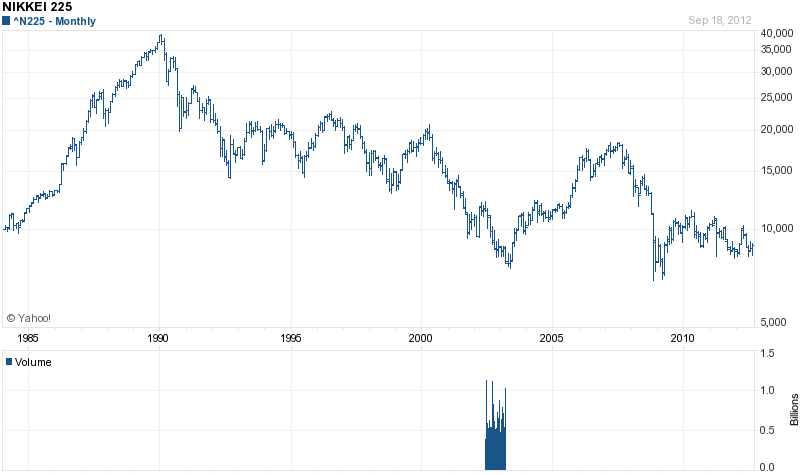
Japan has been in an endless loop of money printing ever since stocks and real estate crashed in the early 1990’s after one of the biggest financial bubbles in history.  Twenty years of quantitative easing and monetary stimulus have resulted in stagnant wages, the largest debt to GDP ratio in the world and a stock market that is still off 75% from its high.  Except for printing additional money, Japan seems flat out of options for reviving its economy.

Courtesy yahoo finance

Does anyone really expect this desperation tactic to cure Japan’s problems?

It Should Be A Very Merry Christmas For Gold Investors

In an interview with Bloomberg TV, Greg Smith, chairman of Global Commodities, is forecasting $2,000 gold by Christmas.

Long term investors in gold would have a very merry Christmas since a price of $2,000 would equate to a 2012 price gain of over 25% from gold’s opening price on January 3, 2012.

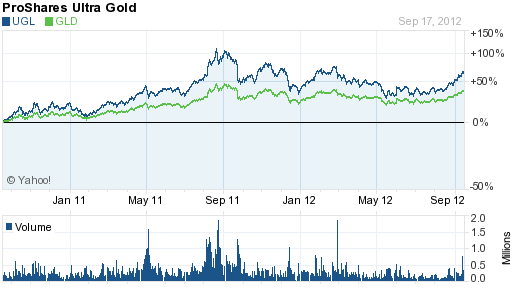
From today’s closing gold price, a $2,000 per ounce price by year end equates to a gain of $241 per ounce or 13.7%.  Aggressive investors have many different ways to leverage gains on a potential run up in gold by year end.  For example, a position in Pro Shares Ultra Gold (UGL) would yield a gain of about 27% if gold hits $2,000 by year end.

The UGL does not hold physical gold but rather invests in futures, forward contracts, options and swap agreements designed to yield gains of 200% of the daily performance of gold bullion.  Last summer when gold soared to an all time high, the UGL returned twice the gains of  the SPDR Gold Shares ETF (GLD).  Keep in mind that leverage works both ways – if gold declines, an investment in the UGL would produce twice the losses compared to holding physical gold or shares in the GLD.

Courtesy: yahoo finance