April 10, 2026

Physical Silver Shortage Worsens Due To Mint Rationing and Surging Investment Demand

The inability of the US Mint to meet public demand for gold and silver bullion products was discussed at a recent House Financial Services Subcommittee hearing.  Testimony by industry experts revealed that the US Mint was losing an estimated one-third of potential bullion sales because they cannot meet demand.

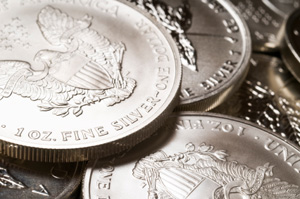
For the past several weeks the US Mint sales figures for Silver Eagle bullion coins have been essentially flat. The US Mint sells its bullion products in bulk to authorized purchasers (AP’s).  The AP’s resell the bullion coins to dealers who then sell the products to the public.  The US Mint has been rationing the 2011 Silver Eagle bullion coins to AP’s, leaving one to conclude that the flat sales of Silver Eagles have been the result of Mint production constraints or supply shortages, rather than flat or reduced market demand.

On past occasions, the US Mint has cited the lack of adequate supplies of silver planchets as the cause for the continuing rationing of silver bullion coin sales. Earlier this year, the Royal Canadian Mint admitted that they were having significant problems in sourcing silver since huge demand was outpacing silver supply.

Combine rationing and surging demand and the obvious result is a severe shortage of  physical gold and silver bullion products.  Confirming this situation, American Precious Metals Exchange (APMEX), announced yesterday that they were seeking to purchase US Mint bullion products from their customers in order to meet “recent incredible demand for gold and silver bullion products”.

APMEX, one of the country’s largest precious metals dealers, offered to purchase American Gold Eagles and American Silver Eagles at generous premiums over spot prices in order to secure inventory.  Despite the increase in the price of gold and silver, public demand obviously remains incredibly strong.

The American public has been provided with plenty of evidence that out of control deficit spending and money printing policies by the Federal Reserve are destroying the value of the paper dollar and they are acting accordingly (see Why There Is No Upside Limit To Gold and Silver Prices).  A loss of confidence in paper money is fueling the rise in gold and silver prices as people seek to protect their wealth.  Any pullbacks in precious metal prices should be viewed as another major buying opportunity.
Gold At Record High As Silver Price Soars Towards $50 – Why The Rally Will Continue

As government spending spirals out of control and the Federal Reserve perpetuates a deliberate strategy of currency debasement, precious metals prices continued to soar. Gold, as measured by the London PM Fix Price, closed at $1504.00, up $27.25 on a shortened four day trading week .
Gold has gained $86 during April and $185 from its January low of $1,319.  The price acceleration in April comes in the aftermath of the government’s dismal failure to reduce deficit spending, even as S&P warned of a credit ratings downgrade for the U.S.  The great budget compromise reached by both parties was soon exposed as a shameful hoax by the Congressional Budget Office, which said that government spending would actually be higher after the “budget cuts” due to gimmicks.

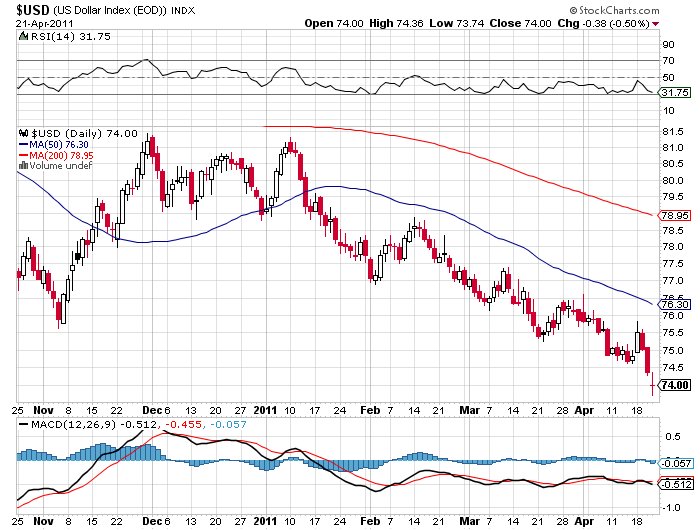
As unsustainable government debt continues to balloon and the Fed continues to print money, the dollar is getting trashed. Governments worldwide are taking steps to protect themselves from the Fed’s explicit policy of dollar debasement and this means selling dollars.  The US dollar has fallen almost 10% since the beginning of the year.  Gold and silver are becoming the de facto reserve currency, as the flight from dollars intensifies.

US Dollar- COURTESY STOCKCHARTS.COM

Silver has continued to confound the bears with another standout performance, gaining $3.65 or 8.57% on the week, after gaining $2.39 in the previous week. The closing price for silver as measured by the London PM Fix Price was $46.26.   Silver is rapidly closing in on its all time closing high of $48.70 hit in January 1980. The current price momentum in silver could easily push silver into new all time highs next week.

The huge rally in silver prices has some wondering if there will be a pullback soon.  Silver has gained $8.63 per ounce this month for a 22% gain.   Since the January low of $26.68, silver has gained a spectacular $19.58 per ounce for a huge gain of 73%.  The question is not one of if, but rather of when there will be a pullback – a routine event in every bull market.

Precious Metals Prices
Fri PM Fix Since Last Recap
Gold $1,504.00 +27.25 (+1.84%)
Silver $46.26 +3.65(+8.57%)
Platinum $1,812.00 +25.00 (+1.40%)
Palladium $765.00 -7.00 (-0.91%)

But perhaps the bears will have to wait a while longer for the much anticipated pullback.  The volume in put options on the silver ETFs has seen numerous days of record volume, implying that some big players are betting on a significant decline in silver prices.  Does the record put buying on silver reflect speculators betting on a silver plunge or merely long time silver investors hedging long positions?  Either way, the implication is that the expectations for a silver pullback seems to be growing, but markets rarely accommodate investors’ perceptions of when a market is truly overbought – expect higher silver prices to shock the put buyers in silver.

Long term, any price pullback in silver should be looked at as a gift.  Financial players should never “fight the Fed”  and in this case, both Federal Reserve and Government policies guarantee higher precious metals prices (see Why There Is No Upside Limit To Gold and Silver Prices).

Are Gold Stocks Really Underforming Gold Bullion?

Depending on which gold stock investor you talk to, gold stocks have either been under performing or outperforming gold bullion.
Theoretically, given the earnings leverage associated with gold miners, a big move up in gold bullion should translate into handsome gains for shareholders of gold mining companies as earnings per share increase.  In the real world, however, the cost of exploration and development, mine depletion and the energy intensive process of gold mining and refining can result in costs that exceed the increased revenue from higher gold prices.  Gold mining companies with operations in less developed countries with weak property rights can also wake up one morning and discover that the government has expropriated their mines.

So which is it?  Would it have been better to own gold stocks or simply buy a gold ETF or take physical possession of gold bullion?  Like many things in life, it all depends, and the result reinforces the argument to maintain a well diversified portfolio.

Gold miners that have been able to translate higher gold prices into higher profits have done very well while other gold miners with poor results have significantly lagged the gains seen in gold bullion.   The results have been company specific.  A gold stock investor who was correct in predicting higher gold prices but picked the “wrong” gold stocks fared poorly.

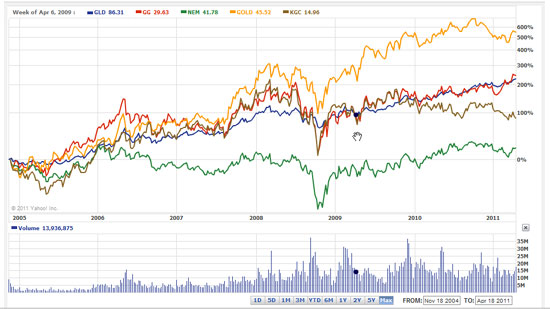
Here’s a sample of the relative performance of some of the largest gold miners compared to the price of gold, using the SPDR Gold Trust (GLD) as a proxy for bullion prices.  Two major gold miners, Newmont Mining Corporation (NEM) and Kinross gold Corporation (KGC), dramatically under performed the GLD, while Goldcorp (GG) tracked the GLD performance.  If you were lucky enough to own Randgold Resources (GOLD), your profits would have been twice the gains on the GLD.

RELATIVE PERFORMANCE STOCKS VS GLD - COURTESY YAHOO FINANCE

The bottom line is that unless an investor has considerable expertise in assessing the gold mining industry and specific company prospects, the better choice was to go with a gold ETF or stash gold bullion in a safe deposit box.  If the biggest gains in gold prices are yet to come, as I believe, an investor with a 100% allocation to individual gold stocks should consider reassessing his portfolio allocation.

The last option that should be mentioned for those seeking higher returns from the leverage of owning gold stocks instead of a gold ETF, would be to invest in a gold mutual fund with a solid track record of investment success.

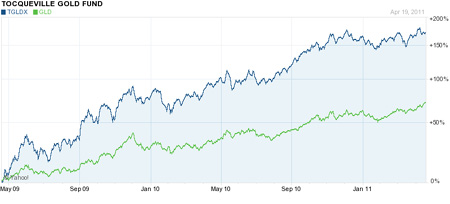
Tocqueville Gold Fund Performance vs. GLD

The Tocqueville Gold Fund(TGLDX) is a highly regarded mutual fund with solid portfolio managers who have had a very successful track record in picking the right gold stocks.  Over the past two years, the TGLDX has outperformed the GLD and with far less volatility.

For Silver, This Time It’s Different

To many investors with a sense of history, the four most dangerous words are “this time it’s different”. The phrase is usually evoked in an attempt to justify why a huge price gain in a particular asset class can continue to defy common sense and historical valuation norms. A surfeit of explanations on why “this time is different” is usually enough to send seasoned investors to the exits.

Silver, having defied the low expectations of many investors, has now seen a monster rally of 392% from $8.88 in October 2008 to the recent market price of $43.67. The pace of the advance has gone almost vertical with silver gaining 60% from the lows of late January.

Long term silver investors no doubt remember the aftermath of the last rapid run up in silver prices to $48.70 in January 1980. Silver prices collapsed shortly thereafter and ultimately slid to the $5 range where it remained throughout the 1990’s. Silver dropped off the radar for most investors and remained dead money for 25 years before decisively breaking out of a very long base in early 2006.

Will history repeat with another meltdown in silver prices at some near point in the future, or is the rise in silver prices indicative of a major trend change in our economic future? I have never believed that the mechanical application of past price trends was a useful tool for predicting the future. Each point is history is unique with new players and new sets of circumstances. Understanding today’s fundamentals are far more important than ascribing importance to past events that are largely irrelevant.

To understand why silver prices are in the initial stages of a long term super cycle advance rather than a replay of the 1980’s, it is necessary to review the differences of the late 1970’s compared to our current situation. Gold and silver both advanced in the 1970’s as a booming, demand driven economy fueled inflation. The huge cost of financing the Vietnam War, low employment and surging wages all contributed to a steadily rising rate of inflation which peaked at 13.5% in 1981. Federal Reserve Chairman Paul Volcker finally stopped inflation dead in its tracks through a series of massive interest rate increases which brought the prime rate to a high of 21.5% in mid 1981. High interest rates caused a severe recession but by 1983, the rate of inflation had collapsed to 3.2%.

Both gold and silver moved dramatically higher during the inflation surge of the late 1970’s and early 1980’s but the meteoric rise in silver prices was driven by specific events. Wealthy brothers Nelson and William Hunt acquired a massive position in silver in an attempt to corner the market. Prices skyrocketed on the news and silver went from $11 per ounce in late 1979 to $48.70 in early 1980. Regulators did not take kindly to market manipulation and margin requirements on commodities were dramatically raised. The Hunt brothers’  ill conceived attempt to drive silver prices higher collapsed along with their net worth. Silver prices plunged to less than $11 per ounce within two months. The last great silver “bull market” lasted less than six months, driven not by fundamental demand but rather by heavily leveraged speculators.

Fast forward 30 years – the finances of governments worldwide have reached the tipping point under ballooning debt levels and massive deficits. Additional borrowing by insolvent nations to rollover debt simply delays the day of reckoning – more debt is not the solution for too much debt.

The message from the gold and silver markets is clear – governments have reached the limits on borrowing and the day of debt Armageddon is approaching. The accelerating exodus from paper assets to historical stores of value is only in its initial stages as desperate governments take desperate measures to stay afloat (see Smart Money Sees The Perfect Storm for Gold and Silver).

The great debt bubble of the United States and much of the rest of the world is reaching its end game as creditors realize that a stealth default of some type is inevitable via a combination of inflation, money printing, currency debasement and/or negative interest rates.  Nor is it likely that S&P’s lowered outlook on U.S. government debt to negative from stable will have any affect on reining in ballooning U.S. debt (see Why There Is No Upside Limit To Gold and Silver Prices).

From a long term perspective, perhaps this time is not different but simply a replay of the history of currencies backed only by the “full faith and credit” of governments.  Voltaire had this to say regarding fiat money – “Paper money eventually returns to its intrinsic value – zero”.

2011 America the Beautiful Silver Bullion Coins Release

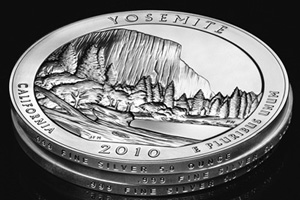
On April 25, 2011, the United States Mint will make the first of the 2011-dated America the Beautiful Silver Bullion Coins available for purchase. This year’s release and distribution of the 5 ounce silver bullion series is expected to be much different than experienced for the previous year.
As with other bullion programs of the United States Mint, the coins are distributed through a network of authorized purchasers. A group of primary distributors may purchase the coins directly from the Mint in bulk quantities based on the market price of the metal plus a modest premium. For the 5 oz. ATB silver bullion coins, this premium is $9.75 per coin. After acquisition, the authorized purchasers resell the coins to other bullion dealers, coin dealers, and the broader public.

For this year’s offering, the US Mint will start by releasing two different designs featuring Gettysburg National Military Park and Glacier National Park, each with a mintage of 126,500 units. This will be followed by three additional designs released later in the year featuring Olympic National Park, Vicksburg National Military Park, and Chickasaw National Recreation Area. The US Mint has stated that their goal is to produce a minimum of 126,500 coins for each of these designs.

For the 2010-dated issues, all five designs had been released on the same date, late in the year. Each of the designs had production of only 33,000 units. This extremely limited mintage generated excitement with collectors, as the coins were viewed more as low mintage numismatic products than bullion coins. In an attempt to prevent price gouging, the US Mint would halt sales and impose terms and conditions on the distribution of the coins at the authorized purchaser level. This included capping the premiums on the coins and distributing directly to the public, with a household limit imposed.

For the upcoming releases, mintage levels are high enough that the US Mint will not impose similar terms on their distributors, except for the standard allocation (rationing) program and a requirement to certify that all of the prior year coins have been distributed in accordance with the rules previously set.

2011 Proof Gold Eagles Available April 21

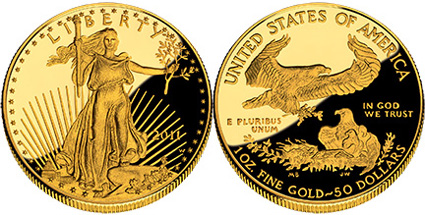
The United States Mint has provided details for the upcoming release of the 2011 Proof American Gold Eagle coins. These collector versions of the popular bullion coin have traditionally been offered each year since the introduction of the series in 1986.

The only year that the US Mint did not offer a collector version of the Gold Eagle was in 2009. In explaining the cancellation, the US Mint cited their requirement to produce the bullion versions of the coins in quantities sufficient to meet public demand. Since they could not meet full demand, they sourced all incoming precious metals blanks to the production of more bullion coins.

In 2010, the offering was resumed, with Proof Gold Eagles available starting on October 7, 2010. The available options sold out by early January of the following year.

The 2011 Gold Eagles will go on sale April 21, 2011. The US Mint will offer individual product options for the 1 oz, 1/2 oz, 1/4 oz, and 1/10 oz coins, as well as a combined 4 Coin Set option. Each coin is struck in 22 karat gold, with the stated weight reflecting the gold content of each coin. The product limits established by the US Mint are shown below.

Product Product Limit
1 oz. Coin 30,000
1/2 oz. Coin 15,000
1/4 oz. Coin 16,000
1/10 oz. Coin 30,000
4 Coin Set 40,000

If the US Mint can achieve a full sell out of the stated product limits for each option, that would represent 118,500 troy ounces of gold. Through the first three months of the year, the US Mint has sold an average of just under 100,000 ounces of Gold Eagle bullion coins per month. Sales of the collector versions typically take place more slowly, since they are sold at a higher premium and marketed to collectors.

Prices will be determined based on the average London Fix gold price for the week prior to the release date. If gold remains within the current range, the 1 oz proof coin would be priced at $1,735.00, reflecting a premium of 16.68% over the market price of the gold content. The 1/2 oz, 1/4 oz, and 1/10 oz coins would cost $881.00, $453.00, and $195.50, respectively. The 4 coin set would cost $3,215.50.

Price Pullbacks in Silver Becoming Shorter and More Shallow

Silver prices continued streaking higher today on fears of a plunging dollar, rampant money printing by central banks, and talk in Europe of a looming debt restructuring (default) by Greece.
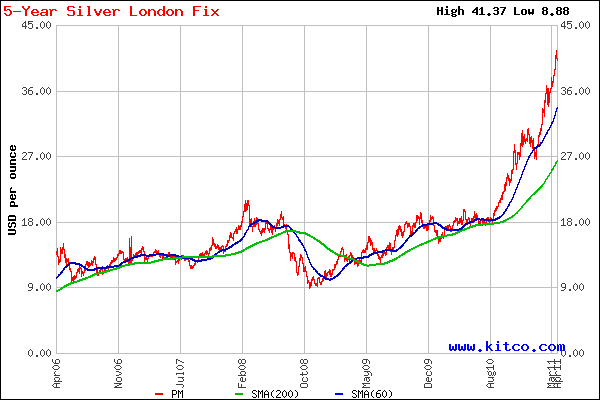
In late afternoon trading silver was up $1.22 to $41.88, a 3% gain for the day.  Since decisively breaking through the $15 price range in early 2008, silver has been in a major bullish uptrend with price pullbacks becoming shorter in duration and more shallow in their extent.

SILVER - COURTESY KITCO.COM

Silver reached an intermediary high of $20.92 in March 2008.  As the financial world headed for a meltdown in late 2008 and every asset class in the world was liquidated, silver experienced a sharp sell off and by October 2008 reached a low of $8.88.  The 2008 low represented a price consolidation of 40% from the base silver had established at the $15 range.

The ensuing recovery in silver took a little over a year before the price once again approached the $20 per ounce level.  In December 2009 silver hit a high for the year at $19.18.  After a brief consolidation below $18 in early 2010, silver broke out of its base in the $18 range  to reach a high of $30.70 in December 2010. The price of silver ended the year up $13.46, for a gain of 78.4% on the year.

In January of 2011 silver again consolidated briefly and pulled back $3.95 or 13% to a low of $26.68 on January 28th.  This month-long pullback turned out to be another fantastic buying opportunity as silver recovered its losses and rose to $36.60 by March 7th.

Over the next 7 trading days, silver consolidated again, declining  from $36.60 on March 7th to $33.88 on March 15th for a loss of $2.72 or 7.4%.  Silver then rallied again to a new annual of $41.37 on April 11th.

Silver’s most recent pullback was the shortest of them all, declining from $41.37 on April 11th to $40.22 on April 13th for a loss of $1.15 or 2.8%. The losses were quickly recovered and a new 31 year high was reached, with silver recently trading at nearly $42 per ounce.

Investors who seized the opportunity to purchase silver on price pullbacks over the past four years have made fantastic profits.  As the bull market in silver has progressed, these pullbacks have become shorter in duration and more shallow in price. This situation seems to be reaching its extreme, where pullbacks last not months, not days, but mere hours. Investors have started to capitalize on even the smallest price declines to increase their positions and drive prices higher.

Smart Money Sees the Perfect Storm for Gold and Silver Prices

A broad sell off in commodity prices triggered by a Goldman Sachs prediction of a “substantial pullback” in oil prices had little impact on the strong uptrend in gold and silver prices. Based on the London closing PM Fix Price, gold ended Tuesday off only $19 or 1.3% from Friday’s all time close. Silver, meanwhile, the absolute star of the precious metals group, closed Tuesday at $40.44, up 22 cents from Friday’s 31 year closing high. After the recent huge run up in both gold and silver prices, the very modest price declines suggests that the bulls are on the right side of the trade.
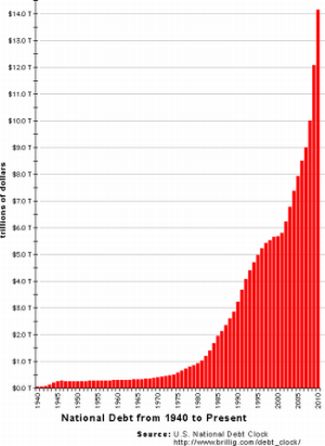
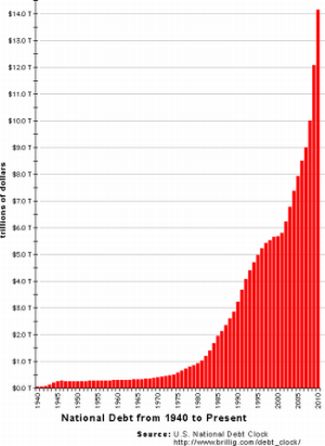
Every bull market has corrections and precious metals will not be an exception. The point to remember is that the U.S. has already passed the point of no return on its inevitable journey to a debt crisis.  The mainstream press focuses on the looming battle in Washington over raising the nation’s legal debt limit past $14.2 trillion, yet there is little discussion of the U.S. Government’s total unfunded liabilities of $75 trillion based on open ended entitlement programs.   The U.S. is in a debt trap from which a painless escape is impossible.

While the majority of Americans don’t know or don’t care about the spiraling debt disaster facing the Nation, smart money is taking steps to survive and profit from the inevitable day of reckoning.

One of the largest bond investors in the world who has a superb investment track record proclaims that U.S. debt securities have “little value.” In recent remarks, Bill Gross of Pimco candidly states his view on how the U.S. debt crisis will soon end. Mr. Gross states that Pimco has sold all holdings of U.S. debt because “they have little value within the context of a $75 trillion total debt burden. Unless entitlements are substantially reformed, I am confident that this country will default on its debt; not in conventional ways, but by picking the pocket of savers via a combination of less observable, yet historically verifiable policies – inflation, currency devaluation and low to negative real interest rates.”

The smart money sees the future.  One logical investment alternative to preserving wealth is in the timeless currencies of gold and silver that governments cannot devalue.

The recent sorry spectacle in Washington only affirms that elected leaders are incapable of preventing an eventual U.S. default (see Why There Is No Upside Limit To Gold and Silver Prices).  After scaring half of the old ladies in the country that they wouldn’t get their next social security check, both political parties declared victory after “reducing spending” by $38 billion – a fraction of a percent of total government spending.  Even worse, the Washington Post reports that many of the “spending cuts” are accounting gimmicks and budget tricks that will not reduce overall spending.

The great “achievement” of Congress becomes even more pathetic after considering that the national debt has expanded by $3 trillion in the past two years and projected budgeted spending will add almost another $10 trillion in debt over the next 10 years.  These horrendous projections assume a growing economy and no major adverse macro economic shocks.

Massive  levels of debt and spending commitments leave the U.S. with two ruinous policy choices.  Congress can cut spending dramatically and watch the economy collapse after which the Government would re-institute massive spending programs and quantitative easing on an unimaginable scale.  The second choice is the odds on favorite – continue the parabolic increase in spending and money printing and watch the economy implode as all bond investors (not just Bill Gross) refuse to purchase worthless treasury debt leaving the U.S. unable to meet its obligations. Either way, the inescapable dilemma that the Nation faces has created the perfect storm for gold and silver.

Gold Hits All Time High and Silver Breaks $40 as Precious Metal Demand Soars

Anything but paper dollars was the theme this week as investors rushed into anything of tangible value.  Gold, silver, oil and commodities of all types have been skyrocketing since last August when the Federal Reserve announced its second round of quantitative easing.
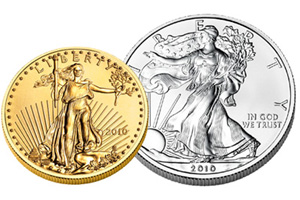
Gold closed at an all time high of $1,469.50 as measured by the London PM Fix Price and silver hit a 31 year high closing the week at $40.22.  Some analysts cautioned that the rapid rise in gold and silver prices could lead to a pullback, but overbought markets tend to defy such logic.  Gold has decisively broken through resistance at the $1,450 level and silver looks ready to challenge the all time high of $48.70 reached in 1980.

Precious Metals Prices
Fri PM Fix Since Last Recap
Gold $1,469.50 +51.50 (+3.63%)
Silver $40.22 +2.59 (+6.88%)
Platinum $1,803.00 +30.00 (+1.69%)
Palladium $798.00 +26.00 (+3.37%)

The surge in precious metals prices reflects the obvious conclusion that developed nations of the world are on a trajectory with a potentially devastating debt crisis.  The budget antics in Washington make it clear to any impartial observer that spending will not be cut and the parabolic growth of debt will continue.  No one knows how the looming debt crisis will ultimately play out for the Nation, but one certain outcome is that the dollar’s purchasing power is likely to diminish greatly (see Ron Paul Talks About Horrendous Currency Debasement).

Gold rose by $51.50 on the week and is up over $300 per ounce over the past year.

GOLD - COURTESY STOCKCHARTS.COM

Silver has been the standout performer over the past year, increasing by over 122% since last August.  This week was no exception with silver sprinting past the $40 mark and gaining 6.9% on the week. Despite the large increase in the price of one ounce of silver, the Silver Institute reports that both investment and fabrication demand soared last year.  During 2010, world investment demand for silver increased by 40% and fabrication demand (which accounts for 83% of total silver demand) rose by 13%.

Platinum and palladium also rose on the week, recouping the price correction experienced after the Japanese earthquake.  Platinum rose by $30 on the week to $1,803 while palladium rose by $26 to $798.

Ron Paul Links Bullion Coin Shortage To Horrendous Currency Debasement

Rep. Ron Paul, during a Subcommittee hearing on problems at the US Mint, linked the shortage of gold and silver coins to the “huge debasement” of the United States currency.

The remarks came during a hearing by the House Financial Services Subcommittee on Domestic Monetary Policy, entitled “Bullion Coin Programs of the United States Mint: Can They Be Improved?”  Four different coin and previous metals industry experts provided testimony on how to address ongoing problems with coin production and shortages.

After some lengthy discussion by witnesses and committee members regarding shortages of silver coin blanks and marketing and production problems at the US Mint, Rep. Paul focused on what he considered to be the primary reason why the US Mint was, at times, unable to meet public demand for gold and silver coins.

Listed below are highlights of Rep. Paul’s remarks at the Subcommittee hearing.

  1. It is “imperative” that the US Mint should be able to produce an adequate supply of coins to the U.S. public.  According to Rep. Paul, investors are rushing to purchase gold and silver due to quantitative easing by the Federal Reserve.
  2. The US Mint should take the appropriate steps to source enough planchets to meet public demand for gold and silver coins.  People are worried, stated Rep. Paul, and are trying to preserve their wealth through the purchase of gold and silver due to government policies that will lead to inflation and debasement of the currency.  Rep. Paul stated that “If we had a sound currency” there would not be a shortage of gold and silver coins since demand by the public would be a non event.
  3. Rep. Paul detailed the “horrendous huge debasement” that has occurred with the US currency.  In the early 1930’s, when gold was on a fixed exchange rate with the US dollar, the dollar was worth 1/20 ounce of gold.  It was subsequently devalued to 1/35 ounce of gold during the 1940’s, to 1/38 ounce of gold in the early 1970’s and to 1/42 in 1973.  Once it became legal for US citizens to own gold and the dollar was based on market prices, the value of one dollar subsequently dropped to 1/1450 ounce of gold.
  4. Rep. Paul noted that total annual demand during 2011 for Silver Eagle bullion coins should reach 48 million ounces, but that total US silver production would amount to only 40 million ounces.  The US Mint should take all necessary steps to ensure that adequate supplies of silver are available to meet public demand for silver coins.

Although not specifically addressed, the issue of whether the US government is making an effort to limit the sale of gold and silver coin to the public remains an open question.  By law, the US Mint is required to produce coins “in quantities and qualities that the Secretary determines are sufficient to meet public demand”.  There were no US Mint representatives present at the Subcommittee hearing to explain why the US Mint is unable to comply with production mandates specified by law.