April 6, 2026

The Road Map To Sound Money and Restoring the Dollar – Ron Paul’s Proposal

“Road Map to Sound Money: A Legislative Hearing on H.R. 1098 and Restoring the Dollar”.

Ron Paul’s efforts to restore a sound currency in the United States continued this week as hearings were held on his proposed legislation that would allow American citizens to chose from among competing currencies.  Ironically, the one man whose proposals could ultimately save the U.S. financial system from collapse, was completely ignored by the mainstream press who provided zero coverage of H.R. 1098.

H.R. 1098, introduced by Ron Paul in March is known as the “Free Competition in Currency Act of 2011”.  According to Ron Paul, “This bill eliminates three of the major obstacles to the circulation of sound money: federal legal tender laws that force acceptance of Federal Reserve Notes; “counterfeiting” laws that serve no purpose other than to ban the creation of private commodity currencies; and tax laws that penalize the use of gold and silver coins as money.”

Ron Paul noted that gold and silver have constituted sound money throughout history.  Loss of confidence in the dollar and profligate deficit spending by the government have caused people to flee to gold and silver as a store of value.  Paul noted that “Even central banks have come to their senses and have begun to stock up on gold once again.”

Presently, the use of gold and silver by citizens is being severely punished by the government.  Ron Paul cited the case of Bernard von NotHaus, creator of the Liberty Dollar, who was convicted of counterfeiting for creating his own gold and silver currency and another individual who was “convicted of tax evasion for paying his employees with silver and gold coins instead of fiat dollars.”

H.R. 1098, according to Ron Paul, would allow citizens to maintain the purchasing value of their money and prevent the government from conducting excessive borrowing which will enslave future generations with debt.

Testimony at the hearing for H.R. 1098 was given by Dr. Lawrence Parks, Foundation for the Advancement of Monetary Education, and Dr. Lawrence White, Professor of Economics, George Mason University.

Dr. Parks, who presented 63 pages of prepared remarks, opened by stating that the current monetary system is not in conformity with the Constitution, is dishonest and unstable and in the process of “blowing up.”

Selected excerpts from Dr. Parks testimony:

With no exceptions, the history of legal tender irredeemable paper-ticket-electronic money is that its purchasing power always approaches its cost of production: ZERO!

With gold-as-money, and without the banking system creating money out of nothing, the amount of financial leverage would be de minimis with no possibility of collapse. Because legal tender irredeemable paper-ticketelectronic money can be created without limit, there is no market based self-correcting mechanism to limit financial leverage. Especially at a time when those who engage in leverage do not bear the full risk of loss, but are able pass the risk on to the public through the banking system, whose balance sheet and liabilities are de facto guaranteed by the public, financial collapse is a certainty.

Many think that the Great Depression was a “market failure.” Mr. Greenspan has written extremely eloquently that the Great Depression was in fact caused by the Federal Reserve feeding too much credit into the banking system, i.e., enabling the banking system to increase leverage too much.

Dr. Parks notes that the price level of the U.S. was stable until President Nixon defaulted on the U.S. promise to redeem dollars for gold.


Dr. Parks says that because the U.S. dollar is the reserve currency of the world, when the dollar collapses, the global financial system will also collapse, plunging most of the world into poverty and war.

Dr. Parks admits that as a “practical matter, absent the debacle of a complete collapse, there can be no abrupt changes to our monetary system.”

The continual appreciation of gold against paper money suggests that the monetary system will not be reformed in time to prevent a financial disaster.   The ongoing debt crises in Europe and the U.S. also provide little hope that governments will diverge from their path of monetary disaster as they seek to cure too much debt with more debt.   The only survivors at the end of this mad experiment with fiat money will be those holding the eternal sound currency of gold and silver.
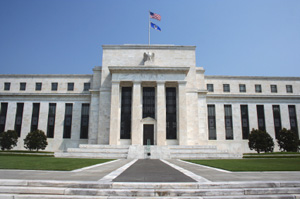
Gold Will Soar On Imminent U.S. Bailout of Europe

It is only a matter of time before the U.S. becomes deeply involved in the bailout of Europe.  Consider Geithner Takes Tougher Tone On Europe as reported by Bloomberg.

Treasury Secretary Timothy F. Geithner will urge European governments to step up their crisis- fighting efforts amid Obama administration concerns that the region’s woes may hurt the U.S. economy.

Geithner will press European Union finance ministers when he meets with them this week, a euro-area official said.“The U.S. has always been discretely preoccupied and discretely present, and now it’s starting to be intensely preoccupied and intensely present,” said Nicolas Veron, a senior fellow at Bruegel, a Brussels-based economics research group.

Geithner’s trip to Wroclaw will be his second to Europe in a week.The visit “underlines the nervousness of the administration in the U.S. about what’s happening in Europe” and the effect the region’s debt crisis is having on U.S. financial markets, Julian Jessop, chief global economist at Capital Economics Ltd. in London, said in an interview yesterday.

President Barack Obama told a group of Spanish-language journalists at the White House on Sept. 12 that “we’re deeply engaged with Europeans to try to solve this crisis.”

The European crisis was “very, very damaging in the American economy last summer,” Geithner told Bloomberg Television on Sept. 9.

“The way the U.S. handled the financial crisis and the lessons learned from that could become a much more important part of the IMF message to Europe,” said Eswar Prasad, a senior fellow at the Brookings Institution in Washington and a professor at Cornell University in Ithaca, New York.

Treasury’s Geithner is clearly laying the groundwork for a major role by the United States in bailing out the European Union.  The potential for a collapse of the European banking system is viewed as an unequivocal threat to the economic health of the United States by the U.S Treasury, the White House and the Federal Reserve.

U.S. participation in bailing out Europe will not be unilateral but rather in conjunction with the IMF and the European Central Bank.  The U.S. financial commitment, however, will be open ended.  The blueprint for saving the EU will be similar to that used by the U.S. during the financial meltdown of 2008 – virtually unlimited lending to prevent the sovereign default of insolvent European Union members.

The looming bailout of insolvent European nations, particularly Greece which is hopelessly bankrupt, will be the definitive signal that a return to sound finances has been utterly abandoned.  Rather than allowing market forces to correct the systemic imbalances in the financial system, the problem will be papered over by more debt, more printed money and massive debasement of paper currencies.

Gold, the enemy of central banks, will soar as governments frantically print and borrow to “save” Europe.

How Would Gold Perform In A Full Blown Depression?

“We need to do massive stimulus, otherwise there’s going to be another Great Depression.  Things are getting worse, and the big difference between now and a few years ago is that this time around we’re running out of policy bullets.”  – Professor Nouriel Roubini

As the global financial system lurches towards financial Armageddon, would a safe haven asset such as gold maintain its value in a severe depression?

This and other questions were addressed in a Barron’s interview with Martin Murenbeeld, chief economist for Canada’s DundeeWealth, an asset management firm.  Murenbeeld has held senior positions with various gold mining firms for 40 years and turned bullish on gold in 2001.

In response to questions from Barron’s, Mr. Murenbeeld provided the following insights on the gold market and where he thinks prices are headed.

-Murenbeeld told Barron’s that the recent surge in gold prices was related to investor worries over impaired sovereign balance sheets, monetary reflation, global financial instability and strong demand for physical gold from Asia.  In addition, global gold production has barely increased.  Murenbeeld sees an average gold price of $2,200 in 2012 and only a 10% chance that gold will pull back to the $1,500 range.

-The current gold bull market could last another 10 years due to expanded Asian demand and unprecedented adverse financial conditions in the world economy.  Murenbeeld says history “has shown that gold prices…go through very long cycles.”  The last gold bull market of the early 1980’s was one of the shortest on record.

-Regarding the current disconnect between gold bullion and gold stocks, Murenbeeld notes that during times of severe financial stress, bullion outperforms gold stocks since investors avoid equity issues in general.  Over the long term, however, gold stocks have outperformed bullion.

-If the world enters a major depression, gold prices would likely drop since “demand for everything falls off.”  Murenbeeld notes, however, that monetary response to a depression would be fast and aggressive which would quickly propel gold prices higher.

-Murenbeeld says that current demand for gold in “unprecedented” and due to Federal Reserve policies, the introduction of gold ETFs and huge demand for physical gold by billions of consumers in Asia.

-In response to how world governments will deal with the current severe financial problems, Murenbeeld said “during my working life the risk of monetary debasement – the outright printing of money supply in the developed countries has never been higher.  Thus, we see the unprecedented interest in gold…Most likely governments will meet the bulk of their debt obligations with currency devaluations and the monetizing of debt”.

-As far as the possibility that investors will lose interest in gold, Murenbeeld says that could happen if “confidence in monetary and fiscal policies is restored”.   (Not much chance of that happening any time soon in this writer’s opinion.)

Gold Bull Market Could Last Another 20 Years With $12,000 Price Target

Bull markets are born from underlying macro economic trends that take decades to fully play out.  The bull market in gold has lasted barely ten years, yet analyst after analyst from the conventional press argue vehemently that gold is in bubble territory and dangerously overpriced.

The voices proclaiming a “gold bubble” do not understand why gold has appreciated for ten years, have never owned gold and have kept their clients out of the best performing asset class of the past decade.

The goldandsilverblog.com has previously argued that given the current fiscal, political and monetary circumstances, there is currently no upside limit for the price of gold.  Those exiting the gold market now will be missing the most explosive and profitable part of the gold bull market.

If the gold bull market duplicates other major bull markets, investors in gold can look forward to decades of continued price appreciation.  Consider the duration and price appreciation of the following asset classes.

United States Housing Bubble

The bull market in housing prices began in the early 1970’s.  The nominal price of a house rose from $25,000 in 1972 to $250,000 in 2006 for a 1,000% gain over 34 years.


Courtesy jparsons.net

NASDAQ Stock Bubble

The NASDAQ rose virtually uninterrupted for 26 years from 55 in 1974 to 4,570 in 2000 for a gain of 8,300%.

Courtesy yahoo.com


30 Year U.S. Treasury Bubble

The price of the U.S. 30 year treasury bond has risen continuously since the mid 1980’s and yields have reached 60 year lows.


Courtesy yahoo.com

U.S. Debt Bubble

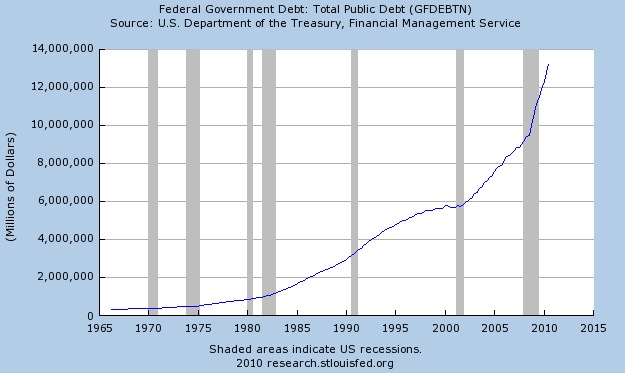
We consider last, the greatest bubble in all of recorded financial history which is the bubble in U.S. debt.  U.S. debt has increased by almost 3,000% since the early 1970’s.  The increase in borrowings by the United States has gone absolutely parabolic and is unsustainable.  The duration of the U.S. debt bubble cannot be predicted, but when this bubble bursts, the repercussions will be devastating to the global economy.  Astute readers will notice that the genesis of the housing, NASDAQ and U.S. debt bubbles coincide perfectly with the end of the gold standard.

The bubbles cited above lasted an average of 31 years.  The average percentage gain for housing, the NASDAQ and U.S. debt bubbles is 4,100%.   Extrapolating from past historical bubbles, the gold bull market should last another 20 plus years with a price target of over $12,000.

Gold Mining Stocks Break Out To New Highs; 3 Gold Stocks That Should Double

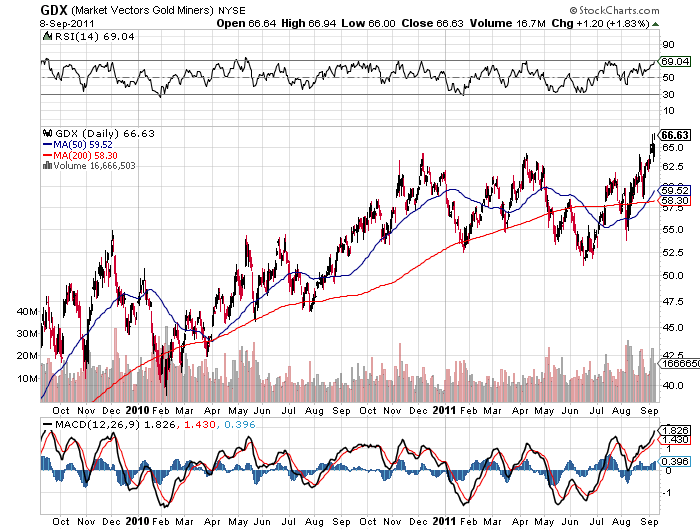
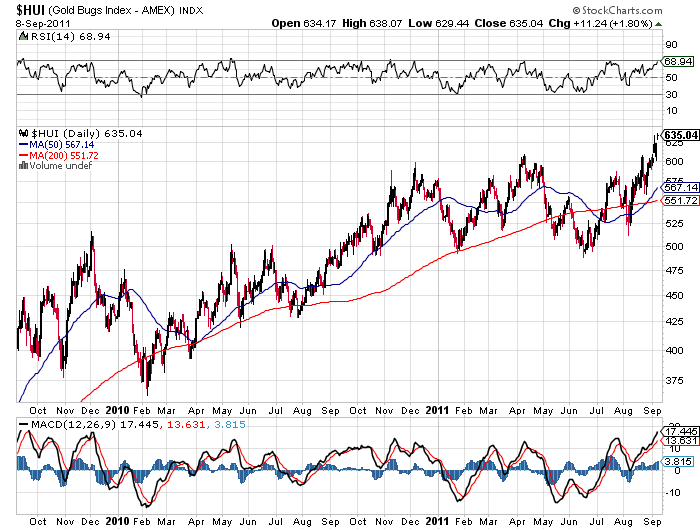
The divergence between the performance of gold bullion and gold stocks seems to be coming to an end.  Both the Market Vectors Gold Miners ETF (GDX) and the Gold Bugs Index ($HUI) have broken out to new highs as investors move into undervalued gold mining shares.


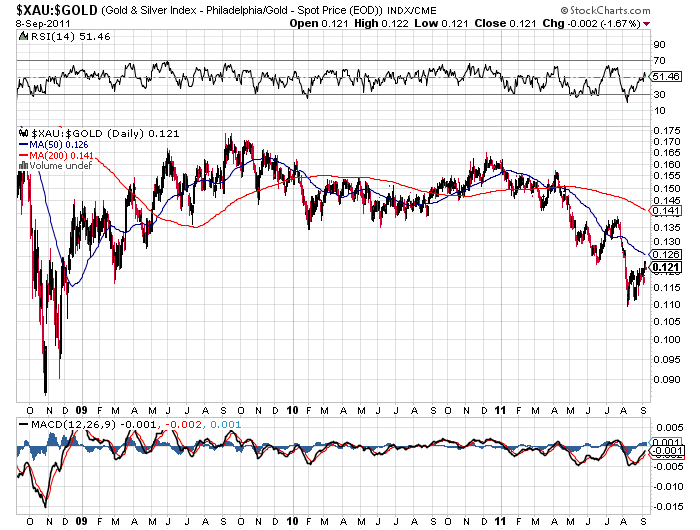
During the initial stages of the gold bull market,gold stocks significantly outperformed gold bullion.  From October of 2000 to June of 2008 gold stocks, as measured by the PHLX Gold/Silver Index (XAU), rose 345% compared to a gain of 252% for gold bullion.

Since 2008 gold stocks have significantly underperformed bullion as gold prices increased by over $1,000 per ounce.    As a result, many gold stocks are selling at bargain prices based on increased earnings and the value of proven gold reserves.

Investors have a wide variety of options for investing in gold mining shares including ETFs and gold stock mutual funds.  One of the best performing gold funds is the Tocqueville Gold Fund (TGLDX) run by John Hathaway.  TGLDX has achieved an average annual return of 26% over the past 10 years.   An investment of $10,000 in the Tocqueville Gold Fund made in June 2001 was worth $102,929 as of June 2011.

For investors who prefer to invest in individual gold mining shares, here’s a short list of three gold mining stocks that could easily double in price.

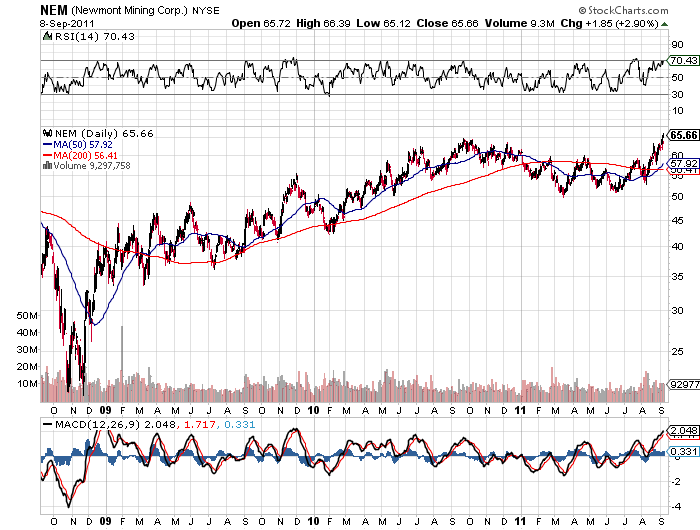
Newmont Mining (NEM) is a large cap gold mining company with proven and probable gold reserves of 93.5 million ounces.  NEM has a strong balance sheet, is forecasting an increase in gold production of 35% over the next six years and pays a cash dividend of 50 cents per share (see A Large Cap Gold Stock That Could Double in Price). NEM hit a new all time high today.

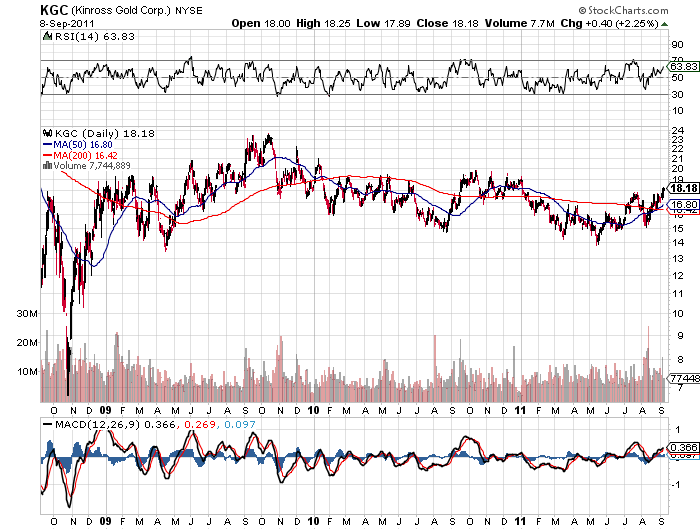
Kinross Gold (KGC) is selling at a large discount to the value of its gold reserves.  One value investor is forecasting a price target of $27 per share (see How Patient Investors Can Buy Gold At $250 Per Ounce).  KGC closed Thursday at $18.18, up $0.40.

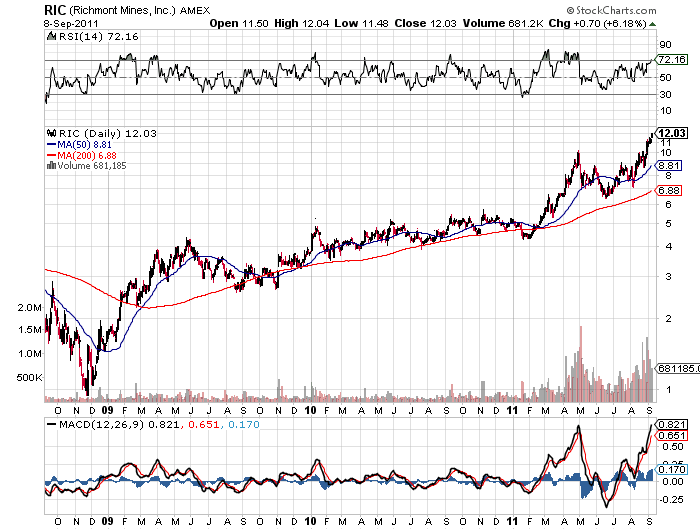
Richmont Mines (RIC) is a junior gold producer.  Earnings for the second quarter of 2011 increased from $0.01 per share to $0.16 per share compared to the prior year.  RIC hit a new high of $12.03 at yesterday’s close.


Gold and Silver Soar On Fears Of Massive Central Bank Stimulus

Precious metals soared across the board this week.  The dismal jobs report released on Friday showed that the American economy has come to a standstill with zero new jobs added in August.

The specter of the US economy plunging back into recession along with imminent banking crises in Europe and the US have fueled speculation that the Federal Reserve is on the verge of conducting another massive wave of monetary stimulus which will further debase the value of the US dollar.  Apprehension is also growing that the magical Obama plan for “creating” new jobs will involve further borrowing by an already bankrupt  American empire.

Also lurking in the background is the fear of coordinated US and European central bank intervention (money printing) to contain the collapse of the European banking system.  Despite the purchase of hundreds of billions of dollars of Spanish, Greek and Italian debt by the European Central Bank, rising interest rates are forecasting default by numerous sovereign states in the European Union.   Rates are rising again on Italian debt and the rate on one year Greek paper now exceeds 70%.  The yields on Greek debt indicate that default is now a certainty and the losses by insolvent European banks holding PIGS debt will require unprecedented government bailouts to prevent complete financial chaos.

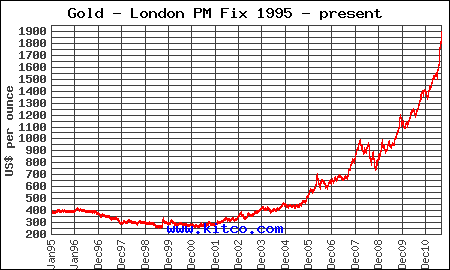
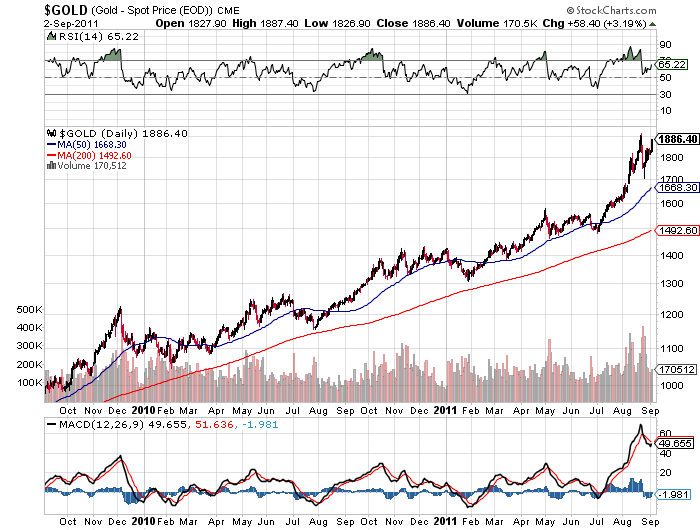
Soaring gold prices have been predicting the collapse of paper money currencies.  As measured by the closing London PM Fix Price, gold soared on Friday by $54.25 to $1,875.25.  In later New York trading, gold continued higher closing at $1,885.20.  Gold is only $2.25 below the all time London close of $1,877.50 reached on August 22nd.

Precious Metals Prices Sept 2
PM Fix Since Last Recap
Gold $1,875.25 +87.25 +4.88%
Silver $42.50 +1.44 +3.51%
Platinum $1,873.00 +61.00 +3.37%
Palladium $785.00 +38.00 +5.09%

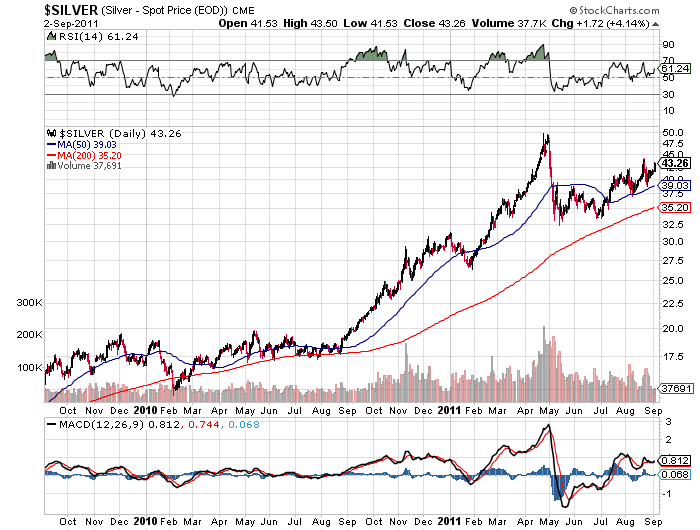
As measured by the closing London PM Fix Price, silver gained $1.44 on the week to $42.50 and continued to rise in later New York trading to $43.35.   After consolidating in the $34 range, silver has resumed its uptrend and is likely to hit new all time highs before year end.


Silver - courtesy stockcharts.com

Platinum soared by $61 on the week to close at $1,873 while palladium finished up $38 to close at $785.

Precious metals may correct after strong advances, but the fundamental case for owning them is growing geometrically.  Expanding deficits and wild money printing will continue as policy makers continue their futile attempts to produce economic recovery by adding more debt to a system already collapsing from the burden of excessive debt.   Continue to increase gold and silver positions on any pullbacks.


Gold - courtesy stockcharts.com

Why Have SPDR Gold Trust (GLD) Holdings Dropped As Gold Soars?

The SPDR Gold Shares Trust (GLD) reported that holdings of gold bullion remained unchanged from the previous week, after dropping by 39.67 tonnes for the week ending August 24th.

On a year to date basis, GLD gold holdings have declined by 48.41 tonnes as the price of gold has increased by $425 (30.6%) from the first of the year.  Why would the GLD show a decline in gold holdings as the price of gold has soared?   Even more interesting, the GLD reached a record high of gold holdings on June 29, 2010 when it held 1,320.47 tonnes and gold was selling at $1,234.50.  From June 29, 2010, while gold has soared by $579 per ounce, the GLD has actually seen a decline in gold holdings of 88.16 tonnes.

The decline of gold holdings by the GLD as the price of gold bullion has skyrocketed indicates that investor preference for gold investment has diversified.  The demand for physical gold has soared as the world financial system becomes more precarious with each passing day.  Confidence in paper assets is becoming more fragile as hapless central banks desperately print money and drive rates to zero in a futile attempt to restore economic growth.  Investors looking for the ultimate safe haven feel more comfortable  holding physical gold.

There have been questions raised about  the safe keeping and even the existence of the gold held by the GLD.  Although these concerns appear to be unwarranted, the financial panic of 2008 blatantly exposed the fact that even institutions considered to be rock solid wound up failing.  (Also see GATA dispatch – How exchange traded fund GLD lets you pretend to own gold).

The SPDR website stresses that the gold with the SPDR Trust is deposited in an allocated account.  According to the SPDR Gold Trust,  “An allocated account is an account with a bullion dealer, which may also be a bank, to which individually identified gold bars owned by the account holder are credited.  The account holder has full ownership of the gold bars and, except as instructed by the account holder, the bullion dealer may not trade, lease or lend the bars.”

Another reason why the GLD gold holdings have not expanded is competition from numerous other gold trusts such as the Sprott Physical Gold Trust which has advantages over the SPDR Gold Trust.

In addition, the shares of many gold mining companies are selling at extreme discounts and investors may be moving funds from gold trusts such as the GLD into mining shares (see Gold Shares Are Positioned For Explosive Move Up).

The GLD currently holds 39.6 million ounces of gold valued at $71.8 billion.

Meanwhile, the case for holding gold grows stronger as concerns about the stability of the world financial system continue to increase.

The Wall Street Journal disclosed today that Goldman Sachs, in a confidential report, estimates that European banks will need as much as $1 trillion in additional capital and that the current situation in world markets is similar to those that preceded the 2008 financial panic.

According to the Wall Street Journal, strategist Alan Brazil of Goldman told clients “Here we go again.  Solving a debt problem with more debt has not solved the underlying problem. In the US, Treasury debt growth financed the US consumer but has not had enough of an impact on job growth. Can the US continue to depreciate the world’s base currency?”

GLD and SLV Holdings (metric tonnes)

August 31-2011 Weekly Change YTD Change
GLD 1,232.31 00.00 -48.41
SLV 9,836.18 -89.38 -1,174.77

Holdings of the iShares Silver Trust (SLV) dropped by 89.38 tonnes this week after increasing by 109.08 tonnes for the week ending August 24th.  The SLV currently holds 313.4 million ounces of silver valued at $13 billion.


Gold Stocks Are Positioned For An Explosive Move Up

Historically, gold stocks have outperformed gold bullion.  Mining companies typically benefit from leveraged earning gains as gold prices rise and production costs remain stable.  Higher gross profits on each ounce of gold produced flow right to the bottom line, boasting profits and stock prices.

During the initial phase of the gold bull market, investors reaped greater profits by owning a basket of gold mining stocks as opposed to holding gold bullion.

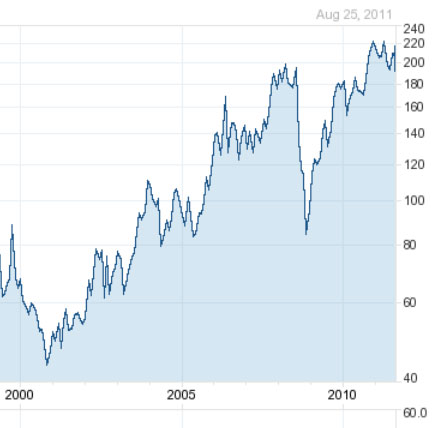
Using the PHLX Gold/Silver Index (XAU) as a proxy for mining stocks, the XAU significantly out performed gold bullion during the initial stages of the gold bull market from 2000 through 2008.  From 43.87 in October 2000, the XAU advanced to 195.25 in June 2008 for a gain of 345%.  During that same period of time, gold rose from $264 in October 2000 to $930 in June of 2008 for a gain of 252%.

XAU GOLD/SLVER INDEX - COURTESY YAHOO FINANCE

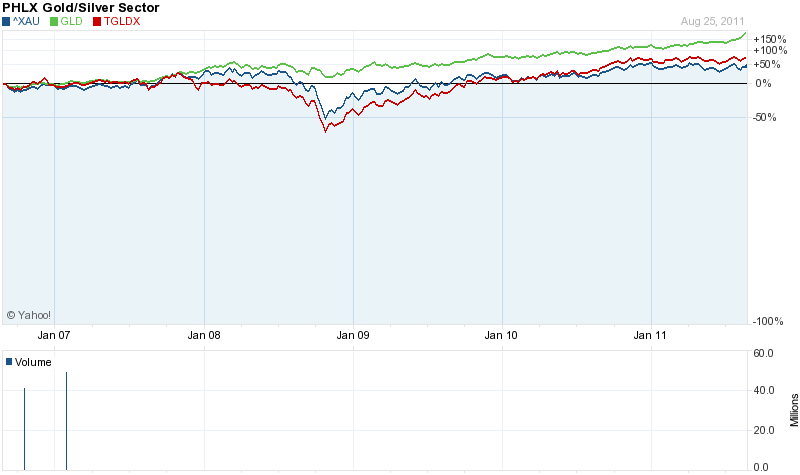
Since 2008, however, the price correlation of gold mining stocks to gold bullion has reversed.  Despite a doubling in the price of gold since 2008, the XAU is only marginally higher at 210.93 for a very paltry gain of 8%.  An investor who was super bullish on gold since 2008 would have gained virtually nothing in mining stocks while the price of gold soared.

Investors in broadly diversified precious metal mutual funds had equally poor results.  As of June 2011, both the Vanguard and Fidelity gold mutual funds have drastically under performing gold bullion since 2008.  The Vanguard Precious Metals Fund (VGPMX) actually delivered a horrendous three year return of minus 0.46% as the price of gold soared 80%.  The only investors in gold mining stocks since 2008 who made profits were those astute enough to pick the handful of mining stocks that out performed gold bullion.

Even the Tocqueville Gold Fund (TGLDX), run by legendary gold investor John Hathaway, has been unable to outperform gold bullion since 2008.


XAU, GLD, TGLDX - COURTESY YAHOO FINANCE

Some of the reasons for the disconnect between gold mining companies and gold bullion since 2008 include the following.

  • Investors learned the downside risks of leverage during 2008 when gold stocks got absolutely crushed while the price of gold bullion had a relatively modest decline.  As measured by the XAU, gold stocks declined by a devastating 65.7% during 2008 while gold bullion declined by only 29% from a peak of $1,011 to a low of $713.
  • A growing preference for holding physical gold and silver.
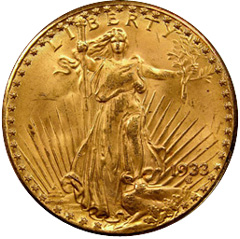
  • The realization by investors that it takes an in-depth technical knowledge of the mining industry as well as the ability to analyze financial statements to be able to pick the gold mining stock that will outperform gold bullion.
  • Gold mining companies can go bankrupt while gold bullion is eternal and will always retain a value and constitute a store of wealth.  Long time gold investors may remember stocks like Echo Bay Mines, Royal Oak Mines and many others which became worthless.
  • The introduction of gold ETFs such as the SPDR gold shares (GLD) created competition for gold mining stocks.  Before gold ETFs were established, investors who wanted exposure to the gold market without having to hold physical bullion would have had to invest in gold mining shares.  The GLD recently became the largest ETF by value with holdings of over $70 billion in gold bullion.

Investor preference for gold bullion and gold ETFs over mining stocks has created a vast pricing disparity between gold bullion and gold stocks.  High quality major gold producers with vast proven reserves of gold are now on the bargain table.  Gold stocks are selling at almost all time lows compared to gold bullion.   Two bargain gold mining stocks previously featured in goldandsilverblog.com are Newmont Mining (NEM) and Kinross Gold (KGC).  Investors in Kinross Gold, for example, are effectively buying gold at around $300 per ounce.

Markets can price stocks far below fundamental values, sometimes for an extended period of time, but ultimately the underlying value will be reasserted.  Gold mining stocks at this time represent immense value and are being steeply discounted.

What will be the trigger for an explosive move up in quality gold mining stocks?  Consider Glencore’s recent bids for nickel, coal and copper miners as reported in ft.com.

Glencore on Wednesday launched a A$268m (US$280m) bid to acquire full control of Minara Resources, an Australia-based nickel miner in which it already has a 73 per cent stake. Last month it offered $475m (£295m) to acquire one of Peru’s largest copper prospects, the Mina Justa project.

Industry executives said that Glencore’s latest target was Optimum, South Africa’s fourth largest coal exporter. The trading house is close to launching a bid for the Johannesburg-listed miner with the support of several South African partners, executives said.

Gold mining stocks have become  irresistible take over targets.  The first takeover bid for a gold mining company will trigger a buying stampede which could rapidly result in a doubling of gold stock prices from currently depressed levels.

Gold Currency – An Escape From A Failing Paper Money System

Fed Chairman Bernanke’s statement that “gold is not money” seems to be an increasingly lonely position.  No less an authority than Alan Greenspan, his predecessor at the Federal Reserve, directly contradicted Bernanke by calling gold a “currency.”

In remarkably candid language, Greenspan spoke in Washington about the Euro ‘Breaking Down’, the European banking crisis and the deterioration of the fiat money system.

“The euro is breaking down and the process of its breaking down is creating very considerable difficulties in the European banking system,” Greenspan said today in Washington.

A lack of confidence in euro-denominated debt is straining the region’s banks, Greenspan said. “That stuff has always been thought of as the ideal collateral and now it’s getting highly questionable,” he said in a question-and-answer session at the Innovation Nation Forum in Washington.

Greenspan also said that he did not think gold, which reached a record above $1,900 an ounce this week, was in a bubble.

“Gold, unlike all other commodities, is a currency,” he said. “And the major thrust in the demand for gold is not for jewelry. It’s not for anything other than an escape from what is perceived to be a fiat money system, paper money, that seems to be deteriorating.”

While Bernanke contemplates additional ways to debase the US currency his counterparts at other Central Banks are retaining gold to help manage debt and adding to their gold reserves at a record pace.  Meanwhile, before providing more bailout funds to insolvent member of the European Union, the German labour minister is demanding that gold be put up as collateral.

Central banks, net buyers of gold for the first time in a generation, are likely to retain their holdings even if they need to raise cash to counter an escalating debt crisis, according to Morgan Stanley.

“Once they’ve sold, that’s it, and buying back would be extremely expensive,” Peter Richardson, chief metals economist at Morgan Stanley Australia Ltd., said in an interview. “They would rather have the backing of a rising asset within their reserve portfolios than use it to reduce debt.”

“Under conditions of austerity we’re going to see a further deterioration of debt,” said Richardson, who has studied metals markets for 20 years. “Rising risk argues in favor of holding on to their gold reserves rather than selling them because they’ve only got one shot at selling.”

“The European central banks won’t sell their gold because while it may be a means to raise cash, it definitely won’t be enough to settle their debts,” said Duan Shihua, head of corporate services at Haitong Futures Co., China’s largest brokerage by registered capital. “Besides, none of the central banks believe in the currencies of other countries.”

Bernanke can deny reality and history by saying that gold is not money while he wildly prints more paper currency, but the rest of the world isn’t buying it.

Gold And Silver ETF Holdings Remain Steady As Gold Plunges

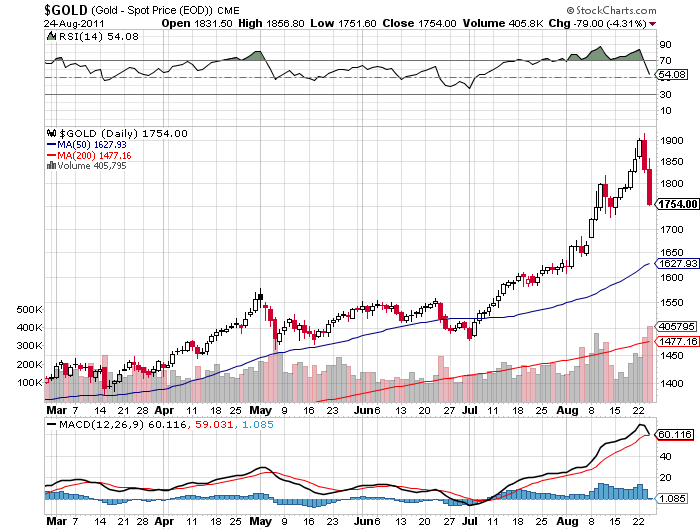
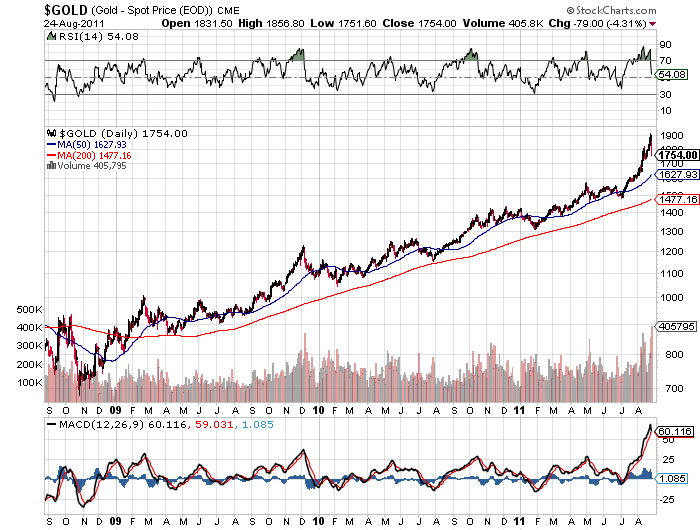
Gold’s non stop advance since early July saw a rapid reversal on Wednesday as gold lost $104.20 to close at $1,752.30 in New York trading.

Gold prices have soared this year on fears of another financial crisis and the continual debasement of paper currencies by governments that are tottering on the brink of default.  Gold began the year at $1,388.50 and by early May traded over $1,550.  After consolidating for two months, gold broke out of its trading range in early July and breached the $1,900 level earlier this week.  Despite today’s sharp sell off, gold is still up $363.80 or 26% for 2011.

As short term trend traders, hedge funds and speculative buyers jumped into gold, prices became overbought with gold trading $423 above its 200 day moving average.  The same traders playing gold for short term profits jumped out just as quickly when prices started to reverse.  Two factors that encouraged profit taking in gold were reports that the Fed would not immediately announce another round of money printing and the sharp hike in margin requirements on gold futures by the CME Group.

On a short term basis gold was overbought and due for a correction after an almost vertical rise from $1,500 as can be seen below.


Gold - courtesy stockcharts.com

A view of a longer term chart gives a different perspective – the long term bull market in gold remains intact and the fundamental reasons for owning gold have not changed.


Gold - courtesy stockcharts.com

The non stop “gold bubble” chatter by talking heads who missed participating in the decades long gold rally are focusing on a short term price movement instead of the fundamentals that will continue to drive gold prices higher.  Every bull market has corrections and are an opportunity to add to positions.  As a long term investor in gold since the early 1990’s, I have seen other investors trade in and out, losing money each time, instead of simply going with the long term bull trend.

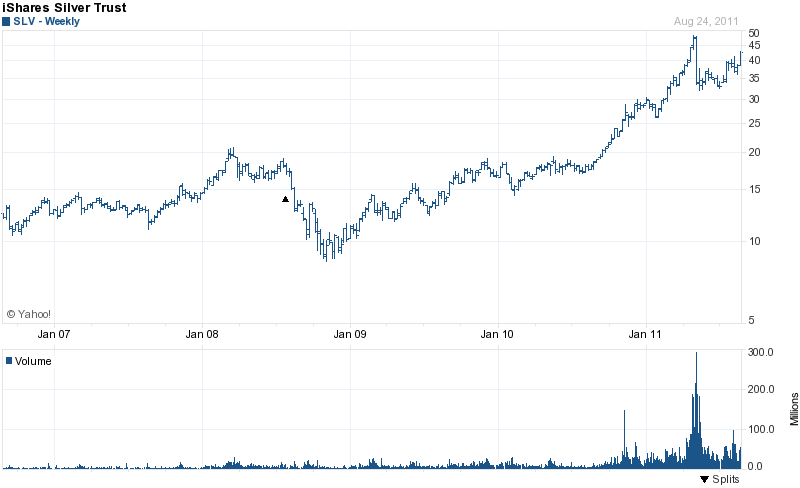
Many analysts have expressed concern that investors might be panicked out of the GLD causing the price of gold to plunge.  This does not seem to be the case despite the large drop in gold prices this week.  As of Wednesday, the GLD gold holdings declined by only 39.67 tonnes.  In addition, when silver spiked in early May, trading volume in the SLV exploded by 750% above the daily average trading volume.  Despite the volatility in gold this week, trading volume in the GLD expanded by only 350% above average trading volumes.  This would seem to indicate that investment in the GLD is a core holding by long term gold investors who are not inclined to sell on normal price corrections.

The SPDR Gold Trust currently holds 39.6 million ounces of gold valued at $70.1 billion.  There has been much hype about the value of the GLD exceeding that of the SPDR S&P 500.  A more proper context for comparison is to compare the value of the GLD to the increase in sovereign debt and money printing.  Bernanke’s latest episode of QE2 money printing was 850% larger than the entire value of the GLD and you can count on additional Fed currency debasement in the future.

GLD and SLV Holdings (metric tonnes)

August 24-2011 Weekly Change YTD Change
GLD 1,232.31 -39.67 -48.41
SLV 9,836.18 +109.08 -1,085.39

The iShares Silver Trust holdings gained 109.08 tonnes for the week ending August 24, despite the slide in silver prices.  The SLV has been building a base in the $35 to $40 range since the May correction.   Many analysts proclaimed that the “bubble” in silver prices had burst after the sharp price correction in May.  From a long term perspective, the May correction did little to diminish either the bullish fundamentals or the long term upward trend in silver prices.


SLV - COURTESY YAHOO FINANCE

The SLV currently holds 316.2 million ounces of silver valued at $13.3 billion.