April 8, 2026

Physical Gold Outperforms Vanguard And Fidelity Gold Mutual Funds

Investors in gold mutual funds have dramatically underperformed the return from holding physical gold over the past three years.  For a variety of reasons, many gold mining companies have been unable to turn higher gold prices into increased earnings.   As a result, gold stock mutual funds have dramatically underperformed the price gains of gold bullion.

Over the past three years, gold has increased by 80%, from a monthly low of $853 in May 2008 to $1,535 at today’s closing price.  Holders of the physical metal have done extremely well while investors in gold mutual funds run by two of the countries largest investment companies (Vanguard and Fidelity) have dramatically underperformed.

According to the Vanguard web site, the Vanguard Precious Metals and Mining Fund (VGPMX) has a three year average annual performance of -.46%, while the price of gold has soared 80%.  Vanguard states that although this fund is not a “pure gold or precious metals fund”, it invests in companies that are ” involved in the mining or of exploration for precious and rare metals and minerals”.  The Vanguard precious metals fund invests in 50 different stocks in 14 different countries and foreign holdings total 92% of assets.  The fund has net assets of $5.8 billion.

In early May 2008, the VGPMX reached $39 per share compared to today’s closing price of $27.20.  The fund has paid out dividends which added to the overall returns of the fund.
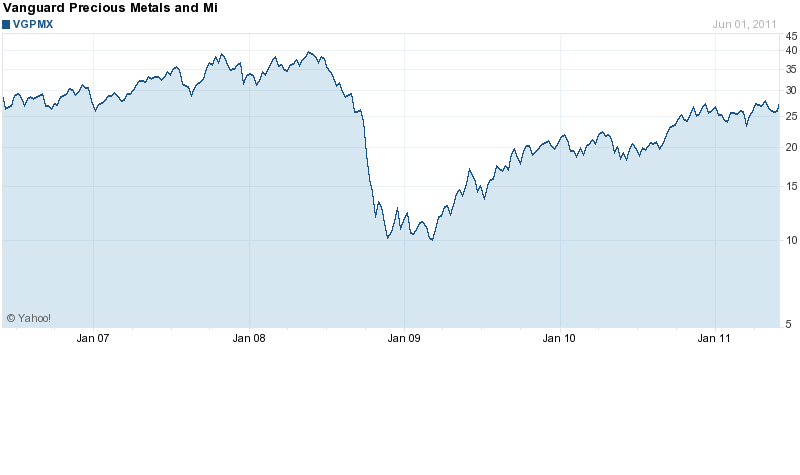
VGPMX - COURTESY YAHOO FINANCE

The ten year return on the Vanguard gold fund, however, would have outperformed holding physical gold.  A $10,000 investment in the Vanguard Precious Metals Fund made in May 2001, would now be worth approximately $76,300.  In May 2001, an investor could have purchased almost 38 ounces of gold for $10,000 which today would be valued at $58,330.  As noted above, the dividend payments by VGPMX added to the fund’s return.

The Fidelity Select Gold Portfolio (FSAGX) has outperformed the Vanguard fund, but still trails the three year return on gold bullion.  According to the Fidelity web site, the Fidelity gold portfolio had a 3 year return of 16.2%, compared to an 80% increase in the price of gold.

The Fidelity Fund invests at least 80% of its assets in companies involved in gold mining, exploration or processing.  The Fund also invests in gold bullion or coins and to a lesser degree, platinum, silver and diamonds.  The FSAGX has net assets of $4.5 billion.  The top ten holdings of the Fund at March 31, 2011 were Goldcorp, Barrick Gold, Newcrest Mining, Anglogold Ashanti, Newmont Mining, Kinross Gold, Agnico-Eagle Mines, Yamana Gold, Rangold Resources and Eldorado Gold Corp.  The total number of holdings of the Fund is 131.
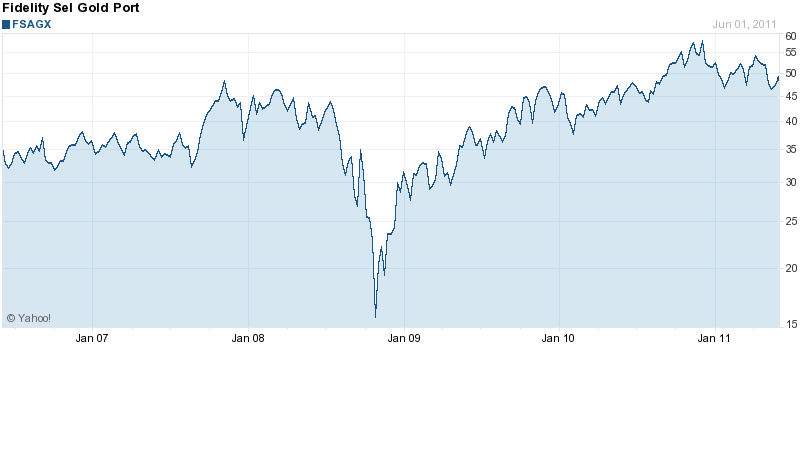
FSAGX - COURTESY YAHOO FINANCE

The long term results of the Fidelity gold fund slightly trail the Vanguard gold fund.  Fidelity had a 10 year average annual performance of 22.54% compared to a return of 24.02% for Vanguard.   Both the Vanguard and Fidelity fund had returns that exceeded the increase in the value of gold over the past ten years.

Will physical gold or gold mutual funds deliver the best return going forward?

A continued rise in gold prices should eventually translate into higher leveraged profits for gold mining companies, unless the substantial costs of gold mining exceed the increase in gold prices.  Inflation is rapidly rising as central banks continue to flood the global economy with cheap money.  A continued rise in energy costs and general inflation could negate the benefit of increased gold prices for gold mining companies.  Investors who hold physical gold or invest in gold trust ETFs, rather than gold mutual funds, should expect to see continued superior investment performance.
Gold And Silver ETF Holdings Show Little Change On Week

Holdings of the iShares Silver Trust (SLV) were unchanged on the week after dropping by 505.10 tonnes in the previous week.

After extreme price volatility at the beginning of May, silver prices were little changed over the previous week.  Based on the closing London PM Fix price, silver closed at $37.17 on May 25th compared to a closing price of $37.95 on June 1st.

The price of silver has now recovered by 16.7% or $5.45 from the low of $32.50 on May 12.  Silver reached a high for the year on April 28th closing at $48.70.  The price correction should be viewed as a buying opportunity since the fundamentals of the silver market have grown stronger with each passing day.

The debt crisis in Europe and the U.S. appear to be on the verge of spinning out of control.  The latest batch of economic reports show weak employment numbers, decline in the manufacturing sector and a continued collapse in U.S. real estate values.  Economies overburdened by debt desperately require higher economic growth which is simply not happening.  The prospect of continued economic weakness was finally acknowledged by previously bullish stock investors, as sellers pushed the Dow Jones down by almost 280 points for a 2.2% loss.

The latest sales figures from the U.S. Mint indicate that many investors see silver as a better store of value than paper currency.  Total year to date sales through May 31st of the Silver Eagle bullion coins totaled 18.9 million ounces, the most since 1986.  Comparable sales of the Silver Eagle for 2010 were 15.2 million ounces.

U.S. Mint sales of the Silver Eagles during May totaled 3.65 million ounces up from 2.82 million ounces in April.  If sales for the rest of the year continue at the average month’s sales volume, U.S. Mint sales of Silver Eagles would total 45.4 million ounces, valued at over $1.7 billion based on today’s closing price of silver.

GLD and SLV Holdings (metric tonnes)

June 1-2011 Weekly Change YTD Change
GLD 1,212.87 -1.21 -67.85
SLV 9,941.33 00.00 -980.24

The holdings of the SPDR Gold Shares Trust (GLD) decreased by a modest 1.21 tonnes over the past week, after gaining 22.74 tonnes in the previous week.   The GLD currently holds 38.99 million ounces of gold valued at $59.8 billion.  The price of gold gained slightly on the week, closing at $1,533.75, up $7.50 from May 25th.

US Mint To Increase Production Of Silver Bullion Coins To Meet “Unprecedented” Demand

The United States Mint announced that it will commence production of American Eagle Silver Bullion Coins at its San Francisco Mint.  For several years now, the Eagle Silver Bullion coins had only been produced at the Mint’s West Point facility.

In a press release this week, the US Mint noted that “Demand for American Eagle Silver Bullion Coins remains at unprecedented high levels.   Adding production at the United States Mint at San Francisco provides manufacturing flexibility across the bullion and numismatic product lines to meet customer needs.”

In the face of huge demand for the silver bullion coins, the US Mint has been allocating orders among its authorized purchasers.  The high demand and limited production has lead to high premiums of up to $5 per coin for purchasers of the silver bullion coins.

The US Mint recently came in for criticism for its failure to meet demand for physical bullion coins.  In early April, during a hearing by the House Financial Services Subcommittee, Rep. Ron Paul criticized the Mint for its failure to meet public demand for silver and gold bullion coins.  Ron Paul linked the shortage of bullion coins to the “huge debasement” of the United State currency and said that it was “imperative” that the US Mint meet public demand for bullion coins.

The US Mint said that it has capacity to mint up to “several hundred thousand coins per week” at the San Francisco facility.  The Mint will use the same packaging and manufacturing process at San Francisco that it uses at West Point and the coins will not have a mint mark.

Although demand for the American Eagle Silver Bullion coins remain high, the purchase of 90% silver coins is becoming a more cost effective and popular way to invest in silver.  There is a very small premium or even a discount from bullion value on the purchase of 90% silver coins.

APMEX is currently selling a $1,000 face value bag of 90% silver coins which contain 715 ounces of pure silver for $27,541.80.  Based on today’s closing New York price for silver of $38.16 per ounce, the silver value of the bag of coins being sold by APMEX is $27,284.

Precious Metals Stage Impressive Rally – Are Gold Stocks Next?

As measured by the closing London PM Fix Price, precious metals staged impressive gains this week, rallying across the board.  Ongoing concerns about the sovereign debt crisis in Europe, the debt limit ceiling stalemate in the U.S. and a weak dollar all contributed to continued fundamental demand for the metals.

After the London close, precious metals continued to gain in New York trading with gold at $1,537.00, silver at $38.15, platinum at $1,805.00 and palladium at $766.00.

The star of the week was silver which gained $2.89 per ounce for a gain of 8.3% on the week.  Although the correction of silver in early May was dramatic, the sharp pullback has provided long term investors with an opportunity to add to positions.  Silver fundamentals remain strong as detailed in a recent report by the Silver Institute in which it was noted that demand remained robust despite higher prices.  In addition, although higher prices has lead to increased mine exploration and production, new silver production during 2010 rose by only 2.5%.

Precious Metals Prices
PM Fix Since Last Recap
Gold $1,533.00 +42.25 (+2.83%)
Silver $37.69 +2.89(+8.30%)
Platinum $1,786.00 +19.00 (+1.08%)
Palladium $757.00 +23.00 (+3.13%)

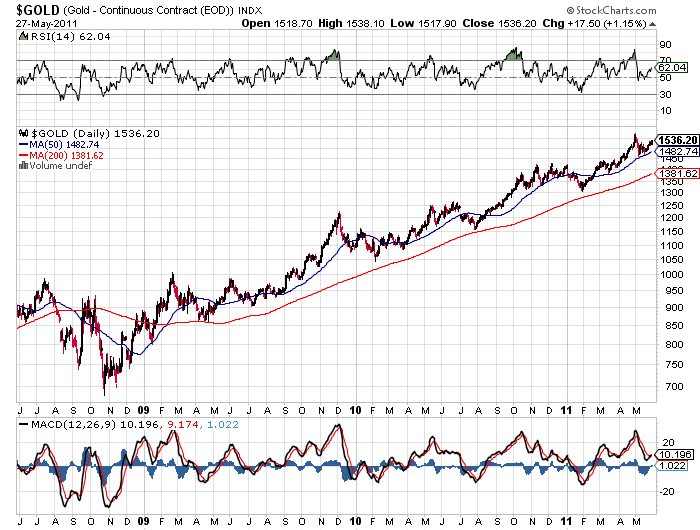
Gold has recovered nearly all of its early May price correction and is now only $8 off its high of $1,541.00 as measured by the London PM Fix Price.  The trend in gold remains solidly bullish and any price corrections should be viewed as a buying opportunity.


GOLD - COURTESY STOCKCHARTS.COM


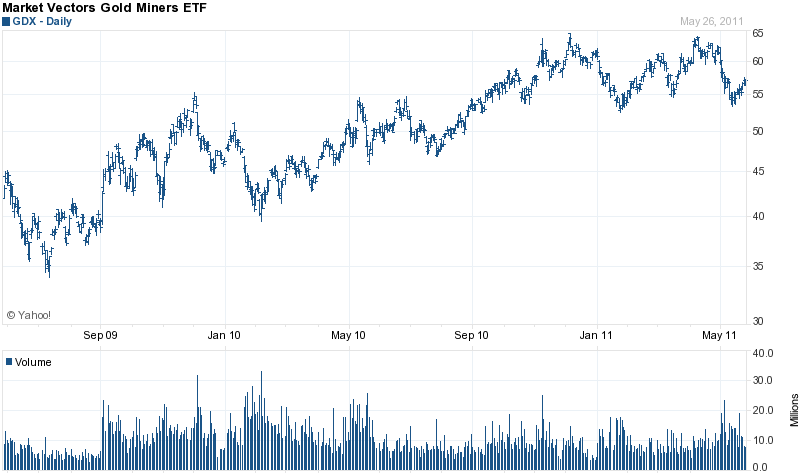
Gold stocks, many of which have trailed the returns of gold bullion, may also be viewed as attractive at this point. As measured by the Market Vectors Gold Miners ETF (GDX),  gold stocks are moving up after making multiple bottoms at the $55 support level.


GDX - COURTESY YAHOO FINANCE

Many of the gold mining stocks are selling at steep discounts to their gold reserves and represent solid values. Earlier this week, Kinross Gold, which sells at the equivalent of $250 per ounce, was a featured story. Value investor David Steinberg of DLS Capital Management, has a price target on Kinross of $27 per share. Kinross closed today at $16.11.

The Federal Reserve Can’t Produce Oil, Food Or Jobs But They Will Continue To Produce Dollars

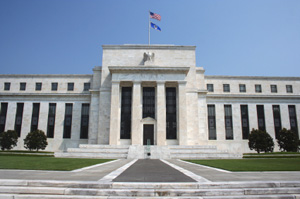
Federal Reserve

No bull market goes straight up without normal price corrections along the way.  The recent sharp pullback in silver prices and the more subdued correction in gold prices are likely to be viewed in hindsight as a superb buying opportunity.

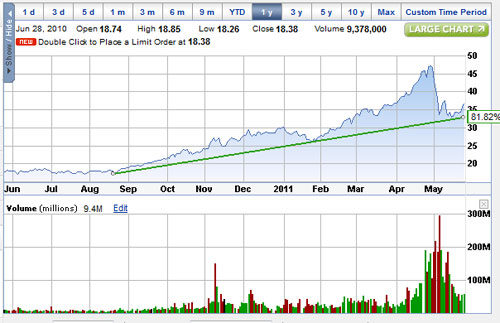
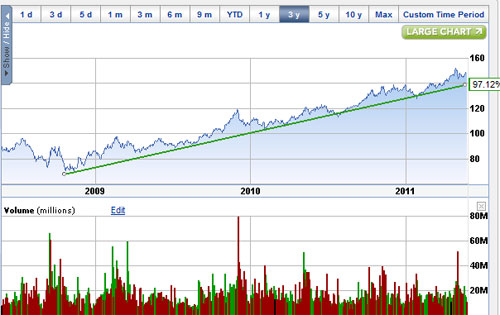
Simple trend line analysis suggests that current prices for gold and silver are in a buying range.  Using the SLV and GLD as proxies for the metals, we can see that the recent sell off has brought prices to trend line support.   Combining the “trend is your friend” theory along with solid fundamental underpinnings for gold and silver, higher prices seem inevitable.  For patient long term investors, especially in the gold market, every pullback of the last decade has simply been another opportunity to exchange depreciating paper dollars into a better store of value.

The SLV recently hit its trend line in the low 30’s.

SLV - COURTESY ETRADE.COM

The GLD’s long term trend line does not even hint of parabolic price movement, contrary to mainstream press reports warning the public of the dangers of gold investing.

GLD - COURTESY ETRADE.COM

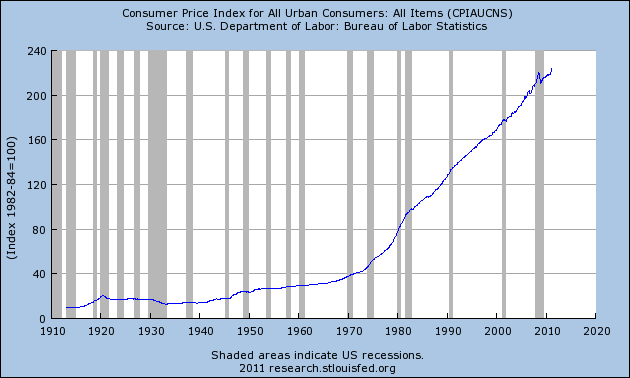
Despite the assertions of Fed Chairman Bernanke that inflation is not a problem, any one outside of the academic inner circle of the Federal Reserve sees inflation everywhere they look.  Soaring gasoline and heating costs have decimated family budgets and retail food inflation is projected to hit 4% or higher in 2011.  Constantly higher inflation, as measured by the Consumer Price Index, has prevailed ever since the U.S. officially went off the gold standard in the early 1970’s.  (See also Why Higher Inflation and $5,000 Gold Are Inevitable).

This week we have seen announcements of higher prices by Starbucks, Smucker Co, Nestle, McDonald’s and Whole Foods.  Walmart previously warned that the debasement of the dollar was translating into higher retail prices on imported items.  The upward price spiral in the cost of necessities is especially burdensome since incomes for the majority of Americans are not increasing.

In an excellent article in the Wall Street Journal this week, Ronald McKinnon persuasively suggests that the United States is entering 1970’s type stagflation, the result of high inflation, high unemployment and stagnant demand.  According to Mr. McKinnon,  “the U.S. economy again seems to be entering stagflation. April’s producer price index for finished goods, which excludes services and falling home prices, rose 6.8%. The Bureau of Labor Statistics reports that intermediate goods prices for April were rising at a 9.4% annual clip. Meanwhile the official nationwide unemployment rate is mired close to 9%.”

McKinnon argues that stagflation is being caused by the Fed’s zero interest rate policies (which besides robbing retirees and savers), has cause a global flood of hot money that has resulted in surging inflation in Asia and Latin America and a 40% rise in commodity prices over the past year.

The Federal Reserve’s policy options at this point seem limited to continuing their policies of cheap money and dollar debasement.  The Fed cannot produce oil as Bernanke recently commented.  Nor can the Fed produce food, jobs or higher housing prices.  The one thing the Fed can and has done is to produce paper dollars in extraordinary quantities.  Debt, when allowed to expand to levels that make repayment impossible, leaves the debtor with no good options – a point that we are rapidly approaching. (See also Why There Is No Upside Limit To Gold and Silver Prices).

How Wall Street Pros Made Huge Profits On Silver ETF Crash As Small Investors Sold

The holdings of the iShares Silver Trust (SLV) declined by a substantial 505.10 tonnes from the previous week.  The decline in SLV silver holdings from the all time high of 11,390.06 tonnes reached on April 25th comes in at a hefty 1,448.73 tonnes or 12.7%.  Silver, meanwhile, has declined in price by $8.31 per ounce or 18.3% since April 25th.

Although the price per share of the SLV tracks the price per ounce of silver very closely, the actual bullion holdings of the SLV can fluctuate, sometimes dramatically, from the underlying price movements of silver.  This same situation applies to the SPDR Gold Shares (GLD).

The reason why the physical holdings of the SLV and GLD do not closely track the price of gold and silver is due to the complex mechanism by which Authorized Participants can “create or redeem” shares in the SLV and GLD.  The silver and gold trusts are structured to allow large Wall Street investment firms to act as Authorized Participants to arbitrage against a premium or discount of the SLV or GLD share prices to the underlying net asset value of the Trusts.

Premiums or discounts to the net asset value of the Trusts occur based on normal supply and demand by investors during the course of trading in SLV and GLD shares.  The Authorized Participants routinely reap profits from their arbitrage activities based on the prevailing discounts or premiums .  According to the prospectuses of the GLD and SLV, the Trusts were structured in this manner to allow the price of the GLD and SLV shares to closely correspond to the underlying value of gold and silver bullion.

The Trusts do not directly buy or sell bullion based on investor buy or sell orders for the SLV and GLD.  The Trusts are not structured like a typical mutual fund which liquidates its holdings if there is a surge of investor redemptions.  Changes in the number of Trust shares outstanding and changes in holdings of gold and silver occur only based on the creation or redemption of shares through Authorized Participants.

Premiums or discounts of the SLV and GLD shares to net asset values are normally less than 1% but can expand dramatically when trading is volatile.  For example, on May 2nd, when silver prices were plunging, the shares of the SLV reached a huge discount of 9.87% from the net asset value of silver held by the SLV Trust.  Investors desperately seeking to liquidate their SLV shares caused the value of the SLV to trade at a steep discount to the underlying net asset value of the Trust.

At this point the lucky Wall Street pros who act as Authorized Participants were gladly buying the SLV shares and simultaneously shorting silver bullion, locking in huge profits.  Authorized Participants who arbitraged during this volatile trading profited greatly at the expense of panicky SLV sellers who sold shares of the SLV at $42.79 that were worth $47.51 based on the net asset value of the SLV.  (Pricing data on the SLV share discount was obtained from the iShares Silver Trust web site).

The Authorized Participants who bought SLV shares during the panic sell off then delivered their SLV shares to the iShare Trust and requested that they be redeemed for silver bullion which was then used to close out short positions in silver bullion.  Under this situation, the silver bullion holdings of the SLV decreased since they delivered silver bullion to the Authorized Participants in exchange for redeemed SLV shares.  This is exactly the situation that has occurred during the May silver sell off and it is therefore no surprise that the holdings of the SLV have plunged.

The average investor in the iShares Silver Trust would be hard pressed to understand the “creation and redemption” features of the SLV shares.  Although the SLV can be an easy way for an investor to participate in silver bullion ownership, my investment thesis is to avoid investments that cannot be fully or easily understood.

For investors seeking to establish investments in gold and silver without having to hold the physical metal, the Sprott Physical Gold Trust (PHYS) or the Sprott Physical Silver Trust (PSLV) offer better opportunities.  Both of these Trust hold specific amounts of physical gold or silver which do not change.  Each share holder has an unallocated interest in the precious metals held by the Trust.

All precious metal holdings of the Sprott Trusts are secured not by a bank, as with the GLD, but by the Royal Canadian Mint of the Canadian Government which is responsible for any loss or damage .  The gold or silver backing the Sprott Trusts are specifically allocated by the Mint to the Sprott Trusts.

From a total investment return standpoint, it is also important to note that the shareholders of the PHYS and PSLV are taxed at the capital gains rate of 15% (if held for more than one year) whereas shareholders of the GLD and SLV are taxed at 28%.  For further information see Sprott Physical Gold Trust Advantages Over SPDR Gold Shares Trust.

GLD and SLV Holdings (metric tonnes)

May 25-2011 Weekly Change YTD Change
GLD 1,214.08 +22.74 -66.64
SLV 9,941.33 -505.10 -980.24

Holdings of the SPDR Gold Shares Trust (GLD) increased by a modest 22.74 tonnes from the prior week to 1,241.08 tonnes.   The GLD held 1,280.72 tonnes at the beginning of the year.  The all time record holdings were reached on June 29, 2010 at 1,320.47 tonnes.  The GLD currently holds 39.0 million ounces of gold bullion valued at $59.6 billion.

Precious Metals Little Changed On Week While Investors Ponder Government Defaults

Precious metal prices traded in a narrow range this week.  As measured by the closing London Fix Price, gold, platinum and silver declined slightly while palladium gained $16 per ounce.

After the London close, prices of precious metals rose across the board in New York afternoon trading.  Gold closed at $1,514.50 up $19.70, silver at $35.26 up $.12, platinum at $1,775 up $8 and palladium at $739 up $8.   Buying in the precious metals may have been prompted by late day worries over the downgrade of Greek debt by Fitch Ratings as well as concerns over the worsening state of public finances in Spain, Portugal and Italy.

Yields of 25% on short term debt Greek debt imply that the markets are are pricing in a very high probability of default by Greece.  What markets do not seem to have priced in is the contagion risk of Greek default and what impact that would have on investor confidence, world financial markets and the global banking system.

Meanwhile the U.S. debt crisis continues to brew as the debt ceiling limit was reached with no indication of a resolution by Congress.  If the past is any guide, Congress will let the debt bomb/deficit crisis simmer until the last minute when the debt ceiling will be raised yet again under the guise of “future fiscal restraint” and the deficit spending and borrowing will continue as usual.

Ignoring the eroding financial condition of the U.S. today only ensures that the inevitable financial crisis will be more devastating than one might chose to contemplate.  The timing may be uncertain but the outcome is not.

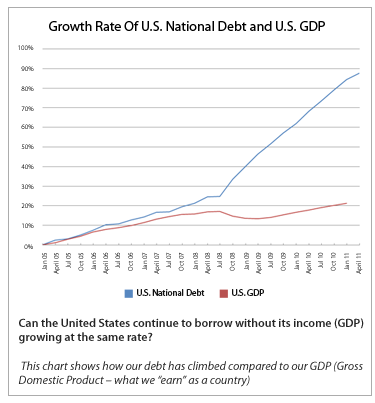
The American Precious Metals Exchange (APMEX) included a chart in one of its latest email newsletters that depicts the gap between the growth of  U.S. GDP and debt.  The chart graphically illustrates the extent to which the U.S. has been living beyond its means and using trillions in deficit financing to do so.

DEBT VS GDP - COURTESY APMEX

APMEX also notes that  “If there is no resolution (of the budget ceiling) by August 2nd, there could be disastrous ramifications for the U.S. and the global economy. The U.S. will be in default on its promises to pay. The value of the dollar could drop dramatically.”


Precious Metals Prices
PM Fix Since Last Recap
Gold $1,490.75 -15.00 (-1.00%)
Silver $34.80 -1.40(-3.87%)
Platinum $1,767.00 -7.00 (-0.39%)
Palladium $734.00 +16.00 (+2.23%)

Precious metals, silver in particular, have been undergoing corrective price action during May, but the fundamental reasons for owning precious metals grows stronger by the day.   Demand for precious metals remains strong.  The World Gold Council’s latest report shows that global demand for gold increased by 11% in the first quarter, while buying by Chinese investors reached all time highs.  The trend is still your friend in the precious metals markets and price weakness should be viewed as an opportunity to increase long term positions.

Why Higher Inflation And $5,000 Gold Are Inevitable

In his press conference on April 27, 2011, Federal Reserve Chairman Bernanke dismissed inflation worries, stating that “Our expectation is that inflation will come down and towards a more normal level”.   Should we believe him?  Not if you want to preserve your wealth and here’s why.
Chairman Bernanke has a perfect record of making inaccurate economic forecasts.

  • Bernanke, March 2007, prior to the historic housing crash said,  “At this juncture . . . the impact on the broader economy and financial markets of the problems in the subprime markets seems likely to be contained.”
  • Bernanke, February 2008, prior to the banking crisis that almost resulted in the collapse of the entire U.S. banking system  said, “I expect there will be some failures. I don’t anticipate any serious problems of that sort among the large internationally active banks that make up a very substantial part of our banking system.”
  • Bernanke, June 2008, prior to the worst recession and job losses since the 1930’s, said the danger of the economy falling into a “substantial downturn” appears to have waned.

Even if the Fed was able to keep inflation at a “benign” rate of 2% a year, the long term effects on savings are devastating.  Over ten years, a 2% inflation rate reduces the value of $100,000 to $82,034, resulting in an 18% loss in purchasing power.

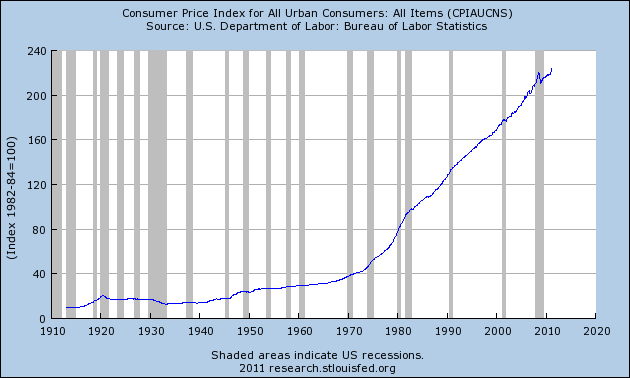
According to the Bureau of Labor Statistics, inflation averaged 3.4% since 1980.  At the beginning of 1980, one dollar had the same purchasing power as $2.86 at the end of 2010.

The cost of living has spiraled upwards since the early 1970’s, correlating perfectly to the point at which the value of the dollar was decoupled from gold.  In 1971, the United States stopped exchanging dollars for gold to foreign official holders of dollars and the dollar gold standard was officially ended in 1973.

The Fed’s policy of pushing easy credit for the past 30 years to fuel economic growth has left Americans swimming in debt.  The housing collapse and declining incomes have resulted in millions of mortgage defaults and underwater homeowners.  The Government’s attempt to bailout a collapsing economy and over leveraged banks and consumers has resulted in trillions of dollars in new debt and a $1.5 trillion deficit.

Government debt has exploded to the point where the solvency of the U.S. Government is now being questioned.  Large tax increases to erase the deficit would spin the U.S. into a deep recession.  The President and Congress lack the political will to cut spending.  The U.S. has spent and borrowed itself to the eve of financial ruin and must “inflate or die” at this point (see Why There Is No Upside Limit For Gold and Silver Prices).

The Fed, with the experience of two money printing campaigns already under its belt, will have no problems extending this practice.  As Bernanke noted in 2002 before he became Fed Chairman, “The U.S. Government has a technology, called a printing press, that allows it to produce as many U.S. dollars as it wishes at no cost”.

The Fed’s cheap money policies and concerted efforts to debase the value of the dollar are just beginning, and that means the biggest move up in precious metals is still in front of us.  My minimum long term forecast for gold remains at $5,000 per ounce and silver at $170 per ounce.

Silver Prices Higher After Latest COMEX Margin Increase

Despite the trepidation by some investors of further price declines, silver bounded higher, even as the fifth recent increase in silver margin futures by the COMEX took affect.  As measured by the London Fix Price, silver closed at $38.00 on Monday, up from $34.20 on Friday.  The impact of the higher COMEX margin requirements had clearly been discounted after being announced last Wednesday.
The COMEX had roiled the silver market last week with a rapid fire series of five hikes in initial margin requirements for trading silver futures (see How The COMEX Crashed The Silver Market).  The actions of the COMEX, combined with a short term overbought market, caused a sell off that sent silver prices plunging by a shocking 26% on the week.  The five margin increases by the COMEX increased initial margin requirements by a substantial 84%.   Thinly capitalized players were forced to liquidate positions driving silver prices lower, causing further forced selling as additional traders liquidated positions to avoid losses and margin calls.

The large increase in margin requirements was highly disruptive to the market and had a dramatic adverse impact on prices.  The mainstream media quickly characterized the drop in silver prices as proof that a speculative bubble had ended and predicted further declines in the price of gold and silver.

However, none of the fundamental forces driving the rise in the price of silver have changed. The forced liquidations of leveraged silver futures traders can be viewed as a positive.  The recent rout likely had the impact of moving positions from weak hands to long term investors willing to ride out the inevitable pullbacks seen in every bull market.

How the COMEX Crashed the Silver Market

By the close of trading on Wednesday, May 4th, the silver market had experienced significant selling pressure that drove prices down by 17.3% from Thursday, April 28th.  This sell off corresponded exactly to a series of increased margin requirements by the COMEX  for trading silver futures contracts.

Silver traders who may have been apprehensive about additional margin increases did not have long to wait.  After the close on Wednesday, May 4th, the COMEX announced two huge additional hikes in silver margin, effective at the close of business on Thursday and another hike effective at the close of trading on Monday, May 9th. As of Monday, initial contract margin requirements would be increased to $21,600 and to $16,000 for hedgers.  A year ago, when silver was trading in the $18 range, the margin requirement for a speculative contract was only $4,250.

The rapid series of five margin increases by the COMEX resulted in raising initial margin requirements for speculators from $11,745 to $21,600 – an increase of 84%.    The margin requirements for hedgers also increased by 84% from $8,700 to $16,000.   Silver futures traders would now be forced to come up with huge amounts of additional cash or liquidate holdings on price weakness.   The collapse in silver prices on Thursday May 5th, triggered by the COMEX margin increases, indicates that many players were forced to liquidate positions.

The actions taken by the COMEX constitute a perfect text book example on how to crash a market. The non stop increases in margin requirements resulted in a dramatic reduction of liquidity in the silver market by forcing out small speculators who were not prepared to commit additional cash for margin maintenance.  As prices fell in response to the COMEX margin increases, bigger players in the silver market were forced to liquidate positions to avoid margin calls and large losses on leveraged positions.

The last two margin increases by the COMEX, after silver had already declined by over 17%, created the perfect crash scenario.   Silver traders liquidating positions to meet new margin requirements caused a further cascade of forced selling and the silver crash became inevitable. The elimination of liquidity from any market will result in falling prices and the COMEX knew this.

If someone wanted to crash the silver market, the moves taken by the COMEX were perfectly designed to accomplish this by reducing liquidity at a time during which the markets were already stressed from previous margin increases. The result was a collapse in silver prices from $48.70 to the $34 range.

In response to the outrage over the devastating series of margin requirement increases, Kim Taylor, President of CME Clearing, which owns the COMEX, issued a statement explaining CME’s actions. According to Ms. Taylor, margin increases are related to risk management and done to prevent default by clearing member firms.  Margins are adjusted based on market volatility and are not designed to move a market or discourage investor participation.  Among the factors considered in setting margins is a CME calculation of a worst case scenario for possible portfolio losses.

Specifically regarding the margin increases on silver futures, Taylor stated that “we have made several changes in recent weeks to adjust to volatility in the marketplace…Our interest is in providing security for the entire market – no matter which way it moves”.

CME’s statement seems disingenuous at best.  The protection they speak of is not for the benefit of investors, but rather for the benefit of CME and clearing house members.  The actions of the COMEX in implementing a rapid series of margin increases, even after silver had already steeply sold off, resulted in large profits to short sellers and reduced risk for CME at the expense of huge losses for silver investors both large and small.

A slower series of margin increases would have seemed more appropriate to address price volatility.  The CME knew or should have known that its actions would severely limit liquidity in the silver market.   The decrease in liquidity caused further market volatility, requiring more margin increases, which in turn crashed the price of silver. Anyone looking into the great silver crash of 2011, can start by looking at the COMEX.