April 8, 2026

Major Buy Signal For Gold And Why Stock Markets Are Ignoring Predictions Of Economic Collapse

Predictions that the global economic system will collapse have been coming at an accelerated pace lately.  Usually, many of  the most extreme scenarios are from sources more interested in gaining publicity rather than offering a balanced analysis.

What’s unusual is that lately, many of these apocalyptic predictions are coming from some of the most normally sedate institutions in the world such as the IMF and the World Bank.

Central bankers and the heads of world financial organizations usually speak in oblique and obfuscated terms designed to convey confidence.  Either the financial powers are writing a new book of rules or we are all headed for some unimaginably horrific scenario of financial and social chaos.

Here’s a small sample of the latest warnings from the sedate and not so sedate.

IMF Chief Warns Europe Must Fuel Growth

BERLIN—The head of the International Monetary Fund warned that in addition to cutting yawning budget deficits Europe needs to do more to promote growth and stop the crisis from spreading to the world economy.

“It is about avoiding a 1930s moment, in which inaction, insularity, and rigid ideology combine to cause a collapse in global demand,” IMF Managing Director Christine Lagarde said before the German Council on Foreign Relations. “A moment, ultimately, leading to a downward spiral that could engulf the entire world,” she said.

World Bank Projects Global Slowdown

“Developing countries need to evaluate their vulnerabilities and prepare for further shocks, while there is still time,” said Justin Yifu Lin, the World Bank’s Chief Economist and Senior Vice President for Development Economics.

Developing countries have less fiscal and monetary space for remedial measures than they did in 2008/09. As a result, their ability to respond may be constrained if international finance dries up and global conditions deteriorate sharply.

“An escalation of the crisis would spare no-one. Developed- and developing-country growth rates could fall by as much or more than in 2008/09” said Andrew Burns, Manager of Global Macroeconomics and lead author of the report. “The importance of contingency planning cannot be stressed enough.”

Feliz Zulauf Sees More Trouble Ahead

Felix Zulauf: Yes, I believe the peripheral nations have entered recession territory, and I believe it will get worse.

So, the situation in Europe will get worse before it gets better. Moreover, the ECB, which has its roots in the German Bundesbank, will see to it that the ECB does not become the lender of last resort until they are absolutely forced into it by the market. For investors, this is very important to understand. The new leader Mr. Draghi may leave Trichet’s conservative path, however, as since he is in power he has talked one way and acted in another way. This is delicate as the credibility of the ECB could be lost quickly.

Euro Breakup Would Cause Global Meltdown

In his speech at Davos, Soros will say it is “now more likely than now” that Greece will formally default in 2012, Newsweek said. Soros nevertheless thinks the euro will survive, according to Newsweek.

The world is facing a period of “evil,” Soros said, adding that he foresees Europe descending into chaos and conflict, while rioting in the streets of the U.S. will lead to a curtailment of civil liberties and the global economic system possibly collapsing altogether, Newsweek reported.

All of the risks to global prosperity mentioned above have been well known by investors for months now.  The day the IMF Chief warned of a global depression worse than the 1930’s, the Dow Jones yawned and drop by 10 points.

Is there a major disconnect from reality by U.S. investors or has the worst already been discounted after the steep stock market sell off last August?  Ever since an inside out day on October 3 of last year, the Dow Jones has powered higher, ignoring all the bad news and warnings of Armageddon.  Exactly what is going on?
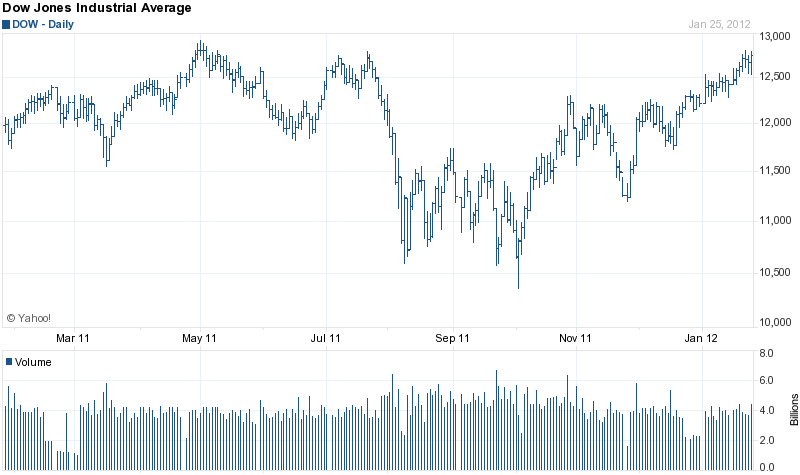
 

Dow Jones - courtesy yahoo.com

The answer is positive for both stocks and gold.  The “collective wisdom” of the markets saw a resolution to the imminent threat of the European debt crisis last fall, and that resolution is known as quantitative easing.  As previously noted in this blog last December, Every Solution To the Euro Crisis Involve Printing Money, which is exactly what happened.  Both the European Central Bank (ECB) and the Federal Reserve stand ready to print whatever quantity of money is required to paper over the European and U.S. debt crisis.

The massive first phase of the ECB’s Long Term Refinancing Operation advanced about $780 billion to Europe’s insolvent banking system, buying time and postponing the day of reckoning.  The ECB will hold a similar operation in February.

Long term this does little to solve Europe’s fundamental problems, but is short term bullish for stocks and extremely long term bullish for gold and silver.


Gold Soars As The Fed Explicitly Promises To Debase The U.S. Dollar

Federal Reserve Chairman Bernanke hit the panic button today by announcing a specific inflation target, vowing to keep rates at zero until at least 2014 and pledging to offer additional monetary stimulus. The Fed also noted, as it has in the past, that the economy still faces “significant downside risks”.

These actions by the Fed come nearly four years after the financial crisis began in 2008.  During that time, the Fed has ballooned its balance sheet to almost $3 trillion, driven real interest rates to negative 1.2% and encouraged lending by flooding the banking system with reserves.  The Fed’s monetary easing was supplemented by trillions of dollars in U.S. deficit financed spending  aimed at restoring economic growth and gluing back together the shattered real estate bubble.

Despite these unprecedented and controversial actions, the economy refuses to rebound.  Collapsing home prices, declining real incomes and an “official” unemployment rate of 8.5% are deflationary and this is what has panicked Bernanke more than anything else.  Deflation is the mortal enemy of a credit fueled, debt burdened economy.  Today’s actions by the Fed show that Bernanke will do whatever is necessary to prevent a deflationary collapse.  Of course, the markets already knew this.

GOLD 01/25/2012 17:15 1710.80 1711.80 +44.40 +2.66% 1648.20 1714.00
SILVER 01/25/2012 17:15 33.27 33.37 +1.22 +3.81% 31.46 33.53

The real reason behind the explosive move up in gold and silver was the historic change in Fed policy with the announcement of an explicitly targeted inflation rate of 2%.   Although the Federal Reserve has been debasing the value of the currency ever since its creation, for the first time ever, currency debasement and financial repression has now become an officially stated policy goal.


Gold Explodes - courtesy kitco.com


The concept of explicit inflation targeting is dangerous and reckless, which is why it has never been done before.  If the Fed decides that we need 2% inflation today, does the rate go higher later?  How will the Fed know exactly when and exactly how to stop creating inflation?  This is the same Fed run by the same Ben Bernanke who could not identify the biggest credit fueled real estate bubble in history.

Will debt-deleveraging overpower the Fed’s ability to create inflation?   Bloomberg’s Michael Kinsley persuasively tells us, Please Remain Worried About Rising Inflation.

About two years ago I wrote an article saying that despite the lack of evidence, and despite the near-universal belief among economists that it was not a problem, I was worried about inflation. My reason was that I couldn’t see how the government could pay off the massive debt it was running up except by inflating at least part of it away.

For this, I was widely ridiculed, and I’d like to take this opportunity to claim vindication. That is, I’d like to — but I can’t. Inflation (CPI) has been creeping up the past couple of years – – from less than 2 percent to more than 3 percent — but that’s still pretty low. Nevertheless, I double down: Barring a miracle, there will be a fierce storm of inflation sometime in the next few years and it will wipe out a big chunk of the national debt, along with the debts of individual citizens, and the savings of others.

One reason I say this is that the arguments on the other side have shifted. It used to be, “It’s not gonna happen — so don’t worry about it.” Now it’s, “You know, a moderate dose of inflation would be no bad thing. So don’t worry about it.” Kenneth Rogoff, an economics professor at Harvard University, is the leading spokesman for this view. He wrote in August that he would like “a sustained burst of moderate inflation, say, 4 percent to 6 percent for several years.” Five years of 5 percent inflation would reduce the value of debts by 27 percent —

It has been four years now, and things are starting to look up a bit. Time to raise taxes or cut spending? Time to stop borrowing? No, not yet (says Krugman). So, when? After eight years? Twelve? Soon you’ll be bumping into the next recession. Or do the annual deficit and the national debt simply not matter? If that’s the case, why do we pay taxes at all?

Although Kinsley cites the example of how “moderate”  inflation of 5% for 5 years would reduce the value of debt by 27%, the obvious corollary would be a decline in the value of the dollar by the same amount.  The U.S. dollar can no longer even pretend to be a store of value, given the new Fed policy of targeted inflation.

The old adage “don’t fight the Fed” is true – and the Fed has just given an all out buy signal on gold.

Demand For Silver Bullion Coins Hits Record High On Bargain Prices

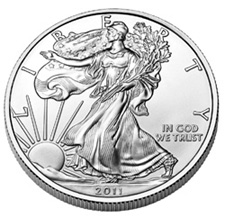
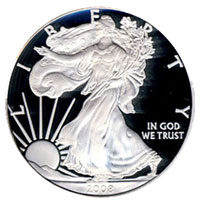
Sales of American Silver Eagle bullion coins hit an all time record high during 2011 according to production figures from the U.S. Mint.

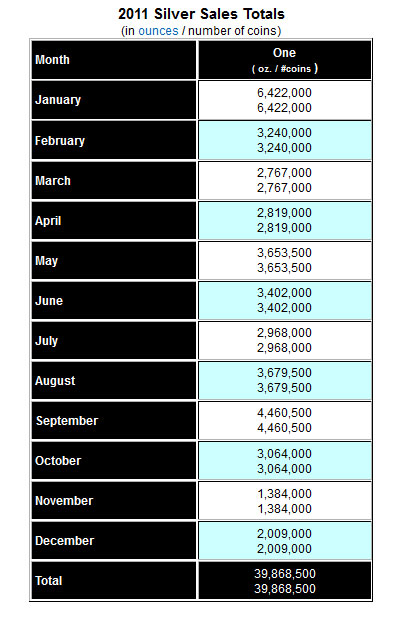
Sales of the Silver Eagle bullion coins increased by 13.3% in December to 2,009,000 compared to last year’s sales of 1,772,000.  For all of 2011, total Silver Eagle sales came in at an all time record high of 39,868,500 ounces, up 15.0% from the prior year’s total of 34,662,500 ounces.

In addition to the silver bullion coins, the U.S. Mint also produces proof and uncirculated American Eagle silver coins which can be purchased by the public directly from the U.S. Mint.  Commencing in 2010, the U.S. Mint began producing the America the Beautiful Silver Bullion 5oz coin.  During 2011, the U.S. Mint sold 397,700 of the 5oz coins, which represents almost another 2 million ounces of physical silver demand during 2011.

The U.S. Mint does not sell the American Silver Eagle bullion coins directly to the public.  The bullion coins are purchased from the U.S. Mint by a network of authorized purchasers who in turn resell them to secondary retailers for public sale.

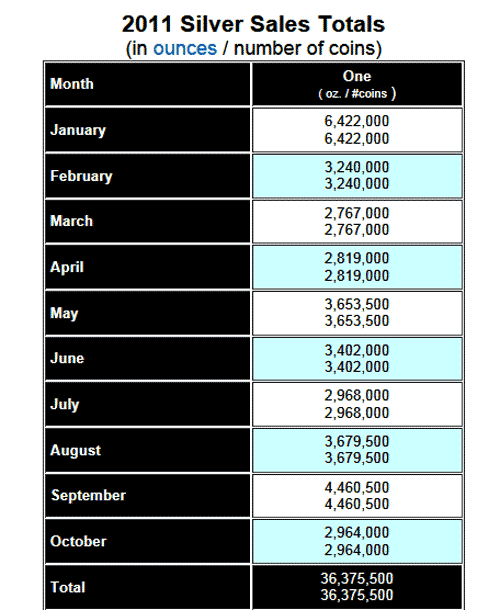
Monthly sales of the Silver Eagle bullion coins during 2011 are shown below.

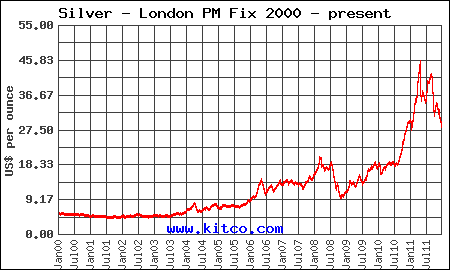
Silver had a volatile year during 2011, reaching a high of $48.70 in April and then dropping to a low of $32.50 in May after the COMEX repeatedly raised margin requirements on silver futures (see How the COMEX Crashed The Silver Market).  After recovering to $43.49 in August, silver declined to end the year at $28.18, off 8.1% for the year.

Despite the volatility in silver prices during 2011, investor demand for physical silver remained exceptionally strong.  After the significant price pullback from the April high, many analysts and armchair commentators who never owned an ounce of silver in their life were predicting a plunge in demand for silver.  The exact opposite occurred as long term investors took advantage of what is another historic buying opportunity comparable to 2008.

The case for buying silver remains rock solid and patient long term investors have been well rewarded.  As opposed to buyers of paper silver products such as the iShares Silver Trust ETF (SLV), holders of physical silver are invested in precious metals as part of a long term wealth preservation and appreciation strategy.  While speculators in paper silver products trade in and out, usually winding up with losses from my observations, long term holders of physical silver have seen the value of their holdings rise significantly.

Silver - courtesy kitco.com

As central banks of the world continue to print money at an accelerated rate, 2012 should be a year of strong gains for both gold and silver.  A steady plan of silver and gold bullion accumulation remains a no-brainer decision.  Since 2008, sales of silver eagle bullion coins have soared.  Last year, extremely heavy demand for silver resulted in periodic product allocations by the U.S. Mint.

In an excellent article by Steve Angelo, it was shown that massive physical demand for both the American Silver Eagles and Canadian Maple Leaf coins resulted in official coin sales surpassing the total silver production of both the United States and Canada.

Expect demand for silver bullion products during 2012 to surpass the record year of 2011.  Shown below are the yearly sales figures since 2000 for the American Silver Eagle bullion coins.

American Silver Eagle Bullion Coins
YEAR OUNCES SOLD
2000 9,133,000
2001 8,827,500
2002 10,475,500
2003 9,153,500
2004 9,617,000
2005 8,405,000
2006 10,021,000
2007 9,887,000
2008 19,583,500
2009 28,766,500
2010 34,662,500
2011 39,868,500


Gold Demand Soars On Fears Of European Debt Defaults

After a sharp September price correction, gold is on track to hit all time highs.  According to a Bloomberg survey, 80% of the forecasters with the most accurate track records are predicting that gold will reach $1,950 by the end of the first quarter.   Investors world wide are fleeing paper currencies as the threat of debt defaults spread across Europe.

Ironically, central bank attempts to stimulate debt burdened economies by lowering interest rates to zero has contributed to the worldwide rush to gold.  Why would investors hold return free government debt with the added risk of principal loss?

As financial turmoil spreads across the globe, gold traders are the most bullish since 2004.

Gold traders and analysts are the most bullish in at least seven years as investors accumulate metal at the fastest pace since August to protect their wealth from a widening European debt crisis.

Gold exceeded $1,800 an ounce for the first time in seven weeks on Nov. 8 and hedge funds are holding their biggest bet on higher prices since mid-September, Commodity Futures Trading Commission data show. The metal is rebounding after tumbling as much as 20 percent in three weeks in September on demand for what are perceived as the safest assets. Almost $9 trillion was wiped off the value of global equities since May and yields on Italian and Greek bonds rose to euro-era records this week.

“Throughout history gold has protected people from the sort of turmoil that we’re seeing,” said Mark O’Byrne, the Dublin-based executive director of GoldCore Ltd., a brokerage that sells everything from quarter-ounce British Sovereigns to 400-ounce bars. It’s “an important thing to own when there is this sort of volatility in stock markets and concern about currency devaluations.”

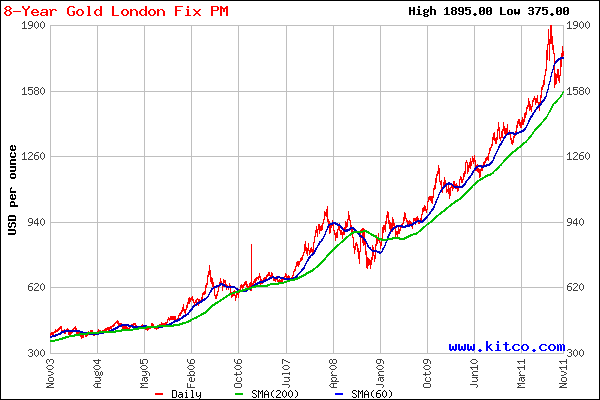
Gold climbed 24 percent to $1,766.72 this year, heading for an 11th consecutive annual advance. It’s the second-best performer behind gas oil in the Standard & Poor’s GSCI Index of 24 commodities, which rose 5 percent.

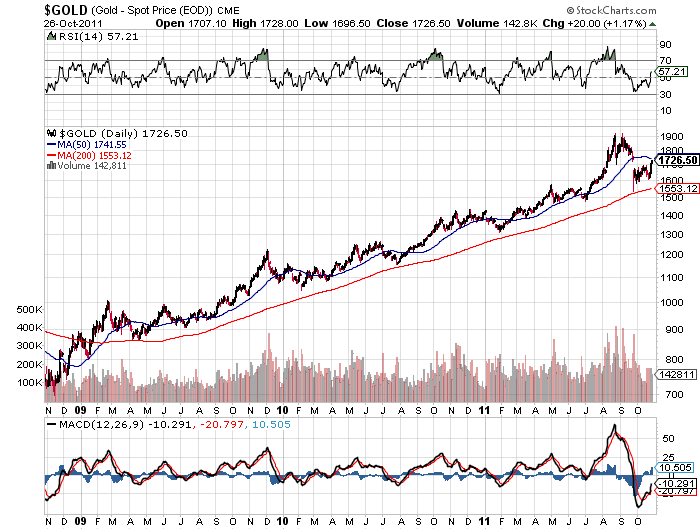
Technical indicators suggest the rally that began in September has further to go. While gold jumped 14 percent since reaching an 11-week low Sept. 26, its 14-day relative-strength index is at 58, below the level of 70 that indicates to some who study technical charts that the metal is poised to drop.


Gold - courtesy kitco.com

As discussed previously in this blog, proclamations by the mainstream press after the September gold price correction that the “gold bubble had burst” constituted a contrarian buy signal for gold and silver.  The September correction was simply another opportunity for long term gold investors to add to positions at bargain prices.
The fundamental reasons for owning gold and silver have not changed and are not likely to anytime soon.


$40 Silver Predicted By Year End

Will silver hit $40 by year end?

The latest in depth report on silver from the Silver Institute builds a sound fundamental rationale for a price of $40/ounce or higher by 2011 year end.  The Silver Institute report analyzes the current silver market, sources of investment demand, paper instruments linked to silver, silver mining stocks and privately held silver stocks.

Highlights of the Silver Institute report are summarized below and the full report can be found here.

1.   China and India dominate retail demand for silver but demand from India can be volatile with periods of heavy disinvestment such as occurred in 2009.  The key to silver demand in India remains linked to consumer price expectations and inflation in India has been soaring, reaching almost double digits.

Based on India’s current 9% inflation rate, 2012 is likely to see continued huge demand for both gold and silver.   Paper assets currently have little appeal to Indians seeking to preserve their wealth since interest rates are currently negative.  According to an article published at GATA, the yield on ten year notes is almost 1% below the rate of inflation resulting in an erosion of wealth for holders of paper assets.  Savers are reacting accordingly and purchasing precious metals to preserve their wealth.  During October, imports of gold and silver rose 40% to $7.2 billion.

2.   The Silver Institute forecasts that gold and silver will benefit as a safe haven based on the expanding European sovereign debt crisis which appears to be spiraling out of control.  Silver should also benefit from asset reallocation as recession in Europe causes losses in traditional paper assets.

Amazingly, as both paper currencies and governments continue to collapse, investors still have a blind misguided faith in paper assets back only by the “full faith and credit” of insolvent nations.  Proof of this is seen by the Silver Institute’s forecast of only a 10% increase in retail demand for bullion coin and small bar in Europe.  Demand for precious metals in the U.S. is forecast even lower at 7%.  Such modest demand for the only currency that cannot be debased by government actions completely refutes those who claim that precious metals are in a bubble.

3.  The Silver Institute forecasts that investment demand in 2011 will reach new record highs of $10 billion.  Chinese demand for physical silver should grow by 25% and Indian demand for silver should increase by a massive 55% to 45 million ounces.  The Institute Report also notes that the silver market in China is still very small since the market for silver was only recently liberalized in 2009.

U.S. investors have also taken the opportunity to capitalize on bargain silver prices.   U.S. Mint sales of American Silver Eagle bullion coins should easily hit an all time record high of over 42 million ounces in 2011.

4.   The Silver Institute notes that the rise in silver prices has correlated with the increased price of gold and also benefited from the introduction of ETF products, such as the iShares Silver Trust (SLV).  The iShares Silver Trust has grown to $10.6 billion with holdings of 314.6 million ounces of silver since its launch in 2006.

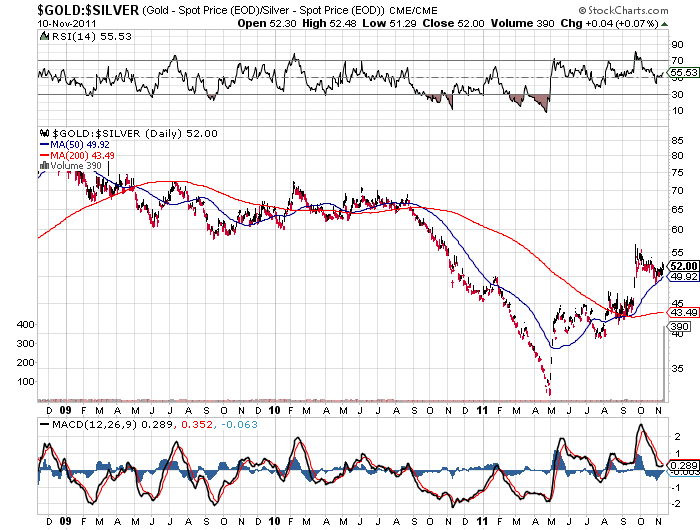
The correlation of silver to gold prices, as represented by the gold/silver ratio, also suggests that the price of silver is undervalued.   From a long term historical perspective, a gold/silver ratio of 16 has prevailed.   After dropping from 70 to 30 during the first half of the year, the gold/silver ratio has climbed to 52.  If the gold/silver ratio returns to 16, silver prices could easily reach $110 per ounce based on the current price of gold.

The increasingly tenuous “value” of paper currencies combined with increased worldwide demand for silver as a safe haven asset makes a compellingly bullish case for additional investment in silver.


American Silver Eagle Bullion Sales Soar As Investors Buy At Bargain Prices

The US Mint’s latest monthly reports on the sale of American Silver Eagle bullion sales show that investor buying has hit all time record levels.

Total sales of the American Silver Eagle bullion coins in 2010 came in at a record high of 34,662,500.

With over two months remaining in 2011, sales of the American Silver Eagle have already surpassed the record level of 2010 with sales of 36,375,500 ounces.  If sales of the Silver Eagle for November and December match the levels of 2010, total sales for 2011 should total over 42 million ounces or more than 20% above the record breaking sales level of 2010.

A review of sales by month for 2011 indicate solid fundamental buying by silver investors.  Typically, buying of an asset will increase as prices go higher and decrease as prices decline.  This was not the case with the American Silver Eagles – despite a sharp sell off in May and September, monthly sales increased as investors took advantage of bargain prices.

Silver had a volatile year, selling at $30.67 per ounce at the beginning of the year and moving up to a high of $48.70 (as measured by the London PM Fix Price) on April 28th.  Silver closed yesterday at $33.47, up $2.80 or 9.1% on the year.

Based on strong fundamental demand for physical silver, expect silver prices to end the year considerably higher.

Why Gold And Silver Prices Will Continue To Rise

The September correction in the price of gold and silver resulted in a flood of bearish articles by the mainstream press, proclaiming that the “gold and silver bubbles” had burst.

Since the mainstream press does not comprehend why precious metals have been in a bull market for the past ten years, the proclamation of the “end of the gold and silver bull markets” was, in reality, a contrarian bullish call.

Every long term bull market has sharp sell offs and gold and silver are no exception to this rule.  The sharp rise of gold prices during the summer attracted hot money from speculators and hedge funds who quickly liquidated positions based on short term technical sell signals, driving down the price of gold by over $300 per ounce.

As previously discussed, the fundamental reasons for owning gold and silver have not changed – in fact, they have grown stronger.  The September sell off in precious metal prices was simply another fantastic opportunity for long term investors to increase positions at bargain prices.

Long term investors in precious metals have outperformed virtually every asset class for the past ten years.  Even after the panic selling of September, gold still held gains of over 20% on the year from a price of $1,405 at the start of 2011.  Silver, despite a very volatile year, also remains above its price of $30.67 at the beginning of the year.

Both gold and silver remain in established long term up trends and remain at oversold, bargain level prices.


One strong fundamental factor providing support for further price gains in gold and silver comes from Mark Hulbert, whose Hulbert Financial Digest measures newsletter sentiment on the gold market.  Recent readings of the Hulbert Gold Newsletter Sentiment Index (HGNSI) (tracked by the Hulbert Financial Digest) revealed that at the end of last week gold timers were extremely bearish on gold.

The HGNSI readings dropped to the most bearish level in two and a half years, with gold market timers recommending a 13% short allocation in gold portfolios.  Hulbert’s research shows that gold usually rises when gold timers are very bearish.  Hulbert notes that gold timers have not been this bearish since March of 2009 – a level from which gold prices subsequently doubled.


Treasure Hunters Find 7 Million Ounces of Silver On SS Gairsoppa

On  February 16, 1941, Ernst Mengersen, Captain of Nazi U-boat 101, torpedoed the starboard side of the British merchant ship SS Gairsoppa, sending her to the bottom of the Atlantic.  Little did Captain Mengersen realize that the value of the sunken ship’s cargo would be worth almost a quarter of a billion dollars seventy years later.

The wreck of the SS Gairsoppa was discovered 300 miles off the coast of Ireland, at a depth of 15,400 feet, by Odyssey Marine Exploration.  The British Government had awarded an exclusive contract to Odyssey to find the SS Gairsoppa which, on her last voyage, was returning from India with a cargo of pig iron, tea and 7 million ounces of silver ingots.

The silver treasure, which is the largest value cargo salvage in history, was originally valued at approximately £600,000 British pounds when the SS Gairsoppa was sent to the bottom of the Atlantic.  Those 7 million ounces of silver today are worth 225 times the 1941 value or about £136,000,000 ($210 million).

The 412 foot steel-hulled SS Gairsoppa had been in service since her construction in 1919 and was sailing with a convoy to England on what turned out to be her last voyage.  Running low on fuel and in a heavy storm, the unlucky ship left the convoy to head for Galway, Ireland.  After being spotted by a German plane, the Gairsoppa’s fate was sealed as U-101 moved in for an easy kill.

Although the general location of the sunken ship was long known, the technical complexity of salvage operations at a depth of 4,700 meters made recovery operations almost impossible.  Recent advances in salvage recovery, as well as the increased value of silver, resulted in the British government soliciting private companies to find and salvage the Gairsoppa’s precious cargo.  Under the agreement with the British government, Odyssey Marine  will keep 80% of the value of the silver bullion recovered.

SS Gairsoppa - courtesy Odyssey Marine Exploration

Odyssey Marine has gained fame for previous discoveries of sunken ships laden with gold and silver treasure.  In 2003 Odyssey discovered the SS Republic, a Civil War era ship with over 50,000 silver and gold coins on board.  Odyssey also recovered a treasure trove of over 500,000 silver and gold coins from a Colonial era shipwreck site code named Black Swan.

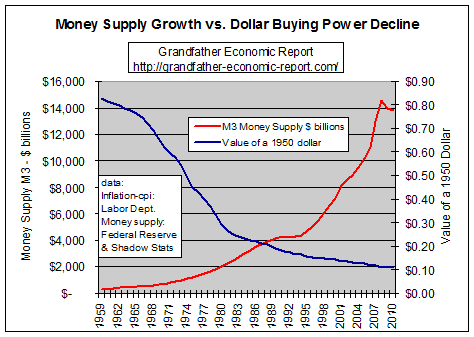
Of the hundreds of thousands of shipwrecks over the centuries, the only cargo worth retrieving (other than archaeological treasures) are precious metals, which have retained value since the dawn of human civilization.  Just for laughs, let’s compare that to the purchasing power of the paper dollar over the past half century.


A Perspective On The Plunge In Gold and Silver

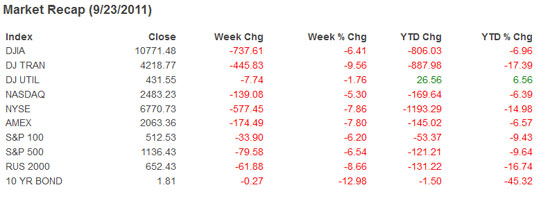
Fed Chairman Ben Bernanke set the world on fire this week as his latest scheme to “twist” long term interest rates lower pleased no one and triggered a 737 point drop in the Dow.  In addition, the Fed panicked investors by admitting that there were “significant downside risks to the economic outlook”.

Virtually every asset class except U.S. treasuries went into full scale meltdowns.  The U.S. stock market registered its worst weekly drop since the dark days of October 2008 when the  U.S. banking system was collapsing.

The rush to liquidity and forced margin selling sent precious metal prices into a tailspin. London silver plunged by $7.07 or 18%, to $32.90, the biggest decline since 1987.  Gold, as measured by the closing London PM Fix Price, dropped $105 on the week to $1,689, the largest weekly decline since 1983.  Spot prices for both gold and silver continued lower in New York afternoon trading with gold settling at $1658.20 and silver at $31.03.

Platinum dropped by $147 on the week to $1,651 and palladium dropped by $73 to $659 for losses of 8.18% and 9.97%, respectively.  Silver, with 60% of its demand relating to industrial use,  took the largest plunge in the precious metals group as economic indicators pointed to a rapidly slowing economy worldwide.

Precious Metals Prices Sept 23
9/23PM Fix Weekly Change
Gold $1,689.00 -105.00 -5.85%
Silver $32.90 -7.07 -17.69%
Platinum $1,651.00 -147.00 -8.18%
Palladium $659.00 -73.00 -9.97%

Although the sharp declines in gold and silver are unsettling, the fundamental reasons for owning gold and silver remain intact.  The rapid price increases in gold and silver since July attracted large investment flows from hedge funds and other short term speculators, who rapidly liquidate large positions based on short term technical sell signals.

Despite this week’s panic selling, long term gold investors have seen their investment rise from $1,405.50 at the beginning of the year, for a gain of $283.50 (20.2%).  Silver, despite this week’s painful sell off, is still higher by $2.23 or 7.3% from the beginning of the year, as measured by the closing London PM Fix Price.

For additional perspective on the relative performance of the gold and silver markets, here’s the record for various stock indices and the 10 year bond since the beginning of 2011.  (Note that the 10 year bond shows yield, not price.)

Asset Performance - courtesy schwab.com

Meanwhile, as the global financial system rapidly moves towards the precipice, faith in the ability of governments to contain the crisis is quickly eroding.  2011 is not a replay of the 2008 financial meltdown – it’s much more dangerous.  The sovereign governments that “saved the system” in 2008 incurred massive amounts of debt which have brought them to the brink of insolvency.  The bankruptcy of one country could ignite a financial firestorm that world governments cannot contain.

The inability of European leaders to effectively act in concert to resolve the Euro debt crisis has drawn the United States into the center of the crisis.  According to The New York Times, the U.S. is pushing Europe to mount a massive bailout to avoid financial Armageddon.

The Obama administration, increasingly alarmed by the spillover effects of Europe’s financial crisis, has begun an intensive lobbying campaign to persuade Chancellor Angela Merkel of Germany and other leaders to ramp up efforts to stem any contagion from the debt crisis in Greece.

In phone calls and meetings over the last week, President Obama urged Mrs. Merkel and President Nicolas Sarkozy of France to take coordinated measures — including spending billions in additional funds to bail out Greece and bolster European financial institutions — to prevent Greece’s debt woes from spreading to its neighbors.

“The biggest single risk to the United States today is that the European situation will spiral out of control,” said Edwin M. Truman, a former Treasury official who is now at the Peterson Institute for International Economics. “Europe is not going to save the U.S. economy, but it could be the straw that breaks it.”

Kenneth Rogoff, a Harvard economist who has written about the history of financial crises, puts Europe’s effect on the United States in blunt political terms. “The downside scenario is awful,” he said…

American officials have also emphasized the Fed’s outsize role in responding to the financial crisis here and urged Europe to view the Fed as a model. It made trillions of dollars in loans so that investors remained able to buy and sell a wide range of financial products.

Given the risks to the United States economy from a banking collapse and sovereign defaults in Europe, anyone who thinks that the United States will not be getting deeply involved in the financial bailout of Europe is delusional.  The “rescue” of Europe will ultimately involve the same techniques (zero interest rates and money printing) used by Bernanke in the United States.  The resulting negative interest rates and worldwide debasement of paper currencies will ultimately send gold soaring to new highs.

Gold and Silver Soar On Fears Of Massive Central Bank Stimulus

Precious metals soared across the board this week.  The dismal jobs report released on Friday showed that the American economy has come to a standstill with zero new jobs added in August.

The specter of the US economy plunging back into recession along with imminent banking crises in Europe and the US have fueled speculation that the Federal Reserve is on the verge of conducting another massive wave of monetary stimulus which will further debase the value of the US dollar.  Apprehension is also growing that the magical Obama plan for “creating” new jobs will involve further borrowing by an already bankrupt  American empire.

Also lurking in the background is the fear of coordinated US and European central bank intervention (money printing) to contain the collapse of the European banking system.  Despite the purchase of hundreds of billions of dollars of Spanish, Greek and Italian debt by the European Central Bank, rising interest rates are forecasting default by numerous sovereign states in the European Union.   Rates are rising again on Italian debt and the rate on one year Greek paper now exceeds 70%.  The yields on Greek debt indicate that default is now a certainty and the losses by insolvent European banks holding PIGS debt will require unprecedented government bailouts to prevent complete financial chaos.

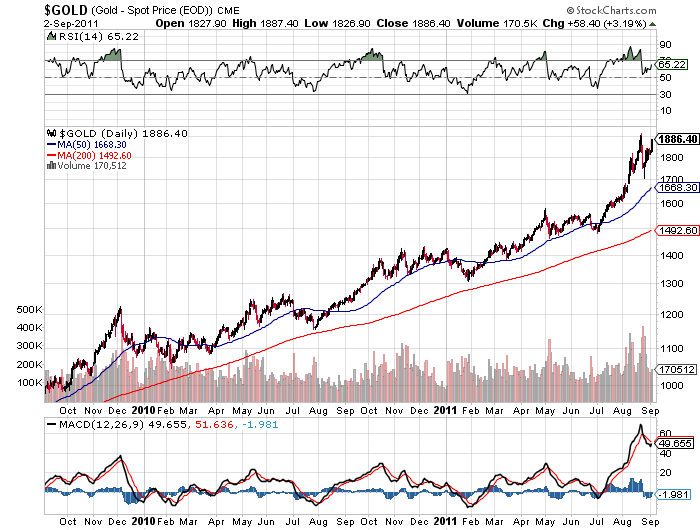
Soaring gold prices have been predicting the collapse of paper money currencies.  As measured by the closing London PM Fix Price, gold soared on Friday by $54.25 to $1,875.25.  In later New York trading, gold continued higher closing at $1,885.20.  Gold is only $2.25 below the all time London close of $1,877.50 reached on August 22nd.

Precious Metals Prices Sept 2
PM Fix Since Last Recap
Gold $1,875.25 +87.25 +4.88%
Silver $42.50 +1.44 +3.51%
Platinum $1,873.00 +61.00 +3.37%
Palladium $785.00 +38.00 +5.09%

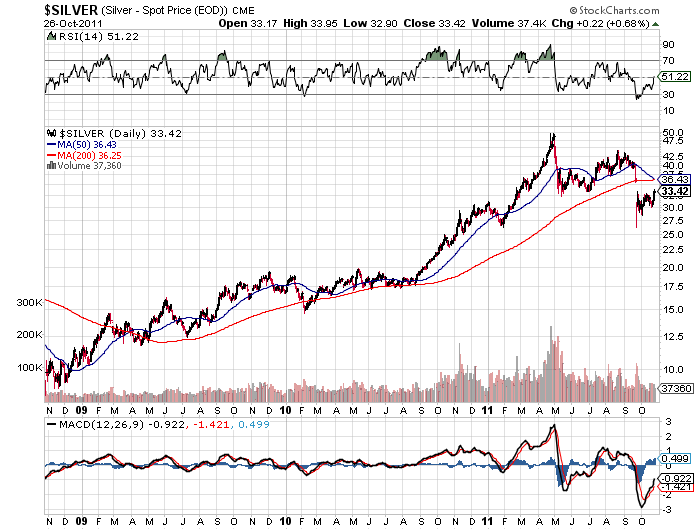
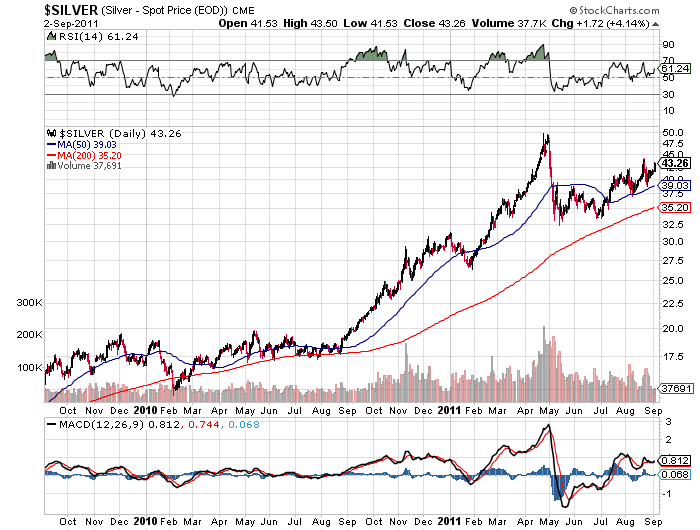
As measured by the closing London PM Fix Price, silver gained $1.44 on the week to $42.50 and continued to rise in later New York trading to $43.35.   After consolidating in the $34 range, silver has resumed its uptrend and is likely to hit new all time highs before year end.


Silver - courtesy stockcharts.com

Platinum soared by $61 on the week to close at $1,873 while palladium finished up $38 to close at $785.

Precious metals may correct after strong advances, but the fundamental case for owning them is growing geometrically.  Expanding deficits and wild money printing will continue as policy makers continue their futile attempts to produce economic recovery by adding more debt to a system already collapsing from the burden of excessive debt.   Continue to increase gold and silver positions on any pullbacks.


Gold - courtesy stockcharts.com