April 13, 2026

iShares Silver Trust Holdings Reach Record High As Gold and Silver Hit New Highs

Silver holdings of the iShares Silver Trust (SLV) jumped to another new record high this week while holdings of the SPDR Gold Shares Trust (GLD) dropped slightly.

The SLV holdings increased by 22.93 tonnes to surpass last week’s record high.  Holdings of the SLV now total 11,162.45 tonnes or 358.9 million ounces of silver valued at $14.2 billion.  Since silver began its nonstop advance in late January, holdings of the SLV have increased by a substantial 757.28 tonnes.

GLD and SLV Holdings (metric tonnes)

6-April-2011 Weekly Change YTD Change
GLD 1,205.47 -6.37 -75.25
SLV 11,162.45 +22.93 +240.88

The London Fix Price for silver increased by $2.10 (5.6%) over the past week, closing today just below $40 at $39.63.  The price of silver has now reached levels last seen 31 years ago in 1980.  Patient silver investors who took the opportunity to increase holdings when the metal was below $10 per ounce are now enjoying the profit of patience.

The astonishing rally in silver prices since late last August has resulted in a gain of 114% for the SLV.  Profits from owning the ProShares Ultra Silver ETF (which does not hold physical silver) have been even more dramatic for silver bulls with a gain of over 400% since last August.

Despite the large price gains in silver since late January, we have not yet witnessed a large volume price spike as was seen in early November 2010 which lead to a 3 month price consolidation.  The next logical resistance level for silver would be on its approach to $50.  Besides the psychological resistance of round numbers, the all time high of silver is $48.70 reached in January 1980.
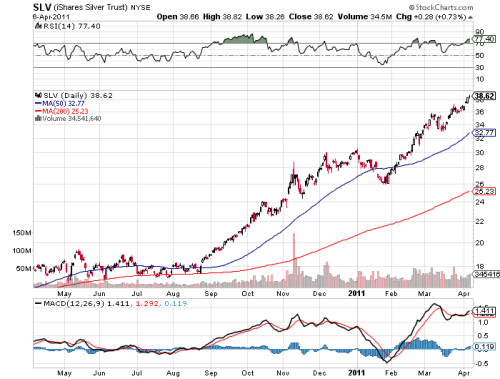
SLV - COURTESY STOCKCHARTS.COM

Holdings of the GLD declined by 6.37 tonnes on the week, bringing the decline in gold bullion holdings to 75.25 tonnes since the beginning of the year.  The all time record holdings of the GLD reached 1,320.47 tonnes on June 29, 2010.  The SPDR Gold Shares Trust (GLD) now holds a total of 38.8 million ounces of gold valued at $56.6 billion.

The price of gold, as measured by the closing London PM Fix Price hit an all time high today of $1,461.50 and has now broken through resistance at the $1,450 level.  Many analysts are now targeting $1,500 as their next price objective.  Fundamentals favoring the gold market continue to be strong, especially as the U.S. continues inexorably towards a debt crisis at some point in the future (see Gold and Silver Soar As Budget Fiasco Sends Wrong Message to U.S. Creditors).
Gold and Silver Prices Soar As Budget Fiasco Sends Wrong Message To U.S. Creditors

Gold and silver prices rose to new highs today on continuing concerns over a weak U.S. dollar, the European debt crisis, growing conflicts in the MidEast and escalating doubts over the ability of the United States to avoid a debt crisis.  The ongoing budget charade in Washington makes it perfectly clear that neither political party has the desire or ability to seriously address the exploding level of U.S. debt.
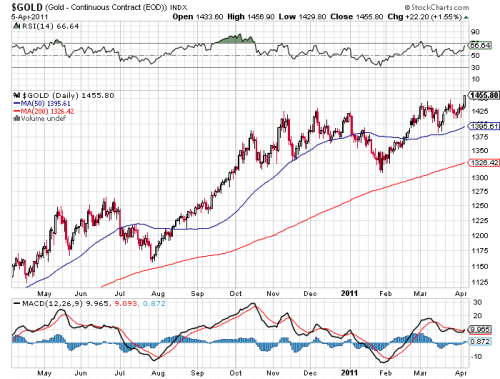
Gold hit a new all time high of $1463.70 and silver reached a 31 year high at $39.79.  Prices of both metals eased in early afternoon trading with the New York Spot Price for gold at $1456.70 and silver down fractionally at $39.33.  The limit on future increases in precious metals prices has effectively been removed due to the absolute inability of Congress to address the looming debt crisis.

GOLD - COURTESY STOCKCHARTS.COM

With the United States facing a $1.5 trillion dollar deficit on a projected budget of $3.6 trillion, politicians are threatening to shut down the Government over their inability to agree on whether spending should be cut by $40 or $60 billion.  Does anyone really believe that Congress is capable of coming to terms with the reality of an exploding deficit and spiraling national debt when agreement cannot be reached on $20 billion – a mere one half of one percent of total government spending?

The surge in gold prices reflects the realization that the nation is on the fast track to higher interest rates, a spiraling increase in the cost of living and a continued debasement of the U.S. dollar (see Why There Is No Upside Limit To Gold and Silver Prices).

Meanwhile, as the threat of a Government shutdown looms, Treasury Secretary Geithner warned of dire consequences if the U.S. is not allowed to borrow more money by raising the debt ceiling above its current limit of $14.3 trillion.  At a meeting with a Senate Appropriations subcommittee Secretary Geithner forecast that a U.S. default would lead to much higher interest rates, the failure of hundreds of thousands of businesses, payment cuts to senior citizens and a financial crisis worse than that of 2008 – 2009.

Geithner’s prediction of Armageddon, unfortunately, comes with no prescription on how to reign in out of control Government financial policies which are the fundamental threat to the country’s economic future.  It’s not just this year’s or last year’s multi trillion dollar deficits that are the root of concern, but rather the massive long term structural deficits that are now built into Government spending budgets.

The debt limit will eventually be raised and both political parties will claim victory.  America’s creditors will ponder the increasing risk of U.S. Treasury debt and ultimately conclude that the U.S. has no will to fix a financial system on the brink of insolvency.  The ultimate day of financial Armageddon, alluded to by Secretary Geithner, will not be forestalled by our unworkable political process.  The final reckoning and hard choices will be made only when forced upon us by markets that refuse to finance additional U.S. borrowing.

Proshares Ultra Silver (AGQ) Delivers Huge Gains On Soaring Silver Price

Surging silver prices over the past two years have resulted in huge gains for silver investors. The price of silver bullion has skyrocketed from the $8 level in late 2008 to a New York Spot Price of over $39 per ounce today for a gain of 388%.
Besides directly purchasing silver bullion, other common ways to profit from the silver bull market include investing in silver stocks or silver Exchange Traded Funds (ETF).  The inconvenience and higher transaction costs of investing directly in physical silver has resulted in a major flow of investment dollars into silver ETFs.

The largest silver ETF, the iShares Silver Trust (SLV), has attracted huge investor interest and has seen an astonishing increase in asset growth. The SLV, which held $263.5 million in silver at its inception in April 2006, closed today with total net assets of $13.7 billion. The SLV is structured so that its net asset value per share approximates the value of one ounce of silver bullion. The SLV has worked as it was designed to and the returns are comparable to the return from a direct investment in silver bullion.

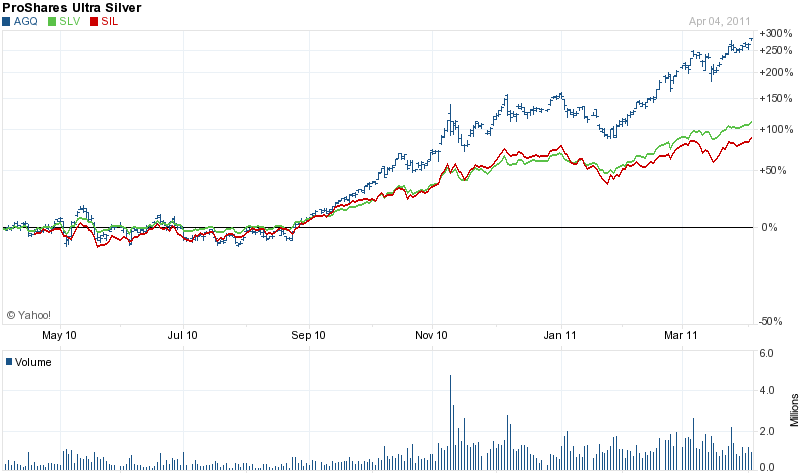
There is another silver ETF, however, that has been the standout winner for silver investors.  The ProShares Ultra Silver (AGQ) has soared from its initial $22 a share price in December 2008 to a closing price today of $243.98, providing initial investors with a gain of over 1,000%.   According to ProShares, the AGQ seeks to provide for a single day twice the return of silver bullion as measured by the London Fix Price.  The gain on the AGQ has exceeded the returns on silver bullion, the SLV, and a basket of silver stocks by a wide margin as can be seen below.

AGQ VS SLV AND SIL - YAHOO FINANCE

The AGQ was launched by ProShares on December 1, 2008, trades on the New York Stock Exchange and is defined by the Commodity Exchange Act as a commodity pool.  ProShares is part of the ProFunds Group which manages over $31 billion in mutual funds and ETFs.  ProShares also offers the UltraShort Silver (ZSL) which is a double inverse ETF and the exact opposite of the AGQ.  The ZSL seeks to produce a 200% opposite investment result of a long position in silver and will therefore increase in value if the price of silver declines.

One important element that investors should be aware of is that the AGQ does not hold physical silver, as is the case with SLV and PSLV.  The AGQ seeks to achieve its stated investment objective by owning financial instruments whose underlying value is correlated to the price of silver.  The AGQ may hold various complex financial instruments such as forward contracts, option contracts, swap agreements and futures contracts. As of April 5, 2011, the ProShares Ultra Silver held the majority of its assets in silver forward contracts.

The ProShares prospectus states that ProShares Ultra Silver seeks a 200% return on the performance of silver bullion “for a single day” since returns over periods greater than one day could vary in direction or amount from the target return due to compounding of daily returns.  The four factors cited by ProShares that could result in differences between daily and long term returns are index volatility, inverse multiples, holding periods, and leverage.

As every investor knows, greater rewards usually involve taking greater risks and the AGQ is no exception to this rule.  ProShares uses complex financial instruments that are subject to volatility in order to achieve leveraged results and the Ultra Silver ETF is therefore subject to much greater risk than investments in traditional silver securities.  ProShares warns investors that certain financial instruments held by the AGQ may be “subject the fund to counterparty risk and credit risk, which could result in significant losses for the fund”.  ProShares also notes that the Ultra Silver ETF is non-diversified and entails risks associated with the use of derivatives.

The bottom line is that the ProShare Ultra Silver is much riskier than investing in silver trust ETFs, silver stocks, or silver bullion and should therefore be used only by knowledgeable investors.   As long as silver continues to increase in value, investors are likely to see outsized gains in the AGQ.  Leverage, however, works both ways and a sharp price correction in silver would result in significant losses to investors in the AGQ. An example of how severe losses can be in a leveraged ETF can be seen by looking at the investment results of the ZSL which is designed to go up in value if the price of silver declines.

ProShares introduced the ZSL when silver was below $10 per ounce and, needless to say, initial investors who maintained an investment in the ZSL have experienced devastating losses.  The ZSL has declined almost 50% this year and since its inception in late 2008, has experienced a split adjusted decline of over 95%.

Gold and Silver Consolidate Recent Gains As Threat Of Sovereign Defaults Grows

Gold and silver prices, as measured by the London PM Fix Price, were largely unchanged on the week.  Gold slipped by $18 per ounce while silver declined modestly by $.05
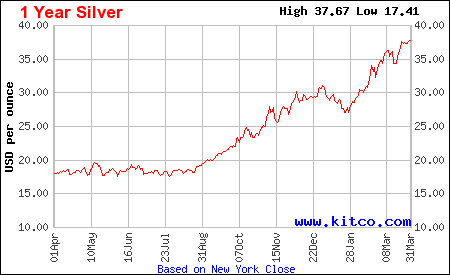
Gold has rallied almost $100 per ounce since late January but has failed to decisively break out to new all time highs.  Silver, the standout performer in the precious metals sector has rallied furiously since late January, gaining $10 per ounce for an increase of 36%.

SILVER - COURTESY KITCOSILVER.COM

Despite the current attempt by Congress to implement very modest budget reductions,  fewer and fewer people seem to have faith in the long term value of the dollar.  The value of gold has not gone up for 10 years straight by accident – it is the result massive increases in debt and the looming threat of paper currency depreciation as governments resort to the printing presses to avoid defaulting.  (See Why There Is No Upside Limit for Gold and Silver).  Recent comments by two prominent individuals reinforce the view that the potential fallout from the debt crisis will be severe.

Bill Gross of Pimco, the world’s largest bond investor, writes in his April 2011 Investment Outlook,  “Unless entitlements are substantially reformed, I am confident that this country will default on its debt; not in conventional ways, but by picking the pocket of savers via a combination of less observable, yet historically verifiable policies – inflation, currency devaluation and low to negative real interest rates”.

John Lipsky of the International Monetary Fund warned that the level of debt by developed nations is unsustainable, having reached levels last witnessed after the end of World War II.  According to Mr. Lipsky, “The fiscal fallout of the recent crisis must be addressed before it begins to impede the recovery and create new risks.  The central challenge is to avert a potential future fiscal crisis, while at the same time creating jobs and supporting social cohesion”.

The reality of a democracy is that we elect those who promise to provide us with the most benefits and entitlements.  Under these constraints, the temptation by elected officials to use printed money to meet promises that cannot be kept is irresistible.  Yes, the promises will be kept but they will be paid for in dollars that have little purchasing value.

Precious Metals Prices
Fri PM Fix Since Last Recap
Gold $1,418.00 -18.00 (-1.25%)
Silver $37.63 -0.05 (-0.13%)
Platinum $1,773.00 +21.00 (+1.20%)
Palladium $772.00 +18.00 (+2.39%)

Platinum and palladium both gained on the week, continuing a rebound from recent sell off lows reached during the height of the panic related to the Japanese earthquake.  Since mid March, platinum has gained $73 per ounce while palladium has gained $60 per ounce.  In late February palladium was at the $860 level while platinum traded in the $1850 range.

US Mint Gold and Silver Bullion Coin Sales

The weekly sales levels for the United States Mint’s gold and silver bullion coins were little changed from the levels of the previous period. Across the available options for gold, sales reached 23,000 ounces. Meanwhile total sales of 697,500 ounces of silver bullion were recorded.
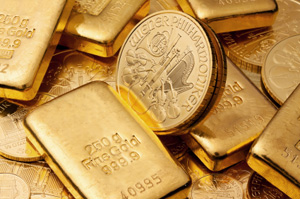
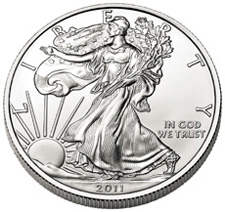
The American Silver Eagle bullion coins feature the obverse design from the classic Walking Liberty Half Dollar. These coins were designed by Adolph A. Weinman and issued for circulation from 1916 to 1947. The reverse design features a heraldic eagle designed by John Mercanti specifically for the series. Each coin is struck in .999 fine silver and contains one troy ounce of silver.

Under current law, the US Mint is required to issue the coins “in quantities and qualities that the Secretary determines are sufficient to meet public demand.” Currently, the bullion version of the coins are subject to rationing, as demand exceeds the available supplies. Recent reports indicate that the US Mint will start limited production at the San Francisco Mint to supplement the production at the West Point Mint.

US Mint Bullion Coin Program Sales 3/30/2011 (ounces)

Prior Week Month to Date Year to Date
American Silver Eagle 697,500 2,069,500 12,429,000
American Gold Eagle 17,000 56,500 299,500
America the Beautiful Silver 0 0 0
American Platinum Eagle 0 0 0
American Gold Buffalo 6,000 38,000 38,000

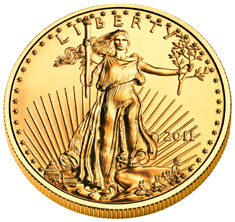
The American Gold Eagle bullion coins feature the obverse design of the Saint Gaudens Double Eagle struck for circulation from 1907 to 1933. The reverse design features an image of a family of eagles designed by Miley Busiek. Coins are struck in 22 karat (.9167 fine) gold and are available in sizes of 1, 1/2, 1/4, and 1/10 troy ounces. These gold bullion coins are not currently subject to rationing.

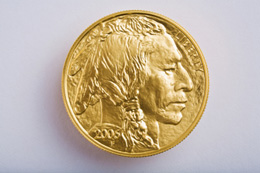
American Gold Buffalo coins feature the obverse and revers design of the Buffalo Nickel, issued for circulation from 1913 to 1938. These gold bullion coins are struck in 24 karat (.9999 fineness) and come only in one troy ounce size. The US Mint began sales of the 2011-dated versions of the bullion coins on March 14, 2011.

Why There Is No Upside Limit for Gold and Silver Prices

The past decade has seen a virtually nonstop advance in the price of gold.  Silver, which lagged gold until last year,  recently hit a 31 year price high.  Gold and silver, both used as currency for thousands of years, have gained broad investor appeal as a hedge against paper currencies.

The increase in the value of gold and silver is due to the fiscal and monetary policies of nations struggling to deal with massive levels of debt – policies that virtually guarantee a continued rise in the price of gold and silver.

Central banks, having exhausted all conventional means of monetary easing, have moved on to the last resort option of quantitative easing and currency debasement.  Federal Reserve Chairman Bernanke has twice resorted to the printing presses, and then shamelessly explained the “virtues” of his money printing policy (in convoluted terms) to a gullible public on national television.  The subsequent absence of broad public opposition to a policy that is certain to ultimately destroy the financial well being of most Americans seems based on ignorance and/or indifference.

One American who is not ignorant or indifferent to the Fed’s policy of printing money issued a dire warning this week on the dangerous path the Federal Reserve has taken.  The reason we should all pay great attention to this warning is because it was issued by a powerful policy maker at the Federal Reserve.

According to Reuters, Richard Fisher, President of the Dallas Federal Reserve stated in a speech that the debt situation in the U.S. is at a “tipping point.” He is quoted as saying, “If we continue down on the path on which the fiscal authorities put us, we will become insolvent.  The question is when”.   Bank President Fisher further said that no additional extraordinary measures should be taken when the current round of money printing ends in June of this year.

We shall see what happens comes mid year when QE2 is scheduled to end.  The problem facing the Fed is that they are out of conventional policy bullets to ease credit conditions with rates already at zero.  The ease and apparent lack of consequences in printing money has made additional quantitative easing a very seductive method of  allowing huge deficit spending by the government.  QE2 is a thinly disguised monetization of the Federal deficit in which the Federal Reserve purchases government debt from the primary dealers after they purchase the debt at Treasury auctions.

Government officials argue that unprecedented deficit spending and quantitative easing are necessary to stimulate economic  growth, but this theory has not worked in the real world.  Despite trillions in stimulus spending,  job creation and economic growth have been extremely weak and are likely to remain so according to economists Kenneth Rogoff and Carmen Reinhart who wrote This Time Is Different: Eight Centuries of Financial Folly.  According to Rogoff and Reinhart, economic growth is subpar when public sector debt exceeds 90% of GPD which the U.S. and many other developed nations have already surpassed.  In addition, a recovery of the job and housing markets after a financial crisis take many years due to the burden of excessive levels of debt.  Ultimately, Rogoff and Reinhart predict that austerity measures will need to be imposed along with some type of debt restructuring.

Is the U.S. capable of reducing spending and  instituting austerity measures? Cutting deficits means cutting payments to a long list of incomeless recipients who really don’t care where the entitlement money comes from.  Those still actually paying taxes will object strongly to any proposed tax increase to fund government spending.  Unable to cut spending or raise taxes leaves the Government with one bad option – print more money.

Politicians, who value getting elected above all else, are likely to strong arm the reliably compliant Federal Reserve Chairman Ben Bernanke to “come to the rescue” again with QE3.   In the minds of politicians and Federal Reserve officials, there will always be very compelling reasons to continue borrowing and money printing.  With the expected retirement of Federal Reserve Bank of Kansas President Thomas Hoenig this October, the Federal Reserve will be dominated by dovish members who favor the easy money policies of Fed Chairman Bernanke.  President Hoenig is one of the few Fed members who oppose continued zero interest rates and quantitative easing.

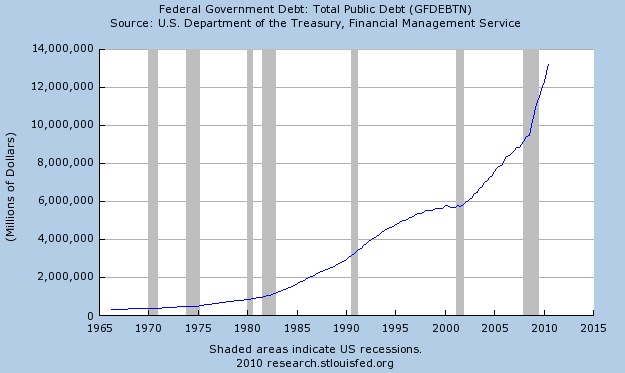
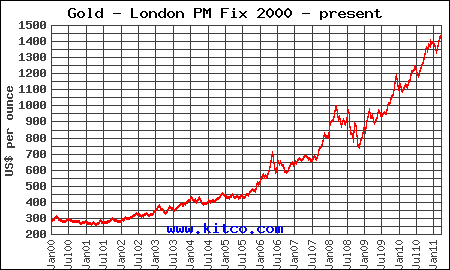
The correlation between parabolic increases in government debt and the price of gold is clear.   Since 2000 both government borrowing and the price of gold have been closely correlated as seen below.  The increased value of gold directly reflects the decreasing value of paper money.

A nation that has reached the limits on taxation and borrowing has few viable policy options other than a continuing series of quantitative easing programs.  Current government policies, if left unchanged, virtually guarantee a continued increase in the price of precious metals.

TOTAL PUBLIC DEBT

GOLD PRICE - COURTESY KITCO.COM

iShares Silver Trust Holdings Hit All Time High

The holdings of the iShares Silver Trust (SLV) soared to an all time high this week, while the holdings of the SPDR Gold Shares Trust (GLD) declined slightly.
The SLV saw holdings increased by 179.13 tonnes from the previous week to an all time high of 11,139.52 tonnes of silver.  The previous record high holdings of the SLV was on March 10 at 10,974.06 tonnes.

The holdings of the SLV have increased significantly as the price of silver moved up strongly from the correction low of late January.   Holdings of the SLV have increased by 217.95 tonnes since the beginning of the year and by a massive 734.35 tonnes since February 1st.

GLD and SLV Holdings (metric tonnes)

30-March-11 Weekly Change YTD Change
GLD 1,211.84 -3.03 -68.88
SLV 11,139.52 +179.13 +217.95

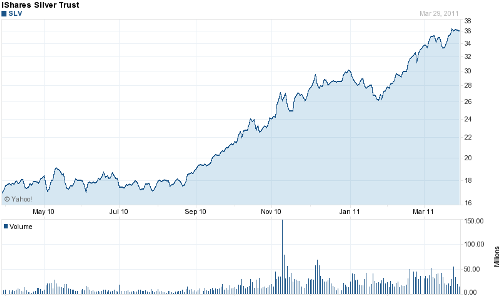
The SLV has gained over 38% since the January lows to close today at $36.53.  The total net assets of the SLV now total $13.4 billion, an astonishing 5,095%  increase from $263.5 million at the Trust’s inception in April 2006.

SLV - COURTESY YAHOO FINANCE

Gold holdings in the GLD were down slightly by 3.03 tonnes as the price of gold continues to consolidate in the low $1400 range.  The GLD has seen a year to date decline of 68.88 tonnes since the first of the year and a decline of 108.63 tonnes from all time high holdings on June 29, 2010.

The value of the gold held by the GLD totals $55.5 billion.  By comparison the market cap of Barrick Gold Corp, the world’s largest gold producers, is $51.5 billion.

Gold has had strong seasonal price trends over the last decade with strong rallies occurring after July into the end of the year.  Based on this tendency, gold may continue to consolidate over the short term before entering its next phase up.  Gold was up 30% in 2010 – a similar move in 2011 would bring gold’s price into the $1,850 range.

The GLD ended up $.46 on the day to close at $138.67, slightly below its 52 week high of $141.28.

Should I Buy Gold Bullion or Gold Trust Shares?

Gold trusts have probably been a decisive factor in promoting the ownership of gold and expanding the market to investors who would otherwise not participate in the market. Prior to the establishment of the gold trusts, investors had two primary options for investing in gold, both of which had drawbacks. Gold investors could purchase the shares of gold mining companies or physically purchase gold coins or bars.
The problem with investing in gold stocks or gold mutual funds is that the investment returns may under perform the appreciation in gold bullion. Many gold stocks have vastly underperformed the price appreciation of gold bullion due to company specific issues such as ore depletion, foreign expropriation, environmental problems or financial difficulties relating to the huge cost of mine exploration, development and production. Picking the right gold stock was often difficult.

Physically purchasing gold coins or bullion presents another wide array of problems and costs. Finding a conveniently located and reputable gold bullion dealer takes time and usually entails a trip to the dealer for every transaction consummated. Liquidity is an issue as well since the physical gold would have to be physically transported or shipped to a dealer prior to receiving sales proceeds. Transactions costs on each side of the trade can easily exceed 5%.  Physically holding gold is expensive due to security, storage, transportation and insurance costs.   Gold coins or bullion can also be lost or stolen, the ultimate nightmare for an investor.

Investment in gold share trusts eliminates all of the problems associated with stock selection and physically holding gold. Shares representing an interest in gold can be sold at any time throughout the trading day at market prices.   Investor ownership of gold trust shares represents an undivided, fractional interest in physical gold held by the trust.

Gold share trusts have become extremely popular with investors due to the advantages of owning gold via gold trust shares.  Investors have poured over $57 billion into two of the largest gold share trusts, the SPDR Gold Shares Trust (GLD) and the Sprott Physical Gold Trust (PHYS).

As gold prices continue to increase, the gold share trusts are likely to be the investment of choice for many investors seeking to establish or increase an investment in gold.

Gold and Silver Prices Push To New Highs, Gold Silver Ratio Drops To 28 Year Low

Gold and silver prices, as measured by the London PM Fix Price, moved to new highs on the week.

Gold, as measured by the closing London PM Fix Price, gained $16 per ounce on the week and hit an all time high of $1,447 on Thursday.  After soaring 30% last year, investors still have plenty of reasons to allocate part of their portfolio to precious metals.

Precious Metals Prices
Fri PM Fix Since Last Recap
Gold $1,436.00 +16.00 (+1.13%)
Silver $37.68 +2.53 (+7.20%)
Platinum $1,752.00 +32.00 (+1.86%)
Palladium $754.00 +27.00 (+3.71%)

Silver was once again the standout performer among the precious metals, gaining $2.53 per ounce on the week.  The price of silver has now risen by over 10% in the past two weeks and is up from a yearly low of $27 in late January.  Silver has far outpaced the gains in gold, which has resulted in a decline in the gold/silver ratio to 38, which is the lowest since late 1983.  A return to the long term historical gold/silver ratio would result in silver prices approaching $100 per ounce.

SILVER - COURTESY STOCKCHARTS.COM

The surge in silver prices caused the CME to increase margin requirements on silver futures, which contributed to a pullback in prices on Thursday.  The move by the CME was seen by some as a manipulation tactic to bring down the price of silver, but increased margin requirements are common when prices are rapidly increasing.  Small and underfunded speculators may have to liquidate, but in the long term silver will merely move from weak hands to strong hands.  Increased margin requirements on highly leveraged positions can produce a short term sell off, but it does nothing to change long term fundamentals.

Platinum and palladium, which both lost over 3% last week, gained on the week as fears of reduced industrial demand were eased by estimates of the huge reconstruction cost in Japan.  The rebuilding of Japan is likely to result in higher prices for all types of commodities and an increased rate of global inflation.

US Mint Gold Bullion Coin Sales Slower

The United States Mint currently has three gold and silver bullion coins available to its network of authorized purchasers. This includes the one ounce American Silver Eagle; the 22 karat American Gold Eagle available in one ounce, half ounce, quarter ounce, and tenth ounce sizes, and the recently released 24 karat American Gold Buffalo coins.

The group of primary distributors is able to purchase the bullion coins directly from the US Mint in bulk quantities based on the market price of the precious metals plus an established mark up for each product type. The coins are then resold to other bullion dealers, coin dealers, and the broader public. The sales levels for US Mint bullion coins can be an indicator of the demand for physical precious metals.

For the weekly period ending March 23, 2011, the US Mint sold a total of 24,500 ounces of gold bullion coins, down from the 45,500 ounces sold in the previous week. The higher numbers in the previous week were in part driven by the release of the 2011 Gold Buffalo, although initial sales levels were not as strong as experienced in 2009 and 2010.

For all of 2010, the US Mint had sold 1,429,500 ounces of gold bullion across all product options. About twelve weeks into the current year, gold bullion sales have reached 314,500 ounces. Assuming the same pace of sales continues for the rest of the year, gold bullion sales would be 1,362,833.

US Mint Bullion Coin Program Sales 3/23/2011 (ounces)

Prior Week Month to Date Year to Date
American Silver Eagle 652,500 2,069,500 11,731,500
American Gold Eagle 14,000 56,500 282,500
America the Beautiful Silver 0 0 0
American Platinum Eagle 0 0 0
American Gold Buffalo 10,500 32,000 32,000

The US Mint sold 652,500 ounces worth of silver bullion coins. The Silver Eagles are currently subject to allocation, meaning that the supplies are rationed amongst the primary distributors based on the available supplies. The allocation program has been in place for all of 2011.

Year to date silver bullion sales have reached 11,731,500. If the rate of sales remains constant for the rest of the year, sales would exceed 50 million ounces. Last year, the US Mint sold a record 34.6 million ounces worth of American Silver Eagles.