April 8, 2026

Why Have SPDR Gold Trust (GLD) Holdings Dropped As Gold Soars?

The SPDR Gold Shares Trust (GLD) reported that holdings of gold bullion remained unchanged from the previous week, after dropping by 39.67 tonnes for the week ending August 24th.

On a year to date basis, GLD gold holdings have declined by 48.41 tonnes as the price of gold has increased by $425 (30.6%) from the first of the year.  Why would the GLD show a decline in gold holdings as the price of gold has soared?   Even more interesting, the GLD reached a record high of gold holdings on June 29, 2010 when it held 1,320.47 tonnes and gold was selling at $1,234.50.  From June 29, 2010, while gold has soared by $579 per ounce, the GLD has actually seen a decline in gold holdings of 88.16 tonnes.

The decline of gold holdings by the GLD as the price of gold bullion has skyrocketed indicates that investor preference for gold investment has diversified.  The demand for physical gold has soared as the world financial system becomes more precarious with each passing day.  Confidence in paper assets is becoming more fragile as hapless central banks desperately print money and drive rates to zero in a futile attempt to restore economic growth.  Investors looking for the ultimate safe haven feel more comfortable  holding physical gold.

There have been questions raised about  the safe keeping and even the existence of the gold held by the GLD.  Although these concerns appear to be unwarranted, the financial panic of 2008 blatantly exposed the fact that even institutions considered to be rock solid wound up failing.  (Also see GATA dispatch – How exchange traded fund GLD lets you pretend to own gold).

The SPDR website stresses that the gold with the SPDR Trust is deposited in an allocated account.  According to the SPDR Gold Trust,  “An allocated account is an account with a bullion dealer, which may also be a bank, to which individually identified gold bars owned by the account holder are credited.  The account holder has full ownership of the gold bars and, except as instructed by the account holder, the bullion dealer may not trade, lease or lend the bars.”

Another reason why the GLD gold holdings have not expanded is competition from numerous other gold trusts such as the Sprott Physical Gold Trust which has advantages over the SPDR Gold Trust.

In addition, the shares of many gold mining companies are selling at extreme discounts and investors may be moving funds from gold trusts such as the GLD into mining shares (see Gold Shares Are Positioned For Explosive Move Up).

The GLD currently holds 39.6 million ounces of gold valued at $71.8 billion.

Meanwhile, the case for holding gold grows stronger as concerns about the stability of the world financial system continue to increase.

The Wall Street Journal disclosed today that Goldman Sachs, in a confidential report, estimates that European banks will need as much as $1 trillion in additional capital and that the current situation in world markets is similar to those that preceded the 2008 financial panic.

According to the Wall Street Journal, strategist Alan Brazil of Goldman told clients “Here we go again.  Solving a debt problem with more debt has not solved the underlying problem. In the US, Treasury debt growth financed the US consumer but has not had enough of an impact on job growth. Can the US continue to depreciate the world’s base currency?”

GLD and SLV Holdings (metric tonnes)

August 31-2011 Weekly Change YTD Change
GLD 1,232.31 00.00 -48.41
SLV 9,836.18 -89.38 -1,174.77

Holdings of the iShares Silver Trust (SLV) dropped by 89.38 tonnes this week after increasing by 109.08 tonnes for the week ending August 24th.  The SLV currently holds 313.4 million ounces of silver valued at $13 billion.
 

Gold And Silver ETF Holdings Remain Steady As Gold Plunges

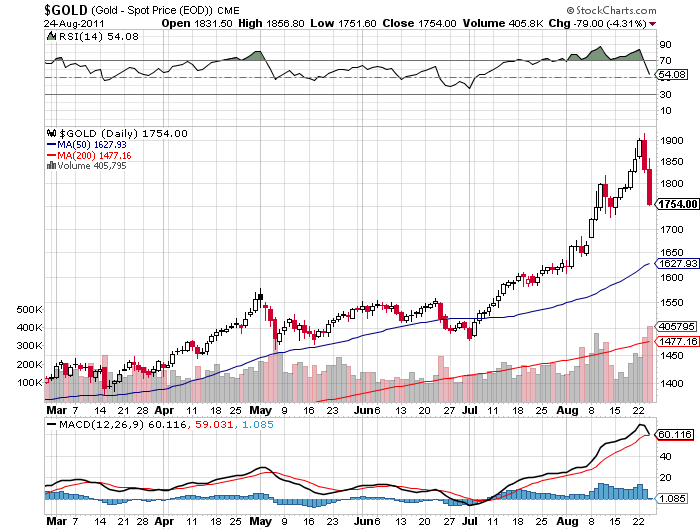
Gold’s non stop advance since early July saw a rapid reversal on Wednesday as gold lost $104.20 to close at $1,752.30 in New York trading.

Gold prices have soared this year on fears of another financial crisis and the continual debasement of paper currencies by governments that are tottering on the brink of default.  Gold began the year at $1,388.50 and by early May traded over $1,550.  After consolidating for two months, gold broke out of its trading range in early July and breached the $1,900 level earlier this week.  Despite today’s sharp sell off, gold is still up $363.80 or 26% for 2011.

As short term trend traders, hedge funds and speculative buyers jumped into gold, prices became overbought with gold trading $423 above its 200 day moving average.  The same traders playing gold for short term profits jumped out just as quickly when prices started to reverse.  Two factors that encouraged profit taking in gold were reports that the Fed would not immediately announce another round of money printing and the sharp hike in margin requirements on gold futures by the CME Group.

On a short term basis gold was overbought and due for a correction after an almost vertical rise from $1,500 as can be seen below.


Gold - courtesy stockcharts.com

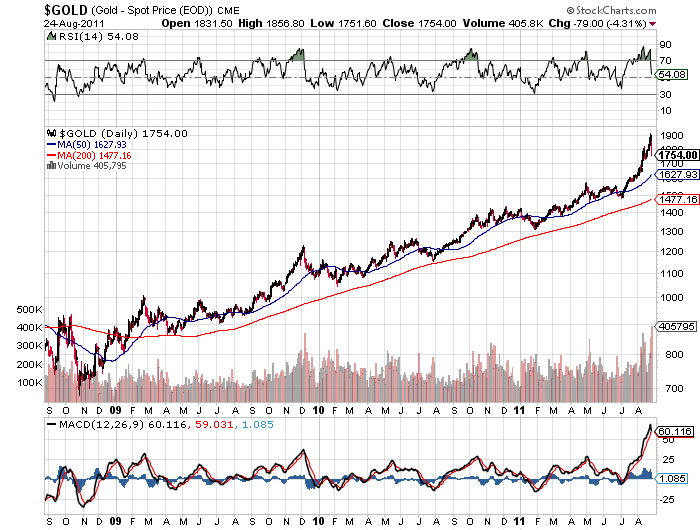
A view of a longer term chart gives a different perspective – the long term bull market in gold remains intact and the fundamental reasons for owning gold have not changed.


Gold - courtesy stockcharts.com

The non stop “gold bubble” chatter by talking heads who missed participating in the decades long gold rally are focusing on a short term price movement instead of the fundamentals that will continue to drive gold prices higher.  Every bull market has corrections and are an opportunity to add to positions.  As a long term investor in gold since the early 1990’s, I have seen other investors trade in and out, losing money each time, instead of simply going with the long term bull trend.

Many analysts have expressed concern that investors might be panicked out of the GLD causing the price of gold to plunge.  This does not seem to be the case despite the large drop in gold prices this week.  As of Wednesday, the GLD gold holdings declined by only 39.67 tonnes.  In addition, when silver spiked in early May, trading volume in the SLV exploded by 750% above the daily average trading volume.  Despite the volatility in gold this week, trading volume in the GLD expanded by only 350% above average trading volumes.  This would seem to indicate that investment in the GLD is a core holding by long term gold investors who are not inclined to sell on normal price corrections.

The SPDR Gold Trust currently holds 39.6 million ounces of gold valued at $70.1 billion.  There has been much hype about the value of the GLD exceeding that of the SPDR S&P 500.  A more proper context for comparison is to compare the value of the GLD to the increase in sovereign debt and money printing.  Bernanke’s latest episode of QE2 money printing was 850% larger than the entire value of the GLD and you can count on additional Fed currency debasement in the future.

GLD and SLV Holdings (metric tonnes)

August 24-2011 Weekly Change YTD Change
GLD 1,232.31 -39.67 -48.41
SLV 9,836.18 +109.08 -1,085.39

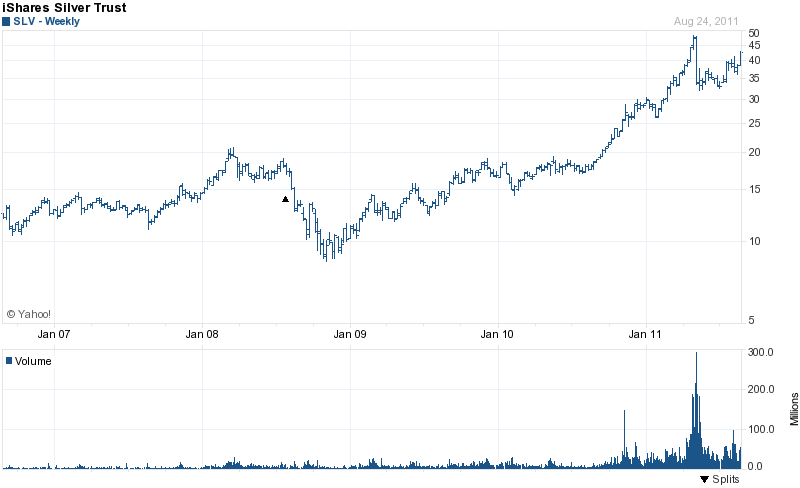
The iShares Silver Trust holdings gained 109.08 tonnes for the week ending August 24, despite the slide in silver prices.  The SLV has been building a base in the $35 to $40 range since the May correction.   Many analysts proclaimed that the “bubble” in silver prices had burst after the sharp price correction in May.  From a long term perspective, the May correction did little to diminish either the bullish fundamentals or the long term upward trend in silver prices.


SLV - COURTESY YAHOO FINANCE

The SLV currently holds 316.2 million ounces of silver valued at $13.3 billion.

Ron Paul Goes All In On Gold and Silver

Rep. Ron Paul, a long time critic of the Fed and advocate of the gold standard, is all in on gold and silver.  Ron Paul has consistently warned of the dangers of a Fed gone wild on easy money and a Government that has borrowed itself into financial oblivion.

The “Honest Money” essay on the Ron Paul website is an all time favorite explanation of how money and inflation work and has drawn almost 6,000 comments.

What, then, is fiat money? It’s exactly what we just talked about: money that can be inflated or increased at the push of a button at the say-so of a powerful person or organization. Nowadays most dollars are just blips on a computer screen and it’s extremely easy for the Federal Reserve to create money out of thin air whenever they want to.

As you can see, inflation and fiat money are very seductive and beneficial to those at the top, and very dangerous to everyone else and the nation as a whole. That’s exactly what Henry Ford was talking about. He knew that every country that relies too much on fiat money is ruined sooner rather than later.

There is only one possible solution to the inflation problem: Stop creating money out of thin air. But we’re already in such a mess that the only way to have a real impact on the money supply is to increase interest rates so that people pay back their loans and borrow less money from the banks, which decreases the amount of money in circulation. However, higher interest rates might very well crash the economy. So the Fed’s current “solution” to overcoming inflation is… creating even more of it.

Fiat money is a dangerous addiction. Even if the Fed found a way to stop inflation, as long as the current system persists the temptation will always be there to resume pushing the easy money button. That’s why we need to get back on the gold standard and eliminate the Federal Reserve altogether.

In order to protect the purchasing power of his savings, Ron Paul has implemented the sound advice that he has been dispensing to America for many years.

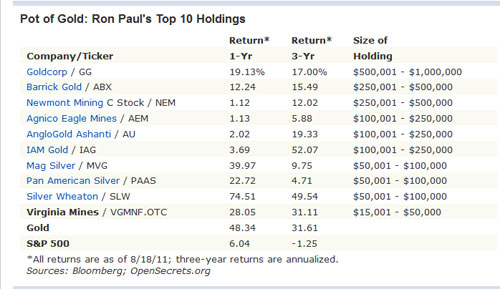
As disclosed in Barron’s this weekend, Ron Paul’s top 10 holdings listed in required financial statement disclosures show that his portfolio is 100% in gold and silver mining stocks.  Ron Paul apparently also owns gold bullion, but the disclosure of asset holdings that may be considered as collectibles is not required.

Without getting into a discussion of the merits of a diversified investment portfolio, Ron Paul’s 100% investment allocation to gold and silver demonstrate his integrity.  If someone believes that the Government is persistently and continually debasing the value of the currency, why would you not invest exclusively in gold and silver?

Ron Paul has taken steps to protect himself from the disastrous affects that Federal Reserve policies will ultimately have on the value of the U.S. currency.  The average American would be well advised to follow his lead.

Here is Ron Paul’s portfolio as disclosed by Barron’s.

Ron Paul portfolio - courtesy Barron's

Americans Remain Tragically Underinvested In Gold And Silver

As predicted many times in this blog, the over indebted and over leveraged world financial system is starting to unravel at warp speed.   Massive amounts of  borrowing by governments during the financial meltdown of 2008 has effectively put many sovereign states at the limits of their borrowing ability.

A rapidly contracting economy and job losses will result in a flood of defaults in the private sector by both businesses and individuals.  A vicious self reinforcing cycle of defaults will cause major banking failures that a bankrupt FDIC will be unable to contain.  Banking holidays will become routine, the jobless rate will triple, the middle class will face financial destruction and social unrest will explode across the country.

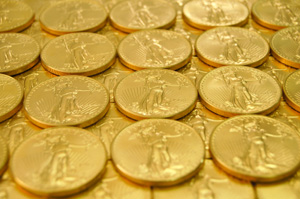
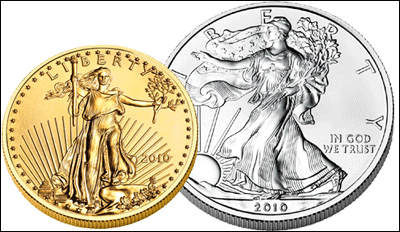
Crushing levels of debt will be the trigger that causes an economic depression that will make the 1930’s look like a minor recession.  Eventually, the creative destruction of capitalism (as described by economist Joseph Schumpeter) will extinguish debt burdens through defaults, allow for economic recovery and the creation of new wealth.  The downside to recovery through creative destruction, however, is that existing wealth is mercilessly devalued as paper based asset wealth is destroyed.  At this point, which would you prefer to own – a pile of paper dollars or a stack of American Gold Eagles?

The ultimate restructuring of a fiat based monetary system to one backed by more than promises is inevitable.  The timing of the event is the only open question since governments will use every power, legal or otherwise, to prevent the scenario described above.  Unfortunately, for holders of paper financial assets, the only viable option available for governments at this point are the printing presses.  The ocean of paper currencies that will be printed to “save the system” will debase paper financial assets, reducing their purchasing power to virtually nothing.

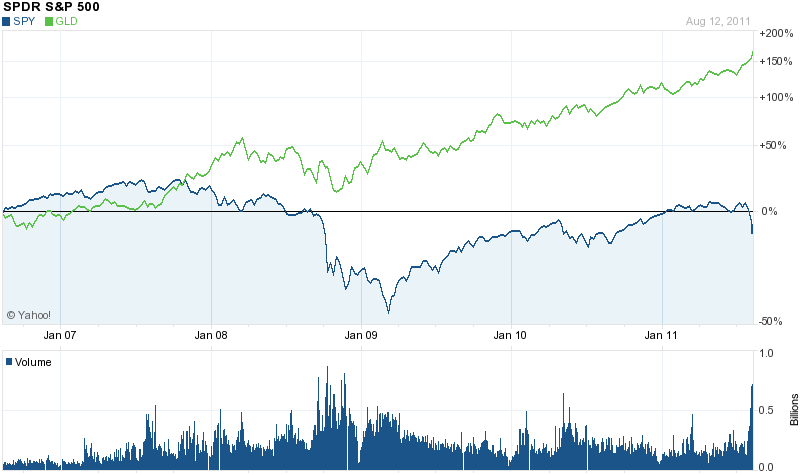
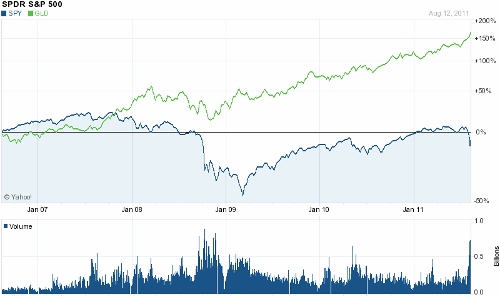
Gold, the only enduring currency, has been forecasting a financial crisis for the past decade and especially since 2008.  As economic Armageddon looms, however, most Americans remain tragically under invested in gold and silver.  Conventional financial planners and investment advisers recommend a zero or minor position in precious metals even as gold steadily outperforms stocks, bank savings and other financial assets.


S&P vs Gold - courtesy yahoo finance

Making matters worse, many Americans are selling the little amount of gold and silver that they do own as the conventional press publishes “gold bubble” articles every time gold hits a new high.  As reported in coinupdate.com, one major dealer reports that:

As for the general public, they have been selling jewelry by the droves this past week.  On Tuesday, my companies set a record going back more than 30 years for the most number of purchases from the public in a single day.  We broke that record Wednesday and weren’t that far from another all-time record on Thursday.  The main pieces that customers have brought to us have been gold jewelry.  The amount of silver and platinum jewelry has remained steady.

We talk with dozens of coin dealers around Michigan and the country every day.  They are reporting the exact same pattern of activity as we are experiencing.

Perhaps many of these sellers are dumping their gold jewelry due to economic duress, but if they were expecting gold to continue to soar higher, they would not be selling.  The bull market in gold and silver is just beginning and those who hold significant positions will preserve and expand their wealth.

SPDR Gold Trust And iShares Silver Trust Holdings Decline

Gold holdings of the SPDR Gold Trust (GLD) declined slightly on the week by 24.54 tonnes after a gain of 10.22 tonnes in the previous week.   GLD  gold holdings have declined by 8.74 tonnes since the beginning of the year.   The all time high holdings of the GLD occurred on June 29, 2010 when the Trust’s holdings reached 1,320.47 tonnes.

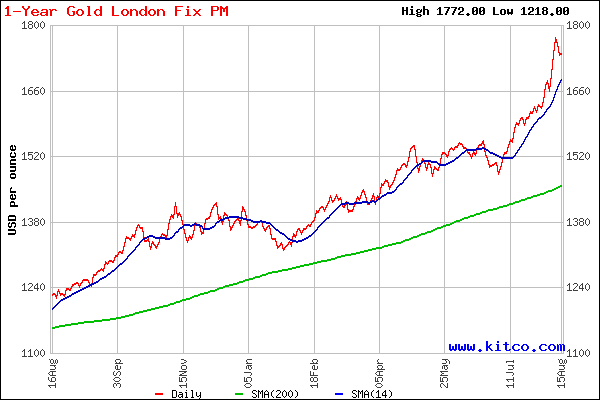
As measured by the closing London PM Fix Price, gold started the year at $1,388.50.  Gold closed in Wednesday trading at $1,790.00 for a gain of $401.50 or 28.9% on the year.  Gold has been in a steady, virtually uninterrupted uptrend since late 2008.  At the beginning of July, the price trend of gold entered an accelerated uptrend.


GOLD - COURTESY KITCO.COM

Although a pullback is possible after an almost vertical rise of $256 since July 1st, it is just as likely that gold could confound the skeptics and continue to rise.  The increase in gold prices for the past  decade has reflected widespread apprehension over the value of paper currencies.  The world economy never recovered from the financial crisis starting in 2008 despite the borrowing and printing of trillions of dollars by world central banks and governments.  The increase in the price of gold is reflecting the growing realization that governments and central banks no longer have the ability to contain a second full blown financial crisis.  Under this scenario, gold effectively has no ceiling price.

The GLD is the largest gold exchange traded fund with 40.9 million ounces of gold.  According to Bloomberg, the total holdings of all  major gold  ETFs worldwide amount to 70.7 million ounces of gold.  Holdings of all gold ETFs worldwide have increased by 4.1 million ounces or 6.2% since the beginning of the year.

The SPDR Gold Trust currently holds 40.9 million ounces of gold valued at $73.2 billion.  For perspective, the entire value of the GLD would fund less than 18 days of US Government deficit spending which is projected to exceed $1.5 trillion this year.


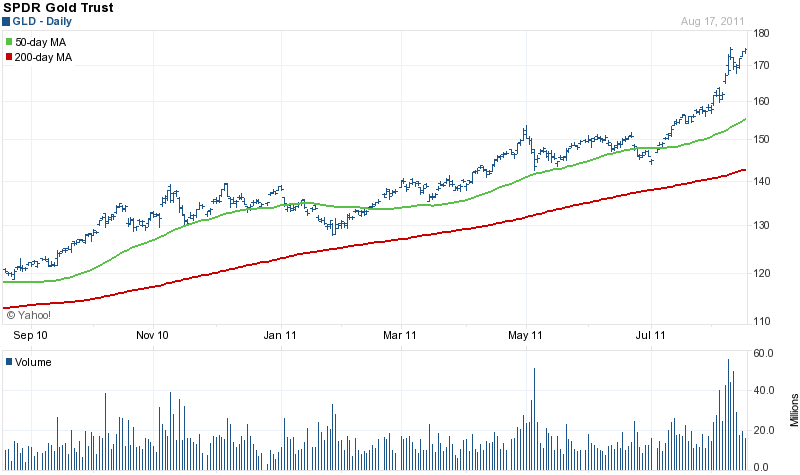
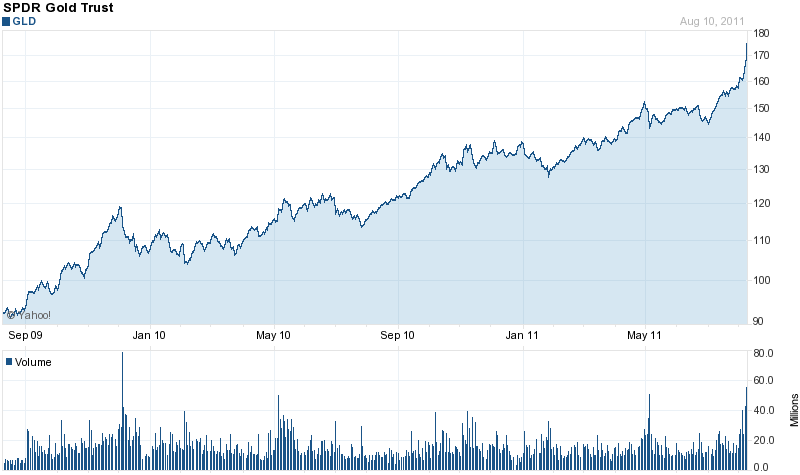
GLD - COURTESY YAHOO FINANCE

The GLD closed the day at $174.42, fractionally below its all time high of $175.13

GLD and SLV Holdings (metric tonnes)

August 17-2011 Weekly Change YTD Change
GLD 1,271.98 -24.54 -8.74
SLV 9,727.10 -45.46 -1,194.47

Holdings of the iShares Silver Trust declined by 45.46 tonnes on the week after a decline of 86.36 tonnes in the previous week.  Since July 1st, the SLV has gained 190.95 tonnes.

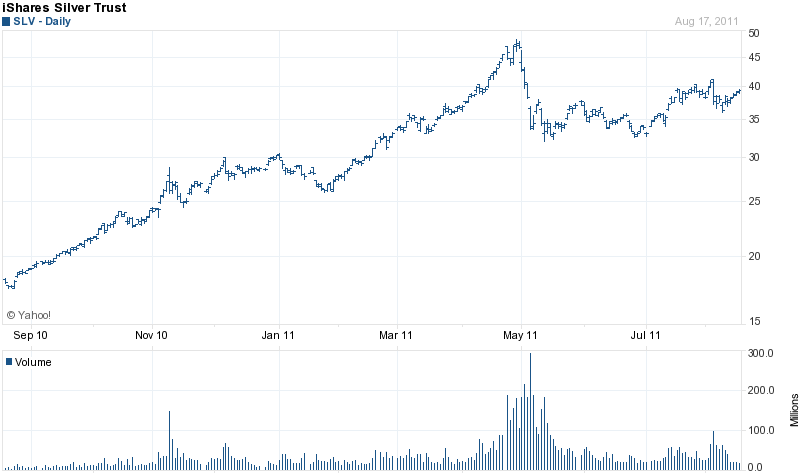
After a price correction in early May, silver has recovered in price and is building a base in the $40 range before the next move up.  Silver has gained $6.17 or 18.2% since July 1st, rising from $33.85 to $40.02.


SLV - COURTESY YAHOO FINANCE

The SLV currently holds 312.7 million ounces of silver valued at $12.5 billion.  Investors in the SLV have had an annual rate of return of 25% over the past three years.

Ultimate Price Of Gold Will Shock The World As Loss Of Global Confidence Leads To Economic Collapse

Gold had another stellar week while stock markets gyrated wildly.   As measured by the closing London PM Fix Price, gold gained $77.25 on the week, hitting all time highs and closing at $1,736.   After the London close, gold recovered from an earlier pullback and closed in New York trading at $1,747.30, up $11.30 from the London close.

Silver ending the week down slightly at $38.29 while platinum gained $91 to $1,800 and palladium edged up $5 to $747.

Gold has gained $253 or 17% since July 1st when it closed at $1,483.00.  The rapid price gains have pushed gold above its long term trend line.  Gold is now trading at $290 (or 20%) above its 200 day moving average.  On previous occasions in late 2009 and the fall of 2010 gold also traded more than $200 dollars above the 200 day moving average and the result was a minor pullback or sideways consolidation.


Gold - courtesy kitco.com

Gold may be overbought on a short term basis but the fundamental reasons for owning gold are expanding exponentially.  Public realization that dysfunctional governments are incapable of solving our economic problems is resulting in a loss of confidence.  A loss of confidence combined with a debt crisis and out of control spending can have only one result – increasingly worthless paper money and stocks as the  world central banks attempt to prevent an economic collapse with zero interest rates and printed money.

Gold Outperforms paper stocks

Government and  central bank policies have been destroying the value of the US currency for decades and have given birth to crashing housing markets, lower incomes, depression level unemployment and numerous stock market crashes.  When one  considers that the last hope of preventing an all out depression now lies in the hands of the very central banks who have already brought Hell down upon us, we should all be very, very scared.

If the last ditch efforts of the Central Banks fail to contain the financial collapse that is imminent, expect to see governments institute totalitarian measures in order to maintain a semblance of organized society.  As bankrupt empires collapse, they also attempt to expropriate every last dollar of wealth from its citizens in order to maintain their grip on power as long as possible.

The most recent large scale example of the implosion of an empire was the USSR, whose sudden collapse surprised CIA analysts who had been studying the Soviet Empire in detail for decades.  Ironically, those even more surprised by the collapse of the USSR were the politicians and bureaucrats who ran the country into the ground as they remained oblivious to their economy killing policies.  Tragically, misguided and misinformed middle class citizens of the USSR saw the value of their rubles collapse along with pension plans, bank savings and other financial assets.  Those who walked away with more than they had, other than corrupt politicians, were those few citizens who converted paper money into gold or silver before the financial system imploded.

A potential short term price correction in gold is a meaningless concern.  Developed world economies are in inexorably decline from which there is no escape.  The primary concern for most US citizens should be to develop a financial strategy that does not leave them impoverished when the end game arrives.

Unfortunately, most Americans have a religious conviction that “The Government” will save and nourish them as has been promised by every politician of this century.  These promises will all be broken but Americans won’t believe it until it happens, at which point there is no financial escape.

As a worldwide systemic financial collapse grows more probable with each passing day, Americans remain in denial and place their life savings in US government debt and bank accounts, secure with the promise that they are “guaranteed by the government”.   Sorry folks, bankrupt governments don’t keep promises.  The proof of American citizens’ faith in paper assets is their very low commitment to gold and silver.  The public will belatedly turn to gold and silver en masse when the system starts crashing down around them.  This event will be the real rush to gold and at that point, prices will rise thousands of dollars per week.

When establishment journalists warn of a “bubble” or “top” in gold, don’t get annoyed – simply buy more gold, especially on pullbacks.  The ultimate price of gold will wind up shocking even the biggest gold bulls.  When gold demand is insatiable and supply very limited, attempting to figure out the ultimate high price for gold is a fruitless exercise. (see Why There Is No Upside Limit For Gold and Silver).

Precious Metals Prices 8/12/11
PM Fix Since Last Recap
Gold $1,736.00 +$77.25 +4.66%
Silver $38.29 -$0.95 -2.42%
Platinum $1,800.00 +$91.00 +5.32%
Palladium $747.00 +$5.00 +0.67%


Gold ETF Holdings Hit All Time High As Silver ETF Holdings Decline

The SPDR Gold Shares Trust (GLD) added 10.22 tonnes of gold since last week as gold prices continue to surge higher.  The GLD now has a net gain in gold holdings of 15.80 tonnes since the first of the year.  The all time high holdings of the Gold Shares Trust was 1320.47 tonnes reached on June 29, 2010.

The value of the GLD during August has increased by 12.1% to $73.9 billion on high volume.  During July, the highest volume day for the GDL was on July 13th when 25.2 million shares traded.  On August 8th, 9th and 10th, volume on the GLD exceeded 40 million shares.  On previous occasions when trading volume in the GLD surged, gold prices either pulled back slightly or consolidated in sideways trading before continuing higher.

All of the fundamental factors that have been pushing gold prices higher for the past decade are now being amplified by a looming currency collapse and sovereign debt crises.  Adding to concerns is the apparent inability of central banks and governments to contain the rapidly expanding financial crisis.

As measured by the closing London PM Fix Price, gold started the year at $1388.50 and closed Wednesday in New York trading at $1796.50, up $51.30.  Gold has gained $407.90 or 29.4% since the first of the year.

Total holdings of all gold ETFs recently reached a record of 2,276 tonnes of gold, valued at $130 billion.  The GLD currently holds 41.7 million ounces of gold valued at $73.9 billion.

GLD - COURTESY YAHOO FINANCE


The GLD hit a new all time high in Wednesday trading, closing at $174.58, up $5.97.

GLD and SLV Holdings (metric tonnes)

August 10-2011 Weekly Change YTD Change
GLD 1,296.52 +10.22 +15.80
SLV 9,772.56 -86.36 -1,149.01

Holdings of the iShares Silver Trust (SLV) declined by 86.36 tonnes on the week but have gained 236.41 tonnes since July 1st when silver prices began rallying.

Silver prices have not kept pace with the increase in gold prices as investors worry about reduced industrial demand for silver in a severe economic downturn.  Silver closed Wednesday at $39.39, up $1.58.  Silver began the year at $30.67 and is now up by $8.72 on the year returning investors a gain of 28.4%.

The SLV peaked in late April at the $50 level before prices corrected to the low 30’s.  The SLV has had an average annualized total return of 25% over the past three years.

The iShares Silver Trust currently holds 314.2 million ounces of silver valued at $12 billion.


SLV - COURTESY YAHOO FINANCE

As the world economy marches off the edge of the cliff and many wonder why, we look back at some prophetic  thoughts from Bill Murphy, co-founder of the Gold Anti-Trust Action Committee (GATA) in an interview with The Motley Fool in June 2010.

“What’s important for your readership to understand is that the markets have been made dysfunctional by U.S. policy and what these bullion banks are doing. Even Alan Greenspan said recently that interest rates were left too low for too long. Had the gold price been allowed to trade freely, interest rates wouldn’t have been able to stay down as low as they were. It would have been a warning sign for people not to get involved in the behavior that they did … not to go with all of the risks that developed. And there’s a good likelihood that the disaster would have been nowhere near as bad as it was.

“Alan Greenspan called gold a “thermometer.” So they diffused the thermometer by keeping the gold price managed. And what’s important for people to understand now is that the same thing is going on. If we’re correct, it’s going to lead to a bigger catastrophe, because no one has learned any lessons.”


Gold Prices Skyrocket, Stocks Plunge – Looking Like 2008 On Steroids

As politicians celebrated the debt limit increase and congratulated themselves for “saving” the nation that they destroyed, collapsing stock markets and soaring gold prices told a different story.  The public spectacle of a dysfunctional Congress debating the debt limit exposed to the world the horrendous extent to which the US government is addicted to endless deficit spending.

Republican presidential candidate Ron Paul summed up the outcome of the debt limit fiasco best:

This deal will reportedly cut spending by only slightly over $900 billion over 10 years. But we will have a $1.6 trillion deficit after this year alone, meaning those meager cuts will do nothing to solve our unsustainable spending problem. In fact, this bill will never balance the budget. Instead, it will add untold trillions of dollars to our deficit. This also assumes the cuts are real cuts and not the same old Washington smoke and mirrors game of spending less than originally projected so you can claim the difference as a ‘cut.’

The plan also calls for the formation of a deficit commission, which will accomplish nothing outside of providing Congress and the White House with another way to abdicate responsibility. In my many years of public service, there have been commissions on everything from Social Security to energy policy, yet not one solution has been produced out of these commissions.

Ron Paul also provided an explanation of what constitutes a “spending cut” in the bizarro world of government accounting and why, in the end, spending and debts will not decrease.

No plan under serious consideration cuts spending in the way you and I think about it. Instead, the “cuts” being discussed are illusory, and are not cuts from current amounts being spent, but cuts in projected spending increases. This is akin to a family “saving” $100,000 in expenses by deciding not to buy a Lamborghini, and instead getting a fully loaded Mercedes, when really their budget dictates that they need to stick with their perfectly serviceable Honda. But this is the type of math Washington uses to mask the incriminating truth about their unrepentant plundering of the American people.

The world was finally tuning in to the reality of the desperate financial condition of the United States.  The mainstream press was predicting a plunge in gold prices and soaring stock prices after Congress agreed to increase the nation’s debt limit.  Instead, the opposite happened as markets reflected underlying economic reality.

Since mid July, the Dow Jones Industrial Average has plunged by 858 points.  Since July 1st, gold has gained $178 per ounce.  Meanwhile, the debt crisis in Europe continues to intensify with bond yields soaring in Italy and Spain.  The world economy is marching off the edge of a cliff as governments lose the ability to contain the spiraling debt crisis.  It’s starting to look like a replay of 2008 on steroids.

Gold  soared by $39.80 on the day to close in New York trading at an all time high of $1,661.10.  Silver more than paced the gain in gold, adding $1.61 to close up 4.1% at $40.95.

SPDR Gold Trust Holdings Increase, Silver ETF Holdings Decline

Holdings of the SPDR Gold Shares Trust (GLD) gained almost 37 tonnes on the week.  For the first time this year, holdings of the GLD are greater than they were at the beginning of the year.  The record holdings of the GLD occurred on June 29, 2010 when the GLD held 1,320.47 tonnes of gold.

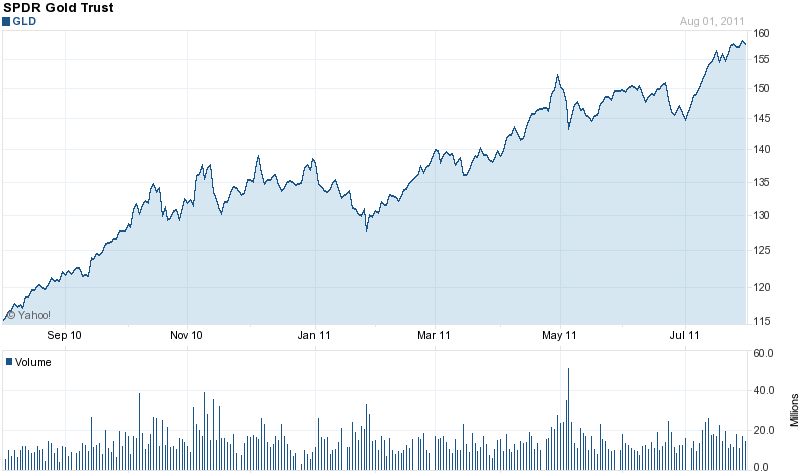
The SPDR Gold Trust currently hold 41.2 million ounces of gold valued at $67.5 billion.  Shares of the GLD hit an all time high, closing at $161.52.


GLD - COURTESY YAHOO FINANCE

Holdings of the iShares Silver Trust (SLV) declined by 90.93 tonnes after an increase of 112.15 tonnes in the prior week.  Since the beginning of July, holdings of the SLV have increased by 288.28 tonnes.

The SLV currently holds 315.9 million ounces of silver valued at $12.5 billion.

GLD and SLV Holdings (metric tonnes)

August 2-2011 Weekly Change YTD Change
GLD 1,281.75 +36.95 +1.04
SLV 9,824.93 -90.93 -1,096.64


US Mint Silver Eagle Bullion Sales On Pace For Record High

Since Congress authorized the production of American Eagle Bullion coins in 1986, it has become one of the easiest ways for investors to accumulate a physical position in precious metals.   American Eagle Bullion coins have been available in gold and silver since the program’s inception.  Platinum has been available under the Bullion coin program since 1997.

The bullion coins are priced at the current market price of gold, silver or platinum plus a dealer markup.  The US Mint does not sell the bullion coins directly to investors but instead sells the coins to a network of Authorized Purchasers who resell  the coins to the public.  Unlike commemorative or numismatic coins, the bullion coins will closely track the price of the underlying precious metal making it easy for investors to follow the value of their bullion holdings.

The American Eagle Silver bullion coin is available only in the one ounce size and is particularly attractive to small investors as a cost effective way to hedge against inflation and debasement of paper money.  The US Mint’s American Silver Eagle Bullion program has been successful from the start.  The first year’s sales of bullion Silver Eagles in 1986 was 5,096,000.

Between 1987 and 2007 sales of the Silver Eagle averaged 7.1 million coins per year.  The lowest year on record for sales was in 1996 when sales of the coin were only 3.6 million.  Since 1986, sales of the American Silver Eagle  exceeded 10 million coins only two times during 2002 and 2006.

The financial crisis of 2008 resulted in a surge of Silver Eagle sales as worries intensified over the integrity of paper money and the soundness of the financial system.   During 2008 Silver Eagle sales soared to 19,583,500 coins which was a record high.  In 2009, sales continued to explode reaching 28,766,500 coins and 2010 was another year of record sales at 34,662,500.

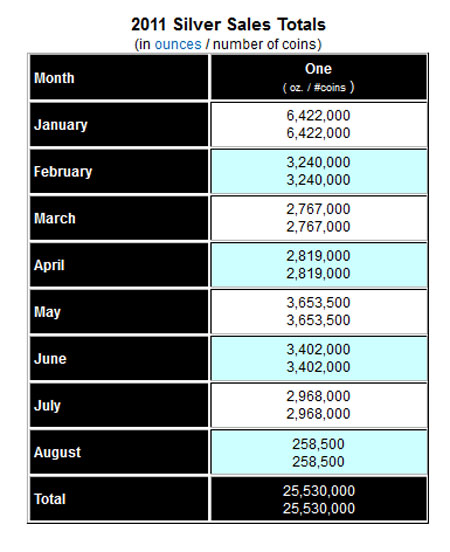
Year to date sales of the Silver Eagle bullion coins during 2011 has now reached 25,530,000.  Based on average monthly sales during 2011, sales for the entire year could easily reach 42 million coins, up 20% over last year.

Investors in silver have preserved their purchasing power and increased their wealth.  As previously discussed, the dip in silver prices during May was a buying opportunity and silver prices should be hitting all time highs before year end (see How Soon Will Silver Hit New Highs?).

American Silver Eagle Bullion Sales 2011


Gold Rallies On Week – Is The World Economy At The Precipice?

Gold continued its winning ways this week.  As measured by the closing London PM Fix Price, gold gained $26.50 to close the week at all an time high of $1,628.50.

Gold has closed higher for the past four consecutive weeks.  The rally that began at the beginning of the month has pushed gold higher by $145.50 or 9.8% since July 1st.  Investors worried about the solvency of sovereign states in Europe have now switched their focus to the United States.

The impasse over raising the US debt limit has morphed into a crisis of confidence over the ultimate value of the US dollar.  There is no clear consensus on how the debt limit negotiations in Washington  will be resolved.  The only certainty is that, regardless of how the debt limit crisis ends, confidence in the “full faith and credit” of the United States will be greatly diminished.

China and Russia, two large holders of US debt, have watched in horror as the US deliberately debases its currency value through money printing and a parabolic increase in debt.  At a time when the US needs to borrow trillions of dollars in new debt, there is likely to be a greatly diminished appetite to purchase additional US debt.

The global debt crisis and a lack of confidence in paper money has resulted in a steady increase in the price of gold.  Will gold continue to soar if global economies start collapsing or will gold be drawn into the deflationary abyss along with all other asset values?  Opinions vary but here are some good thoughts on the matter.

-John Browne of Euro Pacific Capital warns that gold could be subject to a price pullback based on the deflationary impact of a global recession or short term optimism over the US avoiding default.

Decision Point’s Carl Swenlin wonders if gold is too much of a “sure thing” investment and ponders the fate of gold in a deflationary collapse.

-A Citigroup analyst speculates that gold could quickly reach $5,000 based on a “worst case scenario for Euro sovereign debt and USA fiscal problems”.

Confidence is vital in a fiat money based world.  The ongoing global debt crisis may be the trigger that ultimately destroys faith in paper currencies.

Precious Metals Prices 7/29/11
PM Fix Since Last Recap
Gold $1,628.50 +$26.50 +1.65%
Silver $39.63 -$0.04 -0.10%
Platinum $1,779.00 -$14.00 -0.78%
Palladium $824.00 +$17.00 +2.11%

Silver and platinum were essentially unchanged on the week after posting strong advances since the beginning of July.  Palladium advanced by $17 or over 2% on the week and is up $74 since July 1st.