April 13, 2026

Gold and Silver Prices Hold Gains, Rise in Late Trading

Gold and silver prices declined slightly on the week, as measured by the closing London PM Fix prices.  Gold finished the week at $1,411.50 for a loss of $15.50 while silver declined fractionally by 33 cents to close at $34.10.  However, as markets assessed the impact of a slowing world economy, higher inflation, higher oil prices and the massive earthquake in Japan, prices for gold and silver saw significant price improvement in late Friday New York trading.  Gold moved up $9.20 to $1,421.30, while the silver price rose $.60 to $35.90.

In a week of tumultuous economic and political news, platinum and palladium saw significant declines on the week as investors worried about reduced industrial demand in the face of a slowing world economy.

Precious Metals Prices
Fri PM Fix Since Last Recap
Gold $1,411.50 -15.50 (-1.09%)
Silver $34.10 -.33 (-0.96%)
Platinum $1,777.00 -51.00 (-2.79%)
Palladium $754.00 -57.00 (-7.03%

The minor price consolidation for gold and silver over the past week are impressive considering the strong gains of the previous month.  Strong bull moves are never straight and price corrections should be seen as an opportunity to increase positions.

None of the concerns that have propelled the precious metals higher have been resolved.  There is a strong probability that one or more of them will blow up putting major financial pressures on governments that are already staring into the abyss due to untenable levels of debt.  Which event will trigger another financial crisis is impossible to predict, but here’s a quick rundown of the obvious suspects:

1.) The final implications of the massive Japan earthquake will take weeks to assess but is certain to add huge financial stress to a country already overwhelmed by the highest debt to GDP ratio in the world.  The Japanese central bank has already indicated it is ready to loosen monetary conditions to calm financial markets, which may be a signal that they will follow the U.S. Fed’s lead and engage in a significant amount of quantitative easing or money printing.  The cost of credit default swaps on Japanese government debt widened significantly reflecting the need for increased borrowings by a government already overwhelmed by indebtedness.  As investors become increasingly alarmed at the prospects of default on government debt and currency debasement, the flight to gold will accelerate.

2.) The sovereign debt crisis in Europe continues to spiral towards a crisis as the European Central Bank attempts to solve a debt crisis with more debt.  Monetary authorities worldwide are out of standard policy options and will follow the lead of the U.S. Fed by printing money.   The implications of money printing on a global basis removes all constraints on the appreciation limits of the precious metals.

3.) The largest bond fund in the world dumps all longer dated U.S. Treasury securities. Bill Gross, manager of PIMCO, the largest bond fund in the world warns that when QE II stops in June, there will not be enough buyers for government debt, leading to a funding crisis for the U.S. Government.  If one of the planet’s smartest and biggest bond investors thinks it’s time to sell U.S. Treasuries, the risk of contagion becomes substantial.  Foreign governments currently purchase half a trillion dollars of U.S. debt every year and are becoming alarmed by Fed policies which make their debt investments look riskier by the day.  How long will it be before other major investors in U.S. debt decide to follow Bill Gross’s lead and initiate a massive sell off in U.S. treasuries?

4.) Oil prices have pulled back in recent days but the situation remains volatile.  A small group of protesters in Saudi Arabia were immediately dispersed with a hail of rubber bullets from security forces, an action that can only further inflame the passions of those who feel repressed by regimes in Saudi Arabia and other oil producing countries.  Chaos in Saudi Arabia would quickly put the world economy back into an economic meltdown that governments may be unable to contain.
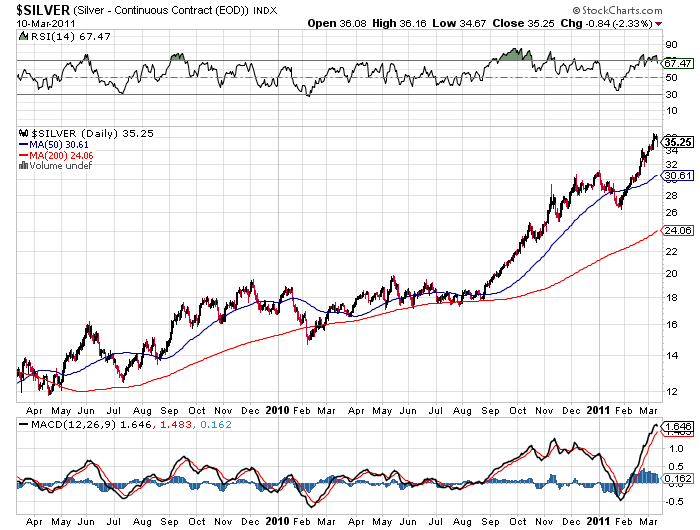
SILVER - COURTESY STOCK CHARTS.COM

The last upward move in silver last four months from September through the end of 2010 with a price gain of over 70%.  After a brief correction early in the year, investor and industrial demand pushed silver to a new yearly high.  A rally equivalent to that of last year would drive silver up to the $50 level by June.
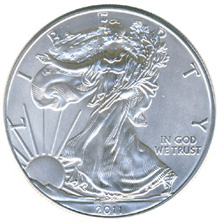
Silver Eagle Sales Slower as US Mint Rations Supplies

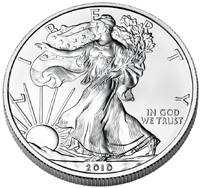
Sales of the United States Mint’s American Silver Eagle bullion coins were slower in the latest week. However, the slow down seems to be the result of the allocation program currently in place, as opposed to a reduction in demand. Sales for Gold Eagle bullion coins dropped to the lowest weekly total for the year to date.
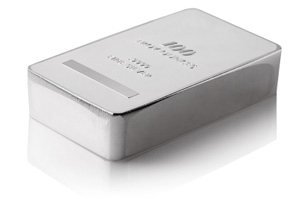
For the weekly period ending March 9, the US Mint recorded sales of 668,500 of the one ounce Silver Eagles. This compares to 1,509,000 coins sold in the previous week.

Since the start of sales for the 2011-dated coins, the US Mint has carried out sales under their standard allocation program. Rather than accepting unrestricted orders, available supplies of silver bullion coins are rationed amongst the authorized purchasers. As such, sales figures reflect the number of coins that the US Mint is able to produce and make available, as opposed to the level of demand from the market.

There has been anecdotal evidence from bullion dealers indicating demand in excess of the available supplies. This reduced availability has caused premium levels for Silver Eagles to expand at the retail level.

Other world mints have indicated that they have been encountering problems obtaining the silver needed to produce coins and other bullion products. The US Mint has not provided any specific explanations.

US Mint Bullion Coin Program Sales 3/9/2011 (ounces)

Prior Week Month to Date Year to Date
American Silver Eagle 668,500 668,500 10,330,500
American Gold Eagle 12,500 18,500 232,000
America the Beautiful Silver 0 0 0
American Platinum Eagle 0 0 0
American Gold Buffalo 0 0 0

Sales of the bullion Gold Eagles were only 12,500 in the latest week compared to a previous weekly total of 37,000 coins. The demand for physical gold has not been as intense as the demand for silver. Since the start of sales for the 2011-dated coins on January 3, 2011, the US Mint has not used the allocation program.

iShares Silver Trust Holdings Continue to Skyrocket

Silver holdings in the iShares Silver Trust (SLV) continued to skyrocket, while holdings of gold in the SPDR Gold Shares Trust (GLD) experienced a modest increase.
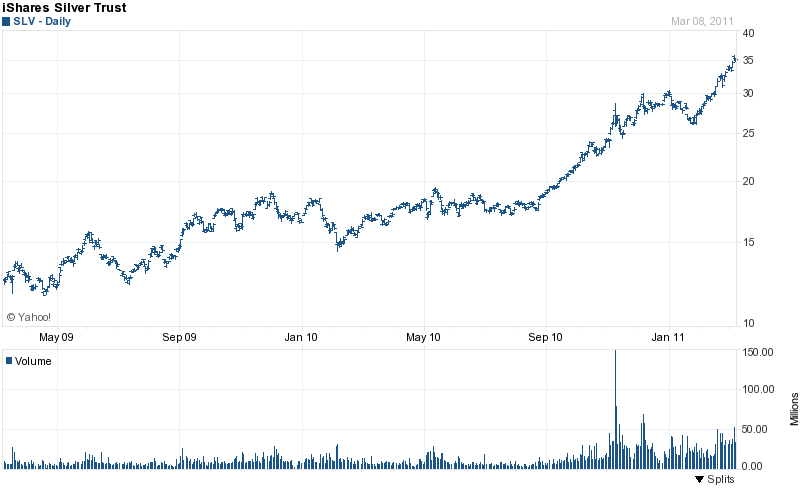
The iShares Silver Trust (SLV) holdings increased by 209.54 tonnes in the latest week.  The prior two weeks have seen increases of 189.29 tonnes and 164 tonnes.  Total holdings of the SLV are now 52.49 tonnes higher than at the beginning of the year.  The SLV holds 352.8 million ounces of silver valued at $12.76 billion.

The holdings of silver in the iShares Silver Trust have now exceeded peak holdings reached at the beginning of the year.  Silver has moved relentlessly higher in price since last August.  After a brief price correction in January which brought silver down to the $26 level, silver prices have exploded to more than $36 per ounce, a gain of 38% in less than two months.

Given the huge run up in the price of silver, it is not surprising to see holdings of the SLV increase dramatically.  The SLV is a proxy for investors who chose to invest in silver without the cost and inconvenience of holding physical silver.  Purchasing the SLV allows an investor to take an immediate position in silver and without the markups associated with physically purchasing bars or coins.

The annual expense ratio of the SLV is only 0.5% compared to common markups of 5% to 10% when purchasing physical bullion or coins from a dealer.  The SLV has been wildly popular with investors since it was launched and has provided huge returns to patient investors.   The SLV has risen from below $10 in October 2008 to its closing price today of $35.27 for a gain of over 250%.  A purchase of a thousand shares of the SLV at the low of $9.13 in October 2008 would have resulted in profits of $26,140.

SLV - Yahoo Finance

It has been over 30 years since silver hit its all time high price of $48.70 in January 1980.  Huge investment and industrial demand as well as physical shortages of silver are all factors that could easily push silver to a new all time high.  Silver has been making up for lost time and has dramatically outperformed the price movement in gold.  A reversion to the centuries old gold silver ratio could easily push silver prices towards the $100 per ounce level.

GLD and SLV Holdings (metric tonnes)

9-March-11 Weekly Change YTD Change
GLD 1,217.30 +6.34 -63.42
SLV 10,974.06 +209.54 +52.49

Holdings in the SPDR Gold Shares Trust (GLD) saw a jump in holdings of nearly 7 tonnes on Monday of this week, which is the largest increase in daily holdings seen in the past two months.  The GLD increased holdings by over 6 tonnes for the week after modest declines in the previous two weeks.   Total GLD holdings are still lower than the beginning of the year by 63.42 tonnes.  The GLD currently holds 39.14 million ounces of gold valued at almost $56 billion.

Since its launch in November 2004 when gold was trading at $445 per ounce, the GLD has been an extremely profitable investment.  As the price of silver broke out and hit new highs, gold has still not decisively broken through its trading range in the low $1400’s.   Gold made a strong move up from $1150 last August and has been consolidating sideways since breaching the $1400 level.

ProShares Ultrashort Silver (ZSL) – Double Inverse Silver ETF

Many of us have been accumulating large positions in silver bullion and silver mining shares. Whether these positions have been held for decades or only for the past year, the recent explosive move up in the silver price has caused some to wonder if there is a way to protect gains from a possible pull back in silver prices.
The bull market in silver has a long ways to go considering the perilous state of sovereign finances, surging commodity prices, and the risk of political and military turmoil in Saudi Arabia. Nonetheless, it is normal for every bull market to experience sharp price sell offs, such as the almost $300 per ounce drop in gold prices during 2008. An experienced investor with a long term view and fundamental understanding of the long term appeal of gold would have used this occasion to increase gold positions in a portfolio.

For investors who may be short term bearish and do not wish to see their portfolio take a steep dive, hedging against a significant short term sell off may make sense and increase overall portfolio returns.

Investors in silver sitting on a 400% gain since October 2008 and wishing to protect profits may consider the purchase of an offsetting position in the ProShares UltraShort Silver (ZSL) to protect profits. Investments in commodities or precious metals can exhibit very volatile price movements. In 2008, the price of silver dropped by 50% in four months, possibly prompting some investors to sell their positions and miss out on the explosive upward move that followed. Hedging volatility to protect large gains without reducing core silver holdings is possible for the average investor by purchasing the ZSL.

The Ultrashort Silver (ZSL) is an inverse ETF that seeks to produce twice (200%) the opposite investment result of the daily price movement in silver. An inverse ETF for silver is therefore a means of profiting from a downward move in silver as measured by the U.S. London fix price. In theory, a 10% drop in the price of silver would result in a 20% gain in the price of the ZSL.

The ZSL trades on the New York Stock Exchange and was launched by ProShares which offers the largest selection of leveraged and inverse ETFs. ProShares is part of the ProFunds Group which has $31 billion in ETF and mutual fund assets.

The ZSL does physically hold any position in silver bullion. In order to achieve a 200% inverse investment result of the price change in silver, the ZSL positions itself daily through the use of financial instruments whose value is based on the underlying silver price. The complex financial instruments used to achieve the ZSL’s investment objectives include swap agreements, forward contracts, futures contracts and option contracts.

ProShares states that the ZSL seeks achievement of the targeted returns for only a single day since investment returns beyond a day can be higher or lower than the 200% inverse investment return objective. According to ProShares, the four factors affecting the divergence between daily and long term investment results are the holding periods, index volatility, leverage and inverse multiples. An investment in the ZSL should be monitored daily since the return for longer periods of time can vary significantly from short term results.

For the investor who understands the risks associated with a double inverse ETF, the ZSL can be a valuable tool to manage the risk of a large investment in silver. The four most common uses of the ZSL (according to ProShares) is to help hedge a silver portfolio, obtain greater profits (or loss) through leverage, commit less cash investment for a specific level of silver exposure, and to reduce exposure to a silver position without a reduction of portfolio holdings.

Ironically, the ZSL was launched near the bottom of the silver market in late 2008 and the investment results have been catastrophic for a buy and hold investor in ZSL. The split adjusted price of ZSL has dropped from $1100 to the mid $20’s as the price of silver soared.  Leverage works on both the upside and downside to magnify investment results and in this regard the ZSL was successful. During 2010, the ZSL had a 77% loss and has declined even further during 2011.

Whether or not the ZSL will be a profitable investment in the future is unknown but it is one investment strategy that can be used to hedge a potential drop in silver prices.

As Silver Prices Soar, Silver Coins Get Smaller

Ten years ago, one ounce silver bullion coins could be purchased for around $7 each. This reflected market silver prices below the $5 level. As recently as one year ago, the prices for one ounce bullion coins had risen to around $18 each. Following the dramatic rise in the silver price experienced in the last five months, newly minted one ounce silver bullion coins from a major world mint are now priced around $39, assuming a purchase in quantity.

Silver has been called “poor man’s gold”, but after the significant rise in price, even the traditionally smallest sized coins are becoming expensive. Thus, it was only a matter of time before smaller sized coins would be introduced.

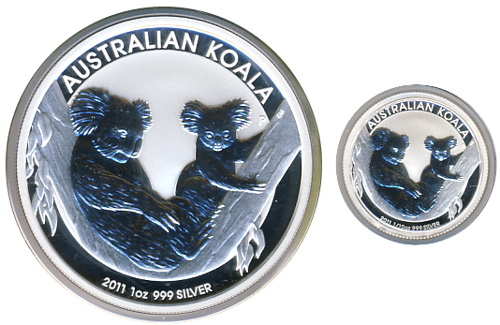
Last month, the Perth Mint of Australia began selling one-tenth ounce Silver Koala coins. Previously, this series had been offered in sizes ranging from one-half ounce to 1 kilo. Other numismatic and bullion coin offerings from the Perth Mint have also been available in sizes starting at one-half ounce, but this seems to be the first instance that a one-tenth ounce size has been available.

As will generally be the case with silver products, the smaller weight offerings carry a larger premium than than larger weight products. This can be the result of the fixed costs associated with manufacture or volume discounts which may be available for purchases in bulk quantities.
The Perth Mint’s website shows the one ounce 2011 Silver Koala priced at US $41.88, reflecting a premium of $5.57 or 15.34%. The one-tenth ounce version is priced at $13.76, reflecting a premium of $10.13 or 279%! (All prices at time of post.)

Obviously when purchasing silver for investment purposes, it makes sense to pay the lowest premium possible. That way, you will get more silver for your money and won’t risk seeing contraction of premiums offset gains.

The move by the Perth Mint to smaller sized silver coins is certainly an interesting one. How long will it be before other world mints follow suit?

Gold Price Hits All Time High, Silver at 31 Year High

The Week in Precious Metals

Gold and silver continued their winning ways this week. Measured by the closing London PM Fix prices, gold gained $24.50 or 1.75%, while silver rose $1.89 or 5.81%. On an intraday basis, the gold price hit an all time high of $1,440.31 while silver traded to a new 31 year high at $35.55.

Gold’s advance for the week came after solid gains of $19 per ounce in the previous week.  Concerns about a weak dollar, skyrocketing oil prices and continuing turmoil in oil producing nations in the Middle East all contributed to reinforce the importance of gold for wealth diversification and as a hedge against a range of adverse economic conditions.

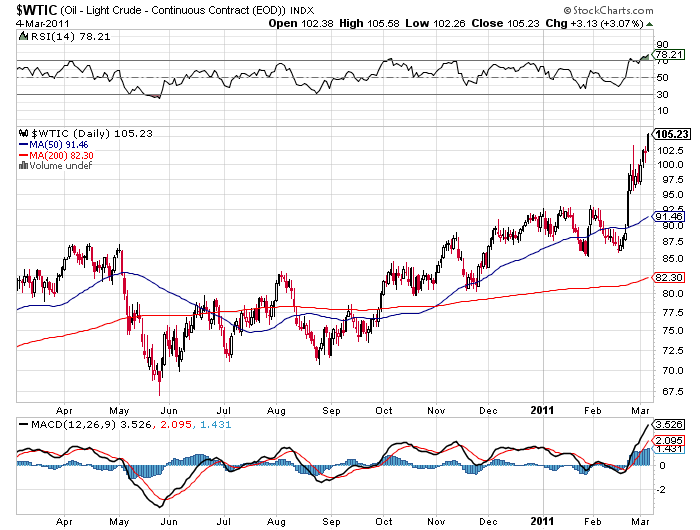
The ongoing surge in oil prices does not reflect an actual shortage in crude production.  Inventories remain robust and excess producing capacity seem adequate to replace all of Libya’s roughly 2 million barrels a year of production.  Rising oil prices reflect the fear that social unrest will spread to Saudi Arabia, the King of oil producers.

Saudi Arabia is surrounded by countries that are in massive social, religious and economic upheaval.   The contagion of violence and revolution has spread throughout the area included Algeria, Libya, Tunisia, Iran, Yemen and Bahrain.  If Saudi Arabia follows the path of its neighbors, the price of oil would quickly be on its way to $200 a barrel.  Small protests in the Saudi Kingdom this week may be a prelude to much larger upheaval in the months ahead.

Oil - Stockcharts.com

The money printing and inflation creation campaigns of the Federal Reserve seem to be giving the struggling U.S. economy some traction and there have been discussions by Fed members regarding the termination of quantitative easing after the current $600 billion round of money printing ends in June of this year.  However, much higher oil prices would quickly put the U.S. economy back into recession since consumer disposable incomes would be drastically reduced.

The Fed’s only easing option to fight another recession is to institute another round of money printing, which at some point leads to an inflationary spiral.  In Senate testimony this week, Fed Chief Bernanke admitted that “sustained rises in the prices of oil or other commodities would represent a threat both to economic  growth and to overall price stability.”  It is no surprise that gold is looking like a sensible option to more and more investors.

Precious Metals Prices
Fri PM Fix Since Last Recap
Gold $1,427.00 +24.50 (+1.75%)
Silver $34.43 +1.89 (+5.81%)
Platinum $1,828.00 +37.00 (+2.07%)
Palladium $811.00 +26.00 (+3.31%

Platinum regained some of its luster with a gain of $37 after last week’s loss of $45, while palladium was up $26 following last week’s loss of $62.

After a gain of almost 2% last week, silver continued its sharp upward price movement and gained $1.89 or almost 6% on the week.  On a percentage basis, silver’s gain on the week was almost three times the gain seen by gold.  Since last summer, silver has vastly outperformed gold, a trend that may continue.

If the gold to silver ratio returns to its long term historical trend of 16, the price of silver would approach $100 per ounce at the current price of gold.

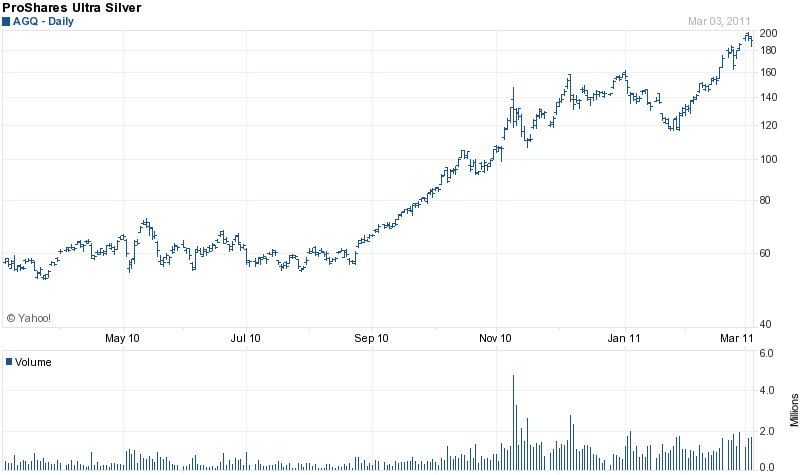
The price of the ProShares Ultra Silver (AGQ)  jumped $23 points on the week to close at $204.19 while the popular iShares Silver Trust (SLV) jumped $2 dollars or 6.2%, closely tracking the price of the metal.

AGQ - Yahoo Finance

Perth Mint Introduces Australian Platypus Platinum Bullion Coins

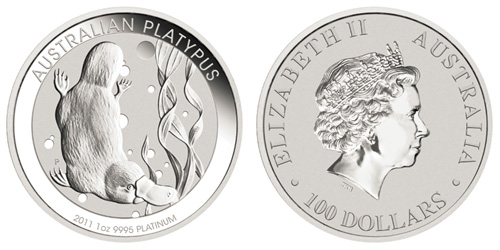
On March 1, 2011, the Perth Mint of Australia introduced a new platinum investment coin to complement the gold and silver offerings of their official bullion program. The Perth Mint has not offered a platinum investment coin since the withdrawal of the Platinum Koala in 2000, however they do produce certain platinum numismatic coins.

The Australian Platinum Platypus contains one troy ounce of 99.95% platinum. The design features the native aquatic mammal diving beneath the water. Above the scene is the inscription “Australian Platypus” with the date of issue, bullion weight, and purity indicated below. The other side of the coin features a portrait of Elizabeth II with the legal tender face value of “100 Dollars”.

The current market price of platinum is $1,835 per troy ounce. Last year the price of platinum rose by 18.08%, under performing gold, silver, and palladium. For the year to date, platinum has risen about 6%. This compares to gains of 1.24% for gold, 15.25% for silver, and 1.77% for palladium.

A maximum of 30,000 Platinum Playpus coins will be issued by the Perth Mint during 2011. All future annual releases will carry the same limit.

Other world mints that offer platinum bullion coins include the Royal Canadian Mint with their Platinum Maple Leaf offering. In the past, the United States Mint has American Platinum Eagle bullion coins, however these have not been issued since 2008. Initially, production was halted in an effort to deal with surging demand for gold and silver bullion coins.

US Mint Silver Eagle Bullion Coin Sales Jump

The pace of United States Mint gold and silver bullion coin sales picked up in the prior week. The US Mint currently has available one ounce American Silver Eagles in allocated quantities and unrestricted quantities of American Gold Eagles.

The latest available statistics show an increase of 1,509,500 ounces of silver bullion sales. In the previous two weeks, the US Mint had sold 908,000 and 833,500. Although sales show a big increase, it could be higher if not for the US Mint’s allocation program. Authorized purchasers are currently limited in the number of coins that they can order, which means sales are not an indication of the full demand for silver bullion.

American Gold Eagle sales increased by 37,000 ounces since the last report. This compares to sales of 28,000 and 31,500 in the prior two weekly periods. The increased demand comes as the price of gold recently reached a new all time high above $1,440 per ounce. For the past several years the rising price of gold has been accompanied by strong demand for physical gold.

US Mint Bullion Coin Program Sales 3/2/2011 (ounces)

Prior Week Month to Date Year to Date
American Silver Eagle 1,509,500 0 9,662,000
American Gold Eagle 37,000 6,000 232,000
America the Beautiful Silver 0 0 0
American Platinum Eagle 0 0 0
American Gold Buffalo 0 0 0

Year to date US Mint bullion coin sales have now reached 9,662,000 ounces of silver and 232,000 ounces of gold. Both figures represent an increase from the average pace of sales experienced in the prior year.

During 2010, the average monthly sales level for Silver Eagles was 2,888,541 ounces, while the average monthly sales of Gold Eagles was 101,708 ounces.

iShares Silver Trust Holdings Increase Sharply

The iShares Silver Trust (SLV) continued to add large amounts of silver to its holdings while the SPDR Gold Shares Trust (GLD) experienced another small decline in holdings.

Holdings in the GLD declined by 7.28 tonnes compared to a decline of 5.77 tonnes in the previous week.  Total holdings have declined by 5.5% or 69.76 tonnes since the start of the year.  The GLD currently holds 1,210.96 tonnes or 38.93 million ounces of gold valued at $55.9 billion.

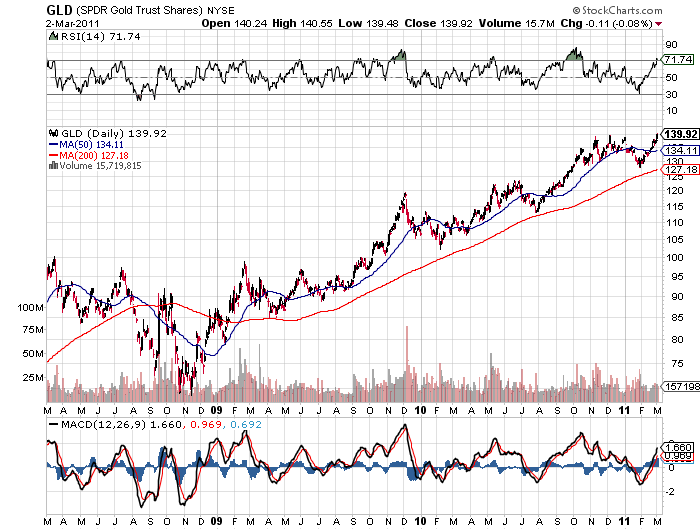
The price of the GLD has traded as low as $128 since last October after running up from approximately $110 from the start of 2010.   The GLD hit new highs yesterday at $140.55 before closing at $139.92 reflecting the new all time high in gold prices.  Gold settled at $1437.20 for March delivery on the Comex division of the New York Mercantile Exchange.

GLD - COURTESY STOCKCHARTS.COM

The GLD is structured to allow investors a means of investing in gold without taking physical delivery and to buy or sell that interest by trading the GLD shares on a regulated stock exchange.  The GLD has been wildly successful since its start by allowing widespread beneficial ownership of gold bullion without the costs involved in physical delivery such as insurance and storage.  The GLD has facilitated gold ownership by both large and small investors by supplying liquidity to the market and ease of ownership.

GLD and SLV Holdings (metric tonnes)

2-March-11 Weekly Change YTD Change
GLD 1,210.96 -7.28 -69.76
SLV 10,764.52 +189.29 -157.05

Holdings in the iShares Silver Trust (SLV) increased by 189.29 tonnes over the past week compared to an increase in the previous week of 164.0  tonnes.  The year to date decline of 157.05 tonnes represents a 1.4% drop in silver holdings since the beginning of the year.  The value of the SLV and GLD are structured to reflect the underlying price of gold and silver but an increase in precious metal prices may not necessarily result in greater gold or silver holdings by the Trusts.

The price of SLV hit an all time high yesterday as March silver prices reached a 31-year high of $34.93 per ounce.  As the credit worthiness of many sovereign nations continues to decline, investors continue to see gold and silver as a viable alternative to currencies as a store of value.

The all time high for silver was $48.70 reached in January 1980.

Since last August, silver has dramatically outperformed gold in price appreciation.  Silver has soared over 92% since last August while the price of gold has increased by only 22%.  This dramatic out performance of silver over gold has resulted in the gold silver ratio declining from a multi decade average of 60 to the current level of 41.  Some observers see the decline in the gold silver ratio as an omen for a price pullback in silver while others view it as a fundamental demand shift indicating further sustained price gains for silver.

SLV - COURTESY YAHOO FINANCE

Demand For Silver Jewelry Soars As Silver Hits New Highs

Demand for silver jewelry hit new records in 2010 according to The Silver Institute. A survey of 340 retail jewelers conducted in February by Nielsen/National Jeweler shows that 87% of retail jewelers experienced sales increases. The retail jewelers surveyed operate 4,000 stores.
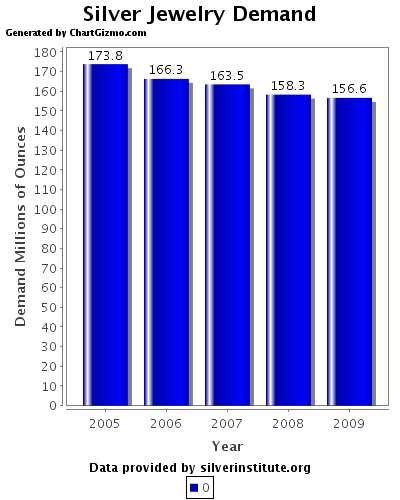
The survey reveals that of the jewelers reporting sales increases, 52% saw sales increases of between 11% and 25%. Sales increased by more than 25% at 28% of the jewelers surveyed.

Sales of gold and platinum jewelry saw increases in sales of 4%, far below the sales increase in silver jewelry. As the price of both gold and silver continue to surge, many smaller investors naturally gravitate to less expensive silver.

The fact that silver jewelry sales increased substantially despite the huge jump in silver prices last year indicates that the general public is recognizing the need to diversify their wealth into an asset that has held its value over the millenniums.  Paper currencies have come and gone over the centuries, leaving paper wealth holders impoverished while gold and silver have always been a store of permanent value.

As the economy hit the wall during 2008 and 2009, silver jewelry sales declined from previous record levels to under 160 million ounces.  A ten year high in silver jewelry demand was reached during 2003 at 179.2 million ounces.  The four other years of the past decade during which silver jewelry sales exceeded 170 million ounces were 2000, 2001, 2004 and 2005.

The silver institute has not yet released their World Silver Supply and Demand statistics for 2010, but based on the survey cited, it appears that silver jewelry demand for 2010 may have exceeded the previous demand record of 179.2 million ounces during 2003.  Assuming that total silver jewelry demand increased by 15% over 2009, total 2010 demand could have exceeded 180 million ounces – a very bullish indicator as silver continues to increase in price.