April 10, 2026

Will Gold Resource (GORO) Become A $5 Stock?

Gold Resource Corp (GORO)  has been one of the best performing gold stocks over the past five years, outperforming the appreciation in gold bullion by around 2,000%.  From a price of $1 per share in September 2006, Gold Resource rose to the $5 per share range by mid year 2007 and earlier this year hit an all time high of $31.38.  GORO closed at $24.10 on Friday and may head much lower in the aftermath of a devastating article published in this week’s Barron’s.

Highlights of the disclosures and questions raised about GORO in the Barron’s article include the following:

  1. The company is run by the Reid family and Bill Conrad, who helped the company in its initial public stock offering in 2006.  Barron’s discloses that the Reids and Conrad “have been consistent sellers of the stock” with $13.7 million of sales in the just the past year.
  2. Gold Resource’s primary mine in El Aguila, Mexico, has seen constant production delays despite promises since 2007 that production would soon increase.  In April of this year, according to Barron’s, the mine produced only 20,000 ounces  after being targeted for 70,000.  The expenditure of $95 million, raised in equity offerings, has produced minimal results in terms of gold production.
  3. The El Aguila mine was abandoned by Apex Silver Mines after they explored the site in the early 2000s.
  4. Gold Resource has never conducted a study to accurately assess the “proven and probable reserves” of the El Aguila mine.  According to Barron’s, investors only have the Reids’ word to rely on for estimates of gold deposits and the cost of extraction them.
  5. The two largest investors in Gold Resource are Hochschild Mining of Peru and the Tocqueville Gold Fund.  According to Barron’s, “the largest holders, who have known the company the longest, have not been buying stock at anywhere near the current price”.   Legendary gold investor John Hathaway of the Tocqueville Gold Fund told Barron’s that his geologist has visited the El Aguila mine twice and ore samples are “consistent with a potential deposit of two to three million ounces of gold equivalent”, worth up to $4.5 billion in gross revenue.  Almost 4% of the Tocqueville Gold Fund is invested in Gold Resources.
  6. Barron’s discloses that Gold Resource President Jason Reid sold $700,000 of stock “on May 19th, a day after Barron’s  first emailed him some questions”.
  7. Barron’s claims that Gold Resource management is “promoting the stock” with cash dividends despite the fact that “the company has never, in a single quarter, produced positive cash flow”.
  8. Barron’s concludes that investors shorting the stock “are probably wise” not to take management’s word on how much gold Gold Resource actually has or how much it will cost to mine.

The recent trading action in Gold Resource Corp stock raises some intriguing questions.  On June 24th, GORO traded down $1.47 as trading volume exploded to 3.3 million shares, the highest volume in the stock’s history and 7.7 times the stock’s daily average trading volume.  The massive surge in trading and lower stock price a mere week before the damning Barron’s article was published suggests that some investors knew in advance what was coming.  Investors also have a significant short interest position in GORO of almost 11% of the stock’s float.


GORO - COURTESY YAHOO FINANCE

If Barron’s doubts about Gold Resource prove correct, the stock may be looking at a return trip to $5 per share.
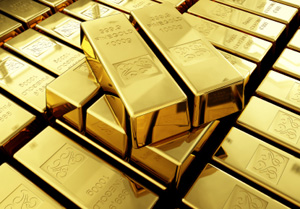
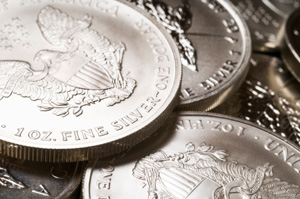
Gold and Silver Decline As World Turns Upside Down After Resolution of Debt Crisis

It wasn’t supposed to be like this.

A default on Greek debt was supposed to have set off a chain reaction collapse of other weak sovereign debtors including Ireland, Spain, Portugal and Italy.   European banks holding huge amounts of Greek debt would be rendered insolvent pushing Europe into a banking crisis.  U.S. banks, holding large positions in credit default swaps and derivatives would follow the European banks into a downward spiral as both confidence and liquidity evaporated.

Money market funds, piled high with toxic debt securities issued by insolvent European banks would be facing a massive run by nervous shareholders.  Central banks, the last great hope of insolvent nations, would be forced to come to the rescue with oceans of printed money.  Nervous holders of paper currencies would rush into gold driving prices sharply higher.

The plausible scenario of default by insolvent members of the European Union suddenly got turned upside with stocks exploding higher and gold prices hitting a six week low.

BloombergGold Falls to Six-Week Low Amid Reduced Concern Greece May Default On Debt

Gold futures tumbled to a six-week low as Greece progressed in staving off a default, curbing demand for the metal as an investment haven.

Greece may get as much as 85 billion euros ($124 billion) in new financing, including a contribution from private investors, in a second bailout aimed at preventing default and ending the euro region’s debt crisis, according to an Austrian Finance Ministry official. Gold dropped 2.2 percent last month.

“Gold’s inability to extend further gains in recent sessions, despite a weaker dollar, could be a warning sign heading into the third quarter,” Australia & New Zealand Banking Group Ltd. (ANZ) said in a report.

The Austrian finance official effectively said that the euro region’s debt crisis was solved by extending further credit to a blatantly insolvent Greece – too much debt was cured with more debt.

The extend and pretend policies, used extensively by policy makers in every past crisis would be employed again, this time to a nation with the lowest rated sovereign debt in the world.

The success of extending further loans to Greece would be guaranteed by the sale of Greek national assets and forcing every citizen of Greece to endure a depressionary lifestyle.  Other members of the EU facing a debt crisis could be handled in the same manner.  The European Central Bank and Wall Street popped the champagne corks and celebrated the end of the debt crisis.

The surreal events of the past two weeks only reinforce the certainty of a greater debt unwind at a fast approaching future date. Expecting Greece to repay its obligations is simply not economically feasible.  Greek citizens, rioting against austerity measures, have made it clear that default is the best option.  Political leaders of Greece, the birthplace of democracy, must eventually accept the public will.

The debt crisis has not been resolved, it has been expanded.  Investors foolish enough to convert precious metal holdings back into paper currency are giving serious long term gold and silver investors a gift opportunity to accumulate at bargain prices.

Precious Metals Prices
PM Fix Since Last Recap
Gold $1,483.00 -31.75 (-2.10%)
Silver $33.85 -0.88(-2.53%)
Platinum $1,708.00 +12.00 (+0.71%)
Palladium $750.00 +11.00 (+1.49%)

Gold  and silver both declined on the week by over 2%, while platinum and palladium saw modest gains.

As measured by the closing London PM Fix Price, gold has declined by $69.50 since June 22.

Silver has now declined three weeks in a row.  Since June 1st, as measured by the London PM Fix Price, silver has declined by $4.10 per ounce or 10.8%.

Magical Properties Of Silver Showcased By New Products

New uses for silver in industrial and medical products have expanded rapidly in recent years.  The almost magical properties of silver in a wide range of new applications is highlighted by The Silver Institute in this month’s issue of Silver News.

Scientists at the California Institute of Technology have discovered a way to use silver to produce a super tough “metal/glass” that combines the best properties of glass and metal.  The high tech process uses silver and a mixture of other compounds.  The resulting super tough metal glass will have applications in medical implants and is far superior to existing products.  Besides being stronger the new metal/glass could reduce infections due to the anti bacterial properties of silver.

Jewelry makers continue to explore new products using silver to replace higher priced gold.  An alloy of platinum and silver, known as Platinaire, is becoming popular.  Platinaire is made with 92.5% silver and 5% platinum and resists tarnishing, is harder than silver and less expensive than gold.

The Silver Institute also explains how specially prepared silver nanoparticles are used as sensors to detect pathogens.  Scientists discovered a way to utilize the optical properties of silver in this process and at the same time prevent the silver from killing the bacteria being identified.

Another new product highlighted by The Silver Institute is a new FDA approved face mask that uses embedded silver particles to kill micro organisms.  The new mask effectively blocks the dangerous staph bacteria and a wide range of other bacteria, thus providing superior protection to health care workers.  The new masks are double the price of traditional face masks but provide a much higher level of protection.

Silver’s use in fighting bacteria seems to be finding an unlimited number of uses.  According to The Silver Institute, researchers at the North Carolina State University are coating surgical implants with silver to prevent infection.

It turns out that silver also has properties that allow oil companies to clean petroleum wastes using a silver based solution.  Silver based liquids have a wide range of use in the chemical industry and their use is projected to grow rapidly.

In another unique application of silver’s germ fighting abilities, The Silver Institute reports that researchers at the University of Wisconsin have found a way to apply silver to wounds by using a rubber stamp.  The method allows silver to be used in precise amounts and takes just seconds to apply to a wound.  The process is still in the animal testing phase but promises to eventually have wide applications in human medicine.


Silver ETF Holdings Gain As Gold ETF Holdings Decline Slightly

Silver holdings of the iShares Silver Trust (SLV) gained by 21.23 tonnes on the week.  In the previous three weeks,  SLV silver holdings had declined by a total of 381.95 tons, bringing the net outflow for the year to 1,340.96 tonnes.

The all time high holdings of the SLV was 11,390.06 tonnes on April 25, 2011.   The decline in SLV holdings from the all time high totals 1,809.45 tonnes, a decline of 15.9%.  The yearly high for the price of silver of $48.70 on April 28th correlates closely to the date of record holdings of the SLV.

The iShares Silver Trust currently holds 308.0 million ounces of silver valued at $10.6 billion.  The total net assets of the SLV have plunged by $6.7 billion since reaching an all time high of $17.3 billion on April 28th.  The dramatic 39% decline in the total net asset value of the SLV reflects the combination of much lower silver prices and reduced silver holdings.   Silver, at today’s close, has declined by $14.31 per ounce (29.4%) from the high of $48.70 on April 28th.


SILVER - COURTESY STOCKCHARTS.COM

Silver, as measured by the closing London PM Fix Price, closed today at $34.39, up $0.43 per ounce.  In later hour New York trading, silver continued to move up and closed at $34.98.  Silver has been in a narrow trading range in the mid 30’s since its decline in early May.

GLD and SLV Holdings (metric tonnes)

June 29-2011 Weekly Change YTD Change
GLD 1,208.23 -0.91 -72.49
SLV 9,580.61 +21.23 -1,340.96

The holdings of the SPDR Gold Shares Trust (GLD) declined slightly on the week by 0.91 tonnes, bringing the decline for the year to 72.49 tonnes.  The GLD currently holds 38.85 million ounces of gold valued at $58.4 billion.

Gold closed in London at $1504.25 and continued to move up in late New York trading, closing at $1512.80, up $9.70.  Gold has remained in the $1,500 range even as oil, stocks, silver and a large number of other commodities have declined in price since early May.

Is The Plunge In Gold Stocks Predicting A Drop In Gold?

American Gold Buffalo

Gold stocks have been under performing gold bullion for the past three years.

The poor performance of gold stocks is reflected in the sub par returns of gold mutual funds run by two of the countries largest investment companies.  The three year return on Vanguard’s Precious Metals Fund (VGPMX) has actually had a negative return over the past three years as the price of gold has soared by 80%.  The Fidelity Select Gold Portfolio (FSAGX) has returned only 16.2% over the past three years. (See Physical Gold Outperforms Vanguard and Fidelity Gold Mutual Funds).

Senior gold producers such as Newmont and Kinross Gold are increasing gold production and solidly positioned for significant earnings increases but their stock prices have not been able to match the returns of gold bullion.

Although there are many reasons to expect that gold stocks will catch up to gold and deliver large gains to investors, so far this has not been the case.

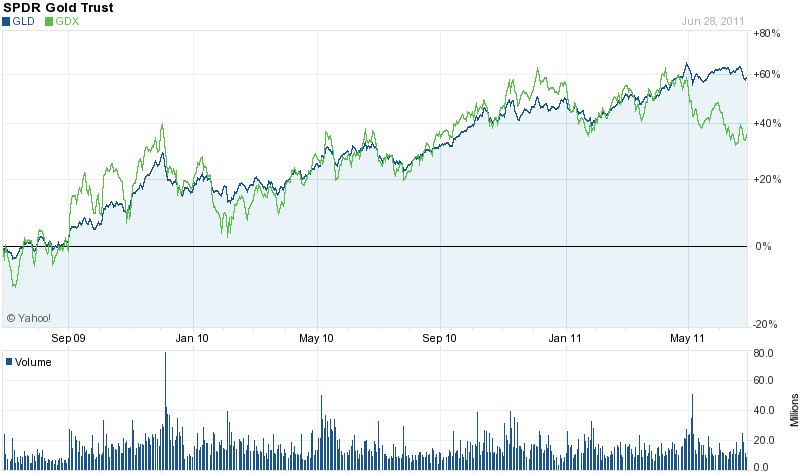
Adding fuel to the investor debate over the relative merits of gold stocks versus gold bullion has been the drastic price divergence exhibited since the beginning of 2011.  While gold has held virtually all of its gains, the price of many gold stocks has plunged.  An investor in gold stocks not tracking the price of gold would probably conclude that the price of gold had collapsed during 2011.

Since January 1st, the price of gold has gained $116 per ounce or 8.3%.  From January lst to recent June lows, the price of Newmont Mining is down  by $9.27 (15.2%), Kinross Gold is down by $3.96 (20.8%) and Agnico-Eagle Mines is down by $16.01 (20.9%).  A broad basket of gold stocks, as measured by the Gold Miners ETF (GDX) has declined by $9.69 or 15.8%.

Adding to concerns about the recent sell off in gold stocks is the especially wide price divergence seen since May lst.  Although many individual gold stocks have long lagged the returns of gold, the GDX, a broad based index of gold stocks has generally tracked the price movement of gold over the past several years.  Since the beginning of May, however, the linkage between gold stocks and gold completely broke down, leaving investors to ponder the significance of such a wide divergence.


STOCKS VS GOLD - COURTESY YAHOO.COM


On past occasions, weakness in the gold mining shares has been a harbinger of a sell off in the gold market.  Is the current weakness in gold stocks currently forecasting a decline in the price of gold?  The end of the Fed’s money printing campaign, the world wide debt crisis, concerns about deflation, a weakening economy and the decline in commodity prices lead some to believe that a liquidity driven crisis could result in lower gold prices.

Despite short term concerns over the price of gold, the reasons for remaining long term bullish on gold are numerous.  The fundamental problems of excessive debt, debased currencies, widespread insolvency among sovereign states and out of control spending by the U.S. government all suggest that we remain on the precipice of another economic crisis.  Governments and central banks have no solutions except for the printing presses, which will be turned up to full speed at the inception of the next financial crisis.

At the margin selling may temporarily drive down gold prices in the short term, despite the solid long term bullish fundamentals for gold.  The long term trend for gold remains higher and any temporary price weakness would be a buying opportunity for gold investors.


Gold, Silver, Platinum and Palladium All Decline On Week

It was a dismal week for precious metals as prices declined across the board.  Platinum declined by over 3%, palladium and silver by 2% and gold by 1.5%.

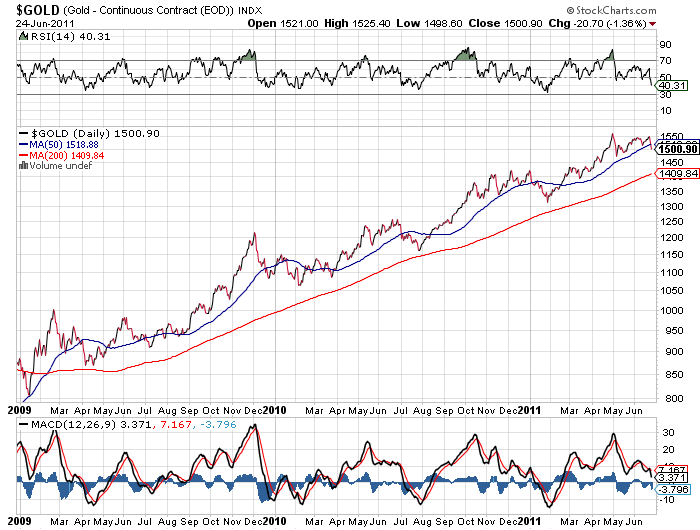
As measured by the London PM Fix Price, gold declined on the week by $22.75 after a gain of $8.25 last week.  After closing Wednesday at $1,552.50 gold was hit by selling that drove the price down by $37.75 at Friday’s close.  Gold has now dipped below its 50 day moving average as it has done on numerous occasions since early 2009 but remains solidly above the 200 day moving average.  Since early 2009 the price trend of gold has remained in a solid uptrend and every sell off to the 200 day moving average was followed by significant upward price moves.  The 200 day moving average for gold is currently at $1,410.


Gold - Courtesy Stockcharts.com

Silver declined modestly on the week, losing $0.66 and has remained in a tight trading range over the past two weeks between $36.22 and $34.68.

Platinum was down $55 on the week, closing at $1,751, after losing $78 in the previous week.  Palladium was also weak, falling $15 to $739 after retreating $61 in the previous week.  Both metals have large industrial uses and sold off as numerous economic indicators suggest a slowing world economy.

Precious Metals Prices
PM Fix Since Last Recap
Gold $1,514.75 -22.75 (-1.48%)
Silver $34.73 -0.66(-1.86%)
Platinum $1696.00 -55.00 (-3.14%)
Palladium $739.00 -15.00 (-1.99%)

Markets had been positioned for an improving economy, higher interest rates, higher inflation and additional monetary stimulus by the world’s central banks.  Since early May, the consensus has reversed considerably.  Commodity prices have declined substantially and U.S. interest rates, contrary to the expectations of many, have declined sharply.  Contributing to the sell offs in equity and precious metal markets were midweek comments by Fed Chairman Bernanke that, despite lower expectations for economic growth, the central bank had no plans for QE3.  Markets, confronting the loss of both fiscal and monetary stimulus along with slower economic growth, sold off sharply.

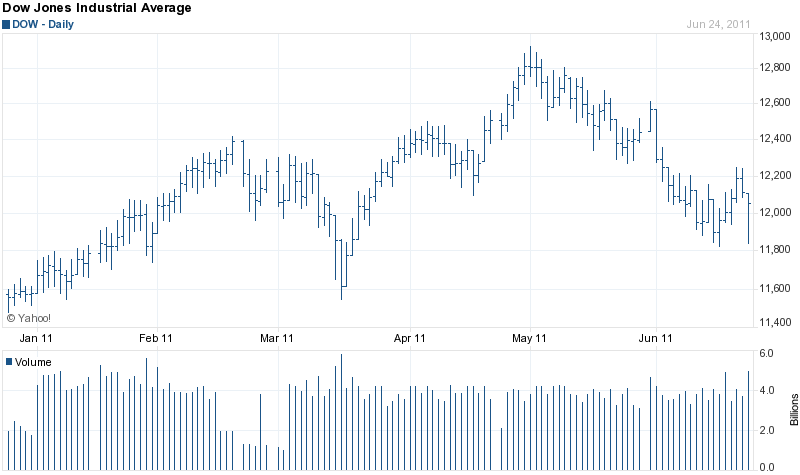
The Dow Jones has plunged over 900 points since early May.


DOW JONE - COURTESY YAHOO.COM

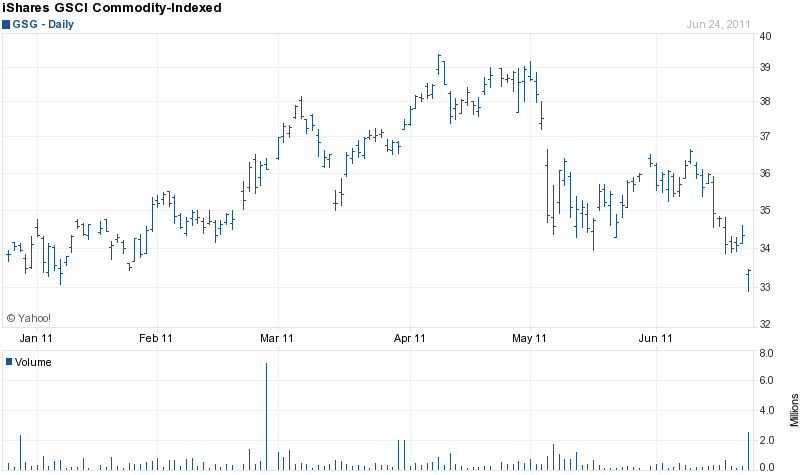
Commodities have tanked by 16%.


COMMODITIES - COURTESY YAHOO.COM

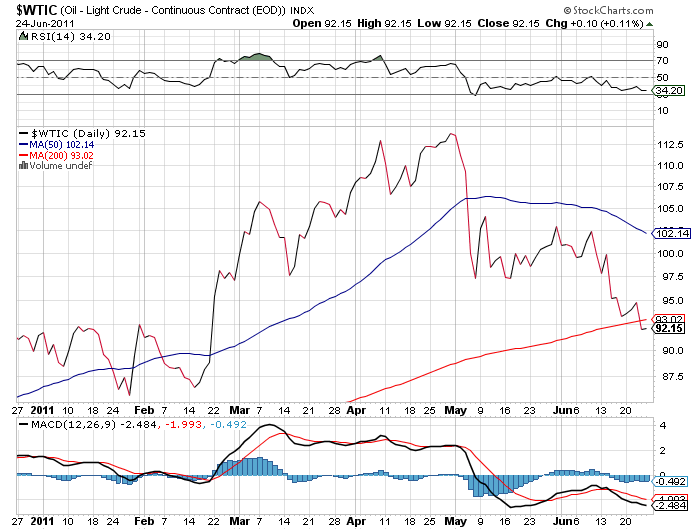
Oil, after peaking in early May at over $112 per barrel, has declined to the low $90’s.


OIL - COURTESY STOCKCHARTS.COM

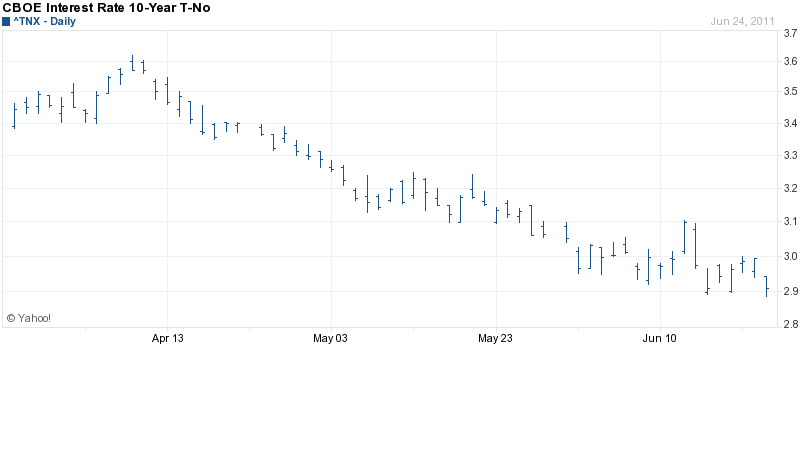
Interest rates, expected to soar after QE2 ended, have declined substantially with the 10 year Treasury note dropping from 3.6% to 2.9%.

10 year treasury - Courtesy yahoo finance


The massive amounts of debt in the system can no longer be supported by economic growth.  Bernanke knows this which is why he is terrified of deflation.  The collapse of asset bubbles have resulted in debt that is now unsupported by collateral value, threatening the solvency of banks and countries.

As the current market sell offs turn into a rout, the Fed will again turn to the only option left – money printing on a scale that will dwarf QE2.  As reported by Bloomberg, former Fed Governor Lyle Gramley said,  “The hurdle for QE3 is obviously high. But if large downside risks materialize and the economy slows enough so that the unemployment rate starts to increase again, QE3 would have to be considered.”

The Federal Reserve can’t create jobs, increase incomes, reduce unemployment or maintain the integrity of the dollar.  The one thing the Fed can and will do is produce dollars in infinite quantities to prevent a 1930’s type debt induced deflationary depression.

Steve Forbes Joins Ron Paul’s Call For Gold Backed Currency

Steve Forbes, CEO of Forbes Magazine, said the U.S. should return to a gold backed currency to prevent further debasement of the U.S. dollar.  Mr. Forbes joins a growing chorus of intellectually honest Americans who view the Federal Reserve as the greatest danger to the American economy and way of life.

The quest to preserve the value of the U.S. currency and rein in the Federal Reserve has long been championed by Rep. Ron Paul.  Apparently, Ron Paul’s message is beginning to make sense to more and more Americans as they watch the purchasing power of their dollars decline daily.

http://youtu.be/3CG9UVagFQ0

Bloomberg is reporting that the public approval rating of Fed Chairman Bernanke has dropped to the lowest level in two years. Bernanke has an approval rating of only 30% compared to 41% in late 2009.  Bernanke’s response to every problem has been to lower interest rates and print money, which have done little to improve the fundamental financial health of consumers or the government.

According to Bloomberg, the public has grown increasing skeptical of increased debt and money printing since unemployment is still near 10%, home values are still in a free fall and the declining purchasing value of the dollar has lowered the standard of living for most Americans.  The Bloomberg Poll showed that a resounding two thirds of Americans think the country is on the wrong track, with 55% expecting their children to have a lower standard of living.

Professor Bernanke can wax eloquent on the benefits of “quantitative easing” but the average American is smart enough to know that a country that needs to print money to pay its bills is in desperate financial condition.

Steve Forbes noted that the ability of the government to print money encourages reckless spending since money can be created out of “thin air.”  According to Mr. Forbes, if the country returned to a gold standard, unlimited spending could not occur.  Ironically, the ability to expand credit and print money is exactly why the government abandoned the gold standard.  The concept of a Federal Reserve and a gold backed currency have become almost mutually exclusive concepts.


Silver ETF Holdings Decline Again As Gold ETF Holdings Gain

Holdings of the iShares Silver Trust (SLV) declined again this week by 106.14 tonnes after a decline of 248.69 tonnes in the previous week.  The year to date decline in silver holdings by the SLV now totals 1,362.19 tons.

The decline in holdings of the SLV from its all time high of 11,390.06 tonnes on April 25, 2011 now totals 1,830.68 tonnes, or a decline of 16.1%.  There is not a direct and timely correlation between the price of silver and the holdings of the SLV as evidenced by the fact that silver has declined in price by a much larger percentage than holdings in the iShares Silver Trust.  From its high of $48.70 on April 28th, silver has had a price correction of 35.6%.

The holdings of silver by the SLV are structured in a complex manner.  The trust is set up so that the SLV price correlates closely to the price of silver.  This is accomplished by allowing Authorized Participants to arbitrage against a premium or discount of the SLV to the trust’s underlying net asset value  (see How Wall Street Made Huge Profits On Silver ETF Crash As Small Investors Sold).

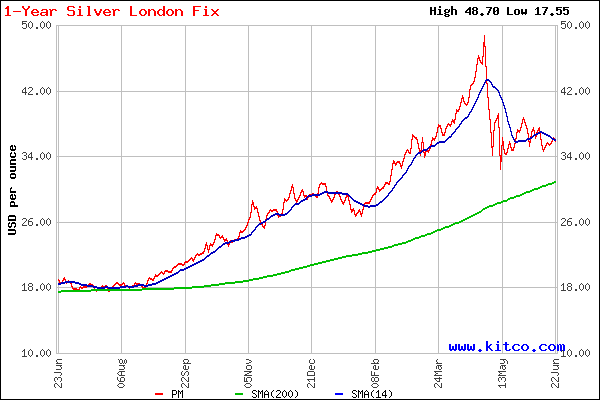
As measured by the closing London PM Fix Price, silver closed today at $35.91, up slightly from last Wednesday’s close of $35.26.  Silver has been consolidating in the mid 30 range after the early May sell off.

As of June 22, 2011, the SLV held 307.3 million ounces of silver valued at $11.0 billion.


SILVER - COURTESY KITCO.COM

Silver seems to be building a base in the mid $30’s and presents a buying opportunity for long term investors.

GLD and SLV Holdings (metric tonnes)

June 22-2011 Weekly Change YTD Change
GLD 1,209.14 +9.09 -71.58
SLV 9,559.38 -106.14 -1,362.19

Holdings of the SPDR Gold Shares Trust (GLD) gained by 9.09 tonnes on the week after a decline of 11.52 tonnes in the previous week.   The GLD currently holds 38.88 million ounces of gold valued at $60.3 billion.

As measured by the closing London PM Fix Price, gold closed on Wednesday at $1,552.50, a new closing high on the year.  The price of gold remains in a solid uptrend supported by huge physical demand from investors and central banks.


GOLD - COURTESY KITCO.COM


Russia Joins China In Rejecting U.S. Debt, Buys Gold Instead

China, the largest foreign holder of U.S. debt, has been concerned about the safety of its U.S. treasury debt holdings for years.

In March 2009, Chinese Premier Wen Jinbao warned Washington that “We have lent a huge amount of money to the U.S.  Of course we are concerned about the safety of our assets. To be honest, I am definitely a little worried.”

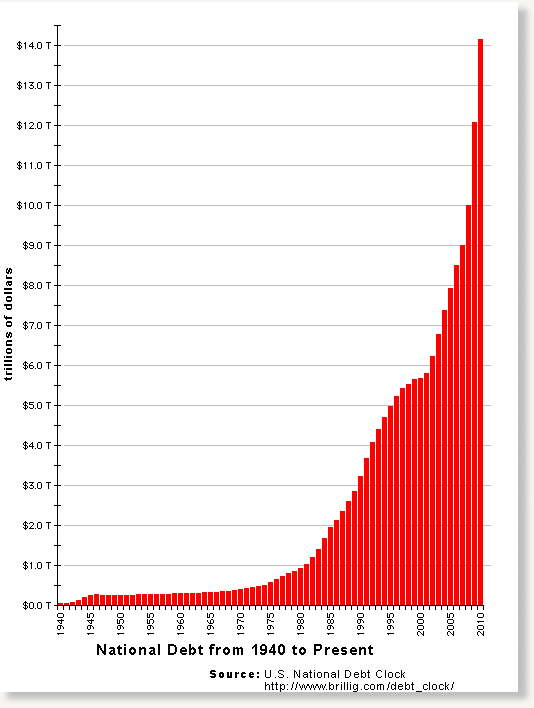
Premier Jinbao’s  was right to worry about the safety of China’s U.S. debt holdings.   Since March 2009, the U.S. debt has increased by more than $3 trillion and Congress is now being pressured by the Federal Reserve and the Treasury to increase the national debt limit by another $2 trillion.  The parabolic increase in U.S. debt, along with recent downgrade warnings on U.S. debt from the credit rating agencies, must be keeping the Chinese up at night.

On Saturday, the Wall Street Journal reported that Russia also decided that holding U.S. debt has become too risky.  In comments to Dow Jones, Arkady Dvorkovich, chief economic adviser to Russian President Medvedev, said “The share of our portfolio in U.S. instruments has gone down and probably will go down further.”  According to the Wall Street Journal, Russia has already reduced its holdings of U.S. debt from $176 billion last fall to $125 billion in April of this year.

Besides diversifying into other currencies such as the Canadian and Australian dollar, Russia has also been substantially increasing its purchases of gold.  Recent reports from the World Gold Council and IMF show that Russia recently bought 50 tons of gold bringing its total gold holdings to almost 670 tons.

If Russian economic advisor Dvorkovich looks at the above chart of U.S. debt, he may well decide to run to the exits and dump all of Russia’s U.S. debt holdings.

The United States has truly entered the Bizarro stage of national finance.  As the exponential increase in U.S. debt moves the Nation ever closer to a debt crisis, Fed Chairman Bernanke and Treasury Secretary Geithner are predicting dire consequences if Congress does not increase the U.S. debt limit.  Should it really be a surprise that two of the world’s biggest holders of U.S. debt are heading for the exits?


BIZARRO WORLD -COURTESY COMICTREADMILL.COM


Gold Gains Slightly On Week While Silver, Platinum and Palladium Decline

Precious metals had a tough week as silver, platinum and palladium all declined, while gold registered a small gain.

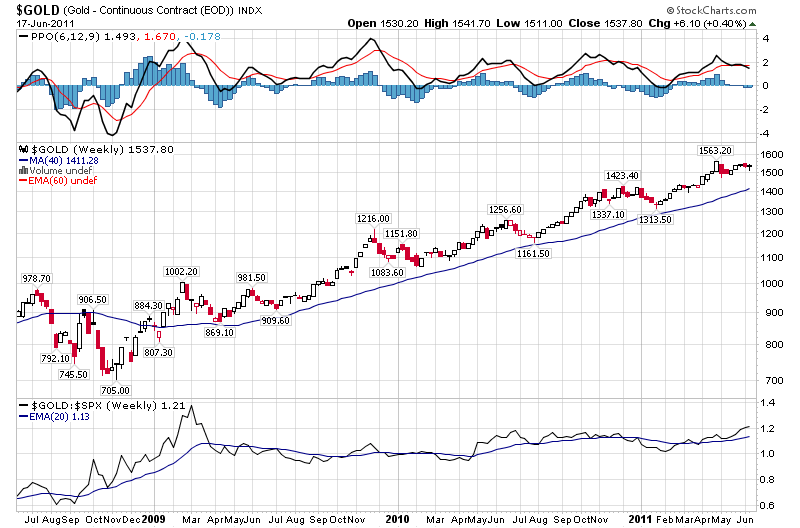
As measured by the closing London PM Fix Price, gold gained $8.25 on the week after declining by $10.75 in the previous week.  Gold remains in a solid long term uptrend.  Since early 2009, gold has remained above its 40 day moving average and every dip to the 40 day moving average has followed with rallies to new highs for gold.

Gold’s last decline to the 40 day moving average in January of this year was subsequently followed by a rally of over $220 per ounce.  A correction to the 40 day moving average would bring gold back to the $1,400 level.


GOLD - COURTESY STOCKCHARTS.COM

Gold has held above $1,500 as world financial markets, oil and other commodities have declined substantially over economic worries.   As the European Central Bank struggles to prevent a Greek default that could trigger a series of other sovereign defaults, debt yields are soaring not only in Greece but also Spain, Portugal, Italy and Ireland.

Markets are beginning to reflect the unavoidable truth that we are reaching an end game where sovereign governments have become the new systemic risk to the financial system.  As debt burdened governments face the prospect of financial collapse and political unrest, the only option will be to sell new debt to the central banks who will buy the debt with newly printed money.  As central banks worldwide compete with each other in massive currency debasement, gold will soar to new highs beyond predictions of the boldest gold bulls.

As the slow motion collapse in Europe unfolds, investors in the U.S. seem resolute in the belief that “it can’t happen here, we are not Greece.”  This argument is rejected by Bill Gross who runs Pimco, one of the largest bond funds in the world.  According to Gross, who recently announced that he would stop buying U.S. Treasury debt, the U.S. is actually in worse shape than Greece.

The total debts of the U.S. government, including off balance sheet obligations for open ended social programs, totals $100 trillion.  Gross notes that “To think that we can reduce that within the space of a year or two is not a realistic assumption.  That’s much more than Greece, that’s much more than almost any other developed country.”

Critics who dismiss the warnings of Bill Gross point to the current level of low yields on U.S. treasury debt.  Why would the U.S. be able to sell its debt at such low rates if the finances of the United States are worse than Greece?  The answer is that crises develop in a linear fashion.  Investors don’t worry about credit risk until the crisis is upon them and suddenly everyone wakes up and panics.

Carmen Reinhart of Harvard and formerly of the IMF correctly predicted that a sovereign debt crisis would follow the financial crisis of 2008.  In a study of bond markets as a forecasting tool, Reinhart showed that rates are a poor forecaster of  repayment risk.  According to Reinhart, “Very often, interest rates are a coincident, rather than a leading indicator” of a looming financial crisis.

Preserving wealth during the next financial meltdown will require taking steps before the inevitable crisis develops.

Precious Metals Prices
PM Fix Since Last Recap
Gold $1,537.50 +8.25 (+0.54%)
Silver $35.39 -1.99(-5.32%)
Platinum $1,751.00 -78.00 (-4.26%)
Palladium $754.00 -61.00 (-7.48%)

Platinum had a volatile week, declining by $78 on the week to $1,751.00.  After moving up by $650 per ounce between July 2009 and May 2010, platinum has been consolidating its gains.  During 2011, platinum has remained in a narrow but volatile trading range between $1,700 and $1,850 per ounce as traders try to sort out whether the predominant demand for platinum is industrial usage or investor demand.

PLATINUM - COURTESY STOCKCHARTS.COM

Palladium had the biggest decline in the precious metals group, falling by $61 per ounce for a loss of 7.48%.  After reaching a high on the year of $858 in February, palladium has been correcting in a sideways pattern.


PALLADIUM - COURTESY KITCO.COM

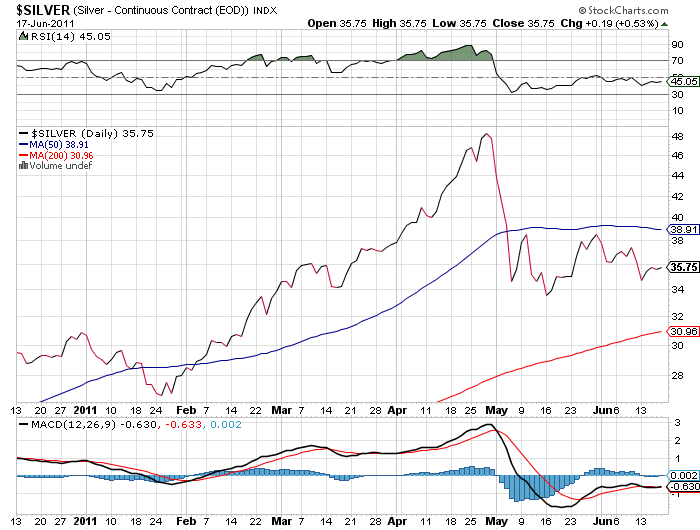
Silver declined by $1.99 on the week to $35.39 after a gain of $2.19 in the previous week.  After the sharp decline in early May, silver has been building a base in the $34 to $38 range.


SILVER - COURTESY STOCKCHARTS.COM