April 13, 2026

US Mint Sells Record 4.26 Million Silver Eagles in November

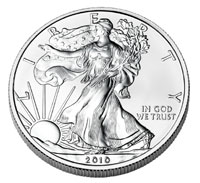
During November 2010, the United States Mint recorded sales of 4,260,000 American Silver Eagle bullion coins. This is significant since it represents the highest monthly sales total in the history of the program.

With the price of silver up more than 65% for the year to date, investment interest in “poor man’s gold” has been on the increase. This has had a big impact on silver bullion sales by world mints, as many prefer to invest in physical precious metals than exchange traded funds or other options.

The previous record for monthly Silver Eagle sales dates back to December 1986 when 3,696,000 of the one ounce silver bullion coins were sold. This had represented the first full month that the coins were available for purchase from the Mint, and reflected the high initial demand for America’s first silver bullion investment product.

In later years, sales of the American Silver Eagle declined, as the price of silver languished. In 1996, bullion sales hit their low as only 3,466,000 coins were sold for the entire year, an amount eclipsed by the monthly sales level a decade earlier.

For the year to date, the US Mint has sold 32,890,500 ounces of silver bullion, which will mark a fresh annual high.

American Silver Eagle Monthly Sales

January 3,592,500
February 2,050,000
March 3,381,000
April 2,507,500
May 3,636,500
June 3,001,000
July 2,981,000
August 2,451,000
September 1,880,000
October 3,150,000
November 4,260,000
December
Total 32,890,500

Details Awaited for America the Beautiful 5 oz. Silver Coins

Silver investors and coin collectors have been awaiting the final details of the United States Mint’s new silver bullion coins. Some preliminary information such as the design, specifications, and production levels have been revealed, but the premiums and exact release dates remain unknown.

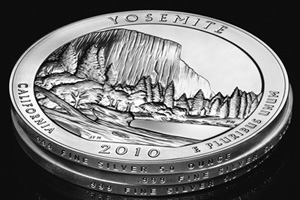
The America the Beautiful Silver bullion coins will feature the designs of the new circulating commemorative quarter series struck in 5 ounces of .999 fine silver. Under Public Law 110-456, the coins will be produced with an unusually large diameter of 3.0 inches. By comparison, the Perth Mint’s 5 oz Lunar silver bullion coins have a diameter of about 2.58 inches. The larger diameter makes the US Mint’s coins more difficult to produce and potentially bendable by hand, due to the thickness of only 0.16 inches.

Following the America the Beautiful Quarters Program, a total of 56 different designs will be released between 2010 and 2021. The releases will feature a National Park or National Site from each of the 50 States, 5 U.S. Territories, and Washington, D.C. The order of release has been established based on the dates the areas were federally designated.

By law the US Mint may issue make the coins available for sale only during the calendar year that the corresponding quarter dollars are released. This means that the 2010 5 oz silver bullion coins featuring Hot Springs, Yellowstone, Yosemite, the Grand Canyon, and Mount Hood must be issued available for sale before the close of the year.

Overall production is left to the discretion of the Treasury Secretary. This is in contrast to the American Silver Eagle, which must be struck based on public demand. For 2010, the US Mint has planned production of 500,000 of the America the Beautiful Silver Bullion Coins, equally divided amongst the five designs.

The new silver bullion coins will be distributed through the US Mint’s authorized purchaser network, which currently distributes other bullion products. The premium that authorized purchasers will need to pay above the market value of the silver has not yet been announced. For the American Silver Eagle, the premium is currently $2.00 per coin. Premiums for American Gold Eagles range from 3% to 9% depending on the bullion weight.

Gold and Silver Recap: Prices Mixed, Eurozone Troubles

Another Precious Week

The big news is once again that the Euro zone is in trouble.  Ireland has rather bizarrely decided to take a bail out loan that it claimed that it never wanted, but that’s not the really, really big news.

No the really, really big news is that the rest of the Euro zone is in trouble.  Both Portugal and Spain are denying that they need bail outs, which to the international markets seems to mean “are in an early rather than a later stage of negotiation”.  Even Belgium is looking vulnerable.  And outside the Eurozone the British, who seem to have been remarkably smug, are also in trouble due to their mainly nationalized banks being up to their neck in bad Irish debt.  So chaos.

And then there’s Korea, where we could have war.  And so more chaos.

But not inflationary chaos, yet.  This has meant that gold and silver swapped places this week.  Gold went up (reflecting a greater danger that the world was going to end soon) while silver went down showing that inflation was probably not likely when everyone’s trying to work out how to wind up a small but rather expansive economy.

Precious Metals Prices
Fri PM Fix Weekly Change
Gold $1,355.00 +12.50 (+0.93%)
Silver $26.62 -0.45 (-1.66%)
Platinum $1,639.00 -11.00 (-0.67%)
Palladium $670.00 -25.00 (-3.60%)

This has not just shown in silver, palladium and platinum prices – it’s also shown in the price for crude oil.  The dollar’s strengthened and everyone’s worried about money going out of the system rather than going in.  Whether this will last is another question, after all although the Euro is a mad concept with a single currency over separate fiscal policies it had a reasonably strong central bank.  Sooner or later someone’s going to start the printing press up as they’ve already done in Washington, Tokyo and London.  And gold rose 3.8% against the Euro.

When looking at the market there hasn’t really been much government action.  The action, as it has been for much of this half of the year, has been among consumers.  For example the GLD ETF, a way of investing in gold if you really trust brokers rather than gold coins in your hand, has been soaking up a lot of the customer interest in gold.  As these ETFs, or exchange traded funds, are adding to the liquidity they could be setting the stage for a sharp reverse.

There’s also some action in Asia as the Indian wedding season is adding yet more pressure as the wedding season starts and Vietnam allows more gold to be imported. One interesting fact is that Chinese consumers have doubled the amount of savings they devote to gold this year to 2%.  There’s plenty of room for growth.

2010 Proof Gold Eagle Selling Quickly

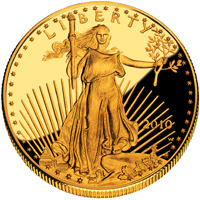
Sales of the recently released 2010 Proof American Gold Eagle already account for more than 74,000 ounces of gold. The collector offerings were first available for sale from the United States Mint on October 7, 2010.
In addition to gold and silver bullion coins distributed through a network of authorized purchasers, the US Mint also typically offers collectible versions of the coins for direct sale. Numismatic products for the American Gold Eagle were canceled last year due to the demand for bullion coins. With the resumption of sales this year, collectors have returned in force.

Through November 21, the total sales for the 2010 Proof Gold Eagles measured in ounces, already exceed the final sales total for the 2008 offerings by more than 50%. The 2008 Proof Gold Eagles were available for a period of more than ten months.

2010 Proof Gold Eagle Sales through 11/21/10

Units Ounces
1 oz 25,000 25,000.00
1/2 oz 6,031 3,015.50
1/4 oz 5,194 1,298.50
1/10 oz 12,809 1,280.90
4 coin set 23,464 43,408.40
Total
74,003.30

2008 Proof Gold Eagle Sales Final

Units Ounces
1 oz 17,720 17,720.00
1/2 oz 10,085 5,042.50
1/4 oz 6,360 1,590.00
1/10 oz 15,599 1,559.90
4 coin set 12,517 23,156.45
Total
49,068.85

Maximum product limits for the 2010 Proof Gold Eagles have been established at 25,000 one ounce coins, 15,000 half ounce, 16,000 quarter ounce, 27,000 tenth ounce, and 39,000 of the 4 coin sets. So far the one ounce option has achieved the maximum.

If all options sell out, this would account for 111,350 ounces of gold.

Gold and Silver Recap: Prices Mixed, $500 Silver Campaign

The excitement seems to generally be wearing off.  It could be the end of the bull market in precious metals.  I don’t think so, but if I call it now and it does happen I will look like a prophet as every one else (including me) thinks that gold is going up.  Words are cheap.  Silver certainly isn’t.
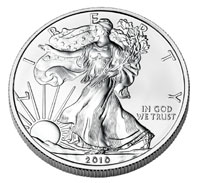
In fact the market has been a bit up and down.  Down for two days on Tuesday and Wednesday, back up on Thursday and then gradually back on Friday.  In fact the gold price for once seems to have been helped by the world not going to pot, as the Euro zone seemed to be edging towards a deal to put Ireland into run off.

Precious Metals Prices
Fri PM Fix Weekly Change
Gold $1,342.50 -46.00 (-3.31%)
Silver $27.07 +0.28 (+1.05%)
Platinum $1,650.00 -62.00 (-3.62%)
Palladium $695.00 -8.00 (-1.14%)

It seems to have affected silver as well.  It only went up 1% this week.  On silver’s past form this is a fall.  So have they stopped competitive devaluation?  You bet they haven’t.  It’s just that fewer people are noticing it.

One stealth seller of gold from the official sector – which has been very quiet – has been the IMF.  While the World Bank goes around telling everyone that the gold standard is something worth considering, the IMF has been ever so quietly selling gold.  This has accelerated when the gold price has been relatively high as the IMF is not making an ideological statement in the same way that Gordon Brown did in the UK when he sold off a chunk of the gold reserves.  This has been counteracted by equally quiet gold buying from some Central Banks, particularly Russia.

Another source of demand is the Asian consumer, and that was quite evident on the week’s trading as much of the dip was attributed to the Chinese resolve in fighting inflation.  If China is successful against inflation then demand for gold will lessen.  One fact on the demand, China is now approaching India as the biggest gold consumer in the world, how long before the Chinese Central Bank shares its peoples growing love of gold?

Silver is still going up, even when all the other precious metals have a bad week.  There’s been relatively little action on the price fixing case, although there is now a rather bizarre campaign to bankrupt JP Morgan (one of the alleged fixers) by having everyone buying an ounce of silver which JP Morgan would have to sell back.  Their target?  Silver at $500 an ounce.  Currently it’s $27.

2010 Proof Silver Eagle Sales Begin

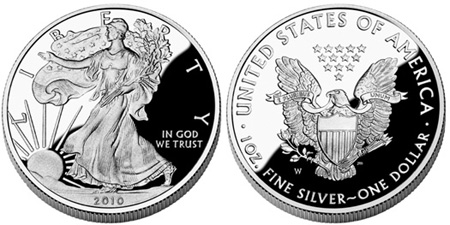
For the first time in more than two years, Proof Silver Eagles are available for purchase from the United States Mint. In recent years, the availability of the collector coins has been prevented by the high demand for physical precious metals.

The US Mint produces American Silver Eagles for both precious metals investors and collectors. The bullion version of the coin is distributed through a network of authorized purchasers, who are able to purchase the coins based on the market price of silver plus a specified premium (currently $2.00 per coin). The authorized purchasers then resell the coins to other bullion dealers and the public, as well as create a two way market for the coins to ensure liquidity. By law the US Mint is required to issue the bullion coins in quantities needed to meet public demand.

The collector versions of the coin are sold by the US Mint directly to the public. Traditionally, a proof version of the coin has been offered to collectors each year. For various occasions, collectible Silver Eagles have also been incorporated into various numismatic products. More recently, a collectible uncirculated version of the coin was offered. Silver Eagles produced for collectors have been offered at fixed prices, generally reflecting a large premium above the value of the silver content. There is no legal requirement for the US Mint to produce or issue collector coins.

Proof Silver Eagles were last available in August 2008. After that point sales of the 2008-dated coins were suspended, never to be resumed. In the following year, the offering was long delayed and eventually canceled. Due to high demand for the bullion version of the coin and the US Mint’s legal requirement to meet public demand, during this period silver planchet supplies were used exclusively to strike bullion coins for this extended period of time.

This year, the US Mint managed to reconcile their legal obligation to precious metals investors and their traditional obligation to coin collectors and sell a record number of bullion coins and offer the collector coins.

The 2010 Proof Silver Eagles are priced at $45.95 each. A limit of 100 coins per household has been imposed by the US Mint for at least the first week of release. Order fulfillment is expected to begin by December 1, 2010.

Will the US Mint Resume Silver Eagle Rationing?

During the course of the past several years, the United States Mint has implemented a rationing program for their popular American Silver Eagle bullion coins at times when demand has exceeded the available supply. Will a recent surge in demand for silver bullion cause them to reinstate the program?

The euphemistically titled “allocation program” was last implemented for Silver Eagles in December 2009. This followed a brief sales suspension during the last few days of November. At the time, the price of silver had been moving steadily higher, supporting increasing interest in precious metals investment. The US Mint experienced a slow month of silver bullion sales in September, followed by increasing demand in October and November leading up to the suspension and ensuing allocation program, which remained in place until this September.

During the past few months, the situation is shaping up to be eerily similar. In September 2010, the US Mint sold 1,880,000 ounces of silver bullion, which represented the lowest monthly sales of the year. In October, sales rebounded strongly to 3,150,000 ounces. For the current month date, sales have already exceeded this amount, measuring 3,175,000.

With the month a little more than half over, the total seems poised to set a new monthly sales record. The current record is 3,636,500 ounces achieved earlier this year in May. Annual sales are already in record territory.

Bullion sales have been rising against a backdrop of steadily rising silver prices. Since the end of September, the silver price has increased from $22.07 to $26.57, representing a gain of more than 20% in less than two months. Reports of tightening supplies or shortages for other silver bullion have also been reported. This may explain the recent move towards the higher premium bullion coins.

The American Silver Eagle is currently the only silver bullion product offered by the United States Mint. A second program known as the America the Beautiful Silver bullion coins has been scheduled to launch this year, but a release date has not yet been specified.

Platinum Price Underperforms Gold, Silver, and Palladium

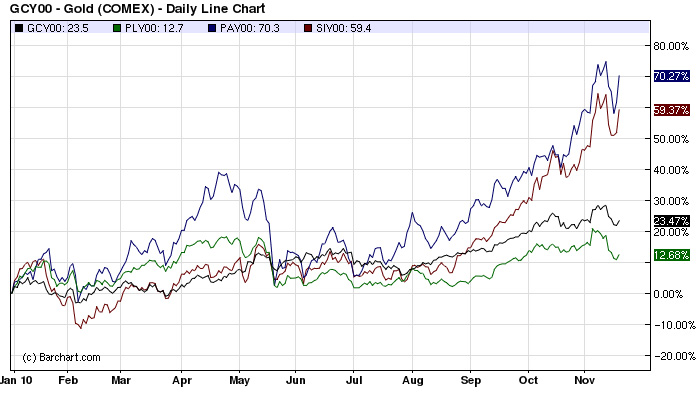
In what has been a strong year for precious metals, platinum is showing only a modest gain of 13.35% for the year to date. This is below the gains experienced for gold and silver, and far below the nearly 75% gain for palladium.

After peaking at $2,273 per ounce in March 2008, platinum dropped precipitously to a low of $763 per ounce by October of the same year. While other precious metals have reattained their 2008 high water marks and then some, platinum has lagged behind.

Gold, Silver, Platinum, and Palladium Performance (London Fix Prices)

Dec 31, 2009 Nov 18, 2010 Change Percent
Gold 1,087.50 1,350.25 262.75 24.16%
Silver 16.99 26.57 9.58 56.39%
Platinum 1,461.00 1,656.00 195.00 13.35%
Palladium 393.00 684.00 291.00 74.05%

The relative under performance of platinum compared to palladium can be explained by the supply and demand situation. While platinum is forecast to be in a surplus of 290,000 ounces for the year, palladium will be in a deficit of around 200,000 ounces. There has been more demand for palladium, which is used in catalytic converters for gas powered automobiles, than platinum, which is used in diesel devices. Palladium recently hit a nine year high above $700 per ounce.

The ratio between the price of platinum and palladium is 2.42, which is the lowest ratio is more than seven years.

Gold, Silver, Platinum, Palladium Chart (COMEX Prices)

Gold and silver prices have benefited from strong demand from investors. Global fiscal imbalances and currency tensions have brought attention to these metals’ historic status as stores of value and inflation hedges. Due to platinum’s predominantly industrial uses and the supply surplus noted, it has not been as significant a beneficiary.

The price difference between platinum and gold is currently $305.75. When platinum reached its peak price in March 2008, the difference had expanded to $1,289. The metals traded close to parity in mid-December 2008.

2010 Third Quarter Gold Demand

Total identifiable gold demand for the third quarter showed an increase of 12% above year ago levels at 921.8 tonnes. Increases in demand from jewelry consumption, industrial sectors, and net retail investment more than offset a decline in demand from electronically traded funds, according to information published by the World Gold Council.
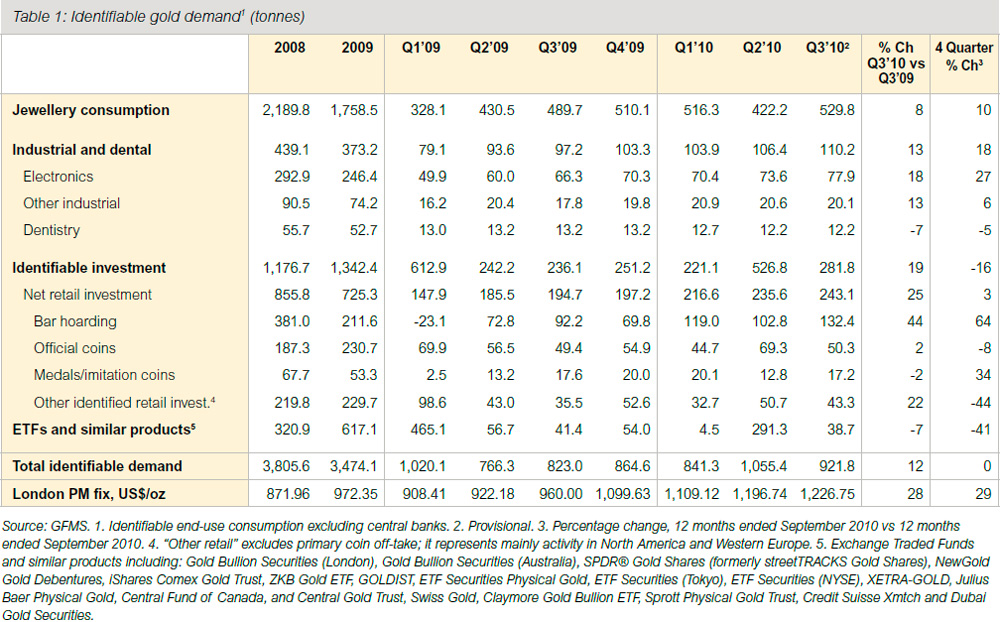
Compared to the 2010 second quarter, gold demand showed a decline of 10%. This was the result of the exceptionally high levels of investment demand experienced in the previous quarter.

During the third quarter, jewelery demand totaled 529.8 tonnes, representing an increase of 8% from the year ago period. Buyers in key markets such as Indian, China, Russia, and Hong Kong were not deterred by record high prices. The highest growth in demand was experienced in India, with an increase of 36%. With the recent focus of the media on gold investors, it’s interesting to note that more than half of identifiable gold demand comes from the jewelry sector.

Industrial demand for gold was 110.2 tonnes, marking an increase of 13% from the year ago period. Demand was led by electronics, which accounted for 77.9 tonnes and measured a gain of 18%. A decline in demand was experienced from the dentistry sector, with a drop of 7% to 12.2 tonnes.

Identifiable investment demand was up 19% from the year ago period at 281.8 tonnes. However, this did represent a decline of 16% from the previous quarter. The largest increase in demand for this category came from bar hoarding, which increased 44% to 132.4 tonnes. This is an interesting contrast to demand from ETFs which dropped 7% to 38.7 tonnes.

The average price of gold during the quarter was $1,226.75, ranging from a low of $1,157.00 to a high of $1,307.50 per ounce.

Identifiable Gold Demand (Source:GFMS)

Paper Money Collapses in Value as Gold and Silver Soar

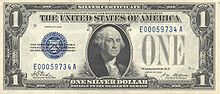
Most people under the age of 50 have probably never seen government currency backed by a tangible asset such as silver.  The $1 dollar Silver Certificates, last produced in 1963, were backed by silver on deposit in the US Treasury and payable in silver to “the bearer on demand”.

The promise to redeem  Silver Certificate dollars for silver was withdrawn by the US Government and holders of such dollars had to be satisfied that the value of their dollar was now backed by the “full faith and credit” of the US Government.  Redemption of Silver Certificates for silver coin ended in 1964 and redemption of Silver Certificates for silver bullion was ended in 1968.

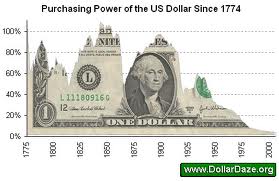
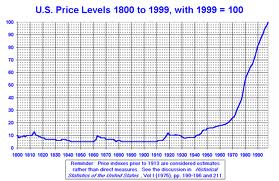
The era of currency backed by real money such as gold or silver ended and the dawn of a fiat currency system began.  The result for holders of currency backed by nothing more than promises has been disastrous as the value of paper dollars has seen its purchasing power virtually disappear.

As the quantity of dollars has grown exponentially, their value has correspondingly diminished, leading to a large increase in general price levels.

Chart pbs.org

Despite the obvious increase in prices and the collapse of the value of the dollar, the Federal Reserve tells us they now need to engage in money printing quantitative easing in order to create inflation to help the economy.  Fed Chairman Bernanke ensures us that the Fed is committed to keeping inflation low.

“Although asset purchases are relatively unfamiliar as a tool of monetary policy, some concerns about this approach are overstated. Critics have, for example, worried that it will lead to excessive increases in the money supply and ultimately to significant increases in inflation. Our earlier use of this policy approach had little effect on the amount of currency in circulation or on other broad measures of the money supply, such as bank deposits. Nor did it result in higher inflation. We have made all necessary preparations, and we are confident that we have the tools to unwind these policies at the appropriate time. The Fed is committed to both parts of its dual mandate and will take all measures necessary to keep inflation low and stable.”

The Fed has not succeeded at keeping inflation low in the past and now seems obsessed with inflating asset values to prop up a weak economy.  It’s all about trust with fiat money, and the Fed Chairman seems to be losing credibility.

The price movements in gold and silver are strong indicators that no one is being fooled by the Fed Chairman’s words.  Investors are watching “what they do – not what they say”.   Expect gold and silver prices to be dramatically higher over time, with an initial objective of $5,000/oz for gold.