April 13, 2026

Gold Featured on Magazine Cover- Should We Be Worried?

There is a body of empirical evidence suggesting that once a particular investment category is featured on the cover of a popular magazine, a major trend change is imminent.

This theory, know as the “Magazine Cover Indicator” was first documented by Paul McRae Montgomery, a strategist at Legg Mason.  According to Mr. Montgomery, “The great value of popular magazine covers is they indicate the extent to which awareness of fundamental factors is widely shared, and therefore are unable to move prices significantly further”.

The Magazine Cover Indicator has been dismissed for being overly simplistic.  Nonetheless, Mr. Montgomery’s research shows that after a financial trend is featured on the cover of a widely distributed magazine, there is a high likelihood of a major trend reversal.  The focus of Mr. Montgomery’s research was Time Magazine cover stories going back to 1914.  When  a specific financial investment was the cover feature, within a year and up to 80% of the time, the trend featured on Time’s cover had reversed and sometimes in a dramatic fashion.

One of the all time great clarion calls for investors was the now infamous BusinessWeek cover story headlined “The Death of Equities” in August, 1979, just prior to the greatest bull market for stocks in history.  According to Montgomery, the indicator has resulted in profits for him and his clients, stating that “It has worked surprisingly well, but people don’t take it seriously.  I actually move money based on it, but I don’t think many other people do”.

Given the research cited above, should we be worried about this week’s magazine cover story by SmartMoney entitled “The Power of Gold”?

Despite the apparently bullish title, after reading “The Power of Gold”, one gets the distinct impression that the article is bearish on the yellow metal.  Investors are portrayed as beset by doubts about owning gold and worried that they will be regarded as “crackpots” if they disclose their predilection for gold ownership.  If the article had been rampantly bullish, it would have quoted gold investors bragging about their investment acumen and predicting further huge price gains.  A bullish article would have also featured photos of small time “joe six pack investors” lined up outside of bullion dealers, desperately clutching handfuls of dollars to convert into gold.  We are not even close to classic signs of a top in the gold market.

SmartMoney notes that “people are buying gold in record amounts, but in many cases they don’t really feel good about it…Others fear that they’ll be targets for robberies or scams, or be branded as crackpots by their friends and neighbors”.  Although SmartMoney mentions the huge growth of the SPDR Gold Shares Trust (GLD), ownership of gold by Americans is still small, representing only one-eighth of all bullion and coins in the world.

SmartMoney also plays down any further upside movement in gold stating that “Of course, a further price surge isn’t inevitable or even, in the eyes of some professional investors, probable.”

The “Magazine Cover Indicator” in this case represents a solid buy signal for gold based on SmartMoney’s bearish article.

Whether one believes in the “power of magazine covers” or not, the fundamental reason for owning gold remains intact – preserving the purchasing power of accumulated wealth.  The value of paper dollars is under ferocious assault by both the government and a financial system that must inflate to survive.

The only government response to the debt crisis has been to add more debt.  The Government budget proposal for fiscal 2012 has the United States borrowing almost half of the entire amount to be spent next year.  The proposed budget requires deficit financing by the United States of an unimaginable $1.65 trillion, or 44% of proposed spending of $3.73 trillion.  Even more disconcerting, a large proportion of the deficit will be funded by the Federal Reserve creating dollars via “quantitative easing”.

Governmental, private and corporate indebtedness has reached levels that make repayment mathematically impossible.  Deflation and debt collapse is not an option being entertained by the government nor is it an option that most Americans would select over inflation.   The nation needs inflation to prevent a level of defaults that would make the Great Depression look like a minor recession.  When this dark reality becomes obvious, gold will have no upside limit.
Weekly US Mint Gold and Silver Bullion Coin Sales

After the furious pace of sales experienced during January for the United States Mint’s American Silver Eagle and American Gold Eagle bullion coins, the current month is progressing at a more measured pace. For the week ending February 9, 2011, the US Mint recorded sales of 847,000 ounces worth of silver and 18,000 ounces worth of gold.
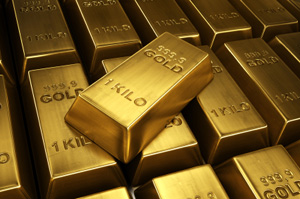
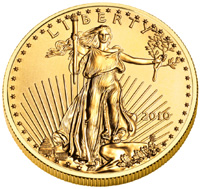
The US Mint offers several bullion coin options in order to provide investors with a convenient and cost effective method for physical precious metals investment. The programs include 22 karat gold coins in one ounce, one-half ounce, one-quarter ounce, and one-tenth ounce sizes; 24 karat gold coins in one ounce size; .999 fine silver coins in one ounce and five ounce sizes; and platinum coins in one ounce, one-half ounce, one-quarter ounce, and one-tenth ounce size.

For the year to date, the US Mint has only offered the one ounce Silver Eagle and 22 karat Gold Eagle bullion coins. The Gold Eagles are available in one ounce size bearing the 2011 date, with some remaining amounts of the fractional weight coins bearing the 2010 date. The remaining bullion coin options have not yet been released.

US Mint Bullion Coin Program Sales 2/9/2011 (ounces)

Prior Week Month to Date Year to Date
American Silver Eagle 847,000 897,000 7,319,000
American Gold Eagle 18,000 24,000 139,500
America the Beautiful Silver 0 0 0
American Platinum Eagle 0 0 0
American Gold Buffalo 0 0 0

Last year, the US Mint recorded sales of 34,662,500 ounces worth of American Silver Eagles and 1,220,500 ounces worth of American Gold Eagles. The amount of silver bullion sold represented an all time record.

GLD Gold Holdings Sixth Largest In The World, SLV Holdings Show Small Decline

The SPDR Gold Shares Trust (GLD) and the iShares Silver Trust (SLV) both registered small declines over the past week as the price of gold and silver recovered some ground.
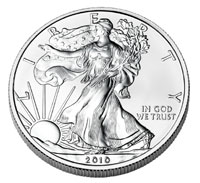
Holdings in the GLD declined by .71 tonnes compared to a decline of 2.43 tonnes in the previous week.  Total holdings have now declined by 4.2% or 54.28 tonnes since the start of the new year.  The GLD currently holds 1,226.44 tonnes or 39.4 million ounces of gold valued at $53.8 billion.

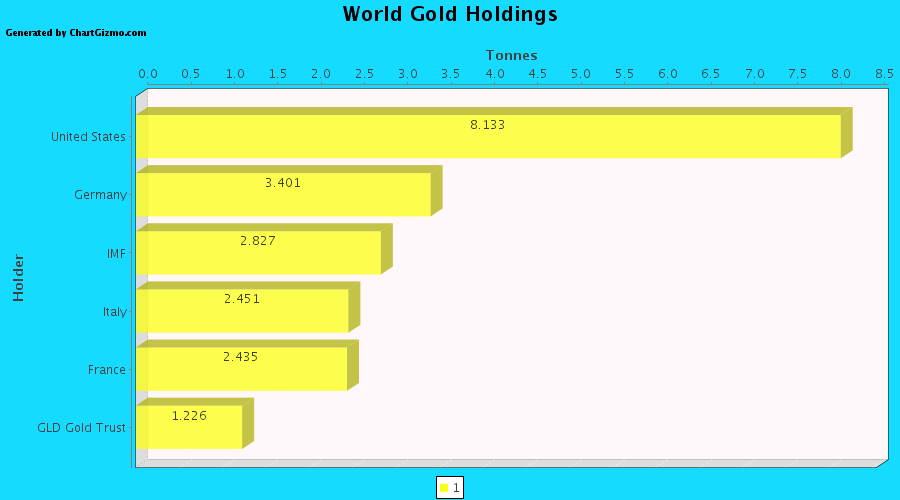
Since launching in November 2004, the Gold Shares Trust has grown very rapidly and is now one of the largest gold holders in the world.  The latest stats show the GLD holding 172.34 more tonnes of gold than China at 1,054.1 tonnes.  From zero at its inception, the GLD has become the world’s sixth largest holder of gold in less than seven years.

World Gold Holdings January 2011 - source: World Gold Council

The GLD came into existence at a very auspicious moment in financial history.  As the worst financial crisis since the Depression unfolded, some of the country’s largest banks failed. The entire financial system seemed to be heading for collapse.  Trillions of dollars in government aid stabilized the banking industry but there were plenty of nervous investors who viewed gold as the last monetary refuge.

Gold does not have the inherent counter-party risk that exists with paper financial assets.  An investor purchasing gold does not have to worry about being bailed out of a gold investment.  Gold and silver have intrinsic value that rapacious governments cannot destroy.

The SPDR Gold Share Trust opened the market to a flood of new buyers who were enticed by a very easy and low cost purchase process. Prior to the GLD, it took a dedicated gold buyer to search for a dealer, check credentials, physically drive to the dealer to pick up a gold purchase, followed by another trip to the safe deposit box.  Commissions on the GLD were minimal compared to the markup at dealers.  The GLD made buying gold simple with low markups and little transaction friction.  Investors, many of whom had never before owned gold, rushed into the GLD which became the fastest growing ETF in history.

The GLD launched in November 2004 when gold was trading at approximately $445 per ounce.  Shortly afterward, gold entered a long term rise concurrent with the geometric increase in GLD gold holdings.  The price of bullion tripled to the current level of $1361.

GLD and SLV Holdings (metric tonnes)

9-Feb-11 Weekly Change YTD Change
GLD 1,226.44 -0.71 -54.28
SLV 10,370.22 -30.38 -551.35

Silver holdings in the iShares Silver Trust (SLV) declined by 30.38 tonnes over the past week compared to a decline in the previous week of 47.10 tonnes.  The year to date decline of 551.35 tonnes represents a 5% drop in silver holdings.    The SLV has declined by a very modest 2.5% from its high of $30.40 at the beginning of the year.  After a huge gain of 67% in the price of silver since late last year, it is normal to see price consolidation before another advance.

US Mint Silver Bullion Sales Set Monthly Record

The pace of sales for the United States Mint’s American Gold Eagle and American Silver Eagle bullion coins jumped in the past week. This propelled silver bullion sales far into record territory for the month of January.
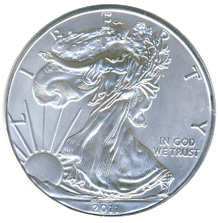
In the prior week ending February 2, 2011, the US Mint sold 1,748,000 ounces worth of Silver Eagles and 56,500 ounces of Gold Eagles. These are sizable increases from the prior week, when the pace of sales had slowed considerably.

Currently, the US Mint offers only these two options for precious metals investors. The American Gold Buffalo, struck in 24 karat gold, has been unavailable for several months. The American Platinum Eagle remains on indefinite hiatus since late 2008. The recently introduced America the Beautiful Silver Bullion Coins are now in production for the 2011 designs, following the rapid sell out of the previous year’s coins.

US Mint Bullion Coin Program Sales 2/2/2011 (ounces)

Prior Week Month to Date Year to Date
American Silver Eagle 1,748,000 50,000 6,472,000
American Gold Eagle 56,500 6,000 139,500
America the Beautiful Silver 0 0 0
American Platinum Eagle 0 0 0
American Gold Buffalo 0 0 0

For the month of January 2011, Silver Eagle bullion coin sales reached 6,422,000, representing the highest monthly sales total in the history of the program. The previous monthly record of 4,260,000 ounces was set in November 2010, at the time breaking the long standing record of 3,696,000 ounces from December 1986.

To put this monthly sales total into perspective, there were ten separate years of the program where annual sales did not reach this level. If the pace of sales continues for the rest of 2011, more than 77 million ounces of silver would be sold. This amount exceeds the total annual domestic silver mining production of the United States.

GLD and SLV Holdings Decline as Investors Ponder Next Move in Gold and Silver

Both the SPDR Gold Share Trust (GLD) and the iShares Silver Trust (SLV) registered minor declines over the past week.
Holdings in the GLD declined by 2.43 tonnes compared to a decline of 21.85 tonnes in the previous week.  Since the start of the year, total holdings have declined by 4.2% or 53.57 tonnes.  The GLD currently holds 39.5 million ounces of gold.

The holdings of the GLD currently have a market value of $52.7 billion, making the GDL a very significant presence in the gold market.   The market cap of the GLD  far exceeds that of major gold producers such as Goldcorp (GG) at $30 billion, Newmont Mining (NEM) at $27.4 billion and Randgold (GOLD) at $7.1 billion.

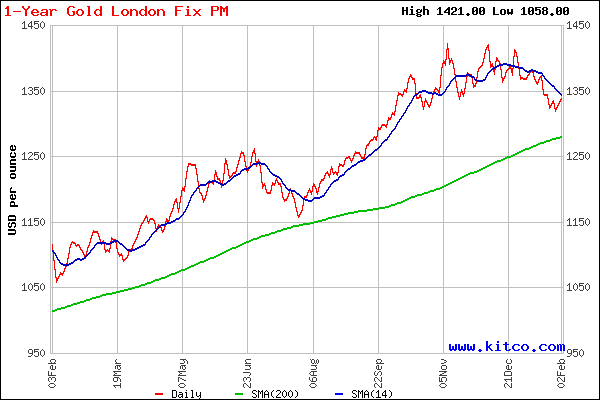
Gold has now made three failed attempts to decisively pierce the $1400 level since last November, forming a triple top in the process.  The failure to breakout to new highs and the large price gain of $250 per ounce since last July has motivated some nervous selling by gold investors.  A look at the one year chart shows that gold’s short term momentum has faltered as prices breached the 14 day moving average.  The next important test will be at the 200 day moving average which gold has traded above for the past two years.

1 YEAR GOLD PRICE - COURTESY KITCO.COM

Despite the recent minor setback in gold prices, the long term trend of gold remains intact technically and fundamentally.

GLD and SLV Holdings (metric tonnes)

2-Feb-2011

Weekly Change

YTD Change

GLD

1,227.15

-2.43

-53.57

SLV

10,400.60

-47.10

-520.97

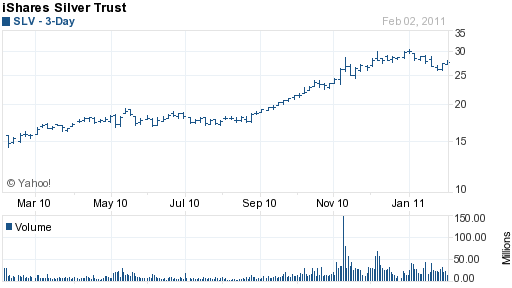
Silver holdings in the iShares Silver Trust (SLV) declined by 47.1 tonnes over the past week compared to a decline in the previous week of 127.6 tonnes.  The year to date decline of 520.97 tonnes represents a 4.7% drop in silver holdings which trails the 7.8% year to date decline in the price of silver.  The SLV has declined by 9% from its high of $30.40 at the beginning of the year.  After a huge gain of 67% in the price of silver since late last year, it is normal to see price consolidation before another advance.

In this writer’s opinion we have not seen a parabolic blow off type price move, nor have we seen the excited entry of first time silver buyers lured by stories of rising prices.  One of the sentiment gauges that I use involve noting how many of my friends and clients ask or offer unsolicited advice on a specific investment category.  Thus far, not even one person has mentioned silver.  Despite the huge advance in silver prices, public awareness seems minimal, implying long term bullishness.

SLV - courtesy yahoo finance

American Gold and Silver Eagle Sales Slower

After generating some mainstream media attention for the record pace of sales, United States Mint bullion coins had a quiet week. According to figures provided by the Mint, only 136,000 ounces of American Silver Eagles and 7,500 ounces of American Gold Eagles were sold in the past week.
Some have noted the divergence in the sales of bullion coins, which are in record territory for the month, and exchange traded fund (ETF) holdings, which continue to decline. Both have an impact on demand for silver, although the nature the of the buyers for each type of investment are different.

Those purchasing ETF’s are more likely to be professionals or other investors trying to participate in short terms price gains. Since bullion coins are comparatively more difficult to buy and sell and carry larger spreads, these buyers are more likely to be making longer term investments.

US Mint Mint Bullion Coin Program Sales 1/26/2011 (ounces)

Prior Week Year to Date
American Silver Eagle 136,000 4,724,000
American Gold Eagle 7,500 83,000
American Platinum Eagle 0 0
American Gold Buffalo 0 0

The US Mint has now sold 4,724,000 of the one ounce Silver Eagles for the year to date. This includes a remaining quantity of 2010-dated coins, as well as the newly released 2011 Silver Eagles. This is the highest monthly sales total in the history of the program.

American Gold Eagle sales total 83,000 for the year to date. This includes sales of 80,500 one ounce coins, 1,000 one-half ounce coins, 2,000 one-quarter ounce coins, and 15,000 one-tenth ounce coins. The fractional weight coins represent 2010 Gold Eagles, while the one ounce coins included 2010 and 2011-dated coins.

Will Speculative Positions in the GLD and SLV Accelerate a Precious Metals Selloff?

Given the recent pullback in the prices of gold and silver, it was not unexpected to see another decline in the holdings of both the SPDR Gold Shares Trust (GLD) and the iShares Silver Trust (SLV).
Holding in the GLD declined by 21.85 metric tonnes, compared to a decline last week of 20.04 tonnes.  The year to date decline now totals 51.14 metric tonnes, representing 1.8 million ounces of gold worth about $2.4 billion.  GLD holdings had declined by 39.75 metric tonnes in 2010 after reaching record high of 1,320.47 tonnes on June 29.

Fluctuations in the holdings in the SPDR Gold Shares Trust are not always directly correlated to price movements in the metal.  As holdings were declining from all time highs in late June, the price of gold continued to soar another $200 per ounce from the $1200 level in July to $1400 by October.

Some have expressed concerns that declines in the price of gold may be compounded if large positions in the GLD held by speculators are sold. Since late 2008, the GLD has doubled in value as gold prices soared.  With the GLD holding a huge $52.5 billion worth of gold, any large scale liquidation of positions would certainly seem to have the impact of accelerating a price correction in gold.

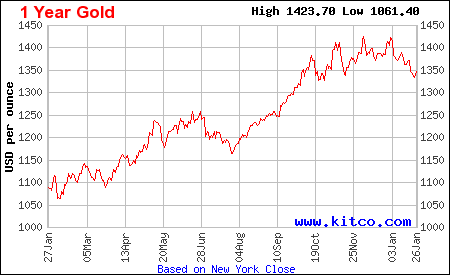
1 Year Gold - Courtesy kitco.com

GLD and SLV Holdings (metric tonnes)

Jan 26, 2011 Weekly Change YTD Change
GLD 1,229.58 -21.85 -51.14
SLV 10,447.70 -127.62 -473.87

Silver holdings in the iShares Silver Trust declined by 1.2% for the week, representing reduction of 127.62 tonnes.  The year to date decline has now reached 473.87 tonnes, or a 4.3% from the beginning of the year.  Meanwhile, the price of silver has seen a 10% drop from its high of $30.70.

The SLV represents an easy vehicle for hot money to jump into the silver market and purchases by the SLV have contributed to demand for silver.

Increased silver purchases by the SLV helped to propel silver prices higher last year, but this same process can work in reverse.   Large sell orders by speculative holders of the SLV could result in a sharp decline in the price of silver as the SLV liquidates its holdings.

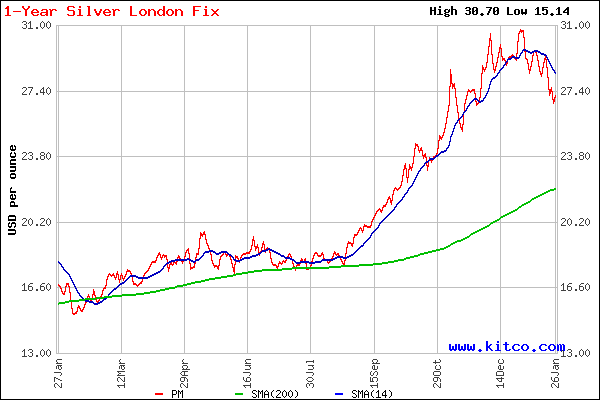
One year silver - Courtesy kitco.com

United States Mint Bullion Program Net Margin Remains at 1.9%

Amidst increased demand for physical gold and silver investment products, the United States Mint achieved record revenue from the sale of bullion coins during their 2010 fiscal year. Annual sales totaled $2.86 billion, which yielded net income of $55.2 million for the segment.
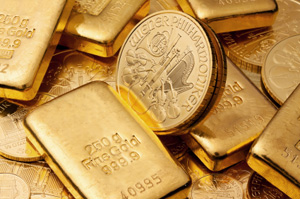
The US Mint produces gold, silver, and platinum bullion coins which are distributed through a network of authorized purchasers. The various programs were authorized by Congress, and the weight, content, and purity of each bullion coin is guaranteed by the U.S. government.

During the fiscal year ending September 30, 2010, the US Mint issued one ounce American Silver Eagles; one ounce, half ounce, quarter ounce, and tenth ounce American Gold Eagles; and one ounce American Gold Buffalo coins. The American Platinum Eagle, which is typically produced in four different bullion weights, was not produced or issued during the year.

Because the purpose of the US Mint’s bullion coin programs is to provide investors with a convenient and cost effective method for investing in precious metals, the programs are managed to a nominal net margin. The bullion coins are sold to authorized purchasers based on the current market price of the metal plus a fixed or percentage mark up to cover minting, distribution, and marketing costs, as well as a net margin targeted at or below 2%. For the past three years, the net margin has remained steady at 1.9%.

The US Mint utilizes a hedging program to avoid the risk related to fluctuations in silver costs. Silver is purchased in large quantities on the open market and then an interest in that silver is sold to a trading partner. The US Mint maintains physical custody and title to the silver. As finished silver bullion coins are sold to authorized purchasers, the trading partner’s interest is repurchased. Transaction fees related to the hedging program were $170,000 for the 2010 fiscal year.

Gold’s Role in India’s Inflation Battle

In India, the problem with inflation shows most clearly when you examine the country’s current level of gold trade and importation. Shipments have increased to 800 metric tons from 557 tons in the last year. That is an all time high and forecasts say that the number is still rising.
The purchase of all this gold shows clearly the concerns that investors have regarding the local economy and the central bank’s battle with inflation.

Why Buy Gold?

“Gold is being used as a store of value to protect against never ending inflation,” according to the head of fixed income at Canara Robeco Asset Management Ltd., Ritesh Jain.

It makes sense, since in India gold is historically and culturally tied to the concepts of wealth and prosperity. Investors are used to buying into gold either as a physical asset or on the exchange market where gold can be purchased and traded without ever taking physical possession. And while the value of gold has climbed in India—the value of the rupee and of the bonds that support the central bank have not done nearly as well.

The Inflation Situation

In the last year alone, more investment dollars flowed out of India’s economy than in. Global funds sold $250 million more shares in Indian companies than they bought. Meanwhile, inflation has been on the rise, such that food prices have risen by 18.3% in the final weeks of 2010.Citizens and politicians alike are calling for actions to be taken to curb this inflation—all the while investing in more and more gold.

Gold and Silver ETF Holdings Continue To Decline

As gold and silver continue to trade in a narrow range, investors have reduced their holdings in both the SPDR Gold Shares Trust (GLD) and the iShares Silver Trust (SLV).
Holdings in the GLD declined by 20.04 metric tonnes over the past week, a substantial decrease compared to last week’s reduction of 1.21 tonnes.  The record high holdings of 1,320.47 tonnes in the GLD was reached last year on June 29 when gold bullion was trading in the $1250 range.

GLD and SLV Holdings (metric tonnes)

Jan 19, 2011 Weekly Change YTD Change
GLD 1,251.43 -20.04 -29.29
SLV 10,575.32 -150.41 -346.25

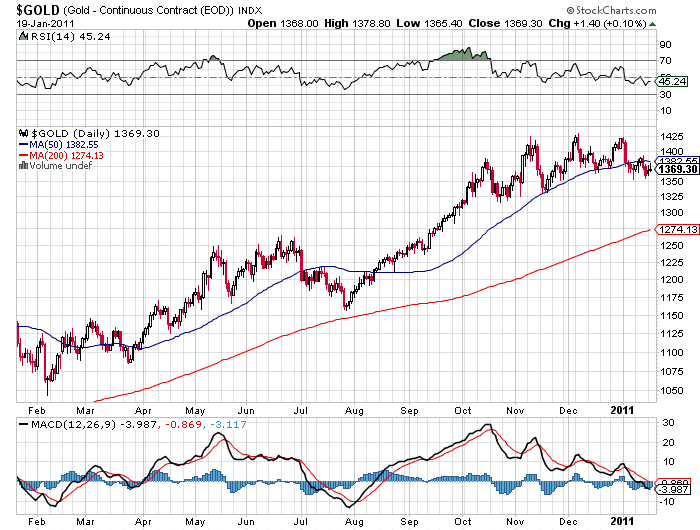
The price of gold has now dipped decisively below its 50 day moving average but is still well above the 200 day moving average.   Last year’s July price correction in gold to slightly above the 200 day moving average was followed by a rally of $260 in the price of gold.  A pullback to the 200 day moving average would result in a price decline of about $100 for gold.

Gold Chart - Courtesy stockcharts.com

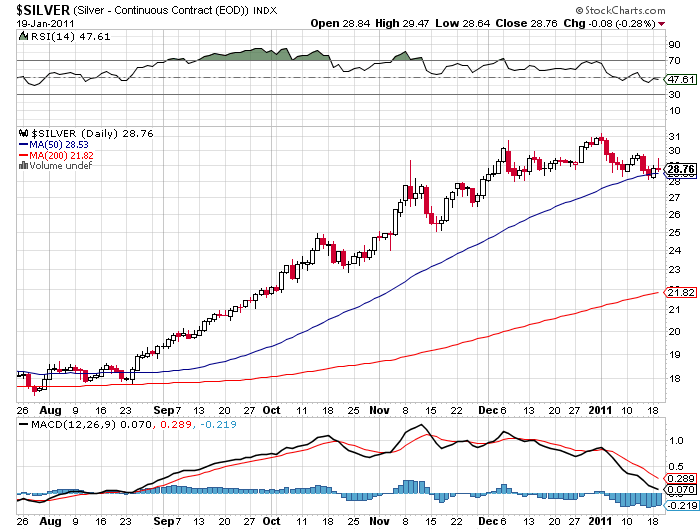
The SLV declined by 150.41 tonnes compared to a reduction of 191.46 tonnes in the previous week.  Total silver held by the Silver Trust amounts to 340.004 million ounces.   Silver has had a huge price move since last September when it was trading in the $18 per ounce range.  Precious metals can exhibit volatile price movements, but so far silver continues to consolidate and has surrendered only a small part of its gains from the $31 per ounce level reached at the beginning of the year.

Silver - Courtesy stockcharts.com