April 13, 2026

Gold Price Hits All Time High, Silver At 31 Year High

The price of gold hit an all time highs for the second day in a row, while silver prices moved up to a new 31 year high.

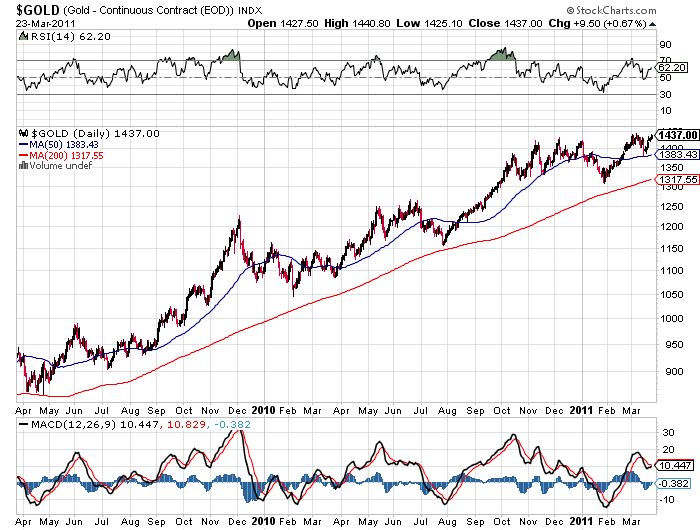
As measured by the closing London P.M. Fix Price, gold reached an all time high of  $1,447.00 up from yesterday’s all time high of $1,439.50.  The previous record London Fix Price was $1,437.50 on March 7th.   The all time record high intraday price of gold was also reached on March 7th at $1,444.95.  Earlier in the day, Comex gold futures had hit an all time high of $1,448.60 before a pull back erased the day’s gains.  In late afternoon trading the bid on New York spot gold was $1,431.30.

Silver futures scored another new 31 year high at $38.18 before sliding to $37.45 in New York spot trading.   The closing London P.M. Fix Price for silver was $37.78.
GOLD - COURTESY STOCKCHARTS.COM

In 2010, the price of gold advanced by 30% as investors grew increasing nervous about the value of paper currencies and the increasing threat of inflation.  The U.S. Federal Reserve policy of printing money to fund government deficits sets a horrendous precedence and it appears that other central banks will soon be conducting their own versions of quantitative easing.

The European Central Bank is struggling to prevent numerous sovereign defaults in an effort to preserve the European Union and monetization of the debt seems to be the only feasible “solution”.   Japan, the most heavily indebted developed nation in the world, needs hundreds of billions of dollars for reconstruction after a devastating earthquake and the printing press seems to be their only option.

Reflecting on the fiscal and monetary policies being conducted by the U.S. Government, Warren Buffet stated that “We’re following policies that will lead to a lot of inflation down the road unless changes are made.  The U.S. can’t run the kind of deficits we’re running and other policies without it being enormously inflationary”.

Unfortunately, intelligent changes are not being made and the ruinous policies of central banks seems likely to continue at an accelerated rate.  Gold has broken out to new highs and should see significant price gains in 2011.
iShares Silver Trust Holdings Continue Higher, as SPDR Gold Shares Trust Holdings Decline

The holdings of the iShares Silver Trust (SLV) increased on the week while holdings of the SPDR Gold Shares Trust (GLD) declined slightly.

Holdings in the SLV increased by 15.18 tonnes from the previous week.  Since March 1st, the Silver Trust has seen a net increase in holdings of 266.71 tonnes and a year to date increase of 38.82 tonnes.  The SLV now holds 352.4 million ounces of silver valued at $12.9 billion.

Silver hit a 31 year price high today, continuing a strong rally that began in late January.  In recent trading, silver was $37.34 per ounce.

At the inception of the iShares Silver Trust in April 2006, the SLV held 653.17 tonnes of silver valued at $263.5 million.  The SLV has been extremely popular with investors as the price of silver has steadily increased since 2006.  In addition, the establishment of the SLV has attracted many investors who would otherwise be disinclined to own silver considering the inconvenience and costs of taking physical delivery.

GLD and SLV Holdings (metric tonnes)

23-March-11 Weekly Change YTD Change
GLD 1,214.87 -2.43 -65.85
SLV 10,960.39 +15.18 +38.82

The price of the SLV hit a new all time high yesterday closing at $36.47, up $.93 on the day.  The move upward continued today in early trading, before a pull back erased the day’s gains. The SLV has gained over $10 since late January providing silver investors with a solid 38% gain.  Since the inception of the Silver Trust in 2006, the SLV has almost tripled.

Holdings of the SPDR Gold Shares Trust (GLD) declined modestly on the week by 2.43 tonnes.  The GLD has seen a year to date decline in its holdings of 65.85 tonnes.  The GLD currently holds 39.1 million ounces of gold valued at $56.2 billion.

iShares Silver Trust Hits New All Time High

During Wednesday trading, the iShares Silver Trust (SLV) reached an all time high price.  At the time of this post, shares were trading up 78 cents to $36.32, which exceeds the previous high of $35.27 reached in early March.

The SLV saw a month long correction in January with the price declining from $30 to $26, which brought the SLV below its 50 day moving average.  The losses on the brief pullback in January were quickly regained and the SLV powered on to new highs by mid February.  The SLV has now jumped more than $10 from its January low, for a gain of over 38% in less than two months.

SLV - COURTESY STOCKCHARTS.COM

Ownership of the SLV gives an investor an undivided, fractional ownership in the physical silver held by the iShares Silver Trust.  The price of the SLV is structured to reflect the underlying price movement in silver.  The gain or loss on the SLV should very closely track the price of one ounce of silver. Over 97% of the Trust’s net asset value is based on physical silver held by the Trust.

The Silver Trust currently holds over 352 million ounces of silver worth $12.7 billion.   Assets of the SLV have grown steadily since the inception of the Trust in April 2006.  The SLV has become extremely popular with investors seeking to establish a position in silver without the costs and risks of taking physical possession of the metal.  Due to the manner in which the Trust is structured, premiums and discounts to the net asset value during the trading day are typically less than 1%.

Investors have seen huge returns on their investment in the iShares Silver Trust.   Last year the SLV rose 79.4%.  Year to date the SLV is up 18.6%.  Since inception of the Silver Trust in April 2006, the net asset value of the SLV has almost tripled from its initial price of  $12.55.   A $5,000 investment in the SLV in April of 2006 is now valued at $14,455.

Sprott Physical Gold Trust (PHYS) Advantages Over SPDR Gold Shares Trust (GLD)

Investors seeking to increase or establish positions in the gold market have been pouring money into gold trusts. The largest gold trust is the SPDR Gold Trust Shares (GLD) which, since its launch in November 2004, has seen huge investor demand. The GLD currently holds over 39 million ounces of gold valued at $55.5 billion.
The Sprott Physical Gold Trust (PHYS), which began trading on the New York Stock Exchange in late February 2010, is similar to the SPDR Gold Trust Shares in that the investor owns an undivided, fractional interest in gold held by the trust. The PHYS, however, has some major differences from the GLD which may result in an investor preference for PHYS.

As detailed below, the advantages of the PHYS over the GLD are a much lower tax rate on gains and government custody of the physical gold backing the PHYS.

PHYS is not an exchange traded fund (ETF) but rather a closed-end mutual fund trust which means that the physical gold holdings and investor units outstanding do not change.  The PHYS holdings remain constant based on the initial trust offering.  The PHYS holds over 820,000 ounces of gold valued at $1.18 billion.

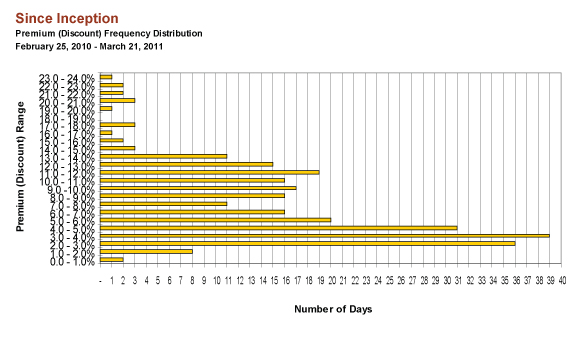
As with any closed end fund, the net asset value of the PHYS can trade at a discount or premium to the market value of gold held by the trust.   Since its creation, the PHYS has consistently traded at a premium to its net asset value.  The premium has at times reached a substantial 24%.  To avoid paying an excessive premium, potential investors in PHYS should compare the net asset value to the purchase cost of PHYS.

PHYS Premium to net asset value - source: Sprott Gold Trust

The premium paid by an investor to own the PHYS is based on two major factors –  very favorable tax treatment and extremely secure custody holding  of the physical gold that backs the PHYS as explained below.

Discounts or premiums to net asset values also occur with the GLD ETF, based on investor supply and demand during the course of daily trading.  Premiums or discounts on the GLD, however, are extremely small, typically ranging only plus or minus 0.5%.  The very small discount or premium on the GLD is due to the complex manner in which the fund is structured.

The GLD has a complex mechanism by which shares can be “created or redeemed” by the GLD Trust via Authorized Participants.  Authorized Participants are large Wall Street investment firms that profit by arbitraging against a premium or discount to the GLD.  The transactions of the Authorized Participants can result in significant changes in gold holdings by the GLD .  The SPDR Gold Trust was structured in this manner so that the price of the GLD would closely correspond to the underlying price movements in gold.

The PHYS holds 99.5% of its assets in physical gold bullion stored at the Royal Canadian Mint in Ottawa, Canada.  The gold backing the PHYS is specifically allocated by the Royal Mint to PHYS.  The Trust does not invest in gold certificates or other paper instruments.  The Royal Canadian Mint of the Canadian Government is responsible for any loss or damage to the bullion held for the PHYS and the gold bullion is subject to annual audits.

The custodian for the gold held by the SPDR Gold Trust (GLD) is HSBC Bank in London. The GLD prospectus notes that the gold held by the Trust is specifically allocated to GLD and that the allocated gold bars “are not a part of the bankrupt’s estate in the event of the bankruptcy of the Custodian”.  In addition, the gold bars allocated to the GLD are identified by number and updated everyday.  After witnessing the failure of very large banks in 2008, investors may be more secure with a Government custodian.

A very significant advantage of the PHYS according to Sprott Asset Management is that investors holding units for more than one year are only taxed at the capital gains rate of 15% compared to a 28% tax rate on gold ETFs and physical gold coins. The gold held by investors in the GLD ETF is considered to be “collectibles” by the IRS and thus taxed at a higher 28% rate.

The prospectus for the PHYS discloses that the fund does have a physical redemption feature that is exercisable on the 15th of each month and processed at the end of the month, a setup which is designed to discourage redemptions. Given the inconvenience, cost and delays involved in redeeming units for physical gold, the Trust expects that most investors will chose to sell their units rather than redeem them for gold bullion.

The reason why the Sprott Physical Gold Trust discourages redemptions is due to the fact that a redemption would be considered a sale of gold by the Trust for tax purposes and thus be taxed at 28%. The taxes paid by the Trust would be passed on to shareholders who would then be liable for taxes above the 15% capital gain rate based on their pro rata share of the gain. Sprott Management believes that it is highly unlikely that any investors would chose redemption versus selling their units on the market.

In any event, even if a partial redemption of units occurred, the pro rata gains would still result in a tax rate significantly less than the 28% that applies to gains on the sale of an ETF. In the extremely unlikely event that all units were physically redeemed, an investor’s tax rate would still be no higher than the 28% rate that applies to an ETF.

Long term ownership of the PHYS in a non tax deferred account thus conveys significant tax advantages over an ETF.  Net investment gains on the PHYS could result in a 13% higher return than an equivalent investment in a gold ETF.  Investors should consult with their tax expert and read the PHYS prospectus before investing.

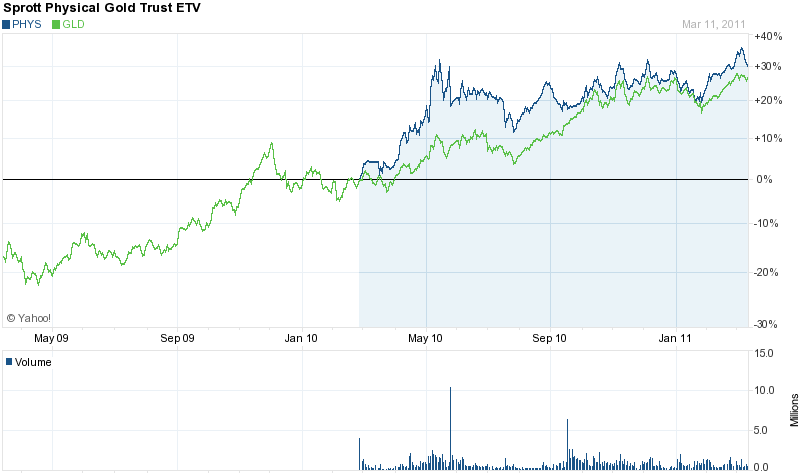
Since its inception, the PHYS has had a higher return than the GLD.

PHYS VS GLD

The PHYS fund is managed by Sprott Asset Management based in Toronto, Canada. Sprott offers hedge funds, mutual funds, fixed asset funds, limited partnerships and bullion focused funds. The holding company, Sprott, Inc. trades on the Toronto Stock Exchange under the symbol “SII”.


US Mint Boosts America the Beautiful Silver Bullion Coin Production

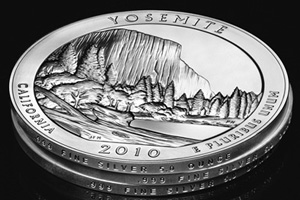
The United States Mint plans to issue the first of this year’s America the Beautiful Silver Bullion Coins in late April. Last year, the series caused quite a stir when the low mintages made them more akin to scarce collectibles than bullion coins. For the current year, the US Mint has planned significantly higher production levels that will eliminate some of the excitement, but hopefully allow the coins to trade as intended, based primarily on the precious metals content.

The coins are struck in 5 troy ounces of .999 fine silver, representing the first time the US Mint has offered bullion coins with a weight greater than one ounce. The designs are exact duplicates of the America the Beautiful Quarters series, which features five different releases annually depicting National Parks or sites in each of the states and territories. The oversized bullion coins also include edge lettering indicating the weight and fineness of the precious metals content.

Each of the 2010-dated bullion releases had a limited production of 33,000 units each. The US Mint tried to solve the problem of high demand for a limited supply by requiring their primary distributors to follow specific terms and conditions, which capped premiums and sought broad distribution.

Recent reports indicate that the US Mint has produced 125,000 of the first 2011-dated releases featuring Gettysburg National Military Park. With production closer to market demand, the same terms and conditions will not apply for the distribution of this year’s coins. However, in order for the primary distributors to participate, they must certify that they have sold their complete allocation from last year in accordance with the rules established by the US Mint.

The remaining 2011-dated releases will feature Glacier National Park, Olympic National Park, Vicksburg National Military Park, and Chickasaw National Recreation Area. These will be released at intervals throughout the year.

With higher mintages, there will be less collector allure for the 2011 coins, however, the status of the 2010 coins as desirable rarities may be reinforced. If the US Mint manages to keep production levels high for the reminder of the twelve year series, the 2010 coins will take on the status of key dates for the bullion series.

Gold and Silver Prices Gain on Week

As measured by the London PM Fix price, gold and silver prices gained on the week after declining approximately 1% each in the previous week.  Gold gained $8.50 per ounce on the week to $1,420.00.  Silver was the stand out gainer on the week with a 3% or $1.05 per ounce gain.   As the situation in Japan and Libya stabilized somewhat, the recent panic selling in financial markets subsided as bargain hunters moved in, although in late trading, stocks gave up much of their gains.  Gold and silver also pulled back slightly in New York trading with gold at $1417.80 and silver at $35.10.
As market analysts worried about the potential for slower economic growth due to the disaster in Japan, classic industrial metals saw further price erosion after significant losses in the prior week.  Platinum fell by $57 on  the week and palladium dropped by $27.  Over the past two weeks, platinum has declined by $108 or over 6% while palladium was off $84 for over a 10% loss.

Precious Metals Prices
Fri PM Fix Since Last Recap
Gold $1,420.00 +8.50 (+0.60%)
Silver $35.15 +1.05 (+3.08%)
Platinum $1,720.00 -57.00 (-3.21%)
Palladium $727.00 -27.00 (-3.58%

As discussed last week , the fundamental forces propelling gold higher remain intact.  The devastation in Japan will require massive amounts of additional borrowing by a government already reaching the limits of its borrowing ability.  Expect Japan to follow the policy of the Federal Reserve with massive amounts of quantitative easing.   The currencies of Japan, Europe and the United States all face a loss of real purchasing value as governments engage in money printing to meet spending and borrowing needs that have spiraled out of control.

The toxic combination of  low economic growth, weak personal incomes and public resistance to additional tax increases have left governments with no other choice than to engage in massive expansion of the public debt.  As constraints on governments’ borrowing ability have grown, the last resort option of money printing will continue to result in the debasement  of currencies.  Increases in the price of precious metals have no upside limit under this scenario.

Silver remains the primary investment choice of many as the metal reasserts itself in relationship to the price of gold.  If the very long term historical gold silver ratio reasserts itself as many expect, the price of silver could easily close in on the $100 per ounce level.

SLV - Courtesy yahoo finance

US Mint Gold Bullion Sales Rise with Gold Buffalo Launch

The number of ounces worth of gold bullion coins sold by the United States Mint rose in the latest week, bolstered by the launch of the 2011 Gold Buffalo coins. Silver bullion sales showed a slight increase, as the year to date total for American Silver Eagles moved above 11 million.
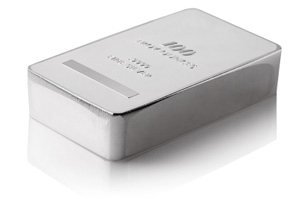
The United States Mint sells bullion products through a network of authorized purchasers. This small group of primary distributors may buy the coins directly in bulk quantities, based on the market price of the metals plus a mark up. The coins are then resold to other dealers and the public for broader distribution.

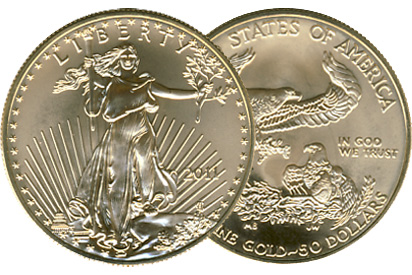
At the current time, the available products include one ounce Silver Eagles; one ounce, half ounce, quarter ounce, and tenth ounce Gold Eagles, and one ounce Gold Buffaloes. The 5 ounce America the Beautiful Silver Bullion Coins are expected to be released in late April. The status of the Platinum Eagle coins remains uncertain.

US Mint Bullion Coin Program Sales 3/16/2011 (ounces)

Prior Week Month to Date Year to Date
American Silver Eagle 748,500 1,417,000 11,079,000
American Gold Eagle 24,000 42,500 268,500
America the Beautiful Silver 0 0 0
American Platinum Eagle 0 0 0
American Gold Buffalo 21,500 0 21,500

Total ounces of gold sold for the week ending March 16, 2011 was 45,500. This consisted of 24,000 ounces of American Gold Eagles and 21,500 ounces of the newly released 2011 Gold Buffalo coins. The latter are only available in one ounce size and are struck in 24 karat gold.

In the past week, the US Mint recorded sales of 748,500 ounces of American Silver Eagles. This is up from the sales of 668,500 reported for the previous period. Sales levels for silver bullion continue to be restrained as the US Mint imposes its allocation program, which rations the available supply amongst the authorized purchasers.

iShares Silver Trust Holdings Decline, SPDR Gold Shares Trust Holdings Unchanged

Holdings of silver in the iShares Silver Trust (SLV) declined slightly on the week, while holdings in the SPDR  Gold Shares Trust (GLD) remained unchanged.
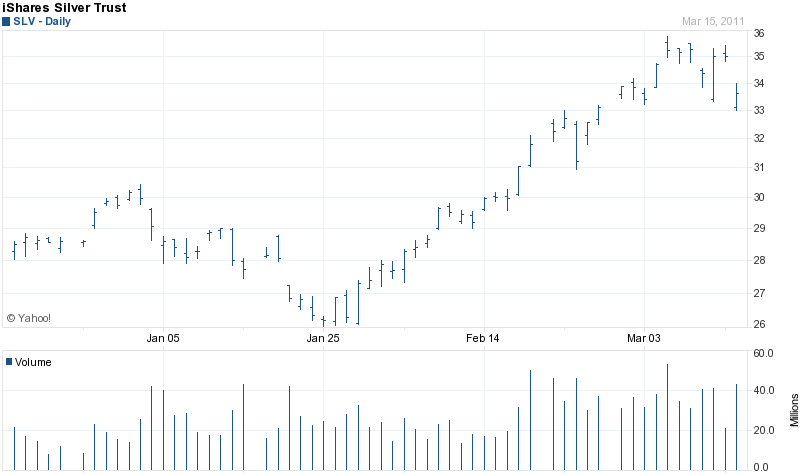
Silver holdings declined by a modest 28.85 tonnes since last week, after seeing increases of 209.54 tonnes and 189.29 tonnes in the previous two weeks.  The year to date holdings in the SLV have increased by 23.64 tonnes.  The value of silver held is valued now $12.22 billion based on holdings of 351.9 million ounces of silver.

Despite collapsing stock markets, a devastating earthquake in Japan, increased turmoil in the Middle East and a wild escalation of money printing by the Bank of Japan, gold and silver moved lower over the past week calling into question the safe haven status of precious metals.

After a huge run up in the price of silver over the past year, it is not unusual to see a correction in prices.  Since consolidating in January, silver prices had run up almost 40% over the past two months from $26 to $36 per ounce.  Aside from normal profit taking after such a huge increase, some of the selling pressure in silver may be due to margin calls.  Investors who have leveraged positions in the market may be liquidating positions to reduce overall exposure until markets stabilize.

Another factor that has ironically made the precious metals markets more volatile is the manner in which the SLV and GLD are structured.   Fast rising prices of gold and silver attract speculators who do not have a long term commitment.  The SLV and GLD allow effective ownership of the metals without the cost and inconvenience of taking physical positions.  Although speculative purchases help to push prices up, the opposite will occur when the fast money crowd decides to take profits at the first sign of price weakness.  Since last week, the price of silver based on the London Fix price, has declined by $1.44 or 4%.

SLV - courtesy yahoo finance

Asian stock futures are down virtually across the board as the situation in Japan deteriorates and spot gold and silver prices are also showing declines.

GLD and SLV Holdings (metric tonnes)

16-March-11 Weekly Change YTD Change
GLD 1,217.30 +0.00 -63.42
SLV 10,945.21 -28.85 +23.64

Holdings in the SPDR  Gold Shares Trust (GLD) remained unchanged from the prior week at 1,217.30 tonnes with a year to date decline of 63.42 tonnes. The GLD currently holds 39.14 million ounces of gold valued at $54.86 billion.

Gold has been unable to mount a strong rally since hitting an all time intraday price of $1,440 in early March.  It may be just a question of time before gold resumes rallying based on continued weakness in the U.S. dollar and virtually unlimited money printing operations by central banks worldwide.  The supply of currencies can be increased with virtually no limit as sovereign governments bump up against the limits of debt expansion.  The supply of gold and silver is limited and will always hold intrinsic value without counter party risk.  The choice will become apparent to more investors as economic conditions continue to deteriorate.

US Mint Begins 2011 Gold Buffalo Coin Sales

Earlier this week the United States Mint began sales of the 2011 American Gold Buffalo coins to their network of authorized purchasers. So far, sales are off to somewhat of a tepid start compared to the high initial demand experienced in recent years.

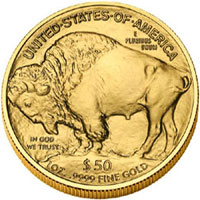
The American Gold Buffalo is a one ounce 24 karat gold coin that has been issued since 2006. Featuring the classic Buffalo Nickel design created by James Earle Fraser, it has enjoyed popularity with both bullion investors and collectors. The US Mint has offered a bullion version of the coin, which is sold to authorized purchasers based on the market price of gold plus a premium, and various collector versions, which are sold to directly by the Mint at higher premiums.

The bullion versions of the coin have not been available since late September, when inventories of the 2010-dated coins became depleted. Prior to the start of sales for the 2011-dated coins on March 14, 2011, the US Mint indicated that they would have a sufficient quantity of the coins to meet public demand. As such, their allocation program, which serves to ration available supplies, would not be necessary. The authorized purchasers were allowed to order unrestricted quantities of the coins, under the typical procedures.

Through March 16, 2011, the US Mint has recorded sales of 21,500 of the one ounce gold bullion coins.

This represents a slower start than the prior two years. In 2009, figures available for the first three days of sales indicated 71,500 coins sold. Last year, opening day sales figures had reached 48,500 coins.

Is Gold Losing Its Safe Haven Status?

In the view of many, recent world events should have resulted in soaring gold prices as investors flocked to gold, the ultimate safe haven investment.  Oddly enough, major sell offs in world stock markets due to turmoil  in the Middle East and a massive earthquake in Japan did nothing to push gold above its all time closing high of $1,440 hit in early March.

As if that weren’t enough, the Bank of Japan flooded its financial markets with yen equivalent to half a trillion U.S. dollars while the U.S. Federal Reserve continued its own money printing campaign to supplement its zero interest rate policy.  In addition, many suspect that in order to prevent Ireland, Greece, Portugal and Spain from defaulting on their sovereign debt, the European Central Bank will have no option but to resort to the printing press.

Traditionally, gold is held in a portfolio due to its negative correlation with returns from more traditional investments such as stocks and bonds.  Gold, as a safe haven investment, is supposed to offset the declines in other asset classes that occur during times of great economic distress.  Exactly how did gold perform relative to the financial markets, using the Dow Jones as a benchmark?

The recent sell off in the Dow Jones Industrial Average resulted in a loss of over 550 points or a 4.5% decline from the yearly high reached in early February.  The price of gold during this tumultuous period dropped by over $40 per ounce resulting in a loss of 2.9% from its all time high.  Although the stock market experienced an intraday loss of 300 points earlier this week, a decline of 4.5% hardly qualifies as a financial panic, thus rendering moot the recent action of gold versus stocks.

The real test of gold as a safe haven asset needs to be examined at a time of extreme financial panic such as was experienced during 2008.  Most people expect gold to perform the best during times of crisis or to be a hedge against a declining stock market.  Unfortunately, those who expected gold to insulate them from losses during the financial meltdown of 2008 were disappointed.

Brutal selling hit virtual every asset class during the panic of 2008 and gold was no exception to the surprise of many.  In late 2008, gold experienced a 30% drop from its yearly high in the $1,000 range to a low of $700 in November.  Regardless of asset allocation, virtually every investor lost money during 2008.  Why did gold decline so dramatically in 2008 instead of performing as a safe haven asset?  It could be argued that gold’s sharp decline during 2008 was due to the fact that highly leveraged investors held large gold positions believing that this would reduce risk in their portfolios.  As other asset classes were decimated, investors receiving multiple margin calls were forced to liquidate everything, including gold positions.

Looking further than the snapshot year of 2008, it can be argued that gold was in fact a safe haven since it outperformed stocks.  At the low of $700 per ounce reached in late 2008, gold was still above its low of $615 reached during early 2007.  Stocks by contrast fared much worse with the Dow Jones plunging 50% from its high of 14,000 reached during 2007.   The Dow Jones is still over 2,000 points below its 2007 high while gold has more than doubled since 2007.  As can be seen on the chart above, gold has outperformed the Dow by about 200% since 2006.

Will gold protect a portfolio during the next financial panic?   Based on the above analysis, gold outperformed stocks during the financial panic of 2008 and significantly outperformed stocks since 2006.  In an uncertain and volatile world, gold is one hedge that has worked quite well for long term investors.