April 7, 2026

Warren Buffett’s View On Silver

A lot of people probably won’t remember this event, but in February 1998 Warren Buffett announced that he had amassed  a huge position in physical silver.  Over the previous seven months Buffett had quietly acquired almost 130 million ounces of silver which, according to CPM Group, amounted to 37% of the world’s above ground raw silver stock.

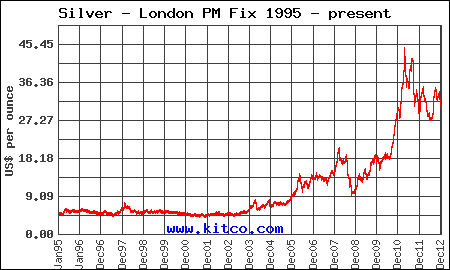
Buffett’s holdings were probably acquired under $6 since the price range of silver fluctuated between $4.22 and $6.26 during the last six months of 1997.

Buffett’s plunge into the silver market was an extraordinary event.

Prior to his silver purchase, Buffett had made his fortune by shrewdly purchasing common stock  in undervalued companies.  As usual, Buffett was ahead of the pack when he correctly foresaw the long term potential for huge gains in the price of silver.  When asked why he purchased silver, Buffett replied coyly that the “equilibrium between supply and demand was only likely to be established by a somewhat higher price.”

What happened next in the Buffett silver saga was just as unusual as Buffett’s original purchase.  Buffett is famous for saying that his holding period is “forever.”  Yet, a mere eight years later, the silver position was gone.

In response to a question at the Berkshire Hathaway shareholders meeting in 2006, Buffett replied curtly – “We had a lot of silver once, but we don’t have it now—and we didn’t make much on our prior holdings.  I bought early and sold early.”  Not much of an explanation for a man who is usually at no loss for words.  Even more curious, Buffett said that his silver hoard was sold for only $7.50 per ounce.
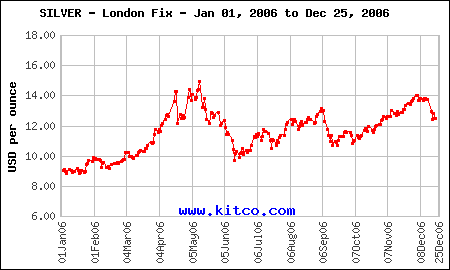
A quick look at the price chart of silver during 2006 raises an obvious question – how did Buffett wind up making such a small gain?  The other big mystery is – why did Buffett liquidate his silver position in violation of his “forever” holding rule?  Theodore Butler of Silver Seek has constructed an intriguing hypothesis that COMEX traders took Buffett to the cleaners.

Here’s what I think happened. Buffett didn’t sell his silver willingly, it was taken from him. He lost it. He lost it through speculation in derivatives of the very kind he publicly vilifies.

Those who have followed the silver market closely have come to know the incredible reliability of the pattern of tech fund/dealer buying and selling of silver futures on the COMEX. This pattern has been documented by the weekly Commitment of Traders Report (COT), which I have written about in countless articles.

I believe that Mr. Buffett (or his advisors) also came to appreciate the compelling logic and power of the COTs. I believe that Mr. Buffett (or his advisors) became a card-carrying member of the dealer silver wolf pack, skinning the tech funds for years. I also believe that Buffett’s involvement in beating the tech funds regularly ultimately ended with his silver being taken from him.

It worked like this. When the tech funds plowed onto the long side in silver as the price broke through various moving averages on the upside, Buffett (or his advisors) would sell short against his real silver holdings. When the tech funds finally sold as prices fell back through the moving averages, those shorts established by Buffett would be bought back., booking substantial recurring profits.

But what worked swimmingly for years, namely, the regularity of tech fund buying and selling at expected price points, stopped working about eight months ago. The tech funds plowed onto the long side back in September at around $7.50 and the dealers sold short aggressively. But instead of the price collapsing, as it always did in the past, the price of silver doubled. And it caught many, including me, off guard. I think it caught Buffett off guard as well. So much so that he had no choice but to turn over his real silver to cover his going short at $7.50 or so. He could have bought it back at $12 or $13 and booked a big loss while keeping his silver, but that disclosure might have been embarrassing.

This would explain how Buffett emerged from silver basically breaking even and selling too early.

Mr. Butler’s astute insights make sense to me and it’s probably the only time Warren Buffett ever got beat up on a position.  But here’s where it gets intriguing for present day silver investors.  Warren Buffett’s record of selecting long term winners is still intact – silver was a brilliant investment.  Buffett’s original position of 130 million ounces bought in 1998 would be worth almost $4.2 billion today, a gain of $3.4 billion or 429% on his original cost of $780 million.
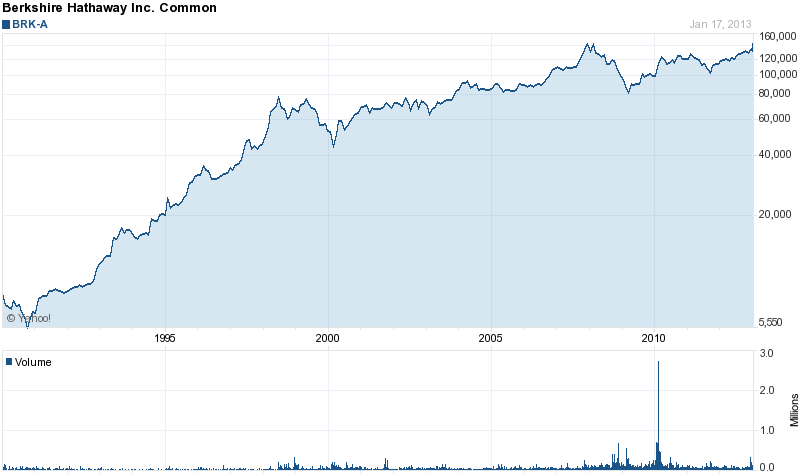
By comparison, Berkshire Hathaway A common stock went from $78,305 in June 1998 to $143,484 as of today, for a gain of only 83%.
Remember that Buffett’s holding period is “forever.”  If Buffett hadn’t had his throat ripped out by Comex traders, silver would still be in his portfolio today along with Coke, Wells Fargo and other “forever” holdings.  Something to think about the next time some “expert” starts snorting off about silver being in a bubble.

Gold and Silver Will Protect You From The Looming Financial Hurricane

By: GE Christenson

What Storm?

  • A hurricane of digital money created by central banks to purchase government debt and other dodgy assets from banks.
  • A tidal wave of deficit spending by governments around the world. It continues, regardless of whether you call it business as usual, stimulus, payoffs, or bailouts.
  • A perfect storm of derivatives – the weapons of mass financial destruction that continue to plague our financial system – but make $Billions (Maybe $Trillions) in profits for the huge banks.
  • A tornado of bailouts, giveaways, loans, and currency swaps from the Federal Reserve to backstop banks, politically connected individuals and corporations, European governments and others.
  • An approaching thunderstorm of new and higher taxes – perhaps a carbon tax, a VAT, and a wealth tax. We hope most of these will be downgraded to a hot air disturbance.
  • A tsunami of Japanese Yen based on the election of Prime Minister Abe and his avowed intention to weaken the Yen.

Why Do We Need Shelter?

  • Derivatives involve huge counter-party risk. The international financial system seems increasingly shaky. Those derivatives might be triggered by a Greek government default, another Lehman-like implosion, or a “black-swan” event that causes derivative contracts be paid. Will the counter-parties be able and willing to pay as required? Was sufficient margin set aside to protect all those derivative contracts? Doubtful!
  • It seems that the $700 Trillion in derivatives is largely based on $70 Trillion of sovereign debt, much of which is of marginal quality. When the collateral is worth less than face value, the derivative is worth considerably less than face value, or perhaps nothing.
  • Medicare and Social Security costs to the US government are huge and increasing. More deficits and accelerating national debt will be the result.
  • Will the dollar weaken against other currencies? Will the bond bubble finally burst?
  • Consumer price inflation is here and increasing.

Where Is The Shelter?

The problems are unbacked paper assets, excess debt, too much government spending, massive government deficits, derivatives that could implode, and lack of political will to correct the problems. We need a shelter that will minimize these risks.

One shelter is to divest out of paper assets and into gold and silver bullion and coins, land, farms, hobby farms, diamonds, and other physical assets. If you must stay in paper, consider using ETFs for crude, grains, sugar, gold, silver and other commodities. Read Ten Steps to Safety.

Conclusions

The investment world is increasingly dangerous. Few understood in late 1999 that an epic crash in the NASDAQ was about to occur. Housing crashed despite a wide-spread belief that real estate always goes up. There are several candidates for another crash – sovereign debt, derivatives, and the dollar.

We can depend less upon the safety of paper assets. We can depend less upon 1′s and 0′s on a financial server that claim we have assets in a brokerage account. When your government is seeking revenue, your assets are less safe. As Doug Casey says, your government currently sees you as a milk cow but may eventually view you as a beef cow.

Give your savings and retirement a chance to preserve their purchasing power. Minimize currency risk, find an alternative to a CD that pays 1% per year or a 30 year bond that pays about 3% per year for 30 years and is guaranteed to be repaid with increasingly depreciated dollars. Gold from 1/1/2000 to 1/1/2013 (13 years – from $282 to $1,655) has increased at a compounded rate of 14% per year. You have choices!

Doug Casey believes we are currently exiting the eye of the financial hurricane that started with the financial crisis of 2008 and that the next phase of the financial storm is imminent. Assets could be “blown away,” and supposedly safe structures might collapse in the financial winds of change.

If the financial hurricane is downgraded to a minor storm, you will still be sheltered in gold, silver, and other physical assets and have lost nothing. However, if the hurricane destroys many paper assets, then gold and silver will shelter you until the storm wreckage is cleared and financial life begins anew.

GE Christenson
aka Deviant Investor

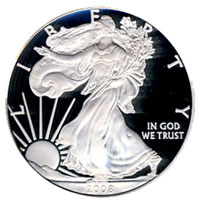
Silver Eagle Demand Soars – U.S. Mint Sold Out

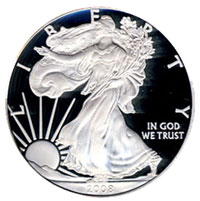
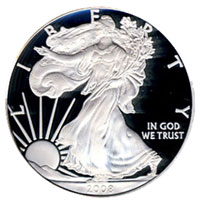
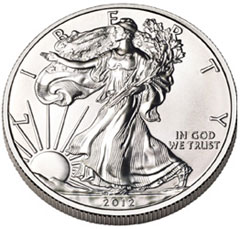
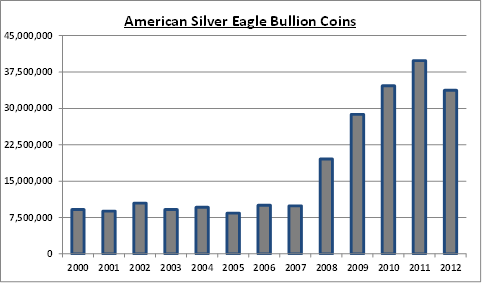
Demand for the United States Mint’s American Silver Eagle bullion coins has been off the charts since the beginning of the year.  After running out of the silver bullion coins last year, 2013 opening day sales of the Silver Eagles were the largest on record with sales of 3,937,000 coins.   First day sales of the silver coins amounted to an astonishing 12% of last year’s total sales of 33,742,500 coins.
Coin Update reports on the rush to Silver Eagles and the likelihood of product allocation once the U.S. Mint is able to catch up with demand.

The US Mint expects the temporary sell out of the 2013-dated coins to last until on or about the week of January 28, 2013. At that point, sales will be resumed under an allocation process. During previous periods of strong demand for gold and silver bullion coins, the Mint has used an allocation process to ration available supplies amongst their primary distributors.

Periodic suspensions and rationing of Silver Eagle bullion coins had become almost commonplace between the years of 2008 and 2010. This situation would led to the cancellation of collector versions of the coins in 2009 and a 2010 Congressional hearing which highlighted the inefficiencies of the Mint’s bullion coin programs. The Mint managed to work its way out of these problems by implementing process improvements at the West Point Mint, increasing the number of precious metals blank suppliers, and adding supplemental Silver Eagle production at the San Francisco Mint, while at the same time demand for silver bullion coins had lessened. For much of 2011 and 2012, the Mint had managed to keep up with demand for their bullion coins and had resumed the traditional numismatic offerings.

The past month seems to be a return to the times of old. The US Mint has not been able to keep up with higher levels of demand, and once again resorted to sales suspensions and rationing as they try to catch up.

Sales of the American Silver Eagle bullion coins has climbed steadily since 2007.  Although total sales for 2012 were below the prior year’s total, they might have hit record highs except for the fact that demand depleted the Mint’s supply of the coins in mid December.  Investors who have steadily accumulated the silver bullion coins are sitting on huge gains, with silver up by double digits for seven of the last ten years.

Investors have purchased almost a quarter billion Silver Eagles since 2000.  The total value of the beautiful one ounce coins are now worth over $7 billion dollars at current market prices.

Late Note:

The premium on the Silver Eagles has increased dramatically after the U.S. Mint announced that it was sold out. Yesterday, one of the dealers I purchase bullion coins from was pricing the 2013 Silver Eagles as low as $2.69 over spot – today the price is $3.99 over spot – a huge increase of 48%.

Silver’s Biggest Gains Are Yet To Come

I think I am becoming a non-fan of infographics.  Maybe it’s just me, but many infographics are getting way too long and complicated.  With that in mind, the latest infographic on silver from the Visual Capitalist is worth a look – they keep the story focused and simple while explaining the investment facts on silver.

The fact that silver has corrected from its highs of 2011 is meaningless in the long term.  Every major multi-decade bull market will have sharp corrections along the way, especially when manipulated downward as was done by the COMEX in May 2011 (see How The COMEX Crashed The Silver Market).  Long term investors can calmly accumulate silver on sell offs and continue to build their wealth.

After breaking out of a long base, silver has had double digit gains in 7 of the past 10 years but is still super cheap as a competing currency to fiat money.  With virtually every major central bank in the world flooding the markets with newly created paper currencies, the value of money based only on  the “full faith and credit” of the issuer is guaranteed to decline against the value of real assets – especially gold and silver.

Silver as an Investment - The Silver Series Part 3

Non-Predictions For Gold and Silver


Non-Predictions for 2013 and 2014

A train wreck is in process. We have been warned. Protect your finances, investments, and retirement. The official numbers may not represent reality.

By: GE Christenson

More of the Same

  • More money printing by central banks. A trillion here and a trillion there, printed money everywhere.
  • More deficit spending. $3 Billion per day, but who cares?
  • More useless commentary about controlling spending, but the result will be increased spending and more useless commentary.
  • More and higher taxes. More consumer price inflation.
  • More QE. Printing money props up the stock market, but for how long?
  • More debt. More student loans, more credit card debt, more mortgages, more sovereign debt, and eventually some nasty defaults.

Less of the Same

  • Less Congressional credibility – low and going lower.
  • Less belief in a better future. It is difficult to believe in a brighter future when the food stamps and welfare payments just don’t buy what they used to.
  • Less employment. People continue to drop out of the employment statistics because they have given up hope of finding work. This is called “structural unemployment.”
  • Less purchasing power for the dollar. The more the central banks print, the higher the cost of food, fuel, beer, and wine.
  • Lower standard of living. With much higher costs, the standard of living for most Americans will continue to decline.

About the Same

  • The media will continue to assure us that gold is in a bubble – a decade of nonsense – wrong then and wrong now.
  • The media will assure us that silver prices are volatile. That and $2.11 will buy a grande coffee.
  • Inflation and unemployment will continue to be under-reported, even in non-election years.
  • Congressional accomplishments will continue to be over-reported.
  • SNAFU: System Non-functional, All Funding Unlimited.
  • TBTF banks will remain Too Big To Fail.
  • European financial troubles will continue. Ditto for Japan, the UK, and the US.
  • The Federal Reserve will bail out banks and fund much of the government deficit. They will claim this benefits both employment and the economy. That benefit plus $2.11 will buy a grande coffee.

GE Christenson
aka Deviant Investor

Oversold Gold Stocks Set For Strong Rally

By: Vin Maru

In spite of the recent down turn in the price of gold and silver, we still remain bullish on precious metals and its equities. Regardless of its paper manipulated price (if you believe this is currently happening), history has shown us that gold is money (not fiat currencies) and it is no one else’s liabilities. When it comes to gold, as always we suggest owning the physical metals outright fully paid for and stored safely where only you have access to it. If you have a significant holding in the physical, it may be wise to diversify your gold internationally in order to minimize country and political risk by reading Getting Your Gold out of Dodge (GYGOOD). Gold seems to be gaining strong support under $1650 which should most likely hold, so now is a great time to be adding to physical holdings.

We could be at transition period in this bull market where the paper gold price dictatorship comes into question and the democratic free market physical price will start ruling the golden kingdom. The dictatorship by Western central planners over the gold price is ready to be challenged and we may come to a point in history where only votes based on actual physical holdings will be counted. There will be no hanging chads counted on this financial election ballet, its either you own the gold legally and outright, or you have paper promises for imaginary gold (similar to government bond and fiat money) where the question around ownership will arise. Trust us; you don’t want to be one holding paper receipts in questionable gold backed investments engineered by most western financial institutions. Ask yourself, can you trust the source of gold dictatorship to protect your financial assets, especially when it comes to your gold holdings?

HUI and the Gold Miners

When it comes to owning the gold miners, we actually believe we hit the bottom of the market this past summer and then most recently this December. Back in the summer we suggested adding to positions and selling into a September rally for trading positions and then look to add back position in the November/December time frame.

Looking at the HUI chart below, it seems this past December low finished off the correction that started in October. If this does turn out to be the lows, then I see some really positive signs in the charts. Since the beginning of December, the RSI, and MACD have been turning up after being in negative territory and they both look like they have room and momentum on their side to move higher. This means the HUI has a good chance at starting an intermediate uptrend which should last at least a month to two and go towards an initial target of 475 before taking a pause.

What is most encouraging is seeing HUI start to make a new trend upward from May 2012 in a series of higher highs and higher lows, this is a positive development especially if the December lows of 425 hold. What would be more encouraging would be to see the HUI start a new uptrend right now, go to 475 and then blow past it to test the resistance seen at 525 in September. If the gold miners do catch a strong bid and can get past the 525 hurdle that is in front of us, then we can be confident that we really do have a strong rally in the miners and that the uptrend will continue to make higher highs and higher lows moving forward. Eventually it may blow past the old highs of 625 which may come sometime towards the end of this year, but most likely in early 2014.

If you plan on trading these markets, pay attention to the above mentioned numbers on the HUI for places to lighten up on positions and then buy back in on any pull backs in a series of higher highs and higher lows. If we are right on this pattern and uptrend, then the next wave up should take out the September high of 525 and more likely run to 575 (hopefully by spring) before we see a significant correction going into the summer doldrums maybe back towards the 450-475 level. Then I suspect we could see a strong yearend rally that goes well into the early part of 2014 and at that time I expect the HUI to be back close to all time highs. This is what I see happening technically on the charts and hopefully the fundamentals will allow this to play out over the coming year and a half; of course this is based on normal market activity and no market manipulations. This is the strategy we have been planning for TDV Golden Trader subscriber and how to play this new uptrend that could be emerging over the next year.

If you enjoyed reading this article and are interested in protecting your wealth with precious metals, you can receive our free blog by visiting TDV Golden Trader. Also learn how you can purchase and protect your gold holdings by getting a copy of our special report Getting Your Gold out of Dodge or protecting the stock investments you currently own with Bullet Proof Shares.

Cheers,

All Money Printing Schemes End Badly

By: GE Christenson

William H. Gross (manages the largest bond fund in the world – PIMCO) has much to say about Quantitative Easing and money printing. His latest article, Money For Nothin’ Writing Checks For Free, discusses Quantitative Easing (printing money) and the inevitable consequences. He notes that central banks have printed over six trillion dollars in the last few years. This begs the question, “Why not print even more?” Mr. Gross and many others have suggested that central banks should be hesitant with money printing schemes since they tend to end badly. He also quotes Sir Isaac Newton regarding the temporary success (and subsequent crash) of the English government’s money printing in the early 1700s South Seas bubble, “I can calculate the movement of the stars but not the madness of men.

What about the madness of men? Do YOU really believe the following are true?

  • Congress can NOT reduce spending! (Would the deficit be eliminated if members of congress lost their salary and benefits every year the government overspent revenues?)
  • We can solve an excess debt crisis by creating more debt! (Will vodka also cure alcoholism?)
  • Printing money (QE4Ever) will create economic prosperity! (It creates wealth for banks, but not for the economy.)
  • More government, at much more cost, will improve the economy!
  • 47,000,000 Americans on food stamps (SNAP) indicates a recovering economy!
  • Paper money will always have value and will always be accepted in payment for real goods! (History indicates otherwise.)
  • Loaning money to an insolvent government at about 3% per year for 30 years is a good investment when the government has assured us that it will devalue the dollars used to repay the loan!

What about the sanity of men? Is it more sensible to believe the following?

  • YOU can control your finances, wealth, and retirement.
  • Gold is real money.
  • Physical assets are safer than paper assets or digital “money” on a computer server. Avoid the train wreck.
  • Gold will retain its value, dollars will not.
  • If you own physical assets, you have less need to trust the safety of the stock market or the bond market.
  • Physical assets are much less vulnerable to the actions of central banks, the “Plunge Protection Team,” High Frequency Trading, and other market manipulations.

Conclusion

“A man sees what he wants to see and disregards the rest.” Simon & Garfunkel

If the government needs money for excessive expenditures, it sees loans and a central bank that “prints money” and disregards the inevitable inflation.

If a bank sees huge unrealized losses on mortgages, derivatives, and mortgage-backed securities, it sees bailouts from the Federal Reserve along with lobbyists purchasing favorable legislation and disregards the economic cost to the nation.

If an aware individual sees unbacked paper money being printed in quantity, he buys physical assets such as gold and silver and disregards the continual media noise and nonsense.

Avoid the madness of men, and seek the safety and sanity of gold and silver. We have been warned.

GE Christenson
aka Deviant Investor

2013 Silver Eagle Bullion Sales Open at 3,937,000

Sales of the United States Mint’s American Silver Eagle bullion coins started the year in impressive fashion. For the opening day of availability for 2013-dated coins, the US Mint received orders for 3,937,000 coins from authorized purchasers.
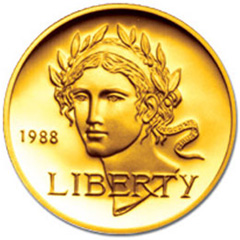
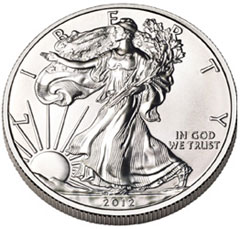
This amount exceeds the opening day sales levels for recent years, which had seen 3,197,000 coins ordered to start 2012; 2,085,000 coins ordered to start 2011; and 2,440,000 coins ordered to start 2010.

The strong opening for the 2013 Silver Eagles has been driven by pent up demand for the popular one ounce silver bullion coins. The US Mint sold out of the 2012-dated coins in mid-December, creating a three week period during which no coins were available for authorized purchasers to order. The pent up demand supplemented the already typically high demand for the first release of the newly dated coins.

To put yesterday’s numbers in perspective, the sale of nearly 4 million one ounce silver coins represents more than one-tenth of annual silver production within the United States. Since the start of the program there have been two years (1996 & 1997) where annual Silver Eagle sales measured in ounces have been lower than yesterday’s sales which occurred in a single day. Measured in dollar terms, yesterday’s sales of approximately $120 million worth of Silver Eagles were higher than the annual sales total for each individual year from 1986 to 2005.

THE ONGOING COLLAPSE IN THE PURCHASING POWER OF THE DOLLAR IS IRREVERSIBLE – TEN STEPS TO PROTECT YOURSELF

By GE Christenson

  • Our financial system, as it currently operates, is unsustainable. Unproductive debt cannot exponentially increase forever. I assume this is obvious to almost everyone. Jim Sinclair says, “The financial system is simply FUBAR. It is that simple. The reason to own all things gold is that simple.” FUBAR has several meanings, but my interpretation of FUBAR is: “Fiscally Unbalanced Beyond Any Reconciliation.”
  • The U.S. government deficits are, on average, larger every year. This means that the total (official) national debt is not only increasing each year but also that the rate of increase is accelerating. Since 10/1/2000 the national debt has increased about 9.1% per year, but since 10/1/2007 it has increased 12.2% per year. Worse, this is only the official debt and does not even consider the net present value of unfunded Social Security, Medicare, Medicaid, and government employee pensions and liabilities. Depending on who is calculating the liabilities, the total unfunded liability is approximately $100 Trillion to $230 Trillion and the annual increase is perhaps $7 – $11 Trillion. (The entire U.S. GDP is about $15 Trillion per year – for comparison.) This will not end well.
  • In essence, the above two facts are incompatible – hence an economic train wreck is in process. What could happen? Follow the logic here.
  • When there is too much of something, it loses value. If we have too many eggs, the price drops. If too many autos are for sale, there will be lower prices for autos. Central banks around the world are currently producing amazing quantities of dollars, euros, yen, and most other unbacked paper currencies. Hence, their value will decrease against the commodities we need for survival – food, energy, and so forth.
  • There is too much debt in our financial system, whether measured in nominal value or as a percentage of GDP. Hence the value of that debt will decline. Some debts will default, bonds will decline in value as interest rates inevitably rise, and other debt will drop in value and purchasing power.
  • Politicians have made excessive guarantees for future benefits to Social Security recipients, Medicare recipients, government pensions, and others. Those guarantees cannot all be delivered as promised, hence they will decline in value and purchasing power, or the promises will not be fulfilled.

Why are the following ten steps necessary?

  1. The best time to start preparing was about a decade ago. The second best time is today. Make a plan and act. Start by reducing living expenses and eliminating credit card debt.
  2. Expect sweeping changes! I hope the inevitable currency collapse is slow and gentle, not rapid and destructive, but history suggests rapid and painful are more likely.
  3. Phase out of paper assets and into something real. Gold, silver, diamonds, farm land, rental property, and buildings come to mind.
  4. Perspective – Perspective – Perspective! It is better to be early than late. It is better to trust yourself than to depend upon a government agency for your food and shelter. To whatever extent you can, take charge of your own financial affairs, savings, and retirement.
  5. Plan on huge inflation in consumer prices for food, energy, transportation, medical costs, and more.
  6. The middle class will be hurt the most. Those who plan and prepare will, as always, survive and prosper. Make a plan!
  7. Government control over the economy will increase. Surveillance on individuals will increase; there will be much less personal and financial privacy. Act accordingly!
  8. Social change will follow a currency collapse. It might be violent. The government is preparing in many ways for social violence. Are you?
  9. Currency induced cost-push inflation appears inevitable. When? As a guess, well before 2016. Gasoline costing $8.99 or more per gallon is a distinct possibility. Don’t discount this just because it sounds extreme. It might be a low estimate.
  10. Economic manipulations, mal-investments, and unsustainable policies will self-correct. Plan on corrections and adjustments that will bring painful consequences. The bigger the bubble, the more catastrophic the collapse and the larger the collateral damage. The sovereign debt and paper money bubbles appear VERY large and ready to pop.

Summary

Unproductive government debt cannot increase forever, but our financial system currently depends upon ever increasing expenditures and debt. There are far too many dollars in circulation, more debt than can be repaid, and massive unfunded liabilities have been created by the promises made by politicians. The purchasing power of the dollar must decline, many debts will not be repaid, and many promises for future benefits will be reduced in value or will simply disappear. Hence, the FUTURE income stream from debt-based assets is increasingly risky. A few to consider are:

  • Social Security benefits. The government must borrow or print to pay current benefits. The value (purchasing power) of future benefits will almost certainly decline.
  • Municipal and state bonds and pension promises are increasingly risky. Will more cities and states default on their bonds? Why are their pension plans, on average, increasingly underfunded? Will your pension plan remain safe? Consider moving your IRA into physical gold and silver safely stored outside the banking system.
  • US government 30 year bonds and 10 year notes will decline in price as interest rates rise, and will also decline in purchasing power as the dollar devalues. Why would you lend money (long-term) to an insolvent government at less than 3% interest per year when that government has assured you it will debase the currency and reduce the value of the debt you bought? Is this a financial train wreck in process?
  • Mutual funds and money markets based on bonds and other debt are at risk. If the underlying debt defaults, the value of the mutual funds and money markets will decline. Counter-party risk is real.

Why is debt based future income increasingly risky? The payoff will be delayed, defaulted or executed in mini-dollars after inflation and counter-party defaults have ravaged the purchasing power of those paper debts. We have Been Warned!

Would you prefer hard assets with no counter-party risk? Reread the Ten Steps To Safety, and then take charge of your financial life to whatever extent you can.

GE Christenson
aka Deviant Investor

American Silver Eagle Bullion Coin Sales For 2012 Tops 33 Million Ounces – Mint Runs Out Of Coins

According to the U.S. Mint, total sales of the American Silver Eagle bullion coins for December 2012 totaled only 1,635,000 ounces, down by 18.6% from 2,009,000 coins sold during December 2011.  The lowest monthly sales for the year occurred in February when 1,490,000 Silver Eagle Bullion coins were sold.  The highest monthly sales of the Silver Eagles occurred in January when 6,107,000 coins were sold.

Demand for the Silver Eagle bullion coins has been robust this year and the low sales for December do not reflect reduced demand but rather reduced U.S. Mint production.   As reported by Coin Update, the Mint reported in mid December that all Silver Eagle bullion coins had sold out and no additional coins would be struck during 2012.  The Mint announced that the 2013 Silver Eagle bullion coins should be available to authorized purchasers on January 7, 2013.

As with other bullion programs, the US Mint does not sell Silver Eagle bullion coins directly to the public, but distributes them through a network of authorized purchasers. The primary distributors are able to purchase the coins in bulk quantities at a price based on the market price of silver plus a fixed mark up. The coins are then resold to other bullion dealers, coin dealers, and the public.

The US Mint originally began accepting orders for the 2012 Silver Eagles from authorized purchasers on January 3, 2012. After a strong January, monthly sales trailed the levels of the prior year until October when demand started to move higher. In November, bullion sales continued their renewed strength, with sales of American Gold and Silver Eagles more than doubling the figures from the year ago period.

The strong sales in November caused the United States Mint to adjust their production plans for one ounce and one-tenth ounce American Gold Eagle bullion coins in order to avoid selling out prior to the end of the year. Apparently, the Mint did not adjust production plans for American Silver Eagle bullion coins.

The sales figures for December would likely have exceeded 3 million ounces if the Mint had produced enough silver bullion coins to meet demand.  Nonetheless, total sales of the Silver Eagle bullion coins for 2012 were the third highest on record with a total of 33,742,500 coins sold.  All time record sales of the Silver Eagle coins occurred during 2011 when almost 40 million coins were sold.


Demand for the Silver Eagles has soared since the financial crisis began in 2008 and recent announcements by the Federal Reserve and other central banks pledging unlimited money printing is certain to increase investors demand for safe haven precious metals.

Since 2000, investors have purchased an astonishing 232,143,000 American Silver Eagle one ounce coins worth over $7 billion at current market prices.