April 13, 2026

Historical Gold Silver Ratio Predicts $100 Silver Price

The gold silver ratio chart below shows the dramatic fashion in which silver has been outperforming gold since last August.  The gold silver ratio is calculated by dividing the price of gold by the price of silver.  A declining gold silver ratio indicates that silver has been outperforming gold.   The gold silver ratio has declined from 65 last summer to a current level of 41.

Since August 2010 gold has moved up 22% from the $1,175 level while silver has soared 92% from the $18 range.  Does the declining gold silver ratio indicate that silver prices are due for a correction or is this a fundamental change in the price relationship?

The gold silver ratio has averaged around 60 since the mid 1970’s.  In January 1980, as silver hit its peak price of $48.70, the gold silver ratio briefly hit 16, but rapidly rose as the Hunt brother’s attempt to corner the silver market came undone and silver prices collapsed.
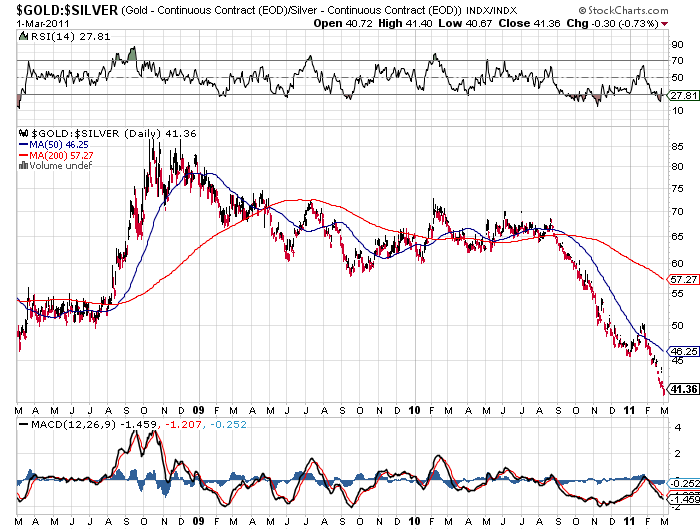
Gold Silver Ratio - Courtesy Stockcharts.com

Will the current decline in the gold silver ratio continue?  From a very long term historical perspective, a gold silver ratio in the 16 range has been the norm.  Since ancient times, it has typically taken 16 ounces of silver to purchase one ounce of gold.  Interestingly, the earth’s  reserves of silver exceeds that of gold by roughly 16 times.  If this ultra long term relationship were to reassert itself, silver would sell for approximately $90 per ounce based on the current price of gold.  With gold at $2,500 per ounce, silver would have a value of $156 per ounce at the historical gold silver ratio of 16.

The fundamental reason that may drive the gold silver ratio back to the 16 range is growing demand by small investors.  Silver, known as the poor man’s gold has seen a huge surge of public demand, as evidenced by record sales of the Silver Eagles.

Increasing public recognition of the need to preserve wealth against paper currencies will continue to propel silver to historic highs.  Simply put, silver is more affordable to the average buyer who cannot afford the higher priced Gold Eagles.  Silver has a lot of catching up to do and we are probably in the early stages of a fundamental reversion to a lower gold silver ratio which will send silver prices soaring past $100 per ounce.
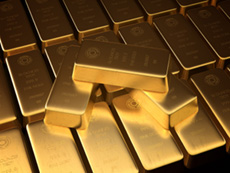
Gold and Silver Prices Higher as Platinum and Palladium Sell Off

As turmoil reigned in the Middle East and worries mounted over the reduction of oil supplies, gold and silver proved their safe haven status as both moved higher in price.
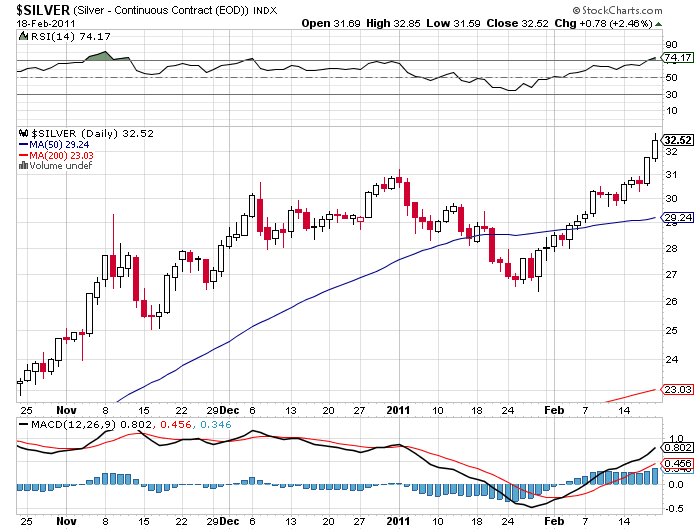
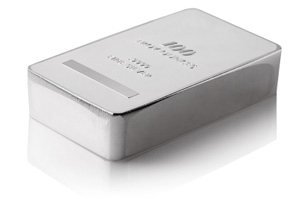
After a very solid gain of $1.94 per ounce last week, silver continued its upward move with another gain of $.60.  The closing London Fix Price for silver was $32.54 for a gain of 1.88% on the week.   The normal price consolidation and pullback in silver that extended from the beginning of the year into the end of January was the setup for a solid breakout into new highs.  Silver has now advanced over 20% from the lows of January.

SILVER - COURTESY STOCKCHARTS.COM

Besides the safe haven/currency alternative lure of silver, the fundamentals in silver are forecasting further dramatic price gains.   There have been numerous reports documenting physical shortages of silver as well as huge investment demand in the U.S., India and China.

One solid indication of the huge demand for physical silver is evidenced by the backwardation in prices.  Typically, the forward price of a commodity will exceed the cash price due to the expenses of insurance, warehousing and inventory financing.  When a commodity has a normal upward pricing curve to reflect a higher futures cost, the situation is termed contango.  Backwardation, the unusual case where the cost of the physical commodity is higher than future prices, is a classic indicator of surging demand.  Another indicator of the great demand for physical silver is the four year low of Comex warehouse silver.

Precious Metals Prices
Fri PM Fix Since Last Recap
Gold $1,402.50 +19.00 (+1.37%)
Silver $32.54 +0.60 (+1.88%)
Platinum $1,791.00 -45.00 (-2.45%)
Palladium $785.00 -62.00 (-7.32%

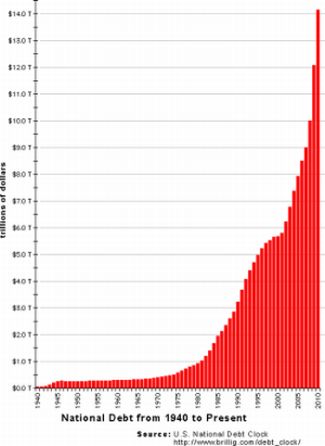
Gold also continued its upward move with a gain of $19 per ounce after an advance of $19.50 in the previous week.  To understand the wealth preservation appeal of gold, one needs only to look at the exponentially increasing level of  U.S. debt.  Ultimately, the staggering amount of sovereign debt can be serviced only through inflation and dollar debasement which is what the Federal Reserve is currently orchestrating through quantitative easing (money printing).

US NATIONAL DEBT - THE ROAD TO FINANCIAL OBLIVION

The U.S. dollar also appears to be losing its cache as the “safe haven” currency.  Despite the unprecedented turmoil in the Middle East and the rise in oil prices, the U.S. dollar has weakened over the past two weeks.  By comparison, during the financial crisis of 2008, the U.S. dollar appreciated 24% against other major currencies.

The surge in oil prices has led to concerns that the U.S. and world economies will see much lower growth as higher oil prices devastate consumer disposable income.  A weakened world economy would probably lead to lower demand for industrial metals such as platinum and palladium which both declined this week.  Platinum sold off by $45 and palladium was rocked by a $62 loss from the prior week.

US Mint Gold and Silver Eagle Bullion Coin Sales

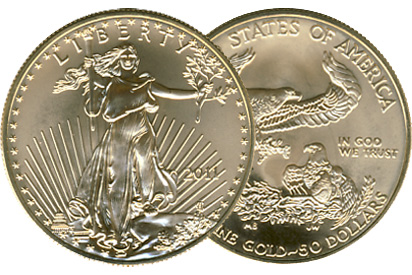
Sales of the United States Mint’s gold and silver bullion coins remained on a relatively steady pace with recent weeks. Sales of 908,000 ounces worth of American Silver Eagle coins were recorded, along with 28,000 ounces worth of American Gold Eagles.

In the previous week, the Mint had recorded bullion sales of 833,500 ounces of silver and 31,500 ounces of gold.

The US Mint utilizes a network of authorized purchasers (AP’s) to distribute bullion products to the public. This small group of private sector businesses are allowed to purchase bullion coins from the Mint in bulk quantities, and in turn resell them to the public. The price charged to the APs is based on the market price of the metal plus a mark up.
The mark up for Silver Eagles is currently $2.00 per coin. The mark up for Gold Eagles varies based on the size of the coin. The premium levels are 3%, 5%, 7%, and 9%, for one ounce, one-half ounce, one-quarter ounce, and one-tenth ounce sized coins, respectively.

US Mint Bullion Coin Program Sales 2/23/2011 (ounces)

Prior Week Month to Date Year to Date
American Silver Eagle 908,000 2,638,500 8,152,500
American Gold Eagle 28,000 83,500 189,000
America the Beautiful Silver 0 0 0
American Platinum Eagle 0 0 0
American Gold Buffalo 0 0 0

For the year to date, the US Mint has sold 8,152,500 ounces of silver bullion and 189,000 ounces of gold bullion. All sales have taken place for the American Eagle coins. Later in the year, 24 karat Gold Buffalo bullion coins and 5 ounce America the Beautiful Silver Coins are expected to be made available.

Silver ETF Holdings Soar as Gold ETF Holdings Decline

The SPDR Gold Shares Trust (GLD) holdings declined slightly on the week, while the iShares Silver Trust (SLV) increased its holdings by a substantial 164 metric tonnes
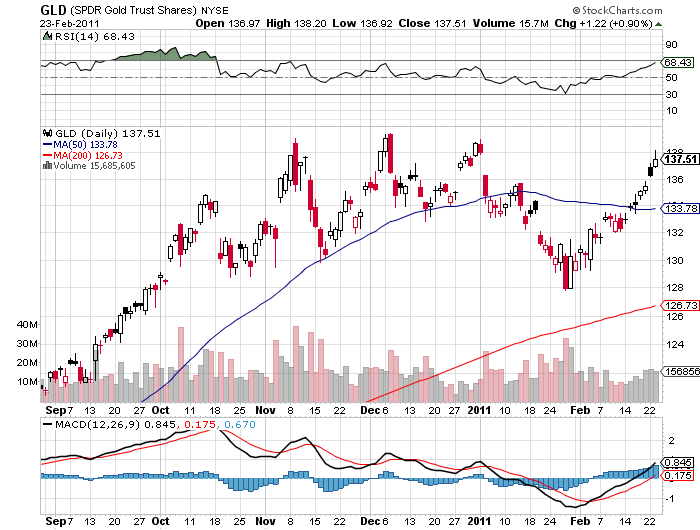
Holdings in the GLD declined by 5.77 tonnes compared to a decline of 2.43 tonnes in the previous week.  Total holdings have declined by 4.9% or 62.48 tonnes since the start of the year.  The GLD currently holds 1,218.24 tonnes or 39.17 million ounces of gold valued at $55.2 billion.

The price of the GLD has traded between $128 and $139 since last October after running up from approximately $110 from the start of 2010.   The GLD was originally launched in November 2004 when the price of gold was trading at $445 per ounce.

GLD - COURTESY STOCKCHARTS.COM

GLD and SLV Holdings (metric tonnes)

23-Feb-11 Weekly Change YTD Change
GLD 1,218.24 -5.77 -62.48
SLV 10,575.23 +164.00 -346.34

Silver holdings in the iShares Silver Trust (SLV) increased by 164 tonnes over the past week compared to an increase in the previous week of 41.01 tonnes.  The year to date decline of 346.34 tonnes represents a 3.2% drop in silver holdings since the beginning of the year.

The Trust is structured so that the value of the iShares will reflect the price of silver owned by the trust.  The price of an iShare should closely track the price of one ounce of silver, less the Trust’s expenses.  However, the price of the SLV will fluctuate during the day as traders buy and sell shares.  If there are many buyers purchasing SLV, the price can rise to a premium over the underlying value of silver as seen in the chart below comparing silver to the SLV.

The amount of silver held by the SLV will vary due to the mechanism by which shares are created or redeemed by the Trust via Authorized Participants.   Authorized Participants are typically large Wall Street Investment firms that will either deliver or take silver from the SLV as they arbitrage to take advantage of premiums or discounts of physical silver to the value of the SLV.  The GLD operates similarly to the SLV which is why an increase in the price of gold and the price of the GLD may not necessarily result in greater gold holdings by the GLD.

SILVER/SLV - COURTESY STOCKCHARTS.COM

The SLV’s closing price of $32.71 on February 23th is 9.2% above last weeks closing price on February 16th and reflects silvers large price increase over the past week as prices broke out to new highs.  Since 2010, the price of silver has more than doubled from the $16 range to the current price of $33.70.

Gold Demand Soars as Supplies Increase Marginally

Gold demand increased strongly across all sectors during 2010, as the supply of gold barely increased.
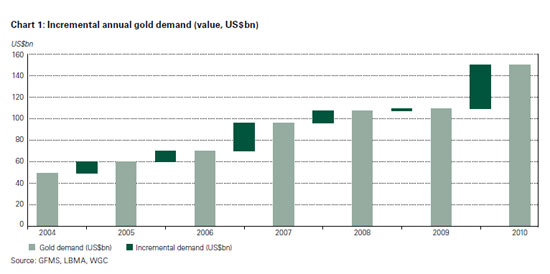

According to the World Gold Council, global demand for gold hit a 10 year high of 3,812.2 tonnes worth $150 billion.  The demand for gold hit an all time high in value as gold prices hit a record high of $1,421 per ounce on the London PM fix.  Typically, as the price of an item increases demand will decrease, but in the case of gold, it seems that  higher gold prices are creating more demand.  The risk of sovereign defaults, inflation, economic concerns and weak currencies have convinced many investors that gold is  integral to the preservation of wealth.

The demand for gold in 2010 was nothing less than extraordinary considering the 25% increase in gold prices.  The London PM Fix price of $1,121.50 at the beginning of 2010 increased steadily throughout the year and closed on December 30, 2010 at $1,405.50.

The World Gold Council noted that key factors affecting the price of gold during 2010 included the following:

  • Jewelry demand increased by 17% over 2009, with demand particularly high in both India and China.  Asia accounted for 51% of total investment and jewelry demand during 2010.
  • For the first time in 21 years, central banks became net purchasers of gold.
  • Investment demand for gold during 2010 was actually down by 2% in 2010 to 1,333 tonnes, but was the second highest demand year on record.

Gold Demand - World Gold Council

The value of gold demand skyrocketed by 38% in 2010 to $150 billion, despite the 40% increase in gold’s value since 2008.  The statistics for specific demand categories, according to the World Gold Council were as follows:

  • Total gold jewelry demand increased by 17% to 2059.6 tonnes despite increased gold prices.  The value of jewelry demand was $81 billion.
  • Investment demand for bar and coin and ETFs remained stable in 2010, down only 2% from the previous year.  In value terms, demand strongly increased by 23% to $52 billion.  Demand for physical bars increased by 56% to 713.2 tonnes.
  • ETFs accounted for 9% or 338.0 tonnes of gold during 2010 which was down by 45% from the peak of 617.1 tonnes in 2009.  At year end 2010 gold holdings by ETFs amounted to 2,175 tonnes worth $96 billion.
  • Gold demand by the technology and electronics industry rose 12.4% to 419.6 tonnes.
  • The market with the strongest growth in gold demand was India.  Gold demand by Indian consumers increased by 66% to 963.1 tonnes worth $38 billion.
  • The market with the strongest investment demand was China which saw a 70% increase in demand for coins and small bars to 179.9 tonnes worth $7 billion.

Total gold supply increased by only 2% as mines struggled to find new deposits and increase production from existing mines.  Out of total yearly gold supply, 40% comes from recycled gold.

Silver Breaks Out of Triple Top for New Bull Move – Is Gold Next?

Triple tops are a well known chart formation that signal the potential for a price trend reversal.  A classic triple top occurs over a period of three to six months during which prices decline after hitting a series of multiple equal highs.  For the reversal pattern to register a definitive sell signal, the price must break below support levels.
A triple top has certain characteristics, each of which must be analyzed.

  • The three highs must be within reasonable price points of each other and spaced over equal time periods.
  • A previous long term uptrend must have occurred which established a definitive uptrend.
  • Volume levels tend to decrease during the formation of a triple top.  If volume increases on a pullback from the third top, more significance must be given to the potential for a significant trend reversal.
  • A triple top is not completed unless the price level breaks a key support level which would be the lowest price point on previous pullbacks from the intermittent tops.
  • A triple top chart pattern is not considered bearish unless support levels are decisively broken

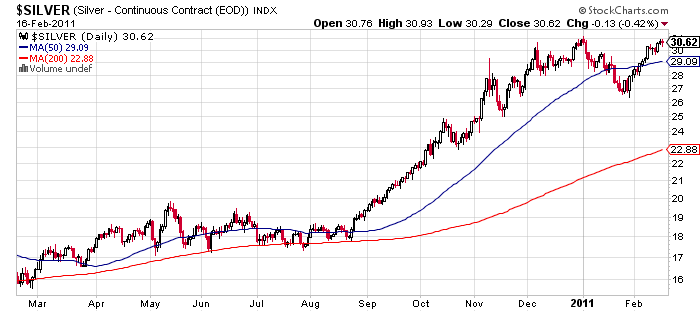
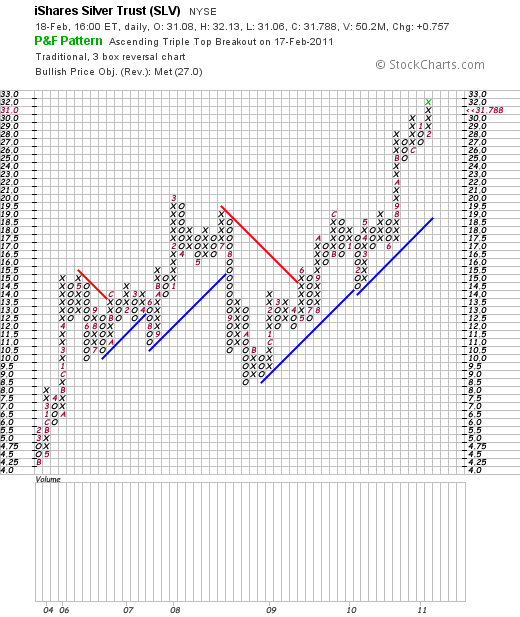
Examining the chart for silver before the recent move up, we could see a pattern developing with characteristics of a triple top.  The critical support level for silver was at  the $27  level.  Silver’s inability to break resistance at the $30 level would have been at best a neutral signal and a break below $27 would have forecast further price declines.   The strong upward price movement in silver last week as it soared past the $30 area is extremely bullish and tells us that the bull market in silver is intact.

Silver - courtesy stockcharts.com

TRIPLE TOP BREAKOUT - COURTESY STOCKCHARTS.COM

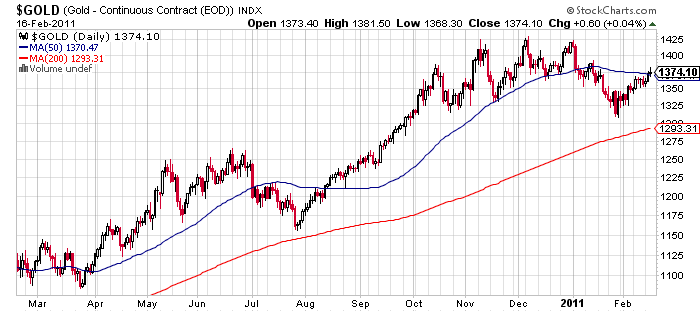
Viewing the chart of gold, we can see that the same potential for a triple top exists.

Gold - courtesy stockcharts.com

Gold has been turned back three times at the $1425 level, the tops are equally spaced over a period of almost 4 months and gold has been in an established uptrend for an extended period of time.  In the case of gold, a drop below support at $1320 would be a bearish signal and reason to take a defensive posture.

Considering the strong fundamentals supporting gold, we may soon see a breakout in the price of gold similar to what we have just witnessed with silver.

Silver Soars to 30 Year High as Precious Metals Resume Upwards Trends

After a brief consolidation below the 50 day moving average in late January, silver resumed its uptrend with a vengeance.  The London PM fix price for silver closed at $31.94 up from $30.00 the previous week.  Since late January, silver has rocketed $5.50  for over a 20% gain.

Silver - courtesy stockcharts.com

The fruitless budget reduction talks in Washington, a slide in the US Dollar Index and a new high on silver are certain to ignite the precious metal markets into another major move upwards.  Most investors under the age of 50 probably don’t remember the last time silver prices have soared past $30 in the early 1980’s.

Technically and fundamentally, silver is poised to make a major move.  Price movements coming out of long bases usually have a long duration.   Silver has broken out from an ultra long base of over 25 years.  The initial move from the $5 area to $30 is simply the first phase of what should turn out to be a major upward move.

Long term silver

Silver hit an all time high of $48.70 in January 1980.  The inflation adjusted historical high for silver is $130 per ounce.  Considering the horrendous manner in which sovereign states are conducting their financial affairs and the potential for another financial crisis, the inflation adjusted high of $130 will look like a bargain price at some future date.

The closing London Fix Prices showed gains across the board from the previous week.  Silver was the standout performer with a gain of 6.5%.

Precious Metals Prices
Fri PM Fix Since Last Recap
Gold $1,383.50 +19.50 (+1.43%)
Silver $31.94 +1.94 (+6.46%)
Platinum $1,836.00 +7.00 (+0.38%)
Palladium $847.00 +25.00 (+3.04%

John Paulson Maintains Huge Holdings in SPDR Gold Shares Trust (GLD)

In 2010, John Paulson personally earned $5 billion, vaulting him into the ranks of the world’s wealthiest persons.  Incredibly, this was not a one time event precipitated by a heavily leveraged bet that just happened to turn out right.  Mr. Paulson had previously made another brilliant call prior to the financial crisis.  Based on his analysis of the subprime mortgage market, Mr. Paulson had the acumen to establish a major bearish position in mortgages, prior to the mortgage meltdown, that resulted in billions of dollars in profits.
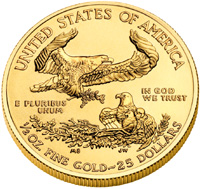
It was how Mr. Paulson made $5 billion during 2010 that makes his every move the object of  intense scrutiny by gold investors worldwide.  Mr. Paulson believes that the Federal Reserve is determined to re-inflate every asset class possible, using whatever means necessary.  Without the “benefit” of inflation, the crushing levels of national debt would eventually lead to massive defaults and an economic disaster.   Based on this conviction, Mr. Paulson invested heavily in gold futures, the SPDR Gold Shares Trust (GLD), and other gold structured investments that resulted in his massive paycheck for 2010.

Last October, while speaking at the University Club in New York, Mr. Paulson predicted that the price of gold could easily reach $4,000 an ounce.

With Mr. Paulson’s track record, any change in his gold holdings would obviously be of great interest to gold investors worldwide.

Mr. Paulson directs most of his investments through his hedge fund, Paulson & Co, and is required to report major holdings to security regulators with 45 days after the end of each quarter.   The latest regulatory Form 13-F filing shows that Mr. Paulson’s position in the SPDR Gold Shares Trust was unchanged for the latest quarter.

At December 31, 2010, Mr. Paulson’s holdings in the GLD amounted to $4.37 billion dollars or about 8% of the total value of the Gold Trust.  The value of the GLD’s holdings are currently $53.95 billion.

Other big time successful investors also maintained or increased their holdings in the GLD.  The Soros Fund Management at year end held $655 million of GLD while PIMCO (run by super star bond manager Bill Gross) had holdings of $307.7 million.

Pace of US Mint Gold and Silver Bullion Sales Ahead of Last Year

In the past week, the United States Mint sold 833,500 ounces of silver bullion and 31,500 ounces of gold bullion. Available products included the American Silver Eagle in one ounce size and the American Gold Eagle in one ounce or three fractional sizes.

For the year to date, the US Mint has now sold 8,152,500 ounces of silver, which is running well ahead of the pace of sales from the previous year. During 2010, the US Mint had sold 5,642,500 ounces through the end of February. Annual sales eventually reached a record 34,662,500 ounces from Silver Eagles, with an additional 875,000 ounces from the America the Beautiful Silver Bullion Coins.

Gold bullion sales for the year to date are now 189,000. Once again, this is running ahead of last year’s pace when the Mint sold 169,000 ounces through the end of February. By year end, sales had reached 1,220,500 ounces worth of Gold Eagles, plus 209,000 ounces from the 24 karat Gold Buffalo coins.

US Mint Bullion Coin Program Sales 2/16/2011 (ounces)

Prior Week Month to Date Year to Date
American Silver Eagle 833,500 1,730,500 8,152,500
American Gold Eagle 31,500 55,500 189,000
America the Beautiful Silver 0 0 0
American Platinum Eagle 0 0 0
American Gold Buffalo 0 0 0

This month the US Mint began sales of the fractional weight 2011-dated American Gold Eagles. Throughout January, only the one ounce size was available bearing this year’s date.

Fractional Gold Eagle sales for the month so far include 100,000 of the one-tenth ounce size coins, 16,000 of the one-quarter ounce coins, and 5,000 of the one-half ounce coins. In recent years, the one ounce size coins have accounted for the bulk of bullion sales.

Gold ETF Holdings Stable As Silver ETF Holdings Increase

The SPDR Gold Shares Trust (GLD) holdings declined marginally on the week, while the iShares Silver Trust (SLV) increased its holdings by over 41 metric tonnes.   As both gold and silver prices consolidate in a tight price range, both the GLD and the SLV have experienced a decline in bullion holdings since the beginning of the year.

Holdings in the GLD declined by 2.43 tonnes compared to a decline of .71 tonnes in the previous week.  Total holdings have declined by 4.4% or 56.71 tonnes since the start of the new year.  The GLD currently holds 1,224.01 tonnes or 39.35 million ounces of gold valued at $53.9 billion.

The price of the GLD has traded between $128 and $139 since last October after running up from approximately $110 from the start of 2010.   The GLD was originally launched in November 2004 when the price of gold was trading at $445 per ounce.

GLD and SLV Holdings (metric tonnes)


16-Feb-11 Weekly Change YTD Change
GLD 1,224.01 -2.43 -56.71
SLV 10,411.23 41.01 -510.34

Silver holdings in the iShares Silver Trust (SLV) increased by 41.01 tonnes over the past week compared to a decline in the previous week of 38.38 tonnes.  The year to date decline of 551.35 tonnes represents a 5% drop in silver holdings.

There is no direct correlation between SLV holdings and the price of the SLV due to the mechanism by which shares are created or redeemed by the Trust via Authorized Participants.  The Trust is structured so that the value of the iShares reflects the price of silver owned by the trust.  The price of an iShare should closely track the price of one ounce of silver, less the Trust’s expenses.

The SLV’s closing price of $29.96 on February 16th is only slightly below the all time high of $30.40 reached at the beginning of the year.  Since 2010, the price of silver almost doubled from the $16 range to the current price of $30.67.