April 10, 2026

Fed Lays Groundwork For Price Explosion In Gold

Gold hit another all time high of $1,779.10 before pulling back to close at $1745.10, up $26.90.  Gold has advanced strongly over the past year as the Federal Reserve engaged in quantitative easing and extremely loose monetary policy.  Over the past 30 days gold has gained $198 and over the past year, a stunning $548.70 per ounce.

At the conclusion of the Federal Open Market Committee (FOMC) meeting on Tuesday, the Fed announced that it would maintain its zero interest rate policy through the middle of 2013.   The Fed does not normally make commitments that limit future policy flexibility and three of the seven members of the FOMC  voted against the pledge to maintain zero interest rates.

The Fed has held interest rates at zero for 32 months now with little to show for it as debt burdened consumers continue to reduce spending.  With inflation running at 5 to 10% (depending on whose stats you believe), real interest rates are negative and savers are seeing the purchasing power of their dollars destroyed by Fed policies.

The FOMC also said that they expect “a somewhat slower pace of recovery over the coming quarters” and that future action might be taken to “promote stronger economic recovery.”  Since the Fed has already exhausted all normal policy tools, the FOMC seems to be positioning itself for another round of quantitative easing.  Some analysts speculate that the Fed will discuss further easing measures later this month at the Fed’s annual conference in Jackson Hole, Wyoming, where QE2 was launched.

Further fiscal stimulus seems improbable given the restrictions put on future spending by Congress as part of the debt limit agreement.  In a sign of how desperate the financial condition of the United States has become, all eyes are now turned towards the Fed.

Since zero interest rates and two rounds of money printing have done little to turn around the US economy, the expectation is that the Fed will need to do more of what failured before, except on a grander scale.  I expect that as the economy continues to weaken, the Fed will announce a “shock and awe” campaign of massive money printing accompanied by an explicit statement that they are committed to higher inflation.

Federal Reserve policies have been the primary factor pushing the price of gold higher.  The inevitable announcement of further quantitative easing will be trigger that pushes gold prices thousands of dollars higher.

Consider the statement of the former Fed Chairman Alan Greenspan who on a “Meet the Press” interview arrogantly proclaimed that the United States could never default because “The United States can pay any debt it has because we can always print money to do that. So there is zero probability of default.”  This is what the United States has come to under the easy money policies of the Federal Reserve and a government that believes prosperity can be created by oceans of debt.  Is it any wonder that the currency is collapsing and the purchasing power of the dollar declining precipitously?

Meanwhile, Kenneth Rogoff (of This Time It’s Different fame) who attended Harvard with Bernanke, tells Bloomberg that the Fed should explicitly set a high inflation target and engage in massive quantitative easing.

Federal Reserve policy makers are likely to embark on a third round of large-scale asset purchases, moving “more decisively” to secure the U.S. recovery, said Harvard University economist Kenneth Rogoff.

“They certainly should do something right away,” said Rogoff, a former International Monetary Fund chief economist who attended graduate school with Fed Chairman Ben S. Bernanke.

“Out-of-the-box policies are called for, especially much more aggressive monetary policy, however unpopular that may be,” said Rogoff, 58, a former Fed economist who like Bernanke earned a Ph.D. from the Massachusetts Institute of Technology. The Fed is “going to move more decisively,” Rogoff said.

Rogoff recommended the Fed say in “very clear statements” that it’s trying to create “moderate inflation.” “In the classic classroom QE, it’s open-ended,” Rogoff said. “You say, ‘I’m trying to create inflation of, let’s say 2 or 3 percent, and I’m going to do whatever it takes.’”

The extreme policy measures recommended by Greenspan and Rogoff prove that the US has already passed the tipping point and has only one policy option left.  If the Fed does not print like crazy, the whole rotten edifice of towering debts will collapse, plunging the country into a deflationary collapse.

Gold will have price corrections as it continues to move upward but the ultimate price will be many thousands of dollars higher than today.  Gold investors should continue to accumulate positions, especially on price weakness and enjoy the unfolding of one of the greatest bull markets in history.
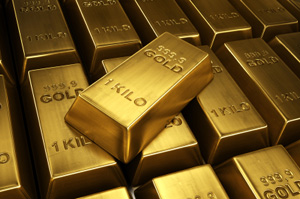
$100 Up Days For Gold To Become Routine

Gold is a small part of most investment portfolios despite a decades long uptrend.  Investment advisers have either routinely dismissed gold as part of an investment portfolio or recommend only a token position as a hedge.  This is likely to change as gold gains recognition as a safe haven alternate currency.  As investors rush to establish positions in gold, $100 up days are likely to become a routine event.

The reasons for investing in gold are well known to readers of this blog.

The financial crisis that began in 2008 was not resolved and is now entering the end game phase.  Governments that propped up the financial system with trillions of dollars of debt have exhausted their borrowing capacity and now need to be rescued themselves.

Crippling levels of debts and deficits have suffocated economic growth necessary to service debt.

A panic is engulfing the global financial system as investors realized that governments are no longer able to contain the debt crisis.

All eyes are now turned towards the central banks.  Will the central banks allow the world to slide into collapse or will they “come to the rescue” with a massive rescue plan using printed money?  The price movement in gold has already answered this question.


Gold Soars Past $1,700 As Debt Crisis Spirals Out Of Control

Gold soared to a new all time high over $1,700 in Asian trading after the credit downgrade of  the United States by Standard & Poors and news that the ECB would conduct large scale purchases of Italian and Spanish bonds. These two event have escalated the debt crisis in Europe and the United States to a new dangerous level.  Investor confidence has been shattered in both equity and bond markets as events seem on the verge of spiraling out of control.

The European Central Bank has been unable to form a coherent strategy to deal with the debt crisis and the Federal Reserve seems to be running out of policy options.  The governments that “saved the world in 2008” through massive fiscal and monetary stimulus now need to be saved themselves.

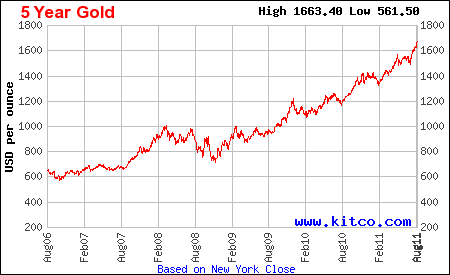
The relentless rise of gold since the financial crisis began reflects the increasing risk of sovereign defaults and  the rampant debasement of paper money.  The gold market is effectively a report card on the failed policies of governments and the grade is an F.

Gold - courtesy kitco.com

The response by U.S. policy makers to the S&P downgrade reflects a dangerous disconnect from reality and political posturing.  In a shoot the messenger response, Treasury Secretary Geithner said that S&P used “terrible judgment” and have “shown a stunning lack of knowledge about the basic US fiscal budget math”.  A more realistic assessment of the US debt downgrade came from investor Jimmy Rogers who said two months ago that “America should already be downgraded. It should have been downgraded years ago. These people, the rating agencies, have got it wrong for 10-15 years now. America is bankrupt”.

The Federal Reserve, which could not recognize the housing bubble, has also been at a loss to deal effectively with the debt crisis.  Consider Bernanke Models Prove Faulty:

“We haven’t had any historical event that really would allow us to reliably statistically calibrate an event like the one we’ve had,” David Stockton, director of the Fed’s Division of Research and Statistics, who has overseen forecasting for a decade, said in an interview at the end of June. “There isn’t going to be a simple story here.”

Stockton calls the 2007-2009 period “an unprecedented financial crisis in the lives of almost every economic agent.”

“That had profound effects on people’s balance sheets, on their spending, and their impetus to deleverage,” he said in the interview. “Something beyond transitory factors are at work.”

Suite of Models

The suite of models used by Fed staff to forecast changes in consumption and investment rely to some extent on past relationships between interest rates, income, and profits. Most also assume credit will be supplied and demanded at a given price or interest rate. Without adjustments, they revert to the mean — after a period of slump they begin to point upward, in line with previous recoveries.

All of those tendencies have made the models less trusty guideposts for what is happening in the current recovery. The staff has to venture judgments and explore new analyses.

“Something new and different is going on,” said Allen Sinai, chief global economist at Decision Economics Inc. in New York. “Neither monetary nor fiscal policy is giving us the kind of bang we have traditionally got. The household sector is simply not spending as it has in the past.”

Ordinarily, monetary policy works by making borrowing cheaper so households and businesses can access credit and keep their consumption stable through an economic slump. Now, that channel is less effective.

Banks have raised lending standards, and the private sector’s expectations about consumption may be shifting to a lower path, said Julia Coronado, chief economist for North America for BNP Paribas in New York, who worked for Stockton from 1997 to 2005.

“This is a standard-of-living shock,” Coronado said. “What we thought we could afford, and what we leveraged to, is much more than we can afford at present and in the future.”

In other words, the problem is too much debt, and the Fed’s response has been to encourage more debt by dropping interest rates to zero and printing money.  As long as the Fed continues its failed policies, the price of gold will continue to soar.


Gold Retains Safe Haven Status – Fundamentals Driving Gold Higher Intensify

Is the day of reckoning finally arriving?

Financial markets are suddenly starting to take the debt crisis seriously.  The sell off in global stock markets has intensified as investors rush to sell risk assets and flee to the safety of cash.  The value of all US stocks as represented by the Wilshire 5000 lost $800 billion on Thursday’s selloff and an astounding $1.9 trillion since mid July.

Gold also dipped in Thursday’s sell off to close in New York at $1,649.80 after trading as high as $1,683.30 in morning trading.  The quick intraday reversal had many in the mainstream press proclaiming that gold was just another risk asset.

Should we be worried about the price of gold sliding into the abyss along with stocks?  The answer is no.  Gold’s modest pullback came after a run up of almost $200 since July 1st while stocks were in the midst of a severe sell off.  To see some profit taking and liquidity driven selling by gold traders on a 500 point down day in the Dow is not surprising.  The fundamental factors driving gold higher are not only still valid but have intensified as the debt crisis ultimately puts the value of all paper assets at risk.

The bullish trend in gold remains intact.  The biggest pullback in gold during the last decade occurred during the financial meltdown of 2008 when gold declined by $250 but quickly recovered thereafter.  To long term gold investors, the decline in 2008 is hardly noticeable on the long term charts.  While gold dropped by 25%, numerous other asset classes saw losses up to three times as large.

Gold - courtesy kitco.com

Gold is at the upper end of its trading channel and a pullback of $50 or $100 to the lower band of the trading channel would merely be another small correction in the long term uptrend.  If investors lose confidence that governments and central banks are no longer capable of containing the debt crisis, gold will begin a rapidly accelerated price move with $100 up days becoming routine.

The debt crisis, which has been building for decades, seems to be reaching a super critical stage.

The massive sell off in global equity markets is based on the realization that we are approaching the financial nightmare of defaulting sovereign states, a looming recession, massive debt levels, a slowing world economy, a disastrous reduction in tax receipts and declining income growth. The end of QE2 along with austerity measures and spending cuts now being discussed in Congress leaves the Federal Reserve as the last firewall against a collapse into depression.

The clumsy and uncoordinated efforts of the ECB to contain the Greek debt crisis resulted in the government imposing losses on bondholders.  The realization by investors that they will not be protected from losses on holdings of other weak sovereign debt was the trigger that set off the rush to sell risk assets and move to cash.  Financial stress in European banks is rising steadily and many are already experiencing a classic run on the bank as depositors withdraw funds and move to (ironically) dollar assets.

It may be too late for the US to attempt a move to fiscal conservatism and austerity measures.  Despite the worries about exploding government deficits, an abrupt end to government deficit spending would probably tip the US economy into a full blown depression with massive job losses and a downward spiral in wage growth.  Politicians don’t think long term – they are worried about the next election.  As unemployment grows along with declining wages and home values, the public pressure on politicians to “do something” will become intense.

The Wall Street Journal recently reported that three former top fed officials are already arguing for a third round of quantitative easing if the economy weakens.  We already have a weak economy.  Both the public and the politicians, oblivious to the dangers of unsustainable deficit spending, will demand that the government “do something.”  Once the Fed has political support, the floodgates of money printing will become wide open.  Open ended quantitative easing may produce the inflation necessary to reduce the real value of sovereign debts, but it will also decimate the purchasing value of paper money.

In the end, the government will continue to administer the same medicine to the dying patient – zero interest rates and fiscal and monetary stimulus.  The arguments will also be the same – these are temporary measures to get the economy growing and buy some time, similar to what the Japanese have been doing since 1990.  Japan has put off the day of reckoning with zero interest rates, money printing and massive fiscal stimulus – the result is a debt to GDP ratio twice that of the United States.  Wasn’t it Thomas Aquinas who said that “problems are not solved, they are survived”?

Many emerging nations experiencing high inflation (due in part to Fed money printing) are turning to gold in a big way as an alternate form of currency and to diversity reserve holdings.  The central banks of emerging nations have already bought almost 180 tonnes of gold this year, more than double the amount purchased for all of last year.

Any price corrections in gold should be viewed as an opportunity to add to positions.  The biggest risk to investors is to be under allocated in gold. (see also Smart Money Sees Perfect Storm for Gold and Silver and Why There Is No Upside Limit For Gold).


Gold Prices Skyrocket, Stocks Plunge – Looking Like 2008 On Steroids

As politicians celebrated the debt limit increase and congratulated themselves for “saving” the nation that they destroyed, collapsing stock markets and soaring gold prices told a different story.  The public spectacle of a dysfunctional Congress debating the debt limit exposed to the world the horrendous extent to which the US government is addicted to endless deficit spending.

Republican presidential candidate Ron Paul summed up the outcome of the debt limit fiasco best:

This deal will reportedly cut spending by only slightly over $900 billion over 10 years. But we will have a $1.6 trillion deficit after this year alone, meaning those meager cuts will do nothing to solve our unsustainable spending problem. In fact, this bill will never balance the budget. Instead, it will add untold trillions of dollars to our deficit. This also assumes the cuts are real cuts and not the same old Washington smoke and mirrors game of spending less than originally projected so you can claim the difference as a ‘cut.’

The plan also calls for the formation of a deficit commission, which will accomplish nothing outside of providing Congress and the White House with another way to abdicate responsibility. In my many years of public service, there have been commissions on everything from Social Security to energy policy, yet not one solution has been produced out of these commissions.

Ron Paul also provided an explanation of what constitutes a “spending cut” in the bizarro world of government accounting and why, in the end, spending and debts will not decrease.

No plan under serious consideration cuts spending in the way you and I think about it. Instead, the “cuts” being discussed are illusory, and are not cuts from current amounts being spent, but cuts in projected spending increases. This is akin to a family “saving” $100,000 in expenses by deciding not to buy a Lamborghini, and instead getting a fully loaded Mercedes, when really their budget dictates that they need to stick with their perfectly serviceable Honda. But this is the type of math Washington uses to mask the incriminating truth about their unrepentant plundering of the American people.

The world was finally tuning in to the reality of the desperate financial condition of the United States.  The mainstream press was predicting a plunge in gold prices and soaring stock prices after Congress agreed to increase the nation’s debt limit.  Instead, the opposite happened as markets reflected underlying economic reality.

Since mid July, the Dow Jones Industrial Average has plunged by 858 points.  Since July 1st, gold has gained $178 per ounce.  Meanwhile, the debt crisis in Europe continues to intensify with bond yields soaring in Italy and Spain.  The world economy is marching off the edge of a cliff as governments lose the ability to contain the spiraling debt crisis.  It’s starting to look like a replay of 2008 on steroids.

Gold  soared by $39.80 on the day to close in New York trading at an all time high of $1,661.10.  Silver more than paced the gain in gold, adding $1.61 to close up 4.1% at $40.95.

SPDR Gold Trust Holdings Increase, Silver ETF Holdings Decline

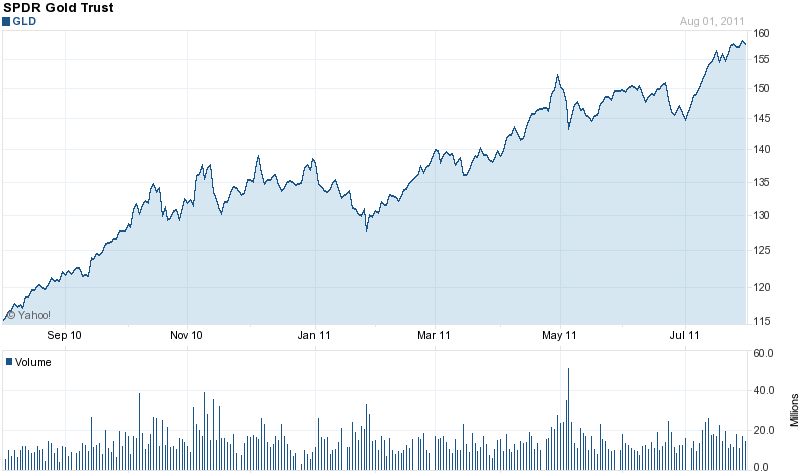
Holdings of the SPDR Gold Shares Trust (GLD) gained almost 37 tonnes on the week.  For the first time this year, holdings of the GLD are greater than they were at the beginning of the year.  The record holdings of the GLD occurred on June 29, 2010 when the GLD held 1,320.47 tonnes of gold.

The SPDR Gold Trust currently hold 41.2 million ounces of gold valued at $67.5 billion.  Shares of the GLD hit an all time high, closing at $161.52.


GLD - COURTESY YAHOO FINANCE

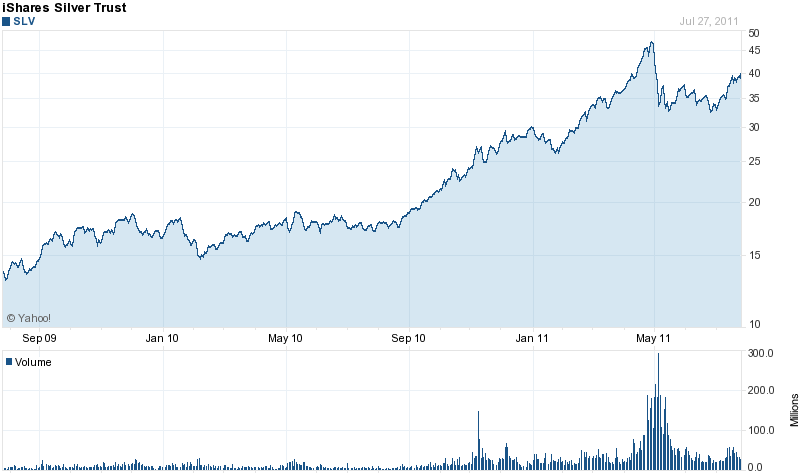
Holdings of the iShares Silver Trust (SLV) declined by 90.93 tonnes after an increase of 112.15 tonnes in the prior week.  Since the beginning of July, holdings of the SLV have increased by 288.28 tonnes.

The SLV currently holds 315.9 million ounces of silver valued at $12.5 billion.

GLD and SLV Holdings (metric tonnes)

August 2-2011 Weekly Change YTD Change
GLD 1,281.75 +36.95 +1.04
SLV 9,824.93 -90.93 -1,096.64


US Mint Silver Eagle Bullion Sales On Pace For Record High

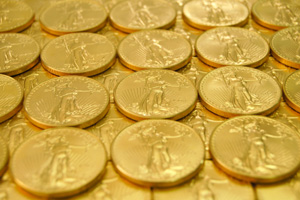
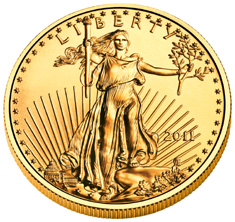
Since Congress authorized the production of American Eagle Bullion coins in 1986, it has become one of the easiest ways for investors to accumulate a physical position in precious metals.   American Eagle Bullion coins have been available in gold and silver since the program’s inception.  Platinum has been available under the Bullion coin program since 1997.

The bullion coins are priced at the current market price of gold, silver or platinum plus a dealer markup.  The US Mint does not sell the bullion coins directly to investors but instead sells the coins to a network of Authorized Purchasers who resell  the coins to the public.  Unlike commemorative or numismatic coins, the bullion coins will closely track the price of the underlying precious metal making it easy for investors to follow the value of their bullion holdings.

The American Eagle Silver bullion coin is available only in the one ounce size and is particularly attractive to small investors as a cost effective way to hedge against inflation and debasement of paper money.  The US Mint’s American Silver Eagle Bullion program has been successful from the start.  The first year’s sales of bullion Silver Eagles in 1986 was 5,096,000.

Between 1987 and 2007 sales of the Silver Eagle averaged 7.1 million coins per year.  The lowest year on record for sales was in 1996 when sales of the coin were only 3.6 million.  Since 1986, sales of the American Silver Eagle  exceeded 10 million coins only two times during 2002 and 2006.

The financial crisis of 2008 resulted in a surge of Silver Eagle sales as worries intensified over the integrity of paper money and the soundness of the financial system.   During 2008 Silver Eagle sales soared to 19,583,500 coins which was a record high.  In 2009, sales continued to explode reaching 28,766,500 coins and 2010 was another year of record sales at 34,662,500.

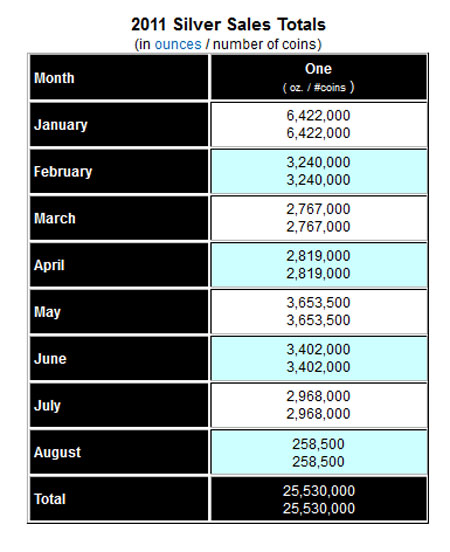
Year to date sales of the Silver Eagle bullion coins during 2011 has now reached 25,530,000.  Based on average monthly sales during 2011, sales for the entire year could easily reach 42 million coins, up 20% over last year.

Investors in silver have preserved their purchasing power and increased their wealth.  As previously discussed, the dip in silver prices during May was a buying opportunity and silver prices should be hitting all time highs before year end (see How Soon Will Silver Hit New Highs?).

American Silver Eagle Bullion Sales 2011


Gold Rallies On Week – Is The World Economy At The Precipice?

Gold continued its winning ways this week.  As measured by the closing London PM Fix Price, gold gained $26.50 to close the week at all an time high of $1,628.50.

Gold has closed higher for the past four consecutive weeks.  The rally that began at the beginning of the month has pushed gold higher by $145.50 or 9.8% since July 1st.  Investors worried about the solvency of sovereign states in Europe have now switched their focus to the United States.

The impasse over raising the US debt limit has morphed into a crisis of confidence over the ultimate value of the US dollar.  There is no clear consensus on how the debt limit negotiations in Washington  will be resolved.  The only certainty is that, regardless of how the debt limit crisis ends, confidence in the “full faith and credit” of the United States will be greatly diminished.

China and Russia, two large holders of US debt, have watched in horror as the US deliberately debases its currency value through money printing and a parabolic increase in debt.  At a time when the US needs to borrow trillions of dollars in new debt, there is likely to be a greatly diminished appetite to purchase additional US debt.

The global debt crisis and a lack of confidence in paper money has resulted in a steady increase in the price of gold.  Will gold continue to soar if global economies start collapsing or will gold be drawn into the deflationary abyss along with all other asset values?  Opinions vary but here are some good thoughts on the matter.

-John Browne of Euro Pacific Capital warns that gold could be subject to a price pullback based on the deflationary impact of a global recession or short term optimism over the US avoiding default.

Decision Point’s Carl Swenlin wonders if gold is too much of a “sure thing” investment and ponders the fate of gold in a deflationary collapse.

-A Citigroup analyst speculates that gold could quickly reach $5,000 based on a “worst case scenario for Euro sovereign debt and USA fiscal problems”.

Confidence is vital in a fiat money based world.  The ongoing global debt crisis may be the trigger that ultimately destroys faith in paper currencies.

Precious Metals Prices 7/29/11
PM Fix Since Last Recap
Gold $1,628.50 +$26.50 +1.65%
Silver $39.63 -$0.04 -0.10%
Platinum $1,779.00 -$14.00 -0.78%
Palladium $824.00 +$17.00 +2.11%

Silver and platinum were essentially unchanged on the week after posting strong advances since the beginning of July.  Palladium advanced by $17 or over 2% on the week and is up $74 since July 1st.

U.S. Currency At No Risk Of Becoming Sound – Gold Has Spoken

Ben Bernanke tells us he wants a sound dollar and Barrack Obama tells us he wants to cut entitlements and reduce the budget deficit.

I have no doubt that both gentlemen are honorable and doing what they believe is best for the country.  Others, perhaps less naive than myself, may be inclined to believe that the Fed Chairman and President are attempting to foist a distorted view of reality on the American public.  Credibility can depend on the public’s perception of reality, a fact well understood by politicians and central bankers.

“If you tell a lie big enough and keep repeating it, people will eventually come to believe it.” – Joseph Goebbels, Propaganda Minister

“When it becomes serious, you have to lie”. – Jean-Claude Juncker, Euro Finance Minister

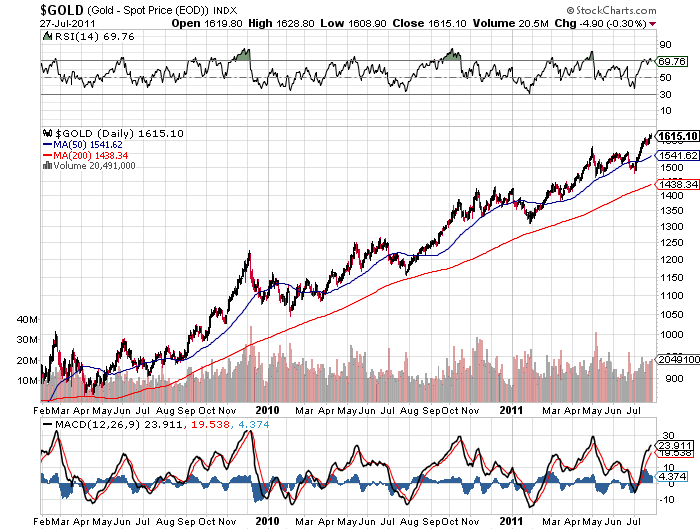
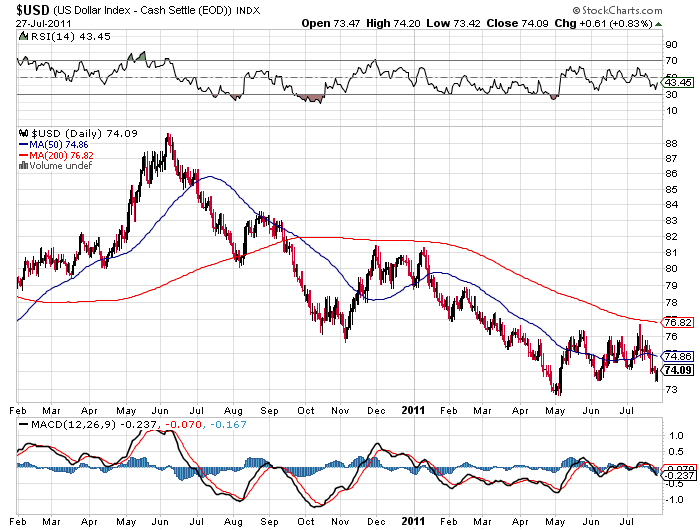
It’s not hard for politicians to fool the American public – they have had many decades of experience honing that skill.  It is another matter to fool the markets and using that scorecard , our dysfunctional and highly polarized government has failed miserably.  The gold market has not been fooled, holders of US dollars have not been fooled and the U.S. debt monster is visible to all.

Gold - courtesy stockcharts.com

US Dollar - courtesy stockcharts.com


After weeks of bitter debate, the best that the Washington elite could manage to do was agree to disagree at a later date and, of course, establish a commission to look further into the debt crisis, also at a later date.

The elegant solution to the nation’s debt problem, as described above, may finally allow John Q. Public to sleep more soundly at night.  Inquiring minds, however, can cite numerous reasons why the Nation’s debt crisis will be keeping all of us awake in the near term future.

-The ultimate compromise to the debt crisis will be more debt, following in the footsteps of the EU’s grand solution to the Greek debt crisis.  “I will gladly pay you tomorrow if you lend me more money today” attitude  is going to quickly wear thin with U.S. creditors.

-The U.S. is borrowing trillions to pump cash into a weakening economy that already can’t create enough income to service the debt we already have – this strategy is the ultimate Ponzi scheme.  The conviction that future economic growth will pay for today’s borrowings is false.  Burdensome levels of public sector debt have been proven to dramatically restrain future economic growth.

-The U.S. and world economies are looking at a replay of the 1930’s depression, except this one won’t be so gentle.  The American public, with the persuasion of politicians, has come to believe that the “richest nation on earth” can provide cradle to grave security based on mathematically impossible entitlement promises.  The financial chaos and social breakdown resulting from broken promises to pay by the government will severely test the foundations of our democracy.

-All of the proposed “solutions” to the country’s overwhelming debt problem involve increasing the national debt by trillions more and agreeing to phantom spending cuts at some point in the future.  The U.S. is on a debt treadmill and all of the political solutions coming out of Washington are equivalent to turning up the speed on  the treadmill and pouring oil on the belt.

-The Dodd-Frank Act, which was supposed to solve the problem of systemically risky institutions, ignored the biggest systemic risk of all to our financial future – the U.S. government.

-The Federal Reserve, which according to Bernanke, “saved  the entire world” from a depression in 2008, has strangely detached itself from the crisis by proclaiming that they are powerless and without policy tools to prevent the looming U.S. debt default.  (See this on Ron Paul’s view of the Fed).  If worse comes to worse, perhaps Bernanke should seek some advice from the insolvent States of California and Illinois on how to go about issuing vouchers.

SPDR Gold Trust Hits All Time High, Silver ETF Holdings Increase

Holdings of the iShares Silver Trust (SLV) gained 112.15 tonnes on the week after increasing by 169.76 tonnes in the previous week.  Although SLV holdings have declined by 1,005.71 tonnes since the beginning of the year, holdings of the silver trust have increased markedly in July as silver prices surged.

Since July 1st, holdings of the iShares Silver Trust have increased by 379.21 tonnes.  Holding of the SLV hit an all time high on April 25th when the Trust held 11,390.06 tonnes of silver.

As measured by the London PM Fix Price, silver has gained $6.96 since July 1st, rising from $33.85 to $40.81.  Silver is up 33.1% since the beginning of the year when it stood at $30.67.  The SLV, after correcting in early May, has broken out of its trading range in the mid 30’s and has been steadily advancing.

Investors looking to past history for clues on the future price move in silver are looking at two entirely different worlds.  The parabolic move and subsequent collapse of silver prices in the 1980’s was driven by specific events which quickly reversed.  After breaking out of a decades long base, silver will not be a replay of the 1980’s but instead is in a long term super cycle which will ultimately result in much higher prices (see For Silver, This Time Is Different).


SLV - COURTESY YAHOO FINANCE

The SLV currently holds 318.8 million ounces of silver valued at $13.0 billion.  Over the past year the SLV has increased by 86%.  Over the past three years the SLV has had an annual rate of return of 25.1%.

GLD and SLV Holdings (metric tonnes)

July 27-2011 Weekly Change YTD Change
GLD 1,244.80 -1.21 -35.91
SLV 9,915.86 +112.15 -1,005.71

Holdings of the SPDR Gold Shares Trust (GLD) dipped slightly on the week by 1.21 tonnes after increasing by 20.60 tonnes in the previous week.

Gold has been in a steady uptrend during July.  As measured by the closing London PM Fix Price, gold has gained 9.6% or $142 since July lst.  Gold started the year at $1388.50.

Since the beginning of the month, the GLD has gained 39.0 tonnes.  The GLD currently holds 1,244.80 tonnes of gold valued at $65.0 billion.

The GLD hit new all time highs this week as the advance in gold prices continued.


Gold Hits New Record High As U.S. Spirals Towards Default

Gold reached all time record highs in Asian trading as legislators in Washington reached an impasse on raising the U.S. debt limit.  Immediate delivery gold soared to $1,624 before pulling back to $1,617.90, up $16.60.

The ongoing fiasco in Washington over increasing the U.S. debt limit has brought into focus the extent to which the United States has become addicted to deficit financing.  Increasing the debt limit to avoid default has become a side issue to worries over the long term ability of the United States to honor its obligations without debasing its currency.

The White House request to increase the debt limit by an astronomical $2.4 trillion, to tide us over for another year and a half, has convinced many investors that a debt downgrade is imminent.

Standard and Poors has already warned that the credit rating of the US might be downgraded regardless of whether a default is averted.  The head of the world’s largest bond fund also predicts that the US will lose its triple AAA rating regardless of how the debt limit issue is resolved.  According to Bloomberg,

“In most likelihood, a last-minute political compromise will avoid a default but will leave the AAA rating extremely vulnerable,’’ El-Erian, the Newport Beach, California-based chief executive officer and co-chief investment officer at Pimco, wrote in an e-mail.

The highly polarized negotiations going on in Washington reflect the ultimately self destructive nature of democracies.  Voters have collectively elected a political class who have promised benefits that are financially impossible to honor.  The tipping point has been reached and the political will to fix the problem is overridden by numerous special interest groups who demand that their benefits be preserved and increased.  In a collective pact of economic suicide, voters are demanding benefits from a wealth redistribution scheme that will eventually make all of us equally poor.

Writing in the Wall Street Journal, Arthur Brooks discusses whether the welfare state in the US has reached the tipping point.

The Bureau of Economic Analysis tells us that total government spending at all levels has risen to 37% of gross domestic product today from 27% in 1960—and is set to reach 50% by 2038. The Tax Foundation reports that between 1986 and 2008, the share of federal income taxes paid by the top 5% of earners has risen to 59% from 43%. Between 1986 and 2009, the percentage of Americans who pay zero or negative federal income taxes has increased to 51% from 18.5%. And all this is accompanied by an increase in our national debt to 100% of GDP today from 42% in 1980.

In the other scenario, our welfare state slowly collapses under its weight, and we get some kind of permanent austerity after the rest of the world finally comprehends the depth of our national spending disorder and stops lending us money at low interest rates. (Think Greece.)

John Sununu, writing in this week’s Time Magazine, makes a similar point.

We all know the nation’s budget is huge, but nothing drives the point home like the number of Americans receiving financial support. Add Medicaid, farm payments, housing subsidies and others to the list, and roughly 47% of all Americans are receiving at least one federal benefit. Tax preferences, like the deductions for mortgage interest, retirement savings and health care, bring the number closer to 75%. The dirty little secret about America is that being on the dole is no longer an exception but the rule.

Voters are characterized according to the programs from which they benefit.  Instead of Americans, we are retires, veterans, farmers, teachers, investors and students.  We have become a nation of spending constituencies.

The entire developed world has taken on financial obligations that are impossible to meet and no longer possible to finance, as we have seen in Greece, Portugal and Ireland.  The relentless rise in the price of gold reflects the desperate efforts of social welfare states to meet their obligations through currency debasement and ballooning deficits.

Jim Rogers, in a Bloomberg podcast, said it best – “I have not sold any gold, I have bought more gold.  If gold goes down I’ll buy more. The price of gold is going to go much, much higher over the next decade.”