April 10, 2026

Will Central Banks Continue To Increase Their Gold Holdings?

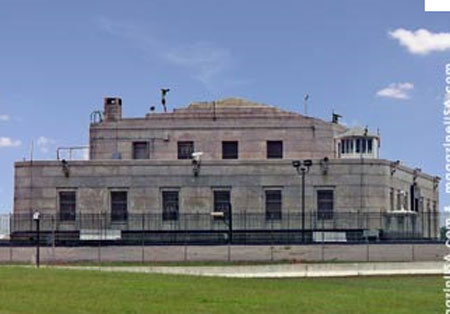
FORT KNOX

Central banks continued to add to their gold reserves in August with three countries adding a total of 643,000 troy ounces to their reserves.

According to the Wall Street Journal, the largest central bank purchaser of gold during August was Thailand which purchased 300,000 troy ounces, bringing their total gold holdings to 4.4 million ounces.  The Bolivian central bank purchased 225,000 ounces increasing their total reserves to 1.36 million ounces and the central bank of Russia purchased 118,000 ounces which increased total reserves to 27.2 million troy ounces.

After selling gold reserves for many years, central banks began purchasing gold around 2000.  Over the past several years central banks have sharply accelerated their purchases of gold to diversify away from the U.S. dollar which is no longer considered to be a safe asset.  China and Russia, large buyers of gold, have been particularly critical of U.S. monetary and fiscal policies and are actively seeking to reduce their reserve holdings of U.S. dollars.

Will central banks continue adding to their gold reserves?  For some insight on this matter, consider the following facts.

In August Russian Prime Minister Putin said that the United States is “not living within its means, shifting the weight of responsibility  on other countries and in a way acting as a parasite.”  Putin also said that a new reserve currency is necessary to protect against a “systemic malfunction” of the U.S.  Putin has reason to worry since Russia has almost half of its reserves in U.S. dollars.  In 1998 Russia had gold reserves of 14.7 million ounces compared to 27.2 million ounces after its latest purchases.  Despite the fact that the Russian central bank has the eight largest official gold holdings in the world, gold amounts to only 8.2% of total reserves.

China, which holds $1.2 trillion of U.S. treasury debt, has the most to lose from the continuous debasement of the U.S. dollar and has become harshly critical of U.S. economic policies.  After the U.S. debt downgrade in August, China said that America must “cure its addiction to debts” and “live within its means.”   China is actively seeking to diversify its reserves and reduce its holdings of  U.S. dollars.  The latest reports show total Chinese gold reserves at 1,054 tonnes compared to 395 tonnes in 1988.   Gold holdings amount to only 1.6% of total Chinese reserves.  China’s 33.9 million ounces of gold is currently valued at only $54.2 billion.  By comparison, the gold holdings of the SPDR Gold Shares ETF (GLD) total 39.9 million ounces valued at $65.6 billion.  Expect China to add dramatically to its gold reserves in the future.

Gold purchases by central banks during 2011 are forecast to be 336 metric tonnes, approximately 13% of total yearly gold mine production.  Central banks during  the second quarter of 2011 purchased four times the amount of gold purchased during the comparable quarter of 2010.  Given the fragile state of the world fiat money system, it is likely that central bank gold purchases could expand dramatically going forward.

Only 7 countries or institutions currently hold more than 1,000 tonnes of gold – the United States, Germany, the IMF, Italy, France, China and Switzerland.

Total official world gold holdings by central banks and the IMF currently total 30,707 tonnes, valued at approximately$1.6 trillion which, coincidentally, is the size of this year’s budget deficit for the United States.  Total gold holdings of the world’s central banks amount to only a fraction of the value of paper currencies that have been exponentially created.

All of the gold mined throughout history totals only 178,000 tonnes or about 6 billion ounces valued at $9.6 trillion.  Central bank holdings amount to only 17% of the total gold supply available.

Despite increasing gold prices, gold mine production has been stagnant.  Most of the easy to mine, high grade ore deposits have already been exploited.  New total yearly gold production adds only 1% per year to the existing supply of gold.  Increasing demand and limited supply result in higher prices.

Only 34 central banks currently hold over 100 tonnes of gold and only 12 central banks or institutions hold more than 500 tonnes of gold.

Ironically, the United States, the most indebted nation in world history has decreased its gold reserves.  In 1962, the United States owned 14,269 tonnes of gold or almost 39% of all gold held by central banks.  By 1972, the United States held only 8,584 metric tonnes of gold.  Currently, U.S. gold reserves allegedly total 8,134 tonnes but the amount remains in question since the government will not allow an independent audit of the actual amount held.

Considering the relatively small amount of gold held by central banks and the exponential increase in the creation of paper money, gold demand by central banks should  increase dramatically in the future.


Value Investor Loads Up On Gold Bullion

Panicky investors may be dumping their gold, but one investor with a superb long term track record of value investing is loading up on gold bullion.

In a Fortune interview, Charles de Vaulx, who runs the IVA Worldwide Fund, explains why his $10 billion fund holds over 7% in gold bullion.

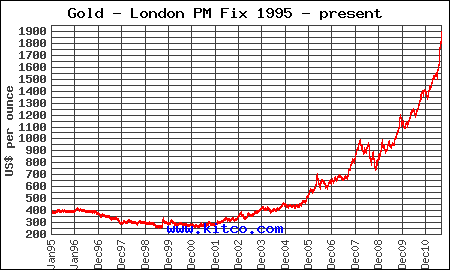
At the time of the interview, gold was selling at $1,900 per ounce and de Vaulx was bullish based on a “mistrust of policymakers, be they in the U.S., Europe, Japan, or even China.”  The inability of politicians to arrive at agreements in the face of a looming debt crisis gives gold an inherent value that paper currencies do not possess.  As to why he would still be buying gold after a sevenfold rise since 2001, de Vaulx said that “the paradox with gold is that even though the price has gone up so much, it is still under-owned.” (See Americans Remain Underinvested In Gold.)  The IVA Fund has invested only in gold bullion which is viewed as being “safer and cheaper” than gold mining stocks.

Regarding the U.S. dollar, de Vaulx thinks that over the long term, the U.S. will be forced to solve its massive debt problems through currency debasement and inflation.   Initially, the bursting of a credit bubble causes deflationary problems but ultimately the policies of the Federal Reserve will produce inflation.  Fed policies will accordingly result in poor returns for bond investors who have sought shelter in U.S. treasury securities.

The circumstances under which de Vaulx would reduce his gold positions would be if policy makers are able to institute policies that would encourage sound currencies or if the values of equities become “truly cheap.”

According to Fortune, de Vaulx launched his fund only three years ago.   Based on a long term track record of superior investment returns, de Vaulx was able to quickly attract $10 billion in assets.  Due to the recent panic sell off in the gold market, de Vaulx’s fund has taken a hit, but my bet is that de Vaulx is taking advantage of the situation by scooping up more gold at bargain prices.

Treasure Hunters Find 7 Million Ounces of Silver On SS Gairsoppa

On  February 16, 1941, Ernst Mengersen, Captain of Nazi U-boat 101, torpedoed the starboard side of the British merchant ship SS Gairsoppa, sending her to the bottom of the Atlantic.  Little did Captain Mengersen realize that the value of the sunken ship’s cargo would be worth almost a quarter of a billion dollars seventy years later.

The wreck of the SS Gairsoppa was discovered 300 miles off the coast of Ireland, at a depth of 15,400 feet, by Odyssey Marine Exploration.  The British Government had awarded an exclusive contract to Odyssey to find the SS Gairsoppa which, on her last voyage, was returning from India with a cargo of pig iron, tea and 7 million ounces of silver ingots.

The silver treasure, which is the largest value cargo salvage in history, was originally valued at approximately £600,000 British pounds when the SS Gairsoppa was sent to the bottom of the Atlantic.  Those 7 million ounces of silver today are worth 225 times the 1941 value or about £136,000,000 ($210 million).

The 412 foot steel-hulled SS Gairsoppa had been in service since her construction in 1919 and was sailing with a convoy to England on what turned out to be her last voyage.  Running low on fuel and in a heavy storm, the unlucky ship left the convoy to head for Galway, Ireland.  After being spotted by a German plane, the Gairsoppa’s fate was sealed as U-101 moved in for an easy kill.

Although the general location of the sunken ship was long known, the technical complexity of salvage operations at a depth of 4,700 meters made recovery operations almost impossible.  Recent advances in salvage recovery, as well as the increased value of silver, resulted in the British government soliciting private companies to find and salvage the Gairsoppa’s precious cargo.  Under the agreement with the British government, Odyssey Marine  will keep 80% of the value of the silver bullion recovered.

SS Gairsoppa - courtesy Odyssey Marine Exploration

Odyssey Marine has gained fame for previous discoveries of sunken ships laden with gold and silver treasure.  In 2003 Odyssey discovered the SS Republic, a Civil War era ship with over 50,000 silver and gold coins on board.  Odyssey also recovered a treasure trove of over 500,000 silver and gold coins from a Colonial era shipwreck site code named Black Swan.

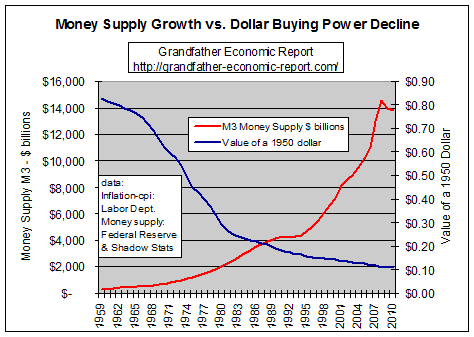
Of the hundreds of thousands of shipwrecks over the centuries, the only cargo worth retrieving (other than archaeological treasures) are precious metals, which have retained value since the dawn of human civilization.  Just for laughs, let’s compare that to the purchasing power of the paper dollar over the past half century.


A Perspective On The Plunge In Gold and Silver

Fed Chairman Ben Bernanke set the world on fire this week as his latest scheme to “twist” long term interest rates lower pleased no one and triggered a 737 point drop in the Dow.  In addition, the Fed panicked investors by admitting that there were “significant downside risks to the economic outlook”.

Virtually every asset class except U.S. treasuries went into full scale meltdowns.  The U.S. stock market registered its worst weekly drop since the dark days of October 2008 when the  U.S. banking system was collapsing.

The rush to liquidity and forced margin selling sent precious metal prices into a tailspin. London silver plunged by $7.07 or 18%, to $32.90, the biggest decline since 1987.  Gold, as measured by the closing London PM Fix Price, dropped $105 on the week to $1,689, the largest weekly decline since 1983.  Spot prices for both gold and silver continued lower in New York afternoon trading with gold settling at $1658.20 and silver at $31.03.

Platinum dropped by $147 on the week to $1,651 and palladium dropped by $73 to $659 for losses of 8.18% and 9.97%, respectively.  Silver, with 60% of its demand relating to industrial use,  took the largest plunge in the precious metals group as economic indicators pointed to a rapidly slowing economy worldwide.

Precious Metals Prices Sept 23
9/23PM Fix Weekly Change
Gold $1,689.00 -105.00 -5.85%
Silver $32.90 -7.07 -17.69%
Platinum $1,651.00 -147.00 -8.18%
Palladium $659.00 -73.00 -9.97%

Although the sharp declines in gold and silver are unsettling, the fundamental reasons for owning gold and silver remain intact.  The rapid price increases in gold and silver since July attracted large investment flows from hedge funds and other short term speculators, who rapidly liquidate large positions based on short term technical sell signals.

Despite this week’s panic selling, long term gold investors have seen their investment rise from $1,405.50 at the beginning of the year, for a gain of $283.50 (20.2%).  Silver, despite this week’s painful sell off, is still higher by $2.23 or 7.3% from the beginning of the year, as measured by the closing London PM Fix Price.

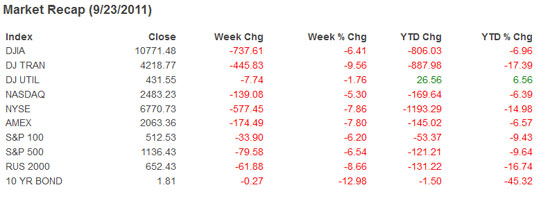
For additional perspective on the relative performance of the gold and silver markets, here’s the record for various stock indices and the 10 year bond since the beginning of 2011.  (Note that the 10 year bond shows yield, not price.)

Asset Performance - courtesy schwab.com

Meanwhile, as the global financial system rapidly moves towards the precipice, faith in the ability of governments to contain the crisis is quickly eroding.  2011 is not a replay of the 2008 financial meltdown – it’s much more dangerous.  The sovereign governments that “saved the system” in 2008 incurred massive amounts of debt which have brought them to the brink of insolvency.  The bankruptcy of one country could ignite a financial firestorm that world governments cannot contain.

The inability of European leaders to effectively act in concert to resolve the Euro debt crisis has drawn the United States into the center of the crisis.  According to The New York Times, the U.S. is pushing Europe to mount a massive bailout to avoid financial Armageddon.

The Obama administration, increasingly alarmed by the spillover effects of Europe’s financial crisis, has begun an intensive lobbying campaign to persuade Chancellor Angela Merkel of Germany and other leaders to ramp up efforts to stem any contagion from the debt crisis in Greece.

In phone calls and meetings over the last week, President Obama urged Mrs. Merkel and President Nicolas Sarkozy of France to take coordinated measures — including spending billions in additional funds to bail out Greece and bolster European financial institutions — to prevent Greece’s debt woes from spreading to its neighbors.

“The biggest single risk to the United States today is that the European situation will spiral out of control,” said Edwin M. Truman, a former Treasury official who is now at the Peterson Institute for International Economics. “Europe is not going to save the U.S. economy, but it could be the straw that breaks it.”

Kenneth Rogoff, a Harvard economist who has written about the history of financial crises, puts Europe’s effect on the United States in blunt political terms. “The downside scenario is awful,” he said…

American officials have also emphasized the Fed’s outsize role in responding to the financial crisis here and urged Europe to view the Fed as a model. It made trillions of dollars in loans so that investors remained able to buy and sell a wide range of financial products.

Given the risks to the United States economy from a banking collapse and sovereign defaults in Europe, anyone who thinks that the United States will not be getting deeply involved in the financial bailout of Europe is delusional.  The “rescue” of Europe will ultimately involve the same techniques (zero interest rates and money printing) used by Bernanke in the United States.  The resulting negative interest rates and worldwide debasement of paper currencies will ultimately send gold soaring to new highs.

The Road Map To Sound Money and Restoring the Dollar – Ron Paul’s Proposal

“Road Map to Sound Money: A Legislative Hearing on H.R. 1098 and Restoring the Dollar”.

Ron Paul’s efforts to restore a sound currency in the United States continued this week as hearings were held on his proposed legislation that would allow American citizens to chose from among competing currencies.  Ironically, the one man whose proposals could ultimately save the U.S. financial system from collapse, was completely ignored by the mainstream press who provided zero coverage of H.R. 1098.

H.R. 1098, introduced by Ron Paul in March is known as the “Free Competition in Currency Act of 2011”.  According to Ron Paul, “This bill eliminates three of the major obstacles to the circulation of sound money: federal legal tender laws that force acceptance of Federal Reserve Notes; “counterfeiting” laws that serve no purpose other than to ban the creation of private commodity currencies; and tax laws that penalize the use of gold and silver coins as money.”

Ron Paul noted that gold and silver have constituted sound money throughout history.  Loss of confidence in the dollar and profligate deficit spending by the government have caused people to flee to gold and silver as a store of value.  Paul noted that “Even central banks have come to their senses and have begun to stock up on gold once again.”

Presently, the use of gold and silver by citizens is being severely punished by the government.  Ron Paul cited the case of Bernard von NotHaus, creator of the Liberty Dollar, who was convicted of counterfeiting for creating his own gold and silver currency and another individual who was “convicted of tax evasion for paying his employees with silver and gold coins instead of fiat dollars.”

H.R. 1098, according to Ron Paul, would allow citizens to maintain the purchasing value of their money and prevent the government from conducting excessive borrowing which will enslave future generations with debt.

Testimony at the hearing for H.R. 1098 was given by Dr. Lawrence Parks, Foundation for the Advancement of Monetary Education, and Dr. Lawrence White, Professor of Economics, George Mason University.

Dr. Parks, who presented 63 pages of prepared remarks, opened by stating that the current monetary system is not in conformity with the Constitution, is dishonest and unstable and in the process of “blowing up.”

Selected excerpts from Dr. Parks testimony:

With no exceptions, the history of legal tender irredeemable paper-ticket-electronic money is that its purchasing power always approaches its cost of production: ZERO!

With gold-as-money, and without the banking system creating money out of nothing, the amount of financial leverage would be de minimis with no possibility of collapse. Because legal tender irredeemable paper-ticketelectronic money can be created without limit, there is no market based self-correcting mechanism to limit financial leverage. Especially at a time when those who engage in leverage do not bear the full risk of loss, but are able pass the risk on to the public through the banking system, whose balance sheet and liabilities are de facto guaranteed by the public, financial collapse is a certainty.

Many think that the Great Depression was a “market failure.” Mr. Greenspan has written extremely eloquently that the Great Depression was in fact caused by the Federal Reserve feeding too much credit into the banking system, i.e., enabling the banking system to increase leverage too much.

Dr. Parks notes that the price level of the U.S. was stable until President Nixon defaulted on the U.S. promise to redeem dollars for gold.


Dr. Parks says that because the U.S. dollar is the reserve currency of the world, when the dollar collapses, the global financial system will also collapse, plunging most of the world into poverty and war.

Dr. Parks admits that as a “practical matter, absent the debacle of a complete collapse, there can be no abrupt changes to our monetary system.”

The continual appreciation of gold against paper money suggests that the monetary system will not be reformed in time to prevent a financial disaster.   The ongoing debt crises in Europe and the U.S. also provide little hope that governments will diverge from their path of monetary disaster as they seek to cure too much debt with more debt.   The only survivors at the end of this mad experiment with fiat money will be those holding the eternal sound currency of gold and silver.

Gold Will Soar On Imminent U.S. Bailout of Europe

It is only a matter of time before the U.S. becomes deeply involved in the bailout of Europe.  Consider Geithner Takes Tougher Tone On Europe as reported by Bloomberg.

Treasury Secretary Timothy F. Geithner will urge European governments to step up their crisis- fighting efforts amid Obama administration concerns that the region’s woes may hurt the U.S. economy.

Geithner will press European Union finance ministers when he meets with them this week, a euro-area official said.“The U.S. has always been discretely preoccupied and discretely present, and now it’s starting to be intensely preoccupied and intensely present,” said Nicolas Veron, a senior fellow at Bruegel, a Brussels-based economics research group.

Geithner’s trip to Wroclaw will be his second to Europe in a week.The visit “underlines the nervousness of the administration in the U.S. about what’s happening in Europe” and the effect the region’s debt crisis is having on U.S. financial markets, Julian Jessop, chief global economist at Capital Economics Ltd. in London, said in an interview yesterday.

President Barack Obama told a group of Spanish-language journalists at the White House on Sept. 12 that “we’re deeply engaged with Europeans to try to solve this crisis.”

The European crisis was “very, very damaging in the American economy last summer,” Geithner told Bloomberg Television on Sept. 9.

“The way the U.S. handled the financial crisis and the lessons learned from that could become a much more important part of the IMF message to Europe,” said Eswar Prasad, a senior fellow at the Brookings Institution in Washington and a professor at Cornell University in Ithaca, New York.

Treasury’s Geithner is clearly laying the groundwork for a major role by the United States in bailing out the European Union.  The potential for a collapse of the European banking system is viewed as an unequivocal threat to the economic health of the United States by the U.S Treasury, the White House and the Federal Reserve.

U.S. participation in bailing out Europe will not be unilateral but rather in conjunction with the IMF and the European Central Bank.  The U.S. financial commitment, however, will be open ended.  The blueprint for saving the EU will be similar to that used by the U.S. during the financial meltdown of 2008 – virtually unlimited lending to prevent the sovereign default of insolvent European Union members.

The looming bailout of insolvent European nations, particularly Greece which is hopelessly bankrupt, will be the definitive signal that a return to sound finances has been utterly abandoned.  Rather than allowing market forces to correct the systemic imbalances in the financial system, the problem will be papered over by more debt, more printed money and massive debasement of paper currencies.

Gold, the enemy of central banks, will soar as governments frantically print and borrow to “save” Europe.

How Would Gold Perform In A Full Blown Depression?

“We need to do massive stimulus, otherwise there’s going to be another Great Depression.  Things are getting worse, and the big difference between now and a few years ago is that this time around we’re running out of policy bullets.”  – Professor Nouriel Roubini

As the global financial system lurches towards financial Armageddon, would a safe haven asset such as gold maintain its value in a severe depression?

This and other questions were addressed in a Barron’s interview with Martin Murenbeeld, chief economist for Canada’s DundeeWealth, an asset management firm.  Murenbeeld has held senior positions with various gold mining firms for 40 years and turned bullish on gold in 2001.

In response to questions from Barron’s, Mr. Murenbeeld provided the following insights on the gold market and where he thinks prices are headed.

-Murenbeeld told Barron’s that the recent surge in gold prices was related to investor worries over impaired sovereign balance sheets, monetary reflation, global financial instability and strong demand for physical gold from Asia.  In addition, global gold production has barely increased.  Murenbeeld sees an average gold price of $2,200 in 2012 and only a 10% chance that gold will pull back to the $1,500 range.

-The current gold bull market could last another 10 years due to expanded Asian demand and unprecedented adverse financial conditions in the world economy.  Murenbeeld says history “has shown that gold prices…go through very long cycles.”  The last gold bull market of the early 1980’s was one of the shortest on record.

-Regarding the current disconnect between gold bullion and gold stocks, Murenbeeld notes that during times of severe financial stress, bullion outperforms gold stocks since investors avoid equity issues in general.  Over the long term, however, gold stocks have outperformed bullion.

-If the world enters a major depression, gold prices would likely drop since “demand for everything falls off.”  Murenbeeld notes, however, that monetary response to a depression would be fast and aggressive which would quickly propel gold prices higher.

-Murenbeeld says that current demand for gold in “unprecedented” and due to Federal Reserve policies, the introduction of gold ETFs and huge demand for physical gold by billions of consumers in Asia.

-In response to how world governments will deal with the current severe financial problems, Murenbeeld said “during my working life the risk of monetary debasement – the outright printing of money supply in the developed countries has never been higher.  Thus, we see the unprecedented interest in gold…Most likely governments will meet the bulk of their debt obligations with currency devaluations and the monetizing of debt”.

-As far as the possibility that investors will lose interest in gold, Murenbeeld says that could happen if “confidence in monetary and fiscal policies is restored”.   (Not much chance of that happening any time soon in this writer’s opinion.)

Gold Bull Market Could Last Another 20 Years With $12,000 Price Target

Bull markets are born from underlying macro economic trends that take decades to fully play out.  The bull market in gold has lasted barely ten years, yet analyst after analyst from the conventional press argue vehemently that gold is in bubble territory and dangerously overpriced.

The voices proclaiming a “gold bubble” do not understand why gold has appreciated for ten years, have never owned gold and have kept their clients out of the best performing asset class of the past decade.

The goldandsilverblog.com has previously argued that given the current fiscal, political and monetary circumstances, there is currently no upside limit for the price of gold.  Those exiting the gold market now will be missing the most explosive and profitable part of the gold bull market.

If the gold bull market duplicates other major bull markets, investors in gold can look forward to decades of continued price appreciation.  Consider the duration and price appreciation of the following asset classes.

United States Housing Bubble

The bull market in housing prices began in the early 1970’s.  The nominal price of a house rose from $25,000 in 1972 to $250,000 in 2006 for a 1,000% gain over 34 years.


Courtesy jparsons.net

NASDAQ Stock Bubble

The NASDAQ rose virtually uninterrupted for 26 years from 55 in 1974 to 4,570 in 2000 for a gain of 8,300%.

Courtesy yahoo.com


30 Year U.S. Treasury Bubble

The price of the U.S. 30 year treasury bond has risen continuously since the mid 1980’s and yields have reached 60 year lows.


Courtesy yahoo.com

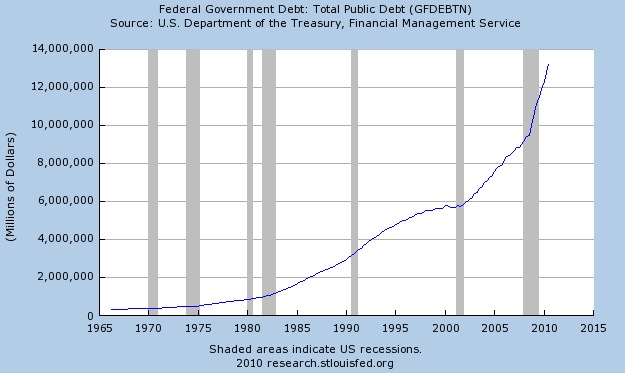
U.S. Debt Bubble

We consider last, the greatest bubble in all of recorded financial history which is the bubble in U.S. debt.  U.S. debt has increased by almost 3,000% since the early 1970’s.  The increase in borrowings by the United States has gone absolutely parabolic and is unsustainable.  The duration of the U.S. debt bubble cannot be predicted, but when this bubble bursts, the repercussions will be devastating to the global economy.  Astute readers will notice that the genesis of the housing, NASDAQ and U.S. debt bubbles coincide perfectly with the end of the gold standard.

The bubbles cited above lasted an average of 31 years.  The average percentage gain for housing, the NASDAQ and U.S. debt bubbles is 4,100%.   Extrapolating from past historical bubbles, the gold bull market should last another 20 plus years with a price target of over $12,000.

Gold Mining Stocks Break Out To New Highs; 3 Gold Stocks That Should Double

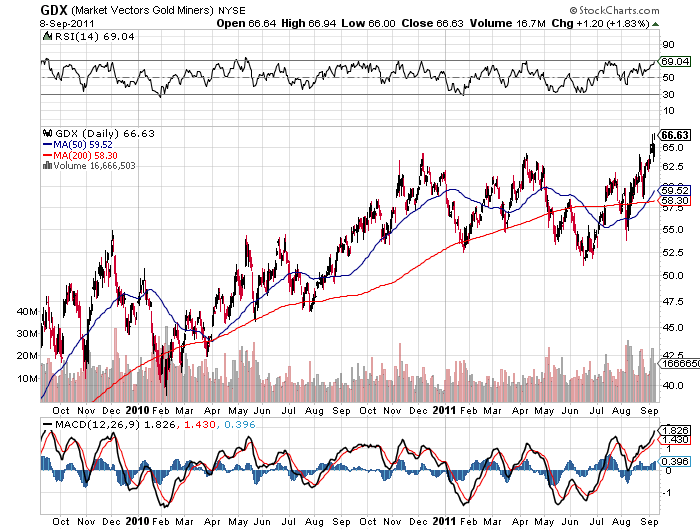
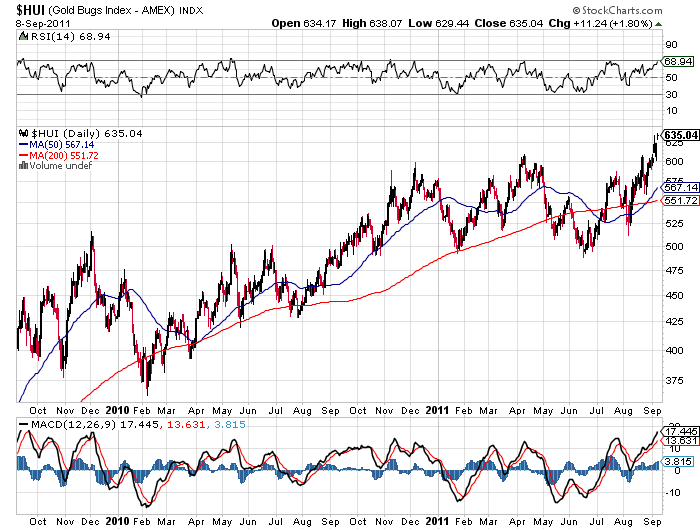
The divergence between the performance of gold bullion and gold stocks seems to be coming to an end.  Both the Market Vectors Gold Miners ETF (GDX) and the Gold Bugs Index ($HUI) have broken out to new highs as investors move into undervalued gold mining shares.


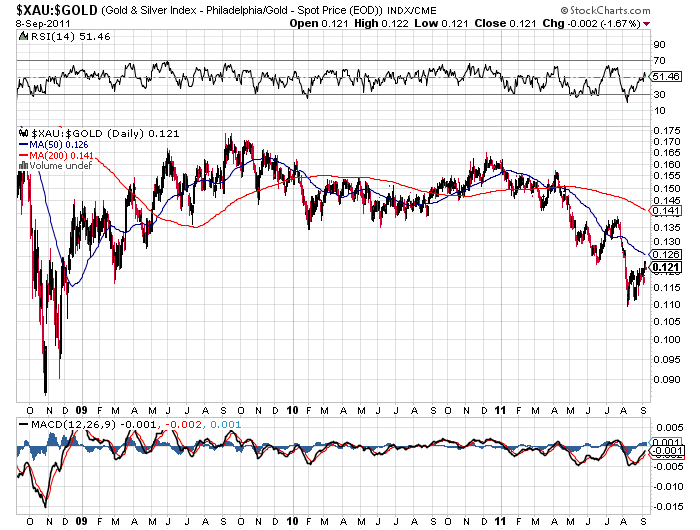
During the initial stages of the gold bull market,gold stocks significantly outperformed gold bullion.  From October of 2000 to June of 2008 gold stocks, as measured by the PHLX Gold/Silver Index (XAU), rose 345% compared to a gain of 252% for gold bullion.

Since 2008 gold stocks have significantly underperformed bullion as gold prices increased by over $1,000 per ounce.    As a result, many gold stocks are selling at bargain prices based on increased earnings and the value of proven gold reserves.

Investors have a wide variety of options for investing in gold mining shares including ETFs and gold stock mutual funds.  One of the best performing gold funds is the Tocqueville Gold Fund (TGLDX) run by John Hathaway.  TGLDX has achieved an average annual return of 26% over the past 10 years.   An investment of $10,000 in the Tocqueville Gold Fund made in June 2001 was worth $102,929 as of June 2011.

For investors who prefer to invest in individual gold mining shares, here’s a short list of three gold mining stocks that could easily double in price.

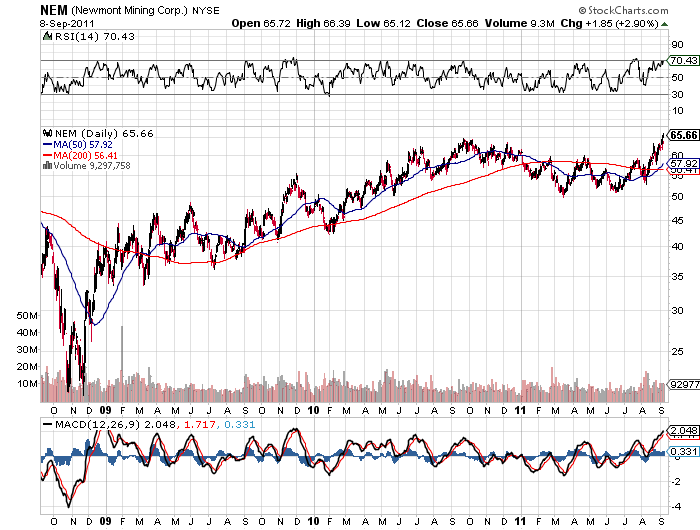
Newmont Mining (NEM) is a large cap gold mining company with proven and probable gold reserves of 93.5 million ounces.  NEM has a strong balance sheet, is forecasting an increase in gold production of 35% over the next six years and pays a cash dividend of 50 cents per share (see A Large Cap Gold Stock That Could Double in Price). NEM hit a new all time high today.

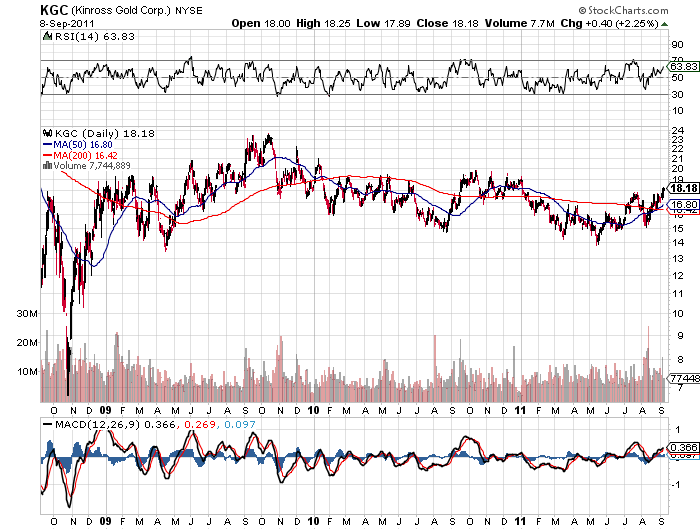
Kinross Gold (KGC) is selling at a large discount to the value of its gold reserves.  One value investor is forecasting a price target of $27 per share (see How Patient Investors Can Buy Gold At $250 Per Ounce).  KGC closed Thursday at $18.18, up $0.40.

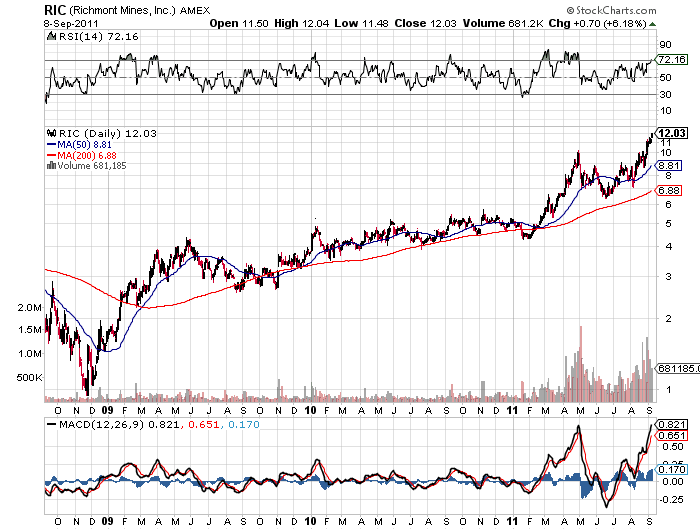
Richmont Mines (RIC) is a junior gold producer.  Earnings for the second quarter of 2011 increased from $0.01 per share to $0.16 per share compared to the prior year.  RIC hit a new high of $12.03 at yesterday’s close.


Gold and Silver Soar On Fears Of Massive Central Bank Stimulus

Precious metals soared across the board this week.  The dismal jobs report released on Friday showed that the American economy has come to a standstill with zero new jobs added in August.

The specter of the US economy plunging back into recession along with imminent banking crises in Europe and the US have fueled speculation that the Federal Reserve is on the verge of conducting another massive wave of monetary stimulus which will further debase the value of the US dollar.  Apprehension is also growing that the magical Obama plan for “creating” new jobs will involve further borrowing by an already bankrupt  American empire.

Also lurking in the background is the fear of coordinated US and European central bank intervention (money printing) to contain the collapse of the European banking system.  Despite the purchase of hundreds of billions of dollars of Spanish, Greek and Italian debt by the European Central Bank, rising interest rates are forecasting default by numerous sovereign states in the European Union.   Rates are rising again on Italian debt and the rate on one year Greek paper now exceeds 70%.  The yields on Greek debt indicate that default is now a certainty and the losses by insolvent European banks holding PIGS debt will require unprecedented government bailouts to prevent complete financial chaos.

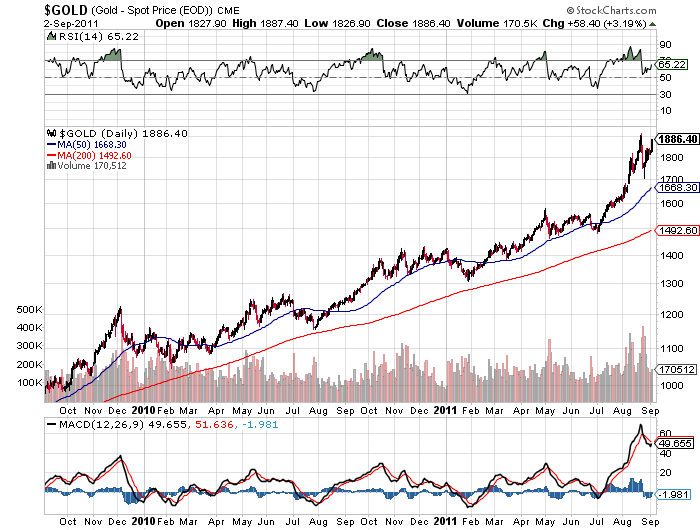
Soaring gold prices have been predicting the collapse of paper money currencies.  As measured by the closing London PM Fix Price, gold soared on Friday by $54.25 to $1,875.25.  In later New York trading, gold continued higher closing at $1,885.20.  Gold is only $2.25 below the all time London close of $1,877.50 reached on August 22nd.

Precious Metals Prices Sept 2
PM Fix Since Last Recap
Gold $1,875.25 +87.25 +4.88%
Silver $42.50 +1.44 +3.51%
Platinum $1,873.00 +61.00 +3.37%
Palladium $785.00 +38.00 +5.09%

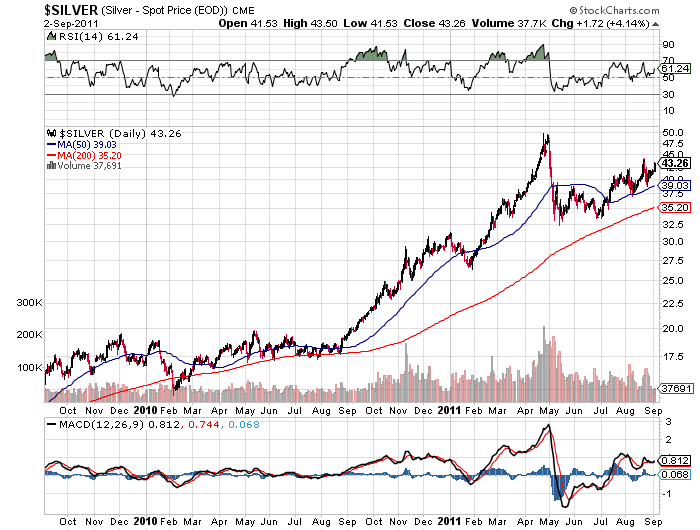
As measured by the closing London PM Fix Price, silver gained $1.44 on the week to $42.50 and continued to rise in later New York trading to $43.35.   After consolidating in the $34 range, silver has resumed its uptrend and is likely to hit new all time highs before year end.


Silver - courtesy stockcharts.com

Platinum soared by $61 on the week to close at $1,873 while palladium finished up $38 to close at $785.

Precious metals may correct after strong advances, but the fundamental case for owning them is growing geometrically.  Expanding deficits and wild money printing will continue as policy makers continue their futile attempts to produce economic recovery by adding more debt to a system already collapsing from the burden of excessive debt.   Continue to increase gold and silver positions on any pullbacks.


Gold - courtesy stockcharts.com