April 13, 2026

Gold and Silver Recap: G20 Aftermath and Silver Price

Well it looks like the G20 worked.  Talk of ending competitive devaluation seems to have put a bit of zip into the dollar, and other currencies.  This has hurt gold, particularly towards the end of the week.

Oddly it didn’t touch silver, the purer inflation play.  So the view is that the end of the world is much less nigh than it was last week, but inflation is still on the way up.  Or perhaps the investors are confused as I am.  It’s usually the second answer when the market is spinning around in the short term.  In the long term the market may be the most rational engine for progress, but in the short term it is irrational and emotional.  Of course it is in the medium term that rational speculators make their money.

Precious Metals London Fix Prices
Gold $1,388.50 -7.00 (-0.50%)
Silver $26.79 +0.65 (+2.49%)
Platinum $1,712.00 -52.00 (-2.95%)
Palladium $703.00 +16.00 (+2.33%)

Talking about the long run, there’s even talk of gold being reintroduced to the international monetary system, from the President of the World Bank, Robert Zoellick.  “The [new monetary] system should also consider employing gold as an international reference point of market expectations about inflation, deflation and future currency values.”  Wow.  Sounds like the London Gold Pool of the 1950s and 1960s, although the United States tried throughout that time to stop private individuals buying gold.  He then says to the fiat money stalwarts “Although textbooks may view gold as the old money, markets are using gold as an alternative monetary asset today.”  Too true.  And silver.

But in the actual precious metals market the real movers were still private individuals rather than governments, with many metals traders warning that there is a big wall of consumer money coming in to the precious metals markets in the shape of planned commodity funds.  Could this be the start of the last leg when the main street investors buy into the death of fiat currency argument?

The silver market still went up, which on the face of it is a puzzle.  If the reason why gold went down was that the market believed that governments weren’t racing to finish off the purchasing power of their currencies, why is silver still going up?  Surely it should be going down.  More.

My theory is that this could be an unwind from the silver price fixing allegations as the action was at the start of the week.  There is also a potentially large overhang of short future positions, which essentially means that there are a lot of people who are selling silver without having bought it.  If they all have to close their positions at once, or buy the silver, then the price could shoot up.
US Mint Mass Email Causes Mass Confusion

Collectors have been eagerly awaiting the release of the 2010 Proof Silver Eagle. Imagine their surprise yesterday when they received a mass email notification from the United States Mint that the product was “sold out” and their orders were canceled one week before the anticipated release date.

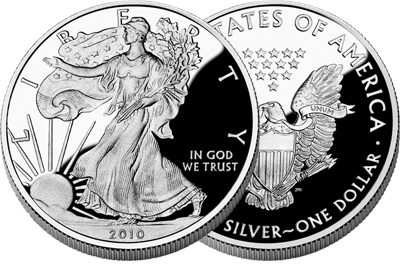
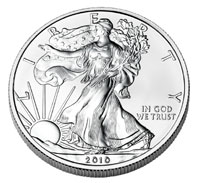
The Proof Silver Eagle is one of the US Mint’s most popular products. Featuring Adolph A. Weinman’s classic “Walking Liberty” design on one ounce of .999 fine silver struck with a proof finish, it makes an exceptionally beautiful item for collecting or gift giving. This did not stop the Mint from canceling the offering last year due to high demand for bullion coins.

This year’s offering was confirmed by the US Mint in early October when it was announced that the 2010 Proof Silver Eagle would go on sale November 19, 2010. The price would be $45.95 and a household limit of 100 would be imposed.

The email notification received yesterday by customers who entered orders through the US Mint’s subscription program was as follows:

Greetings from the United States Mint.
Thank you for ordering from the United States Mint.
We regret to inform you that the item(s) listed below
are currently sold out. A customer service representative
will be happy to assist you in finding an alternative item.

Order #
Sold To
Ship To

Item: PS1 Qty:
2010 AE SILVER PRF 1 OZ

This is a system generated e-mail. Please do not reply.
If you have questions, please visit the Help page at
http://catalog.usmint.gov or call us at 1-800-USA-MINT.

The mass emailing set off a torrent of calls to the US Mint’s toll free number. Many feared a repeat of the situation last year where the offering had been canceled due to bullion demand. After all, this year’s American Silver Eagle bullion coins are already in record territory for annual sales. The rising price of silver also seemed to have potential to impact the offering, which was priced more than a month ago.

Callers were told that the emails were sent in error and the subscriptions would be reinstated. It wasn’t until later that evening that a second email was sent to customers officially confirming that the offering was not canceled.

A mass emailing falsely announcing a product cancellation one week before the release date is certainly not a great way for the US Mint to ingratiate themselves with their customers– especially considering the many missteps of the recent past.

Which is Better to Own – Gold Bullion or Gold Stocks?

Gold investors have two basic choices – buying gold bullion or buying shares in companies that produce or own gold. As we examine the two basic investment vehicles available to gold investors, it becomes apparent that choosing the best investment option can be a complex decision. Some of the questions that a gold investor should consider include the following.
What has produced better investment results – owning gold bullion or a gold mutual fund?

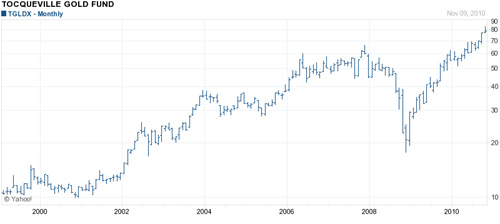
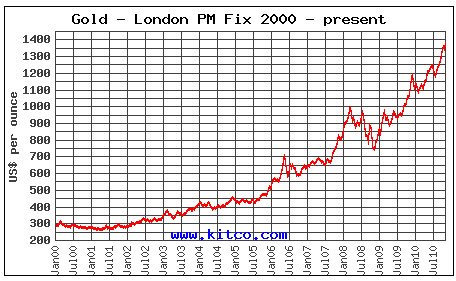
To gain insight into investment returns, let’s compare how an investment in gold bullion compared to investing in the Tocqueville Gold Fund (TGLDX).  I selected TGLDX since it is one of the best performing, actively managed gold funds with a long term track record.  An investment of $10,000 in the Tocqueville Gold Fund in 2000 would now be worth approximately $86,000 for a stunning return of 860%.   A $10,000 investment in gold bullion in 2000 would currently be worth approximately $46,400 or a 467% return.

Since gold mining companies are leveraged to the price movement of gold, it is not entirely surprising that the gold stocks would outperform the metal. Leverage, however, works both ways and in 2008, when gold experienced a price correction, TGLDX dropped from 65 to 19, a horrendous decline of 71%, whereas gold bullion experienced a normal bull market correction of only approximately 25%.   For those investors unwilling to tolerate huge price fluctuations, bullion seems a better way to go. When gold is moving up, expect the gold funds to outperform the metal.  In 2010, TGLDX has increased 42.7% compared to an increase in gold of 27%.

TGLDX Chart : Yahoo Finance

Gold 2000-Present: Kitco

If I decide to invest in gold stocks instead of the bullion, how many different stocks should I buy?

One of the primary tenets of sound investing is to always diversify.   Although selected gold stocks have vastly outperformed the price movement in bullion, many have not and some have dramatically underperformed.   Evaluating the prospects of an individual gold mining company is difficult, even for the experts.  An investor choosing to allocate a large percent of assets into gold stocks is probably better off (from a risk standpoint) investing in a well managed gold fund with a solid long term track record.  For an investor that does not want to hold physical gold nor own individual gold stocks, investment in a gold ETF such as GLD, that tracks the price movement of the bullion, would be an option.

I don’t trust paper assets and want to hold only gold bullion – what are my options?

For a conservative, risk averse investor looking to protect the value of his money,  investing only in gold bullion is a sound strategy.  Holding actual bullion, however raises security questions on how and where to store the physical gold.  Investors who wish to have their gold stored on their behalf can chose from a variety of firms that securely store gold in protected and insured vaults.  For an investor storing gold on his own in a safe deposit box, it would perhaps be wise to diversify storage geographically by using more than one bank.

Is the tax treatment different for gold bullion versus gold stocks?

The IRS considers gold to be a collectible.  Gains on gold bullion or coins and ETF’s backed by physical gold and held for more than a year have a maximum tax rate of 28%, while positions sold in less than a year are taxed at ordinary income rates.   Gold stocks are considered capital assets by the IRS and standard capital gain tax rates apply to profits.

As nations compete with each other to devalue their currencies and the Federal Reserve engages in outright money printing, gold investors should be expecting substantial profits regardless of what investment vehicle is chosen.

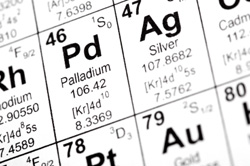
Palladium Price at Nine Year High

While gold and silver have dominated the media spotlight this year, the price of palladium has outperformed both. For the year to date, palladium is up $337 per ounce or more than 85%.
By comparison, gold has risen $333.50 per ounce or 30.67% from the start of the year. Meanwhile, silver has risen by $11.56 per ounce for the year to date, or around 68%. Much of silver’s rise has come over the course of the past three months.

November 19, 2010 London PM Fix Prices
Gold $ 1,421.00
Silver $ 28.55
Platinum $ 1,786.00
Palladium $ 730.00

Palladium’s strong performance began following the sharp decline across all precious metals prices that took place at the end of 2008. Measured from palladium’s low of $164 reached in December 2008, the price is up an astonishing 345%.

From gold’s low price of $712.50 reached in October 2008, the price increase measures about 100%. For silver, from the low price of $8.88 reached in October 2008, the has returned 221.5%. Once again, palladium outshines the performance of both.

The current price of palladium represents a nine year high for the metal. The continued rise has been attributed to dwindling stockpiles in Russia amidst increased use within China for catalytic converters in gasoline powered automobiles.

Earlier this year the first palladium ETF for U.S. investors was launched by ETFS Securities, trading until the symbol PLL. More recently, a bill was introduced in the U.S. House of Representatives seeking to authorize American Palladium Eagle bullion coins.

Gold and Silver Recap: The Fed Gives a Helping Hand

So the Fed decides that quantitative easing was going to boost the economy, as if the way to prove that you’re really clever is to do the thing that wasn’t working before, just all over again.  This is naturally going to give precious metals a boost as investors realize that whether or not QE2 works for the economy, it’s definitely going to work for inflation.
Silver has always been a purer inflation hedge than gold, apart from in the days of the bi-metallic agitation, but no one’s really sure what that was about.  Those were the days, when to be a money crank was the minimum standard of a self-educated mind.  Of course the biggest money cranks of all, the fiat currency crowd, won.

But while gold is an inflation hedge as well, it’s also an “OMG the whole world’s going to end and I’m going to be living my life in a bunker” hedge.

The smart money is starting to notice silver, which could make things interesting.  The argument for gold to go up is that not every one’s really bought it yet.  How much more true is that of silver?

Anyway the crucial thing here is the gold to silver ratio.  Currently 52 ounces of silver will buy one ounce of gold (or pounds if you want to think big).  Historically it has been around 30 ounces of silver for every ounce of gold.  But recently there’s been manipulation that’s kept the price down through deliberate manipulation of silver short positions.  Well that’s what some investors are claiming and have named HSBC and JP Morgan in a lawsuit.

Well silver’s been the tearaway kid this week but there’s still some action in gold.  Diwali is over and the Republicans have been elected, which means both Indian jewelery buying and US government spending are going to take a short breather.  Although the dollar went up against a basket of currencies it really looks like these events have suppressed demand for gold.

Central banks are starting to notice gold with countries as diverse as the Philippines and South Africa slowly increasing their reserves.  How long will it be before the foreign currency giants such as China, Japan, Taiwan and the oil states start looking at the only currencies that are still standing five thousand years later?

American Silver Eagle Bullion Sales Break Record

Sales of the United States Mint’s American Silver Eagle have just moved into record territory. The most recent available sales figures show a total of 28,885,500 of the one ounce coins sold for the year to date. This edges out the annual record sales achieved in the previous year when 28,766,500 coins were sold.

With nearly two months left in the year, the final total for 2010 seems likely to beat out the old record by a comfortable margin. During the first ten months, average monthly sales have been 2,863,050, suggesting full year sales of around 34 million.

2010 American Silver Eagle Sales (through 11/5/2010)

January 3,592,500
February 2,050,000
March 3,381,000
April 2,507,500
May 3,636,500
June 3,001,000
July 2,981,000
August 2,451,000
September 1,880,000
October 3,150,000
November 255,000
December
Total 28,885,500

On an historical basis, sales levels for the American Silver Eagle have been immense during the past three years. This has frequently resulted in the US Mint suspending or rationing the available supply of coins. It has also resulted in the cancellation of certain collector versions of the coin.

As an interesting point of reference, the lowest annual sales total for the bullion offering was 3,466,000, achieved in 1996. This year monthly sales exceeded this amount on two separate occasions.

Gold and Silver Recap: Making Up Lost Ground

Another Precious Week in the Market

So the world’s returning to normal, and that’s a mild and slowly accelerating form of panic.  And all the precious metals are going up, at least against the dollar.

But there’s some bad news.  A load of tea partying gold bugs are heading to congress, and according to HSBC that’s bad for the price of gold.  Not really much evidence from their actual policies, but there’s a “loose correlation” between the gold price and democratic control of congress.

Precious Metals London Fix Prices
Gold $1,346.75 +24.25 (+1.83%)
Silver $23.96 +0.91 (+3.95%)
Platinum $1,700.00 +27.00 (+1.61%)
Palladium $640.00 +54.00 (+9.22%)

There’s also the Indian festival season which accounts for a stunning quarter of annual gold sales in India (a massive gold market).  This is good news, but Diwali is when it ends – and this year that’s Friday the 5th.  As the gold that is purchased is physical gold, then this is done for the year.  That’s a bit of a tighter correlation.

But there’s another piece of “news”, the London based Financial Times – a business paper that is essentially of the left (and the British left at that – so quite far left in American terms) has said that gold is a buy because the Chinese want it.  Well, actually when you look at it it’s an opinion piece written by David Hale of David Hale Global Economics, and although he sounds certain about the Chinese wish to project financial power and the Chinese consumer’s wish to protect him or herself from inflation, it’s based on conjecture.  They are useful signposts – and we should watch for them, but it’s not a sure fire prediction.

Palladium is the metal to watch at the moment (which probably will mean to watch … going down).  It was the only metal that held up last week, and it’s gone up considerably this week.  Palladium is driven by the demand for automobiles as well as having a Russian supply issue.  That is the Russians aren’t that keen on supplying it.

From undoubted manipulation, to probably imagined manipulation, the silver prices is not the star of the show this week.  There is some fevered speculation that there is another Bunker Hunt style cornering of the silver market.   Yes, it can happen, but look at what happened to those who tried it.

Platinum has been the most subdued of the precious metals this week, although there seems to be some radical restructuring of that particular industry with the world’s largest producer, South Africa’s Anglo Platinum going into “negotiations”, although it’s not clear what that is.  As they’ve recently been increasing output then it’s hardly likely to be closing the joint.

Gold and Silver Recap: Falling Prices

Another Precious Week in the Market

So who’s buying on the dips then?  Gold, silver and platinum prices are all down – mainly from Friday.

But have thy really gone down?  After all, the reason that we’re being given is that the dollar’s not weakening any more.  So what’s really happening, gold going down or the dollar going up?  Temporarily up.

Precious Metals London Fix Prices
Gold $1,322.50 -45.00 (-3.29%)
Silver $23.05 -1.37 (-5.61%)
Platinum $1,673.00 -18.00 (-1.06%)
Palladium $586.00 -5.00 (-0.85%)

Gold is essentially a short on all the currencies in the world, so it does pay us to look at what those currencies are doing.  For a while it seemed that they were only agreed on one thing, they were going to get to the bottom first.  Even the British Conservative government, that relishes its tough spending talk, has said that it is monetarily expansive.

So gold can’t help but go up.  Let’s not treat it as some speculative metal that people hold when the entire world is going crazy (although it helps when the world is going crazy) but look at it as a currency among others, but one that can not be printed.

So gold is bound to get in a bit of trouble when the industrial countries decide to get serious about printing out money.  If competitive devaluation is really over then so is gold, for the next few years.  But who are we kidding?  Competitive devaluation will be there until inflation starts hitting.  Then it will be too late.  And the central banks will be buying gold as well.

Speaking of which, South Korea is starting to buy gold.  It’s all a bit odd, these Asian countries with massive foreign currency reserves (and South Korea is only the fifth largest) speaking about buying gold.  If China loses faith with the dollar, then it could get hairy.  The dollars prospects, that is, not China.

Silver has been the purer precious metal play and so almost doubled gold’s fall.  This is despite China suggesting that it will cut back on its exports by as much as 40%.  Jim Rogers, the man who first opened the eyes of many investors to commodities, has also come out as a big bull on silver.

So the dark horse is palladium, which declined the least of the metals this week.

Palladium is like platinum in that most of the production is in either the Russian Federation or South Africa. But unlike platinum, Russia has been in a price fixing operation, by buying stocks of the metal in lean times and has been offloading it.  Well these stocks are drying up.  Just like central bank stockpiles of gold started to about five years ago.  And we all know what happened then.

US Mint Changes Rules for Authorized Purchasers

The United States Mint recently revised the requirements to become an Authorized Purchaser for their American Eagle Gold and Silver bullion programs. Since the start of the program, the US Mint has used an authorized purchaser network to distribute the coins to the public.

These Authorized Purchasers are the only ones allowed to buy bullion coins directly from the United States Mint. They purchase the bullion coins based on the market prices of the metals plus an established premium. The premiums are currently $2 for Silver Eagles and 3%, 5%, 7%, and 9% for one ounce, one-half ounce, one-quarter ounce, and one-tenth ounce Gold Eagles. Authorized purchasers are also required to create a two way market for the coins to ensure liquidity for US Mint bullion coin investors.

There are currently eight authorized purchasers for gold and twelve for silver.

Changes to the requirements recently made effective included modifications to the sections “Purpose”, “Marketing Support”, “Experienced Market Maker”, and “Tangible Net Worth”. The most significant change was the addition of a new section “Right to Temporarily Refrain from the Review of New Applications.”

The new section states the following (emphasis added):

The United States Mint reserves the right to temporarily refrain from the review of new AP applications during periods in which the allocation of any bullion product is required. The temporary refrain period will continue until a minimum of nine months after all allocations have been lifted, but no more than one year after all allocations have been lifted.

For more than two years the US Mint has continually resorted to their allocation program (rationing) in times when gold and silver bullion demand has spiked. From 2008 to 2010, Silver Eagles have spent more time under allocation than not, with the program implemented February 2008, lifted in June 2009, reinstated in December 2009, and lifted in September 2010.

Under the newly established rules, the US Mint can refrain from considering applications of potential new authorized purchasers until at least June 2011. During this time, if another demand spike necessitates the use of the allocation program, the clock starts again, but only after allocation has been lifted. Given the pattern of the past two years, the period of refrain could last indefinitely.

By law the US Mint is required to supply American Gold and Silver Eagles in quantities sufficient to meet public demand. In reality, the supply of coins is limited based on the number of planchets the US Mint can obtain from foreign suppliers, and distribution is limited based on the small number of authorized purchasers and the new hurdles placed before potential applicants.


Gold and Silver Recap: Are We Peaking Yet? Silver Goes on a Tear

Another Precious Week in the Market

Last week I tried to explain the theory that gold wasn’t actually that high, the dollar was just weak.  So as to stop the hate mail, chair throwing, death threats and broken windows (how did you find my address?) I’d like to point out that this is not a reason for not holding gold.

Precious Metals London Fix Prices
Gold $1,367.50 +26.00 (+1.94%)
Silver $24.42 +2.05 (+9.16%)
Platinum $1,691.00 +8.00 (+0.48%)
Palladium $591.00 +19.00 (+3.32%)

In fact, it is one of the three reasons for holding gold. It is still not really that expensive, its just that paper money is getting progressively cheaper – as any trip to the supermarket or the gas pump will confirm.  The reason is that it’s still a minority taste, and if this is a bubble you’re safe to buy until the shoe shine boy is talking about it.  If you can’t find a shoe shine boy look for a project manager – when they start talking about gold coins then maybe it’s time to short gold.  The third reason is the optional one that we’re all doomed.  But we’ve been all doomed for the last forty years, so just concentrate on the first two.

And gold has done OK this week.  Ben Bernanke has talked about more easing and gold went up.  Towards the end of the week it dipped down again.  One of the interesting things is that the idea of currency wars has come into the open, where the large currencies all play beggar thy neighbor.  There has been no evidence of central government selling of gold.

However, gold is relatively subdued compared to silver.  Due to Nelson Bunker Hunt, it will be a long time before we can say “record highs”, but although second best may not sound so great these “30 year highs” are a big deal due to the fact that this is not some mad Texan billionaire with too much oil money.  These are diverse consumers worried about inflation.

Let’s put this in another way, silver has risen by 45.8% in dollar terms from the start of the year.  One thing that has been noticeable with silver this week has been the amount of articles from places like the Motley Fool.  Could be the chance to take a breather?  Silver has been priced weakly compared to gold in the last couple of years, but 9% in a week is looking essentially unsustainable.