April 13, 2026

2010 Second Quarter Gold Demand

Not surprisingly, gold demand for the second quarter of 2010 was up significantly compared to the year ago period, according to the recently released Gold Demand Trends report from the World Gold Council.

Total identifiable gold demand for the quarter was 1,050.3 tonnes. This represents an increase of 36% over the level for the year ago period and an increase of more than 38% over the level for the first quarter of 2010. Demand was led by increases in identifiable investment (+118%) and industrial demand (+14%), which more than offset a small decrease in jewelry demand (-5%).

Behind the increase in investment demand were the concerns about sovereign debt of European countries. This sparked strong demand in German speaking countries, with demand in Germany increasing by 59% year over year. The U.S. was another source of strong demand with an increase of 32% year over year.

The average gold price for the second quarter was $1,196.74 per ounce, or 30% above the average for the year ago period. During the quarter, gold also reached a fresh all time high in dollar terms when it reached $1,261.00 per ounce on June 28, 2010.

The World Gold Council continues to expect robust demand for gold throughout the remainder of 2010, citing growth in demand from India and China, and increasing global investment demand driven by uncertainty about public debt and the economic recovery.
2010 Platinum Eagles Available

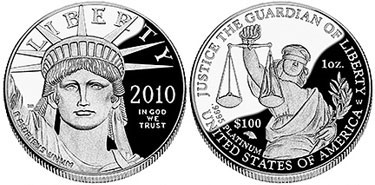
The United States Mint began selling 2010 American Platinum Eagles this week– not the bullion coins, but the collectible proof version of the coin.

Platinum bullion coins actually have not been produced by the US Mint since late 2008. The 2009-dated bullion coins were announced canceled as part of a broader announcement, citing “unprecedented demand” for gold and silver bullion coins. There have been no specific updates on the status of platinum bullion coins for the current year.

The one ounce proof 2010 Platinum Eagles are limited to a maximum mintage of 10,000 coins. The initial sales price was set at $1,892. In the absence of bullion versions of the American Platinum Eagle, will this offering have a broader appeal from precious metals investors, rather than just coin collectors?

At the current price, the one ounce proof coins carry a premium of nearly 25% above the current price of platinum. By comparison, a well known bullion dealer has one ounce Platinum Maple Leaf coins available for $1,645 each, or one ounce Platinum Eagles priced at $1,725. These prices represent premiums of 8.22% and 13.49%.

Pricing for the US Mint’s 2010 Proof Platinum Eagle is tiered and based on a weekly average price of platinum, which presents an opportunity to wait for a more favorable price. Assuming the coins do not sell out and platinum prices remain around the current levels, prices for the coins should actually be decreased by $100 on Wednesday of next week. If the price does decline to $1,792 per coin and platinum stays at $1,520 per ounce, the premium above platinum value would be cut down to 17.89%. At around 4.4% more than the premium for random date, bullion quality American Platinum Eagles, precious metals investors may be enticed.

The 2009 Proof Platinum Eagles, which were limited to 8,000 coins, managed to sell out after about a week. The coins now sell for around $2,400 each due to demand from the collector market.

Proof Silver Eagles Possible… With Change in Law

There might be a chance for proof versions of the American Silver Eagle after all.
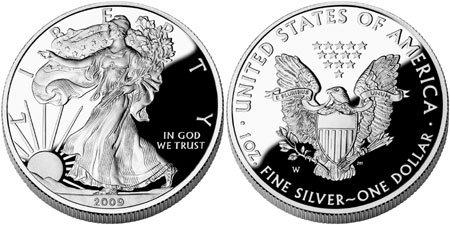
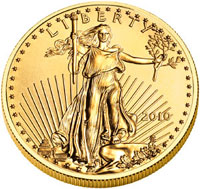
Shortly after my post on the dimming prospects of the 2010 Proof Silver Eagle, US Mint Director Edmund Moy delivered testimony to the Subcommittee on Domestic Monetary Policy and Technology on “The State of U.S. Coins and Currency”. Within the testimony, Director Moy mentioned that the subcommittee was considering amending the existing law to allow the Mint to produce collectible uncirculated and proof versions of the Silver Eagle, even if full demand for bullion coins was not being met.

It was revealed that the US Mint has already, in fact, provided drafting assistance for the amendment to the law. If it could be enacted soon, the Mint could begin production of Proof Silver Eagles in September at a rate of 200,000 coins per month. This would allow total production of 830,000 coins before the end of the year.

Frankly, after two years of stalled production, a change in law is not really the solution I was expecting. Two years should have provided the US Mint with sufficient time to either find additional precious metals blank suppliers, or set up their own production of precious metals blanks in-house. During the course of the subcommittee meeting, the US Mint Director was questioned on these two options and did not provide satisfactory responses. If the US Mint sought to change the law to legitimize the fact that they cannot satisfy bullion demand, then they could have taken this step two years ago.

As it stands, the US Mint claims that there is plenty of gold, silver, and platinum in raw material form, they just can not get it fabricated into planchets fast enough. This is another tough statement to accept without scrutiny. As covered in prior posts, other world mints quickly managed to adapt to the increased level of demand for precious metals. The US Mint has apparently been staring down the same bottleneck for two years.

During the course of the questioning, Director Moy was asked about the possibility of producing back dated 2009 Proof Silver Eagles, to fill the gap left by last year’s cancellation. He stated that this was not allowed.

2010 Proof Silver Eagles at Risk of Cancellation

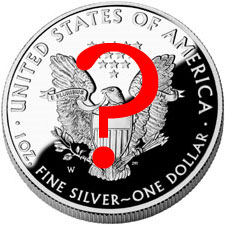
One of the consequences of the record pace of United States Mint silver bullion coins might be the cancellation of the popular Proof American Silver Eagle for the second year running.

The Proof Silver Eagles have been issued each year from 1986 to 2008. During this period, the coins have sold between 372,168 and 1,092,477 coins per year and had firmly established itself as one of the United States Mint’s most popular products.

2009 Proof Silver Eagle (not issued)

The offering was abruptly canceled for 2009 to the dismay of many collectors. The US Mint explained that it was legally required to produce the bullion version of the American Silver Eagle in quantities sufficient to meet public demand. They were not under any legal requirement to produce the collectible proof or uncirculated versions of the coins. Because demand for silver bullion coins apparently outweighed production, the US Mint sourced all incoming blank supplies towards the production of bullion coins.

The announcement of last year’s cancellation came by way of a press release issued October 6, 2009, which highlighted the two collectible precious metals offerings that would be available in 2009, before enumerating the long list of products which were canceled. As if in validation of the high demand for US Mint bullion Silver Eagles, in late November the US Mint was forced to temporarily suspended sales of bullion coins after inventories were depleted.

During 2010 to date, Silver Eagle bullion coin sales are running at a higher pace than the prior year. An average of 3,028,083 ounces have been sold per month this year, compared to an average of 2,397,208 ounces per month last year. Demand shows no signs of abating, as investors continue to buy every silver bullion coin the US Mint can produce.

The US Mint recently unveiled a numismatic product release schedule for the remainder of 2010. The 2010 Proof Silver Eagle and most other precious metal products were conspicuously listed as “TBD.” The Mint is still preserving some hope that these coins may be issued, but the situation looks rather bleak.

Why can’t the United States Mint produce bullion coins in sufficient numbers along with the traditionally issued collectible precious metals products? Is it the result of the onerous requirement that precious metals must be sourced from newly mined domestic sources? Is there a lack of manufacturing capacity? Or is it a case of managerial incompetence?

The same excuse of blaming “unprecedented demand from investors” is getting a bit old after two years.

US Mint Silver Bullion Sales on Record Pace, Gold Sales on Pace for Fourth Highest

Through June 30, 2010, the United States Mint has sold 18,168,500 ounces of silver bullion and 833,500 ounces of gold bullion. If the current pace is maintained for the rest of the year, US Mint silver bullion sales will break another record and gold will be within the top four annual sales totals.

The United States Mint currently offers the one ounce American Silver Eagle. This has been the US Mint’s only silver bullion coin option since its debut in 1986. Annual sales totals have ranged from a low of 3,466,000 ounces sold in 1996 to a high of 28,766,500 ounces sold in 2009.

This year’s mid-year total sales of 18,168,500 suggests that a new record high for annual sales will be extremely likely. Monthly sales figures have been relatively steady with four months above the 3 million level. It should be noted that this is not necessarily indicative of steady demand, as sales of the coins are currently subject to an allocation program, which rations the available supply amongst the US Mint’s authorized purchasers.

Later this year, the US Mint will be releasing a new series of America the Beautiful Silver Bullion Coins. These coins will contain 5 ounces of silver and feature designs which are duplicates of the current quarter program. It’s still uncertain just how many of these new silver bullion coins the US Mint will produce and whether this will have a meaningful impact on overall silver bullion sales.

On the gold bullion side, the US Mint current offers the American Gold Eagle and the American Gold Buffalo. The first is a 22 karat gold coin available in one ounce, one-half ounce, one-quarter ounce, and one-tenth ounce sizes. The latter is a 24 karat gold coin available in one ounce size only.

The mid-year gold bullion sales total of 833,500 ounces is made up of the following:

  • 618,500 American Gold Eagle 1 oz
  • 31,000 American Gold Eagle 1/2 oz
  • 44,000 American Gold Eagle 1/4 oz.
  • 280,000 American Gold Eagle 1/10 oz.
  • 160,500 American Gold Buffalo 1 oz.

According to the latest information I have read, the one ounce bullion coins are not subject to allocation, however the fractional weight gold bullion coins are subject to allocation. These coins available to authorized purchasers starting on June 10, 2010.

The highest annual US Mint gold bullion sales was achieved in 1999 when 2,055,500 ounces were sold. This is followed by 1998 at 1,839,500 ounces, 1986 at 1,787,750 ounces, and 2009 with 1,625,500 ounces. The lowest annual gold bullion sales total occurred in 2002 when only 164,500 ounces of gold were sold for the entire year. The US Mint actually sold more gold bullion than this last month when 185,000 ounces were sold.

Gold, Silver, Platinum, Palladium 2010 Second Quarter Performance

Although gold and silver are experiencing a sharp decline today, they recorded strong performance during the second quarter of 2010. Platinum and palladium both posted declines for second quarter, but maintain gains for the year to date.
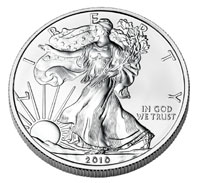
The table below shows the last London Fix Price of 2009 for each metal and the last price for June 30, 2010 followed by the percentage gain or loss for the 2010 Second Quarter and the Year to Date performance.

2009 Close June 30, 2010 Close 2nd Quarter YTD
Gold $ 1,087.50 $ 1,244.00 11.52% 14.39%
Silver $ 16.99 $ 18.74 7.09% 10.30%
Platinum $ 1,461.00 $ 1,532.00 -6.87% 4.86%
Palladium $ 393.00 $ 446.00 -6.89% 13.49%

Gold recorded the largest gain for the most recent quarter with an increase of 11.52%. It is also showing the strong performance out of the four metals for the year to date, up 14.39%. During 2009, the other three metals had outperformed gold by wide margins.

Silver posted a gain of 7.09% for the quarter and is up 10.30% for the year to date. Notably, silver has now posted a gain for the past six consecutive quarters. This represents the longest quarterly winning streak which took place through the beginning of 1980 when silver had eleven consecutive quarters of gains.

Platinum and palladium showed declines of 6.87% and 6.89% for the quarter. Year to date numbers remain positive at 4.86% and 13.49%.

Gold Currency Status, GATA Interview, Gold and Silver Prices

A selection of recent articles on gold and silver from across the internet:

Gold reclaims its currency status as the global system unravelsTelegraph.co.uk

“Central banks of Russia, the Philippines, Kazakhstan and Venezuela have been buying gold, and Saudi Arabia’s monetary authority has ‘restated’ its reserves upwards from 143m to 323m tonnes. If there is any theme to the bullion rush, it is fear that the global currency system is unravelling. Or, put another way, gold itself is reclaiming its historic role as the ultimate safe haven and benchmark currency.”

The story that’s GATA be told Motley Fool

An interview with Bill Murphy, co-founder of the Cold Antitrust Action Committee (GATA).

“What’s important for your readership to understand is that the markets have been made dysfunctional by U.S. policy and what these bullion banks are doing. Even Alan Greenspan said recently that interest rates were left too low for too long. Had the gold price been allowed to trade freely, interest rates wouldn’t have been able to stay down as low as they were. It would have been a warning sign for people not to get involved in the behavior that they did … not to go with all of the risks that developed. And there’s a good likelihood that the disaster would have been nowhere near as bad as it was.

“Alan Greenspan called gold a “thermometer.” So they diffused the thermometer by keeping the gold price managed. And what’s important for people to understand now is that the same thing is going on. If we’re correct, it’s going to lead to a bigger catastrophe, because no one has learned any lessons.”

Silver may advance to $23Bloomberg Businessweek

Silver is called a cheap alternative to gold. The current gold/silver ratio is compared to historical levels.

“An ounce of gold for immediate delivery bought about 65.81 ounces of silver today, compared with the 2008 low of 47.55 ounces and the decade average of 61.99 ounces.”

Five reasons to expect gold and silver prices to be suppressed this weekCoin Update

After reaching an all time high price Monday morning, the price of gold has already dropped by about $30 and silver is down more than $1.

“There are more reasons than usual why the US government would want gold and silver prices to be in the dumps this week…”

US Mint Gold and Silver Bullion Sales Highest in More Than a Decade

During May 2010, the United States Mint’s gold and silver bullion sales levels reached their highest level in a decade or more for the two most popular offerings. This heavy demand for physical gold was experienced by several world mints last month, driven by concerns and uncertainty about Greece and the Euro.
The United States Mint sold 190,000 of their 1 oz. American Gold Eagle coins. This ranked as the highest monthly sales total for the bullion option since January 1999 when 208,500 coins were sold. The all time record high for sales in a single month took place in October 1986 when 609,500 of the one ounce coins were sold.

There were 3,636,500 of the 1 oz. American Silver Eagle coins sold during May 2010. This was just shy of the all time monthly sales record of 3,696,000 coins sold in December 1986. The month of May ended with a three day weekend, if one more day of sales had taken place, the record may have been broken. It’s worth noting that Silver Eagle bullion coins are also subject to the US Mint’s allocation (rationing) program, meaning these impressive sales still do not reflect full public demand.

Recent articles report similar surges in bullion coin demand. Production of Gold Krugerrands by the Rand Refinery reached their highest weekly production levels in 25 years. The treasurer of the refinery cited Germany as a large source of demand. The Perth Mint of Australia which did not provide production levels, has doubled their capacity over the past 18 months. As soon as the European Commission announced that they would bail out Greece their stock of gold “all went.”

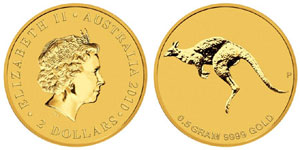
Perth Mint “Mini Roo” Half Gram Gold Coin

I suppose it’s natural that escalating gold prices would lead to smaller sized gold coin offerings. As the price has increased, standard sized gold bullion offerings grow more expensive, and perhaps out of reach for some smaller scale investments.

The Perth Mint recently introduced a half gram gold coin called the “Mini Roo.” This is a miniature version of their popular Gold Kangaroo, which is also offered in weight ranging from one-tenth ounce to one kilo.

The diminutive coin features a newly designed bounding kangaroo and carries a legal tender face value of 2 Australian Dollars. The coins have a diameter of 11.60 mm, thickness of 0.70 mm, and contain 99.99% pure gold.

One half gram of gold works out to 0.016 troy ounces of gold. At today’s gold price, the intrinsic value of the Mini Roo is $19.60. The Perth Mint’s website shows the coins priced at US $38.18 each. This is actually only slightly cheaper than the pricing for one gram gold bars, but a manufacturing premium is to be expected for coins over bars.

2010 First Quarter Gold Demand

The World Gold Council has released Gold Demand Trends for the First Quarter of 2010. The report indicates a drop in gold demand for the covered period, but suggests that demand will be strong for the rest of the year.

Identifiable gold demand during the first quarter of 2010 was 760.2 tonnes, representing a drop of 25% compared to levels seen for the first quarter of 2009. The change was driven by a 69% decline in investment demand, offset by a 43% increase in jewelry demand and 31% increase in demand from industrial sectors.

The drop in investment demand was driven by a sharp decline in demand from ETFs and similar products. Total demand was only 3.8 tonnes for the quarter compared to 465.1 tonnes for the year ago period. Comparisons are also influenced by an unusually strong year ago period.

Investment demand did pick up right after the close of the first quarter, when concerns about Greece and debt contagion fears led to a significant pick up in demand for physical gold. In a previous post, I explored how physical gold demand had surged compared to the muted levels of the first quarter. More significantly, there has also been a resurgence in demand from the GLD ETF in the past month.

In their forecast for strong demand for the remainder of 2010, the WGC cites jewelry demand in India and China, as well as investment demand for the United States and Europe as the drivers.