April 13, 2026

Gold and Silver Reach Record Highs While Ron Paul Weighs In On Spending Fiasco

Silver was again the star performer in the precious metals group, hitting a new yearly high of $42.61.  For  the second week in a row, silver has added over $2 per ounce as measured by London PM Fix Price.  After soaring $2.59 in the previous week, silver capped another standout week with a gain of $2.39.

As a long time patient investor in silver, the moves over the past couple of years have been nothing less than amazing.  In the early 1990’s, a one ounce silver eagle  did not cost much more than $5 per coin.  In just the past two weeks we have witnessed silver increase in value by $4.98 per ounce.  Am I nervous about the rapid appreciation or worrying about a correction that the main stream press is calling for?

Not in the least – I am in silver for the long term and the policies of our government and central bank virtually guarantee much larger profits in the future (see Why Gold and Silver Have No Upside Limit, and Budget Fiasco Sends Wrong Message To Creditors and The Perfect Storm for Gold and Silver).

Any price corrections in the precious metals (and yes they will happen) should be viewed as opportunities to increase positions.

Precious Metals Prices
Fri PM Fix Since Last Recap
Gold $1,476.75 +7.25 (+0.49%)
Silver $42.61 +2.39(+5.94%)
Platinum $1,787.00 -16.00 (-0.89%)
Palladium $772.00 -26.00 (-3.26%)

Gold, as measured by the closing London PM Fix Price, hit another all time high, closing at $1,476.75, up $7.25 on the week after running up $51.50 in the previous week. After breaking out of its base in the $1,450 range, gold could be getting ready for a substantial move upwards.

Paper money is all about confidence and, to anyone paying attention, last week’s “budget compromise” proved conclusively that our government is absolutely incapable of reducing spending.  After threatening us with a government shutdown and terrifying half of the citizens of this Nation with a potential cutoff of entitlements, both political parties proclaimed victory with an inconsequential  spending reduction of $38 billion.  Keep in mind that this year’s deficit is almost 37 times the proposed spending cuts.

The problem with the “compromise cuts”  is that both political parties lied to us and they were called out by the Congressional Budget Office (CBO) which said actual spending would be reduced by only a laughable $352 million.  Futhermore, the CBO noted that when “emergency spending” and the cost of multiple wars is factored in, actual spending would actually be $3 billion higher than the 2011 budget forecast.  It is not by accident that gold and silver have been soaring.

Ron Paul, one of the very few courageous and honest politicians that this country is lucky to have, said the following in a commentary about the latest events in Washington.

Last week, Congress and the administration refused to seriously consider the problem of government spending.  Despite the fear-mongering, a government shutdown would not have been as bad as claimed.

A compromise was struck at the last minute, but until Democrats agree to rein in entitlement spending, and Republicans back off the blank checks to the military industrial complex, it all amounts to political gamesmanship.

Unfortunately, the compromises always seem to be just the opposite.  Instead of the left agreeing to cut social spending and the right agreeing to cut military spending, the right agrees to more welfare and the left agrees to more warfare.  In spite of all the rhetoric, we will go deeper in debt, the Fed will print more money, and the value of the dollar will continue to plummet.  How long will it be before foreigners stop buying our debt, and hyperinflation arrives?  Throughout history, empires have always overextended themselves through conquests and wealth transfers leading to eventual collapse, from the Roman Empire to the Soviet Union.  We are headed in the same direction and it seems only the chaos of the collapse of the dollar will stop the spending spree.  Arguing over funding for Planned Parenthood and NPR, though important, only shows that leadership in Washington either won’t face reality, or don’t understand how serious the problem is.

Of course, an actual government collapse would create serious problems for many people who have come to depend on government payments for healthcare, retirement income, their children’s education, and even food and housing.  However, these so-called entitlement programs are unconstitutional to begin with and have engendered a culture of dependence on wealth transfer payments that is out of control. It concerns me greatly that instead of dealing seriously with our situation, so many in Washington would rather allow the chaos that will ensue when all of the dependent people are suddenly cut off.  Better to look reality squarely in the face and tell people the difficult truth that government is simply not capable of managing people’s lives from cradle to grave as was foolishly promised.  We face trillions in deficits with any of the budgets under consideration.  Keeping those promises is, sadly, just not one of our options in the long run.  Better to admit the nanny state is coming to an end and we are no longer working on “compromises” but a transition – to a sustainable way of life, one that respects the constitution, the rule of law and property rights.

In a sign that perhaps the economy may not be as strong going forward as some seem to think, industrial metals platinum and palladium both sold off on the week.   Platinum ended down $16 at $1,787 while palladium lost $26 to $772.
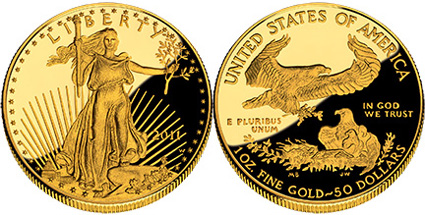
2011 Proof Gold Eagles Available April 21

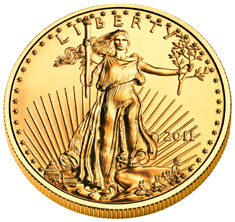
The United States Mint has provided details for the upcoming release of the 2011 Proof American Gold Eagle coins. These collector versions of the popular bullion coin have traditionally been offered each year since the introduction of the series in 1986.

The only year that the US Mint did not offer a collector version of the Gold Eagle was in 2009. In explaining the cancellation, the US Mint cited their requirement to produce the bullion versions of the coins in quantities sufficient to meet public demand. Since they could not meet full demand, they sourced all incoming precious metals blanks to the production of more bullion coins.

In 2010, the offering was resumed, with Proof Gold Eagles available starting on October 7, 2010. The available options sold out by early January of the following year.

The 2011 Gold Eagles will go on sale April 21, 2011. The US Mint will offer individual product options for the 1 oz, 1/2 oz, 1/4 oz, and 1/10 oz coins, as well as a combined 4 Coin Set option. Each coin is struck in 22 karat gold, with the stated weight reflecting the gold content of each coin. The product limits established by the US Mint are shown below.

Product Product Limit
1 oz. Coin 30,000
1/2 oz. Coin 15,000
1/4 oz. Coin 16,000
1/10 oz. Coin 30,000
4 Coin Set 40,000

If the US Mint can achieve a full sell out of the stated product limits for each option, that would represent 118,500 troy ounces of gold. Through the first three months of the year, the US Mint has sold an average of just under 100,000 ounces of Gold Eagle bullion coins per month. Sales of the collector versions typically take place more slowly, since they are sold at a higher premium and marketed to collectors.

Prices will be determined based on the average London Fix gold price for the week prior to the release date. If gold remains within the current range, the 1 oz proof coin would be priced at $1,735.00, reflecting a premium of 16.68% over the market price of the gold content. The 1/2 oz, 1/4 oz, and 1/10 oz coins would cost $881.00, $453.00, and $195.50, respectively. The 4 coin set would cost $3,215.50.

Price Pullbacks in Silver Becoming Shorter and More Shallow

Silver prices continued streaking higher today on fears of a plunging dollar, rampant money printing by central banks, and talk in Europe of a looming debt restructuring (default) by Greece.
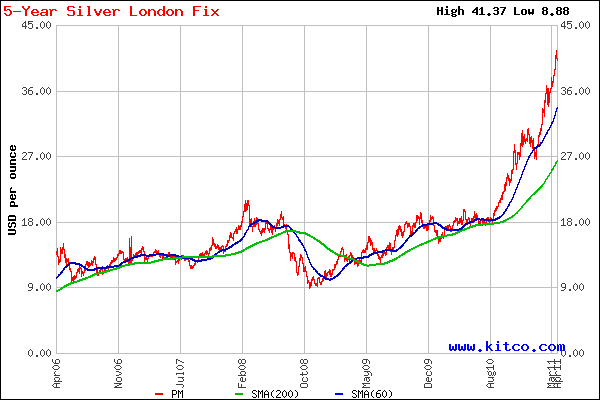
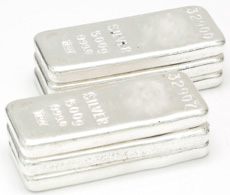
In late afternoon trading silver was up $1.22 to $41.88, a 3% gain for the day.  Since decisively breaking through the $15 price range in early 2008, silver has been in a major bullish uptrend with price pullbacks becoming shorter in duration and more shallow in their extent.

SILVER - COURTESY KITCO.COM

Silver reached an intermediary high of $20.92 in March 2008.  As the financial world headed for a meltdown in late 2008 and every asset class in the world was liquidated, silver experienced a sharp sell off and by October 2008 reached a low of $8.88.  The 2008 low represented a price consolidation of 40% from the base silver had established at the $15 range.

The ensuing recovery in silver took a little over a year before the price once again approached the $20 per ounce level.  In December 2009 silver hit a high for the year at $19.18.  After a brief consolidation below $18 in early 2010, silver broke out of its base in the $18 range  to reach a high of $30.70 in December 2010. The price of silver ended the year up $13.46, for a gain of 78.4% on the year.

In January of 2011 silver again consolidated briefly and pulled back $3.95 or 13% to a low of $26.68 on January 28th.  This month-long pullback turned out to be another fantastic buying opportunity as silver recovered its losses and rose to $36.60 by March 7th.

Over the next 7 trading days, silver consolidated again, declining  from $36.60 on March 7th to $33.88 on March 15th for a loss of $2.72 or 7.4%.  Silver then rallied again to a new annual of $41.37 on April 11th.

Silver’s most recent pullback was the shortest of them all, declining from $41.37 on April 11th to $40.22 on April 13th for a loss of $1.15 or 2.8%. The losses were quickly recovered and a new 31 year high was reached, with silver recently trading at nearly $42 per ounce.

Investors who seized the opportunity to purchase silver on price pullbacks over the past four years have made fantastic profits.  As the bull market in silver has progressed, these pullbacks have become shorter in duration and more shallow in price. This situation seems to be reaching its extreme, where pullbacks last not months, not days, but mere hours. Investors have started to capitalize on even the smallest price declines to increase their positions and drive prices higher.

Sales of US Mint Gold Bullion Coins Slower on the Week

Gold Eagle Sales Slower, Silver Eagles Little Changed

The number of ounces of gold sold through the US Mint’s bullion programs was slower the past week. Meanwhile, sales of silver bullion rose slightly, although they remain within the same basic range seen over the past several weeks.

The US Mint sold 17,500 troy ounces of gold bullion for the weekly period ending April 13, 2011. This consisted of 13,000 ounces of American Gold Eagles and 4,500 ounces of American Gold Buffalo coins. All gold bullion coins sold during the week were one ounce coins, with no fractional weight coins sold.

This sales level is down from the 32,000 ounces sold in the previous week. The drop may be the impact of seasonality, as precious metals sales tend to be slower around the US individual income tax filing deadline. For the year to date, gold bullion sales have reached 390,000 ounces.

US Mint Bullion Coin Program Sales 4/13/2011 (ounces)

Prior Week Month to Date Year to Date
American Silver Eagle 715,500 1,374,000 13,803,000
American Gold Eagle 13,000 45,000 344,500
America the Beautiful Silver 0 0 0
American Platinum Eagle 0 0 0
American Gold Buffalo 4,500 7,500 45,500

Silver bullion sales for the week reached 715,500 ounces, consisting entirely of the one ounce American Silver Eagle coins. As mentioned in previous reports, these bullion coins continue to be subject to the US Mint’s allocation program. This serves to ration the available supply of coins amongst the authorized purchasers. As such, the weekly sales levels are an indication of the number of coins the US Mint was able to produce and make available, as opposed to the level market demand.

The US Mint has plans to expand the production of Silver Eagles by utilizing the facility at San Francisco, which may be able to strike a few hundred thousand additional coins per week. Test strikes have reportedly begun, and full scale production is expected to begin some time next month. Hopefully, this will alleviate some of the excess demand for silver bullion coins, although it doesn’t seem like it will solve the problem completely.

iShares Silver Trust Holdings Decline

The iShares Silver Trust (SLV) saw silver holdings slump on the week while holdings of the SPDR Gold Shares Trust (GLD) increased.
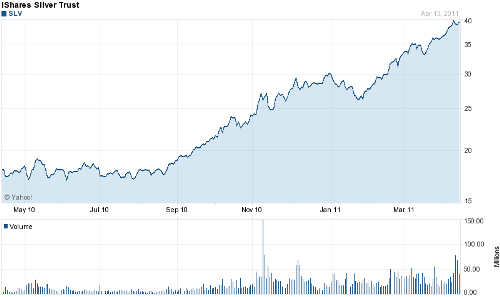
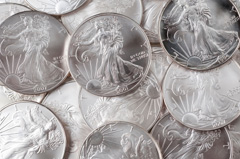
SLV holdings dropped by 192.74 tonnes on the week after adding 22.93 tonnes in the previous week.  Total holdings of the SLV amount to 10,969.71 tonnes or 352.7 million ounces of silver valued at $14.2 billion.  There is not always a direct correlation between the movement in silver prices and the amount of silver held by the trust.  For example, the total silver holdings of the SLV have increased by only .4% since the start of the year, while silver prices have increased by 32% over the same period.

There is a direct correlation between the price of the SLV and the price of silver.  The iShares Silver Trust was structured to track the price movement in silver bullion and it has achieved that result.  Since the inception of the SLV in April 2006, the annualized total return of the SLV has been 25.17% compared to an annualized total return for silver of 25.79%, the difference being primarily attributable to sponsor fees of .5% a year.

GLD and SLV Holdings (metric tonnes)

13-April-2011 Weekly Change YTD Change
GLD 1,212.96 +7.49 -67.76
SLV 10,969.71 -192.74 +48.14

The SLV has experienced a huge long term increase in silver holdings based on investor demand.  Since the inception of the trust in April 2006, total holdings of the SLV have exploded by almost 1,600% from 653.17 tonnes to the current total of 10,969.71 tonnes.

Silver experienced price volatility during the past week but ended up $.59 per ounce at Wednesday’s close from the prior week.  Earlier in the week, silver saw a brief pullback from its highs as investors took profits in the commodity sector.  In addition, the silver market was spooked by word of an investor taking a large bearish options position in the May SLV put contracts.

SLV - COURTESY YAHOO FINANCE

Holdings of the GLD increased by 7.49 tonnes on the week.  The GLD currently holds 1,212.96 tonnes or 39.0 million ounces of gold valued at $56.8 billion.  As measured by the London PM Fix Price, gold declined by a modest $4 per ounce from its April 6th closing price.

GFMS,  a prestigious metals consulting firm based in London,  issued a bullish forecast for gold prices during 2011.  Barring a major rise in interest rates or a strong rally in the US dollar, GFMS is predicting that gold will reach $1,600 per ounce by the end of the year.  GFMS based its bullish forecast on very easy monetary policies, surging rates of inflation in Asian economies and continuing investment demand for gold.

Smart Money Sees the Perfect Storm for Gold and Silver Prices

A broad sell off in commodity prices triggered by a Goldman Sachs prediction of a “substantial pullback” in oil prices had little impact on the strong uptrend in gold and silver prices. Based on the London closing PM Fix Price, gold ended Tuesday off only $19 or 1.3% from Friday’s all time close. Silver, meanwhile, the absolute star of the precious metals group, closed Tuesday at $40.44, up 22 cents from Friday’s 31 year closing high. After the recent huge run up in both gold and silver prices, the very modest price declines suggests that the bulls are on the right side of the trade.
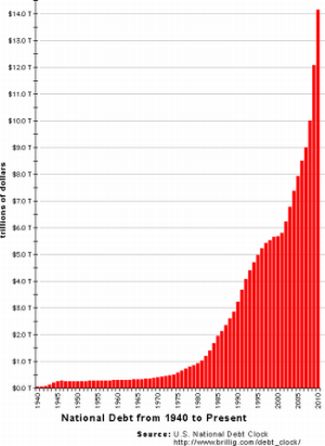
Every bull market has corrections and precious metals will not be an exception. The point to remember is that the U.S. has already passed the point of no return on its inevitable journey to a debt crisis.  The mainstream press focuses on the looming battle in Washington over raising the nation’s legal debt limit past $14.2 trillion, yet there is little discussion of the U.S. Government’s total unfunded liabilities of $75 trillion based on open ended entitlement programs.   The U.S. is in a debt trap from which a painless escape is impossible.

While the majority of Americans don’t know or don’t care about the spiraling debt disaster facing the Nation, smart money is taking steps to survive and profit from the inevitable day of reckoning.

One of the largest bond investors in the world who has a superb investment track record proclaims that U.S. debt securities have “little value.” In recent remarks, Bill Gross of Pimco candidly states his view on how the U.S. debt crisis will soon end. Mr. Gross states that Pimco has sold all holdings of U.S. debt because “they have little value within the context of a $75 trillion total debt burden. Unless entitlements are substantially reformed, I am confident that this country will default on its debt; not in conventional ways, but by picking the pocket of savers via a combination of less observable, yet historically verifiable policies – inflation, currency devaluation and low to negative real interest rates.”

The smart money sees the future.  One logical investment alternative to preserving wealth is in the timeless currencies of gold and silver that governments cannot devalue.

The recent sorry spectacle in Washington only affirms that elected leaders are incapable of preventing an eventual U.S. default (see Why There Is No Upside Limit To Gold and Silver Prices).  After scaring half of the old ladies in the country that they wouldn’t get their next social security check, both political parties declared victory after “reducing spending” by $38 billion – a fraction of a percent of total government spending.  Even worse, the Washington Post reports that many of the “spending cuts” are accounting gimmicks and budget tricks that will not reduce overall spending.

The great “achievement” of Congress becomes even more pathetic after considering that the national debt has expanded by $3 trillion in the past two years and projected budgeted spending will add almost another $10 trillion in debt over the next 10 years.  These horrendous projections assume a growing economy and no major adverse macro economic shocks.

Massive  levels of debt and spending commitments leave the U.S. with two ruinous policy choices.  Congress can cut spending dramatically and watch the economy collapse after which the Government would re-institute massive spending programs and quantitative easing on an unimaginable scale.  The second choice is the odds on favorite – continue the parabolic increase in spending and money printing and watch the economy implode as all bond investors (not just Bill Gross) refuse to purchase worthless treasury debt leaving the U.S. unable to meet its obligations. Either way, the inescapable dilemma that the Nation faces has created the perfect storm for gold and silver.

Gold Hits All Time High and Silver Breaks $40 as Precious Metal Demand Soars

Anything but paper dollars was the theme this week as investors rushed into anything of tangible value.  Gold, silver, oil and commodities of all types have been skyrocketing since last August when the Federal Reserve announced its second round of quantitative easing.
Gold closed at an all time high of $1,469.50 as measured by the London PM Fix Price and silver hit a 31 year high closing the week at $40.22.  Some analysts cautioned that the rapid rise in gold and silver prices could lead to a pullback, but overbought markets tend to defy such logic.  Gold has decisively broken through resistance at the $1,450 level and silver looks ready to challenge the all time high of $48.70 reached in 1980.

Precious Metals Prices
Fri PM Fix Since Last Recap
Gold $1,469.50 +51.50 (+3.63%)
Silver $40.22 +2.59 (+6.88%)
Platinum $1,803.00 +30.00 (+1.69%)
Palladium $798.00 +26.00 (+3.37%)

The surge in precious metals prices reflects the obvious conclusion that developed nations of the world are on a trajectory with a potentially devastating debt crisis.  The budget antics in Washington make it clear to any impartial observer that spending will not be cut and the parabolic growth of debt will continue.  No one knows how the looming debt crisis will ultimately play out for the Nation, but one certain outcome is that the dollar’s purchasing power is likely to diminish greatly (see Ron Paul Talks About Horrendous Currency Debasement).

Gold rose by $51.50 on the week and is up over $300 per ounce over the past year.

GOLD - COURTESY STOCKCHARTS.COM

Silver has been the standout performer over the past year, increasing by over 122% since last August.  This week was no exception with silver sprinting past the $40 mark and gaining 6.9% on the week. Despite the large increase in the price of one ounce of silver, the Silver Institute reports that both investment and fabrication demand soared last year.  During 2010, world investment demand for silver increased by 40% and fabrication demand (which accounts for 83% of total silver demand) rose by 13%.

Platinum and palladium also rose on the week, recouping the price correction experienced after the Japanese earthquake.  Platinum rose by $30 on the week to $1,803 while palladium rose by $26 to $798.

Ron Paul Links Bullion Coin Shortage To Horrendous Currency Debasement

Rep. Ron Paul, during a Subcommittee hearing on problems at the US Mint, linked the shortage of gold and silver coins to the “huge debasement” of the United States currency.

The remarks came during a hearing by the House Financial Services Subcommittee on Domestic Monetary Policy, entitled “Bullion Coin Programs of the United States Mint: Can They Be Improved?”  Four different coin and previous metals industry experts provided testimony on how to address ongoing problems with coin production and shortages.

After some lengthy discussion by witnesses and committee members regarding shortages of silver coin blanks and marketing and production problems at the US Mint, Rep. Paul focused on what he considered to be the primary reason why the US Mint was, at times, unable to meet public demand for gold and silver coins.

Listed below are highlights of Rep. Paul’s remarks at the Subcommittee hearing.

  1. It is “imperative” that the US Mint should be able to produce an adequate supply of coins to the U.S. public.  According to Rep. Paul, investors are rushing to purchase gold and silver due to quantitative easing by the Federal Reserve.
  2. The US Mint should take the appropriate steps to source enough planchets to meet public demand for gold and silver coins.  People are worried, stated Rep. Paul, and are trying to preserve their wealth through the purchase of gold and silver due to government policies that will lead to inflation and debasement of the currency.  Rep. Paul stated that “If we had a sound currency” there would not be a shortage of gold and silver coins since demand by the public would be a non event.
  3. Rep. Paul detailed the “horrendous huge debasement” that has occurred with the US currency.  In the early 1930’s, when gold was on a fixed exchange rate with the US dollar, the dollar was worth 1/20 ounce of gold.  It was subsequently devalued to 1/35 ounce of gold during the 1940’s, to 1/38 ounce of gold in the early 1970’s and to 1/42 in 1973.  Once it became legal for US citizens to own gold and the dollar was based on market prices, the value of one dollar subsequently dropped to 1/1450 ounce of gold.
  4. Rep. Paul noted that total annual demand during 2011 for Silver Eagle bullion coins should reach 48 million ounces, but that total US silver production would amount to only 40 million ounces.  The US Mint should take all necessary steps to ensure that adequate supplies of silver are available to meet public demand for silver coins.

Although not specifically addressed, the issue of whether the US government is making an effort to limit the sale of gold and silver coin to the public remains an open question.  By law, the US Mint is required to produce coins “in quantities and qualities that the Secretary determines are sufficient to meet public demand”.  There were no US Mint representatives present at the Subcommittee hearing to explain why the US Mint is unable to comply with production mandates specified by law.

Silver Price Above $40 and Gold Hits New All Time High in Overseas Trading

Gold soared to new all time highs in Asian markets and silver pierced the $40 per ounce level as new demand continues to drive precious metal prices higher.

The world spot price of gold hit an all time high of $1,470.80 up $12.40 and silver pierced the psychological $40 level, reaching $40.23 per ounce.  Platinum and palladium were also both up over 1% to $1,808 and $794, respectively.

Precious metal buyers had numerous reasons to be bullish including skyrocketing oil and food prices, the worsening situation with the European debt crisis, continuing conflicts in major oil producing countries and the ugly specter of a government shutdown in the U.S. due to the inability of Congress to come to grips with an exploding deficit and looming debt crisis (see Budget Fiasco Sends Wrong Message To U.S. Creditors).

Gold has now risen by over $31 per ounce this week and by $50 since March 28, breaking through resistance at the $1,450 level. Investors are seeking to protect their wealth from inflation and the continuing debasement of paper currencies as nation after nation continues to run huge deficits in an attempt to revive weak economies.  A glimpse of the end game to massive government deficits and liabilities is currently on display in Washington and the message is a resounding endorsement for diversifying out of paper money.  Politicians will not cut spending for a large variety of reasons, calling into question the future solvency of numerous sovereigns worldwide.

Silver has now advanced a spectacular $9.33 or 30% since the beginning of the year and shows no sign of slowing down.  According to the Silver Institute, world investment demand for silver skyrocketed by 40% during 2010 and was the primary reason for the huge 78% increase in silver prices last year.  Total fabrication demand, which accounted for 83% of silver demand last year,  increased by almost 13% despite the large rise in silver prices.

The looming global debt crisis and the printing of money has lead to surging investor demand for real assets.  Since late last summer when the Federal Reserve initiated its latest money printing campaign, the price of raw material prices as represented by the S&P GSCI Spot Index has soared by 35%.

US Mint Gold Bullion Coin Sales Shift Back to American Eagles

In the past week, the level of gold bullion sales at the United States Mint rose to a three week high at 35,000 ounces. The level of silver bullion sales remained little changed from recent weeks at 658,500 ounces, as coins continue to be subject to the US Mint’s allocation program.

Buyers shifted their focus back to the American Gold Eagles, which accounted for 32,000 ounces worth of sales. In previous weeks, a larger portion of sales had taken place for the recently released 2011 Gold Buffalo. These one ounce 24 karat gold coins were made available to authorized purchasers starting on March 14. Prior to that date, the coins had last been available from the Mint on September 27, 2010.

US Mint Bullion Coin Program Sales 4/6/2011 (ounces)

Prior Week Month to Date Year to Date
American Silver Eagle 658,500 658,500 13,087,500
American Gold Eagle 32,000 32,000 331,500
America the Beautiful Silver 0 0 0
American Platinum Eagle 0 0 0
American Gold Buffalo 3,000 3,000 41,000

The US Mint sold 658,000 ounces of silver bullion in the form of one ounce American Silver Eagles. Since the 2011-dated versions of the coins were first released, the coins have been subject to the Mint’s allocation program. This program serves to ration the available supplies amongst the eleven authorized purchasers. While the rationing is taking place, the level of silver bullion sales represents the number of coins the US Mint has made available, rather than the demand of the market place.

At a House subcommittee hearing on the US Mint’s bullion coin programs held earlier today, one of the witnesses estimated that the US Mint loses about a third of potential bullion sales because they cannot meet full demand.