June 13, 2026

Archives for May 2009

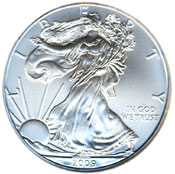
Gold and Silver Eagle Shortage Becomes Surplus

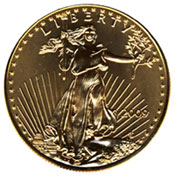
For countless months, authorized purchasers of US Mint gold and bullion coins have been subject to a rationing process, which limited the number of coins they could purchase. The rationing program had been put into place after the demand for gold and silver coins exceeded the US Mint’s ability to supply them. In a few recent posts I have provided some indications that the shortage of American Silver Eagles and American Gold Eagles might be ending. There’s yet another indication that the end of the shortage and rationing is close at hand.

Throughout the rationing period, the entire supply of coins available from the US Mint had been divvied up and sold to the authorized purchasers. For the first time since rationing began, the US Mint failed to sell their total production of Gold and Silver Eagles.

Dave Harper, the editor of Numismatic News, writes:

In the prior two weeks, the 14 purchasers authorized to buy the American Eagle coins from the U.S. Mint have not taken the maximum number of coins that are available, leaving the Mint with an extra 39,000 one-ounce gold American Eagles and 185,000 extra silver American Eagles.

To my knowledge, the rationing program for Gold and Silver Eagles still remains in place despite the surplus of recent weeks. The US Mint is likely waiting to build an inventory of bullion before attempting to remove purchasing restrictions completely.

When the rationing program was instated by the US Mint, it generated a lot of attention from blogs and news sites. The rationing was cited as evidence of the overwhelming demand for physical precious metals that would eventually carry market prices higher. With the opposite situation developing, opposite predictions have emerged.

In befuddlement to both arguments, the the disconnect between physical demand and market price continues. Amidst the unraveling of the physical scarcity situation, the prices for gold and silver have risen to multi-month highs with many predicting impending breakouts, which will carry prices even higher.

Gold Dispensing ATMs, Hedge Funds Buy Gold, World Gold Production

With gold now reaching it’s highest price of the year, gold related stories seem to be popping up in more places. Here are a few gold related articles and blog posts from the past week that are worth the read.
German firm plans gold ATMs to meet growing demand

It seems like other countries are always creating new ways to make gold easier to purchase amidst growing demand. India started selling gold coins in post offices around the country. Now Germany, Switzerland, and Austria will have gold dispensing automatic teller machines in various public locations. In the United States, the response to high demand has been to ration the supply of gold.

Hedge Funds Making Big Bets on Gold

Hedge funds are waking up to gold. Paulson & Co bought 31.5 million shares of the gold ETF worth $2.8 billion. Stephen Mandel’s Lone Pine bought 26.5 million shares worth $2.4 billion.

Bullion Premiums Now Normal

As I have explored in some other recent posts, the premiums for gold and silver have been contracting recently amidst the rising prices. Premiums are now back to normal for most gold and silver coins.

Gold production in the world

A recently published piece examining gold production in 2008. World gold production peaked in 2001 and has been on the decline ever since. Also, there have been some interesting shifts in top gold producing countries.

Money Magazine, gold, and hedge funds

Watching Money Magazine as a contrary indicator. They recently pass off gold as a “speculative play” that has delivered “lousy returns” since its below the peak reached in 1980. They conveniently ignore gold’s 300%+ return since 2000.

Gold’s Extremists

Is it just me, or does it seem like mainstream publications all start publishing negative gold stories when the price starts rising? Forbes trots out some analyst zingers, “fundamentals not supportive”, “crowded trade”, and “ripe for correction”. Excuse me while I go buy some more gold.

Coming Soon: Rhodium Bullion Coins

Rhodium is a member of the platinum metals group. It is silvery white in appearance and highly reflective. It has been used as a finish for jewelry and mirrors, electric connections in aircraft turbine engines, in catalytic converters of automobiles, and in alloys with platinum and palladium. Rhodium is known as one of the most scarce and expensive precious metals, but there have been few avenues for investing in the rhodium. This will soon change when the world’s first rhodium bullion coin becomes available.

Total rhodium supply for 2008 was a mere 695,000 ounces according to Johnson Matthey. To put this in perspective, for 2008 total platinum supply was 5.97 million ounces and total gold supply was 3,468 tonnes. Two regions account for the majority of all rhodium supply with 82% coming from South Africa and 12% coming from Russia.

Total demand for the rhodium in 2008 was 689,000 ounces. Demand by application was dominated by auto, which accounted for 84%.

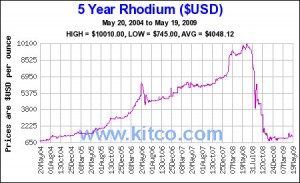
Rhodium reached a peak price of $10,010 per ounce in July 2008 before experiencing a precipitous drop which brought the price below $1,000 per ounce. The price of rhodium is now back up to $1,300 per ounce. The incredible price decline for this scarce metal has tantalized bargain hunters, but there have been few options for investing in rhodium. The few options available include pooled accounts or the purchase of scientific element samples. The upcoming rhodium bullion coins will provide an easier alternative, especially for investors.

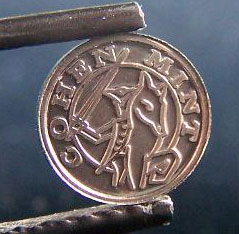
The Cohen Mint produced the first investment grade .999 fine rhodium coin on April 29, 2009. The coins are expected to be available for sale to the public within the next few weeks. Eitan Cohen, the owner and operator of the Cohen Mint, was kind enough to answer a few questions on rhodium and the new rhodium bullion coins.

How many rhodium bullion coins are being produced and when will they be available?
We have the capability of producing as many coins as there is a demand for. We will be selling the coins individually, and also in wholesale. There will not be any minimum order requirements.

What sizes will the coins be available in? Can you provide an idea of the projected price?

Initially, the Rhodium bullion will come in a 1 gram size. We decided both in terms of pricing as well as recognition, the 1 gram size would be perfect for this new bullion piece. The projected price at current raw material values hovers around $100.00. Now that price not only includes the coin, it includes the sealed plastic coin slab that will securely encase the coin, which is perfect for display as well as protection, a certificate of authenticity with each coin, and free priority shipping to your door.

How long have you been working on perfecting the process of minting coins in rhodium, and how does minting coins in rhodium differ from other metals?

We’ve been working on this for over a year now, its cost us a lot of money as well as time. The work involved in getting this project off the ground has been tremendous, easily the biggest thing our company has ever done. This is really an historic moment, where a truly unique precious metal product comes onto the market, and we’re just excited to be the ones to have pioneered it.

Making coins out of Rhodium has got to be as different from making other kinds of coins as can be. Normally, making coins is a very straightforward process. You roll an ingot out into a sheet, punch blank disks, and then stamp the disks with the design to make coins. This process works with just about any metal you can think of, copper, silver, gold, platinum, palladium, etc. You try and do that with Rhodium and you’ll end up with a bunch of broken flakes and powder. Rhodium has uncommon properties that make it extremely hard, brittle and down right stubborn, features that do not lend themselves to making coins easily.

The way we had to approach it was to come up with a completely new method, a method that was developed through trial and error, through extensive research, and through our own testing here at our facility. After nearly giving up a dozen times, we reached a “eureka” moment a couple of weeks ago, when we realised that we finally cracked the code, and would be able to set up full scale production. Boy, was that exciting.

After rhodium climbed above $10,000 per ounce, the price collapsed below $1,000. Demand continues to be dominated by a single industry. What is your take on the market for rhodium?

There will always be demand for Rhodium, and the price is temporarily depressed due to the terrible state of our economy and the even worse state of all automobile manufacturers. What’s important to keep in mind is that this artificial price dip is not forever, and there will come a point in the near future when people will start demanding cars again, manufacturers will start building them again, and the prices for many commodities will start to rise. Rhodium will be on the vanguard of this revival, and will climb back up to prices that will make us look back longingly at present values.

As the green movement takes a bigger hold on our world, Rhodium’s use in cleaning factory and power plant emissions will grow to be a substantial chunk of global Rhodium usage. Internal combustion engines are not going away any time soon, and of anything, emissions standards are only going to get stricter. This metal, along with platinum and palladium will feel a resurgence once the economy begins to pick back up and consumer confidence reawakens. Now is a great time to buy.

Gold and Silver Paper and Physical Markets Realign

Late last year and early this year, a continual observation of the gold and silver markets was the disconnect between the prices quoted on paper markets and the prices that you would actually need to pay to buy physical precious metals. In the past few weeks premiums for physical gold and silver have declined as the prices quoted on the paper market have risen, basically bringing the two markets back into alignment.
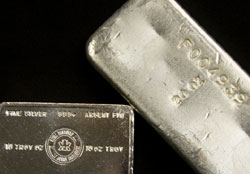
Back in October 2008, I had examined 100 ounce silver bars as an example of the excessive premiums being paid for physical precious metals. I collected some data from recently completed eBay auctions that showed the average price of the 100 ounce silver bar ranging from $1,329 to $1,557 while the market price of silver ranged from $8.88 to $10.89. This represented premiums ranging from $39.62% to 56.45%. This was particularly ridiculous since the 100 ounce silver bar has been traditionally viewed as a low premium method for silver investing.

Reviewing some data for eBay auctions completed yesterday now shows the prices paid for 100 ounce silver bars ranging from $1,450 to $1,500. At yesterday’s closing price of silver of $14.09, this represents a much more reasonable premium of about 3% to 6%.

Peculiarly, the decline in premium is a close match to the increase in price for spot silver. If you invested in silver by buying physical bars back in October, you might be showing zero profit even though the market price is up over 40%.

Future Gold and Silver Price Implications?

When the premiums for physical precious metals were high, it was viewed as a sign of heavy demand amidst a diminished supply that would eventually force market prices to move higher. Now that the disconnect between the paper and physical markets has seemingly resolved itself, is this a signal of slower demand that will lead to lower prices?

Despite the implication of slower demand, I think the realignment of the markets represents a long term positive for the price of gold and silver. Back when premiums were high, I am sure that many potential investors backed away from the market when they were faced with excessive premiums. Potential investors will now actually be able to buy physical gold and silver around the market prices. This is a much better environment for fostering mainstream demand to keep gold and silver moving higher.
[phpbay]100 ounce silver bar, 3, “”, “”[/phpbay]

US Mint Bullion Sales for April 2009

The US Mint’s bullion sales figures for April 2009 remained robust. The amount of gold bullion sold during the month was the highest of the year. Silver bullion sold was the second highest figure for the year. Once again, the US Mint did not sell any platinum bullion coins. This offering has been delayed with no indication of when sales might begin. Similarly, the 24 karat Gold Buffalo coins were not offered as they are also delayed.

The sales totals for all bullion coins offered by the United States Mint are presented below.

April 2009 US Mint Bullion Sales
1 oz. 1/2 oz. 1/4 oz. 1/10 oz. Total oz.
Gold Eagle 147,500 147,500
Gold Buffalo
Silver Eagle 2,518,000 2,518,000
Platinum Eagle

There were 147,500 ounces of gold sold during April 2009. This consisted entirely of one ounce gold coins, as fractional coins were still not offered.This represented the highest sales level of the year to date. The prior month had sales of 136,500. Sales for the year ago period of April 2008 were 47,500 ounces.

There were 2,518,000 ounces of silver sold during April 2009. Silver bullion sales continue to be at higher levels, on pace for a record year. Since the coins are subject to rationing, this might be an indication that the Silver Eagle shortage might be ending. The prior month silver bullion sales were 3,132,000. Sales for the year ago period of April 2008 were 1,584,000.

Palladium Bullion Coins Proposed

With the price of palladium down from the peak price reached during 2008, there seems to be increased interest in creating methods for investing in palladium. I previously wrote a post on the proposal to create a palladium ETF. Now there is a proposal for a United States palladium bullion coin.

A bill was introduced in the United States Senate on April 1, 2009 to create palladium bullion and numismatic coins for the year 2009. The coins would bear the design of the 1907 Ultra High Relief Gold Double Eagle and contain one ounce of .995 palladium. The bill was sent to committee and the prospects of becoming law are uncertain.

According to data from Johnson Matthey, palladium supply for 2008 was 7.51 million ounces while demand was 7.19 million ounces. Investment demand only accounted for 4% of overall demand.

There are no palladium bullion investment coins currently produced by any of the major world mints. The Royal Canadian Mint briefly offered the Palladium Maple Leaf. The coin was only offered from 2005 to 2007 before it was discontinued. They sold approximately 40,000 in 2005, 70,000 in 2006, and 15,000 in 2007.

Current methods of investing in physical palladium are primarily one ounce palladium bars or the Palladium Maple Leaf coins. The coins usually carry premiums of over 50% and it can be difficult to locate a bullion dealer who keeps them in stock. If a new palladium bullion coin is produced, it would likely be available for much lower premiums and much easier to locate.

Is the Silver Eagle Shortage Ending?

World mints have struggled to keep up with the booming demand for precious metals. The situation has been ongoing for more than a year and frustrated physical silver investors with suspensions, rationing, and delays. There are finally some signs that the shortage may be coming to an end, in particular for the American Silver Eagle bullion coin.

The Silver Eagle shortage first began in February 2008. The US Mint became so overwhelmed with orders for the popular silver bullion coin that they were forced to suspend taking new orders. The suspension was only in place until March 2009, however, sales were resumed on a rationed basis. Authorized purchasers were limited in the number of coins that they could order. Early suggestions indicated that the rationed amounts covered only a fraction of the overall demand.

More than one year later, there are some indications that the situation may finally be abating. As I mentioned in my post on the US Mint’s March 2009 Bullion Sales, sales of silver and gold reached extremely high levels. Sales of silver coins were actually the highest monthly total since 1986. Since these are rationed sales, the high level was more of an indication of reduced supply constraints than increased demand.

Recently, there have been more indications at the dealer level that the shortage may be ending. One  dealer has reported that delays for delivery of Silver Eagles are shortening, and premiums for the coins is declining. At the height of the shortage premiums were as high as $4.50 over the spot price of silver. Premiums have now pulled back to around $3.00 over spot.