June 8, 2026

Archives for July 2009

Silver ETF Anomalies, National Gold Exchange, Regan Gold and Silver Coins

I’m still catching up after a vacation in Europe. For now here are links to some recommended articles about gold, silver, and precious metals from around the net.

Multiple Anomalies Detected in Silver ETFs

A recently released working paper on statistical and factual anomalies in silver ETFs including internal duplicates, weight duplicates, statistical clustering, and cross-reference duplicates. From the conclusions section: “The only way for all of these anomalies to occur together as noted in this paper, is via systemic fraud or gross accounting error bordering on jaw-dropping incompetence.”

Greenlight Holds Bullion

A $5 billion hedge-fund firm switched its entire holding in the Gold ETF to physical gold bullion. During the first quarter the firm held 4.2 million shares of the SPDR Gold Trust.

New law boosts gold bar sale in South Africa

Until recently it was illegal for South Africans to hold unwrought gold, such as gold in bar form. The law change has sparked a surge in new bullion demand.

National Gold Exchange Inc of Tampa

National Gold Exchange, one of the world’s largest coin wholesalers, has filed for Chapter 11 bankruptcy. The company has more than $50 million in debts.

Catching the Gold Bug

From a few weeks ago. The Wall Street Journal ran this high profile piece on gold investing. Someone interviewed for the article said: “When you’re in uncharted economic waters, people buy gold.”

Ronald Regan Gold and Silver Coins Proposed

Should Ronald Reagan appear on gold and silver commemorative coins? Over the years there have apparently been several proposals to put his likeness on a coin, but none ever gained sufficient support to become law.
Gold Investment Report – 2009 Second Quarter

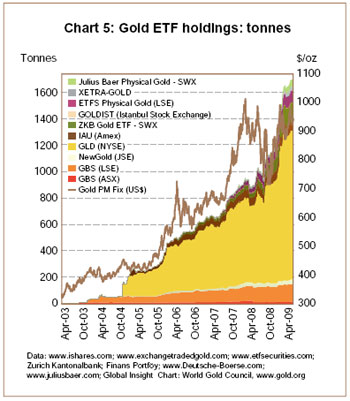
The World Gold Council is out with their latest Gold Investment Digest, providing an analysis of gold for the second quarter. The most notable aspect of the report is the incredible slow down in investment demand experienced during the quarter.

During the second quarter, the price of gold rose from $916.50 per ounce to $934.50. This slight gain compared to much larger gains in major world stock markets and the Dow Jones Commodity Index. Gold had reached a peak price of $981.75 during the quarter before moving lower.

Investment demand for gold showed a big decline from the previous levels, but remained positive. For the second quarter, Gold ETFs showed inflows of 46 tonnes. This compared to inflows of 459 tonnes during the first quarter.

Sales of coins and bars started the second quarter very strong before tapering from May onwards. The report also notes the decline in margins on coins and bars as availability constraints eased. As I have noted in some of the monthly bullion sales reports, although sales have shown month to month declines, levels remain far above year ago levels.

While some have pointed to the recent slow down in investment demand as evidence that the so-called “new gold rush” is over, I think this call is premature. During the quarter world stock markets and sentiment about the economy rebounded from the depths of despair to the current “don’t worry be happy” mentality. Despite the shift, gold investors have remained patient and continued overall accumulation of the metal. The allure of an investment which has delivered positive annual returns for eight consecutive years, compared to the perpetual boom and bust of other asset classes, seems to have an enduring appeal.

Gold and Silver Eagle Bullion Sales June 2009

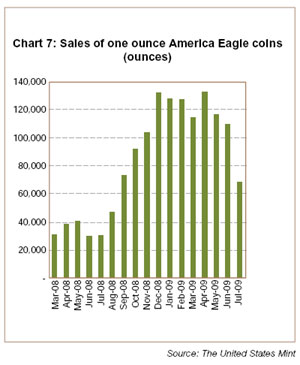
The US Mint’s sales of gold and silver bullion coins during June 2009 showed increases from both the prior month and year ago levels. The increases came amidst two interesting developments for the US Mint’s bullion coin programs.

In the middle of the month, the US Mint announced that their long standing rationing programs would be lifted. Authorized purchasers of bullion coins had been limited in the total number of coins that they could order. This had been cited by many as a sign of the high physical demand for precious metals which would eventually drive prices higher.

Later in the month, the US Mint made the seemingly contradictory announcement that the American Gold Buffalo bullion coin offering would be canceled for 2009. This had been the US Mint’s 24 karat gold bullion coin, launched in 2006 as a way of competing with other world mints that produced gold coins with greater fineness than the 22 karat Gold Eagle.

Here’s a look at the US Mint’s gold, silver, and platinum bullion sales during the month of June 2009. A year to date total appears in the last column.

June 2009 US Mint Bullion Sales
1 oz. 1/2 oz. 1/4 oz. 1/10 oz. Total oz. YTD Total oz.
Gold Eagle 116,000 116,000 670,000
Silver Eagle 2,245,000 2,245,000 13,824,500
Platinum Eagle

Sales of the Gold Eagle were still confined to only the one ounce bullion coin. A total of 116,000 ounces were sold, which was close to double the prior month’s sales of 65,000 ounces. This also marks a huge increase from the year ago period when only 15,500 ounces of gold were sold. It’s interesting to note that the sales increase comes amidst a down month for gold. Physical gold buyers have tended to increase purchases during period of price decline and curtail purchases during periods of price appreciation.

Sales of the Silver Eagle reached 2,245,000 ounces. This was an increase from the prior month when 1,904,500 ounces were sold and an increase from the year ago period when 1,735,500. With the year now half completed, the American Silver Eagle remains on pace to exceed last year’s record sales of 19,583,500 ounces.

Once again, the US Mint did not offer the Platinum Eagle bullion coin in any size.

Gold, Silver & Platinum 2009 Second Quarter Performance

With the second quarter behind us, let’s take a look at the performance of gold, silver, and platinum for the second quarter of 2009 and year to date.
All of the metals posted gains, but at single digit levels. The best performer for the second quarter was silver with a gain of 6.33%, followed by platinum with a gain of 5.52%, and then gold with a gain of 1.96%. The closing numbers don’t tell the full story. At the beginning of June, precious metals prices had spiked. At this recent peak, silver had been up as much as 22% for the quarter. Platinum and gold were also showing heftier gains at this time.

2009 Second Quarter Gold, Silver, and Platinum Performance
31-Mar-09 30-Jun-09 Change Percent
Gold 916.5 934.50 18.00 1.96%
Silver 13.11 13.94 0.83 6.33%
Platinum 1,124.00 1186.00 62.00 5.52%

On a year to date basis, the top precious metal performer remains as platinum with a gain of 32.07% on the year. This is followed by silver with a gain of 29.19% and gold with a gain of 7.44%. The performance of the metals had lined up in the same manner at the close of the first quarter.

2009 YTD Gold, Silver, and Platinum Performance
30-Dec-08 30-Jun-09 Change Percent
Gold 869.75 934.50 64.75 7.44%
Silver 10.79 13.94 3.15 29.19%
Platinum 898.00 1186.00 288 32.07%

Precious Metals Investment Tax Rates

Gains from the sale of investments in precious metals are currently subject to a tax rate of 28%. This compares to the current long term capital gains rate of 15%, which applies to other investment classes such as stocks and bonds. A bill has been introduced which seeks to tax precious metals investors at the same preferential rates afforded to other investors.

Precious metals investments are considered “collectibles” under the current tax code. Gold, silver, and other precious metals are lumped into the same classification as works of art, rugs, antiques, and stamps. The tax rate for “collectibles gains” is currently 28% regardless of whether the assets were held for more than one year.

The classification as collectibles comes from the section of the Tax Code which describes the capital gains tax rates which apply to different asset classes. This section references a definition of collectibles found in another section of the code, which interestingly provides an exception for certain precious metals. This exception is curiously disregarded for the purposes of capital gains taxation.

The bill S. 1367 Fair Treatment for Precious Metals Investors Act seeks to rectify the disadvantageous tax rates imposed on precious metals investors. The bill would amend the Tax Code to preserve the exception created for certain coins and bullion. After the amendment, common precious metals investments such as American Eagle bullion coins would no longer be classified as “collectibles” and would be eligible for lower long term capital gains rates.

In order to become law, the bill would need to be approved in the House of Representatives, the Senate, and signed by the President. A similar bill was introduced in 2007, but it never gained the support necessary to become law. You can following the progress of the current bill on GovTrack.